Asia Pacific Data Center Equipment Market Analysis and Forecast by Size, Share, Growth, Trends 2031
Asia Pacific Data Center Equipment Market Size and Forecast (2021-2031), Regional Share, Trend, and Growth Opportunity Analysis Report Coverage: By Equipment Type [Servers, Storage Devices, Cooling Equipment, Power Distribution Units (PDUs), Racks, Enclosures, Others], Servers (Rack Server, Blade Server, Tower Server), Cooling Equipment (Air Conditioners, Chillers, Air Handling Units, Heat Exchangers, Others), Power Distribution Units (Switched Rack PDU, Metered Rack PDU, Monitored Rack PDU, and Basic Rack PDU), Racks (Enclosed Racks, Open Frame Racks, Wall Mount Racks, and Others), and Tier Type (Tier 3, Tier 4, Tier 1, Tier 2)
- Report Date : Oct 2025
- Report Code : TIPRE00041460
- Category : Electronics and Semiconductor
- Status : Published
- Available Report Formats :


- No. of Pages : 206
The Asia Pacific data center equipment market size is expected to reach US$ 1,25,929.14 million by 2031 from US$ 50,054.12 million in 2024. The market is estimated to record a CAGR of 14.2% from 2025 to 2031.
Executive Summary and Asia Pacific Data Center Equipment Market Analysis:The Asia Pacific data center equipment market is segmented into Australia, China, India, Japan, South Korea, and the Rest of Asia Pacific. According to the Asia Cloud Computing Association in July 2024, data centers are growing quickly across APAC, with projections showing strong market growth. This increase is driven by factors such as the rise in internet usage, the growth of e-commerce, digital transformation efforts, and the use of advanced technologies such as AI and cloud computing. Moreover, according to the H2 2024 Asia Pacific Data Centre Market Update report by Cushman & Wakefield, Over US$ 116 billion will be needed to build out the existing colocation data center pipeline across Asia Pacific in the coming five to seven years as demand for the sector grows. This significant investment will drive the Asia Pacific data center equipment market by increasing the demand for essential infrastructure, such as servers, cooling systems, power management tools, and networking equipment. As more data centers are built and expanded to meet the rising demand for digital services, cloud computing, and AI technologies, the need for advanced, energy-efficient equipment will grow, creating new opportunities for market growth.
The data center industry in the Asia Pacific has seen considerable growth in both advanced and developing economies, driven by the increasing willingness of companies to invest in new data storage and deployment infrastructure. For instance, according to the Cushman & Wakefield report, India's data center capacity across the top seven cities currently stands at 977 MW. The country's data center capacity is expected to grow significantly, with an additional 1.03 GW under construction by 2028. Moreover, plans for further expansion of 1.29 GW would bring India's total projected data center capacity to 3.29 GW by 2028.
Moreover, the launch of new data centers is contributing to the Asia Pacific data center equipment market. A few recent developments are mentioned below:
- In February 2025, Colt Data Centre Services (Colt DCS), a leading global provider of hyperscale and large enterprise data center solutions, announced the launch of its new hyperscale data center, Inzai 4, in Tokyo, Japan.
- In January 2025, Doma Infrastructure Group (DIG) announced plans for a 50MW to 60MW data center in West Sydney, Australia.
Thus, the substantial growth in the data center industry will propel the Asia Pacific data center equipment market by boosting the demand for advanced infrastructure and equipment, including servers, cooling systems, and power management solutions.
Customize Research To Suit Your Requirement
We can optimize and tailor the analysis and scope which is unmet through our standard offerings. This flexibility will help you gain the exact information needed for your business planning and decision making.
Asia Pacific Data Center Equipment Market: Strategic Insights


Naveen
Have a question?
Naveen will walk you through a 15-minute call to present the report’s content and answer all queries if you have any.
 Speak to Analyst
Key segments that contributed to the derivation of the Asia Pacific data center equipment market analysis are equipment type and tier type.
- By equipment type, the Asia Pacific data center equipment market is segmented into servers, storage devices, cooling equipment, power distribution units (PDUs), racks, enclosures, and others. The servers segment held the largest share of the market in 2024.
- By tier type, the Asia Pacific data center equipment market is segmented into tier 3, tier 4, tier 1, and tier 2. The tier 3 segment held the largest share of the market in 2024.
E-waste generated by data centers has reached crisis levels. The Global E-waste Monitor reported that in 2022, 61.9 million metric tons of e-waste were generated, with this number increasing by 2.6 million tons each year. Additionally, data center power demand contributes to 2% of total greenhouse gas emissions worldwide. According to the International Energy Agency (IEA), global data centers consumed nearly 460 terawatt hours (TWh) of electricity in 2022, and they are likely to consume 1000 TWh by 2026. If not addressed, this could significantly impact the global carbon reduction targets. Hence, businesses and governments worldwide are intensifying their efforts to address climate change and reduce carbon footprints. Data center operators are increasingly turning to sustainable and energy-efficient technologies to meet both regulatory requirements and environmental goals. In response, equipment manufacturers are investing heavily in developing next-generation technologies that focus on sustainability and energy efficiency.
For instance, in December 2024, Microsoft launched a new data center design that optimizes AI workloads and consumes zero water for cooling. By adopting chip-level cooling solutions, Microsoft can deliver precise temperature control without water evaporation. This design avoids the need for more than 125 million liters of water per year per data center. Similarly, in December 2024, Amazon Web Services, Inc. announced new data center components aimed at supporting the next generation of AI innovation and meeting customers' evolving needs. These capabilities combine innovations in power, cooling, and hardware design to create more energy-efficient data centers. Such innovations are helping data centers become more energy-efficient, reducing operational costs and contributing to a greener, more sustainable future. As data centers strive to reduce their energy consumption, lower emissions, and meet regulatory and consumer demands for greener operations, the demand for energy-efficient and sustainable technologies is expected to continue rising. Thus, the growing focus on sustainability and energy-efficient equipment is expected to provide lucrative opportunities for the data center equipment market growth.
Asia Pacific Data Center Equipment Market Country InsightsBased on country, the Asia Pacific data center equipment market comprises China, Japan, India, South Korea, Australia, and the Rest of Asia Pacific. China held the largest share in 2024.
China has been increasing its investment in computing capacity in response to export controls imposed by the US, which have restricted the sale of advanced chips to companies. This push to develop domestic technological capabilities drives the demand for advanced data center infrastructure and equipment. As China works to build self-sufficiency in computing resources, there is a growing need for high-performance servers, storage systems, and networking solutions to support the country's data processing and AI advancements. Companies and government initiatives are investing in infrastructure to replace or supplement foreign technology. In July 2024, China Mobile launched a data center in Beijing. The computing center was one of 12 that China Mobile has in regions such as Jing-Jin-Ji, CNI Yangtze Index, Greater Bay Area, Chengdu-Chongqing, Guizhou, Inner Mongolia, Ningxia, Heilongjiang, Hubei, and Shandong.
Asia Pacific Data Center Equipment Market Company ProfilesSome of the key players operating in the market include ABB Ltd, Legrand SA, Schneider Electric SE, Rittal GmbH and Co KG, Eaton Corp Plc, Dell Technologies Inc, Honeywell International Inc, Vertiv Group Corp., Delta Electronics Inc, and Cisco Systems Inc., among others. These players are adopting various strategies such as expansion, product innovation, and mergers and acquisitions to provide innovative products to their consumers and increase their market share.
Asia Pacific Data Center Equipment Market Research Methodology :The following methodology has been followed for the collection and analysis of data presented in this report:
Secondary Research
The research process begins with comprehensive secondary research, utilizing both internal and external sources to gather qualitative and quantitative data for each market. Commonly referenced secondary research sources include, but are not limited to:
- Company websites, annual reports, financial statements, broker analyses, and investor presentations.
- Industry trade journals and other relevant publications.
- Government documents, statistical databases, and market reports.
- News articles, press releases, and webcasts specific to companies operating in the market.
All financial data included in the Company Profiles section has been standardized to USD. For companies reporting in other currencies, figures have been converted to USD using the relevant exchange rates for the corresponding year.
Primary Research
The Insight Partners conducts a significant number of primary interviews each year with industry stakeholders and experts to validate its data analysis and gain valuable insights. These research interviews are designed to:
- Validate and refine findings from secondary research.
- Enhance the expertise and market understanding of the analysis team.
- Gain insights into market size, trends, growth patterns, competitive dynamics, and future prospects.
Primary research is conducted via email interactions and telephone interviews, encompassing various markets, categories, segments, and sub-segments across different regions. Participants typically include:
- Industry stakeholders: Vice Presidents, business development managers, market intelligence managers, and national sales managers
- External experts: Valuation specialists, research analysts, and key opinion leaders with industry-specific expertise

Report Coverage
Revenue forecast, Company Analysis, Industry landscape, Growth factors, and Trends

Segment Covered
This text is related
to segments covered.

Regional Scope
North America, Europe, Asia Pacific, Middle East & Africa, South & Central America

Country Scope
This text is related
to country scope.
1. Introduction
1.1 Report Guidance
1.2 Market Segmentation
2. Executive Summary
2.1 Key Insights
2.2 Market Attractiveness
3. Research Methodology
3.1 Secondary Research
3.2 Primary Research
3.2.1 Hypothesis formulation:
3.2.2 Macro-economic factor analysis:
3.2.3 Developing base number:
3.2.4 Data Triangulation:
3.2.5 Country level data:
4. Asia Pacific Data Center Equipment Market Landscape
4.1 Overview
4.2 Ecosystem Analysis
4.3 List of Vendors in the Value Chain
5. Asia Pacific Data Center Equipment Market – Key Market Dynamics
5.1 Asia Pacific Data Center Equipment Market – Key Market Dynamics
5.2 Market Drivers
5.2.1 Rising Investments in Data Centers
5.2.2 Growing Reliance on Compute-Intensive Workloads
5.3 Market Restraints
5.3.1 Rise in Refurbishment and Repurposing Initiatives
5.3.2 High Cost of Infrastructure Development
5.4 Market Opportunities
5.4.1 Growing Focus on Sustainability and Energy-Efficient Equipment
5.4.2 Increasing Adoption of IoT Devices
5.5 Trends
5.5.1 Growing Interest in Advanced RISC Machine (ARM) Servers in Data Centers
5.6 Impact of Drivers and Restraints:
6. Asia Pacific Data Center Equipment Market Analysis
6.1 Asia Pacific Data Center Equipment Market Volume (Thousand Units), 2021–2031
6.2 Asia Pacific Data Center Equipment Market Volume Forecast and Analysis (Thousand Units)
6.3 Asia Pacific Data Center Equipment Market Revenue (US$ Million), 2024–2031
6.4 Asia Pacific Data Center Equipment Market Forecast and Analysis
7. Asia Pacific Data Center Equipment Market Volume and Revenue Analysis – by Equipment Type
7.1 Servers
7.1.1 Overview
7.1.2 Servers: Asia Pacific Data Center Equipment Market – Volume and Forecast, 2021–2031 (Thousand Units)
7.1.3 Servers: Asia Pacific Data Center Equipment Market – Revenue and Forecast, 2021–2031 (US$ Million)
7.2 Storage Devices
7.2.1 Overview
7.2.2 Storage Devices: Asia Pacific Data Center Equipment Market – Volume and Forecast, 2021–2031 (Thousand Units)
7.2.3 Storage Devices: Asia Pacific Data Center Equipment Market – Revenue and Forecast, 2021–2031 (US$ Million)
7.3 Cooling Equipment
7.3.1 Overview
7.3.2 Cooling Equipment: Asia Pacific Data Center Equipment Market – Volume and Forecast, 2021–2031 (Thousand Units)
7.3.3 Cooling Equipment: Asia Pacific Data Center Equipment Market – Revenue and Forecast, 2021–2031 (US$ Million)
7.4 Power Distribution Units (PDUs)
7.4.1 Overview
7.4.2 Power Distribution Units (PDUs): Asia Pacific Data Center Equipment Market – Volume and Forecast, 2021–2031 (Thousand Units)
7.4.3 Power Distribution Units (PDUs): Asia Pacific Data Center Equipment Market – Revenue and Forecast, 2021–2031 (US$ Million)
7.5 Racks
7.5.1 Overview
7.5.2 Racks: Asia Pacific Data Center Equipment Market – Volume and Forecast, 2021–2031 (Thousand Units)
7.5.3 Racks: Asia Pacific Data Center Equipment Market – Revenue and Forecast, 2021–2031 (US$ Million)
7.6 Enclosures
7.6.1 Overview
7.6.2 Enclosures: Asia Pacific Data Center Equipment Market – Volume and Forecast, 2021–2031 (Thousand Units)
7.6.3 Enclosures: Asia Pacific Data Center Equipment Market – Revenue and Forecast, 2021–2031 (US$ Million)
7.7 Others
7.7.1 Overview
7.7.2 Others: Asia Pacific Data Center Equipment Market – Revenue and Forecast, 2021–2031 (US$ Million)
8. Asia Pacific Data Center Equipment Market Revenue Analysis – by Servers Type
8.1 Rack Server
8.1.1 Overview
8.1.2 Rack Server: Asia Pacific Data Center Equipment Market – Revenue and Forecast, 2021–2031 (US$ Million)
8.2 Blade Server
8.2.1 Overview
8.2.2 Blade Server: Asia Pacific Data Center Equipment Market – Revenue and Forecast, 2021–2031 (US$ Million)
8.3 Tower Server
8.3.1 Overview
8.3.2 Tower Server: Asia Pacific Data Center Equipment Market – Revenue and Forecast, 2021–2031 (US$ Million)
9. Asia Pacific Data Center Equipment Market Revenue Analysis – by Cooling Equipment Type
9.1 Air Conditioners
9.1.1 Overview
9.1.2 Air Conditioners: Asia Pacific Data Center Equipment Market – Revenue and Forecast, 2021–2031 (US$ Million)
9.2 Chillers
9.2.1 Overview
9.2.2 Chillers: Asia Pacific Data Center Equipment Market – Revenue and Forecast, 2021–2031 (US$ Million)
9.3 Air Handling Units
9.3.1 Overview
9.3.2 Air Handling Units: Asia Pacific Data Center Equipment Market – Revenue and Forecast, 2021–2031 (US$ Million)
9.4 Heat Exchangers
9.4.1 Overview
9.4.2 Heat Exchangers: Asia Pacific Data Center Equipment Market – Revenue and Forecast, 2021–2031 (US$ Million)
9.5 Others
9.5.1 Overview
9.5.2 Others: Asia Pacific Data Center Equipment Market – Revenue and Forecast, 2021–2031 (US$ Million)
10. Asia Pacific Data Center Equipment Market Revenue Analysis – by Power Distribution Units (PDUs) Type
10.1 Switched Rack PDU
10.1.1 Overview
10.1.2 Switched Rack PDU: Asia Pacific Data Center Equipment Market – Revenue and Forecast, 2021–2031 (US$ Million)
10.2 Metered Rack PDU
10.2.1 Overview
10.2.2 Metered Rack PDU: Asia Pacific Data Center Equipment Market – Revenue and Forecast, 2021–2031 (US$ Million)
10.3 Monitored Rack PDU
10.3.1 Overview
10.3.2 Monitored Rack PDU: Asia Pacific Data Center Equipment Market – Revenue and Forecast, 2021–2031 (US$ Million)
10.4 Basic Rack PDU
10.4.1 Overview
10.4.2 Basic Rack PDU: Asia Pacific Data Center Equipment Market – Revenue and Forecast, 2021–2031 (US$ Million)
11. Asia Pacific Data Center Equipment Market Revenue Analysis – by Racks Type
11.1 Enclosed Racks
11.1.1 Overview
11.1.2 Enclosed Racks: Asia Pacific Data Center Equipment Market – Revenue and Forecast, 2021–2031 (US$ Million)
11.2 Open Frame Racks
11.2.1 Overview
11.2.2 Open Frame Racks: Asia Pacific Data Center Equipment Market – Revenue and Forecast, 2021–2031 (US$ Million)
11.3 Wall Mount Racks
11.3.1 Overview
11.3.2 Wall Mount Racks: Asia Pacific Data Center Equipment Market – Revenue and Forecast, 2021–2031 (US$ Million)
11.4 Others
11.4.1 Overview
11.4.2 Others: Asia Pacific Data Center Equipment Market – Revenue and Forecast, 2021–2031 (US$ Million)
12. Asia Pacific Data Center Equipment Market Revenue Analysis – by Tier Type
12.1 Tier 3
12.1.1 Overview
12.1.2 Tier 3: Asia Pacific Data Center Equipment Market – Revenue and Forecast, 2021–2031 (US$ Million)
12.2 Tier 4
12.2.1 Overview
12.2.2 Tier 4: Asia Pacific Data Center Equipment Market – Revenue and Forecast, 2021–2031 (US$ Million)
12.3 Tier 1
12.3.1 Overview
12.3.2 Tier 1: Asia Pacific Data Center Equipment Market – Revenue and Forecast, 2021–2031 (US$ Million)
12.4 Tier 2
12.4.1 Overview
12.4.2 Tier 2: Asia Pacific Data Center Equipment Market – Revenue and Forecast, 2021–2031 (US$ Million)
13. Asia Pacific Data Center Equipment Market – Country Analysis
13.1 Asia Pacific
13.1.1 Asia Pacific Data Center Equipment Market – Volume, Revenue, and Forecast Analysis – by Country
13.1.1.1 Asia Pacific Data Center Equipment Market Volume and Forecast Analysis – by Country
13.1.1.2 Asia Pacific Data Center Equipment Market – Revenue and Forecast Analysis – by Country
13.1.1.3 China: Asia Pacific Data Center Equipment Market – Volume, Revenue, and Forecast, 2021–2031 (US$ Million)
13.1.1.3.1 China: Asia Pacific Data Center Equipment Market Share – by Equipment Type
13.1.1.3.2 China: Asia Pacific Data Center Equipment Market Share – by Servers Type
13.1.1.3.3 China: Asia Pacific Data Center Equipment Market Share – by Cooling Equipment Type
13.1.1.3.4 China: Asia Pacific Data Center Equipment Market Share – by Power Distribution Units (PDUs) Type
13.1.1.3.5 China: Asia Pacific Data Center Equipment Market Share – by Racks Type
13.1.1.3.6 China: Asia Pacific Data Center Equipment Market Share – by Tier Type
13.1.1.4 Japan: Asia Pacific Data Center Equipment Market – Volume, Revenue, and Forecast, 2021–2031 (US$ Million)
13.1.1.4.1 Japan: Asia Pacific Data Center Equipment Market Share – by Equipment Type
13.1.1.4.2 Japan: Asia Pacific Data Center Equipment Market Share – by Servers Type
13.1.1.4.3 Japan: Asia Pacific Data Center Equipment Market Share – by Cooling Equipment Type
13.1.1.4.4 Japan: Asia Pacific Data Center Equipment Market Share – by Power Distribution Units (PDUs) Type
13.1.1.4.5 Japan: Asia Pacific Data Center Equipment Market Share – by Racks Type
13.1.1.4.6 Japan: Asia Pacific Data Center Equipment Market Share – by Tier Type
13.1.1.5 India: Asia Pacific Data Center Equipment Market – Volume, Revenue, and Forecast, 2021–2031 (US$ Million)
13.1.1.5.1 India: Asia Pacific Data Center Equipment Market Share – by Equipment Type
13.1.1.5.2 India: Asia Pacific Data Center Equipment Market Share – by Servers Type
13.1.1.5.3 India: Asia Pacific Data Center Equipment Market Share – by Cooling Equipment Type
13.1.1.5.4 India: Asia Pacific Data Center Equipment Market Share – by Power Distribution Units (PDUs) Type
13.1.1.5.5 India: Asia Pacific Data Center Equipment Market Share – by Racks Type
13.1.1.5.6 India: Asia Pacific Data Center Equipment Market Share – by Tier Type
13.1.1.6 South Korea: Asia Pacific Data Center Equipment Market – Volume, Revenue, and Forecast, 2021–2031 (US$ Million)
13.1.1.6.1 South Korea: Asia Pacific Data Center Equipment Market Share – by Equipment Type
13.1.1.6.2 South Korea: Asia Pacific Data Center Equipment Market Share – by Servers Type
13.1.1.6.3 South Korea: Asia Pacific Data Center Equipment Market Share – by Cooling Equipment Type
13.1.1.6.4 South Korea: Asia Pacific Data Center Equipment Market Share – by Power Distribution Units (PDUs) Type
13.1.1.6.5 South Korea: Asia Pacific Data Center Equipment Market Share – by Racks Type
13.1.1.6.6 South Korea: Asia Pacific Data Center Equipment Market Share – by Tier Type
13.1.1.7 Australia: Asia Pacific Data Center Equipment Market – Volume, Revenue, and Forecast, 2021–2031 (US$ Million)
13.1.1.7.1 Australia: Asia Pacific Data Center Equipment Market Share – by Equipment Type
13.1.1.7.2 Australia: Asia Pacific Data Center Equipment Market Share – by Servers Type
13.1.1.7.3 Australia: Asia Pacific Data Center Equipment Market Share – by Cooling Equipment Type
13.1.1.7.4 Australia: Asia Pacific Data Center Equipment Market Share – by Power Distribution Units (PDUs) Type
13.1.1.7.5 Australia: Asia Pacific Data Center Equipment Market Share – by Racks Type
13.1.1.7.6 Australia: Asia Pacific Data Center Equipment Market Share – by Tier Type
13.1.1.8 Rest of APAC: Asia Pacific Data Center Equipment Market – Volume, Revenue, and Forecast, 2021–2031 (US$ Million)
13.1.1.8.1 Rest of APAC: Asia Pacific Data Center Equipment Market Share – by Equipment Type
13.1.1.8.2 Rest of APAC: Asia Pacific Data Center Equipment Market Share – by Servers Type
13.1.1.8.3 Rest of APAC: Asia Pacific Data Center Equipment Market Share – by Cooling Equipment Type
13.1.1.8.4 Rest of APAC: Asia Pacific Data Center Equipment Market Share – by Power Distribution Units (PDUs) Type
13.1.1.8.5 Rest of APAC: Asia Pacific Data Center Equipment Market Share – by Racks Type
13.1.1.8.6 Rest of APAC: Asia Pacific Data Center Equipment Market Share – by Tier Type
14. Competitive Landscape
14.1 Heat Map Analysis by Key Players
14.2 Company Market Share Analysis, 2024
15. Industry Landscape
15.1 Overview
15.2 Market Initiative
15.3 Product Development
15.4 Mergers & Acquisitions
16. Company Profiles
16.1 ABB Ltd
16.1.1 Key Facts
16.1.2 Business Description
16.1.3 Products and Services
16.1.4 Financial Overview
16.1.5 SWOT Analysis
16.1.6 Key Developments
16.2 Legrand SA
16.2.1 Key Facts
16.2.2 Business Description
16.2.3 Products and Services
16.2.4 Financial Overview
16.2.5 SWOT Analysis
16.2.6 Key Developments
16.3 Schneider Electric SE
16.3.1 Key Facts
16.3.2 Business Description
16.3.3 Products and Services
16.3.4 Financial Overview
16.3.5 SWOT Analysis
16.3.6 Key Developments
16.4 Rittal GmbH & Co KG
16.4.1 Key Facts
16.4.2 Business Description
16.4.3 Products and Services
16.4.4 Financial Overview
16.4.5 SWOT Analysis
16.4.6 Key Developments
16.5 Eaton Corp Plc
16.5.1 Key Facts
16.5.2 Business Description
16.5.3 Products and Services
16.5.4 Financial Overview
16.5.5 SWOT Analysis
16.5.6 Key Developments
16.6 Dell Technologies Inc
16.6.1 Key Facts
16.6.2 Business Description
16.6.3 Products and Services
16.6.4 Financial Overview
16.6.5 SWOT Analysis
16.6.6 Key Developments
16.7 Honeywell International Inc
16.7.1 Key Facts
16.7.2 Business Description
16.7.3 Products and Services
16.7.4 Financial Overview
16.7.5 SWOT Analysis
16.7.6 Key Developments
16.8 Vertiv Group Corp.
16.8.1 Key Facts
16.8.2 Business Description
16.8.3 Products and Services
16.8.4 Financial Overview
16.8.5 SWOT Analysis
16.8.6 Key Developments
16.9 Delta Electronics Inc
16.9.1 Key Facts
16.9.2 Business Description
16.9.3 Products and Services
16.9.4 Financial Overview
16.9.5 SWOT Analysis
16.9.6 Key Developments
16.10 Cisco Systems Inc
16.10.1 Key Facts
16.10.2 Business Description
16.10.3 Products and Services
16.10.4 Financial Overview
16.10.5 SWOT Analysis
16.10.6 Key Developments
17. Appendix
17.1 Word Index
17.2 About the Insight Partners
List of Tables
Table 1. Asia Pacific Data Center Equipment Market Segmentation
Table 2. List of Vendors
Table 3. Asia Pacific Data Center Equipment Market – Volume and Forecast, 2021–2031 (Thousand Units)
Table 4. Asia Pacific Data Center Equipment Market – Revenue and Forecast, 2021–2031 (US$ Million)
Table 5. Asia Pacific Data Center Equipment Market – Volume and Forecast, 2021–2031 (Thousand Units) – by Equipment Type
Table 6. Asia Pacific Data Center Equipment Market – Revenue and Forecast, 2021–2031 (US$ Million) – by Equipment Type
Table 7. Asia Pacific Data Center Equipment Market – Revenue and Forecast, 2021–2031 (US$ Million) – by Servers Type
Table 8. Asia Pacific Data Center Equipment Market – Revenue and Forecast, 2021–2031 (US$ Million) – by Cooling Equipment Type
Table 9. Asia Pacific Data Center Equipment Market – Revenue and Forecast, 2021–2031 (US$ Million) – by Power Distribution Units (PDUs) Type
Table 10. Asia Pacific Data Center Equipment Market – Revenue and Forecast, 2021–2031 (US$ Million) – by Racks Type
Table 11. Asia Pacific Data Center Equipment Market – Revenue and Forecast, 2021–2031 (US$ Million) – by Tier Type
Table 12. Asia Pacific Data Center Equipment Market – Revenue and Forecast, 2021–2031 (US$ Million) – by Country
Table 13. China: Asia Pacific Data Center Equipment Market – Revenue and Forecast, 2021 – 2031 (US$ Million) – by Equipment Type
Table 14. China: Asia Pacific Data Center Equipment Market – Revenue and Forecast, 2021 – 2031 (US$ Million) – by Servers Type
Table 15. China: Asia Pacific Data Center Equipment Market – Revenue and Forecast, 2021 – 2031 (US$ Million) – by Cooling Equipment Type
Table 16. China: Asia Pacific Data Center Equipment Market – Revenue and Forecast, 2021 – 2031 (US$ Million) – by Power Distribution Units (PDUs) Type
Table 17. China: Asia Pacific Data Center Equipment Market – Revenue and Forecast, 2021 – 2031 (US$ Million) – by Racks Type
Table 18. China: Asia Pacific Data Center Equipment Market – Revenue and Forecast, 2021 – 2031 (US$ Million) – by Tier Type
Table 19. Japan: Asia Pacific Data Center Equipment Market – Revenue and Forecast, 2021 – 2031 (US$ Million) – by Equipment Type
Table 20. Japan: Asia Pacific Data Center Equipment Market – Revenue and Forecast, 2021 – 2031 (US$ Million) – by Servers Type
Table 21. Japan: Asia Pacific Data Center Equipment Market – Revenue and Forecast, 2021 – 2031 (US$ Million) – by Cooling Equipment Type
Table 22. Japan: Asia Pacific Data Center Equipment Market – Revenue and Forecast, 2021 – 2031 (US$ Million) – by Power Distribution Units (PDUs) Type
Table 23. Japan: Asia Pacific Data Center Equipment Market – Revenue and Forecast, 2021 – 2031 (US$ Million) – by Racks Type
Table 24. Japan: Asia Pacific Data Center Equipment Market – Revenue and Forecast, 2021 – 2031 (US$ Million) – by Tier Type
Table 25. India: Asia Pacific Data Center Equipment Market – Revenue and Forecast, 2021 – 2031 (US$ Million) – by Equipment Type
Table 26. India: Asia Pacific Data Center Equipment Market – Revenue and Forecast, 2021 – 2031 (US$ Million) – by Servers Type
Table 27. India: Asia Pacific Data Center Equipment Market – Revenue and Forecast, 2021 – 2031 (US$ Million) – by Cooling Equipment Type
Table 28. India: Asia Pacific Data Center Equipment Market – Revenue and Forecast, 2021 – 2031 (US$ Million) – by Power Distribution Units (PDUs) Type
Table 29. India: Asia Pacific Data Center Equipment Market – Revenue and Forecast, 2021 – 2031 (US$ Million) – by Racks Type
Table 30. India: Asia Pacific Data Center Equipment Market – Revenue and Forecast, 2021 – 2031 (US$ Million) – by Tier Type
Table 31. South Korea: Asia Pacific Data Center Equipment Market – Revenue and Forecast, 2021 – 2031 (US$ Million) – by Equipment Type
Table 32. South Korea: Asia Pacific Data Center Equipment Market – Revenue and Forecast, 2021 – 2031 (US$ Million) – by Servers Type
Table 33. South Korea: Asia Pacific Data Center Equipment Market – Revenue and Forecast, 2021 – 2031 (US$ Million) – by Cooling Equipment Type
Table 34. South Korea: Asia Pacific Data Center Equipment Market – Revenue and Forecast, 2021 – 2031 (US$ Million) – by Power Distribution Units (PDUs) Type
Table 35. South Korea: Asia Pacific Data Center Equipment Market – Revenue and Forecast, 2021 – 2031 (US$ Million) – by Racks Type
Table 36. South Korea: Asia Pacific Data Center Equipment Market – Revenue and Forecast, 2021 – 2031 (US$ Million) – by Tier Type
Table 37. Australia: Asia Pacific Data Center Equipment Market – Revenue and Forecast, 2021 – 2031 (US$ Million) – by Equipment Type
Table 38. Australia: Asia Pacific Data Center Equipment Market – Revenue and Forecast, 2021 – 2031 (US$ Million) – by Servers Type
Table 39. Australia: Asia Pacific Data Center Equipment Market – Revenue and Forecast, 2021 – 2031 (US$ Million) – by Cooling Equipment Type
Table 40. Australia: Asia Pacific Data Center Equipment Market – Revenue and Forecast, 2021 – 2031 (US$ Million) – by Power Distribution Units (PDUs) Type
Table 41. Australia: Asia Pacific Data Center Equipment Market – Revenue and Forecast, 2021 – 2031 (US$ Million) – by Racks Type
Table 42. Australia: Asia Pacific Data Center Equipment Market – Revenue and Forecast, 2021 – 2031 (US$ Million) – by Tier Type
Table 43. Rest of APAC: Asia Pacific Data Center Equipment Market – Revenue and Forecast, 2021 – 2031 (US$ Million) – by Equipment Type
Table 44. Rest of APAC: Asia Pacific Data Center Equipment Market – Revenue and Forecast, 2021 – 2031 (US$ Million) – by Servers Type
Table 45. Rest of APAC: Asia Pacific Data Center Equipment Market – Revenue and Forecast, 2021 – 2031 (US$ Million) – by Cooling Equipment Type
Table 46. Rest of APAC: Asia Pacific Data Center Equipment Market – Revenue and Forecast, 2021 – 2031 (US$ Million) – by Power Distribution Units (PDUs) Type
Table 47. Rest of APAC: Asia Pacific Data Center Equipment Market – Revenue and Forecast, 2021 – 2031 (US$ Million) – by Racks Type
Table 48. Rest of APAC: Asia Pacific Data Center Equipment Market – Revenue and Forecast, 2021 – 2031 (US$ Million) – by Tier Type
Table 49. Heat Map Analysis by Key Players
Table 50. List of Abbreviation
List of Figures
Figure 1. Asia Pacific Data Center Equipment Market Segmentation – Country
Figure 2. Impact Analysis of Drivers and Restraints
Figure 3. Asia Pacific Data Center Equipment Market Volume (Thousand Units), 2021–2031
Figure 4. Asia Pacific Data Center Equipment Market Revenue (US$ Million), 2024–2031
Figure 5. Asia Pacific Data Center Equipment Market Share (%) – Equipment Type, 2024 and 2031
Figure 6. Servers: Asia Pacific Data Center Equipment Market – Volume and Forecast, 2021–2031 (Thousand Units)
Figure 7. Servers: Asia Pacific Data Center Equipment Market – Revenue and Forecast, 2021–2031 (US$ Million)
Figure 8. Storage Devices: Asia Pacific Data Center Equipment Market – Volume and Forecast, 2021–2031 (Thousand Units)
Figure 9. Storage Devices: Asia Pacific Data Center Equipment Market – Revenue and Forecast, 2021–2031 (US$ Million)
Figure 10. Cooling Equipment: Asia Pacific Data Center Equipment Market – Volume and Forecast, 2021–2031 (Thousand Units)
Figure 11. Cooling Equipment: Asia Pacific Data Center Equipment Market – Revenue and Forecast, 2021–2031 (US$ Million)
Figure 12. Power Distribution Units (PDUs): Asia Pacific Data Center Equipment Market – Volume and Forecast, 2021–2031 (Thousand Units)
Figure 13. Power Distribution Units (PDUs): Asia Pacific Data Center Equipment Market – Revenue and Forecast, 2021–2031 (US$ Million)
Figure 14. Racks: Asia Pacific Data Center Equipment Market – Volume and Forecast, 2021–2031 (Thousand Units)
Figure 15. Racks: Asia Pacific Data Center Equipment Market – Revenue and Forecast, 2021–2031 (US$ Million)
Figure 16. Enclosures: Asia Pacific Data Center Equipment Market – Volume and Forecast, 2021–2031 (Thousand Units)
Figure 17. Enclosures: Asia Pacific Data Center Equipment Market – Revenue and Forecast, 2021–2031 (US$ Million)
Figure 18. Others: Asia Pacific Data Center Equipment Market – Revenue and Forecast, 2021–2031 (US$ Million)
Figure 19. Asia Pacific Data Center Equipment Market Share (%) – Servers Type, 2024 and 2031
Figure 20. Rack Server: Asia Pacific Data Center Equipment Market – Revenue and Forecast, 2021–2031 (US$ Million)
Figure 21. Blade Server: Asia Pacific Data Center Equipment Market – Revenue and Forecast, 2021–2031 (US$ Million)
Figure 22. Tower Server: Asia Pacific Data Center Equipment Market – Revenue and Forecast, 2021–2031 (US$ Million)
Figure 23. Asia Pacific Data Center Equipment Market Share (%) – Cooling Equipment Type, 2024 and 2031
Figure 24. Air Conditioners: Asia Pacific Data Center Equipment Market – Revenue and Forecast, 2021–2031 (US$ Million)
Figure 25. Chillers: Asia Pacific Data Center Equipment Market – Revenue and Forecast, 2021–2031 (US$ Million)
Figure 26. Air Handling Units: Asia Pacific Data Center Equipment Market – Revenue and Forecast, 2021–2031 (US$ Million)
Figure 27. Heat Exchangers: Asia Pacific Data Center Equipment Market – Revenue and Forecast, 2021–2031 (US$ Million)
Figure 28. Others: Asia Pacific Data Center Equipment Market – Revenue and Forecast, 2021–2031 (US$ Million)
Figure 29. Asia Pacific Data Center Equipment Market Share (%) – Power Distribution Units (PDUs) Type, 2024 and 2031
Figure 30. Switched Rack PDU: Asia Pacific Data Center Equipment Market – Revenue and Forecast, 2021–2031 (US$ Million)
Figure 31. Metered Rack PDU: Asia Pacific Data Center Equipment Market – Revenue and Forecast, 2021–2031 (US$ Million)
Figure 32. Monitored Rack PDU: Asia Pacific Data Center Equipment Market – Revenue and Forecast, 2021–2031 (US$ Million)
Figure 33. Basic Rack PDU: Asia Pacific Data Center Equipment Market – Revenue and Forecast, 2021–2031 (US$ Million)
Figure 34. Asia Pacific Data Center Equipment Market Share (%) – Racks Type, 2024 and 2031
Figure 35. Enclosed Racks: Asia Pacific Data Center Equipment Market – Revenue and Forecast, 2021–2031 (US$ Million)
Figure 36. Open Frame Racks: Asia Pacific Data Center Equipment Market – Revenue and Forecast, 2021–2031 (US$ Million)
Figure 37. Wall Mount Racks: Asia Pacific Data Center Equipment Market – Revenue and Forecast, 2021–2031 (US$ Million)
Figure 38. Others: Asia Pacific Data Center Equipment Market – Revenue and Forecast, 2021–2031 (US$ Million)
Figure 39. Asia Pacific Data Center Equipment Market Share (%) – Tier Type, 2024 and 2031
Figure 40. Tier 3: Asia Pacific Data Center Equipment Market – Revenue and Forecast, 2021–2031 (US$ Million)
Figure 41. Tier 4: Asia Pacific Data Center Equipment Market – Revenue and Forecast, 2021–2031 (US$ Million)
Figure 42. Tier 1: Asia Pacific Data Center Equipment Market – Revenue and Forecast, 2021–2031 (US$ Million)
Figure 43. Tier 2: Asia Pacific Data Center Equipment Market – Revenue and Forecast, 2021–2031 (US$ Million)
Figure 44. Asia Pacific Data Center Equipment Market Breakdown, by Key Countries, 2024 and 2031 (%)
Figure 45. China: Asia Pacific Data Center Equipment Market – Revenue and Forecast, 2021– 2031 (US$ Million)
Figure 46. Japan: Asia Pacific Data Center Equipment Market – Revenue and Forecast, 2021– 2031 (US$ Million)
Figure 47. India: Asia Pacific Data Center Equipment Market – Revenue and Forecast, 2021– 2031 (US$ Million)
Figure 48. South Korea: Asia Pacific Data Center Equipment Market – Revenue and Forecast, 2021– 2031 (US$ Million)
Figure 49. Australia: Asia Pacific Data Center Equipment Market – Revenue and Forecast, 2021– 2031 (US$ Million)
Figure 50. Rest of APAC: Asia Pacific Data Center Equipment Market – Revenue and Forecast, 2021– 2031 (US$ Million)
Figure 51. Company Market Share Analysis, 2024
Yes! We provide a free sample of the report, which includes Report Scope (Table of Contents), report structure, and selected insights to help you assess the value of the full report. Please click on the "Download Sample" button or contact us to receive your copy.
Absolutely - analyst assistance is part of the package. You can connect with our analyst post-purchase to clarify report insights, methodology or discuss how the findings apply to your business needs.
Once your order is successfully placed, you will receive a confirmation email along with your invoice.
• For published reports: You'll receive access to the report within 4-6 working hours via a secured email sent to your email.
• For upcoming reports: Your order will be recorded as a pre-booking. Our team will share the estimated release date and keep you informed of any updates. As soon as the report is published, it will be delivered to your registered email.
We offer customization options to align the report with your specific objectives. Whether you need deeper insights into a particular region, industry segment, competitor analysis, or data cut, our research team can tailor the report accordingly. Please share your requirements with us, and we'll be happy to provide a customized proposal or scope.
The report is available in either PDF format or as an Excel dataset, depending on the license you choose.
The PDF version provides the full analysis and visuals in a ready-to-read format. The Excel dataset includes all underlying data tables for easy manipulation and further analysis.
Please review the license options at checkout or contact us to confirm which formats are included with your purchase.
Our payment process is fully secure and PCI-DSS compliant.
We use trusted and encrypted payment gateways to ensure that all transactions are protected with industry-standard SSL encryption. Your payment details are never stored on our servers and are handled securely by certified third-party processors.
You can make your purchase with confidence, knowing your personal and financial information is safe with us.
Yes, we do offer special pricing for bulk purchases.
If you're interested in purchasing multiple reports, we're happy to provide a customized bundle offer or volume-based discount tailored to your needs. Please contact our sales team with the list of reports you're considering, and we'll share a personalized quote.
Yes, absolutely.
Our team is available to help you make an informed decision. Whether you have questions about the report's scope, methodology, customization options, or which license suits you best, we're here to assist. Please reach out to us at sales@theinsightpartners.com, and one of our representatives will get in touch promptly.
Yes, a billing invoice will be automatically generated and sent to your registered email upon successful completion of your purchase.
If you need the invoice in a specific format or require additional details (such as company name, GST, or VAT information), feel free to contact us, and we'll be happy to assist.
Yes, certainly.
If you encounter any difficulties accessing or receiving your report, our support team is ready to assist you. Simply reach out to us via email or live chat with your order information, and we'll ensure the issue is resolved quickly so you can access your report without interruption.
The Insight Partners performs research in 4 major stages: Data Collection & Secondary Research, Primary Research, Data Analysis and Data Triangulation & Final Review.
- Data Collection and Secondary Research:
As a market research and consulting firm operating from a decade, we have published many reports and advised several clients across the globe. First step for any study will start with an assessment of currently available data and insights from existing reports. Further, historical and current market information is collected from Investor Presentations, Annual Reports, SEC Filings, etc., and other information related to company’s performance and market positioning are gathered from Paid Databases (Factiva, Hoovers, and Reuters) and various other publications available in public domain.
Several associations trade associates, technical forums, institutes, societies and organizations are accessed to gain technical as well as market related insights through their publications such as research papers, blogs and press releases related to the studies are referred to get cues about the market. Further, white papers, journals, magazines, and other news articles published in the last 3 years are scrutinized and analyzed to understand the current market trends.
- Primary Research:
The primarily interview analysis comprise of data obtained from industry participants interview and answers to survey questions gathered by in-house primary team.
For primary research, interviews are conducted with industry experts/CEOs/Marketing Managers/Sales Managers/VPs/Subject Matter Experts from both demand and supply side to get a 360-degree view of the market. The primary team conducts several interviews based on the complexity of the markets to understand the various market trends and dynamics which makes research more credible and precise.
A typical research interview fulfils the following functions:
- Provides first-hand information on the market size, market trends, growth trends, competitive landscape, and outlook
- Validates and strengthens in-house secondary research findings
- Develops the analysis team’s expertise and market understanding
Primary research involves email interactions and telephone interviews for each market, category, segment, and sub-segment across geographies. The participants who typically take part in such a process include, but are not limited to:
- Industry participants: VPs, business development managers, market intelligence managers and national sales managers
- Outside experts: Valuation experts, research analysts and key opinion leaders specializing in the electronics and semiconductor industry.
Below is the breakup of our primary respondents by company, designation, and region:
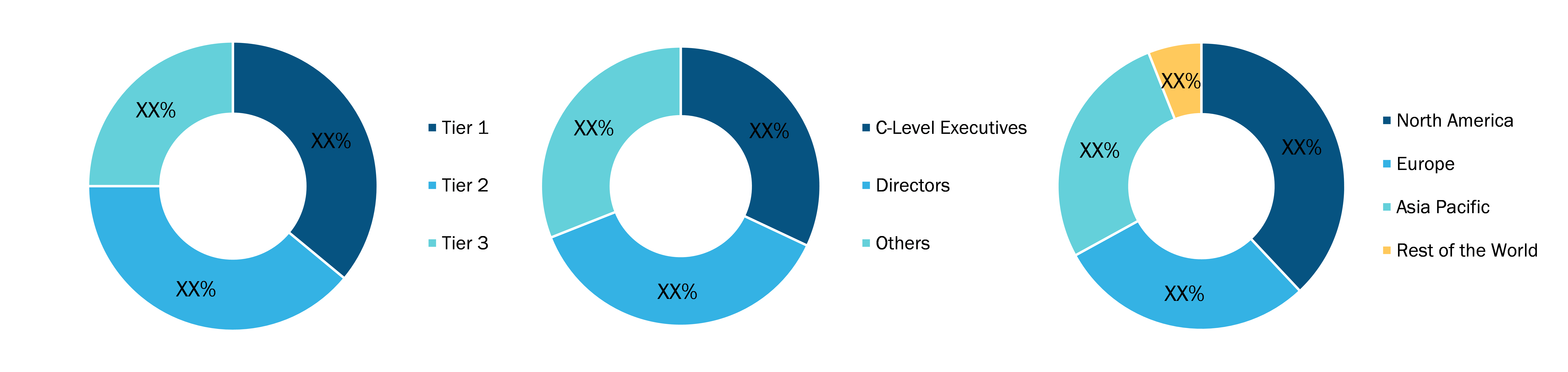
Once we receive the confirmation from primary research sources or primary respondents, we finalize the base year market estimation and forecast the data as per the macroeconomic and microeconomic factors assessed during data collection.
- Data Analysis:
Once data is validated through both secondary as well as primary respondents, we finalize the market estimations by hypothesis formulation and factor analysis at regional and country level.
- 3.1 Macro-Economic Factor Analysis:
We analyse macroeconomic indicators such the gross domestic product (GDP), increase in the demand for goods and services across industries, technological advancement, regional economic growth, governmental policies, the influence of COVID-19, PEST analysis, and other aspects. This analysis aids in setting benchmarks for various nations/regions and approximating market splits. Additionally, the general trend of the aforementioned components aid in determining the market's development possibilities.
- 3.2 Country Level Data:
Various factors that are especially aligned to the country are taken into account to determine the market size for a certain area and country, including the presence of vendors, such as headquarters and offices, the country's GDP, demand patterns, and industry growth. To comprehend the market dynamics for the nation, a number of growth variables, inhibitors, application areas, and current market trends are researched. The aforementioned elements aid in determining the country's overall market's growth potential.
- 3.3 Company Profile:
The “Table of Contents” is formulated by listing and analyzing more than 25 - 30 companies operating in the market ecosystem across geographies. However, we profile only 10 companies as a standard practice in our syndicate reports. These 10 companies comprise leading, emerging, and regional players. Nonetheless, our analysis is not restricted to the 10 listed companies, we also analyze other companies present in the market to develop a holistic view and understand the prevailing trends. The “Company Profiles” section in the report covers key facts, business description, products & services, financial information, SWOT analysis, and key developments. The financial information presented is extracted from the annual reports and official documents of the publicly listed companies. Upon collecting the information for the sections of respective companies, we verify them via various primary sources and then compile the data in respective company profiles. The company level information helps us in deriving the base number as well as in forecasting the market size.
- 3.4 Developing Base Number:
Aggregation of sales statistics (2020-2022) and macro-economic factor, and other secondary and primary research insights are utilized to arrive at base number and related market shares for 2022. The data gaps are identified in this step and relevant market data is analyzed, collected from paid primary interviews or databases. On finalizing the base year market size, forecasts are developed on the basis of macro-economic, industry and market growth factors and company level analysis.
- Data Triangulation and Final Review:
The market findings and base year market size calculations are validated from supply as well as demand side. Demand side validations are based on macro-economic factor analysis and benchmarks for respective regions and countries. In case of supply side validations, revenues of major companies are estimated (in case not available) based on industry benchmark, approximate number of employees, product portfolio, and primary interviews revenues are gathered. Further revenue from target product/service segment is assessed to avoid overshooting of market statistics. In case of heavy deviations between supply and demand side values, all thes steps are repeated to achieve synchronization.
We follow an iterative model, wherein we share our research findings with Subject Matter Experts (SME’s) and Key Opinion Leaders (KOLs) until consensus view of the market is not formulated – this model negates any drastic deviation in the opinions of experts. Only validated and universally acceptable research findings are quoted in our reports.
We have important check points that we use to validate our research findings – which we call – data triangulation, where we validate the information, we generate from secondary sources with primary interviews and then we re-validate with our internal data bases and Subject matter experts. This comprehensive model enables us to deliver high quality, reliable data in shortest possible time.
 Get Free Sample For