The global Eco-Friendly Water Bottle market size is projected to reach US$ 14.16 billion by 2034 from US$ 9.69 billion in 2025. The market is anticipated to register a CAGR of 4.3% during the forecast period 2026–2034. Key market dynamics include regulatory pressure on single‑use plastics, rising sustainability awareness, and ongoing product innovation in insulated, filtered, and smart bottles. Additionally, the market is expected to benefit from the surging global commitment to reducing single‑use plastics, the rapid expansion of organized retail and e‑commerce channels across emerging economies, and the increasing integration of sustainably designed, reusable bottles into premium lifestyle, outdoor, and wellness-oriented product segments.
Eco-Friendly Water Bottle Market AnalysisThe Eco-Friendly Water Bottle market analysis indicates the market’s competitive edge is converging around material circularity, feature-rich differentiation, and brand purpose. Brands are competing on recycled content (e.g., certified post‑consumer stainless steel), traceable supply chains, and repairable, modular parts to extend product lifecycles—moves that reduce Scope 3 emissions while supporting premium positioning. At the product level, companies are prioritizing temperature performance, spill-proof ergonomics, and micro-filtration/UV-C purification for travel, office, fitness, and outdoor use cases. Strategically, vendors should, Own the sustainability narrative with evidence, Invest in channel mix and D2C personalization like online customization and limited color drops sustain engagement, while wholesale partnerships unlock scale. Followed by, bundle hardware with services, which filter subscriptions, app-based hydration prompts, and refill‑station tie‑ins create recurring revenue and loyalty moats. UV/filtration integrations and NFC-enabled impact tracking demonstrate clear use-case value beyond “reusability.”
Eco-Friendly Water Bottle Market OverviewEco‑friendly water bottles span around metal, glass, paper-based composites, and other low‑impact materials. These have evolved from basic drinkware into lifestyle and performance gear. Mass adoption has been catalyzed by plastic-waste legislation, the mainstreaming of fitness/outdoor culture, and the normalization of refill behaviors at workplaces, campuses, gyms, and transit hubs. Product portfolios now commonly integrate double‑wall vacuum insulation, modular, replaceable lids, filter/straw systems, and app or NFC features that quantify waste avoided. Regionally, Europe benefits from stringent single-use directives and design-for-recyclability norms, North America from high brand innovation and omnichannel retail, and APAC from large, young consumer bases receptive to trend-led hydration accessories. For instance, the market in the US is positioned as everyday carry essentials across work, school, fitness, and travel. Retailers emphasize insulated, leak‑resistant designs and fashionable finishes. Brand storytelling centers on sustainability credentials, refill culture, and durability, with strong traction in e‑commerce and specialty outdoor chains.
Strategic InsightsEco-Friendly Water Bottle Market Drivers and OpportunitiesMarket Drivers:
- Escalating Regulation and Corporate Plastic Reduction: Expanding limits on single-use plastics and corporate zero‑waste commitments are shifting consumers and enterprises toward high‑quality reusables, reinforcing demand across retail and B2B merchandising.
- Performance and Wellness Convergence: Adoption in fitness and outdoor activities elevates demand for insulated, durable, and ergonomic formats, with filtration/UV options for safety and convenience on the go.
- Material Innovation and Circularity: Verified recycled stainless steel, recycled aluminum, and modular parts reduce lifecycle impacts while enabling premium price points and compliance with retailer sustainability benchmarks.
Market Opportunities
- Premiumization via Advanced Features: Vacuum insulation, ceramic linings, interchangeable lids, and integrated filtration/UV present upsell pathways; “smart” cues (NFC, hydration tracking) add service layers and community building.
- Impact‑Linked Branding & Partnerships: Models that finance plastic collection or community initiatives build differentiation and enterprise gifting appeal; co‑branding with outdoor, apparel, and automotive partners scales reach.
- Omnichannel Expansion in Growth Markets: APAC and select LATAM corridors offer volume growth via specialty retail and marketplace platforms; localized designs and climate‑appropriate insulation specs can accelerate adoption.
The Eco-Friendly Water Bottle Market share is analyzed across various segments to provide a clearer understanding of its structure, growth potential, and emerging trends. Below is the standard segmentation approach used in most industry reports:
By Material:
- Paper: Emerging fiber‑based or papier‑composite formats targeted at events and travel retail for short‑cycle reuse with recyclability messaging.
- Metal: Stainless steel and aluminum dominate premium and performance tiers, favored for durability, insulation, and recycled content credentials.
- Glass: Niche but growing for purity and taste neutrality; silicone sleeves and ergonomic caps improve portability.
- Others: Includes bio‑based polymers, silicone, and hybrid materials designed for lightweight convenience or specialty use cases.
By Distribution Channel:
- Supermarkets and Hypermarkets: High‑visibility placements, seasonal color runs, and bundle promotions drive mainstream adoption.
- Specialty Stores: Outdoor, sporting goods, and lifestyle boutiques curate premium insulated and technical SKUs.
- Online Retail: D2C customization, limited drops, and rapid colorway refreshes spur repeat purchases and community engagement.
- Others: Department stores, campus stores, corporates/B2B merchandising, and travel retail.
By Geography:
- North America
- Europe
- Asia Pacific
- South & Central America
- Middle East & Africa
Asia-Pacific is expected to grow fastest in the coming years. Emerging markets in South & Central America, the Middle East, and Africa present untapped opportunities for premium, impact‑led brands, especially where refill infrastructure and anti‑litter campaigns are accelerating behavior change.
The eco‑friendly water bottle market is undergoing a decisive shift from commodity drinkware to purpose‑led, performance‑validated products. Growth is driven by the proliferation of refill culture, rising outdoor/fitness participation, and regulatory headwinds against disposable plastics. Below is a summary of market share context and trends by region:
North America
- Market Share: A mature, innovation‑intense market with strong D2C brands, robust specialty retail, and enterprise gifting channels.
- Key Drivers:
- Consumer demand for insulated, leak‑proof formats supporting hybrid work and travel.
- Retailer emphasis on sustainability claims and recycled content across assortments.
- Expanding outdoor and fitness ecosystems sustaining premium performance SKUs.
- Trends: Elevated color drops and collaborations; ceramic linings and next‑gen lids; early traction for smart/UV and filtration bottles.
Europe
- Market Share: Advanced sustainability policy environment, with brands aligning to circularity and recyclability criteria across channels.
- Key Drivers:
- Single‑use reduction mandates directing consumers to reusables.
- Preference for recycled aluminum/stainless solutions and locally produced SKUs.
- Strong outdoor and urban mobility adoption, supporting insulated and commuter‑friendly formats.
- Trends: Repairable components, modularity, and brand commitments to recycled inputs and climate certifications.
Asia-Pacific
- Market Share: The fastest‑growing region, anchored by large consumer bases and strong e‑commerce penetration.
- Key Drivers:
- Urbanization and lifestyle shifts toward portable hydration and heat‑management.
- Social/commerce platforms amplifying aesthetic and functional trends.
- Expansion of specialty chains and marketplaces driving premiumization.
- Trends: Lightweight insulated bottles, slim profiles for commute bags, and region‑specific colorways.
South and Central America
- Market Share: An emerging base with growth tied to outdoor lifestyle, eco‑tourism, and retailer sustainability initiatives.
- Key Drivers:
- Rising awareness of ocean plastic and coastal conservation programs.
- Modernization of specialty retail in Brazil and Mexico.
- Corporate promotional demand for branded, sustainable drinkware.
- Trends: Partnerships with conservation NGOs and growth in refill‑station pilots at events and campuses.
Middle East and Africa
- Market Share: Developing but opportunity‑rich, especially in climate‑challenged geographies where hydration accessories are daily necessities.
- Key Drivers:
- High demand for heat‑resilient, insulated formats due to arid climates.
- Growing interest in sustainable materials and refill culture among urban millennials.
- Investment in retail modernization and tourism‑oriented assortments.
- Trends: Durable, large‑capacity insulated bottles and corporate gifting aligned to green goals.
High Market Density and Competition
Competition is intensifying due to the presence of established leaders such as Chilly's, S'well, Ocean Bottle, Corkcicle, Hydro Flask, Bottles Società Benefit S.r.l. P.IVA, Frank Green, Qwetch, Klean Kanteen, and Kinto Co., Ltd, also contribute to a diverse and rapidly expanding market landscape.
This competitive environment pushes vendors to differentiate through:
- Premiumization and Proof: Temperature retention, leak‑proof engineering, and third‑party certifications (B Corp, Climate Neutral, recycled content) reinforce quality and ethics.
- Portfolio Innovation: UV‑enabled self‑cleaning, integrated filters, modular/repairable parts, and recycled‑content metallurgy elevate feature sets.
- Vertical Integration and Ethical Sourcing: Traceable recycled inputs (e.g., 90% PCR steel; 100% recycled aluminum) and impact programs (e.g., plastic‑collection funding) deliver transparent, values‑driven propositions.
- Advanced Manufacturing and Design: Vacuum insulation, ceramic coatings/linings, and ergonomic lids/straws designed for spill resistance and ease of cleaning.
Opportunities and Strategic Moves
- Partner with Outdoor, Fitness, and Lifestyle Channels: Collaborations and limited editions with outdoor retailers, fitness communities, and apparel brands can unlock new segments and strengthen seasonal sell‑through.
- Embed White‑Label & B2B Programs: Enterprise gifting and promotional markets reward verifiable impact claims and customization; aligning with corporate ESG agendas sustains volume.
- Invest in Circular Materials and Impact Accounting: Transitioning to certified recycled metals and publishing auditable impact (e.g., plastic‑collection equivalents) sharpen brand trust and pricing power.
- Chilly's
- S'well
- Ocean Bottle
- Corkcicle
- Hydro Flask
- Bottles Società Benefit S.r.l. P.IVA
- Frank Green
- Qwetch
- Klean Kanteen
- Kinto Co., Ltd.
Disclaimer: The companies listed above are not ranked in any particular order.
Eco-Friendly Water Bottle Market News and Recent Developments- In February 2024, BRITA SE, acquired LARQ, Inc. The medium‑sized, family‑owned company based in Taunusstein, Germany, viewed this acquisition as a strategic milestone, particularly for advancing its consumer business in the North American market.
- In January 2024, YETI Holdings, Inc. announced that it had signed an agreement to acquire MYSTERY RANCH. As part of its expanding ecosystem of high‑performance outdoor gear, YETI emphasized that the acquisition is likely to complement its Eco‑Friendly Water Bottle portfolio by strengthening its position among consumers who prioritize durability and sustainability.
The Eco-Friendly Water Bottle Market Size and Forecast (2021–2034) report provides a detailed analysis of the market covering below areas:
- Eco-Friendly Water Bottle Market size and forecast at global, regional, and country levels for all the key market segments covered under the scope
- Eco-Friendly Water Bottle Market trends, as well as market dynamics such as drivers, restraints, and key opportunities
- Detailed PEST and SWOT analysis
- Eco-Friendly Water Bottle Market analysis covering key market trends, global and regional framework, major players, regulations, and recent market developments
- Industry landscape and competition analysis covering market concentration, heat map analysis, prominent players, and recent developments in the Eco-Friendly Water Bottle Market.
- Detailed company profiles
Have a question?
Shejal
Shejal will walk you through a 15-minute call to present the report’s content and answer all queries if you have any.
Speak to Analyst
- Sample PDF showcases the content structure and the nature of the information with qualitative and quantitative analysis.
- Request discounts available for Start-Ups & Universities
- Sample PDF showcases the content structure and the nature of the information with qualitative and quantitative analysis.
- Request discounts available for Start-Ups & Universities
Report Coverage
Revenue forecast, Company Analysis, Industry landscape, Growth factors, and Trends

Segment Covered
Material, Distribution Channel

Regional Scope
North America, Europe, Asia Pacific, Middle East & Africa, South & Central America

Country Scope
Argentina, Australia, Brazil, Canada, China, France, Germany, India, Italy, Japan, Mexico, Russia, Saudi Arabia, South Africa, South Korea, UAE, UK, US
Frequently Asked Questions
Key players include Chilly's, S'well, Ocean Bottle, Corkcicle, Hydro Flask, Bottles Società Benefit S.r.l. P.IVA, Frank Green, Qwetch, Klean Kanteen, and Kinto Co., Ltd.
Challenges include commoditization pressure from low‑cost entrants, raw material price volatility, greenwashing scrutiny around sustainability claims, and retailer/brand compliance with recycled‑content and packaging standards across jurisdictions.
Asia‑Pacific is the fastest‑growing region in the baseline period due to large consumer bases, lifestyle shifts, and robust retail penetration.
Europe is shaped by single‑use reduction policies and recycled‑content preferences; Asia‑Pacific is propelled by urban, trend‑driven adoption and strong e‑commerce; North America emphasizes performance innovation, certifications, and omnichannel retail.
The market is expected to reach approximately US$ 14.16 billion by 2034 from US$ 9.69 billion in 2025. The market is anticipated to register a CAGR of 4.3%.
Yes! We provide a free sample of the report, which includes Report Scope (Table of Contents), report structure, and selected insights to help you assess the value of the full report. Please click on the "Download Sample" button or contact us to receive your copy.
Absolutely - analyst assistance is part of the package. You can connect with our analyst post-purchase to clarify report insights, methodology or discuss how the findings apply to your business needs.
Once your order is successfully placed, you will receive a confirmation email along with your invoice.
• For published reports: You'll receive access to the report within 4-6 working hours via a secured email sent to your email.
• For upcoming reports: Your order will be recorded as a pre-booking. Our team will share the estimated release date and keep you informed of any updates. As soon as the report is published, it will be delivered to your registered email.
We offer customization options to align the report with your specific objectives. Whether you need deeper insights into a particular region, industry segment, competitor analysis, or data cut, our research team can tailor the report accordingly. Please share your requirements with us, and we'll be happy to provide a customized proposal or scope.
The report is available in either PDF format or as an Excel dataset, depending on the license you choose.
The PDF version provides the full analysis and visuals in a ready-to-read format. The Excel dataset includes all underlying data tables for easy manipulation and further analysis.
Please review the license options at checkout or contact us to confirm which formats are included with your purchase.
Our payment process is fully secure and PCI-DSS compliant.
We use trusted and encrypted payment gateways to ensure that all transactions are protected with industry-standard SSL encryption. Your payment details are never stored on our servers and are handled securely by certified third-party processors.
You can make your purchase with confidence, knowing your personal and financial information is safe with us.
Yes, we do offer special pricing for bulk purchases.
If you're interested in purchasing multiple reports, we're happy to provide a customized bundle offer or volume-based discount tailored to your needs. Please contact our sales team with the list of reports you're considering, and we'll share a personalized quote.
Yes, absolutely.
Our team is available to help you make an informed decision. Whether you have questions about the report's scope, methodology, customization options, or which license suits you best, we're here to assist. Please reach out to us at sales@theinsightpartners.com, and one of our representatives will get in touch promptly.
Yes, a billing invoice will be automatically generated and sent to your registered email upon successful completion of your purchase.
If you need the invoice in a specific format or require additional details (such as company name, GST, or VAT information), feel free to contact us, and we'll be happy to assist.
Yes, certainly.
If you encounter any difficulties accessing or receiving your report, our support team is ready to assist you. Simply reach out to us via email or live chat with your order information, and we'll ensure the issue is resolved quickly so you can access your report without interruption.
The Insight Partners performs research in 4 major stages: Data Collection & Secondary Research, Primary Research, Data Analysis and Data Triangulation & Final Review.
- Data Collection and Secondary Research:
As a market research and consulting firm operating from a decade, we have published many reports and advised several clients across the globe. First step for any study will start with an assessment of currently available data and insights from existing reports. Further, historical and current market information is collected from Investor Presentations, Annual Reports, SEC Filings, etc., and other information related to company’s performance and market positioning are gathered from Paid Databases (Factiva, Hoovers, and Reuters) and various other publications available in public domain.
Several associations trade associates, technical forums, institutes, societies and organizations are accessed to gain technical as well as market related insights through their publications such as research papers, blogs and press releases related to the studies are referred to get cues about the market. Further, white papers, journals, magazines, and other news articles published in the last 3 years are scrutinized and analyzed to understand the current market trends.
- Primary Research:
The primarily interview analysis comprise of data obtained from industry participants interview and answers to survey questions gathered by in-house primary team.
For primary research, interviews are conducted with industry experts/CEOs/Marketing Managers/Sales Managers/VPs/Subject Matter Experts from both demand and supply side to get a 360-degree view of the market. The primary team conducts several interviews based on the complexity of the markets to understand the various market trends and dynamics which makes research more credible and precise.
A typical research interview fulfils the following functions:
- Provides first-hand information on the market size, market trends, growth trends, competitive landscape, and outlook
- Validates and strengthens in-house secondary research findings
- Develops the analysis team’s expertise and market understanding
Primary research involves email interactions and telephone interviews for each market, category, segment, and sub-segment across geographies. The participants who typically take part in such a process include, but are not limited to:
- Industry participants: VPs, business development managers, market intelligence managers and national sales managers
- Outside experts: Valuation experts, research analysts and key opinion leaders specializing in the electronics and semiconductor industry.
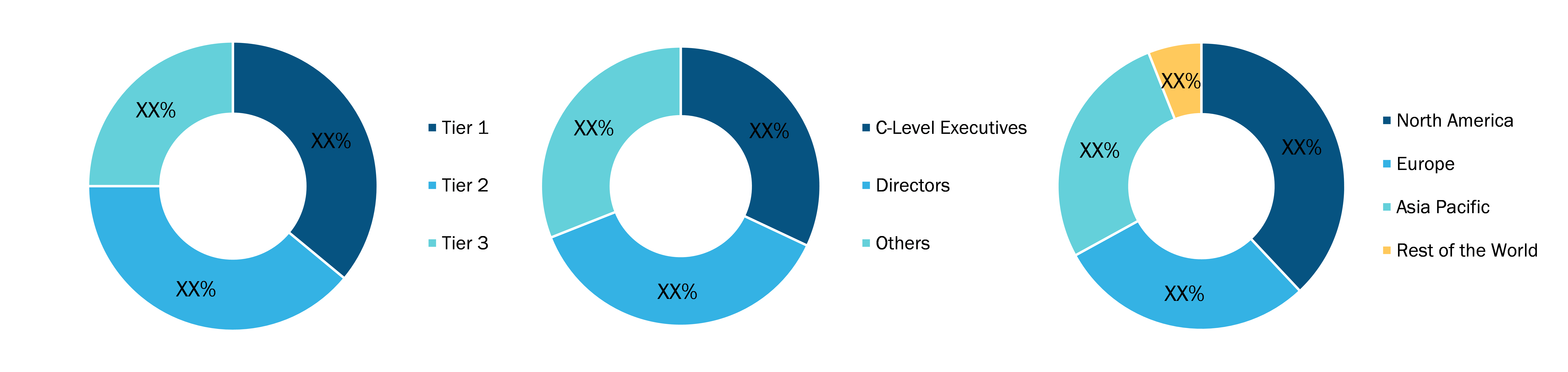
Below is the breakup of our primary respondents by company, designation, and region:
Once we receive the confirmation from primary research sources or primary respondents, we finalize the base year market estimation and forecast the data as per the macroeconomic and microeconomic factors assessed during data collection.
- Data Analysis:
Once data is validated through both secondary as well as primary respondents, we finalize the market estimations by hypothesis formulation and factor analysis at regional and country level.
- 3.1 Macro-Economic Factor Analysis:
We analyse macroeconomic indicators such the gross domestic product (GDP), increase in the demand for goods and services across industries, technological advancement, regional economic growth, governmental policies, the influence of COVID-19, PEST analysis, and other aspects. This analysis aids in setting benchmarks for various nations/regions and approximating market splits. Additionally, the general trend of the aforementioned components aid in determining the market's development possibilities.
- 3.2 Country Level Data:
Various factors that are especially aligned to the country are taken into account to determine the market size for a certain area and country, including the presence of vendors, such as headquarters and offices, the country's GDP, demand patterns, and industry growth. To comprehend the market dynamics for the nation, a number of growth variables, inhibitors, application areas, and current market trends are researched. The aforementioned elements aid in determining the country's overall market's growth potential.
- 3.3 Company Profile:
The “Table of Contents” is formulated by listing and analyzing more than 25 - 30 companies operating in the market ecosystem across geographies. However, we profile only 10 companies as a standard practice in our syndicate reports. These 10 companies comprise leading, emerging, and regional players. Nonetheless, our analysis is not restricted to the 10 listed companies, we also analyze other companies present in the market to develop a holistic view and understand the prevailing trends. The “Company Profiles” section in the report covers key facts, business description, products & services, financial information, SWOT analysis, and key developments. The financial information presented is extracted from the annual reports and official documents of the publicly listed companies. Upon collecting the information for the sections of respective companies, we verify them via various primary sources and then compile the data in respective company profiles. The company level information helps us in deriving the base number as well as in forecasting the market size.
- 3.4 Developing Base Number:
Aggregation of sales statistics (2020-2022) and macro-economic factor, and other secondary and primary research insights are utilized to arrive at base number and related market shares for 2022. The data gaps are identified in this step and relevant market data is analyzed, collected from paid primary interviews or databases. On finalizing the base year market size, forecasts are developed on the basis of macro-economic, industry and market growth factors and company level analysis.
- Data Triangulation and Final Review:
The market findings and base year market size calculations are validated from supply as well as demand side. Demand side validations are based on macro-economic factor analysis and benchmarks for respective regions and countries. In case of supply side validations, revenues of major companies are estimated (in case not available) based on industry benchmark, approximate number of employees, product portfolio, and primary interviews revenues are gathered. Further revenue from target product/service segment is assessed to avoid overshooting of market statistics. In case of heavy deviations between supply and demand side values, all thes steps are repeated to achieve synchronization.
We follow an iterative model, wherein we share our research findings with Subject Matter Experts (SME’s) and Key Opinion Leaders (KOLs) until consensus view of the market is not formulated – this model negates any drastic deviation in the opinions of experts. Only validated and universally acceptable research findings are quoted in our reports.
We have important check points that we use to validate our research findings – which we call – data triangulation, where we validate the information, we generate from secondary sources with primary interviews and then we re-validate with our internal data bases and Subject matter experts. This comprehensive model enables us to deliver high quality, reliable data in shortest possible time.

Get Free Sample For