The global encapsulated fragrances market size is projected to reach US$ 2.15 billion by 2034 from US$ 1.45 billion in 2025. The market is anticipated to register a CAGR of 4.5% during the forecast period 2026–2034.
Key market dynamics include a heightening global focus on long-lasting sensory experiences, rising consumer awareness regarding the benefits of controlled-release scent technology in personal care, and a significant shift toward premium, sustainable household products. Additionally, the market is expected to benefit from the growing popularity of wellness-oriented aromatherapy, expansion in organized retail channels across emerging economies, and the increasing inclusion of fragrance encapsulation in high-value segments like activewear textiles and luxury home care.
Encapsulated Fragrances Market AnalysisThe encapsulated fragrances market analysis indicates a clear move toward advanced delivery technologies as consumers place greater emphasis on long‑lasting scent performance and added functional benefits. Encapsulated fragrances are evolving into two distinct areas: one centered on conventional synthetic polymer systems and another gaining rapid momentum through biodegradable, bio‑based encapsulation matrices. Significant opportunities are emerging in premium laundry and fabric care applications, where microencapsulation provides a notable advantage by safeguarding delicate, volatile fragrance oils and ensuring controlled release. Market growth will also hinge on the stability of aroma compounds and the precision of release mechanisms that maintain sensory impact over time. Competitive differentiation increasingly depends on brands’ ability to showcase sustainable materials and transparent ingredient profiles. These attributes enable both global leaders and specialized innovators to command premium pricing in a market that is progressively oriented toward environmental responsibility and high technical performance.
Encapsulated Fragrances Market OverviewScent delivery systems have evolved from basic masking agents to sophisticated functional components of modern consumer goods. Encapsulated fragrances include thermal-release capsules for textiles, pH-triggered release for deodorants, and biodegradable capsules for eco-conscious home care. Both global chemical giants and specialized biotech startups compete in this market, using materials such as polysaccharides, proteins, and synthetic polymers. Growing demand for all-day freshness among urban consumers in North America and Europe has increased the popularity of encapsulated scents as a premium wellness solution. Europe leads in revenue due to its established luxury perfume and personal care industry, while Asia-Pacific is advancing in manufacturing innovation and massive retail adoption. The US market is highly developed, driven by the broad availability of advanced laundry detergents and fabric softeners. Competition among brands is fueling greater variety in release triggers and the inclusion of natural essential oils.
Strategic InsightsEncapsulated Fragrances Market Drivers and OpportunitiesMarket Drivers:
- Demand for Extended Scent Longevity: Consumers seek products that provide sustained freshness days after application. Encapsulation protects volatile oils from evaporation, ensuring a controlled release that traditional liquid fragrances cannot achieve.
- Premiumization of Personal Care and Home Care: The expansion of the masstige and luxury segments has sustained high demand for sophisticated fragrance delivery. As consumers trade up to premium experiences, encapsulated formulations in skin care and fabric softeners continue to see stable volume gains.
- Technological Advancements in Microencapsulation: Innovations in shell wall materials have allowed for more stable and cost-effective production, making the technology accessible to a wider range of mass-market products.
Market Opportunities:
- Development of Biodegradable Shell Materials: With increasing regulatory pressure on microplastics, there is a significant opportunity for producers to develop biobased, plastic-free capsules that meet new environmental standards.
- Expansion into Functional Textiles: Beyond liquid products, encapsulated fragrances offer massive potential in smart textiles and activewear, where friction-activated scent release can provide odor-neutralizing benefits.
- Growth in Emerging APAC Markets: Strategic partnerships between global fragrance houses and local consumer goods manufacturers in China and India may facilitate access to high-margin segments where demand for premium household products is surging.
The Encapsulated Fragrances Market share is analyzed across various segments to provide a clearer understanding of its structure, growth potential, and emerging trends. Below is the standard segmentation approach used in most industry reports:
By Product Type:
- Fragrance Blends: The dominant volume driver, particularly within the home care and laundry, due to the need for complex, multi-layered scent profiles that require stable delivery.
- Aroma Chemicals: A high-value segment focused on specific synthetic or natural molecules used in fine fragrances and specialized cosmetic applications.
By Application:
- Perfumes and Fragrances: Focuses on enhancing the longevity of fine scents and luxury perfumes through controlled release.
- Cleaning Products: The largest application segment, primarily driven by laundry detergents and fabric softeners requiring long-lasting freshness.
- Cosmetics: Includes skin care and color cosmetics where encapsulation protects sensitive ingredients and provides sensory triggers.
- Personal Hygiene Products: Covers soaps, deodorants, and shower gels where scent release is often triggered by moisture or friction.
- Food and Beverages: A specialized segment utilizing encapsulation to preserve flavor profiles and ensure consistent aromatic experiences in consumer goods.
By Geography:
- North America
- Europe
- Asia Pacific
- South & Central America
- Middle East & Africa
Asia-Pacific is expected to grow fastest in the coming years due to rapid urbanization and the expansion of the consumer goods industry. Emerging markets in South & Central America and the Middle East also have many untapped opportunities for premium home care and personal hygiene brands.
The encapsulated fragrances market is undergoing a significant transformation, moving from basic laundry additives to high-value sensory delivery systems. Growth is driven by the rising demand for long-lasting freshness in household products, the expansion of the luxury personal care industry, and the implementation of biodegradable technology in major markets. Below is a summary of market share and trends by region:
1. North America
- Market Share: Holds a significant share driven by a mature personal care and high consumer willingness to spend on premium, high-performance fragrance products.
- Key Drivers:
- Strong demand for ready-to-use and convenient laundry products that utilize controlled-release technology.
- Rising consumer emphasis on personal grooming and wellness-driven home fragrances.
- A strict regulatory landscape favoring advanced safety standards in chemical usage.
- Trends: Integration of digital tools and AI in scent development, alongside the successful adoption of specialty certifications for eco-friendly encapsulation.
2. Europe
- Market Share: Holds the largest global share, anchored by the presence of major global fragrance houses in Switzerland, Germany, and France.
- Key Drivers:
- Established infrastructure for high-end cosmetic and perfume manufacturing.
- Robust regulatory frameworks like REACH are driving the shift toward biodegradable microcapsules.
- High domestic consumption of premium household and fabric care products.
- Trends: A strategic pivot toward plastic-free encapsulation materials to eliminate microplastic waste, meeting the demands of eco-conscious European consumers.
3. Asia-Pacific
- Market Share: The fastest-growing region, with China and India acting as massive consumption hubs for fragranced goods.
- Key Drivers:
- Rapid urbanization and a burgeoning middle class seeking westernized luxury personal care.
- Expanding manufacturing capabilities for detergents and cosmetics in emerging industrial zones.
- Increasing disposable incomes leading to a preference for value-added, long-lasting aromatic products.
- Trends: Heavy reliance on e-commerce platforms and rising B2B contracts for high-end encapsulated oils used in the local skin care and textile industries.
4. South and Central America
- Market Share: An emerging market with a growing artisanal and premium market in countries like Brazil and Chile.
- Key Drivers:
- Growing awareness of hygiene and the role of fragrance in conveying cleanliness.
- Modernization of local manufacturing facilities to include advanced scent delivery systems.
- Trends: Growth of boutique fragrance brands and the introduction of encapsulated scents in mass-market cleaning products to differentiate from domestic competitors.
5. Middle East and Africa
- Market Share: Developing market with deep cultural roots in perfumery, now transitioning toward formalized commercial production.
- Key Drivers:
- High demand for strong, shelf-stable fragrance profiles in arid and hot climates.
- Strategic investments in local production to reduce reliance on imported chemical inputs.
- Trends: Adoption of modern refrigeration and stability technologies to ensure the integrity of volatile aroma chemicals in regional supply chains.
High Market Density and Competition
Competition is intensifying as established leaders like Givaudan, International Flavors & Fragrances (IFF), and DSM-Firmenich dominate the landscape. These giants are joined by regional experts and innovators such as Symrise AG, Mane SA, Takasago, and Sensient Technologies, creating a highly concentrated yet innovative environment.
This competitive environment pushes vendors to differentiate through:
- Next-Generation Scent Delivery: Positioning encapsulated fragrances as superior to liquid counterparts by emphasizing longevity, fabric adherence, and triggered-release (e.g., friction or moisture).
- Product Diversification: Moving beyond laundry to include fine fragrances, probiotic cosmetics, and even high-end food-grade aromatic encapsulates.
- Sustainability Leadership: Managing the entire lifecycle of the capsule, from biodegradable shell sourcing to ethical raw material procurement, meeting global clean-label standards.
- Technological Integration: Utilizing AI for predictive modeling in flavor/scent development and implementing spray-drying or coacervation to ensure high-quality, stable powders.
Opportunities and Strategic Moves
- Invest in Bio-Based R&D: Develop and patent biodegradable shell materials (such as those based on starch or proteins) to preemptively comply with global microplastic bans and appeal to Gen Z consumers.
- Localized Formulation: Create region-specific scent profiles, such as popular blends like rose-sandalwood or lemon-eucalyptus, to tap into cultural preferences in the growing APAC and Middle Eastern corridors.
- Ashland Inc
- Firmenich SA.
- Follmann GmbH and Co KG, Inc.
- Givaudan SA
- Glatt GmbH
- Ingredion Inc
- Insilico Medicine Inc
- International Flavors & Fragrances Inc
- MikroCaps doo
- Symrise AG
Disclaimer: The companies listed above are not ranked in any particular order.
Encapsulated Fragrances Market News and Recent Developments- In November 2025, Givaudan announced that PlanetCaps is now available for personal care applications. This new development offers a microplastic-free solution, fully compliant with ECHA regulations, delivering a long‑lasting fragrance performance in hair and body care.
- In July 2025, IFF launched ENVIROCAP—its newest sustainable scent delivery system designed for the future of fabric care. Developed by IFF’s world-class scientists and fragrance delivery experts, ENVIROCAP sets a new standard in innovation: it is fully ECHA-compliant, biodegradable, and vegan-suitable. The launch of ENVIROCAP™ marks a bold new chapter in fragrance encapsulation.
The Encapsulated Fragrances Market Size and Forecast (2021–2034) report provides a detailed analysis of the market covering below areas:
- Encapsulated Fragrances Market size and forecast at global, regional, and country levels for all the key market segments covered under the scope
- Encapsulated Fragrances Market trends, as well as market dynamics such as drivers, restraints, and key opportunities
- Detailed PEST and SWOT analysis
- Encapsulated Fragrances Market analysis covering key market trends, global and regional framework, major players, regulations, and recent market developments
- Industry landscape and competition analysis covering market concentration, heat map analysis, prominent players, and recent developments in the Encapsulated Fragrances Market.
- Detailed company profiles
Have a question?
Shejal
Shejal will walk you through a 15-minute call to present the report’s content and answer all queries if you have any.
Speak to Analyst
- Sample PDF showcases the content structure and the nature of the information with qualitative and quantitative analysis.
- Request discounts available for Start-Ups & Universities
- Sample PDF showcases the content structure and the nature of the information with qualitative and quantitative analysis.
- Request discounts available for Start-Ups & Universities
Report Coverage
Revenue forecast, Company Analysis, Industry landscape, Growth factors, and Trends

Segment Covered
Product Type, and Application

Regional Scope
North America, Europe, Asia Pacific, Middle East & Africa, South & Central America

Country Scope
Argentina, ASEAN, Australia, Brazil, Canada, China, France, Germany, India, Italy, Japan, Mexico, Russia, Saudi Arabia, South Africa, South Korea, UAE, UK, United States
Frequently Asked Questions
Key players operating in the global encapsulated fragrances market include Firmenich SA., Givaudan SA, Ingredion Inc, International Flavors & Fragrances Inc, MikroCaps doo, Symrise AG, Glatt GmbH, Insilico Medicine Inc, Follmann GmbH and Co KG, Inc., and Ashland Inc.s
Key challenges include the high cost of advanced encapsulation technologies, strict regulatory compliance regarding synthetic chemicals, and the technical difficulty of ensuring wash durability in textiles.
Trends include shifting toward biodegradable capsules in Europe, high-performance laundry tech in North America, and rapid premiumization in Asia-Pacific.
The market is expected to reach approximately US$ 2.15 billion, growing from a 2025 valuation of US$ 1.45 billion.
Asia-Pacific is the fastest-growing region, driven by rapid urbanization and the rising middle-class demand for premium household and personal care products.
Yes! We provide a free sample of the report, which includes Report Scope (Table of Contents), report structure, and selected insights to help you assess the value of the full report. Please click on the "Download Sample" button or contact us to receive your copy.
Absolutely - analyst assistance is part of the package. You can connect with our analyst post-purchase to clarify report insights, methodology or discuss how the findings apply to your business needs.
Once your order is successfully placed, you will receive a confirmation email along with your invoice.
• For published reports: You'll receive access to the report within 4-6 working hours via a secured email sent to your email.
• For upcoming reports: Your order will be recorded as a pre-booking. Our team will share the estimated release date and keep you informed of any updates. As soon as the report is published, it will be delivered to your registered email.
We offer customization options to align the report with your specific objectives. Whether you need deeper insights into a particular region, industry segment, competitor analysis, or data cut, our research team can tailor the report accordingly. Please share your requirements with us, and we'll be happy to provide a customized proposal or scope.
The report is available in either PDF format or as an Excel dataset, depending on the license you choose.
The PDF version provides the full analysis and visuals in a ready-to-read format. The Excel dataset includes all underlying data tables for easy manipulation and further analysis.
Please review the license options at checkout or contact us to confirm which formats are included with your purchase.
Our payment process is fully secure and PCI-DSS compliant.
We use trusted and encrypted payment gateways to ensure that all transactions are protected with industry-standard SSL encryption. Your payment details are never stored on our servers and are handled securely by certified third-party processors.
You can make your purchase with confidence, knowing your personal and financial information is safe with us.
Yes, we do offer special pricing for bulk purchases.
If you're interested in purchasing multiple reports, we're happy to provide a customized bundle offer or volume-based discount tailored to your needs. Please contact our sales team with the list of reports you're considering, and we'll share a personalized quote.
Yes, absolutely.
Our team is available to help you make an informed decision. Whether you have questions about the report's scope, methodology, customization options, or which license suits you best, we're here to assist. Please reach out to us at sales@theinsightpartners.com, and one of our representatives will get in touch promptly.
Yes, a billing invoice will be automatically generated and sent to your registered email upon successful completion of your purchase.
If you need the invoice in a specific format or require additional details (such as company name, GST, or VAT information), feel free to contact us, and we'll be happy to assist.
Yes, certainly.
If you encounter any difficulties accessing or receiving your report, our support team is ready to assist you. Simply reach out to us via email or live chat with your order information, and we'll ensure the issue is resolved quickly so you can access your report without interruption.
The Insight Partners performs research in 4 major stages: Data Collection & Secondary Research, Primary Research, Data Analysis and Data Triangulation & Final Review.
- Data Collection and Secondary Research:
As a market research and consulting firm operating from a decade, we have published many reports and advised several clients across the globe. First step for any study will start with an assessment of currently available data and insights from existing reports. Further, historical and current market information is collected from Investor Presentations, Annual Reports, SEC Filings, etc., and other information related to company’s performance and market positioning are gathered from Paid Databases (Factiva, Hoovers, and Reuters) and various other publications available in public domain.
Several associations trade associates, technical forums, institutes, societies and organizations are accessed to gain technical as well as market related insights through their publications such as research papers, blogs and press releases related to the studies are referred to get cues about the market. Further, white papers, journals, magazines, and other news articles published in the last 3 years are scrutinized and analyzed to understand the current market trends.
- Primary Research:
The primarily interview analysis comprise of data obtained from industry participants interview and answers to survey questions gathered by in-house primary team.
For primary research, interviews are conducted with industry experts/CEOs/Marketing Managers/Sales Managers/VPs/Subject Matter Experts from both demand and supply side to get a 360-degree view of the market. The primary team conducts several interviews based on the complexity of the markets to understand the various market trends and dynamics which makes research more credible and precise.
A typical research interview fulfils the following functions:
- Provides first-hand information on the market size, market trends, growth trends, competitive landscape, and outlook
- Validates and strengthens in-house secondary research findings
- Develops the analysis team’s expertise and market understanding
Primary research involves email interactions and telephone interviews for each market, category, segment, and sub-segment across geographies. The participants who typically take part in such a process include, but are not limited to:
- Industry participants: VPs, business development managers, market intelligence managers and national sales managers
- Outside experts: Valuation experts, research analysts and key opinion leaders specializing in the electronics and semiconductor industry.
Below is the breakup of our primary respondents by company, designation, and region:
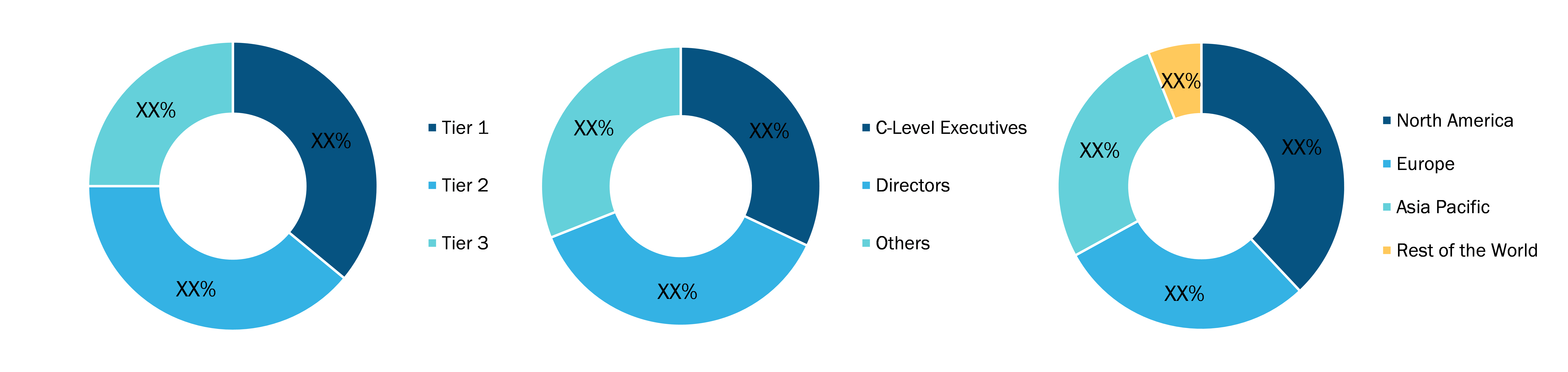
Once we receive the confirmation from primary research sources or primary respondents, we finalize the base year market estimation and forecast the data as per the macroeconomic and microeconomic factors assessed during data collection.
- Data Analysis:
Once data is validated through both secondary as well as primary respondents, we finalize the market estimations by hypothesis formulation and factor analysis at regional and country level.
- 3.1 Macro-Economic Factor Analysis:
We analyse macroeconomic indicators such the gross domestic product (GDP), increase in the demand for goods and services across industries, technological advancement, regional economic growth, governmental policies, the influence of COVID-19, PEST analysis, and other aspects. This analysis aids in setting benchmarks for various nations/regions and approximating market splits. Additionally, the general trend of the aforementioned components aid in determining the market's development possibilities.
- 3.2 Country Level Data:
Various factors that are especially aligned to the country are taken into account to determine the market size for a certain area and country, including the presence of vendors, such as headquarters and offices, the country's GDP, demand patterns, and industry growth. To comprehend the market dynamics for the nation, a number of growth variables, inhibitors, application areas, and current market trends are researched. The aforementioned elements aid in determining the country's overall market's growth potential.
- 3.3 Company Profile:
The “Table of Contents” is formulated by listing and analyzing more than 25 - 30 companies operating in the market ecosystem across geographies. However, we profile only 10 companies as a standard practice in our syndicate reports. These 10 companies comprise leading, emerging, and regional players. Nonetheless, our analysis is not restricted to the 10 listed companies, we also analyze other companies present in the market to develop a holistic view and understand the prevailing trends. The “Company Profiles” section in the report covers key facts, business description, products & services, financial information, SWOT analysis, and key developments. The financial information presented is extracted from the annual reports and official documents of the publicly listed companies. Upon collecting the information for the sections of respective companies, we verify them via various primary sources and then compile the data in respective company profiles. The company level information helps us in deriving the base number as well as in forecasting the market size.
- 3.4 Developing Base Number:
Aggregation of sales statistics (2020-2022) and macro-economic factor, and other secondary and primary research insights are utilized to arrive at base number and related market shares for 2022. The data gaps are identified in this step and relevant market data is analyzed, collected from paid primary interviews or databases. On finalizing the base year market size, forecasts are developed on the basis of macro-economic, industry and market growth factors and company level analysis.
- Data Triangulation and Final Review:
The market findings and base year market size calculations are validated from supply as well as demand side. Demand side validations are based on macro-economic factor analysis and benchmarks for respective regions and countries. In case of supply side validations, revenues of major companies are estimated (in case not available) based on industry benchmark, approximate number of employees, product portfolio, and primary interviews revenues are gathered. Further revenue from target product/service segment is assessed to avoid overshooting of market statistics. In case of heavy deviations between supply and demand side values, all thes steps are repeated to achieve synchronization.
We follow an iterative model, wherein we share our research findings with Subject Matter Experts (SME’s) and Key Opinion Leaders (KOLs) until consensus view of the market is not formulated – this model negates any drastic deviation in the opinions of experts. Only validated and universally acceptable research findings are quoted in our reports.
We have important check points that we use to validate our research findings – which we call – data triangulation, where we validate the information, we generate from secondary sources with primary interviews and then we re-validate with our internal data bases and Subject matter experts. This comprehensive model enables us to deliver high quality, reliable data in shortest possible time.

Get Free Sample For