Live Commerce Market Trends, Size & Forecast by 2034

Coverage: Live Commerce Market covers analysis By Product Type (Vitamins & Minerals, Antioxidants, Herbal Extracts / Nutraceuticals, Others), Application (Dietary Supplements, Sports & Fitness, Medical & Clinical Nutrition, Others), Distribution Channel (Online Retail, Direct Sales, Offline), and Geography (North America, Europe, Asia Pacific, the Middle East and Africa, and South and Central America)

  • Status : Upcoming
  • Report Code : TIPRE00043085
  • Category : Technology, Media and Telecommunications
  • No. of Pages : 150
  • Available Report Formats : pdf-format excel-format

The live commerce market size is expected to reach US$ 238.65 billion by 2034 from US$ 14.60 billion in 2025. The market is anticipated to register a CAGR of 27.3% during 2026–2034.

Live Commerce Market Analysis

Live commerce is rapidly growing within a fast-evolving digital economy that combines entertainment and shopping to capture consumers' attention in real time. As this market matures, it will transform e-commerce by offering unique and interactive experiences across categories and geographic regions through immersive, personalized experiences, powered by technology and shifts in consumer preferences. The instant engagement creates more customer trust and confidence in their purchasing decisions, ultimately leading to a more significant conversion. Platforms like TikTok, Instagram, YouTube, and Facebook have begun offering live shopping functions to consumers, which has allowed brands to reach huge audiences in a frictionless and efficient manner.

Live Commerce Market Overview

The Live Commerce Market, more commonly referred to as live-stream shopping or shoppertainment, is one of the most significant changes to occur in the global retail environment. Live commerce combines live video streaming with e-commerce to allow consumers to engage with hosts or influencers in real-time, ask product questions, and seamlessly purchase during the live session. This interactive form of shopping alters traditional online shopping by adding an entertaining, engaging, and personalized element. Live commerce is an increasingly popular option for consumers who crave authentic, immersive, and social online shopping experiences that replicate more traditional in-store shopping.

Strategic InsightsLive Commerce Market Drivers and Opportunities

Market Drivers:

  • Growing Demand for Interactive and Immersive Shopping Experiences: Consumers demand for interactive shopping experiences that are immersive, integrating entertainment and instant purchasing to increase trust and satisfaction, is rising. A shift towards dynamic and engaging formats is a significant factor driving growth in live commerce, distinguishing it from traditional static models of e-commerce.
  • Social Media Platform Integration: The addition of live shopping features within social media platforms, such as TikTok, Instagram, and Facebook, offers brands the possibility of engaging with vast communities, capitalizing on these platforms' interest, engagement, and influencer community to drive sales and increase brand awareness.
  • Influence of Creator-Driven and Influencer Marketing: Influencer and creator-driven marketing creates a level of authenticity and relatability for live commerce sessions, creating interest for Millennial and Generation Z consumers. Influencers act as trusted voices in their community, often increasing user engagement and conversions, contributing to the expansion of live commerce.

Market Opportunities:

  • Technological Advancements: Technological innovations--such as artificial intelligence (AI), augmented reality (AR), and interactive features--allow for a more diversified and personalized live shopping experience that engages and attracts consumers.
  • Growth of Tier-2 and Tier-3 Cities: Heightening smartphone adoption and mobile internet connectivity (5G coverage) delivers better quality and accessibility of live-streaming experience, creating growth opportunities, even in tier-2 and tier-3 cities.
  • Emerging Market: Growing adoption in emerging markets presents untapped potential for live commerce penetration, as digital infrastructure continues to expand and consumer shopping habits evolve.
Live Commerce Market Report Segmentation Analysis

The live commerce market share is analyzed across various segments to provide a clearer understanding of its structure, growth potential, and emerging trends. Below is the standard segmentation approach used in most industry reports:

By Product Type:

  • Fashion & Apparel: Clothing, shoes, and accessories. This category often leads when compared to the other product categories due to visually appealing content and support of fashion influencers.
  • Beauty & Personal Care: Skincare, cosmetics, hair care, fragrances. Production demonstrations, tutorial videos, and influencer endorsement drive this category.
  • Consumer Electronics: Smartphones, gadgets, home appliances, tech accessorizing. Live demo videos provide the opportunity to demonstrate features and also build trust in the product featured.
  • Food & Beverages: Packaged foods, beverages, cooking ingredients, and live cooking demonstrations. Interactive tasting sessions are emerging in this segment.
  • Home & Living: Furniture, décor, kitchenware, and household essentials. AR-based visualization is increasingly used.
  • Others: Health & wellness, fitness equipment, baby products, and niche items.

By Platform Type:

  • Social Media Platforms: TikTok, Instagram Live, YouTube Live, and Facebook Live - these platforms extend the circling of content with commerce, thus driving engagement.
  • E-commerce Platforms: Amazon Live, Taobao Live, Flipkart Live - these integrate live commerce into the e-commerce experience from the start.
  • Brand-Owned Platforms: Direct-to-Consumer (D2C) websites or apps - brands utilize live streaming experiences to control branding, customer data, and sales.

By Geography:

  • North America
  • Europe
  • Asia-Pacific
  • South & Central America
  • Middle East & Africa
Market Report ScopeLive Commerce Market Share Analysis by Geography

Asia Pacific leads with a dominant market share and highly integrated digital ecosystems, North America shows fast growth driven by tech investments and influencer marketing, Europe grows via fashion/luxury sectors with cultural localization, and emerging regions present promising new opportunities as infrastructure and digital literacy improve globally.

The live commerce market shows a different growth trajectory in each region due to factors such as advanced smart technology, urbanization, intelligent traffic systems, and real-time information initiatives. Below is a summary of market share and trends by region:

1. North America

  • Market Share: Holds the highest market share, driven by the region's advanced digital infrastructure and a strong culture of early technology adoption.
  • Key Drivers:
    • Substantial investment by major tech/retail companies, influencer marketing, strong digital infrastructure, consumer preference for convenience, and broader age demographic engagement compared to Asia.
  • Trends: Rapid growth in live commerce, diverse content strategies, strong presence of Amazon Live, TikTok, Facebook live shopping; increasing adoption in Canada.

2. Europe

  • Market Share: The growth of this region is due to the region’s emphasis on omnichannel retail strategies and the growing consumer demand for transparency and real-time engagement.
  • Key Drivers:
    • High digital literacy, strong e-commerce foundation, luxury and fashion brands leveraging live streams for launches/events, demand for localized/region-specific content due to language/culture diversity.
  • Trends: Fragmented market requiring localization; luxury and fashion live commerce expanding; growing use of influencer-led campaigns.

3. Asia Pacific

  • Market Share: The fastest-growing regional market driven by the region’s mobile-first population, high social media engagement, and widespread use of super apps that combine shopping, payments, and streaming.
  • Key Drivers:
    • Mobile-first population, high social media engagement, integration of super apps combining shopping/payments/streaming, young digital-native consumers, strong influencer culture, advanced digital payments, and government support for innovation
  • Trends: Explosive growth in South Korea, Thailand, Indonesia; growth in Japan driven by storytelling and quality focus; heavy usage of platforms like Taobao Live, Douyin, Kuaishou; increasing live commerce expansion into tier-2/tier-3 cities.​

4. South and Central America

  • Market Share: Emerging market with significant growth potential.
  • Key Drivers:
    • High smartphone penetration facilitates access to live commerce.
    • Widespread use of platforms like Facebook and Instagram supports live commerce activities.
  • Trends: Tailoring live commerce sessions to regional languages and cultures.

5. Middle East and Africa

  • Market Share: Emerging markets with significant growth potential due to rising internet penetration and smartphone adoption.
  • Key Drivers:
    • Young, digitally native populations; increasing social commerce adoption; improving digital infrastructure.
  • Trends: Rapid proliferation of social commerce; increasing localized content strategies; growing investments and market development.
Live Commerce Market Players Density: Understanding Its Impact on Business Dynamics

The AI in social media market is witnessing intensified competition due to the presence of major global technology providers such as Microsoft, IBM, Google, and Adobe, alongside emerging niche players and specialized startups. Companies are actively innovating to strengthen their market position and meet the growing demand for intelligent decision-making platforms across industries.

The competitive landscape is driving vendors to differentiate through:

  • Vendors are hosting separate live shopping streams for their e-commerce platforms and social media while adapting content style, pacing, and interactions to better serve different audiences.
  • Brands are engaging in product launches, live unboxings, demos, seasonal specials, complementary content, and collaborations.
  • New technologies like augmented reality (AR), virtual reality (VR), artificial intelligence (AI), and real-time analytics.

Opportunities and Strategic Moves

  • Invest in advanced technologies like AI-powered personalization, real-time analytics, and interactive AR/VR to enhance customer engagement and optimize conversion rates.
  • E-commerce growth creates demand for innovative, real-time shopping formats that combine entertainment and commerce to outpace traditional static models.
  • Build or enhance brand-owned live commerce platforms for greater control over the shopping journey and customer data.
Major Companies Operating in the Live Commerce Market Are:
  1. Amazon.com, Inc- United States
  2. Bilibili- China
  3. Facebook- United States
  4. Heliophilia Pte. Ltd. (Lemon8)- Singapore
  5. Kuaishou Technology- China
  6. Pinterest TV- United States
  7. Popshop Liv- United States
  8. Shopify- Canada
  9. TikTok- China
  10. YouTube- United States
  11. NTWRK- United States

Disclaimer: The companies listed above are not ranked in any particular order.

Live Commerce Market News and Recent Developments
  • For instance, on January 23, 2025, Kuaishou Technology announced the global rollout of Kling AI’s new multi-image reference feature, a significant advancement in AI video generation. This innovation tackles the long-standing challenge of maintaining visual consistency by allowing the AI to analyze and merge elements from multiple reference images. Combined with user-provided text prompts, the technology enables the creation of cohesive, high-quality videos, offering content creators enhanced control and creative flexibility.
  • In February 2024, NTWRK announced an agreement to acquire media publisher Complex, aiming to build a new hub for superfan culture at the intersection of commerce, digital media, and music. The move signals a new chapter in Complex’s evolution, strengthening its role as a leading voice for youth-driven trends, products, and style in the digital era.
Live Commerce Market Report Coverage and Deliverables

The "Live Commerce Market Size and Forecast (2021–2034)" report provides a detailed analysis of the market covering below areas:

  • Live Commerce Market size and forecast at global, regional, and country levels for all the key market segments covered under the scope
  • Live Commerce Market trends, as well as market dynamics such as drivers, restraints, and key opportunities
  • Detailed PEST and SWOT analysis
  • Live Commerce Market analysis covering key market trends, global and regional framework, major players, regulations, and recent market developments
  • Industry landscape and competition analysis covering market concentration, heat map analysis, prominent players, and recent developments in the Live Commerce Market. Detailed company profiles
REGIONAL FRAMEWORK
World Geography

Have a question?

Analyst

Naveen

Naveen will walk you through a 15-minute call to present the report’s content and answer all queries if you have any.

Analyst   Speak to Analyst
  • Sample PDF showcases the content structure and the nature of the information with qualitative and quantitative analysis.
  • Request discounts available for Start-Ups & Universities
MARKET PLAYERS
  • Sample PDF showcases the content structure and the nature of the information with qualitative and quantitative analysis.
  • Request discounts available for Start-Ups & Universities
Report Coverage
Report Coverage

Revenue forecast, Company Analysis, Industry landscape, Growth factors, and Trends

Segment Covered
Segment Covered

This text is related
to segments covered.

Regional Scope
Regional Scope

North America, Europe, Asia Pacific, Middle East & Africa, South & Central America

Country Scope
Country Scope

This text is related
to country scope.

Frequently Asked Questions


What are the future trends of the live commerce market?

The live commerce market is moving toward AI-driven personalization, augmented reality product trials, and shoppable video content. Influencer and social commerce growth, coupled with gamification and real-time engagement, will enhance interactivity, boost conversions, and redefine the global retail experience.

What are the driving factors impacting the global live commerce market?

Growth of the live commerce market can be attributed to the increasing demand for interactive and immersive shopping experiences, the proliferation of social media platforms, and mobile penetration. Live commerce integrates live streaming with instant purchasing, allowing consumers to engage with hosts or influencers in real-time, ask questions, and make informed decisions.

Which regions are leading in the adoption of the live commerce market?

The Asia Pacific region holds a leading market share, supported by highly integrated digital ecosystems. North America is experiencing rapid growth, fueled by technology investments and influencer-driven marketing. Europe’s expansion is primarily driven by the fashion and luxury sectors, with strategies adapted to local cultures. Meanwhile, emerging regions offer promising opportunities as digital infrastructure and literacy continue to improve worldwide.

What is the future outlook for live commerce?

The live commerce market is expected to continue its rapid growth, with projections indicating a significant increase in market size over the next decade. Advancements in technology, such as AI-driven personalization and augmented reality, are anticipated to further enhance the live shopping experience. Additionally, the expansion of 5G networks is expected to improve streaming quality and accessibility, driving adoption in new regions.

Your Key Concerns Addressed - Question & Answer
Can I view a sample of the report before purchasing?

Yes! We provide a free sample of the report, which includes Report Scope (Table of Contents), report structure, and selected insights to help you assess the value of the full report. Please click on the "Download Sample" button or contact us to receive your copy.

Is analyst support included with the purchase?

Absolutely - analyst assistance is part of the package. You can connect with our analyst post-purchase to clarify report insights, methodology or discuss how the findings apply to your business needs.

What are the next steps once I place an order?

Once your order is successfully placed, you will receive a confirmation email along with your invoice.

• For published reports: You'll receive access to the report within 4-6 working hours via a secured email sent to your email.
• For upcoming reports: Your order will be recorded as a pre-booking. Our team will share the estimated release date and keep you informed of any updates. As soon as the report is published, it will be delivered to your registered email.

Can the report be tailored to suit my specific needs?

We offer customization options to align the report with your specific objectives. Whether you need deeper insights into a particular region, industry segment, competitor analysis, or data cut, our research team can tailor the report accordingly. Please share your requirements with us, and we'll be happy to provide a customized proposal or scope.

In what format is the report delivered?

The report is available in either PDF format or as an Excel dataset, depending on the license you choose.

The PDF version provides the full analysis and visuals in a ready-to-read format. The Excel dataset includes all underlying data tables for easy manipulation and further analysis.
Please review the license options at checkout or contact us to confirm which formats are included with your purchase.

How secure is the payment process on your platform?

Our payment process is fully secure and PCI-DSS compliant.

We use trusted and encrypted payment gateways to ensure that all transactions are protected with industry-standard SSL encryption. Your payment details are never stored on our servers and are handled securely by certified third-party processors.
You can make your purchase with confidence, knowing your personal and financial information is safe with us.

Do you provide special pricing for buying multiple reports?

Yes, we do offer special pricing for bulk purchases.
If you're interested in purchasing multiple reports, we're happy to provide a customized bundle offer or volume-based discount tailored to your needs. Please contact our sales team with the list of reports you're considering, and we'll share a personalized quote.

Can I connect with your team to discuss the report before buying?

Yes, absolutely.
Our team is available to help you make an informed decision. Whether you have questions about the report's scope, methodology, customization options, or which license suits you best, we're here to assist. Please reach out to us at sales@theinsightpartners.com, and one of our representatives will get in touch promptly.

Will I get a billing invoice upon purchase?

Yes, a billing invoice will be automatically generated and sent to your registered email upon successful completion of your purchase.
If you need the invoice in a specific format or require additional details (such as company name, GST, or VAT information), feel free to contact us, and we'll be happy to assist.

Is there support available if I can't access my report?

Yes, certainly.
If you encounter any difficulties accessing or receiving your report, our support team is ready to assist you. Simply reach out to us via email or live chat with your order information, and we'll ensure the issue is resolved quickly so you can access your report without interruption.

The Insight Partners performs research in 4 major stages: Data Collection & Secondary Research, Primary Research, Data Analysis and Data Triangulation & Final Review.

  1. Data Collection and Secondary Research:

As a market research and consulting firm operating from a decade, we have published many reports and advised several clients across the globe. First step for any study will start with an assessment of currently available data and insights from existing reports. Further, historical and current market information is collected from Investor Presentations, Annual Reports, SEC Filings, etc., and other information related to company’s performance and market positioning are gathered from Paid Databases (Factiva, Hoovers, and Reuters) and various other publications available in public domain.

Several associations trade associates, technical forums, institutes, societies and organizations are accessed to gain technical as well as market related insights through their publications such as research papers, blogs and press releases related to the studies are referred to get cues about the market. Further, white papers, journals, magazines, and other news articles published in the last 3 years are scrutinized and analyzed to understand the current market trends.

  1. Primary Research:

The primarily interview analysis comprise of data obtained from industry participants interview and answers to survey questions gathered by in-house primary team.

For primary research, interviews are conducted with industry experts/CEOs/Marketing Managers/Sales Managers/VPs/Subject Matter Experts from both demand and supply side to get a 360-degree view of the market. The primary team conducts several interviews based on the complexity of the markets to understand the various market trends and dynamics which makes research more credible and precise.

A typical research interview fulfils the following functions:

  • Provides first-hand information on the market size, market trends, growth trends, competitive landscape, and outlook
  • Validates and strengthens in-house secondary research findings
  • Develops the analysis team’s expertise and market understanding

Primary research involves email interactions and telephone interviews for each market, category, segment, and sub-segment across geographies. The participants who typically take part in such a process include, but are not limited to:

  • Industry participants: VPs, business development managers, market intelligence managers and national sales managers
  • Outside experts: Valuation experts, research analysts and key opinion leaders specializing in the electronics and semiconductor industry.

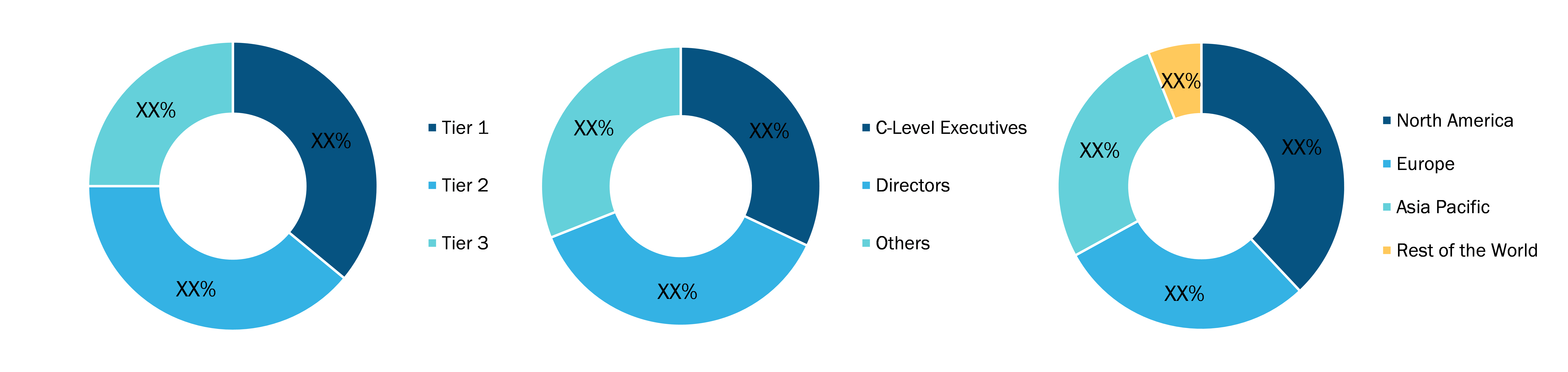
Below is the breakup of our primary respondents by company, designation, and region:
Research Methodology

Once we receive the confirmation from primary research sources or primary respondents, we finalize the base year market estimation and forecast the data as per the macroeconomic and microeconomic factors assessed during data collection.

  1. Data Analysis:

Once data is validated through both secondary as well as primary respondents, we finalize the market estimations by hypothesis formulation and factor analysis at regional and country level.

  • 3.1 Macro-Economic Factor Analysis:

We analyse macroeconomic indicators such the gross domestic product (GDP), increase in the demand for goods and services across industries, technological advancement, regional economic growth, governmental policies, the influence of COVID-19, PEST analysis, and other aspects. This analysis aids in setting benchmarks for various nations/regions and approximating market splits. Additionally, the general trend of the aforementioned components aid in determining the market's development possibilities.

  • 3.2 Country Level Data:

Various factors that are especially aligned to the country are taken into account to determine the market size for a certain area and country, including the presence of vendors, such as headquarters and offices, the country's GDP, demand patterns, and industry growth. To comprehend the market dynamics for the nation, a number of growth variables, inhibitors, application areas, and current market trends are researched. The aforementioned elements aid in determining the country's overall market's growth potential.

  • 3.3 Company Profile:

The “Table of Contents” is formulated by listing and analyzing more than 25 - 30 companies operating in the market ecosystem across geographies. However, we profile only 10 companies as a standard practice in our syndicate reports. These 10 companies comprise leading, emerging, and regional players. Nonetheless, our analysis is not restricted to the 10 listed companies, we also analyze other companies present in the market to develop a holistic view and understand the prevailing trends. The “Company Profiles” section in the report covers key facts, business description, products & services, financial information, SWOT analysis, and key developments. The financial information presented is extracted from the annual reports and official documents of the publicly listed companies. Upon collecting the information for the sections of respective companies, we verify them via various primary sources and then compile the data in respective company profiles. The company level information helps us in deriving the base number as well as in forecasting the market size.

  • 3.4 Developing Base Number:

Aggregation of sales statistics (2020-2022) and macro-economic factor, and other secondary and primary research insights are utilized to arrive at base number and related market shares for 2022. The data gaps are identified in this step and relevant market data is analyzed, collected from paid primary interviews or databases. On finalizing the base year market size, forecasts are developed on the basis of macro-economic, industry and market growth factors and company level analysis.

  1. Data Triangulation and Final Review:

The market findings and base year market size calculations are validated from supply as well as demand side. Demand side validations are based on macro-economic factor analysis and benchmarks for respective regions and countries. In case of supply side validations, revenues of major companies are estimated (in case not available) based on industry benchmark, approximate number of employees, product portfolio, and primary interviews revenues are gathered. Further revenue from target product/service segment is assessed to avoid overshooting of market statistics. In case of heavy deviations between supply and demand side values, all thes steps are repeated to achieve synchronization.

We follow an iterative model, wherein we share our research findings with Subject Matter Experts (SME’s) and Key Opinion Leaders (KOLs) until consensus view of the market is not formulated – this model negates any drastic deviation in the opinions of experts. Only validated and universally acceptable research findings are quoted in our reports.

We have important check points that we use to validate our research findings – which we call – data triangulation, where we validate the information, we generate from secondary sources with primary interviews and then we re-validate with our internal data bases and Subject matter experts. This comprehensive model enables us to deliver high quality, reliable data in shortest possible time.

Please use your business email for quicker response
Your data will never be shared with third parties, however, we may send you information from time to time about our products that may be of interest to you. By submitting your details, you agree to be contacted by us. You may contact us at any time to opt-out.