The global Teeth Whitening Kits market size is projected to reach US$ 14.43 billion by 2034 from US$ 8.05 billion in 2025. The market is anticipated to register a CAGR of 6.7% during the forecast period 2026–2034. Key market dynamics include easy at-home access, social media-amplified aesthetic demand, and broader OTC availability relative to clinical procedures. However, misleading claims and potential sensitivity or adverse events remain headwinds. Additionally, the market is expected to benefit from the surging influence of social media-driven beauty standards, the rapid expansion of organized retail and e‑commerce channels across emerging economies, and the growing inclusion of advanced whitening technologies, such as LED‑accelerated systems and peroxide‑alternative formulations, within premium at‑home oral care portfolios. These factors collectively strengthen consumer adoption and broaden the appeal of whitening kits beyond traditional cosmetic users.
Teeth Whitening Kits Market AnalysisThe teeth‑whitening kits market is increasingly consolidating around a three‑pillar value equation: efficacy, convenience, and safety. Both established players and DTC disruptors are carving differentiation through LED‑accelerated systems, evolving peroxide and PAP(+)-based formulations, and enhanced sensitivity‑management technologies such as potassium nitrate, hydroxyapatite, and ACP. From a strategic perspective, winning brands tend to excel in three aspects: Digitally engineered consumer journeys that guide users seamlessly from discovery to purchase, leveraging influencers, targeted performance media, and conversion‑optimized DTC funnels. Portfolio architecture that ladders consumers upward—from everyday brightening toothpastes into higher‑value strips, LED kits, and dentist‑dispensed take‑home gels—maximizing lifetime value while meeting diverse whitening intensities. Claims underpinned by robust clinical substantiation, which is becoming essential as advertising scrutiny intensifies across paid social, retail media, and regulatory bodies.
For companies exploring market entry or expansion, promising pathways include co‑creating dentist‑guided take‑home services that blend clinical trust with at‑home convenience, forming big‑box retail partnerships for seasonal demand spikes, and localizing claims to navigate regional peroxide caps, ingredient restrictions, and labeling standards.
Brands are anticipated to heighten attention from NAD/FTC on whitening efficacy, “X‑shades whiter” claims, and “sensitivity‑free” positioning. Proactively investing in rigorous clinical protocols, claim‑mapping, and risk‑mitigation frameworks can be critical to sustaining competitiveness as the category matures.
Teeth Whitening Kits Market OverviewTeeth whitening has normalized from a clinic-driven, episodic service to an everyday self-care ritual supported by OTC kits, strips, pens, LED trays, and dentist-dispensed take-home gels. Category growth correlates with rising oral-care literacy, social image platforms, and omnichannel retail. Broadly, hydrogen peroxide and carbamide peroxide remain mainstream actives, while PAP/PAP+ and color‑correcting adjuncts are carving a gentler‑positioned niche. Established CPGs scale through ADA-accepted SKUs and nationwide distribution; dental OEMs extend professional take-home systems (e.g., custom trays shipped direct) to bridge the clinic and home. Overall momentum is strongest where convenience, sensitivity management, and credible efficacy intersect. For instance, the market in the US benefits from high retail penetration, strong dentist influence on brand trust, and vibrant DTC challengers. Big‑box promotions and influencer content accelerate trial. At the same time, scrutiny of advertising claims nudges brands toward clearer labeling, sensitivity-aware formulas, and dentist-guided at-home programs to complement in-office whitening.
Strategic InsightsTeeth Whitening Kits Market Drivers and OpportunitiesMarket Drivers:
- At‑Home Accessibility and Omnichannel Reach: OTC kits are widely available across mass retail and e-commerce, offering lower-cost, convenient alternatives to in-office whitening with rapid, visible outcomes, key to repeat purchase and regimen "laddering" from toothpaste to strips and LED kits.
- Technology-Enabled Efficacy & Sensitivity Management: Integration of LED light accelerators, enamel-safe peroxide ranges, and remineralizing or desensitizing co-ingredients (e.g., hydroxyapatite, potassium nitrate) has improved perceived efficacy while addressing sensitivity, a primary barrier to adoption. Dental brands are also enabling custom tray and gel fulfillment from the clinic to the home.
- Aesthetic Culture & Social Validation: Influencer ecosystems and retailer reviews amplify whitening outcomes and speed claims, reinforcing the category's role in everyday beauty and confidence routines and driving new-user trial across demographics.
Market Opportunities:
- Dentist-Guided Take-Home Models: Partnership models where dentists capture intraoral scans and vendors ship trays/gels directly to patients reduce clinic overhead and expand recurring revenue, while elevating trust and compliance, an opening for B2B2C platforms and hybrid kits.
- Sensitive & Peroxide‑Alternative Portfolios: Demand for gentler, low-sensitivity or peroxide-free (e.g., PAP+) solutions remains elevated, particularly for frequent users and younger cohorts. Brands that pair robust substantiation with clear usage guidance can win share and avoid corrective advertising actions.
- Big‑Box & Seasonal Exclusives: Retail club-channel exclusives and holiday programs drive sharp unit velocity and new-user acquisition; partners that bundle LED devices and advanced gels at accessible price points can scale quickly.
The Teeth Whitening Kits Market share is analyzed across various segments to provide a clearer understanding of its structure, growth potential, and emerging trends. Below is the standard segmentation approach used in most industry reports:
By Product Type:
- Whitening Toothpaste: Everyday stain management that often seeds trial for higher-efficacy kits; frequently ADA‑accepted in select SKUs and positioned for enamel safety.
- Whitening Gels and Strips: Core at-home whitening formats balancing speed, cost, and ease; evolving toward LED-assisted variants and PAP(+)/desensitizing formulas.
- Powders: Niche adjuncts focused on polishing/adsorption; typically used as regimen boosters rather than primary whitening engines.
- Teeth Whitening Kits Devices: LED light trays and hybrid systems that promise faster results and professional-style experiences at home; increasingly bundled with pens/serums.
By Distribution Channel:
- Supermarkets & Hypermarkets: High visibility and price-led promotions; strong for strips and entry kits.
- Convenience Stores: Impulse purchases and travel-friendly SKUs (pens/mini kits).
- Online Retail: Education-rich PDPs, subscription refills, and direct brand storytelling; accelerates launches and exclusive bundles.
By Geography:
- North America
- Europe
- Asia Pacific
- South & Central America
- Middle East & Africa
Market Report Scope
Teeth Whitening Kits Market Share Analysis by GeographyThe Asia-Pacific region for the market is expected to grow rapidly in the coming years. Emerging markets in South & Central America, the Middle East, and Africa also have many untapped opportunities for high-performance suppliers and premium oral care brands to expand.
The teeth whitening kits market continues its shift toward science-driven, at-home convenience. Growth is buoyed by online retailing, influencer adoption, and pro-grade take-home solutions. Below is a summary of market share dynamics and trends by region, following the standard format:
North America
- Market Share: A dominant and highly innovative segment supported by dense retail coverage and large CPG/dental portfolios.
- Key Drivers:
- Elevated consumer spend on performance-driven at-home kits and dentist-guided take-home programs.
- Rapid adoption of LED‑accelerated and sensitivity-aware formulations.
- Strong advertising and claims oversight are prompting substantiated efficacy and safety labeling.
- Trends: Club‑channel and seasonal exclusive kits; ADA‑accepted SKUs shaping trust; consolidation of strips and light devices into premium bundles.
Europe
- Market Share: Mature market framed by strict peroxide concentration limits and rigorous labeling norms.
- Key Drivers:
- Regulatory peroxide concentration caps, driving innovation in gentler peroxide and alternative formulations.
- High trust in dentist-guided whitening solutions, supporting professional take-home gels and custom‑tray systems as preferred premium options.
- Increased demand for sensitivity-reduced and enamel-protective whitening products, reinforcing clean labeling and substantiated claims.
- Trends: Portfolio engineering toward lower‑peroxide or alternative actives and enhanced claim substantiation, with omnichannel education to navigate restrictions.
Asia-Pacific
- Market Share: Fastest growth, amplified by beauty-forward consumers and social commerce.
- Key Drivers:
- Strong influence of social commerce, where whitening results are showcased extensively across platforms, driving rapid adoption of Teeth Whitening Kits.
- Rising aesthetic consciousness and multi-step oral beauty routines, especially in markets like South Korea, China, and Japan.
- High penetration of online marketplaces, expanding access to LED kits, strips, brightening pens, and instant color-correcting products.
- Trends: DTC acceleration via marketplaces; rising interest in peroxide‑alternative messaging and enamel‑care co-ingredients.
South & Central America
- Market Share: Emerging opportunity with growing awareness and pharmacy or e-commerce expansion.
- Key Drivers:
- Rising consumer shift toward affordable at-home whitening, encouraged by the high cost of in-clinic treatments.
- Expansion of pharmacy and e-commerce channels, improving availability of Teeth Whitening Kits, and creating room for mid-range SKUs.
- Growing interest in cosmetic oral care, supported by lifestyle trends and social media visibility.
- Trends: Pharmacy chains and marketplaces scaling entry-to-mid kits; education on safe use and sensitivity mitigation.
Middle East & Africa
- Market Share: Developing market with premium aspirations concentrated in urban hubs.
- Key Drivers:
- Demand for fast, event-driven whitening solutions, especially LED-accelerated kits popular among urban consumers.
- Growth of e-commerce and cross-border platforms, enabling access to international premium Teeth Whitening Kits.
- Increasing focus on clean, sensitivity-aware formulas, aligning with climate-driven oral-sensitivity concerns and cultural preferences.
- Trends: Growth via online specialty and clinic-linked offerings; rising appetite for LED-accelerated kits.
Competition is intensifying due to the presence of established leaders such as BRODIE & STONE, Colgate-Palmolive Company, Johnson and Johnson Services, Inc., Unilever PLC, GlaxoSmithKline plc., CCA Industries, Inc., Procter & Gamble, SUPERSMILE, and Henkel AG & COMPANY, KGAA, which also contribute to a diverse and rapidly expanding market landscape.
This competitive environment pushes vendors to differentiate through:
- Premiumization and Clinical Validation: Elevating kits with LED accelerators, dentist endorsements, and ADA-accepted SKUs; publishing clinicals for sensitivity and shade‑shift performance.
- Portfolio Diversification: Moving beyond strips to include pens, dissolving strips, color‑correctors, and professional take-home trays/gels shipped direct.
- Vertical Integration and Ethical Sourcing: Tightening supply, substantiation, and claims governance to withstand NAD/FTC scrutiny, while improving transparency on ingredients and safety.
- Advanced Delivery Technologies: Blue/LED light devices, rechargeable trays, and gel innovations for faster whitening with lower sensitivity.
- Partner with Retail & Pro Channels: Combine big‑box exclusives and dentist-guided take-home services for reach + credibility; time launches to seasonal peaks.
- Invest in Substantiation & Compliance: Pre-clear sensitivity and "instant" claims; standardize shade assessment and advertise clear, region-compliant instructions to reduce regulatory risk.
- BRODIE & STONE
- Colgate-Palmolive Company
- Johnson and Johnson Services, Inc.
- Unilever PLC
- GlaxoSmithKline plc.
- CCA Industries, Inc.
- Proctor & Gamble
- SUPERSMILE
- Henkel AG & COMPANY, KGAA
- Church & Dwight, Inc.
Disclaimer: The companies listed above are not ranked in any particular order.
Teeth Whitening Kits Market News and Recent Developments- In April 2025, Philips introduced the latest iteration of its take-home Teeth Whitening Kits solution, Philips Zoom, which allowed dental professionals to ship Zoom DayWhite or NiteWhite whitening gels and custom trays directly to patients' homes through an easy three-step process. Dental professionals captured patients' intraoral scans in the office, uploaded them to the Philips lab, and made-to-order custom trays were then shipped directly to patients' homes.
- In November 2024, SNOW® Oral Care announced the launch of its award-winning Teeth Whitening Kits at 100 Costco locations across the US and on Costco.com, starting November 10, just in time for the holiday season. This exclusive offering was made available to Costco members at a special holiday price of $49, reduced from the original $149, making SNOW's high-performance whitening technology more affordable and accessible than ever before for consumers looking to enhance their smile or gift a dazzling whitening solution.
The Teeth Whitening Kits Market Size and Forecast (2021–2034) report provides a detailed analysis of the market covering below areas:
- Teeth Whitening Kits Market size and forecast at global, regional, and country levels for all the key market segments covered under the scope
- Teeth Whitening Kits Market trends, as well as market dynamics such as drivers, restraints, and key opportunities
- Detailed PEST and SWOT analysis
- Teeth Whitening Kits Market analysis covering key market trends, global and regional framework, major players, regulations, and recent market developments
- Industry landscape and competition analysis covering market concentration, heat map analysis, prominent players, and recent developments in the Teeth Whitening Kits Market.
- Detailed company profiles
Have a question?
Shejal
Shejal will walk you through a 15-minute call to present the report’s content and answer all queries if you have any.
Speak to Analyst
- Sample PDF showcases the content structure and the nature of the information with qualitative and quantitative analysis.
- Request discounts available for Start-Ups & Universities
- Sample PDF showcases the content structure and the nature of the information with qualitative and quantitative analysis.
- Request discounts available for Start-Ups & Universities
Report Coverage
Revenue forecast, Company Analysis, Industry landscape, Growth factors, and Trends

Segment Covered
Product Type, and Distribution Channel

Regional Scope
North America, Europe, Asia Pacific, Middle East & Africa, South & Central America

Country Scope
Argentina, Australia, Brazil, Canada, China, France, Germany, India, Italy, Japan, Mexico, RoSCAM, Saudi Arabia, South Africa, South Korea, Spain, United Arab Emirates, United Kingdom, United States
Frequently Asked Questions
Asia-Pacific is broadly cited as the fastest-growing region in global whitening, underpinned by beauty-centric consumers and digital retail expansion.
Key players include BRODIE & STONE, Colgate-Palmolive Company, Johnson and Johnson Services, Inc., Unilever PLC, GlaxoSmithKline plc., CCA Industries, Inc., Procter & Gamble, SUPERSMILE, and Henkel AG & COMPANY, KGAA.
Key challenges include claim substantiation amid NAD/FTC scrutiny, managing sensitivity and usage safety, and regulatory heterogeneity (e.g., peroxide caps, labeling) that complicates global SKU standardization.
North America emphasizes LED-assisted kits and ADA-accepted claims; Europe calibrates to peroxide limits and compliant labeling; Asia?Pacific scales fastest via social commerce and kit adoption; dentist-guided take-home programs are rising across markets.
The market is expected to reach approximately US$ 14.43 billion by 2034 from US$ 8.05 billion in 2025. The market is anticipated to register a CAGR of 6.7%.
Yes! We provide a free sample of the report, which includes Report Scope (Table of Contents), report structure, and selected insights to help you assess the value of the full report. Please click on the "Download Sample" button or contact us to receive your copy.
Absolutely - analyst assistance is part of the package. You can connect with our analyst post-purchase to clarify report insights, methodology or discuss how the findings apply to your business needs.
Once your order is successfully placed, you will receive a confirmation email along with your invoice.
• For published reports: You'll receive access to the report within 4-6 working hours via a secured email sent to your email.
• For upcoming reports: Your order will be recorded as a pre-booking. Our team will share the estimated release date and keep you informed of any updates. As soon as the report is published, it will be delivered to your registered email.
We offer customization options to align the report with your specific objectives. Whether you need deeper insights into a particular region, industry segment, competitor analysis, or data cut, our research team can tailor the report accordingly. Please share your requirements with us, and we'll be happy to provide a customized proposal or scope.
The report is available in either PDF format or as an Excel dataset, depending on the license you choose.
The PDF version provides the full analysis and visuals in a ready-to-read format. The Excel dataset includes all underlying data tables for easy manipulation and further analysis.
Please review the license options at checkout or contact us to confirm which formats are included with your purchase.
Our payment process is fully secure and PCI-DSS compliant.
We use trusted and encrypted payment gateways to ensure that all transactions are protected with industry-standard SSL encryption. Your payment details are never stored on our servers and are handled securely by certified third-party processors.
You can make your purchase with confidence, knowing your personal and financial information is safe with us.
Yes, we do offer special pricing for bulk purchases.
If you're interested in purchasing multiple reports, we're happy to provide a customized bundle offer or volume-based discount tailored to your needs. Please contact our sales team with the list of reports you're considering, and we'll share a personalized quote.
Yes, absolutely.
Our team is available to help you make an informed decision. Whether you have questions about the report's scope, methodology, customization options, or which license suits you best, we're here to assist. Please reach out to us at sales@theinsightpartners.com, and one of our representatives will get in touch promptly.
Yes, a billing invoice will be automatically generated and sent to your registered email upon successful completion of your purchase.
If you need the invoice in a specific format or require additional details (such as company name, GST, or VAT information), feel free to contact us, and we'll be happy to assist.
Yes, certainly.
If you encounter any difficulties accessing or receiving your report, our support team is ready to assist you. Simply reach out to us via email or live chat with your order information, and we'll ensure the issue is resolved quickly so you can access your report without interruption.
The Insight Partners performs research in 4 major stages: Data Collection & Secondary Research, Primary Research, Data Analysis and Data Triangulation & Final Review.
- Data Collection and Secondary Research:
As a market research and consulting firm operating from a decade, we have published many reports and advised several clients across the globe. First step for any study will start with an assessment of currently available data and insights from existing reports. Further, historical and current market information is collected from Investor Presentations, Annual Reports, SEC Filings, etc., and other information related to company’s performance and market positioning are gathered from Paid Databases (Factiva, Hoovers, and Reuters) and various other publications available in public domain.
Several associations trade associates, technical forums, institutes, societies and organizations are accessed to gain technical as well as market related insights through their publications such as research papers, blogs and press releases related to the studies are referred to get cues about the market. Further, white papers, journals, magazines, and other news articles published in the last 3 years are scrutinized and analyzed to understand the current market trends.
- Primary Research:
The primarily interview analysis comprise of data obtained from industry participants interview and answers to survey questions gathered by in-house primary team.
For primary research, interviews are conducted with industry experts/CEOs/Marketing Managers/Sales Managers/VPs/Subject Matter Experts from both demand and supply side to get a 360-degree view of the market. The primary team conducts several interviews based on the complexity of the markets to understand the various market trends and dynamics which makes research more credible and precise.
A typical research interview fulfils the following functions:
- Provides first-hand information on the market size, market trends, growth trends, competitive landscape, and outlook
- Validates and strengthens in-house secondary research findings
- Develops the analysis team’s expertise and market understanding
Primary research involves email interactions and telephone interviews for each market, category, segment, and sub-segment across geographies. The participants who typically take part in such a process include, but are not limited to:
- Industry participants: VPs, business development managers, market intelligence managers and national sales managers
- Outside experts: Valuation experts, research analysts and key opinion leaders specializing in the electronics and semiconductor industry.
Below is the breakup of our primary respondents by company, designation, and region:
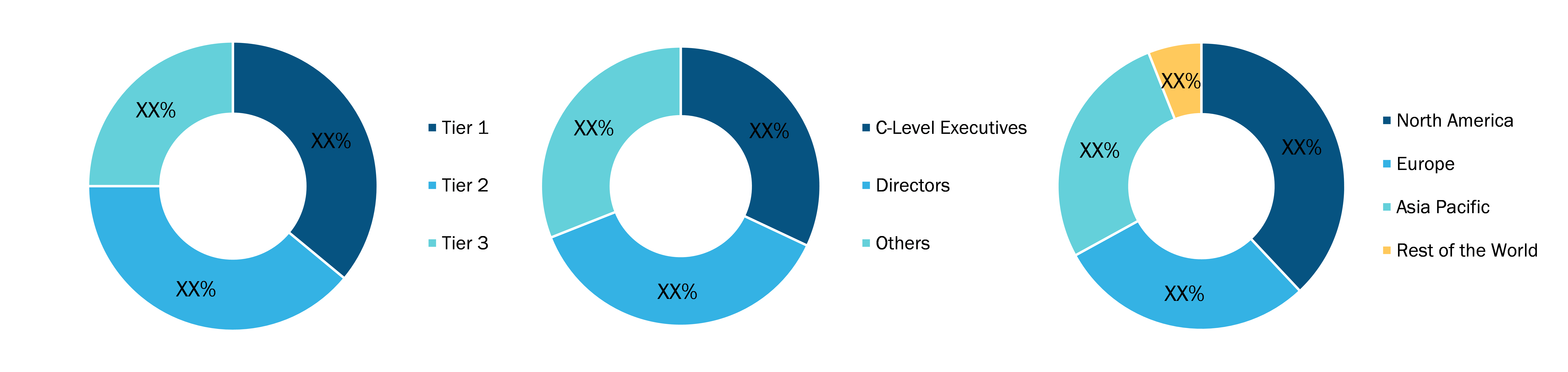
Once we receive the confirmation from primary research sources or primary respondents, we finalize the base year market estimation and forecast the data as per the macroeconomic and microeconomic factors assessed during data collection.
- Data Analysis:
Once data is validated through both secondary as well as primary respondents, we finalize the market estimations by hypothesis formulation and factor analysis at regional and country level.
- 3.1 Macro-Economic Factor Analysis:
We analyse macroeconomic indicators such the gross domestic product (GDP), increase in the demand for goods and services across industries, technological advancement, regional economic growth, governmental policies, the influence of COVID-19, PEST analysis, and other aspects. This analysis aids in setting benchmarks for various nations/regions and approximating market splits. Additionally, the general trend of the aforementioned components aid in determining the market's development possibilities.
- 3.2 Country Level Data:
Various factors that are especially aligned to the country are taken into account to determine the market size for a certain area and country, including the presence of vendors, such as headquarters and offices, the country's GDP, demand patterns, and industry growth. To comprehend the market dynamics for the nation, a number of growth variables, inhibitors, application areas, and current market trends are researched. The aforementioned elements aid in determining the country's overall market's growth potential.
- 3.3 Company Profile:
The “Table of Contents” is formulated by listing and analyzing more than 25 - 30 companies operating in the market ecosystem across geographies. However, we profile only 10 companies as a standard practice in our syndicate reports. These 10 companies comprise leading, emerging, and regional players. Nonetheless, our analysis is not restricted to the 10 listed companies, we also analyze other companies present in the market to develop a holistic view and understand the prevailing trends. The “Company Profiles” section in the report covers key facts, business description, products & services, financial information, SWOT analysis, and key developments. The financial information presented is extracted from the annual reports and official documents of the publicly listed companies. Upon collecting the information for the sections of respective companies, we verify them via various primary sources and then compile the data in respective company profiles. The company level information helps us in deriving the base number as well as in forecasting the market size.
- 3.4 Developing Base Number:
Aggregation of sales statistics (2020-2022) and macro-economic factor, and other secondary and primary research insights are utilized to arrive at base number and related market shares for 2022. The data gaps are identified in this step and relevant market data is analyzed, collected from paid primary interviews or databases. On finalizing the base year market size, forecasts are developed on the basis of macro-economic, industry and market growth factors and company level analysis.
- Data Triangulation and Final Review:
The market findings and base year market size calculations are validated from supply as well as demand side. Demand side validations are based on macro-economic factor analysis and benchmarks for respective regions and countries. In case of supply side validations, revenues of major companies are estimated (in case not available) based on industry benchmark, approximate number of employees, product portfolio, and primary interviews revenues are gathered. Further revenue from target product/service segment is assessed to avoid overshooting of market statistics. In case of heavy deviations between supply and demand side values, all thes steps are repeated to achieve synchronization.
We follow an iterative model, wherein we share our research findings with Subject Matter Experts (SME’s) and Key Opinion Leaders (KOLs) until consensus view of the market is not formulated – this model negates any drastic deviation in the opinions of experts. Only validated and universally acceptable research findings are quoted in our reports.
We have important check points that we use to validate our research findings – which we call – data triangulation, where we validate the information, we generate from secondary sources with primary interviews and then we re-validate with our internal data bases and Subject matter experts. This comprehensive model enables us to deliver high quality, reliable data in shortest possible time.

Get Free Sample For