
Roll-to-Roll Technologies for Flexible Devices Market Share, Growth & Forecast by 2034
Coverage: by Mechanism (Gravure, Flatbed and Rotary Screen Printing, Imprint Lithography, Flexographic Printing, Laser Photo Ablation, Offset Printing, Inkjet Printing); Application (Automotive, Energy, Consumer Electronics, Healthcare); Type (Circuit Devices, Optoelectronic Devices, Photovoltaic Devices, Sensors And Other Devices) , and Geography (North America, Europe, Asia Pacific, and South and Central America)
- Status : Data Released
- Report Code : TIPRE00004028
- Category : Electronics and Semiconductor
- No. of Pages : 150
- Available Report Formats :


- Last update date : September 07, 2026


2025 Market Size
US$ 46.18 Bn
Base year value
2034 Forecast
US$ 63.92 Bn
Projected by 2034
CAGR 2026-2034
4.15 %
Growth rate
Addressable Market
US$ 512.13 Bn
(2026-2034)
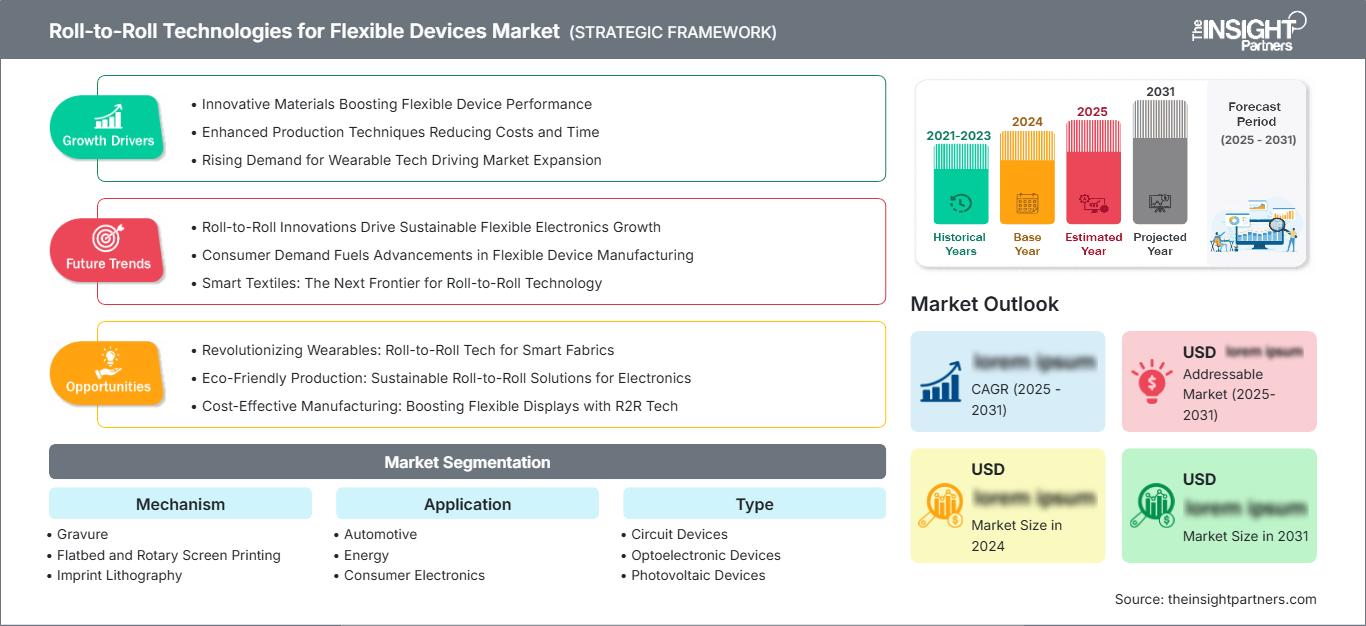
The roll-to-roll technologies for flexible devices market is valued at US$ 46.18 Billion in 2025 and is projected to reach US$ 63.92 Billion by 2034, expanding at a CAGR of 4.15% during 2026–2034. The market encompasses continuous manufacturing approaches that process flexible substrates through printing, patterning, coating, and related operations for electronic, optoelectronic, photovoltaic, and sensing devices.
North America is expected to maintain a structurally important position, supported by investment in advanced electronics, aerospace photovoltaics, flexible sensors, and domestic semiconductor supply chains. The regional market is estimated to expand at a 4.40–5.00% CAGR between 2026 and 2034, with demand benefiting from localized manufacturing, technology development, and adoption of lightweight electronic architectures, contributing to the growth of the Roll-to-Roll Technologies for Flexible Devices Market Size.
Roll-to-Roll Technologies for Flexible Devices Market Assessment and Insights
- North America: North America is estimated to represent 25–29% share in 2025 and is projected to grow at a 4.40–5.00% CAGR between 2026–2034, supported by flexible electronics R&D, aerospace applications, and advanced manufacturing investment.
- US: The US accounts for approximately 72–76% of North America's 2025 share and is expected to expand at a 4.50–5.10% CAGR between 2026–2034, driven by flexible sensors, thin-film photovoltaics, and electronics localization.
- Europe: Europe is estimated at 21–25% share in 2025, growing at 3.90–4.60% CAGR between 2026–2034, with Germany, the UK, France, Italy, and the Netherlands supporting automotive electronics, industrial sensing, and sustainable manufacturing.
- Asia Pacific: Asia Pacific holds approximately 43–47% share in 2025 and is forecast to grow at a 4.70–5.30% CAGR between 2026–2034, led by China, Japan, South Korea, Taiwan, and India across electronics and photovoltaic manufacturing.
- Largest Segment: Consumer Electronics is the leading application, while its associated production ecosystem represents an estimated 32–36% market share in 2025, expanding at a 4.60–5.20% CAGR during 2026–2034.
- High Growth Segment: Photovoltaic Devices represent approximately 22–26% market share in 2025 and are expected to grow at a 5.20–6.00% CAGR during 2026–2034, supported by lightweight and conformable solar architectures.
- Key companies analyzed in detail: Ascent Solar Technologies, Inc.; E Ink Holdings Inc.; Emfit Ltd.; Flexium Interconnect, Inc.; Fujikura Ltd.; GSI Technology, Inc.; Johnson Electric Holdings Limited; Materion Corporation; NIPPON MEKTRON, LTD.; Sumitomo Electric Industries, Ltd.
Source: The Insight Partners' analysis based on proprietary research, government publications, company annual reports, investor presentations, industry databases, and expert interviews.
Continuous web manufacturing has moved from traditional printed circuit manufacturing to multilayer functional manufacturing with the use of conductive inks, dielectrics, semiconductors, and transparent conductors. Better registration, web tension control, drying techniques, laser patterning, and ink formulations enable fine lines and multilayers to be achieved. Screen printing is technically important, but inkjet, gravure, flexography, laser, and imprint processes cater for resolution and other issues.
Over the forecast period, commercialization is expected to broaden beyond established flexible circuits and displays toward sensors, photovoltaic modules, healthcare interfaces, and lightweight automotive electronics, according to the Roll-to-Roll Technologies for Flexible Devices Market Report. Investment will increasingly prioritize production repeatability, sustainable materials, inline inspection, and integration with conventional semiconductor processes. Government-backed electronics manufacturing initiatives in Asia and North America should also strengthen regional supply chains and encourage localized capacity.
Roll-to-Roll Technologies for Flexible Devices Market Report Scope
| Report Attribute | Details |
|---|---|
| Market size in 2025 | US$ 46.18 Billion |
| Market Size by 2034 | US$ 63.92 Billion |
| Global CAGR (2026 - 2034) | 4.15% |
| Historical Data | 2021-2024 |
| Forecast period | 2026-2034 |
Roll-to-Roll Technologies for Flexible Devices Market Analysis
Demand is being shaped by the need for lighter, thinner, conformable, and increasingly integrated electronic products. The roll-to-roll technologies for flexible devices market growth is closely linked to the ability of continuous processing to reduce handling steps and improve substrate utilization. Material suppliers, equipment manufacturers, ink developers, device designers, converters, and electronics assemblers form an interconnected value chain in which yield, registration accuracy, drying performance, and substrate compatibility determine commercial viability.
According to the Roll-to-Roll Technologies for Flexible Devices Market, supply dynamics vary significantly by device class. Printed Flexible Circuits benefit from relatively developed manufacturing ecosystems, but printed sensors, photovoltaics, and optoelectronics necessitate a higher degree of control and qualification. Gravure, flexographic, and screen printing approaches tend to be better suited for high volume production, while digitally controlled ink jet and laser methods offer more flexibility. The combination of the two methods enables companies to choose their manufacturing architectures based on resolution, throughput, substrate, and customizability criteria.
Vertical integration and specific material qualifications are becoming increasingly important for competitive advantage rather than equipment alone. Ascent Solar Technologies, Inc. specializes in thin-film photovoltaics, while E Ink Holdings Inc. works in the area of flexible displays. Fujikura Ltd., Flexium Interconnect, Inc., and NIPPON MEKTRON, LTD. have competencies that are useful for flexible circuit architectures, while Sumitomo Electric Industries, Ltd. and Johnson Electric Holdings Limited expand the exposure to electronic and electromechanical components.
Roll-to-Roll Technologies for Flexible Devices Market Trends indicate that investment is increasingly moving toward process reliability, materials engineering, and application-specific production platforms. Materion Corporation brings materials expertise, GSI Technology, Inc. contributes semiconductor-related capabilities, and Emfit Ltd. participates in flexible sensing applications. The resulting competitive landscape is fragmented across technology layers, with strategic advantage increasingly determined by qualified materials, customer-specific process know-how, production yield, and the ability to scale prototypes into repeatable manufacturing.
● REPORT CUSTOMIZATION
Tailor This Report To Align With Your Specific Business Requirements
This report can be customized to align precisely with your business objectives, scope, and target markets. Customization options include tailored segmentation, geography, competitive analysis, and strategic insights to support informed decision-making.
Customize This Report →WHAT YOU CAN ADJUST
- ● Segmentations
- ● Geography
- ● Competitive Analysis
- ● Language Preferences
Roll-to-Roll Technologies for Flexible Devices Market: Strategic Insights
Regional Insights
North America roll-to-roll technologies for flexible devices market
North America is estimated to hold 25–29% of the roll-to-roll technologies for flexible devices market share in 2025 and is projected to record a 4.40–5.00% CAGR through 2034. The US dominates regional demand through advanced electronics research, aerospace programs, flexible photovoltaic development, medical devices, and investments supporting domestic semiconductor and electronics manufacturing. Canada contributes through printed sensors, materials research, and specialized electronics manufacturing.
Regional adoption is increasingly connected with defense, aerospace, healthcare, and automotive applications requiring lightweight and conformable components, according to the Roll-to-Roll Technologies for Flexible Devices Market Report. Thin-film photovoltaic production is particularly relevant where mass and flexibility influence system design. Universities, national laboratories, specialized materials companies, and electronics manufacturers provide an ecosystem capable of moving technologies from laboratory demonstrations toward production qualification. North American customers also place strong emphasis on reliability, traceability, and domestic supply resilience.
U.S. roll-to-roll technologies for flexible devices Market
The US represents approximately 72–76% of North America's 2025 roll-to-roll technologies for flexible devices market share and is forecast to grow at a 4.50–5.10% CAGR. Demand is supported by aerospace photovoltaics, flexible displays, printed sensors, wearable healthcare systems, and advanced automotive electronics. Domestic manufacturing initiatives reinforce interest in shorter and more resilient component supply chains.
Application trends favor devices where flexibility, low mass, or distributed sensing creates measurable system-level benefits. Ascent Solar Technologies, Inc. is relevant to thin-film photovoltaic applications, while GSI Technology, Inc. contributes semiconductor expertise. The US ecosystem also includes research organizations and specialized equipment suppliers developing high-precision web processing, laser patterning, functional inks, and inline inspection. These capabilities support gradual movement from pilot production toward higher-volume applications.
Europe roll-to-roll technologies for flexible devices Market
Europe is estimated to represent 21–25% share of the roll-to-roll technologies for flexible devices market in 2025, with a 3.90–4.60% CAGR through 2034. The leader in the region is Germany, backed by electronics, industrial automation, materials science and advanced manufacturing. The UK contributes to the market through the research of flexible electronics and healthcare-related applications, while France, Italy, and Spain add opportunities for automotive, renewable energy and industrial electronics.
The strong manufacturing sector in Germany adds to the demand for sensors, printed circuits and functional materials that are part of cars and industrial machinery. The research sector in the UK is supportive of the development of healthcare applications and printed electronics. France and Italy gain due to the application of automotive, aerospace and industrial technologies, while Spain has renewable energy and electronics manufacturing opportunities.
APAC roll-to-roll technologies for flexible devices Market
APAC is estimated to command 43–47% share of the roll-to-roll technologies for flexible devices market in 2025 and grow at a 4.70–5.30% CAGR. China is ahead in terms of regional production, with Japan and South Korea being the next leaders, with India and Australia offering further possibilities. Consumer electronics, flexible displays, photovoltaic production, and the production of printed circuits continue to be key industrial players.
Governments’ backing of electronics localization, renewable energy, and manufacturing adds to the appeal. Japan’s unique materials and components industry, South Korea’s skills in displays, China’s scale in manufacturing, India’s development in electronics, and Australia’s strength in renewable energy form differentiated demand pools. In the Asia-Pacific, volume production goes hand-in-hand with advanced use of flexible devices.
Middle East & Africa roll-to-roll technologies for flexible devices Market
The Middle East and Africa roll-to-roll technologies for flexible devices market represents a smaller but developing opportunity, supported by renewable-energy investment, infrastructure modernization, and electronics localization. Saudi Arabia and the UAE lead regional technology investment, while South Africa provides the strongest established electronics and industrial manufacturing base.
Demand is concentrated around photovoltaic devices, industrial sensors, smart infrastructure, and selected consumer electronics applications. Energy diversification programs in the Gulf can support lightweight photovoltaic technologies, while infrastructure development creates opportunities for distributed sensing. The region is expected to expand at approximately 3.60–4.30% CAGR, with Saudi Arabia representing the leading emerging market.
Segmentation Analysis
Mechanism
Mechanism determines throughput, registration, resolution, material compatibility, and production economics. The segment is projected to grow at a 4.20–5.00% CAGR during 2026–2034, as manufacturers combine established analog processes with digital and laser-based methods. Selection increasingly depends on device complexity, substrate characteristics, production volume, and required pattern resolution.
- Gravure: Supports high-throughput deposition and consistent pattern reproduction, making it strategically important for large-area conductive layers, displays, sensors, and photovoltaic structures.
- Flatbed and Rotary Screen Printing: Provides broad material compatibility and comparatively straightforward process control, supporting conductive, dielectric, and functional layers across flexible substrates.
- Imprint Lithography: Enables fine pattern replication for advanced flexible and optoelectronic structures where nanoscale features and repeatability justify higher process complexity.
- Flexographic Printing: Offers continuous high-speed processing and efficient ink transfer, supporting scalable production of functional patterns where moderate resolution and large volumes are required.
- Laser Photo Ablation: Provides digitally controlled selective material removal and high patterning precision, supporting prototyping, multilayer correction, and complex device architectures.
- Offset Printing: Uses established printing infrastructure for precise thin-layer deposition and can support applications requiring efficient material usage and repeatable pattern formation.
- Inkjet Printing: Enables maskless, digitally programmable deposition and rapid design changes, making it valuable for customized electronics, low-volume production, and functional-material development.
Application
The Roll-to-Roll Technologies for Flexible Devices Market Forecast indicates that the Application segment represents the principal demand interface between production technologies and end-use requirements. The segment is expected to expand at a 4.40–5.20% CAGR during 2026–2034 as flexible devices move into applications where conventional rigid electronics create weight, form-factor, or integration constraints. Automotive and consumer electronics remain substantial demand centers, while healthcare and energy provide differentiated growth opportunities.
- Automotive: Flexible sensors, heating elements, displays, antennas, and circuit structures support vehicle electrification, interior electronics, sensing, and space-efficient integration.
- Energy: Lightweight photovoltaic devices and flexible energy components create opportunities where conventional rigid modules are constrained by weight, geometry, or installation surfaces.
- Consumer Electronics: Foldable, wearable, flexible display, sensor, and interface architectures remain central applications because manufacturers increasingly prioritize thinness, portability, and conformability.
- Healthcare: Flexible biosensors, wearable monitoring interfaces, and skin-conforming electronics benefit from low-profile structures that maintain functionality during movement.
Type
Type defines the functional device category produced through continuous processing. The segment is projected to expand at a 4.50–5.40% CAGR during 2026–2034, with growth dependent on successful integration of printed layers with conventional electronic components and the qualification of materials for long-term reliability.
- Circuit Devices: Flexible circuits provide electrical interconnection while reducing thickness and enabling routing around constrained geometries in electronics and automotive systems.
- Optoelectronic Devices: Flexible optoelectronics support displays, light management, photodetection, and related functions where conformability and lightweight construction provide design advantages.
- Photovoltaic Devices: Thin-film and flexible photovoltaic architectures address applications requiring low mass, unconventional installation geometries, and improved portability.
- Sensors And Other Devices: Printed and flexible sensors extend electronic functionality across healthcare, automotive, industrial, and wearable applications requiring distributed or conformal detection.
Opportunity Snapshot
| Application | Revenue Contribution | Trend Tag | Adoption Stage |
| Automotive | High | Vehicle Sensors | Scaling |
| Energy | Medium | Flexible Solar | Scaling |
| Consumer Electronics | High | Foldable Devices | Mature |
| Healthcare | Medium | Wearable Sensors | Scaling |
Roll-to-Roll Technologies for Flexible Devices Market Growth Drivers and Impact Analysis
Demand for Lightweight and Conformable Electronics
Flexible materials are becoming more popular in situations where there are limits based on weight, thickness, curvature, or human comfort in relation to hard materials. Continuous processing allows manufacturers to create electronics on plastic films, metallic films, and other flexible substrates without using exclusively rigid-board technology. There are clear benefits in applications such as wearable technologies, automotive interior designs, aircrafts, medical patches, and consumer electronics that have smaller sizes. The benefit is most pronounced in situations where flexibility is part of enhancing the overall performance of a system, as opposed to simply adding an aesthetic benefit. In applications where product designers are using curved shapes and distributed electronics, those suppliers who are able to register multiple layers, ensure adhesion, and conductivity, among other things, become more commercially relevant.
Expansion of Thin-Film and Printed Photovoltaics
The application of photovoltaic cells is one means of expanding continuous flexible manufacturing due to the ability of thin film structures to be fabricated on substrates that are significantly lighter compared to traditional glass-based photovoltaic panels. Aerospace industry, portable power, building integration photovoltaics, and special energy systems could use this product form. Market acceptance would require increasing the efficiency of the process as well as the durability of these devices and their interconnections. Ascent Solar Technologies, Inc., serves as an example of the importance of lightweight thin-film photovoltaic technology for aerospace and space applications. Commercial success of the product requires establishing qualification criteria as well as the availability of the necessary materials and manufacturing process.
Localization of Advanced Electronics Manufacturing
As a consequence of disruption within semiconductor devices, display panels, printed circuit boards, and specific materials, governments and producers are giving more focus to their domestic electronics supply chains. Thus, there is a structural advantage for continuous flexible-device manufacturing due to the potential of producing locally and avoiding reliance on a dispersed international chain of production processes. Increasing investments in Asia, North America, and Europe are focusing on electronics components, advanced materials, and manufacturing processes. It does not stop at the investment in equipment but involves the need for qualified inks, substrates, tooling, inspection, and process engineering for production. Hence, the suppliers who can create a regional ecosystem have an opportunity to increase responsiveness to customers while decreasing logistics risk.
Roll-to-Roll Technologies for Flexible Devices Market Future Trends
Inline Intelligence and Closed-Loop Process Control
Future production lines are likely to include advanced machine vision, sensors, automatic registration adjustment, and closed-loop web controls. This will make it possible for manufacturers to detect defects during the production process without having to depend on subsequent inspection. Artificial intelligence can aid in anomaly classification, predictive maintenance, and process optimization for ink deposition, drying, web tension, and multilayer alignment. This is especially important as devices get thinner and multilayer registration becomes stricter. Implementation of digital control processes will enable better yield visibility and provide manufacturers with valuable process data for qualification. In the future, intelligent manufacturing solutions will play an important role as a differentiator between pilot-scale operations and competitive high-volume production environments.
Hybrid Manufacturing Across Printed and Silicon Electronics
The next step in the evolution of such electronics will likely involve hybrid approaches in which printed functional layers are combined with existing semiconductor components instead of attempting to replace silicon electronics altogether by using printed devices. Hybrid systems may allow the use of flexible processes for implementing simple interconnections, sensors, antennas, and conductors and keep silicon components where more computational power is needed. This will increase the functionality of systems without incurring the costs associated with printing all the components. Studies in printed and flexible electronics are currently focusing on integration, reliability, and sensor proximity as key areas for development. As hybrid technology evolves, companies will pay more attention to process compatibility, thermal budget, and mechanical reliability.
Roll-to-Roll Technologies for Flexible Devices Market Opportunities
Localized Production Platforms for Specialized Flexible Devices
Manufacturers of equipment and material vendors can focus on regional production platforms tailored to individual application needs and not just mass volume electronics. Each healthcare patch, aerospace photovoltaic film, automobile sensor, and industrial monitoring device needs a different substrate, ink type, and process requirements. Setting up modular production units that have the capabilities of printing, coating, laser processing, curing, inspecting, and rewinding can cut down on the time needed to go from prototype production to actual manufacturing. Investors can also look at vendors of material and process recipes since such processes are tough to duplicate by competitors.
Advanced Materials and Sustainable Functional Inks
Another potential investment approach would be through material innovations since process economy and performance is strongly dependent on conductive inks, dielectrics, semiconducting layers, transparent conductors, and the suitability of substrate materials. Lower temperature curing solutions by suppliers will help widen the variety of polymer substrates used in manufacturing processes, whereas solutions that reduce solvents and can be recycled will help meet environmental criteria. Increasing emphasis is being placed on the ecological sustainability of materials along with performance and scalability in research circles. Commercial possibilities are not only limited to traditional silver ink but also include other materials like copper, carbon, nanomaterials, and other function-material-based solutions.
Frequently Asked Questions

- Comprehensive Market Sizing and Forecast Analysis
- Detailed Segmentation Analysis
- In-Depth Market Dynamics Assessment
- Regional and Country-Level Insights
- Competitive Landscape and Company Benchmarking
- Strategic Business Intelligence
Recent Reports
Testimonials

The Insight Partners' SCADA System Market report is comprehensive, with valuable insights on current trends and future forecasts. The team was highly professional, responsive, and supportive throughout. We are very satisfied and highly recommend their services.
RAN KEDEM Partner, Reali Technologies LTDs
I requested a report on a very specific software market and the team produced the report in a few days. The information was very relevant and well presented. I then requested some changes and additions to the report. The team was again very responsive and I got the final report in less than a week.
JEAN-HERVE JENN Chairman, Future Analytica
We worked with The Insight Partners for an important market study and forecast. They gave us clear insights into opportunities and risks, which helped shape our plans. Their research was easy to use and based on solid data. It helped us make smart, confident decisions. We highly recommend them.
PIYUSH NAGPAL Sr. Vice President, High Beam Global
The Insight Partners delivered insightful, well-structured market research with strong domain expertise. Their team was professional and responsive throughout. The user-friendly website made accessing industry reports seamless. We highly recommend them for reliable, high-quality research services
YUKIHIKO ADACHI CEO, Deep Blue, LLC.
This is the first time I have purchased a market report from The Insight Partners.While I was unsure at first, I visited their web site and felt more comfortable to take the risk and purchase a market report.I am completely satisfied with the quality of the report and customer service. I had several questions and comments with the initial report, but after a couple of dialogs over email with their analyst I believe I have a report that I can use as input to our strategic planning process.Thank you so much for taking the extra time and making this a positive experience.I will definitely recommend your service to others and you will be my first call when we need further market data.
JOHN SUZUKI President and Chief Executive Officer, Board Director, BK Technologies
I wish to appreciate your support and the professionalism you displayed in the course of attending to my request for information regarding to infectious disease IVD market in Nigeria. I appreciate your patience, your guidance, and the fact that you were willing to offer a discount, which eventually made it possible for us to close a deal. I look forward to engaging The Insight Partners in the future, all thanks to the impression you have created in me as a result of this first encounter.
DR CHIJIOKE ONYIA MANAGING DIRECTOR, PineCrest Healthcare Ltd.Reason to Buy
- Informed Decision-Making
- Understanding Market Dynamics
- Competitive Analysis
- Identifying Emerging Markets
- Customer Insights
- Market Forecasts
- Risk Mitigation
- Boosting Operational Efficiency
- Strategic Planning
- Investment Justification
- Tracking Industry Innovations
- Aligning with Regulatory Trends





 Get Free Sample for