
Rotary Wing Air Ambulance Services Market Size, Growth & Trends by 2034
Coverage: By Service Model (Hospital-Based, Government Run, and Independent), End User (Domestic and International), and Geography (North America, Europe, Asia Pacific, Middle East and Africa, and South and Central America)
- Status : Published
- Report Code : TIPRE00043065
- Category : Aerospace and Defense
- No. of Pages : 217
- Available Report Formats :


- Last update date : March 26, 2026


2025 Market Size
US$ 7.46 Bn
Base year value
2034 Forecast
US$ 17.7 Bn
Projected by 2034
CAGR 2026-2034
10.3 %
Growth rate
Addressable Market
US$ 113.16 Bn
(2026-2034)
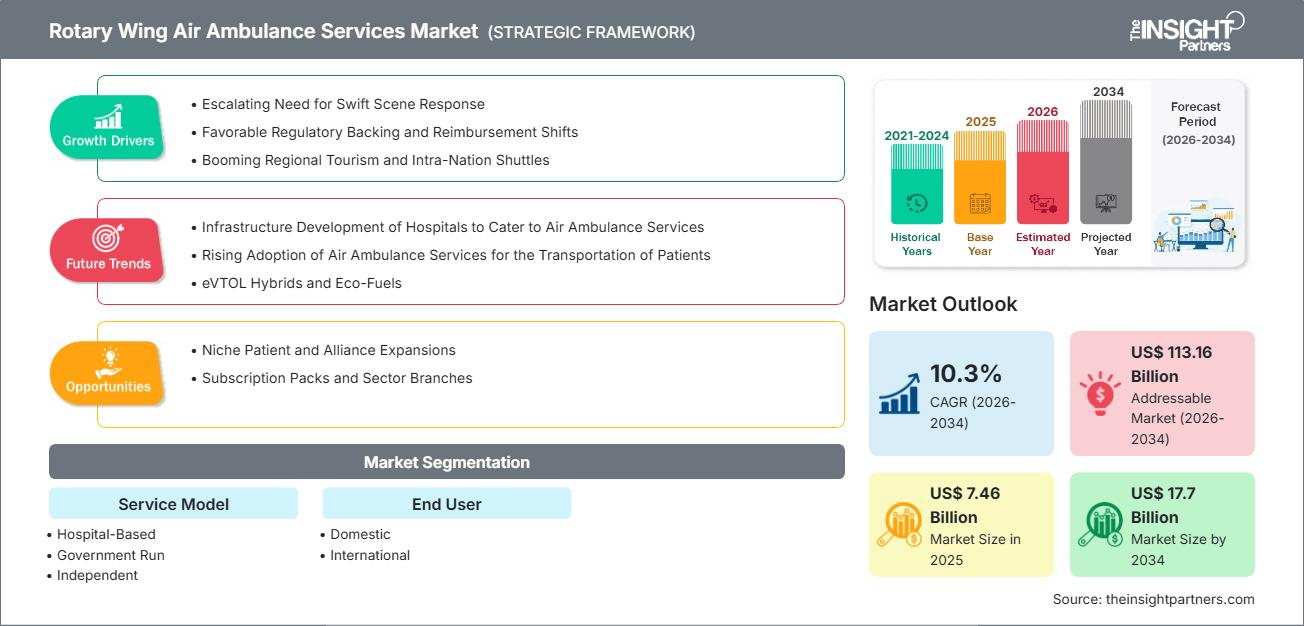
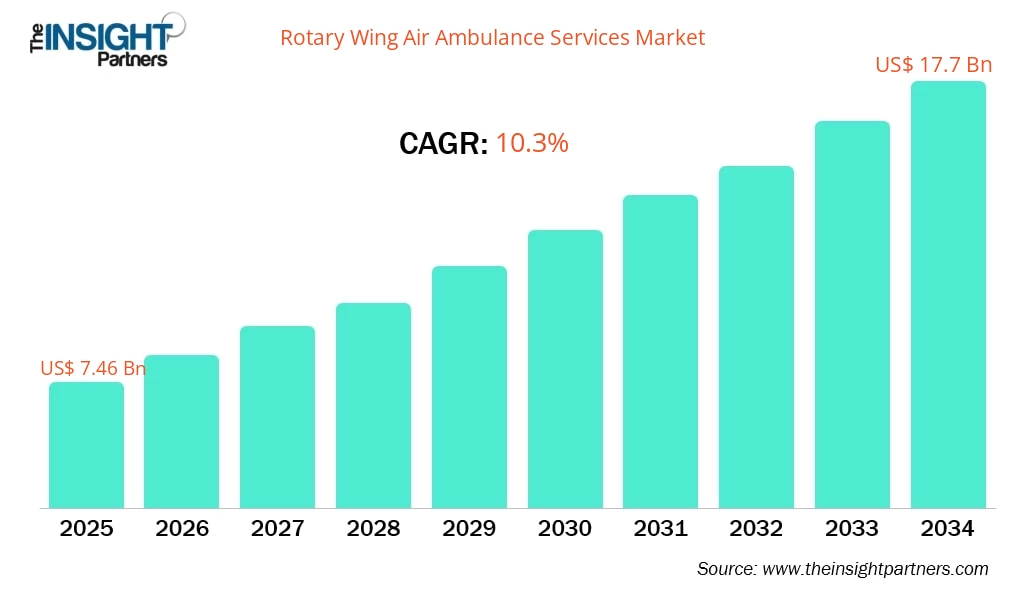
The rotary wing air ambulance services market size is expected to reach US$ 17.70 billion by 2034 from US$ 7.46 billion in 2025. The market is anticipated to register a CAGR of 10.3% during 2026–2034
Rotary Wing Air Ambulance Services Market Analysis
The global rotary wing air ambulance services market is witnessing a rapid growth phase owing to immediate demand for fast scene response in urban and remote emergencies, a rising number of trauma cases, an expanding emergency medical services (EMS) infrastructure, and enhanced short-range critical care transport capabilities. Due to their ability to take off/land vertically, helicopters have a significant time-saving advantage over fixed-wing aircraft when it comes to time, critical interventions. Telemedicine onboard and the provision of advanced life support make it possible to treat during the flight cardiac arrests, strokes, and polytrauma patients.
Rotary Wing Air Ambulance Services Market Overview
Rotary wing air ambulances are great at reaching accident scenes, rooftops, highways, and even tight rural locations that are not accessible by vehicles with wheels or fixed-wing aircraft. They provide ICU-level care during transport for short to medium distances. They have ventilators, intra-aortic balloon pumps, blood transfusion kits, and the ability to send real-time telemetry to trauma centers. Thus, the crew can perform resuscitation on the spot, transport neonates, retrieve organs, carry out disaster extractions, and do interfacility handoffs. They are very useful in sparsely populated areas.
Market Research Highlights
- North America dominated the market with 40.5% share in 2025.
- Asia Pacific is poised to grow at a CAGR of 11.2% over the forecast period.
- US market is projected to grow at a CAGR of 10.7% over the forecast period.
- By Service Model, the Hospital-Based segment accounted for the largest market share of 60.9% in 2025.
- By End User, the Domestic segment is anticipated to witness the fastest growth, registering a CAGR of 10.7% over the forecast period
- The report profiles key industry players such as Babcock International Group, Acadian Ambulance Service, Global Medical Response, Inc., PHI Air Medical, Ornge, Air Methods Corporation, DRF Luftrettung, Swiss Air Ambulance, REVA, Inc., Life Flight Network, while also analyzing key developments in novel ideas, disruptive products, and innovative services that could reshape the future market and reveal emerging themes across the industry.
Source: The Insight Partners' analysis based on proprietary research, government publications, company annual reports, investor presentations, industry databases, and expert interviews.
● REPORT CUSTOMIZATION
Tailor This Report To Align With Your Specific Business Requirements
This report can be customized to align precisely with your business objectives, scope, and target markets. Customization options include tailored segmentation, geography, competitive analysis, and strategic insights to support informed decision-making.
Customize This Report →WHAT YOU CAN ADJUST
- ● Segmentations
- ● Geography
- ● Competitive Analysis
- ● Language Preferences
Rotary Wing Air Ambulance Services Market: Strategic Insights
-
Get Top Key Market Trends of this report.This FREE sample will include data analysis, ranging from market trends to estimates and forecasts.
Rotary Wing Air Ambulance Services Market Drivers and Opportunities
Market Drivers:
- Rising Demand for Scene Response and Urban Emergencies: Continuous increase in road accidents, urban violence, and mass casualty incidents requires helicopters' rapid hover and extract capabilities, especially in dense cities and isolated areas.
- Supportive Regulatory Frameworks and EMS Integration: FAA/EASA certifications, government subsidies for rural coverage, and insurance reimbursements increase the viability of services in the face of mounting healthcare access requirements.
- Aging Populations and Time-Critical Conditions: A rise in stroke/heart attack cases among elderly people calls for immediate air evacuation to stroke centers, increasing short-haul rotary missions.
Market Opportunities:
- Technological Advancements and Fleet Modernization: Adoption of eVTOL, autonomous navigation, and AI-driven dispatch systems opens doors for faster, safer operations, reducing response times in congested airspace and enabling 24/7 all-weather missions.
- Public-Private Partnerships and Infrastructure Expansion: Collaborations between governments, hospitals, and operators can fund new bases in underserved rural and remote regions, tapping into growing demand for equitable access amid urbanization and disaster-prone areas.
- Medical Tourism and Repatriation Services: Rising global travel boosts need for premium international patient transfers, creating revenue streams through specialized fleets equipped for long-distance critical care and cross-border coordination.
Rotary Wing Air Ambulance Services Market Report Segmentation Analysis
The rotary wing air ambulance services market is categorized into distinct segments to understand its structure, growth prospects, and emerging trends. Below is the standard segmentation approach used in industry reports:
By Service Model:
- Hospital-Based: Integrated extensions of trauma centers with dedicated crews for scene-to-OR transfers.
- Government Run: Publicly funded fleets prioritizing disaster response and rural coverage under national EMS protocols.
- Independent: Commercial operators offering charter flexibility for routine transfers and medical tourism evacuations.
By End User:
- Domestic: Intra-regional missions leveraging hover precision for urban/rural short hops under 150nm.
- International: Extended-range equipped helicopters for cross-border neonatal/organ transports with customs coordination.
By Geography:
- North America
- Europe
- Asia Pacific
- South & Central America
- Middle East & Africa
Rotary Wing Air Ambulance Services Market Report Scope
| Report Attribute | Details |
|---|---|
| Market size in 2025 | US$ 7.46 Billion |
| Market Size by 2034 | US$ 17.7 Billion |
| Global CAGR (2026 - 2034) | 10.3% |
| Historical Data | 2021-2024 |
| Forecast period | 2026-2034 |
| Segments Covered |
By Service Model
|
| Regions and Countries Covered |
North America
|
| Market leaders and key company profiles |
|
Rotary Wing Air Ambulance Services Market Players Density: Understanding Its Impact on Business Dynamics
The Rotary Wing Air Ambulance Services Market is growing rapidly, driven by increasing end-user demand due to factors such as evolving consumer preferences, technological advancements, and greater awareness of the product's benefits. As demand rises, businesses are expanding their offerings, innovating to meet consumer needs, and capitalizing on emerging trends, which further fuels market growth.
Rotary Wing Air Ambulance Services Market Share Analysis by Geography
The worldwide rotary wing air ambulance services market forecast showcases different regional trends. North America is the dominant region due to advanced EMS networks, a high number of trauma cases, and the presence of a mature operator infrastructure in the US and Canada, which together account for ~37.50% of the market. Europe is a major player with well-integrated HEMS systems and public funding. APAC is rapidly developing due to the challenges of urbanization, increasing private EMS usage, and government-supported infrastructure in China, India, and Indonesia. The MEA is an emerging market due to medical tourism and the demand for oilfield medevac. South America is witnessing high remote Amazon access and disaster response requirements. Differences in the rate of growth can be attributed to variations in healthcare spending, the nature of geographical challenges (e.g., rural isolation, urban density), the level of regulatory maturity for air medical ops, and the degree of technological adoption.
The expansion of the rotary wing air ambulance services market trends is not uniform across regions due to variations in EMS infrastructure development, trauma epidemiology, aviation regulations, and public, private healthcare integration. The following are the key highlights of the market share and trends in individual regions:
1. North America
- Market Share: Largest portion of the global market, supported by sophisticated trauma networks, high per capita healthcare expenditure (US$ 12, 500+ annually), and the leading operators such as Air Methods and PHI Air Medical.
- Key Drivers:
- Extensive geography comprises remote rural areas and large suburban districts, which need a fast scene response.
- Federal/state legislations require rural EMS coverage (e.g., HRSA grants funding US$ 100 million bases.
- Trends: Night vision goggles (NVG) are made widely available, allowing 24/7 operations. Telemedicine command centers are centralized, linking rotors to Level I trauma bays. Aggressive M&A consolidation.
2. Europe
- Market Share: A considerable market share, due to the early and strict EU regulations maintained through integrated HEMS (Helicopter Emergency Medical Services) networks that cover more than 30 countries.
- Key Drivers:
- Patient transfers across borders without passport checks in the Schengen area are allowed under EU Directive 2011/24/EU.
- The neonatal/pediatric transport segment is expanding, due to the demand for specialized isolette-equipped EC135s.
- Trends: Pilots of hybrid/electric helicopters (e.g., H135 hybrid tests); harmonization of pan-European HEMS through EASA regulations; outdoor recreational areas in the Alpine/Baltic region have been served with the addition of new bases.
3. Asia Pacific
- Market Share: Fastest-growing region with the 3rd largest market share, driven by megacity congestion and archipelago challenges.
- Key Drivers:
- Urban trauma epidemic due to more than 1.3 billion vehicles (India/China road deaths: 300K/year).
- Private EMS proliferation amid rising middle-class insurance penetration (20%+ CAGR).
- Geographic isolation (Indonesia, 17K islands, Himalayan interiors) mandates rotary access.
- Trends: Indigenous platforms such as HAL-ICATT Dhruv-NG for cost-effective ops; ASEAN cross-border protocols; new operators in Tier-2 cities (Bangalore, Jakarta).
4. Middle East and Africa
- Market Share: Minor share of the market but rapidly expanding, driven by utilities revenues and healthcare demand of expatriates.
- Key Drivers:
- Huge desert areas where single, incident long, distance SAR/medevac from offshore rigs are inevitable.
- Medical tourism centers (Dubai, Riyadh) require repatriation flights of expatriates.
- Investment of sovereign wealth in dedicated rotary fleets (e.g., Saudi Red Crescent 50+ H145s).
- Trends: Insurer, hospital alliances offering rotary coverage as a bundle. Strategic heliport networks at oilfields/airports. VIP, configured rotors for executive medevac.
5. South & Central America
- Market Share: Steadily growing market share amid infrastructural maturation.
- Key Drivers:
- The Amazon and the Andean indigenous populations (about 70 million people are underserved).
- In the event of an earthquake/flood, people will need to be quickly extracted, so the area will be vulnerable to any such natural disasters.
- Private clinics are supplementing the deficiency of EMS in the public sector.
- Trends: Multi-role Bell 429s blending medevac/firefighting; government-NGO consortia (e.g., Brazil SAMU expansions); upgraded avionics for IMC ops in tropics.
High Market Density and Competition
Competition is intense due to the presence of major global players such as DRF Luftrettung, REVA Air Ambulance, Air Methods, Global Medical Response, PHI Air Medical, CareFlight, Babcock International Group Plc, Swiss Air-Rescue Rega, Life Flight Network, and Luxembourg Air Rescue.
This high level of competition urges companies to stand out by offering:
- Enhanced Patient Safety and Security Features
- Value-Added Medical and Operational Services
- Flexible and Competitive Pricing Models
- Robust Customer Support and Medical Coordination
Opportunities and Strategic Moves
- Hospital-insurer alliances for dedicated rotors.
- Bundled ECMO/ventilator packages with follow-up care.
- Modular interiors for mission reconfiguration.
Other companies analyzed during the course of research:
- Yorkshire Air Ambulance
- CareFlight
- Ornge
- Helijet International
- Pafford EMS
- NAKANIHON AIR
- Brasil Vida Taxi Aereo.
Rotary Wing Air Ambulance Services Market News and Recent Developments
- In January 2025, Babcock signed an agreement with Scotland’s Charity Air Ambulance (SCAA) - Babcock was awarded a10-year contract by Scotland’s Charity Air Ambulance (SCAA) to continue their role as the charity’s aviation partner, providing exclusive aviation support to the charity from bases at Perth and Aberdeen International Airport, 365 days a year. Communities across Scotland trust SCAA to provide pre-hospital emergency care to those who need it most, particularly in some of the most remote and rural areas of the country. As part of the contract, they will upgrade helicopter operations and increase night flying capability as part of the charity’s longer-term strategy to extend its operating hours.
- In March 2025, Global Medical Response signed an agreement with Airbus Helicopters - Global Medical Response (GMR), and Airbus Helicopters signed an agreement for up to 15 H140 helicopters in the emergency medical services (EMS) sector. GMR is one of the launch customers for the new H140 helicopter that was unveiled at the vertical lift industry show VERTICON in Dallas, Texas.
Rotary Wing Air Ambulance Services Market Report Coverage and Deliverables
The "Rotary Wing Air Ambulance Services Market Size and Forecast (2021–2034)" report provides a detailed analysis of the market covering below areas:
- Rotary wing air ambulance services market size and forecast at global, regional, and country levels for all the segments covered under the scope
- Rotary wing air ambulance services market trends, as well as dynamics such as drivers, restraints, and key opportunities
- Detailed PEST and SWOT analysis
- Rotary wing air ambulance services market covering key trends, global and regional framework, major players, regulations, and recent developments
- Industry landscape and competition analysis covering market concentration, heat map analysis, prominent players, and recent developments for the rotary wing air ambulance services market
- Detailed company profiles
Frequently Asked Questions

- Comprehensive Market Sizing and Forecast Analysis
- Detailed Segmentation Analysis
- In-Depth Market Dynamics Assessment
- Regional and Country-Level Insights
- Competitive Landscape and Company Benchmarking
- Strategic Business Intelligence
Recent Reports
Testimonials

The Insight Partners' SCADA System Market report is comprehensive, with valuable insights on current trends and future forecasts. The team was highly professional, responsive, and supportive throughout. We are very satisfied and highly recommend their services.
RAN KEDEM Partner, Reali Technologies LTDs
I requested a report on a very specific software market and the team produced the report in a few days. The information was very relevant and well presented. I then requested some changes and additions to the report. The team was again very responsive and I got the final report in less than a week.
JEAN-HERVE JENN Chairman, Future Analytica
We worked with The Insight Partners for an important market study and forecast. They gave us clear insights into opportunities and risks, which helped shape our plans. Their research was easy to use and based on solid data. It helped us make smart, confident decisions. We highly recommend them.
PIYUSH NAGPAL Sr. Vice President, High Beam Global
The Insight Partners delivered insightful, well-structured market research with strong domain expertise. Their team was professional and responsive throughout. The user-friendly website made accessing industry reports seamless. We highly recommend them for reliable, high-quality research services
YUKIHIKO ADACHI CEO, Deep Blue, LLC.
This is the first time I have purchased a market report from The Insight Partners.While I was unsure at first, I visited their web site and felt more comfortable to take the risk and purchase a market report.I am completely satisfied with the quality of the report and customer service. I had several questions and comments with the initial report, but after a couple of dialogs over email with their analyst I believe I have a report that I can use as input to our strategic planning process.Thank you so much for taking the extra time and making this a positive experience.I will definitely recommend your service to others and you will be my first call when we need further market data.
JOHN SUZUKI President and Chief Executive Officer, Board Director, BK Technologies
I wish to appreciate your support and the professionalism you displayed in the course of attending to my request for information regarding to infectious disease IVD market in Nigeria. I appreciate your patience, your guidance, and the fact that you were willing to offer a discount, which eventually made it possible for us to close a deal. I look forward to engaging The Insight Partners in the future, all thanks to the impression you have created in me as a result of this first encounter.
DR CHIJIOKE ONYIA MANAGING DIRECTOR, PineCrest Healthcare Ltd.Reason to Buy
- Informed Decision-Making
- Understanding Market Dynamics
- Competitive Analysis
- Identifying Emerging Markets
- Customer Insights
- Market Forecasts
- Risk Mitigation
- Boosting Operational Efficiency
- Strategic Planning
- Investment Justification
- Tracking Industry Innovations
- Aligning with Regulatory Trends





 Get Free Sample for