
Airport Infrastructure Market Size, Share & Forecast to 2034
Coverage: By Infrastructure Type (Terminal, Control Tower, Taxiway and Runway, Hangar, and Others); Airport Type (Commercial Airport, Military Airport, and General Aviation Airport), and Geography
- Status : Published
- Report Code : TIPRE00023774
- Category : Aerospace and Defense
- No. of Pages : 245
- Available Report Formats :


- Last update date : October 07, 2026


2025 Market Size
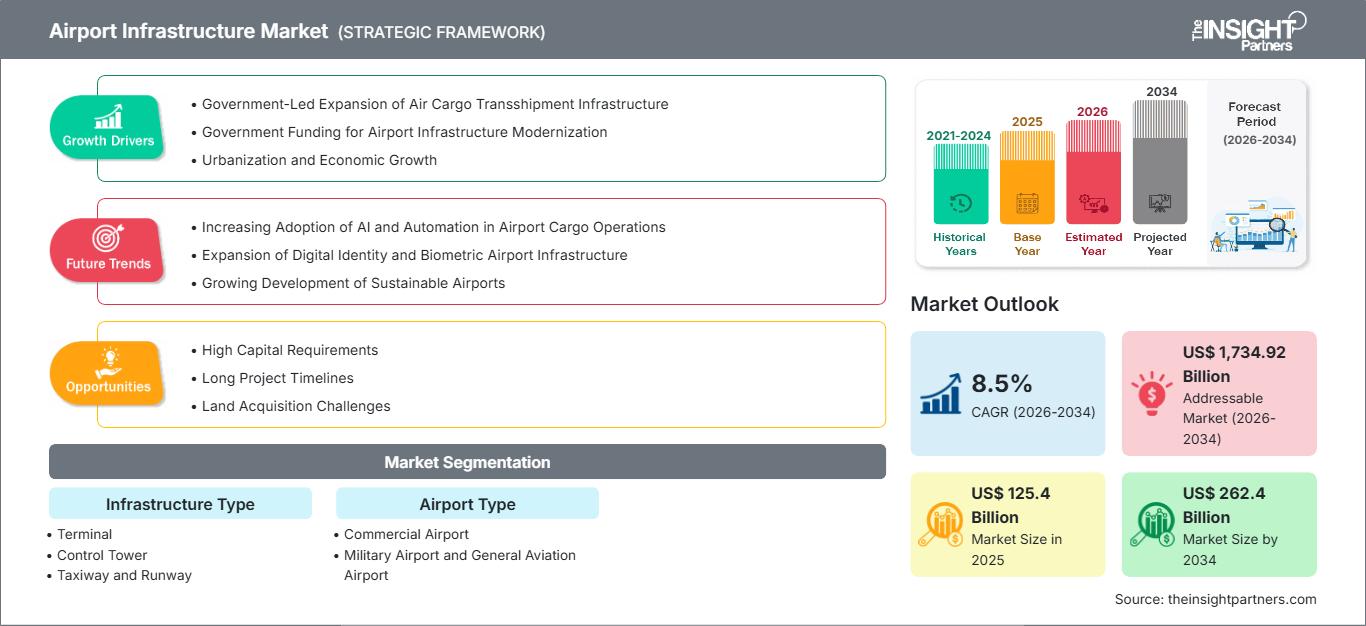
US$ 125.4 Bn
Base year value
2034 Forecast
US$ 262.4 Bn
Projected by 2034
CAGR 2026-2034
8.5 %
Growth rate
Addressable Market
US$ 1,734.92 Bn
(2026-2034)
Global Airport Infrastructure Market reached US$ 125.4 billion in 2025 and is projected to reach US$ 262.4 billion by 2034, registering a CAGR of 8.5% during 2026–2034. The market covers terminals, control towers, taxiways and runways, hangars, and related assets serving commercial, military, and general aviation airports. Capacity additions, asset renewal, safety compliance, and digitally enabled passenger processing shape expenditure priorities.
Together in North America, the markets for global airport infrastructure will grow a modelled 8.7% CAGR through 2034. A high installed base encourages replacement of existing terminal infrastructure as well as scope expansion of airport-wide airfield work, resilient utilities, and luggage handling. Robust large multiyear programs in several prime gateways will underpin contractor backlogs; additional federal grants, airport revenue bonds, passenger-facility funding, and even public-private delivery vehicles will strengthen the capital stack.
Airport Infrastructure Market Assessment and Insights
Regional Outlook
- North America: 24.66% of the global market in 2025| 8.7% CAGR through 2034. Market position: The region ranks first as aging hub assets, high construction costs, rigorous safety standards, and financed modernization programs sustain large project values.
- US: 78% of North American market revenue in 2025 | 8.9% CAGR through 2034. Market position: The country leads North America through major terminal, runway, control-facility, and landside programs across large hubs and regional airports.
- Europe: 26% of the global market in 2025 | 8.4% CAGR through 2034. Market position: Mature networks emphasize decarbonization and brownfield efficiency, with the UK, Germany, France, Spain, and Italy anchoring procurement.
- Asia Pacific: 34% of the global market in 2025 | 9.1% CAGR through 2034. Market position: The fastest-growing region combines greenfield airports and hub expansion, led by China in Asia Pacific, with India adding a strong pipeline.
Segment Outlook
- Commercial Airport: 47.30% Share in 2025 | 8.6% CAGR through 2034. Market position: Passenger and cargo throughput, airline connectivity, non-aeronautical revenue, and mandated security investment concentrate capital in commercial facilities.
- Infrastructure Type: 8.5% CAGR through 2034. Market position: The category expands as terminal programs bundle passenger systems, utilities, accessibility, commercial space, and low-carbon building upgrades.
Competitive Coverage
Hensel Phelps Construction Co., AECOM, Skanska AB, Turner Construction Company, TAV Tepe Akfen Investment Construction and Operation Co. Inc., Austin Industries, Inc., PCL Constructors Inc., Hill International, Inc., Sundt Construction, Inc., McCarthy Building Companies, Inc.
Methodology
The Insight Partners follows Data Collection & Secondary Research, Primary Research, Data Analysis, and Data Triangulation & Final Review to validate market estimates and insights.
Source: The Insight Partners' analysis based on proprietary research, government publications, company annual reports, investor presentations, industry databases, and expert interviews.
Airport development has moved from isolated civil works toward integrated programs that coordinate terminal architecture, airfield geometry, security, baggage, utilities, digital systems, and ground access. Contractors increasingly sequence work around live operations, using building information models, modular assemblies, digital twins, and off-site fabrication to reduce closures and schedule risk. Production remains locally intensive because concrete, aggregates, labor, and permitting are geography-specific, while specialist systems and program-management expertise travel across borders.
Through 2034, expansion will increasingly follow traffic recovery, urbanization, cargo corridors, defense readiness, and replacement cycles rather than uniform greenfield construction. Asia Pacific and selected Middle Eastern markets offer capacity-led pipelines, whereas North America and Europe concentrate on modernization and resilience. Procurement will favor phased packages, outcome-based design, and financing structures that connect capacity triggers to airline commitments. Carbon standards, extreme-weather adaptation, accessibility rules, and air-navigation upgrades will influence specifications.
Airport Infrastructure Market Report Scope
| Report Attribute | Details |
|---|---|
| Market size in 2025 | US$ 125.4 Billion |
| Market Size by 2034 | US$ 262.4 Billion |
| Global CAGR (2026 - 2034) | 8.5% |
| Historical Data | 2021-2024 |
| Forecast period | 2026-2034 |
Airport Infrastructure Market Analysis
Growth of the Global Airport Infrastructure Market is both a capacity issue and an asset-quality issue at once. As passenger numbers and aircraft movements increase, more gates, the ability to move aircraft down taxiways, aircraft stands and baggage capacity is required, as well as the latter investments being needed to upgrade or replace aging pavements, power supplies and terminal envelopes. The demand so goes from architects and engineers to constructors and systems integrators, and through to equipment supply firms operators commercial airlines, regulators, and investors. Although the planning through to investments is long, processes for environmental review, land availability, stakeholder approval and operational phasing slow the conversion of announced capital projects into actual construction revenues.
Interfaces are valuable to companies capable of accommodating them, such as remotorized runway work that takes pavement materials lighting drainage, and limited (short) closure windows, and terminal delivery requiring a combination of structural packages and highly integrated mechanical, electrical, security, and passenger-processing packages. Construction professionals and material suppliers confront the rising costs of skilled labor and unreliable material prices, the advantages of early contractor involvement, prefabrication, and disciplined procurement.
Global Airport Infrastructure Market analysis reveal a significant competitive arena divided among at international program managers or national contractors and aviation experts. AECOM and Hill International, Inc. compete by planning and program controls, whereas Skanska AB, Turner Construction Company, PCL Constructors Inc. and McCarthy Building Companies, Inc. offer complex construction delivery. The regional execution depth and integrated capabilities are provided by Hensel Phelps Construction Co. Austin Industries, Inc. Sundt Construction, Inc. and TAV Tepe Akfen Investment Construction and Operation Co. Inc.
Investment positioning is more about certainty of funding, phasing, and margin-adjusted risk than headline project value. Firms with a renewed focus on airports can more accurately price operational constraints and keep specialist subcontractors to complete the work. Strategic advantages are shifting to digital coordination, modular delivery, low-carbon materials and lifecycle services. Contractors who make design decisions that boost maintainability and energy performance can survive and thrive beyond construction.
● REPORT CUSTOMIZATION
Tailor This Report To Align With Your Specific Business Requirements
This report can be customized to align precisely with your business objectives, scope, and target markets. Customization options include tailored segmentation, geography, competitive analysis, and strategic insights to support informed decision-making.
Customize This Report →WHAT YOU CAN ADJUST
- ● Segmentations
- ● Geography
- ● Competitive Analysis
- ● Language Preferences
Airport Infrastructure Market: Strategic Insights
Regional Insights
North America Global Airport Infrastructure Market
North America is forecast to grow at 8.7% CAGR through 2034. Its selling proposition is based on brownfield modernization not network creation: terminals need to accommodate shifting passenger movements, airports need repetitive rehabilitation, and aging utilities need resiliency enhancements. Large airports operations invest in multi-year programs, while smaller regional facilities rely to a greater extent on public subsidies and phased procurement. Airport owners are also focusing on curbside circulation, intermodal connectivity and power capacity as passenger processing systems are becoming more highly automated and energy consuming.
North America share of the Global Airport Infrastructure Market is underpinned by high unit costs, strict operational parameters and deep financial markets. The bundling of baggage security curbside interface, power generation and passenger amenities by owners into co-ordinated programs has escalated demands on experienced 'live-airport' contractors with sound schedule controls. Canadian interests focus on terminal economies, northern access and climate resilience, while Mexican gateways provide targeted expansion to match tourism trends and metro growth. Throughout the region, conventional sources of finance and slow disciplined phasing underpin the achievable pace of design momentum engendered by approved capital programs..
U.S. Global Airport Infrastructure Market
U.S. dominates the 78% of North American revenue in 2025with a 9.3% CAGR through 2034. Up this size, due to the portfolio activity large airport system, redevelopment of major hub, renewal of runways and taxiways and improvement of air traffic control facilities. FAA support completing airport bonds, airline arrangements, passengers-originated fees. Meanwhile, the last instalment of Airport Infrastructure Grant of federal infrastructure program builds a pipeline extending for both primary and nonprimary airports, and terminal grants focus to aging passenger terminals with airline interest, and airport-owned control towers.
AECOM, Skanska AB, Turner Construction Company, Hensel Phelps Construction Co., PCL Constructors Inc., Sundt Construction, Inc., and McCarthy Building Companies, Inc. have relevant delivery footprints. Application demand spans terminal concourses, baggage systems, seismic and climate resilience, road access, lighting, radar support, and phased airfield works that preserve operations. Large airports favor integrated teams able to coordinate airlines, security agencies, utilities, and concessionaires, whereas smaller airports often procure discrete pavement, lighting, hangar, or safety-area packages. This mix creates opportunities for both national program managers and specialized regional contractors.
Europe Global Airport Infrastructure Market
Europe gets 26% of revenue in 2025 and modelled 8.4% CAGR through 2034. Compact airport systems and scarce land drive emphasis on terminal reconfiguration and pier extension, baggage auto, runway rehab, noise reduction, surface access integration. Decarbonization policies also favor electrically-powered ground ops, high-performance heating and cooling, green power, and less embodied carbon materials.
The UK is evaluated top of the top 5 European countries due to hub scale, need for modernization, and mature private airport model. Germany compares with a focus on capacity efficiencies and the rail-air integration, while France uses a setup of main hub programs coupled with local airport improvements. Lastly, Spain relies on tourism to drive upgrade needs for capacity and flow, not unlike Italy, which strives for a combination of gateway modernization and regional access.
Procurement remains a technical challenge still, as projects are increasingly occurring in a closed, ongoing station estate. In Europe, contracts for system integration, safety, and environmental approval, and end-to-end lifecycle performance are competing with electrical ground power and charging provision, and interface with public-transport and data-led operations. Building co-ordination needs between airport operators airlines energy suppliers, regulators, and local town planning authorities, and early phased schemes with historic data on emissions, capacity, and passenger flow advantages are becoming even more vital.
APAC Global Airport Infrastructure Market
Asia Pacific holds 34% of global revenue in 2025 and is the fastest-growing region at 9.1% CAGR through 2034. China is the leading country in Asia Pacific, supported by a large airport network and continued hub investment. India adds greenfield and terminal capacity, while Japan and South Korea emphasize renewal, automation, and resilience.
Australia combines metropolitan expansion with regional-airport upgrades. Across the region, urbanization, airline network development, industrial corridors, tourism, and public infrastructure policy support new terminals, runways, taxiways, and multimodal access. South Korea's hub strategy centers on transfer efficiency and integrated logistics, while Japan's constrained airports emphasize automation and asset productivity. India presents a different mechanism, with new airports and terminal capacity supporting rapidly expanding domestic connectivity. Land acquisition, local approvals, utility readiness, and execution complexity remain the principal schedule constraints.
Middle East & Africa Global Airport Infrastructure Market
The Middle East & Africa market is modelled to grow at 6.9% CAGR through 2034. UAE is the leading country in the Middle East & Africa, supported by international hub operations and integrated aviation strategies, while Saudi Arabia is building capacity around tourism, logistics, and economic diversification.
South Africa focuses more on rehabilitation, operational reliability, and selective expansion. Across the rest of MEA, sovereign funding, development finance, energy availability, and urban connectivity determine project timing. Gulf projects can integrate airport capacity with airlines, logistics zones, tourism districts, and surface transport, while African programs often prioritize essential runway, terminal, navigation, and utility reliability. Heat resilience, water efficiency, dependable power, and phased construction are central design considerations, particularly where supply chains and specialist labor must be mobilized across long distances.
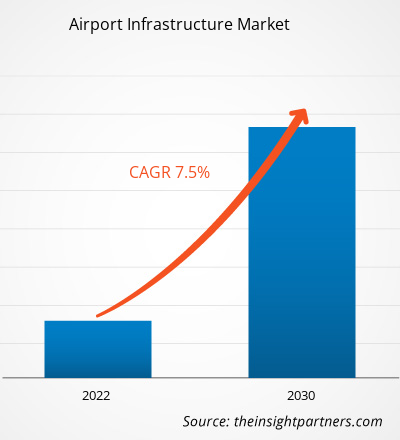
Segmentation Analysis
Infrastructure Type
Infrastructure Type is forecast to grow at 8.5% CAGR from 2026 to 2034. The scope of Global Airport Infrastructure Market across the Infrastructure Type segment comprises passenger buildings, facilities for air traffic, airside pavements, shelters for aircraft and enabling assets. The demand for designing of air traffic facilities is influenced by factors such as capacity constraints, frequent pavement renewal, safety regulations and adoption of digital, electrical, and low-carbon technology into current air traffic facilities.
- Terminal: Terminals command the strongest capital concentration because they combine structural works, baggage handling, security, passenger processing, retail, accessibility, and energy systems. Modular construction and phased gate delivery reduce disruption at operating airports.
- Control Tower: Control tower investment follows airspace modernization, visibility requirements, surveillance upgrades, and replacement of aging facilities. Procurement favors resilient communications, redundant power, ergonomic operating environments, and compatibility with remote or digital tower concepts.
- Taxiway and Runway: Airfield pavement remains mission-critical, with demand driven by aircraft load, safety-area standards, drainage, lighting, and capacity optimization. Night possessions and rapid-cure materials help airports maintain schedules during rehabilitation.
- Hangar: Hangar demand tracks fleet growth, maintenance localization, business aviation, and military readiness. Clear-span structures, fire protection, tooling utilities, and adjacency to aprons shape cost and operational value.
Airport Type
The Airport Type segment is forecast to grow at a CAGR of 8.5% during 20262034. Revenue is largely driven by commercial airports, which demand high volumes of passengers and freight; air force and general aviation airports need to support niche requirements. Investment models, security levels traffic usage and ownership models will influence whether airports will grow in capacity durability mission or renewal of life cycle.
- Commercial Airport: Commercial airports represent the largest demand pool, supported by terminal expansion, baggage automation, runway renewal, cargo facilities, and landside access. Airline agreements and non-aeronautical revenue strengthen financing for phased capital programs.
- Military Airport: Military airports prioritize mission assurance, hardened utilities, secure communications, runway strength, rapid deployment, and specialized hangars. Procurement is standards-intensive and often favors contractors with controlled-site experience and dependable program governance.
- General Aviation Airport: General aviation airports invest selectively in runways, aprons, hangars, fixed-base operator facilities, and safety systems. Business aviation, flight training, emergency services, and regional economic development underpin demand.
Opportunity Snapshot
| Airport Type | Revenue Contribution | Trend Tag | Adoption Stage |
| Commercial Airport | High | Hub Renewal | Scaling |
| Military Airport | Medium | Mission Resilience | Mature |
| General Aviation Airport | Low | Hangar Expansion | Scaling |
Airport Infrastructure Market Growth Drivers and Impact Analysis
Capacity additions for sustained passenger and cargo expansion
Traffic growth in the terminal and airfield leads directly to gate apron taxiway, baggage capacity and processing area increases. Gaining improvement of the existing airport resources is no longer sustainable once peak hour-induced delays, airline schedules, and passenger acceptance is reduced. Capacity projects have flow-on effects in the local infrastructure too like roads utilities carparking and freight areas. These effects are increased where airline networks, inbound tourism, urban set-vents and freight activity grow concurrently. As airport projects always need to be fully safe and operationally continuous, construction expenditure is phased annually; so, a series of long- term engineering and construction pipelines is created rather than an ad hoc stagnating procurement spike.
Renewal of aging airfields, terminals, and control assets
Mature airport systems face recurring replacement needs even when traffic grows slowly. Pavements deteriorate under repeated aircraft loading, terminal systems become inefficient, and older control facilities require modern communications, surveillance, and power resilience. Renewal spending is less discretionary than purely aesthetic upgrades because safety, reliability, accessibility, and regulatory compliance determine operating continuity. This mechanism supports the Global Airport Infrastructure Market across economic cycles. Contractors benefit when owners package structural rehabilitation with energy, baggage, security, and passenger-flow upgrades, although live-site sequencing and short possession windows raise execution risk.
Resilience, sustainability, and digital operating requirements
Airports are also focusing on infrastructure resilience to extreme heat flooding energy assurance, digital/cyber resilience and reduced lifecycle carbon emissions. This expands projects: hydrology microgrids high-performance building envelopes, electrified ground-support vehicle charging, smart lighting and integrated asset management are all integrated into capital planning. Digital delivery improves clash detection and construction sequencing, in particular on site constrained projects. This shifts portfolio design requirements towards higher intensity design teams who can seamlessly overlay civil, building, systems, and operational datasets; the market has moved away from lowest capital cost to measures of reliability, maintainability, and entire lifecycle design performance.
Airport Infrastructure Market Future Trends
Modular delivery and digital twins reshape project execution
The international airport infrastructure market is moving toward off site fabrication, modular airport terminal elements and digital twins linking design-build- operate. Prefabrication can relocate complex jobs away from airside secure area eliminating labor overcrowding and airside closure. Digital twins assist in managing quantities, utility clash detection, commissioning, and later maintenance. But it is predicted that in the next twenty years including 2034, airport owners will want more structured asset data in handover because of this quality of information will need to be a contractual output. Suppliers who can develop more standard repeatable elements while still maintaining airport specific interfaces can gain schedule certainty without imposing a standard airport design.
Infrastructure becomes energy and climate adaptive
The next generation of airport programs will view capacity-enabling power, water, heat, and storm resilience as an incremental addition to demand. New electrified ground vehicle fleets, charging systems, renewable generation, storage, and terminal systems will create new demands on airport electrical systems. Climate adaptation will re-architect pavement materials, drain sizing, cooling requirements and equipment locations. Capital investments will necessarily trade avoided disruption and variable operating costs against initial capital. Demonstrating to the financial community that integrated master-planning utilities installation ahead of terminal or apron expansion can have the financial benefit of avoiding capacity constraints.
Airport Infrastructure Market Opportunities
Brownfield modernization packages at operating hubs
The largest actionable opportunity is to bundle terminal, baggage, airfield, utility, and access upgrades into phased packages that maintain operations. Global Airport Infrastructure Market Forecasts support a long runway for this model because mature hubs must add throughput without proportional land expansion. Contractors can improve win rates through early constructability input, possession planning, digital coordination, and transparent cost controls. Investors and airport owners can reduce delivery risk by linking packages to traffic triggers and airline commitments rather than launching oversized single phases.
Localized delivery platforms in high-growth aviation corridors
Asia-Pacific and selected Middle Eastern markets present opportunities to leverage global program management capabilities together with local engineering, materials, and labor markets. Addressable work ranges from greenfield airports, terminal additions, parallel taxiways, maintenance hangars and multimodal connections. Approach should emphasize local fit through qualified local alliances, endurance in current capacity, supply chain analysis, and pricing currency risk. Successful companies with proven scalable regional delivery mechanisms will be able to partake in subsequent growth stages as traffic scales. The market is best positioned where airport transformation it complements tourism logistics urban integration and government connectivity strategies, not where it relies on any single speculative demand source.
Recent Developments
- January 2026: Skanska AB - In a joint venture with Flatiron, Skanska signed an additional Los Angeles World Airports contract for the Airfield and Terminal Modernization Program roadway improvements at Los Angeles International Airport. The total contract is valued at US$ 868 million, with Skanska's share at US$ 445 million. Work includes roadway reconfiguration, bridges, signals, and traffic-monitoring systems, with completion expected in 2030.
- December 2025: AECOM - The company received a U.S. Federal Aviation Administration indefinite-delivery, indefinite-quantity architecture and engineering contract with a program ceiling exceeding US$ 270 million over ten years. The vehicle covers air traffic control towers, terminal radar approach control facilities, navigational aids, lighting, multidisciplinary design, and construction administration across three service areas.
- July 2025: McCarthy Building Companies, Inc. - The company was awarded the New Gen A and B Concourses project at Reno-Tahoe International Airport. The pre-approved US$ 650 million program replaces aging concourses with larger passenger areas, integrated travel technology, expanded amenities, and a centralized utility plant, supported by a ten-year airline agreement.
Frequently Asked Questions

- Comprehensive Market Sizing and Forecast Analysis
- Detailed Segmentation Analysis
- In-Depth Market Dynamics Assessment
- Regional and Country-Level Insights
- Competitive Landscape and Company Benchmarking
- Strategic Business Intelligence
Recent Reports
Testimonials

The Insight Partners provided valuable market intelligence that supported our global go-to-market strategy. Their team was professional, responsive, and attentive to our feedback, providing thoughtful analysis and helpful methodological clarifications throughout the project.
Junmo Kim Chief Financial Officer (CFO), Enertech Co., Ltd.
The Insight Partners' SCADA System Market report is comprehensive, with valuable insights on current trends and future forecasts. The team was highly professional, responsive, and supportive throughout. We are very satisfied and highly recommend their services.
RAN KEDEM Partner, Reali Technologies LTDs
I requested a report on a very specific software market and the team produced the report in a few days. The information was very relevant and well presented. I then requested some changes and additions to the report. The team was again very responsive and I got the final report in less than a week.
JEAN-HERVE JENN Chairman, Future Analytica
We worked with The Insight Partners for an important market study and forecast. They gave us clear insights into opportunities and risks, which helped shape our plans. Their research was easy to use and based on solid data. It helped us make smart, confident decisions. We highly recommend them.
PIYUSH NAGPAL Sr. Vice President, High Beam Global
The Insight Partners delivered insightful, well-structured market research with strong domain expertise. Their team was professional and responsive throughout. The user-friendly website made accessing industry reports seamless. We highly recommend them for reliable, high-quality research services
YUKIHIKO ADACHI CEO, Deep Blue, LLC.
This is the first time I have purchased a market report from The Insight Partners.While I was unsure at first, I visited their web site and felt more comfortable to take the risk and purchase a market report.I am completely satisfied with the quality of the report and customer service. I had several questions and comments with the initial report, but after a couple of dialogs over email with their analyst I believe I have a report that I can use as input to our strategic planning process.Thank you so much for taking the extra time and making this a positive experience.I will definitely recommend your service to others and you will be my first call when we need further market data.
JOHN SUZUKI President and Chief Executive Officer, Board Director, BK Technologies
I wish to appreciate your support and the professionalism you displayed in the course of attending to my request for information regarding to infectious disease IVD market in Nigeria. I appreciate your patience, your guidance, and the fact that you were willing to offer a discount, which eventually made it possible for us to close a deal. I look forward to engaging The Insight Partners in the future, all thanks to the impression you have created in me as a result of this first encounter.
DR CHIJIOKE ONYIA MANAGING DIRECTOR, PineCrest Healthcare Ltd.Reason to Buy
- Informed Decision-Making
- Understanding Market Dynamics
- Competitive Analysis
- Identifying Emerging Markets
- Customer Insights
- Market Forecasts
- Risk Mitigation
- Boosting Operational Efficiency
- Strategic Planning
- Investment Justification
- Tracking Industry Innovations
- Aligning with Regulatory Trends






 Get Free Sample for