
Rubidium Market Trends, Size & Forecast by 2034
Coverage: By Product Type, [Rubidium Chloride (RbCl), Rubidium Carbonate (Rb2CO3), Rubidium Hydroxide (RbOH), Rubidium Nitrate (RbNO3), Rubidium Sulfate (Rb2SO4), Rubidium Metal, and Others], By Application (Electronics and Semiconductors, Specialty Glass Manufacturing, Biomedical Research, Telecommunications, Quantum Computing, Pyrotechnics, and Others), and Geography (North America, Europe, Asia Pacific, the Middle East and Africa, and South and Central America)
- Status : Published
- Report Code : TIPRE00026391
- Category : Chemicals and Materials
- No. of Pages : 333
- Available Report Formats :


- Last update date : August 12, 2026


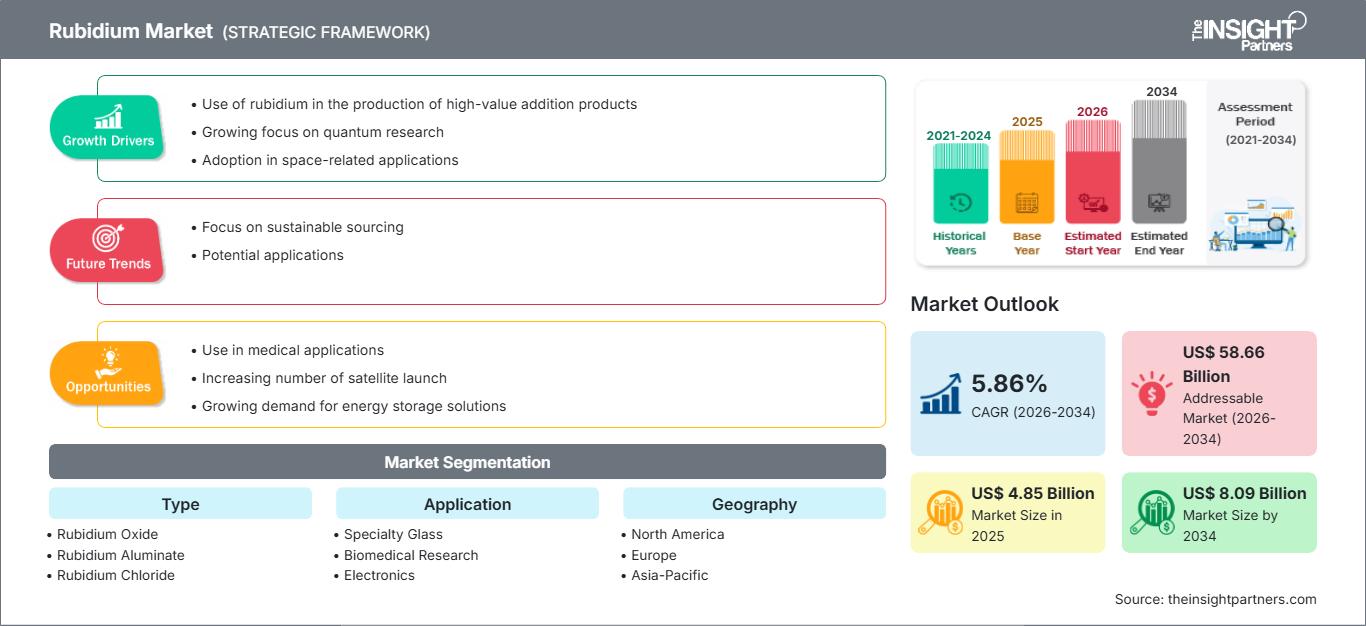
2025 Market Size
US$ 4,850 Mn
Base year value
2034 Forecast
US$ 8,090 Mn
Projected by 2034
CAGR 2026-2034
5.8 %
Growth rate
Addressable Market
US$ 58,479.59 Mn
(2026-2034)
The Rubidium Market was valued at US$ 4.85 Billion in 2025 and is projected to reach US$ 8.09 Billion by 2034, registering a CAGR of 5.8% during 2026–2034. Increasing adoption of rubidium compounds and high-purity rubidium metal in quantum technologies, specialty electronics, biomedical research, telecommunications, and advanced glass manufacturing continues to support market expansion. Growing investments in strategic minerals, semiconductor manufacturing, and precision instrumentation are expected to strengthen demand across both developed and emerging economies.
North America continues to represent a technologically advanced market owing to strong investments in quantum computing, semiconductor fabrication, and defense research. The Rubidium Market size across the region is expected to expand at an estimated CAGR of 4.6% through 2034, supported by increasing public funding for quantum technologies, expanding electronics manufacturing, and rising demand for ultra-high-purity specialty chemicals.
Rubidium Market Assessment and Insights
- North America: Accounted for 27.96% share in 2025 and is projected to register a CAGR of 4.6% during 2026–2034, supported by advanced semiconductor manufacturing, quantum technology research, aerospace applications, and strong investment in specialty chemicals.
- US: Represented 65.10% of the North American market in 2025 and is expected to grow at a CAGR of 4.5%, driven by expanding quantum computing programs, semiconductor R&D, and biomedical research activities.
- Europe: Held 23.59% share in 2025 while advancing at a CAGR of 5.7%, led by Germany, France, the United Kingdom, and the Netherlands with strong research infrastructure and advanced specialty material industries.
- Asia Pacific: Captured 35.68% share in 2025 and is forecast to record the fastest growth at a CAGR of 6.7%, supported by expanding semiconductor production, electronics manufacturing, and strategic investments across China, Japan, South Korea, and Taiwan.
- Largest Segment: Electronics and Semiconductors accounted for 18.08% market share in 2025 and is projected to expand at a CAGR of 6.2%, reflecting increasing utilization of high-purity rubidium compounds in advanced electronic applications.
- High Growth Segment: Quantum Computing represented 6.36% market share in 2025 while registering the highest 5.6% CAGR, supported by expanding investments in quantum sensing, atomic clocks, and next-generation computing technologies.
- Key companies analyzed in detail: Ganfeng Lithium Group Co., Ltd., Thermo Fisher Scientific Inc., Otto Chemie Pvt. Ltd., ESPI Metals, Jiangxi Special Electric Motor Co., Ltd., Kanto Chemical Co., Inc., FUJIFILM Wako Pure Chemical Corporation, GFS Chemicals, Inc., MP Biomedicals, LLC, ProChem, Inc., Merck KGaA, I.V. Labs, Inc., Strem Chemicals, Inc., Material Technology & Crystals GmbH (MaTecK), and Sinomine Resource Group Co., Ltd.
Source: The Insight Partners' analysis based on proprietary research, government publications, company annual reports, investor presentations, industry databases, and expert interviews.
The rise in commercial applications of quantum technologies and high performance electronics has brought a major change in the demand pattern of rubidium during the last decade. The capacity for production of very high purity rubidium chemicals has been increased in order to meet the demands for atomic clocks, optoelectronics, specialty glass, and scientific instruments.
In the future, the growing amount of investments in semiconductor manufacturing, quantum technology, and critical minerals supply chains will generate new commercial possibilities for the industry. Government efforts for the domestic production of critical materials, along with the growing research budgets and technology innovations, are expected to create new plants and develop new products during the forecast period.
Rubidium Market Report Scope
| Report Attribute | Details |
|---|---|
| Market size in 2025 | US$ 4,850 Million |
| Market Size by 2034 | US$ 8,090 Million |
| Global CAGR (2026 - 2034) | 5.8% |
| Historical Data | 2021-2024 |
| Forecast period | 2026-2034 |
Rubidium Market Analysis
Growing investment in advanced electronics, telecommunications infrastructure, and quantum information science continues to accelerate Rubidium Market growth. Rubidium compounds with high purity levels are critical in the manufacture of atomic clocks, frequency standards, photoelectric devices, biomedical laboratories, and semiconductors requiring special purity levels and stability. Growing applications of quantum computers and the increased need for precision timing devices in the aerospace, defense, and telecommunication industries have created steady opportunities for firms producing specialty rubidium products.
The value chain consists of mineral mining, specialty chemical processing, purification, crystal growth, manufacturing of components, research laboratories, and end-users. Availability of these products continues to be dependent on lithium and cesium mining processes since rubidium is often obtained as a by-product. Increased investments in purification processes and analysis are improving the quality of the products while guaranteeing their steady supply to research organizations and manufacturing industries.
Competition continues to intensify as producers expand high-purity material portfolios and strengthen regional distribution capabilities. The Rubidium Market analysis indicates that companies including Merck KGaA, Thermo Fisher Scientific Inc., Ganfeng Lithium Group Co., Ltd., Sinomine Resource Group Co., Ltd., ESPI Metals, and FUJIFILM Wako Pure Chemical Corporation continue investing in specialty chemicals, research-grade materials, and strategic collaborations with semiconductor manufacturers and research institutions. Smaller specialty suppliers such as ProChem, Inc., GFS Chemicals, Inc., and MaTecK focus on customized products serving laboratories and advanced materials research.
Efforts aimed at enhancing purification efficiency, assuring quality, and ensuring supply security have become key considerations for manufacturers in view of rising demand in the technological sector. Enhancements in refining capabilities, sustainable extraction processes, and processing critical minerals will continue to boost competitiveness. Collaborations with research institutions, electronics firms, and innovative government initiatives are anticipated to increase business opportunities while developing new rubidium technologies.
● REPORT CUSTOMIZATION
Tailor This Report To Align With Your Specific Business Requirements
This report can be customized to align precisely with your business objectives, scope, and target markets. Customization options include tailored segmentation, geography, competitive analysis, and strategic insights to support informed decision-making.
Customize This Report →WHAT YOU CAN ADJUST
- ● Segmentations
- ● Geography
- ● Competitive Analysis
- ● Language Preferences
Rubidium Market: Strategic Insights
Regional Insights
North America Rubidium Market
North America accounted for 27.96% of the Rubidium Market share in 2025 and is projected to expand at a CAGR of 4.6% during 2026–2034. There is also the advantage of having advanced manufacturing capabilities for semiconductors, quantum science studies, aerospace engineering, and military modernization initiatives. In addition, the growing government investment in critical mineral logistics and domestic fabrication of semiconductors is likely to boost the demand for rubidium chemicals utilized in atomic clocks, photonics, precision instruments, and electronics.
In North America, the U.S. is still the largest regional contributor to the market; on the other hand, Canada provides market development in terms of mining operations, mineral processing technologies, and academic quantum science research. Ongoing investments in national laboratories, electronics fabrication, and telecommunication infrastructure are projected to ensure continued demand. Global specialty chemical suppliers and research institutions located in the region facilitate emerging rubidium application developments.
U.S. Rubidium Market
The United States represented 65.10% of the North American market in 2025 and is anticipated to register a CAGR of 4.5% through the forecast period. The continued large-scale investments made through semiconductor manufacturing ventures, defense modernization projects, and quantum information science studies remain crucial for the acceptance of ultra-high purity rubidium chemicals. The increasing use of precise timing devices, navigation equipment, and optics technology will also play an important role in boosting domestic demand.
Leading vendors such as Thermo Fisher Scientific Inc., GFS Chemicals, Inc., ProChem, Inc., ESPI Metals, and I.V. Labs, Inc. have robust distribution channels catering to research laboratories, universities, aerospace companies, and electronics companies. The growing cooperation between government agencies, national laboratories, and private tech companies is likely to boost the development of quantum computing systems and precision measurement systems using specialty rubidium products.
Europe Rubidium Market
Europe captured 23.59% of the global market in 2025 and is projected to expand at a CAGR of 5.7% during the forecast period. Germany continues to be the leading regional market due to its highly sophisticated semiconductor industry, advanced industrial automation technologies, and substantial research investments in photonics. The specialty chemicals and laboratory material suppliers continue to support the electronics industry demand in the region.
The United Kingdom continues to build on its advantages due to national quantum technology programs, research conducted at universities, increasing investments in photonics and precision instruments. Germany has the advantage of well-developed industrial manufacturing base, while the contributions to the regional demand are made by France, Italy, and Spain due to aerospace research, biomedical innovations, specialty glass industry, and scientific research infrastructure development.
APAC Rubidium Market
Asia Pacific accounted for 35.68% of global demand in 2025 and is forecast to record the fastest CAGR of 6.7% through 2034. China leads regional consumption owing to its expanding semiconductor manufacturing base, strategic mineral processing capabilities, and growing investments in quantum technology research.
Japan, South Korea, India, and Australia are still bolstering regional demand through their electronics manufacturing, advanced material research, telecommunication development, and governmental semiconductor initiatives. Enhanced production capability and investment in mineral processing would make their competitiveness stronger.
Middle East & Africa Rubidium Market
The Middle East & Africa market is projected to register a CAGR of 6.0% during the forecast period. Regional demand remains relatively modest but continues increasing with investments in scientific research, industrial diversification, and advanced manufacturing initiatives. Saudi Arabia leads regional growth through technology-focused industrial development programs.
While the United Arab Emirates facilitates adoption through development of research and innovation facilities, South Africa adds value through mining knowledge and ability in specialty mineral processing. It is anticipated that further diversification of industrial economies coupled with research collaboration will provide gradually increasing prospects for specialty rubidium products in the region.
Segmentation Analysis
Product Type
The product type segment defines the commercial landscape of the Rubidium Market based on chemical composition and end-use suitability. The segment is projected to grow at a CAGR of 5.7–6.1% during 2026–2034. Demand is influenced by purity requirements, application-specific performance, and research intensity across electronics, specialty chemicals, and scientific laboratories. The Rubidium Market scope continues to expand as manufacturers develop higher-purity compounds and customized formulations for emerging technologies, particularly quantum computing and advanced optoelectronic applications.
- Rubidium Chloride (RbCl): Widely utilized in biomedical research, analytical chemistry, and laboratory diagnostics due to its high purity and compatibility with biological and chemical testing applications. Demand remains stable across research institutions and pharmaceutical laboratories.
- Rubidium Carbonate (Rb₂CO₃): Used extensively in specialty glass manufacturing and advanced ceramic formulations where it improves optical characteristics, electrical conductivity, and thermal stability. Growing demand for specialty optical materials supports continued consumption.
- Rubidium Hydroxide (RbOH): Applied in specialty chemical synthesis, catalyst preparation, and research activities requiring highly reactive alkaline compounds. Consumption is primarily concentrated in research laboratories and niche industrial chemical production.
- Rubidium Nitrate (RbNO₃): Serves specialized applications in pyrotechnics, analytical chemistry, and scientific experimentation. Although relatively niche, consistent laboratory demand and defense-related research contribute to stable market utilization.
- Rubidium Sulfate (Rb₂SO₄): Primarily employed in chemical research, crystal growth studies, and specialized inorganic synthesis. Demand is supported by academic institutions and advanced materials development programs requiring high-purity inorganic compounds.
- Rubidium Metal: High-purity rubidium metal is increasingly adopted in atomic clocks, photoelectric cells, vacuum tubes, quantum devices, and semiconductor research where exceptional purity and controlled performance characteristics are essential.
Application
Application remains the largest contributor to overall demand as technological advancement continues creating new commercial opportunities. This segment is expected to register a CAGR of 6.2–6.7% during 2026–2034, supported by expanding semiconductor fabrication, quantum technologies, advanced telecommunications, and research-driven innovation. Increasing commercialization of precision electronic devices continues strengthening long-term demand for high-performance rubidium compounds.
- Electronics and Semiconductors: The leading application segment utilizes rubidium compounds in photoelectric devices, vacuum components, semiconductor research, and precision electronic systems requiring high material purity and exceptional performance consistency.
- Specialty Glass Manufacturing: Rubidium compounds enhance optical performance, durability, refractive characteristics, and thermal resistance in specialty glass products used across scientific instruments, lasers, and high-performance optical equipment.
- Biomedical Research: Research laboratories employ rubidium isotopes and specialty compounds in tracer studies, biochemical investigations, physiological experiments, and pharmaceutical research supporting expanding life sciences innovation.
- Telecommunications: Rubidium frequency standards are widely deployed in precision timing systems, communication infrastructure, satellite navigation, and synchronization equipment supporting modern telecommunications networks.
- Quantum Computing: Rapid investment in quantum sensing, atomic clocks, quantum processors, and precision measurement technologies continues driving exceptional demand for ultra-high-purity rubidium products across research institutions and commercial developers.
- Pyrotechnics: Selected rubidium salts are utilized in specialized pyrotechnic formulations, research demonstrations, and defense-related experimental applications where unique spectral emission characteristics are required.
Opportunity Snapshot
| Application | Revenue Contribution | Trend Tag | Adoption Stage |
|---|---|---|---|
| Electronics and Semiconductors | High | Chip Scaling | Mature |
| Specialty Glass Manufacturing | Medium | Optical Glass | Mature |
| Biomedical Research | Medium | Molecular Imaging | Scaling |
| Telecommunications | High | Precision Timing | Mature |
| Quantum Computing | Medium | Quantum Sensors | Emerging |
| Pyrotechnics | Low | Specialty Ignition | Mature |
Rubidium Market Growth Drivers and Impact Analysis
Expansion of Quantum Computing and Precision Timing Infrastructure
The rising interest in quantum technologies drives up the demand for high purity rubidium compounds and metal. Rubidium atomic clocks are still critical for satellite navigation, telecommunication time synchronization, aerospace industry, and other sectors where extremely accurate timekeeping is needed. Various national quantum programs, implemented in the United States, European Union, China, and Japan, keep developing infrastructure and encouraging further implementation of quantum processors and quantum sensors in production. Funding from governments, universities, and the private sector helps increase the demand for rubidium used in laboratories. As quantum technologies move closer to commercialization, suppliers that can provide ultra-high purity compounds will see an increase in orders.
Growing Semiconductor Manufacturing and Advanced Electronics Production
Global semiconductor manufacturing facilities are undergoing fast expansion, thereby driving the need for specialty chemicals and ultra-high-purity elements. The rubidium compounds have found applications in electronics, vacuum devices, optoelectronics, and other fields of material science research that contribute to future developments in semiconductors. There are various government initiatives for encouraging domestic production of chips in North America, Europe, and the Asia Pacific region through funding in research institutions and specialty chemicals. The ongoing trend of miniaturizing electronics and their performance is projected to drive the demand for pure materials.
Increasing Strategic Importance of Critical Mineral Supply Chains
Governments all around the world are increasingly developing policies that will facilitate the manufacture of strategic minerals within their territories. Even though rubidium is extracted from the mineral processing of lithium and cesium, the investments in critical mineral mining and refining have increased the future availability of these minerals. The diversification of the processing plants and advances in mineral processing and refining, as well as the collaborations between the miners and manufacturers of specialty chemicals, have played an important role in increasing supply chain reliability and fulfilling growing demands of electronic, telecom, biomedical research, and quantum technology industries..
Rubidium Market Future Trends
Commercialization of Quantum Technologies
One of the most significant Rubidium Market trends is the transition of quantum technologies from research laboratories to commercial deployment. Increasing investments in quantum communication, quantum sensing, and atomic clock technologies are creating new demand for ultra-high-purity rubidium compounds. Technology developers continue collaborating with universities, government laboratories, and semiconductor manufacturers to accelerate commercialization. As quantum computing platforms mature, suppliers capable of maintaining stringent purity specifications and reliable production volumes are expected to secure stronger positions within the global specialty materials ecosystem.
Higher Purity Standards for Specialty Chemical Production
Purification technology is being adopted by many manufacturing companies because of the rising demand for research grade and electronic grade rubidium chemicals. With modern analysis tools, automation of quality control procedures and improvements in the refining process, highly purified products that are fit for use in semiconductors production, medical research, photonic applications and optical devices are now produced. The manufacturers that can sustain consistent quality and effective scalability are bound to benefit in future as the requirements get more demanding.
Rubidium Market Opportunities
Expansion of Domestic Critical Mineral Processing
Growing government initiatives supporting domestic production of strategic minerals present attractive investment opportunities for specialty chemical manufacturers. Rubidium Market Forecasts indicate increasing demand for localized refining capabilities, particularly in North America and Europe, where policymakers seek greater supply chain resilience for advanced technology industries. Investments in extraction technologies, purification infrastructure, and downstream specialty chemical production could reduce dependence on imported materials while supporting semiconductor manufacturing, defense applications, telecommunications, and quantum technology development. Companies expanding integrated production capabilities are expected to benefit from long-term procurement programs and public funding supporting critical mineral independence.
Development of Next-Generation Electronic Materials
The rise in the number of studies related to the development of electronic materials provides many opportunities for suppliers of high purity rubidium compounds. The demand for novel optical devices, precise optical equipment, quantum sensors, biomedical instruments, and semiconductor devices is consistently increasing along with the advancement in technology. The cooperation of manufacturers of specialty chemicals, scientific universities, and companies that manufacture electronic products will help in the rapid commercialization of such products. The businesses which have developed custom-made formulations and products have great chances of gaining success in the future.
Recent Developments
- November 2025: The Union Cabinet, led by Prime Minister Narendra Modi, approved new royalty rates for four critical minerals: graphite, caesium, rubidium, and zirconium. This decision aims to enhance the auction and domestic production of these minerals, essential for high-tech and green energy applications. The specific royalty rates set are 2% for both caesium and rubidium, 1% for zirconium, and 2% or 4% for graphite depending on the carbon content of the ore.
- July 2025: Surge Battery Metals Inc. announced the discovery of significant rubidium and cesium mineralization at its Nevada North Lithium Project. Initial assay results from eight drilled holes indicate consistent grades of these critical minerals, suggesting a substantial domestic resource in the U.S.
Frequently Asked Questions

- Comprehensive Market Sizing and Forecast Analysis
- Detailed Segmentation Analysis
- In-Depth Market Dynamics Assessment
- Regional and Country-Level Insights
- Competitive Landscape and Company Benchmarking
- Strategic Business Intelligence
Recent Reports
Testimonials

The Insight Partners provided valuable market intelligence that supported our global go-to-market strategy. Their team was professional, responsive, and attentive to our feedback, providing thoughtful analysis and helpful methodological clarifications throughout the project.
Junmo Kim Chief Financial Officer (CFO), Enertech Co., Ltd.
The Insight Partners' SCADA System Market report is comprehensive, with valuable insights on current trends and future forecasts. The team was highly professional, responsive, and supportive throughout. We are very satisfied and highly recommend their services.
RAN KEDEM Partner, Reali Technologies LTDs
I requested a report on a very specific software market and the team produced the report in a few days. The information was very relevant and well presented. I then requested some changes and additions to the report. The team was again very responsive and I got the final report in less than a week.
JEAN-HERVE JENN Chairman, Future Analytica
We worked with The Insight Partners for an important market study and forecast. They gave us clear insights into opportunities and risks, which helped shape our plans. Their research was easy to use and based on solid data. It helped us make smart, confident decisions. We highly recommend them.
PIYUSH NAGPAL Sr. Vice President, High Beam Global
The Insight Partners delivered insightful, well-structured market research with strong domain expertise. Their team was professional and responsive throughout. The user-friendly website made accessing industry reports seamless. We highly recommend them for reliable, high-quality research services
YUKIHIKO ADACHI CEO, Deep Blue, LLC.
This is the first time I have purchased a market report from The Insight Partners.While I was unsure at first, I visited their web site and felt more comfortable to take the risk and purchase a market report.I am completely satisfied with the quality of the report and customer service. I had several questions and comments with the initial report, but after a couple of dialogs over email with their analyst I believe I have a report that I can use as input to our strategic planning process.Thank you so much for taking the extra time and making this a positive experience.I will definitely recommend your service to others and you will be my first call when we need further market data.
JOHN SUZUKI President and Chief Executive Officer, Board Director, BK Technologies
I wish to appreciate your support and the professionalism you displayed in the course of attending to my request for information regarding to infectious disease IVD market in Nigeria. I appreciate your patience, your guidance, and the fact that you were willing to offer a discount, which eventually made it possible for us to close a deal. I look forward to engaging The Insight Partners in the future, all thanks to the impression you have created in me as a result of this first encounter.
DR CHIJIOKE ONYIA MANAGING DIRECTOR, PineCrest Healthcare Ltd.Reason to Buy
- Informed Decision-Making
- Understanding Market Dynamics
- Competitive Analysis
- Identifying Emerging Markets
- Customer Insights
- Market Forecasts
- Risk Mitigation
- Boosting Operational Efficiency
- Strategic Planning
- Investment Justification
- Tracking Industry Innovations
- Aligning with Regulatory Trends





 Get Free Sample for