
Semiconductor Foundry Market Size, Trends & Growth by 2034
Coverage: by Technology Node (10/7/5nm, 16/14nm, 20nm, 45/40nm, Others); Application (Consumer Electronics, Automotive, Industrial) , and Geography (North America, Europe, Asia Pacific, and South and Central America)
- Status : Data Released
- Report Code : TIPRE00009550
- Category : Electronics and Semiconductor
- No. of Pages : 150
- Available Report Formats :


- Last update date : July 10, 2026


2025 Market Size
US$ 100.4 Bn
Base year value
2034 Forecast
US$ 150.19 Bn
Projected by 2034
CAGR 2026-2034
4.58 %
Growth rate
Addressable Market
US$ 1,137.94 Bn
(2026-2034)
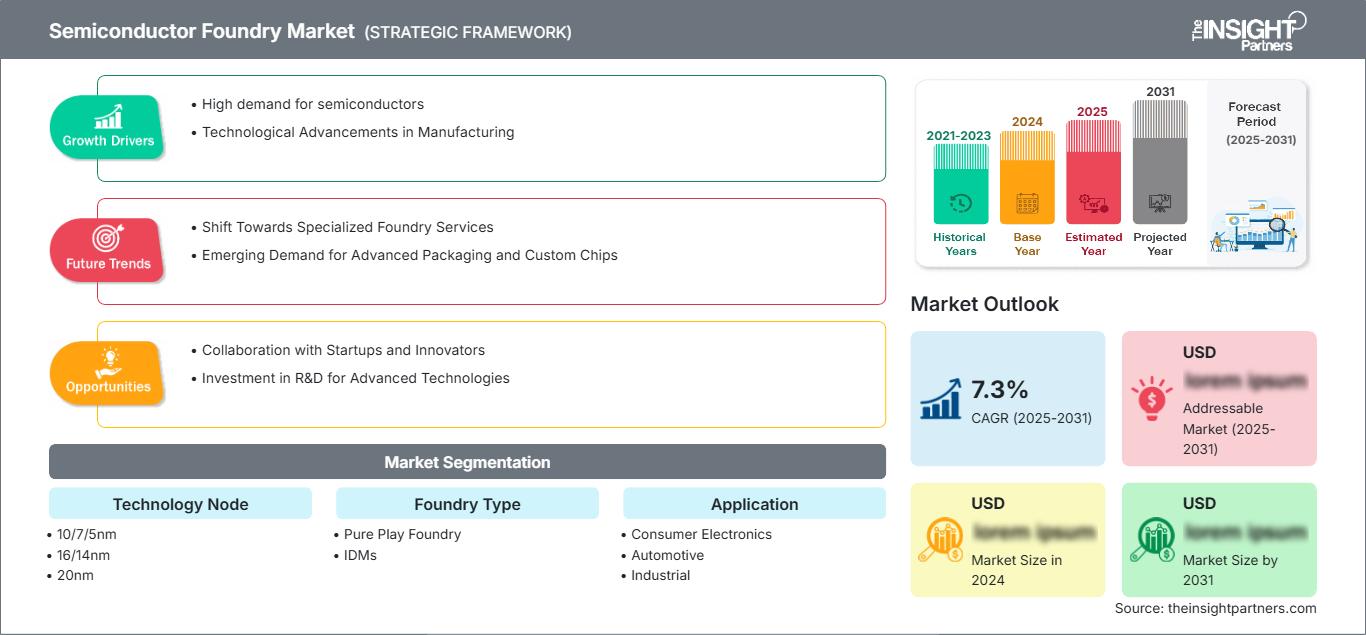
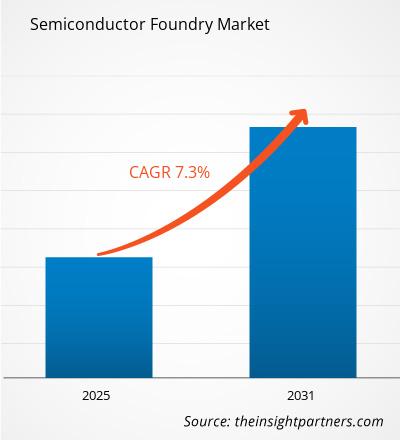
The Semiconductor Foundry Market size is projected to grow from US$ 100.4 Billion in 2025 to US$ 150.19 Billion by 2034; it is expected to register a CAGR of 4.58% from 2026 to 2034. Demand is expanding as fabless chipmakers, integrated device manufacturers, and system companies outsource wafer production for advanced logic, specialty analog, connectivity, and power management devices.
According to the Semiconductor Foundry Market report, North America is forecast to grow at a CAGR of 3.8–4.2% from 2026 through 2034, owing to reshoring, demand for AI infrastructure, and foundries with capabilities to serve the automotive, aerospace, defense, and industrial electronics segments. This region enjoys strengths such as a chip-design ecosystem, increasing investments in wafer fabrication, and supply chain localization, even though Asian capacity will remain key to volume economics.
Semiconductor Foundry Market Assessment and Insights
- North America: The region accounted for 12–15% share in 2025 and is projected to grow at a 3.8–4.2% CAGR between 2026–2034, led by AI servers, defense electronics, automotive chips, and policy-backed domestic fabrication.
- US: The US represented 78–82% of North America in 2025 and is expected to expand at a 3.9–4.3% CAGR, supported by advanced packaging, cloud infrastructure, and foundry investments.
- Europe: Europe held 8–11% share in 2025 and is forecast to grow at a 3.2–3.7% CAGR, with Germany, France, and the UK leading automotive, industrial, and secure electronics demand.
- Asia Pacific: Asia Pacific captured 68–72% share in 2025 and is anticipated to grow at a 4.9–5.4% CAGR, led by Taiwan, South Korea, China, and Japan across leading-edge and mature-node production.
- Largest Segment: Pure Play Foundry held 70–74% market share in 2025 and is projected to grow at a 4.7–5.2% CAGR, reflecting fabless reliance on outsourced manufacturing scale.
- High Growth Segment: 10/7/5nm accounted for 28–32% market share in 2025 and is forecast to grow at a 6.1–6.8% CAGR, driven by AI accelerators, smartphones, and high-performance computing.
- Key companies analyzed in detail: Taiwan Semiconductor Manufacturing Company Limited, Samsung Electronics Co., Ltd., Intel Corporation, GlobalFoundries Inc., United Microelectronics Corporation, Semiconductor Manufacturing International Corporation, Hua Hong Semiconductor Limited, Tower Semiconductor Ltd., Vanguard International Semiconductor Corporation, Powerchip Semiconductor Manufacturing Corporation.
Source: The Insight Partners' analysis based on proprietary research, government publications, company annual reports, investor presentations, industry databases, and expert interviews.
There has been a shift in the Semiconductor Foundry Market from capacity-focused outsourcing to technology-focused partnerships. There has been a concentration of leading-edge demand for 10/7/5nm nodes in artificial intelligence accelerators, premium mobile phones, and HPC chips, while 45/40nm and other mature nodes have been essential for automotive and power management applications. Therefore, the Semiconductor Foundry Market share is influenced by node leadership, yields, packaging access, and customer commitments within multi-year wafer supply deals.
In the next few years, new fabrication centers will be established in the US, Japan, India, and Europe, but this will not displace the size advantage still enjoyed by the Asia Pacific region. It is government incentives, export controls, and the need for a trusted supply chain that have expanded the scope of the Semiconductor Foundry Market beyond being simply cost-oriented.
Semiconductor Foundry Market Report Scope
| Report Attribute | Details |
|---|---|
| Market size in 2025 | US$ 100.4 Billion |
| Market Size by 2034 | US$ 150.19 Billion |
| Global CAGR (2026 - 2034) | 4.58% |
| Historical Data | 2021-2024 |
| Forecast period | 2026-2034 |
Semiconductor Foundry Market Analysis
Demand is driven by compute-centric workload trends, connected devices, electric vehicle trend, and industrial automation. Semiconductor industry revenues exceeded US$ 630 billion in 2024 and are set to rise in 2025, supporting wafer demand for logic, memory, adjacent controller, sensor, and connectivity chips. The Semiconductor Foundry Market size gains from this trend, as fabless clients need capacity outside their own fabs to shorten time-to-market for products.
Supply trends continue to vary by node. Advanced nodes have limited capacity due to EUV technology, process integration complexity, and packaging limitations, whereas utilization of mature nodes depends on demand for automotive chips, display drivers, power chips, and microcontrollers. According to the Semiconductor Foundry Market analysis, customers are increasingly using both leading-edge and specialty foundries to share risk.
The competitive environment has narrowed at the forefronts but broadened at the specialty-node level. Taiwan Semiconductor Manufacturing Company Limited and Samsung Electronics Co., Ltd. are leading the competition in advanced process technologies, while Intel Corporation has shifted its manufacturing focus to external partners. GlobalFoundries Inc., United Microelectronics Corporation, Tower Semiconductor Ltd., and Vanguard International Semiconductor Corporation remain significant in differentiated mature processes.
Investment has now focused on ecosystem control rather than just wafer capacity. Advanced packaging, design enablement, intellectual property libraries, automotive qualification, and secure manufacturing have emerged as differentiating factors. Semiconductor Manufacturing International Corporation, Hua Hong Semiconductor Limited, and Powerchip Semiconductor Manufacturing Corporation are enhancing regional supply chain security, while international firms are investing in AI, automotive, and sovereign semiconductor initiatives.
● REPORT CUSTOMIZATION
Tailor This Report To Align With Your Specific Business Requirements
This report can be customized to align precisely with your business objectives, scope, and target markets. Customization options include tailored segmentation, geography, competitive analysis, and strategic insights to support informed decision-making.
Customize This Report →WHAT YOU CAN ADJUST
- ● Segmentations
- ● Geography
- ● Competitive Analysis
- ● Language Preferences
Semiconductor Foundry Market: Strategic Insights
Regional Insights
North America Semiconductor Foundry
In 2025, North America held a 12-15% market share, and it is forecast to grow at a CAGR of 3.8-4.2%. Drivers of demand include AI data centers, defense electronics, automotive compute, and security of the supply chain. Public policies and investments have made wafer fabrication better within the country; however, high-volume wafer fabrication uses an Asia-based ecosystem due to cost considerations and supply.
The strengths of North America include semiconductor chip design, EDA, cloud customers, and demand for advanced packaging. Semiconductor Foundry Market in North America highlights that customers are focused on trusted capacity for aerospace, communications, and industrial control applications.
U.S. Semiconductor Foundry Market
The US represented 78–82% of North America in 2025 and is forecast to expand at a 3.9–4.3% CAGR. Demand is supported by hyperscale AI infrastructure, automotive electronics, and defense-grade manufacturing needs. Intel Corporation, GlobalFoundries Inc., and new overseas investments are strengthening the domestic foundry base.
The Semiconductor Foundry Market forecast suggests that trends include AI accelerators, network chips, power management ICs, and secure microcontrollers. The US market is not only increasing wafer capacity but also increasing advanced packaging and design enablement capabilities. This approach enables the customer to minimize disruption to their supply chain and support the growth of the Semiconductor Foundry in critical applications.
Europe Semiconductor Foundry Market
Europe held 8–11% share in 2025 and is expected to grow at a 3.2–3.7% CAGR, with Germany as the leading country. The UK market is oriented toward design, compound semiconductors, defense electronics, and automotive-adjacent innovation rather than large-scale logic manufacturing.
Germany serves as the manufacturing anchor for the region due to its requirements for skilled wafer manufacturing and production lifecycle. Foundry demand is driven by the need for vehicle electrification, factory automation, and power infrastructure, thereby making mature and specialty nodes critical.
France, Italy, and Spain contribute to the manufacturing needs through their demand in aerospace, telecommunications, smart infrastructure, and industrial electronics sectors. European policies have been supportive of regional manufacturing needs; however, the region remains very selective in its approach.
APAC Semiconductor Foundry Market
APAC captured 68-72% market share in 2025 and will continue to grow at a CAGR of 4.9-5.4%, driven by Taiwan. China, South Korea, Japan, and India will drive demand for smartphones, AI servers, automotive semiconductors, and industrial localization.
Taiwan and South Korea lead in advanced nodes and packaging; China focuses on mature nodes and localization and domestic demand; and Japan provides materials, equipment, and specialty production. India will develop its industry through policy support and electronics manufacturing.
Australia plays a less significant role in research, military applications, and semiconductor programs. Local supply chain development will be stimulated by regional industrial policies; however, the core APAC advantage lies in scale, supply chain density, engineering expertise, and high utilization.
Middle East & Africa Semiconductor Foundry Market
Middle East & Africa is forecast to grow at a 3.1–3.6% CAGR from a smaller base. Saudi Arabia and the UAE are investing in digital infrastructure, AI data centers, and industrial diversification, creating downstream demand for semiconductor-enabled systems.
South Africa participates via telecommunications, mining automation, energy, and industrial control systems. The rest of MEA will continue to depend on smart cities, renewable energy, logistics, and defense communications rather than on local wafer fabrication capacity.
UAE emerges as the most prominent player in terms of technology investment intensity. The MEA Semiconductor Foundry Market's potential is indirect; it centers on purchasing chips, securing supply chain agreements, and possibly specialized packaging/design services.
Segmentation Analysis
Technology Node
Technology Node is projected to grow at a 4.6–5.1% CAGR from 2026 to 2034. Advanced nodes capture premium demand from AI, smartphones, and high-performance computing, while mature nodes sustain automotive, industrial, connectivity, and power applications. Foundries must balance capital-intensive scaling with stable long-tail production across qualified platforms.
- 10/7/5nm nodes hold strategic importance for AI accelerators, application processors, and networking silicon, where density, power efficiency, and packaging integration determine customer competitiveness.
- 16/14nm remains relevant for cost-efficient performance chips, mid-range mobile processors, connectivity devices, and automotive compute platforms requiring proven yields and long qualification cycles.
- 20nm supports select consumer, communication, and embedded applications where customers prioritize design reuse, predictable wafer pricing, and stable process availability over frontier scaling.
- 45/40nm serves microcontrollers, display drivers, power management, industrial control, and automotive electronics, providing durable demand through reliability, analog integration, and lifecycle support.
Foundry Type
Foundry Type is expected to register a 4.4–4.9% CAGR between 2026 and 2034. Pure play foundries benefit from fabless chip design expansion and multi-customer scale, while IDMs are opening capacity to external customers to improve utilization, monetize process expertise, and participate in regional supply-chain resilience programs.
- Pure Play Foundry dominates outsourced wafer manufacturing because customers value neutral manufacturing, broad process portfolios, strong design enablement, and high-volume execution across multiple end markets.
- IDMs are gaining relevance as strategic alternatives for secure supply, automotive qualification, and regional manufacturing, especially where integrated design, process, and packaging capabilities support differentiated products.
Application
Application demand is projected to grow at a 4.5–5.0% CAGR from 2026 to 2034. Consumer electronics and communication drive volume, automotive and industrial applications improve margin stability, and computer workloads create advanced-node intensity. Foundries are aligning capacity planning with customer roadmaps across AI, 5G, electrification, and automation.
- Consumer Electronics generates high-volume wafer demand through smartphones, wearables, tablets, and smart devices, where product refresh cycles require rapid ramp-up and power-efficient silicon.
- Automotive demand is expanding through electrification, ADAS, infotainment, and zonal architectures, with foundries prioritizing quality systems, reliability standards, and long lifecycle commitments.
- Industrial applications rely on mature and specialty nodes for automation, robotics, energy systems, and sensors, where stability, ruggedness, and continuity of supply matter more than node migration.
- Communication applications require RF, networking, baseband, and optical-related chips, supporting foundry demand from 5G densification, data traffic growth, and edge connectivity infrastructure.
- Computer applications increasingly depend on advanced logic, chiplets, and packaging for AI PCs, servers, accelerators, and high-performance processors, making node access strategically decisive.
Opportunity Snapshot
| Segment Name | Revenue Contribution | Trend Tag | Adoption Stage |
| Consumer Electronics | High | AI Devices | Mature |
| Automotive | Medium | Software Vehicles | Scaling |
| Industrial | Medium | Factory Edge | Scaling |
| Communication | High | 5G Networks | Mature |
| Computer | High | AI Servers | Scaling |
Semiconductor Foundry Market Growth Drivers and Impact Analysis
AI Workloads Increase Advanced-Node Wafer Demand
The need for complex logic, high-bandwidth memory interfaces, and chiplet architecture is rising due to the growing requirements of AI training, inference, and data center networking. The fabs offering 10/7/5 nm node capability, along with advanced packaging technology,, are getting premium wafer starts owing to the AI accelerator’s need for high transistor density, power efficiency, and predictable yield learning.
Automotive Electronics Extend Mature-Node Visibility
The growing trends of electrified vehicles, ADAS, infotainment, battery management, and zonal controllers have been contributing to the rising semiconductor content per car. The automotive applications do not always benefit from moving to the latest technology nodes due to their reliability requirements and the lifetime of silicon, which are more important than a fast transition. As a result, a steady foundry demand for 45/40nm and similar specialty technologies emerges.
Supply-Chain Localization Reshapes Customer Sourcing
There is now pressure on governments and strategic customers to adopt geographic diversity to address supply disruptions that have highlighted the risks associated with the concentration of wafer fab capacity. The incentives driving these changes in the US, Europe, Japan, and India are shifting the sourcing discussion from one based on lowest cost to one focused on trust and resilience in manufacturing operations. This driver helps new fabs get off the ground, but also adds execution challenges.
Semiconductor Foundry Market Future Trends
Chiplet Manufacturing Becomes a Foundry Differentiator
Chiplet adoption will make foundry competitiveness less dependent on transistor scaling alone. Customers will evaluate process nodes, interconnect density, packaging roadmaps, thermal performance, and known-good-die ecosystems as one manufacturing decision. This trend favors providers that can support heterogeneous integration across compute, memory, analog, and RF functions. Over time, design enablement kits and packaging-qualified IP will influence wafer allocation as much as raw process leadership.
Specialty Nodes Gain Strategic Relevance
Specialty technologies such as embedded nonvolatile memory, RF, power management, image sensors, silicon photonics, and high-voltage processes will gain importance as end markets diversify. These platforms do not always require the smallest nodes, but they demand process stability, application-specific performance, and long-term supply. Foundries with differentiated mature-node portfolios can improve pricing resilience and customer retention, especially in automotive, industrial, communication, and energy infrastructure applications.
Semiconductor Foundry Market Opportunities
Automotive-Grade Capacity Partnerships
Automakers and Tier 1 suppliers need predictable access to microcontrollers, power devices, sensors, and compute chips across long vehicle platforms. Foundries can convert this requirement into durable revenue by offering automotive-qualified capacity, failure-analysis support, and lifecycle guarantees. The opportunity is strongest where customers want dual sourcing without redesigning critical components. Investment in quality systems, traceability, and regional production can strengthen supplier selection and reduce future shortage exposure.
Regional Advanced Packaging Ecosystems
Advanced packaging capacity is becoming a gating factor for AI accelerators, high-performance processors, and chiplet-based systems. Foundries can capture greater value by integrating wafer fabrication with packaging, testing, substrate partnerships, and thermal validation. Regional packaging ecosystems also support supply-chain resilience because customers can qualify more production steps closer to end markets. This opportunity favors coordinated investment among foundries, OSAT providers, material suppliers, and large system customers.
Recent Developments
- June 2026: The Semiconductor Industry Association (SIA) announced the support for the expansion of Coherent’s indium phosphide manufacturing facility in Sherman, Texas. Indium phosphide-based photonic devices are essential components in the high-speed optical interconnects that powers AI systems, advanced communications networks, and next-generation data centers.
- February 2025: In the Union Budget 2026–27, India Semiconductor Mission 2.0 is announced to strengthen domestic semiconductor capabilities. ISM 2.0 would aim to manufacture semiconductors and semiconductors' equipment in India, develop Indian semiconductors' Intellectual Property (IP) and strengthen the supply chain.
- January 2026: The year 2025 saw many facilities set up by semiconductor manufacturers amid onshoring activities all over the world involving manufacturing, materials, packaging, designing, and research and development. Funding came from both the industry and the government sectors. Collaborations were made in order to address today's technological issues ranging from high requirements of AI chips and memory to complicated technologies like robotics and autonomous cars. Other than artificial intelligence, which is present everywhere, other popular areas of funding included photonics, SiC, and power ICs.
Frequently Asked Questions

- Comprehensive Market Sizing and Forecast Analysis
- Detailed Segmentation Analysis
- In-Depth Market Dynamics Assessment
- Regional and Country-Level Insights
- Competitive Landscape and Company Benchmarking
- Strategic Business Intelligence
Recent Reports
Testimonials

The Insight Partners' SCADA System Market report is comprehensive, with valuable insights on current trends and future forecasts. The team was highly professional, responsive, and supportive throughout. We are very satisfied and highly recommend their services.
RAN KEDEM Partner, Reali Technologies LTDs
I requested a report on a very specific software market and the team produced the report in a few days. The information was very relevant and well presented. I then requested some changes and additions to the report. The team was again very responsive and I got the final report in less than a week.
JEAN-HERVE JENN Chairman, Future Analytica
We worked with The Insight Partners for an important market study and forecast. They gave us clear insights into opportunities and risks, which helped shape our plans. Their research was easy to use and based on solid data. It helped us make smart, confident decisions. We highly recommend them.
PIYUSH NAGPAL Sr. Vice President, High Beam Global
The Insight Partners delivered insightful, well-structured market research with strong domain expertise. Their team was professional and responsive throughout. The user-friendly website made accessing industry reports seamless. We highly recommend them for reliable, high-quality research services
YUKIHIKO ADACHI CEO, Deep Blue, LLC.
This is the first time I have purchased a market report from The Insight Partners.While I was unsure at first, I visited their web site and felt more comfortable to take the risk and purchase a market report.I am completely satisfied with the quality of the report and customer service. I had several questions and comments with the initial report, but after a couple of dialogs over email with their analyst I believe I have a report that I can use as input to our strategic planning process.Thank you so much for taking the extra time and making this a positive experience.I will definitely recommend your service to others and you will be my first call when we need further market data.
JOHN SUZUKI President and Chief Executive Officer, Board Director, BK Technologies
I wish to appreciate your support and the professionalism you displayed in the course of attending to my request for information regarding to infectious disease IVD market in Nigeria. I appreciate your patience, your guidance, and the fact that you were willing to offer a discount, which eventually made it possible for us to close a deal. I look forward to engaging The Insight Partners in the future, all thanks to the impression you have created in me as a result of this first encounter.
DR CHIJIOKE ONYIA MANAGING DIRECTOR, PineCrest Healthcare Ltd.Reason to Buy
- Informed Decision-Making
- Understanding Market Dynamics
- Competitive Analysis
- Identifying Emerging Markets
- Customer Insights
- Market Forecasts
- Risk Mitigation
- Boosting Operational Efficiency
- Strategic Planning
- Investment Justification
- Tracking Industry Innovations
- Aligning with Regulatory Trends





 Get Free Sample for