
Semiconductor Rectifiers Market Size, Growth & Demand by 2034
Coverage: By Product Type (Single Phase, Three Phase); Industry Vertical (Automotive, Consumer Electronics, Power and Utility, IT and Telecom, Others) , and Geography (North America, Europe, Asia Pacific, and South and Central America)
- Status : Data Released
- Report Code : TIPRE00019106
- Category : Electronics and Semiconductor
- No. of Pages : 150
- Available Report Formats :


- Last update date : July 13, 2026


2025 Market Size
US$ 5.26 Bn
Base year value
2034 Forecast
US$ 7.96 Bn
Projected by 2034
CAGR 2026-2034
4.71 %
Growth rate
Addressable Market
US$ 60.01 Bn
(2026-2034)
The global Semiconductor Rectifiers market was valued at US$ 5.26 billion in 2025 and is expected to reach US$ 7.96 billion by 2034; it is estimated to record a CAGR of 4.71% during 2026-2034.
Semiconductor Rectifiers Market Assessment and Insights
- North America: The region accounted for 24–27% share in 2025 and is growing at a CAGR of 4.8–5.2% between 2026–2034, led by EV charging, utility upgrades, and data-center power supplies.
- US: The country represented 78–82% of North America in 2025 and is growing at a CAGR of 4.9–5.3% between 2026–2034, supported by domestic power semiconductor capacity.
- Europe: The region held 18–21% share in 2025 and is growing at a CAGR of 4.5–4.9% between 2026–2034, with Germany, France, and the UK leading automotive and industrial demand.
- Asia Pacific: The region captured 43–46% share in 2025 and is growing at a CAGR of 5.8–6.2% between 2026–2034, led by China, Japan, South Korea, and India.
- Largest Segment: Single Phase held 58–62% share of the Semiconductor Rectifiers market in 2025 and is growing at a CAGR of 4.9–5.3% between 2026–2034 due to broad consumer and telecom deployment.
- High Growth Segment: Automotive held 22–25% market share in 2025 and is growing at a CAGR of 6.2–6.7% between 2026–2034 as electrified platforms raise rectifier content.
- Key companies analyzed in detail: Infineon Technologies AG, Vishay Intertechnology, Inc., onsemi, STMicroelectronics N.V., Diodes Incorporated, Nexperia B.V., Toshiba Electronic Devices & Storage Corporation, ROHM Co., Ltd., Littelfuse, Inc., Microchip Technology Incorporated.
Source: The Insight Partners' analysis based on proprietary research, government publications, company annual reports, investor presentations, industry databases, and expert interviews.
The technology of semiconductor rectifiers has evolved from generic silicon-based rectifier production to application-specific performance-oriented procurement that depends on leakage currents, thermal resistivity, surge capability, and packaging footprint. The dynamics of production have also changed, driven by the need for automotive and telecom customers to procure their supplies from a chain of qualified suppliers and to support longer life cycle with better system-level efficiency.
Future demand will continue to grow as developing countries deploy their charging infrastructures, renewable energy generation, telecommunications densification, and industrial electric drives. Policies encouraging domestic semiconductor ecosystems in the US, Europe, India, Japan, and South Korea ensure future supply security. The Semiconductor Rectifiers Market scope will therefore move from mere component replacement to engineering power conversion reliability solutions for mobility, grid, electronics, and digital infrastructures.
Semiconductor Rectifiers Market Report Scope
| Report Attribute | Details |
|---|---|
| Market size in 2025 | US$ 5.26 Billion |
| Market Size by 2034 | US$ 7.96 Billion |
| Global CAGR (2026 - 2034) | 4.71% |
| Historical Data | 2021-2024 |
| Forecast period | 2026-2034 |
Semiconductor Rectifiers Market Analysis
The demand is driven by applications in which the stability of the DC supply, the compactness of power supplies, and temperature control affect equipment reliability. In automotive applications, rectifiers are used in alternators, onboard chargers, lighting systems, battery management, and auxiliary converters, whereas in consumer electronics, low-loss technology is deployed in adapters and home appliances. Bridge and high-current rectifiers are used in power and utilities for inverters, protection circuitry, and grid-connected converter systems.
The value chain comprises wafer manufacturing, epitaxy process, packaging, qualification, distribution, and OEM integration. The supply depends on the availability of substrates, product qualification on the automotive application platform, and trade policies in certain regions. In the context of Semiconductor Rectifiers Market analysis, it has been analyzed that customers are increasingly judging the total system efficiency and not unit pricing, especially in high-duty-cycle equipment.
The competitive landscape is moderately fragmented, with global providers competing on the basis of package density, voltage range, heat dissipation capability, and longevity. Infineon Technologies AG, Vishay Intertechnology, Inc., onsemi, STMicroelectronics N.V., and Diodes Incorporated are competitors offering products in their standard, Schottky, ultrafast, and bridge rectifiers’ product lines. Nexperia B.V. and ROHM Co., Ltd. have gained a foothold in small-sized and automotive-certified products.
Investments in capabilities are directed toward wide band-gap capability, automated assembly, leadless packages, and localized customer engineering support. Toshiba Electronic Devices & Storage Corporation, Littelfuse, Inc., and Microchip Technology Incorporated have positioned themselves in highly reliability-dependent use cases where surge protection and documentation matter. Strategic positioning will require an ever-growing emphasis on application design in partnership with OEMs.
● REPORT CUSTOMIZATION
Tailor This Report To Align With Your Specific Business Requirements
This report can be customized to align precisely with your business objectives, scope, and target markets. Customization options include tailored segmentation, geography, competitive analysis, and strategic insights to support informed decision-making.
Customize This Report →WHAT YOU CAN ADJUST
- ● Segmentations
- ● Geography
- ● Competitive Analysis
- ● Language Preferences
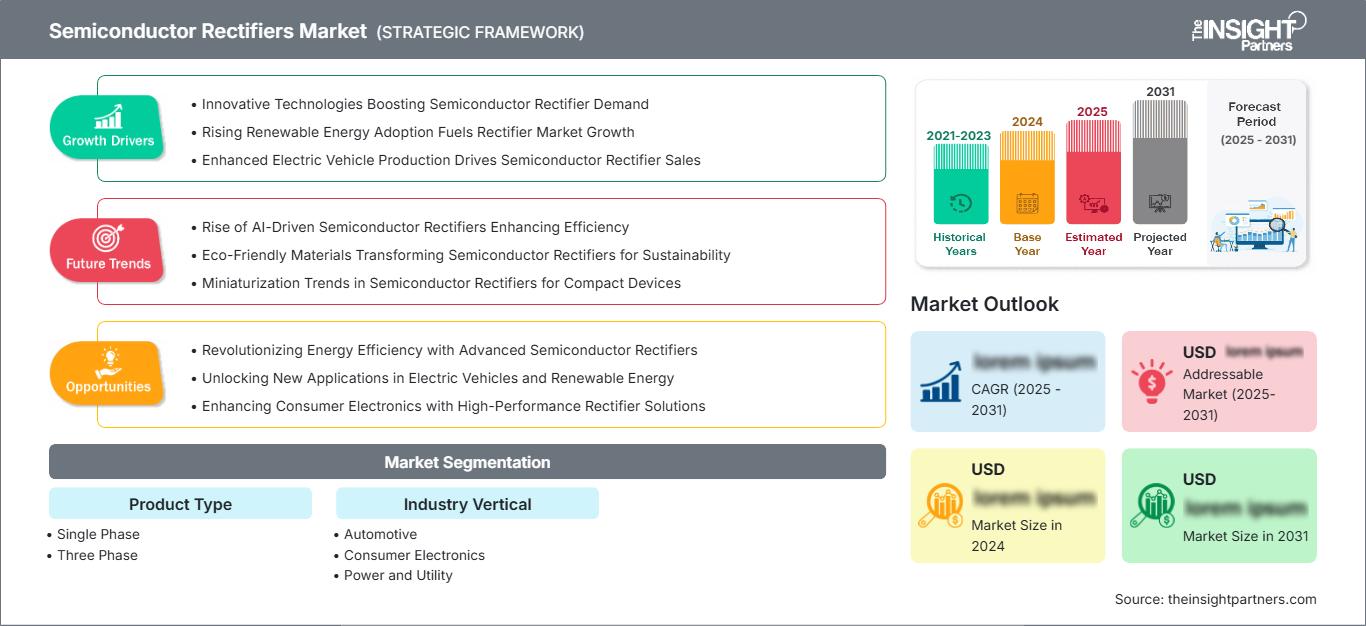
Semiconductor Rectifiers Market: Strategic Insights
Regional Insights
North America Semiconductor Rectifiers
North America accounted for 24-27% share in 2025 and will experience a CAGR of 4.8-5.2% during 2034. The demand is mainly driven by automotive electrification, cloud computing infrastructure, military electronics, and grid modernization. The IEA highlights the continued growth in electric mobility infrastructure, as well as increased data center power density demanding for an efficient AC-DC stage.
The regional sourcing is becoming increasingly important in the wake of increasing demands for supply security, AEC parts, and life-cycle awareness. The Semiconductor North America Rectifiers market share gains strength from production incentives in the US, utility resilience, high content per vehicle, and telecom power systems with requirements for surge protection.
U.S. Semiconductor Rectifiers Market
The US represented 78–82% of North American demand in 2025 and is expected to grow at a CAGR of 4.9–5.3% between 2026 and 2034. Adoption is strongest in EV charging hardware, industrial controls, communication power supplies, and renewable integration. Domestic semiconductor funding encourages qualification of local and allied supply chains.
Company presence includes design, sales, distribution, and application engineering from onsemi, Diodes Incorporated, Vishay Intertechnology, Inc., Microchip Technology Incorporated, and Littelfuse, Inc. Application trends favor compact Schottky devices for adapters, ultrafast rectifiers for switching supplies, and higher-voltage products for charging, solar, and industrial energy systems.
Europe Semiconductor Rectifiers Market
Europe held 18–21% share in 2025 and is projected to expand at a CAGR of 4.5–4.9% through 2034. The UK Semiconductor Rectifiers market is shaped by offshore wind connections, charging infrastructure, and electronics manufacturing niches that require efficient conversion in power supplies, rail systems, and industrial automation.
Germany leads the European countries due to automotive electronics, industrial drives, and renewable power equipment. The demand includes automotive rectifiers, SiC-capable systems, and highly reliable parts for manufacturing machines. Qualified suppliers who can fulfill the need for documentation, traceability, and extended product cycle are preferred by OEMs.
Aerospace electronics, utility upgradation, appliances, and solar power installation from France, Italy, and Spain add value to the Semiconductor Rectifiers Market forecast. Focus on electrification and energy efficiency in policies boosts the forecast of the market in connection with grid-tied conversion and industrial upgrade.
APAC Semiconductor Rectifiers Market
APAC holds a share of 43-46% in 2025 and is estimated to grow at a CAGR of 5.8-6.2% from 2026 to 2034. The region leads in electronics assembly, EV assembly, solar inverters, and industrial automation owing to advantages related to scale economies in sourcing components and integration into systems.
Japan and South Korea contribute with their electronics for automobiles, power devices, robotics, and advanced packaging. The suppliers focus on low leakage, high surge currents, and compact designs for consumer electronics and mobility systems.
India and Australia provide additional growth opportunities for the market through expansion in telecommunication, solar energy, electrification of infrastructure, and industrial equipment demand.
Middle East & Africa Semiconductor Rectifiers Market
Middle East & Africa is expected to grow at a CAGR of 4.2–4.6% through 2034. Saudi Arabia is the leading country as grid reinforcement, industrial diversification, and solar procurement raise demand for robust power-conversion components.
UAE is responsible for making contributions through data centers, smart infrastructure, airport and distributed generation facilities. Rectifiers find application in UPS systems, telecom power applications, lighting control systems and building management systems where continuity and thermal stability are critical.
South Africa and the Rest of MEA contribute to the demand in mining operations, backup power, transmission system and off-grid solar power applications. Harsh operating environments require high surge capacity and robust packages.
Segmentation Analysis
Product Type
Product type is projected to grow at a CAGR of 5.0–5.5% between 2026 and 2034 as customers balance cost, efficiency, and installation complexity. Selection depends on load profile, voltage stability, phase configuration, and thermal headroom. Single phase remains broad-based, while three phase gains relevance in industrial, utility, and high-power charging systems.
- Single Phase devices dominate low-to-medium power conversion in appliances, adapters, lighting, and telecom equipment. Their strategic role comes from broad availability, simple integration, and cost-efficient replacement cycles.
- Three Phase rectifiers serve industrial drives, grid equipment, EV charging, and utility conversion where balanced loads, higher current handling, and operational durability are essential for system reliability.
Industry Vertical
Industry vertical demand is projected to grow at a CAGR of 5.3–5.8% during 2026–2034, reflecting broader electrification and digital infrastructure investment. Automotive is the high-growth vertical, while consumer electronics provide volume stability. Power and utility applications emphasize ruggedness, and IT and telecom systems prioritize efficient, compact, always-on conversion.
- Automotive demand is driven by EV platforms, charging systems, lighting, infotainment, and battery management. Rectifier reliability directly affects thermal performance, vehicle uptime, and qualification confidence.
- Consumer Electronics remains a volume engine through adapters, appliances, displays, gaming devices, and wearables. Buyers prioritize compact packages, low forward voltage, and stable supply at competitive cost.
- Power and Utility applications use rectifiers in inverters, protection circuits, substations, and renewable systems. Strategic importance rises with grid upgrades, storage integration, and decentralized energy assets.
- IT and Telecom demand reflects 5G base stations, servers, routers, UPS systems, and optical networks. Efficiency and uptime requirements favor low-loss rectifiers and dependable sourcing.
Opportunity Snapshot
| Industry Vertical | Revenue Contribution | Trend Tag | Adoption Stage |
| Automotive | High | EV Power | Scaling |
| Consumer Electronics | High | Compact Adapters | Mature |
| Power and Utility | Medium | Grid Inverters | Scaling |
| IT and Telecom | Medium | 5G Power | Scaling |
Semiconductor Rectifiers Market Growth Drivers and Impact Analysis
Electrification Raises Power Conversion Content
Vehicle electrification is significantly increasing the number of rectification points across modern transportation systems. These rectifiers are essential in onboard chargers, DC-DC converters, LED lighting, auxiliary power modules, battery management systems, and charging infrastructure. As electric vehicle (EV) adoption continues to accelerate, demand for reliable and efficient power electronics is expanding throughout the mobility ecosystem. According to the International Energy Agency (IEA), electric car sales continued to grow in 2025, further strengthening the need for advanced semiconductor and rectification technologies.
This growth is creating practical challenges and opportunities for automotive manufacturers. Original equipment manufacturers (OEMs) increasingly require components that deliver lower power losses, higher efficiency, and the ability to operate reliably under elevated temperatures and demanding driving conditions. In addition, automakers place greater emphasis on automotive-grade quality standards, qualification testing, traceability, and long-term documentation support. As a result, purchasing decisions are shifting away from simple catalog availability toward validated, application-proven platforms that can support vehicle programs for many years while minimizing warranty costs, maintenance issues, and overall lifecycle risk.
Digital Infrastructure Expands Always-On Power Loads
Cloud computing expansion, artificial intelligence (AI) workloads, edge computing deployments, and telecom network densification are significantly increasing the demand for continuous and efficient power conversion across digital infrastructure. Data centers, hyperscale cloud facilities, 5G base stations, routers, switches, and uninterruptible power supply (UPS) systems all rely on rectifiers to convert alternating current (AC) into stable direct current (DC) power for critical operations. As these systems operate around the clock, even minor improvements in rectifier efficiency can generate substantial energy savings and reduce overall operating expenses.
The growing intensity of AI processing and high-performance computing further elevates power requirements, placing greater emphasis on advanced rectification technologies that can handle higher loads while maintaining efficiency and reliability. Consequently, equipment manufacturers are adopting stricter performance specifications, including tighter leakage-current limits, enhanced thermal management, detailed power-loss modeling, and robust redundancy architectures to ensure uninterrupted service.
Renewable Integration Requires Reliable Conversion
Solar, wind, storage, and distributed energy assets depend on rectification and power-conditioning stages that can withstand variable loads and harsh environments. The IEA has highlighted sustained clean-energy investment, which increases the installed base of inverters, chargers, protection circuits, and control equipment. The Semiconductor Rectifiers Market impact is visible in demand for higher-voltage, thermally robust rectifiers with strong surge handling. Utilities and system integrators also favor suppliers that can provide consistent documentation, traceability, and regional support for long-duration infrastructure projects.
Semiconductor Rectifiers Market Future Trends
Wider Adoption of SiC and Advanced Packaging
Future product roadmaps will increasingly combine silicon carbide, low-profile packaging, copper-clip interconnects, and improved thermal paths. These technologies are not expected to replace silicon in every application, but they will gain share where efficiency, high switching frequency, and compact design justify higher component cost. The Semiconductor Rectifiers Market trends indicate that suppliers able to scale advanced packages while maintaining automotive and industrial qualification will capture premium opportunities in charging, renewable conversion, and high-density power supplies.
Regionalized Supply Chains and Qualification Discipline
Procurement strategies are moving toward regional resilience, dual sourcing, and deeper qualification records. Automotive, defense, telecom, and utility customers increasingly want visibility into wafer origin, assembly sites, product-change notices, and long-term availability. This trend will favor suppliers with distributed manufacturing, application engineering, and strong quality systems. It may also reduce buyer dependence on the lowest-cost source when lifecycle risk, regulatory exposure, and downtime penalties are material to project economics.
Semiconductor Rectifiers Market Opportunities
Application-Specific Rectifier Platforms for EV Charging
Charging equipment manufacturers need rectifiers optimized for heat dissipation, compact board layouts, surge events, and long service intervals. Suppliers can create value by offering platform families that cover residential, workplace, fleet, and public charging designs with consistent qualification data. The investment opportunity lies in co-development with charger OEMs, reference designs, and regional technical support. Companies that reduce design validation time while improving energy efficiency can win repeat sockets as charging networks scale.
High-Reliability Products for Grid and Industrial Systems
Grid modernization, factory automation, mining equipment, and renewable power plants require rectifiers that tolerate electrical stress, temperature variation, and maintenance constraints. Suppliers can target this opportunity with rugged bridge rectifiers, fast-recovery devices, and documentation packages tailored to infrastructure procurement. The commercial advantage comes from lowering field failures and simplifying qualification for engineers. Semiconductor Rectifiers Market participants with strong distributor coverage and technical service can expand in projects where reliability outweighs marginal component price differences.
Recent Developments
- May 2026: The Government of India has been making all possible efforts to build up a resilient and trustworthy semiconductor ecosystem within the country. As a part of the Semicon India Programme, till now, 12 Fab/Packaging and 24 semiconductors design projects have been approved by the government.
- April 2026: Vishay Intertechnology, Inc. launched 16 FRED Pt ultrafast rectifiers in the new low-profile DFN6546A package with wettable flanks. These compact and efficient components for commercial, industrial, and automotive applications come in voltages of 200 V and offer current ratings ranging from 6 A to 15 A.
- July 2024: The rectifiers have been launched by Nexperia in a D2PAK package called Real-to-Pin. The wide range of applications that can be served by these rectifiers includes charging adapters, PV systems, inverters, servers, and SMPS and are suitable for the automotive, industrial, and consumer industries.
Frequently Asked Questions

- Comprehensive Market Sizing and Forecast Analysis
- Detailed Segmentation Analysis
- In-Depth Market Dynamics Assessment
- Regional and Country-Level Insights
- Competitive Landscape and Company Benchmarking
- Strategic Business Intelligence
Recent Reports
Testimonials

The Insight Partners' SCADA System Market report is comprehensive, with valuable insights on current trends and future forecasts. The team was highly professional, responsive, and supportive throughout. We are very satisfied and highly recommend their services.
RAN KEDEM Partner, Reali Technologies LTDs
I requested a report on a very specific software market and the team produced the report in a few days. The information was very relevant and well presented. I then requested some changes and additions to the report. The team was again very responsive and I got the final report in less than a week.
JEAN-HERVE JENN Chairman, Future Analytica
We worked with The Insight Partners for an important market study and forecast. They gave us clear insights into opportunities and risks, which helped shape our plans. Their research was easy to use and based on solid data. It helped us make smart, confident decisions. We highly recommend them.
PIYUSH NAGPAL Sr. Vice President, High Beam Global
The Insight Partners delivered insightful, well-structured market research with strong domain expertise. Their team was professional and responsive throughout. The user-friendly website made accessing industry reports seamless. We highly recommend them for reliable, high-quality research services
YUKIHIKO ADACHI CEO, Deep Blue, LLC.
This is the first time I have purchased a market report from The Insight Partners.While I was unsure at first, I visited their web site and felt more comfortable to take the risk and purchase a market report.I am completely satisfied with the quality of the report and customer service. I had several questions and comments with the initial report, but after a couple of dialogs over email with their analyst I believe I have a report that I can use as input to our strategic planning process.Thank you so much for taking the extra time and making this a positive experience.I will definitely recommend your service to others and you will be my first call when we need further market data.
JOHN SUZUKI President and Chief Executive Officer, Board Director, BK Technologies
I wish to appreciate your support and the professionalism you displayed in the course of attending to my request for information regarding to infectious disease IVD market in Nigeria. I appreciate your patience, your guidance, and the fact that you were willing to offer a discount, which eventually made it possible for us to close a deal. I look forward to engaging The Insight Partners in the future, all thanks to the impression you have created in me as a result of this first encounter.
DR CHIJIOKE ONYIA MANAGING DIRECTOR, PineCrest Healthcare Ltd.Reason to Buy
- Informed Decision-Making
- Understanding Market Dynamics
- Competitive Analysis
- Identifying Emerging Markets
- Customer Insights
- Market Forecasts
- Risk Mitigation
- Boosting Operational Efficiency
- Strategic Planning
- Investment Justification
- Tracking Industry Innovations
- Aligning with Regulatory Trends





 Get Free Sample for