
Sensor Fusion Market Demand, Size & Forecast by 2034
Coverage: by Sensors Type (Accelerometer, Capacitive Sensor, Pressure Sensors, Temperature Sensors, Touch Sensors, Radar Sensors, and Image Sensors); Technology (MEMS and Non-MEMS); and Applications (Consumer Electronics, Automotive, Medical, and Military), and Geography (North America, Europe, Asia Pacific, and South and Central America)
- Status : Data Released
- Report Code : TIPTE100000598
- Category : Electronics and Semiconductor
- No. of Pages : 150
- Available Report Formats :


- Last update date : July 10, 2026


2025 Market Size
US$ 8.76 Bn
Base year value
2034 Forecast
US$ 30.89 Bn
Projected by 2034
CAGR 2026-2034
15.03 %
Growth rate
Addressable Market
US$ 169.36 Bn
(2026-2034)
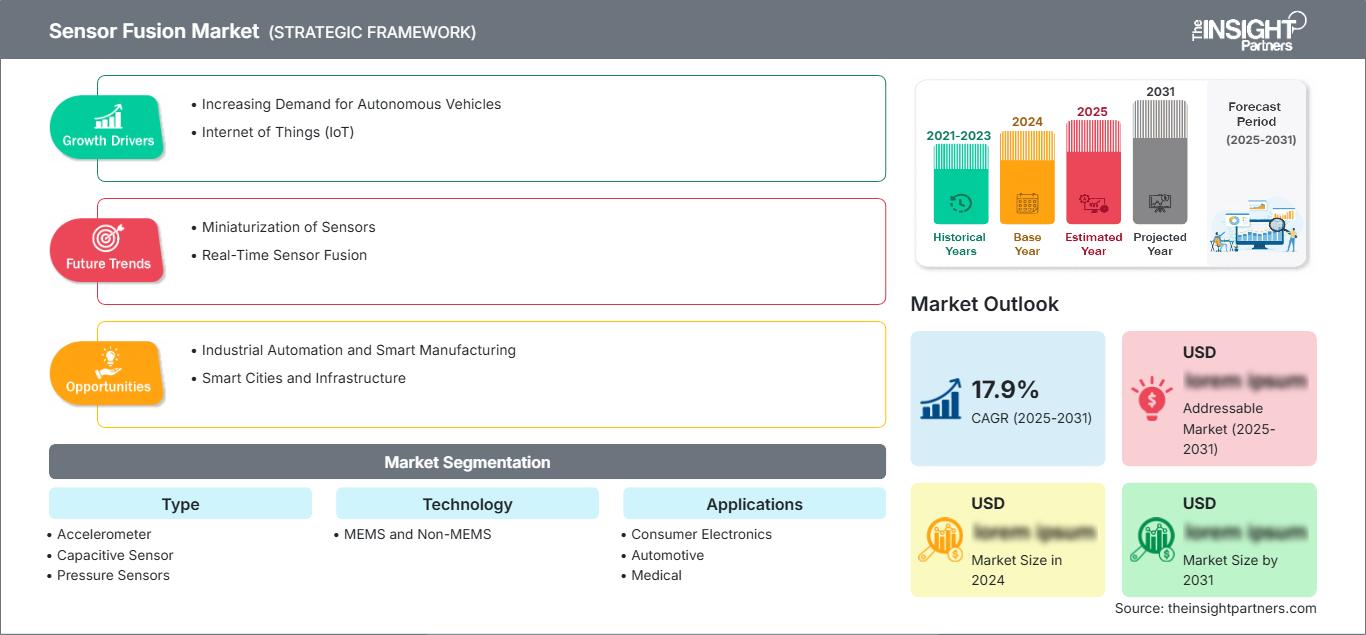
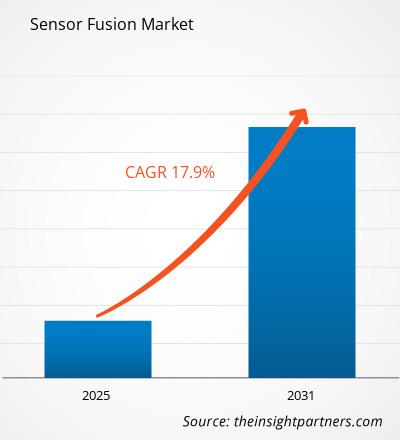
The Sensor Fusion Market size is projected to grow from US$ 8.76 Billion in 2025 to US$ 30.89 Billion by 2034; it is expected to register a CAGR of 15.03% during 2026–2034. Growth reflects rising integration of multi-sensor data processing across automotive, consumer electronics, medical monitoring, and military systems, where reliability, latency reduction, and contextual awareness are becoming central design requirements.
North America is expected to expand at a 13.8–14.6% CAGR during 2026–2034, supported by vehicle automation programs, defense modernization, and health-device adoption. The region benefits from semiconductor design depth, strong autonomous mobility testing, and demand for real-time edge intelligence. Sensor Fusion growth is also supported by regulatory focus on road safety and the shift toward software-defined platforms.
Sensor Fusion Market Assessment and Insights
- North America accounted for 30–32% of the Sensor Fusion Market share in 2025 and is growing at a CAGR of 13.8–14.6% between 2026–2034, driven by ADAS validation, defense autonomy, and medical-grade connected monitoring.
- The US represented 78–82% of North America in 2025 and is growing at a CAGR of 13.9–14.7% during 2026–2034, led by automotive software stacks and aerospace electronics.
- Europe held 22–24% share in 2025 and is growing at a CAGR of 13.1–13.9% between 2026–2034, with Germany, the UK, and France leading safety, robotics, and industrial sensing demand.
- Asia Pacific captured 34–36% share in 2025 and is growing at a CAGR of 16.1–16.9% between 2026–2034, supported by China, Japan, South Korea, and India electronics manufacturing.
- Largest Segment: Consumer electronics held 37–40% of the sensor fusion market share in 2025 and is growing at a CAGR of 14.2–15.0% during 2026–2034, sustained by wearables and XR devices.
- High Growth Segment: Automotive held 28–31% market share in 2025 and is growing at a CAGR of 16.8–17.6% during 2026–2034, supported by ADAS and autonomous mobility.
- Key companies analyzed in detail: Analog Devices, Inc.; Bosch Sensortec GmbH; TDK InvenSense; Infineon Technologies AG; Amphenol Corporation; Microchip Technology Inc.; NXP Semiconductors N.V.; Renesas Electronics Corporation; STMicroelectronics N.V.; TE Connectivity Ltd.
Source: The Insight Partners' analysis based on proprietary research, government publications, company annual reports, investor presentations, industry databases, and expert interviews.
The Sensor Fusion Market forecast Robots and XR platforms will have a need for synchronization of motion, depth, touch, and environment sensing in order to provide natural interactions and autonomous operations. Accuracy of the fusion process will affect motion-to-photon latency, object tracking, collision avoidance, and operator experience. This development opens up opportunities for advanced inertial modules, radar-assisted perception, and temperature-calibrated calibration. With the advancements in industrial robots, service robots, and HMDs, sensor companies which deliver hardware with application ready algorithms will generate more value compared to standalone sensor providers.
Sensor Fusion Market Report Scope
| Report Attribute | Details |
|---|---|
| Market size in 2025 | US$ 8.76 Billion |
| Market Size by 2034 | US$ 30.89 Billion |
| Global CAGR (2026 - 2034) | 15.03% |
| Historical Data | 2021-2024 |
| Forecast period | 2026-2034 |
Sensor Fusion Market Analysis
With demand on the rise because of the need to make sense of movements, location, touch, pressure, and environmental conditions all at once, there is consistent pull through for accelerometers, radar sensors, pressure sensors, and software that supports their use. The supply chain is comprised of sensor manufacturing, MEMS assembly, calibration, firmware, signal processing capabilities, and application-level analytics.
This market’s value chain includes sensor manufacture, MEMS assembly, calibration, firmware, signal processing capabilities, and application-level analytics. It will be influenced by silicon capacity, automotive qualification timelines, and software certification. Firms who offer both hardware and reference software are at an advantage because Original Equipment Manufacturers are more interested in platform technology than discrete pieces of hardware.
The sensor fusion market report includes a competitive environment which involves semiconductors and sensor vendors with proven design wins. Some examples include Analog Devices Inc., Bosch Sensortec GmbH, Infineon Technologies AG, NXP Semiconductors N.V., Renesas Electronics Corporation, and STMicroelectronics N.V. Their competitive differentiators include mixed-signal capabilities, MEMS manufacturing capacity, automotive product portfolio, and software ecosystem. TE Connectivity Ltd. and Amphenol Corporation focus on sensing interfaces, and Microchip Technology Inc. focuses on embedded control architectures.
Investments are being made towards edge AI, sensor hubs operating at low power levels, and functional safety compliance. The strategic positioning is becoming more focused on reference designs of software-defined vehicles, XR headsets, robots, and remote monitoring devices. The Sensor Fusion market share as a proportion of platform value increases with lower integration risk, deterministic latency, and long-term product life cycle.
● REPORT CUSTOMIZATION
Tailor This Report To Align With Your Specific Business Requirements
This report can be customized to align precisely with your business objectives, scope, and target markets. Customization options include tailored segmentation, geography, competitive analysis, and strategic insights to support informed decision-making.
Customize This Report →WHAT YOU CAN ADJUST
- ● Segmentations
- ● Geography
- ● Competitive Analysis
- ● Language Preferences
Sensor Fusion Market: Strategic Insights
Regional Insights
North America Sensor Fusion Market
North America held 30–32% share in 2025 and is expected to register a 13.8–14.6% CAGR during 2026–2034. Safety requirements in automobiles, autonomy initiatives in the defense domain, and connectivity requirements for medical devices provide impetus to consistent adoption. The design environment in the region supports fast deployment of sensor fusion systems in the form of sensor hubs, radars, IMUs, and analytics. The buyers in the region prefer products that undergo validation, are secure, and provide lifecycle support, thereby benefiting the suppliers who have an experience of qualification in automotive and aerospace industries.
U.S. Sensor Fusion Market
The US accounted for 78–82% of North America in 2025 and is projected to grow at a 13.9–14.7% CAGR during 2026–2034. Demand is concentrated in ADAS, software-defined vehicles, aerospace electronics, industrial automation, and connected medical systems. Domestic semiconductor design capability supports faster customization of fused sensing architectures.
Company presence is strong through Analog Devices, Inc., Microchip Technology Inc., Amphenol Corporation, and TE Connectivity Ltd., alongside global suppliers serving US OEM programs. Application trends include cabin monitoring, radar-enhanced perception, surgical equipment feedback, and defense situational awareness. The Sensor Fusion size in the country benefits from venture investment and federal technology priorities.
Europe Sensor Fusion Market
Europe held 22–24% share in 2025 and is expected to grow at a 13.1–13.9% CAGR during 2026–2034. UK is underpinned by connected health, aerospace, and autonomy in vehicles tests, whereby consumers emphasize proven electronics and safety compliant software for industrial and defense purposes.
Germany leads among all nations, backed up by automotive technology, robotics, and automation in industries. Original Equipment Manufacturers (OEMs) as well as Tier I suppliers employ radar, inertial, pressure, and temperature sensors in order to enhance perception and reliability of machines. Functional Safety Standards push suppliers to provide fused sensing system with proven calibration and redundancy.
France, Italy, and Spain contribute in this space through aerospace, medical, advanced manufacturing, and mobility electronics. In particular, France concentrates on avionics and defense, Italy – on machinery manufacturing and medical technologies, and Spain – on production of automotive components. Growth of Regional Sensor Fusion depends on priorities of EU regarding safety, electrification, and industrial digitalization.
APAC Sensor Fusion Market
Asia Pacific held 34–36% share in 2025 and is projected to grow at a 16.1–16.9% CAGR during 2026–2034. China is the leading country due to electric vehicles, smartphones, robotics, and surveillance systems.
Japan and South Korea contribute through precision electronics, automotive safety, and advanced displays, while India is expanding demand through electronics manufacturing and medical-device localization.
Australia’s role is smaller but relevant in mining automation, defense, and remote health monitoring. Policy incentives for semiconductor ecosystems, industrial automation, and electric mobility strengthen Sensor Fusion Market adoption across the region.
Middle East & Africa Sensor Fusion Market
Middle East & Africa is expected to expand at a 12.4–13.2% CAGR during 2026–2034. Saudi Arabia is the leading country, driven by smart infrastructure, energy automation, and defense modernization programs.
The UAE is adopting fused sensing in smart cities, logistics, aviation, and surveillance systems, where low-latency environmental awareness supports operational resilience and public-sector technology programs.
South Africa and Rest of MEA demand is linked to mining safety, utilities, telecom infrastructure, and medical access. Energy-sector digitalization creates opportunities for rugged pressure, temperature, and motion fusion systems.
Segmentation Analysis
Type
The type segment in the sensor fusion market is expected to grow at a 14.6–15.4% CAGR during 2026–2034 as device makers combine motion, pressure, touch, radar, and thermal inputs into unified perception layers. Demand is strongest where redundancy, miniaturization, and energy efficiency are required. The Sensor Fusion Market benefits from broader availability of calibrated sensor packages and firmware-ready reference designs.
- Accelerometer demand remains broad across wearables, smartphones, medical monitors, drones, and vehicles because motion tracking is a foundational input for orientation, vibration monitoring, fall detection, and navigation support.
- Capacitive sensor adoption is supported by touchless interfaces, proximity detection, smart appliances, and medical equipment controls, where low power consumption and compact integration improve product usability.
- Pressure sensors are strategically important in industrial systems, medical devices, automotive controls, and environmental monitoring because pressure feedback improves safety, diagnostics, and operational efficiency.
- Temperature sensors support compensation, thermal protection, medical monitoring, and battery management, making them essential in fused sensing designs where accuracy changes with operating conditions.
- Touch sensors remain central to consumer electronics, automotive interiors, and medical interfaces as product designers move toward sealed surfaces, gesture inputs, and simplified human-machine interaction.
- Radar sensors are gaining strategic importance in automotive, robotics, security, and industrial automation because they provide distance and velocity data in conditions where optical sensing can be limited.
Technology
The technology segment in the sensor fusion market is expected to grow at a 14.9–15.7% CAGR during 2026–2034. MEMS devices dominate compact and high-volume applications, while non-MEMS solutions remain essential for radar, industrial, and specialized medical requirements. Buyers evaluate technology by latency, drift, noise, calibration burden, reliability, and compatibility with embedded analytics across the Sensor Fusion Market.
- MEMS technology is favored in smartphones, wearables, hearing devices, drones, and automotive modules because miniaturization, low power use, and scalable production support high-volume deployment.
- Non-MEMS technology remains important for radar, pressure, temperature, and specialized industrial systems where robustness, range, sensitivity, or environmental tolerance outweigh extreme miniaturization priorities.
Applications
The applications segment in the sensor fusion market is expected to grow at a 15.2–16.0% CAGR during 2026–2034, led by consumer electronics volume and automotive value growth. Medical and military applications provide higher reliability requirements and longer qualification cycles. Sensor Fusion Market demand increases as end users require contextual data, fault tolerance, and real-time decision support across mission-critical and user-facing systems.
- Consumer electronics generate high revenue contribution through smartphones, wearables, hearables, XR devices, gaming systems, and smart appliances that require motion awareness, gesture recognition, and low-power contextual sensing.
- Automotive applications are strategically significant because ADAS, automated parking, cabin sensing, battery management, and chassis control need fused data to improve safety and reduce false decisions.
- Medical applications rely on fused sensing for patient monitoring, surgical tools, rehabilitation devices, and diagnostics, where accuracy, repeatability, and regulatory compliance influence procurement decisions.
- Military applications use sensor fusion in unmanned systems, navigation, surveillance, targeting, and soldier systems, where resilience in harsh environments and dependable situational awareness are essential.
Opportunity Snapshot
| Applications | Revenue Contribution | Trend Tag | Adoption Stage |
| Consumer Electronics | High | XR Motion | Mature |
| Automotive | High | ADAS Perception | Scaling |
| Medical | Medium | Remote Monitoring | Scaling |
| Military | Medium | Autonomous Defense | Emerging |
Sensor Fusion Market Growth Drivers and Impact Analysis
ADAS and Software-Defined Vehicle Adoption
Automotive platforms have a growing need for fused information from sensors such as radar, camera, inertial, pressure, and temperature sensors to help make safer decisions. The use of sensor fusion ensures that there is less uncertainty if weather conditions, poor lighting, vibration, or obstruction from a single input sensor is affecting the decision-making process. This will be especially true for advanced driver assistance systems (ADAS), automated parking, driver monitoring, and vehicle stability systems, since false alarms may lead to safety issues.
Expansion of Wearables and Context-Aware Electronics
There is competition between consumer devices in terms of health monitoring, gesture control, immersive interface, and intelligent energy efficiency. Combining information from an accelerometer, touchscreen, temperature sensor, pressure sensor, and environment allows the device to recognize context without sending data to the cloud all the time. This trend drives increased need for small-sized MEMS solutions equipped with firmware and software that works in conjunction. The actual market implication is the change from components procurement to platform procurement since device manufacturers require tested algorithms.
Safety-Critical Monitoring in Healthcare and Defense
Fused sensing technology will be used by the healthcare industry and military procurement agencies if the need for higher reliability outweighs the issue of price for the devices. The medical monitoring devices use sensor fusion of movement, temperature, pressure, and bio signals in order to minimize false alarms and enhance patient monitoring. Military applications use sensor fusion of inertial, radar, pressure, and environmental sensors for navigational purposes and surveillance activities in tough conditions. The focus of the WHO in terms of telemedicine resilience and military modernization efforts make the demand quantifiable.
Sensor Fusion Market Future Trends
Edge AI Inside Sensor Modules
The sensor fusion market trends include designs that will be smart enough to have their intelligence embedded within the modules themselves, not necessarily dependent on the host processor to make all the decisions. With embedded microcontrollers, trained algorithms, and event-driven software, sensors will become more adept at recognizing gestures, falls, anomalies, and environmental changes. This approach will redefine supplier value proposition in terms of the efficiency of software libraries, updates to the models, and security of the sensors. Purchasers will look into whether such sensors have the potential to run privacy-preserving inference and field calibration.
Multimodal Perception for Robotics and XR
Robotics and XR devices will increasingly require synchronized motion, depth, touch, and environmental awareness to support natural interaction and safe autonomy. Fusion accuracy will influence motion-to-photon latency, object tracking, collision avoidance, and operator comfort. The trend creates opportunities for high-bandwidth inertial modules, radar-enhanced perception, and temperature-compensated calibration. As industrial robots, service robots, and head-mounted displays become more capable, suppliers that combine hardware precision with application-ready algorithms will capture greater value than providers of standalone sensors.
Sensor Fusion Market Opportunities
Reference Platforms for Regulated Devices
Suppliers can create value by offering prevalidated sensor fusion reference platforms for automotive, medical, aerospace, and defense applications. These buyers face long qualification cycles, documentation requirements, and interoperability testing, which makes integration support a meaningful differentiator. Platforms that include calibrated sensors, firmware, safety documentation, and development tools can reduce customer engineering workload. The opportunity is especially strong for mid-sized OEMs that lack large internal perception teams but still need reliable, compliant sensing capabilities for new connected products.
Localized Manufacturing and Supply Resilience
Geopolitical supply risk and semiconductor shortages have made sourcing resilience a purchasing priority. Companies that diversify MEMS packaging, test, calibration, and final assembly capacity near major electronics and automotive clusters can improve lead times and customer confidence. Localized manufacturing also supports government-backed semiconductor and defense programs in North America, Europe, and Asia Pacific. The commercial opportunity lies in combining regional supply assurance with consistent calibration quality, allowing OEMs to scale fused sensing without redesigning platforms for every geography.
Recent Developments
- January 2026: With a myriad of announcements that have been made at CES 2025, AONDevices launch of the AON1120 sensor fusion IC. It integrates sensor fusion technology together with energy efficiency, allowing it to carry out activities like voice recognition, sound classification, and biometric identification using very little power.
- August 2024: The following two products have been launched by Dewesoft at ADAS & Autonomous Vehicle Technology Expo California 2024: Obsidian and Navion. Obsidian is a state-of-the-art sensor fusion platform offered by Dewesoft, which provides unprecedented accuracy and reliability for autonomous vehicles, and due to its superior data processing ability, it can easily be integrated with different sensors.
- June 2023: TIER IV, one of the leading companies offering open-source AD technologies, introduced the release of the Sensor Fusion Development Kit (referred to as “the Kit”) that makes development of the autonomous driving (AD) systems and applications using advanced perception technologies easier and faster.
Frequently Asked Questions

- Comprehensive Market Sizing and Forecast Analysis
- Detailed Segmentation Analysis
- In-Depth Market Dynamics Assessment
- Regional and Country-Level Insights
- Competitive Landscape and Company Benchmarking
- Strategic Business Intelligence
Recent Reports
Testimonials

The Insight Partners' SCADA System Market report is comprehensive, with valuable insights on current trends and future forecasts. The team was highly professional, responsive, and supportive throughout. We are very satisfied and highly recommend their services.
RAN KEDEM Partner, Reali Technologies LTDs
I requested a report on a very specific software market and the team produced the report in a few days. The information was very relevant and well presented. I then requested some changes and additions to the report. The team was again very responsive and I got the final report in less than a week.
JEAN-HERVE JENN Chairman, Future Analytica
We worked with The Insight Partners for an important market study and forecast. They gave us clear insights into opportunities and risks, which helped shape our plans. Their research was easy to use and based on solid data. It helped us make smart, confident decisions. We highly recommend them.
PIYUSH NAGPAL Sr. Vice President, High Beam Global
The Insight Partners delivered insightful, well-structured market research with strong domain expertise. Their team was professional and responsive throughout. The user-friendly website made accessing industry reports seamless. We highly recommend them for reliable, high-quality research services
YUKIHIKO ADACHI CEO, Deep Blue, LLC.
This is the first time I have purchased a market report from The Insight Partners.While I was unsure at first, I visited their web site and felt more comfortable to take the risk and purchase a market report.I am completely satisfied with the quality of the report and customer service. I had several questions and comments with the initial report, but after a couple of dialogs over email with their analyst I believe I have a report that I can use as input to our strategic planning process.Thank you so much for taking the extra time and making this a positive experience.I will definitely recommend your service to others and you will be my first call when we need further market data.
JOHN SUZUKI President and Chief Executive Officer, Board Director, BK Technologies
I wish to appreciate your support and the professionalism you displayed in the course of attending to my request for information regarding to infectious disease IVD market in Nigeria. I appreciate your patience, your guidance, and the fact that you were willing to offer a discount, which eventually made it possible for us to close a deal. I look forward to engaging The Insight Partners in the future, all thanks to the impression you have created in me as a result of this first encounter.
DR CHIJIOKE ONYIA MANAGING DIRECTOR, PineCrest Healthcare Ltd.Reason to Buy
- Informed Decision-Making
- Understanding Market Dynamics
- Competitive Analysis
- Identifying Emerging Markets
- Customer Insights
- Market Forecasts
- Risk Mitigation
- Boosting Operational Efficiency
- Strategic Planning
- Investment Justification
- Tracking Industry Innovations
- Aligning with Regulatory Trends





 Get Free Sample for