
Shock Sensor Market Size, Demand & Growth by 2034
Coverage: by Type (Piezoelectric, Piezoresistive, Capacitors, Strain Gage, Others); End-user (Automotive, Aerospace, Consumer Electronics, Others) , and Geography (North America, Europe, Asia Pacific, and South and Central America)
- Status : Data Released
- Report Code : TIPRE00008287
- Category : Electronics and Semiconductor
- No. of Pages : 150
- Available Report Formats :


- Last update date : July 15, 2026


2025 Market Size
US$ 1,736.5 Mn
Base year value
2034 Forecast
US$ 9,147.12 Mn
Projected by 2034
CAGR 2026-2034
20.28 %
Growth rate
Addressable Market
US$ 43,968.53 Mn
(2026-2034)
The global Shock Sensor market will grow from US$ 1,736.5 million in 2025 to US$ 9,147.12 million by 2034, posting a CAGR of 20.28% during 2026-2034. Market trends include an increased use of shock sensors in impact sensing, vibration detection, tamper alarms, and asset management in the automobile, industrial electronics, logistics, aviation, and security sectors.
North America continues to be an important regional market due to the forecast CAGR of 18.5-20.5%. Factors affecting the Shock Sensor Market size in North America include connected car penetration, warehouse automation, and upgrades in security electronics. Good OEM certification and sensor components availability facilitate the adoption of sensors in vehicle safety applications and logistics and industrial assets monitoring.
Shock Sensor Market Assessment and Insights
- North America held 33–35% Shock Sensor market share in 2025 and is expected to grow at an 18.5–20.5% CAGR between 2026–2034, led by vehicle security, industrial automation, and connected logistics adoption.
- US accounted for 76–80% of North America in 2025 and is projected to grow at an 18.8–20.8% CAGR, supported by automotive electronics and smart security upgrades.
- Europe represented 22–24% share in 2025 and is forecast to grow at a 17.5–19.5% CAGR, with Germany, the UK, and France leading demand from automotive and industrial systems.
- Asia Pacific held 28–30% share in 2025 and is expected to grow at a 21.0–23.0% CAGR, led by China, Japan, South Korea, and India across electronics, vehicles, and logistics.
- Largest Segment Piezoelectric type held 36–39% market share in 2025 and is projected to grow at an 18.8–20.8% CAGR because of durability, fast response, and broad industrial compatibility.
- High Growth Segment Digital output held 47–50% market share in 2025 and is expected to grow at a 21.5–23.5% CAGR as IoT-ready devices require clean signal integration.
- Key companies analyzed in detail: Climax Technology Co., Ltd.; Dytran Instruments, Inc.; Honeywell International Inc.; Parker Meggitt; Mobitron AB; Murata Manufacturing Co., Ltd.; PCB Piezotronics, Inc.; SignalQuest, LLC; SpotSee; TE Connectivity Ltd.
Source: The Insight Partners' analysis based on proprietary research, government publications, company annual reports, investor presentations, industry databases, and expert interviews.
There are modifications in the design of the sensors where there is the development from single mechanical sensors to calibrations of piezoelectric, MEMS, and multi-axis sensors for measuring the magnitude of the shock, direction of the shock, and the time of the shock. There are modifications in the production of the sensors where the manufacturers are incorporating miniaturized sensors with processing, wireless capability, and strong packaging. This makes it possible for expanding applications in car security, fragile load tracking, micro drive protection, and machinery monitoring. This is because early detection of shocks reduces downtime and warranty claims.
Future growth will depend on the establishment of new manufacturing centers, production of electric vehicles, and regulated logistics processes that require verification of impact handling history. Investment is expected to be in digital sensors, wireless tag, and temperature resistance materials. The importance of monitoring the integrity of cargo, safety of vehicles, and reliability of industrial equipment will ensure that the Shock Sensor market keeps pace with other condition monitoring technologies.
Shock Sensor Market Report Scope
| Report Attribute | Details |
|---|---|
| Market size in 2025 | US$ 1,736.5 Million |
| Market Size by 2034 | US$ 9,147.12 Million |
| Global CAGR (2026 - 2034) | 20.28% |
| Historical Data | 2021-2024 |
| Forecast period | 2026-2034 |
Shock Sensor Market Analysis
Demand is strengthened through automation, connectivity and logistics management. Shock Sensor Market expansion is greatest in cases where impact data can avoid monetary damage, such as in electric vehicle battery handling, robotic operations in warehouses, and delivery of expensive electronics components. The purchasers have moved their focus away from price alone to response time, calibration repeatability, and operating temperature.
The value chain comprises sensing material providers, signal processing electronics firms, packaging, assembly of modules, distribution, and systems integration providers. Demand dynamics favor suppliers who can provide smaller sizes, repeatable sensitivity, and durable casings. In logistics and automotive industry segments, traceability is an additional factor and hence increased demand for sensors integrated with cloud-based dashboards or gateways.
The competitive positioning of players within the Shock Sensor Market involves the concept of application specialization. The companies such as Honeywell International Inc., TE Connectivity Ltd., Murata Manufacturing Co., Ltd., and Parker Meggitt are catering to the general needs of the industrial and mobility sectors while other companies such as Dytran Instruments, Inc., PCB Piezotronics, Inc., etc. have specialized themselves in the application segment.
Investment focuses are increasingly leaning towards sensor fusion technology, energy efficient electronic products, and reliable digital output technology designs. Companies that have the capacity to qualify in automotive, aerospace, and industrial sectors will be better positioned to protect their profit margins compared to firms that are competing purely on vibration switches technology.
● REPORT CUSTOMIZATION
Tailor This Report To Align With Your Specific Business Requirements
This report can be customized to align precisely with your business objectives, scope, and target markets. Customization options include tailored segmentation, geography, competitive analysis, and strategic insights to support informed decision-making.
Customize This Report →WHAT YOU CAN ADJUST
- ● Segmentations
- ● Geography
- ● Competitive Analysis
- ● Language Preferences
Shock Sensor Market: Strategic Insights
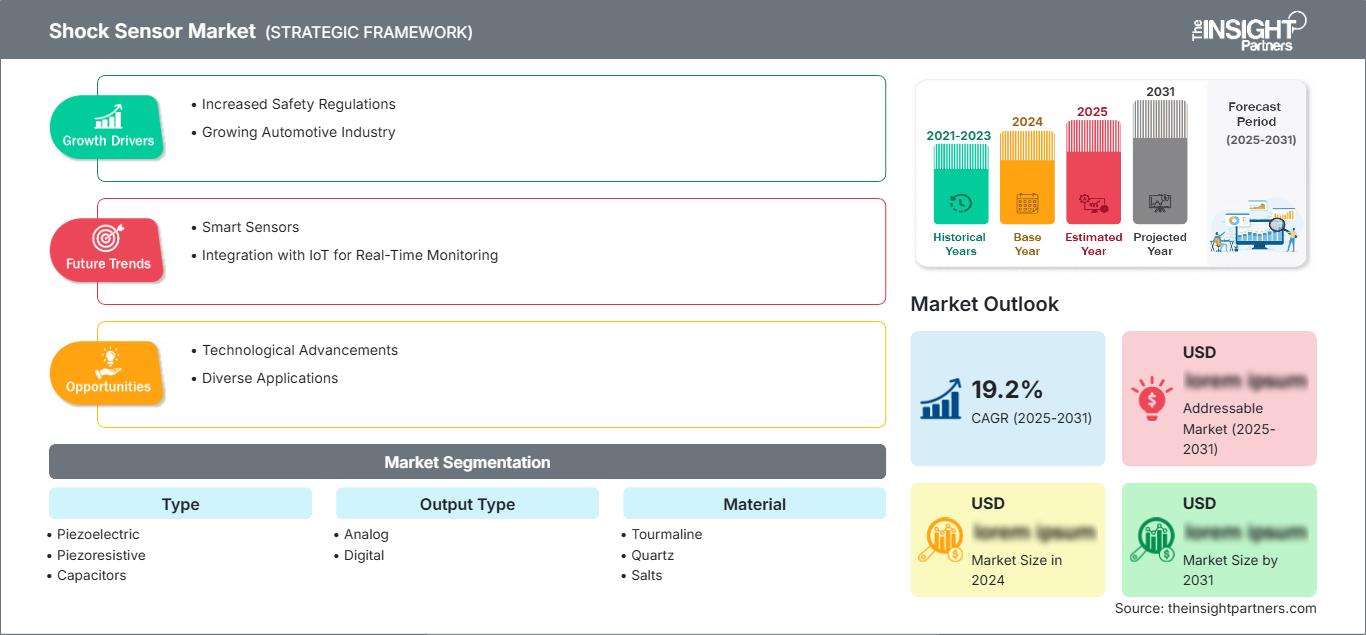
Regional Insights
North America Shock Sensor Market
North America held 33–35% market share of 2025 demand and will grow at an 18.5-20.5% CAGR. The market share of the Shock Sensor depends on automotive anti-theft devices, aerospace testing, warehouse management, and shipment regulation. Consumers value certified shock sensors, reliable responses, and compatibility with current alarm/telematics solutions.
Moreover, the U.S. and Canada have significant installed bases of industrial equipment and security products. Market growth will occur in smart packaging, EV battery transportation, and facility protection. There is a growing need for real-time event documentation to capture shock level, timing, and incidents during transport.
U.S. Shock Sensor Market
The United States accounted for 76–80% of North America consumption in 2025 and expected to record a CAGR of 18.8–20.8%. The major applications include automotive electronics, aerospace testing systems, logistics visibility solutions, and intrusion detection in the commercial sector. The market is characterized by high demand from validated suppliers offering technical support and widespread distribution network.
Market presence is robust owing to the operations of Honeywell International Inc., PCB Piezotronics, Inc., Dytran Instruments, Inc., SignalQuest, LLC, and SpotSee. Some application areas that are on trend include impact logging in medical equipment, micro drive protection in electronics, and tamper alarms in smart buildings.
Europe Shock Sensor Market
The Europe market had a share of 22–24% in 2025 and is predicted to have a CAGR of 17.5–19.5%. It is led by Germany due to its automotive manufacture, automation industry and test facilities. In the United Kingdom, there is reliable use of RFID in aerospace, defense electronics, and logistic tracking for the trackable impacts on assets.
In France, Italy, and Spain, the usage is due to vehicle protection, machinery protection, and packaging uses. The users from Europe focus on reliability, electromagnetic compatibility, and longevity of products. Manufacturers that include robust hardware with application engineering are best suited as European users are adopting digitized maintenance processes and shipment accountability.
APAC Shock Sensor Market
APAC holds a 28-30% market share in 2025 and has a projected CAGR of 21.0-23.0%. APAC will be dominated by the electronics manufacturing sector and electric vehicles in China, while Japan and South Korea will provide sensor manufacturing and automobile expertise.
The logistics and infrastructure sectors of India and Australia, as well as security electronics, will drive the growth. Policies favoring home manufacturing and connectivity of transport systems will lead to increased use of shock detection in cargo, equipment, and industrial assets. Growth in the region will be greatest where cost-effective digital monitoring has replaced manual checks.
Middle East & Africa Shock Sensor Market
Middle East & Africa will have a CAGR of 16.0-18.0%. Saudi Arabia and United Arab Emirates lead this segment with regard to adoption. Projects within the energy sector, airport logistics, heavy machinery construction equipment, and critical infrastructure need tamper-resistant features and impact monitoring capabilities.
South Africa and Rest of MEA provide incremental demand from the mining industry, transport, and commercial security applications. The purchase decision includes considerations such as rugged housings, high battery performance, and ease of integration given the nature of operating environments.
Segmentation Analysis
Type
The growth rate of Type is forecasted to be within 18.8–20.8%, which is based on its advantages such as quick responsiveness, portability, and strength. The scope of the Shock Sensor Market by types is quite large due to different design criteria for consumer, automotive, cargo, and aviation testing applications.
- Piezoelectric sensors lead adoption where rapid impact conversion, wide frequency response, and robust operation are required in industrial monitoring, automotive alarms, and precision testing environments.
- Piezoresistive sensors serve applications needing measurable resistance change under mechanical stress, making them relevant for compact electronics, crash detection modules, and calibrated force monitoring.
- Capacitors support shock detection in space-constrained systems by measuring capacitance variation, often fitting low-power devices that require simple threshold-based event recognition.
- Strain Gage solutions remain important where structural deformation and load-linked impact measurement are central, especially in machinery, aerospace, and engineered asset monitoring.
Output Type
The Output Type segment is expected to register CAGR of 20.0–22.0%, as consumers will shift from conventional alarm signals to sensors that allow the storage, transmission, and processing of data. Analog output type continues to be popular in old devices, whereas digital is becoming increasingly popular in logistics, security, and industrial sectors.
- Analog output remains relevant for established equipment architectures because it offers simple signal interpretation, lower integration complexity, and compatibility with many existing controllers.
- Digital output is scaling quickly as connected devices need cleaner interfaces, event timestamps, threshold programming, and easier integration with gateways or embedded processors.
Material
Material growth is expected to have a CAGR between 18.0% and 20.0%, which is attributed to the need for reliable electrical-mechanical conversion in thermally, vibrationally, and humid environments. The selection of material impacts sensitivity, aging effects, and operation stability, which makes it a very important purchasing factor.
- Tourmaline supports niche sensing requirements where natural piezoelectric behavior and stability are valued, although adoption depends on application-specific calibration needs.
- Quartz is widely used because it offers stable response, high stiffness, and strong performance in precision measurement, testing, and harsh industrial environments.
- Salts address selected applications where cost and sensitivity profiles are suitable, but moisture management and packaging remain important for long-term reliability.
- Gallium Phosphate is strategically relevant in high-temperature environments because it can sustain piezoelectric performance where conventional materials face operational limits.
Application
Applications are expected to see a 19.5-21.5% CAGR growth, driven by security, cargo visibility, and impact-sensing electronics applications. Increasingly, consumers prefer electronic sensors that can sense shock events, differentiate between false vibration events, and produce evidence for warranty, maintenance, and insurance cases.
- Tap detection supports user interfaces and wake-up functions in compact electronics, where low power consumption and reliable signal discrimination remain central to design selection.
- Micro-drive protection remains relevant for sensitive storage and precision devices, helping prevent damage by detecting sudden impact before mechanical components fail.
- Shipping and handling adoption is expanding as exporters, medical suppliers, and electronics brands use impact records to reduce disputes and improve packaging decisions.
- Automotive security systems use shock sensing to identify attempted intrusion, forced entry, collision events, and abnormal vibration in connected alarms and vehicle telematics.
- General tamper-proofing demand is rising in smart meters, premises security, equipment cabinets, and remote assets where physical interference must trigger alerts quickly.
Opportunity Snapshot
| Application | Revenue Contribution | Trend Tag | Adoption Stage |
| Tap detection | Medium | Touch Wake | Scaling |
| Micro-drive protection | Low | Drive Safety | Mature |
| Shipping and handling | High | Cargo Proof | Scaling |
| Automotive security systems | High | Vehicle Guard | Scaling |
| General tamper-proofing | Medium | Asset Shield | Scaling |
| Others | Low | Specialty Uses | Emerging |
Shock Sensor Market Growth Drivers and Impact Analysis
Connected Logistics Requires Verifiable Impact Records
The trend towards shipping high-value freight, medical equipment, electronic goods, and machinery has led to the use of multiparty chains where the liability for damage needs to be established. Shock sensors allow to transform an accident into an audit-proof piece of evidence by eliminating the need for visual assessment after delivery. The above driver affects the market directly since it leads to the change in procurement of label-based systems to those involving connectivity for claims, packaging design, and carriers' responsibility. With the ongoing process of digitalization of logistics providers' warehouses and last mile delivery, the attractiveness of sensors with wireless capabilities, threshold settings, and event logging increases.
Vehicle Electronics Need Faster Impact Awareness
Security/safety architectures of automobiles need sensors that will be able to sense sudden force, glass breaking, vibration from collisions, and impacts on battery pack enclosures with a reduced rate of false alarms. In the case of electric vehicles, there is an added need since battery packs, charging units, and other electronic modules need protection. Market dynamics include an increase in demands for compact and temperature stable sensors with digital capability. Those vendors who are capable of meeting the needs of the automotive industry with their products will get the benefit of participating in life-long programs, whereas aftermarket security systems will generate volume sales opportunities.
Industrial Automation Expands Condition Monitoring Use
Factories, utility companies, and other types of infrastructures are deploying more sensors to detect vibrations and mechanical shocks as well as any potential equipment impacts to avoid any further escalation. Shock sensors work as an add-on to accelerometers and vibration sensors in identifying any abrupt forces on the machinery. The market implications of using such sensors are significant, particularly because the higher expenses associated with preventive maintenance programs justify the use of high-quality sensors that are more expensive than their counterparts.
Shock Sensor Market Future Trends
Sensor Fusion Moves Shock Detection Toward Predictive Context
Shock Sensor market trends will revolve more around the integration of impact measurement with other parameters such as temperature, humidity, orientation, GPS and vibration. Such trends would allow the users not just to know about the occurrence of an event, but to get knowledge about the location of such an event and about the surrounding conditions as well. The ability to predict context would be the most valuable feature in applications for cold chain logistics, transportation of EV batteries, aerospace equipment, and industry spares.
Low-Power Wireless Designs Extend Asset Monitoring
Future implementations would make it more cost-effective to have power-conserving wireless sensors that work for months and even years in mobile assets, containers, cabinets, and remote devices. The development of low-power microcontrollers, wake-up on shock capability, and narrowband communication would result in less maintenance while providing visibility for all events continuously. This will extend the potential application areas from high-cost freight to mid-priced cargo, rented assets, and dispersed infrastructure. It will also push vendors toward adopting subscription models with packages of hardware, connectivity, and dashboards.
Shock Sensor Market Opportunities
Smart Packaging for Regulated and Fragile Goods
The suppliers of packaging, logistics firms, and sensor producers can offer differentiated solutions by integrating the shock detection functionality in the design of reusable packaging, medical packaging, semiconductor packaging, and instrument cases. Opportunities in the shock sensor market forecasts are driven by the impact of damage indication on warranty claims, insurance claims, and patient safety. The opportunities for investment arise as the value lies in the integration of monitoring services, analytic software subscriptions, and packaging optimization. Firms collaborating with cold chain logistics, electronics exports, and health care distribution firms can go beyond just selling devices.
Aftermarket Security and Retrofit Monitoring
The retrofit requirement presents an opportunity in automobiles, warehouses, retail display units, utility infrastructure, and industrial machinery that were initially installed without any provision for connected monitoring. The aftermarket sensor can enable tampering detection, impact logging, and remote notification without replacing the whole system. It makes sense from a cost perspective as modular sensors cut down installation duration and capital requirements. Distributors and security system installers will have the option to package shock sensors with alarms, gateways, and service agreements. It is an opportunity where suppliers of adaptable thresholds, easy commissioning, and tough housing excel.
Recent Developments
- May 2022: Pyronix releases a compact grade 2 wireless shock sensor NanoShock to enhance perimeter protection.
- July 2026: Standard Motor Products, Inc. (SMP) announced it has entered into a 50/50 joint venture agreement with Techstrong Holdings Limited to form Techstrong Electronics (Thailand) Company Limited ("SMP Techstrong"), an automotive sensor manufacturing company.
- June 2026: Honeywell Technologies has officially commenced operations as an independent automation-focused company following the successful completion of the spin-off of its Aerospace Technologies business. The move concludes the company’s multi-year portfolio transformation strategy, creating three standalone businesses with dedicated growth strategies and greater operational focus.
Frequently Asked Questions

- Comprehensive Market Sizing and Forecast Analysis
- Detailed Segmentation Analysis
- In-Depth Market Dynamics Assessment
- Regional and Country-Level Insights
- Competitive Landscape and Company Benchmarking
- Strategic Business Intelligence
Recent Reports
Testimonials

The Insight Partners' SCADA System Market report is comprehensive, with valuable insights on current trends and future forecasts. The team was highly professional, responsive, and supportive throughout. We are very satisfied and highly recommend their services.
RAN KEDEM Partner, Reali Technologies LTDs
I requested a report on a very specific software market and the team produced the report in a few days. The information was very relevant and well presented. I then requested some changes and additions to the report. The team was again very responsive and I got the final report in less than a week.
JEAN-HERVE JENN Chairman, Future Analytica
We worked with The Insight Partners for an important market study and forecast. They gave us clear insights into opportunities and risks, which helped shape our plans. Their research was easy to use and based on solid data. It helped us make smart, confident decisions. We highly recommend them.
PIYUSH NAGPAL Sr. Vice President, High Beam Global
The Insight Partners delivered insightful, well-structured market research with strong domain expertise. Their team was professional and responsive throughout. The user-friendly website made accessing industry reports seamless. We highly recommend them for reliable, high-quality research services
YUKIHIKO ADACHI CEO, Deep Blue, LLC.
This is the first time I have purchased a market report from The Insight Partners.While I was unsure at first, I visited their web site and felt more comfortable to take the risk and purchase a market report.I am completely satisfied with the quality of the report and customer service. I had several questions and comments with the initial report, but after a couple of dialogs over email with their analyst I believe I have a report that I can use as input to our strategic planning process.Thank you so much for taking the extra time and making this a positive experience.I will definitely recommend your service to others and you will be my first call when we need further market data.
JOHN SUZUKI President and Chief Executive Officer, Board Director, BK Technologies
I wish to appreciate your support and the professionalism you displayed in the course of attending to my request for information regarding to infectious disease IVD market in Nigeria. I appreciate your patience, your guidance, and the fact that you were willing to offer a discount, which eventually made it possible for us to close a deal. I look forward to engaging The Insight Partners in the future, all thanks to the impression you have created in me as a result of this first encounter.
DR CHIJIOKE ONYIA MANAGING DIRECTOR, PineCrest Healthcare Ltd.Reason to Buy
- Informed Decision-Making
- Understanding Market Dynamics
- Competitive Analysis
- Identifying Emerging Markets
- Customer Insights
- Market Forecasts
- Risk Mitigation
- Boosting Operational Efficiency
- Strategic Planning
- Investment Justification
- Tracking Industry Innovations
- Aligning with Regulatory Trends





 Get Free Sample for