
Shrink Packaging Market Trends, Demand & Growth by 2034
Coverage: By Material (Linear Low-Density Polyethylene (LLDPE), Low-Density Polyethylene (LDPE), PVC); Product (Hoods, Labels and Sleeves, Wrap); Application (Food Packaging, Beverages), and Geography (North America, Europe, Asia Pacific, and South and Central America)
- Status : Data Released
- Report Code : TIPRE00015505
- Category : Chemicals and Materials
- No. of Pages : 150
- Available Report Formats :


- Last update date : July 17, 2026


2025 Market Size
US$ 27.71 Bn
Base year value
2034 Forecast
US$ 39.11 Bn
Projected by 2034
CAGR 2026-2034
3.90 %
Growth rate
Addressable Market
US$ 303.44 Bn
(2026-2034)
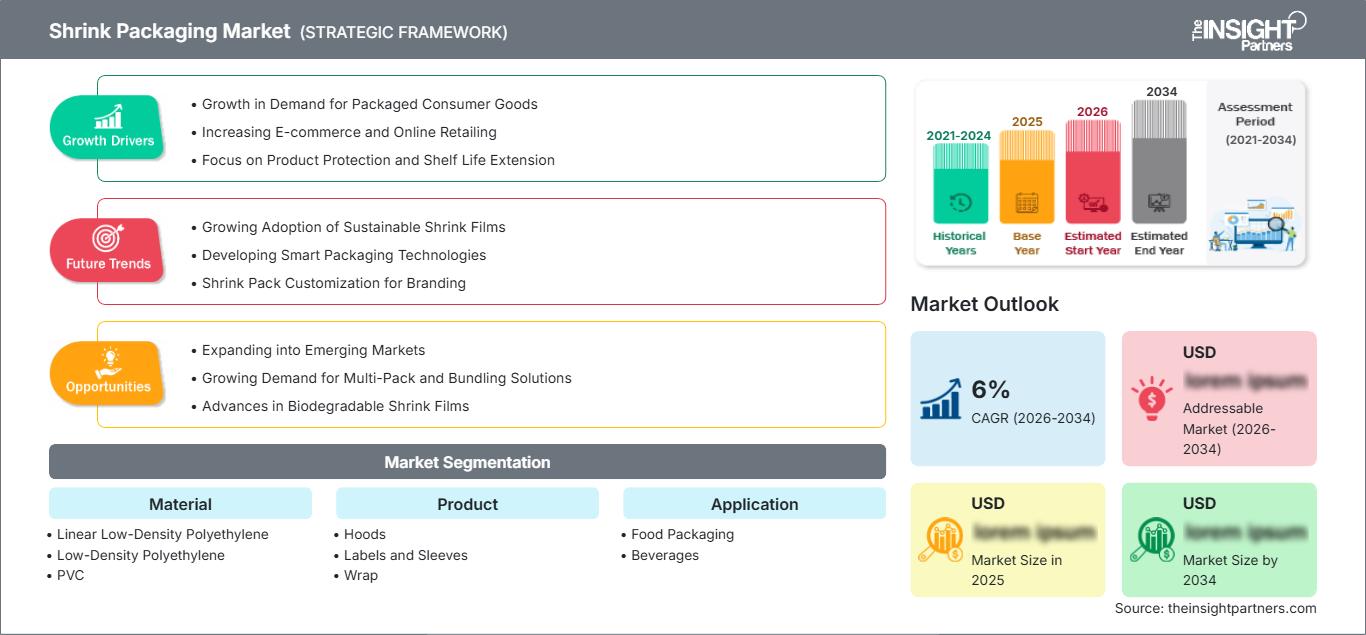
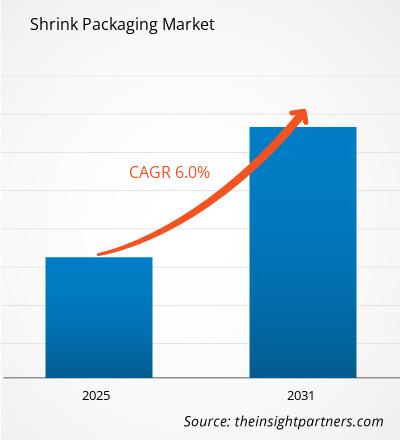
The Shrink Packaging Market was valued at US$ 27.71 Billion in 2025 and is projected to reach US$ 39.11 Billion by 2034, registering a CAGR of 3.90% during 2026–2034. Demand is supported by tamper-evident protection, multipack efficiency, and shelf-ready presentation across food and beverage distribution channels, where films, sleeves, labels, wraps, and hoods improve containment while reducing package weight compared with rigid alternatives.
Across North America, converters are expected to post a 3.6–4.1% CAGR as food processors, bottled beverage producers, and club-store retailers expand automated bundling lines. Shrink Packaging Market size momentum in the region is shaped by resin availability, strong cold-chain retailing, and a shift toward recyclable polyethylene films that help brand owners meet extended producer responsibility requirements without compromising line speed or pack integrity.
Shrink Packaging Market Assessment and Insights
- North America accounted for 30–33% share in 2025 and is growing at a CAGR of 3.6–4.1% between 2026–2034, supported by beverage multipacks, warehouse club formats, and PE film capacity.
- US represented 78–82% of North America in 2025 and is growing at a CAGR of 3.5–4.0% between 2026–2034, led by food retail automation.
- Europe held 24–27% share in 2025 and is growing at a CAGR of 3.2–3.7% between 2026–2034, with Germany, the UK, France, Italy, and Spain leading recyclable film adoption.
- Asia Pacific captured 28–31% share in 2025 and is growing at a CAGR of 4.4–4.9% between 2026–2034, driven by China, India, Japan, South Korea, and Australia.
- Largest Segment Linear Low-Density Polyethylene held 42–46% market share in 2025 and is growing at a CAGR of 4.0–4.5% during 2026–2034.
- High Growth Segment Labels and Sleeves held 31–35% market share in 2025 and is growing at a CAGR of 4.6–5.1% during 2026–2034.
- Key companies analyzed in detail: Aakriti Packaging, Amcor plc, American Eagle Packaging Corporation, Bemis Company, Inc., Berry Global, Inc., Bonset America Corporation, Deufol SE, The Dow Chemical Company, Printpack Incorporated, Sealed Air Corporation.
Source: The Insight Partners' analysis based on proprietary research, government publications, company annual reports, investor presentations, industry databases, and expert interviews.
Downgauging films, high-definition printing and quicker control of the heat tunnel are revolutionizing shrink format development. We've transitioned away from commoditized wrapping film to an engineered solution of protection with optimized balance of seal strength, puncture resistance, optics and recyclability tailored to different retail distribution networks. The dynamics of manufacturing are going to become ever more reliant on resin sourcing, extrusion capability and applicability to automated food/beverage lines.
In terms of the future, growing demands in India, Southeast Asia, the Gulf and Latin America will grow with increasing penetration of packaged food and improved logistics of beverages. The regulatory environment will drive the adoption of mono-material polyethylene structures, recycled content experimentation and sleeve formats that can be easily separated in the recycle process.
Shrink Packaging Market Report Scope
| Report Attribute | Details |
|---|---|
| Market size in 2025 | US$ 27.71 Billion |
| Market Size by 2034 | US$ 39.11 Billion |
| Global CAGR (2026 - 2034) | 3.90% |
| Historical Data | 2021-2024 |
| Forecast period | 2026-2034 |
Shrink Packaging Market Analysis
The market relies on high throughput food & beverage operations needing secondary containment, tamper proofing, and branding. Market demand gets a boost where retailers favor shelf-ready multipacks, and where food & beverage companies choose films over boxes. Resin production, film conversion, printing, and heat sealing all impact the chain of value creation from resin manufacturers through to brand owners.
Suppliers of the material are continuing to base their activities on resin cost, related to oil prices, local extrusion capacities, and qualification time required for customers. This market is mature for beverage packages, but immature for shrink sleeves, labels, and food wraps that are recyclable. In this case, those manufacturers who can reduce gauge and provide load containment may have a margin defense strategy.
According to Shrink Packaging Market, there is a very competitive environment in which Amcor plc, Berry Global, Inc., Printpack Incorporated, The Dow Chemical Company, and Sealed Air Corporation utilize technology of resin usage, scale of processing, and partnership with owners of brands for increasing product differentiation. Regional players like Aakriti Packaging and American Eagle Packaging Corporation stay relevant due to customized supplies, quick lead times, and special application services.
Nowadays, investments are focused on development of recyclable shrink films, PCR ready structures, as well as digital or flexographic print improvements. Positioning in the industry requires capability of conducting audits of packaging, line trials, and regulatory documentation. Companies with wide portfolio of films can benefit from multi-application programs that include beverages, canned foods, frozen products, and warehouse distribution.
● REPORT CUSTOMIZATION
Tailor This Report To Align With Your Specific Business Requirements
This report can be customized to align precisely with your business objectives, scope, and target markets. Customization options include tailored segmentation, geography, competitive analysis, and strategic insights to support informed decision-making.
Customize This Report →WHAT YOU CAN ADJUST
- ● Segmentations
- ● Geography
- ● Competitive Analysis
- ● Language Preferences
Shrink Packaging Market: Strategic Insights
Regional Insights
North America Shrink Packaging Market
North America held 30–33% share in 2025 and is projected to grow at a 3.6–4.1% CAGR through 2034. Shrink Packaging Market share is supported by warehouse club merchandising, high beverage multipack penetration, and strong automated packaging infrastructure. The US anchors regional demand, while Canada and Mexico add growth through processed food, dairy, and export-oriented manufacturing.
Structural drivers include abundant polyethylene supply, cold-chain grocery expansion, and retailer preference for shelf-ready configurations. Regional converters are investing in recyclable PE shrink, downgauged overwrap, and sleeve formats that comply with evolving packaging waste rules. These conditions make the market resilient despite resin price volatility and periodic destocking by consumer goods companies.
U.S. Shrink Packaging Market
The US accounted for 78–82% of North America in 2025, and its growth rate from 2026 to 2034 was estimated at a 3.5–4.0% compound annual growth rate. Shrink film remains an essential part of the market because it is used in beverage multipacks, canned foods, frozen meals, and household items to provide visibility and stability during transportation.
Companies have a wide reach, including Amcor plc, Berry Global, Inc., Printpack Incorporated, Sealed Air Corporation, and The Dow Chemical Company, who offer films, resins, and applications for shrink wrap. Beverage and food packaging have the strongest demand, where line speeds, puncture strength, and graphic capabilities are more important than the price per pound.
Europe Shrink Packaging Market
The European region was contributing to 24%-27% share in 2025 and growing at 3.2-3.7% CAGR rate with Germany dominating the market. While the UK is focused on recyclable sleeves in beverages and convenience foods application, Germany benefits from its advanced deposit return systems, efficient machine suppliers and strict packaging policies favoring good quality separable labels and films.
France, Italy and Spain are making progress thanks to high-end food packaging, dairy packaging, bottled water and seasonal multipacks. EU Regulation No. 2025/40 issued in January 2025 stresses the importance of package recyclability and waste reduction taking converters away from the difficult-to-recycle package designs. Monomaterial design, thin gauge and PET bottle recycling friendly labels became preferable.
APAC Shrink Packaging Market
APAC holds 28%–31% market share in 2025, growing at a rate of 4.4%–4.9% CAGR, and is the fastest-growing regional platform. China dominates in terms of volume consumption in beverage, dairy, and packaged foods production; while Japan and South Korea focus on clarity sleeves and precise packaging machines.
India and Australia provide impetus through organized retail, growth in the cold chain, and policy initiatives towards waste plastic management. The industrial factors responsible are increase in resin conversions, ability to print locally, and increase in demand for durable transit packs.
Middle East & Africa Shrink Packaging Market
The Middle East and Africa region is experiencing a 3.8-4.3% CAGR, driven by Saudi Arabia and the UAE in beverage, dairy, and bottled water packaging. Availability of energy-related resin and investment in downstream plastics conversions increase competitive position in this region, especially PE wrap and hoods.
Additional demand will come from South Africa and the rest of the MEA region via retail modernization, import substitution, and food processing growth. Investments in infrastructure and climate conditions increase the demand for puncture resistant shrink film, while sustainability regulations support thin films and recyclability.
Segmentation Analysis
Material
Material is projected to grow at a 3.7–4.2% CAGR during 2026–2034. The Shrink Packaging Market scope across materials is shaped by resin performance, recycling compatibility, cost stability, and heat response. Polyethylene structures dominate heavy-duty bundling, while PVC remains selective where clarity and shrink force are valued, subject to recycling and regulatory scrutiny.
- Linear Low-Density Polyethylene leads demand because it offers puncture resistance, seal strength, and downgauging potential for beverage bundles, frozen foods, and heavy multipacks requiring durable containment.
- Low-Density Polyethylene remains important for clarity, flexibility, and stable sealing performance in wraps and hoods used across food distribution, retail bundling, and pallet protection.
- PVC is used selectively in high-clarity sleeves and labels, but regulatory pressure and recycling concerns are redirecting growth toward recyclable polyolefin and polyethylene alternatives.
Product
Product is expected to expand at a 3.8–4.4% CAGR during 2026–2034. Demand varies by packaging function, from containment to decoration and logistics protection. Wraps remain central to multipack economics, labels and sleeves add brand differentiation, and hoods serve large-format industrial or palletized applications that require stable load coverage.
- Hoods are favored for pallet stabilization, appliance protection, and industrial goods where weather resistance, dust control, and transport security are more important than decorative shelf appeal.
- Labels and Sleeves are expanding through beverage bottles, dairy cups, and personal-care containers because full-body graphics improve brand visibility while tamper-evident features support retail trust.
- Wrap remains the workhorse product for multipacks, canned foods, and bottled beverages, offering cost-efficient bundling, reduced board usage, and compatibility with high-speed heat tunnels.
Application
Application is forecast to grow at a 3.9–4.5% CAGR during 2026–2034. Food packaging provides steady base demand through frozen, canned, bakery, and processed categories. Beverages generate stronger format innovation because multipacks, sleeve labels, and retail-ready packs must combine load security, graphic impact, moisture resistance, and fast line changeovers.
- Food Packaging accounts for broad recurring demand across frozen meals, meat, bakery, and canned products, where shrink formats protect freshness, enable tamper evidence, and simplify shelf replenishment.
- Beverages are strategically important because bottled water, carbonated drinks, dairy beverages, and cans rely on shrink wraps and sleeves for multipack handling and high-impact branding.
Opportunity Snapshot
| Application | Revenue Contribution | Trend Tag | Adoption Stage |
| Food Packaging | High | Freshness Guard | Mature |
| Beverages | High | Sleeve Branding | Scaling |
Shrink Packaging Market Growth Drivers and Impact Analysis
Expansion of Retail-Ready Food and Beverage Multipacks
Retailers are minimizing manual handling through requests to their suppliers for packages that can be moved directly from the pallet to the shelf with very little effort. Demand in the market for shrink wrapping is increased due to the ability of wraps and sleeves to hold multiple units together while keeping the labels protected and visible without using cartons. Manufacturers of beverages are taking advantage of shrink packaging by reducing the weight of the packaging material, improving its cube ratio, and making pack changes easier for promotional activities.
Shift Toward Recyclable Polyethylene Structures
Packaging waste rules are pushing converters and brand owners to simplify material structures. Polyethylene-based shrink films are gaining attention because they can support downgauging, sealing strength, and improved recyclability compared with mixed-material alternatives. Regulation (EU) 2025/40 also increases pressure on packaging placed in Europe to meet recyclability and waste-prevention expectations. This driver changes purchasing criteria from price alone to documented performance, recyclability compatibility, and line validation. Suppliers with tested mono-material films, PCR integration capability, and technical support can win longer programs with multinational customers seeking risk reduction before compliance deadlines.
Automation and High-Speed Packaging Line Conversion
Manufacturers are installing faster wrapping, sealing, and heat-shrink systems to reduce labor intensity and improve throughput. This raises demand for films that run consistently at high speed without tearing, blocking, or inconsistent shrink force. The Shrink Packaging Market benefits when packaging materials are engineered for machine compatibility, stable optics, and predictable sealing windows. Automation also increases the value of technical service because downtime can be costly on beverage and frozen food lines. Converters that collaborate with equipment suppliers can improve qualification success and secure repeat contracts across plants.
Shrink Packaging Market Future Trends
Wash-Off and Floatable Sleeve Designs
Shrink Packaging Market trends will increasingly center on sleeve designs that detach or separate cleanly from PET, HDPE, and glass containers during recycling. Brand owners want full-body graphics, but recyclers require labels that do not contaminate flakes or reduce bale value. Future development will emphasize floatable films, washable inks, and adhesives that release under standard recycling conditions. These solutions can preserve shelf impact while improving circularity claims. Adoption should be strongest in beverages and dairy, where high-volume bottles face deposit systems, retailer sustainability scorecards, and consumer scrutiny over plastic waste.
Data-Enabled Packaging Quality Control
Converters are expected to integrate inspection data, resin traceability, and machine feedback into shrink film quality management. The next phase will link extrusion parameters, print registration, seal performance, and customer line outcomes to reduce defects before shipment. This trend matters because high-speed packaging operations tolerate little variation in gauge, coefficient of friction, or shrink profile. Digital quality records can also support regulatory documentation and customer audits. Suppliers that provide measurable line-performance evidence may strengthen pricing power and reduce qualification cycles with multinational food and beverage accounts.
Shrink Packaging Market Opportunities
Localized Capacity for Emerging Food Processing Hubs
Emerging economies are expanding packaged food manufacturing, but many still rely on imported specialty shrink films or inconsistent local supply. Shrink Packaging Market Forecasts point to opportunities for converters that establish regional extrusion, printing, and technical service near food-processing clusters. Localized capacity can reduce lead times, improve responsiveness to seasonal demand, and help customers qualify recyclable materials under domestic waste rules. Investors should prioritize markets with rising cold-chain penetration, beverage bottling capacity, and organized retail growth. Partnerships with equipment suppliers can accelerate customer trials and support long-term contracts.
Premium Printed Sleeves for Beverage Differentiation
Beverage brands are using packaging to differentiate flavors, limited editions, and regional campaigns without changing container molds. This creates opportunity for high-quality shrink sleeves that deliver 360-degree graphics, tamper evidence, and moisture resistance. Converters can capture value by offering rapid artwork changes, shorter production runs, and recyclable sleeve options. The strongest investment case lies in digital print integration, color consistency systems, and sleeve materials that support recycling separation. Suppliers that combine creative agility with compliance-ready materials can serve both premium beverage launches and mass-market promotional cycles.
Recent Developments
- February 2026: Amcor, a global leader in developing and producing responsible packaging solutions, has expanded its North America capabilities for polyethylene (PE) shrink films and labels, making it the largest manufacturer of PE overwrap applications in North America. This expansion emphasizes Amcor’s strong background in the beverage and industrial overwrap space and supports customers’ needs for PE shrink films and labels that deliver the strength, economy and standout brand graphic appeal required to protect products and stand out on shelf.
- January 2025: Industry-leading packaging distributor, Kite Packaging, has unveiled an upgraded range of shrink wrap machines, featuring four models from Robopac, including the Micra L, Micra M, 5040 M, and 6050 M. Each model is designed to meet diverse operational requirements, delivering improved efficiency, reliability, and versatility.
- September 2024: Amcor, a global leader in developing and producing responsible packaging solutions, has announced the launch of its new Clear-Tite 40 shrink bag solution for fresh and processed meat. This new solution achieves an impressive 19% reduction in weight when compared to standard 50µ shrink bags. At only 40µ, the Clear-Tite 40 reduces the amount of plastic used per product, while maintaining product freshness.
Frequently Asked Questions

- Comprehensive Market Sizing and Forecast Analysis
- Detailed Segmentation Analysis
- In-Depth Market Dynamics Assessment
- Regional and Country-Level Insights
- Competitive Landscape and Company Benchmarking
- Strategic Business Intelligence
Recent Reports
Testimonials

The Insight Partners' SCADA System Market report is comprehensive, with valuable insights on current trends and future forecasts. The team was highly professional, responsive, and supportive throughout. We are very satisfied and highly recommend their services.
RAN KEDEM Partner, Reali Technologies LTDs
I requested a report on a very specific software market and the team produced the report in a few days. The information was very relevant and well presented. I then requested some changes and additions to the report. The team was again very responsive and I got the final report in less than a week.
JEAN-HERVE JENN Chairman, Future Analytica
We worked with The Insight Partners for an important market study and forecast. They gave us clear insights into opportunities and risks, which helped shape our plans. Their research was easy to use and based on solid data. It helped us make smart, confident decisions. We highly recommend them.
PIYUSH NAGPAL Sr. Vice President, High Beam Global
The Insight Partners delivered insightful, well-structured market research with strong domain expertise. Their team was professional and responsive throughout. The user-friendly website made accessing industry reports seamless. We highly recommend them for reliable, high-quality research services
YUKIHIKO ADACHI CEO, Deep Blue, LLC.
This is the first time I have purchased a market report from The Insight Partners.While I was unsure at first, I visited their web site and felt more comfortable to take the risk and purchase a market report.I am completely satisfied with the quality of the report and customer service. I had several questions and comments with the initial report, but after a couple of dialogs over email with their analyst I believe I have a report that I can use as input to our strategic planning process.Thank you so much for taking the extra time and making this a positive experience.I will definitely recommend your service to others and you will be my first call when we need further market data.
JOHN SUZUKI President and Chief Executive Officer, Board Director, BK Technologies
I wish to appreciate your support and the professionalism you displayed in the course of attending to my request for information regarding to infectious disease IVD market in Nigeria. I appreciate your patience, your guidance, and the fact that you were willing to offer a discount, which eventually made it possible for us to close a deal. I look forward to engaging The Insight Partners in the future, all thanks to the impression you have created in me as a result of this first encounter.
DR CHIJIOKE ONYIA MANAGING DIRECTOR, PineCrest Healthcare Ltd.Reason to Buy
- Informed Decision-Making
- Understanding Market Dynamics
- Competitive Analysis
- Identifying Emerging Markets
- Customer Insights
- Market Forecasts
- Risk Mitigation
- Boosting Operational Efficiency
- Strategic Planning
- Investment Justification
- Tracking Industry Innovations
- Aligning with Regulatory Trends





 Get Free Sample for