
Situational Awareness Market Size, Share & Demand by 2034
Coverage: by Platform (Cyber Security, Risk Management, Decision Support, Others); Component Type (Sensors, GPS, Gyroscopes, Displays, NVR, Others); Product (Fire and flood alarm systems, HMI, RFID, Access Control, RADAR, CBRN systems, Command and Control Systems, Others); Industry (Military and Defense, Cyber-security, Automotive, Healthcare, Others) , and Geography (North America, Europe, Asia Pacific, and South and Central America)
- Status : Data Released
- Report Code : TIPRE00009315
- Category : Electronics and Semiconductor
- No. of Pages : 150
- Available Report Formats :


- Last update date : July 24, 2026


2025 Market Size
US$ 26.68 Bn
Base year value
2034 Forecast
US$ 42.34 Bn
Projected by 2034
CAGR 2026-2034
5.26 %
Growth rate
Addressable Market
US$ 313.00 Bn
(2026-2034)
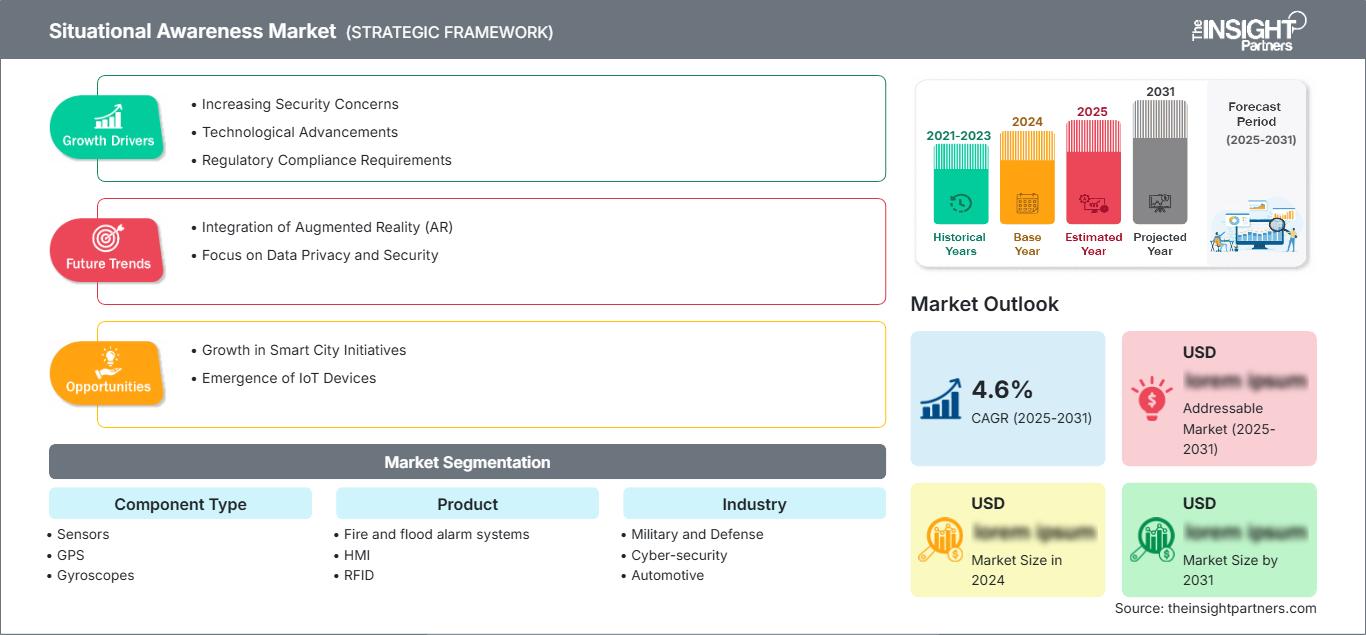
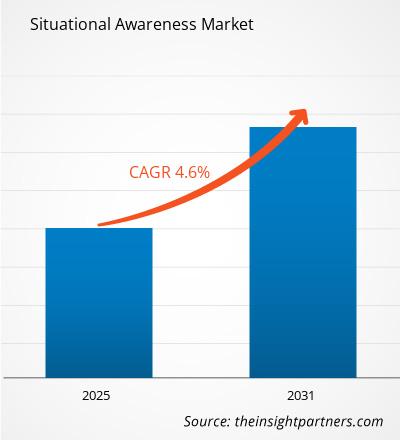
The Situational Awareness Market is projected to grow from US$ 26.68 Billion in 2025 to US$ 42.34 Billion by 2034, registering a CAGR of 5.26% during 2026–2034. Demand is being shaped by defense modernization, cyber resilience, industrial safety, automotive intelligence, and healthcare monitoring requirements. Integrated sensors, GPS, gyroscopes, displays, NVR, RFID, access control, radar, CBRN, HMI, and command and control systems are becoming core decision-support layers.
Across North America, the Situational Awareness Market size is supported by defense network upgrades, homeland security integration, cyber situational awareness, and connected vehicle safety programs. The region is estimated to expand at a CAGR of 5.0–5.6% during 2026–2034, with the U.S. remaining the primary demand center. Federal procurement, critical infrastructure protection, and enterprise cybersecurity investments are creating sustained pull for interoperable platforms that combine surveillance, analytics, and response coordination.
Situational Awareness Market Assessment and Insights
- North America held 35–38% share in 2025 and is expected to grow at a CAGR of 5.0–5.6% during 2026–2034, driven by defense modernization, cyber resilience, smart infrastructure, and integrated emergency response programs.
- US accounted for 78–82% of North America in 2025 and is projected to grow at a CAGR of 5.1–5.7% during 2026–2034, led by defense and cyber applications.
- Europe represented 24–27% share in 2025 and is forecast to grow at a CAGR of 4.6–5.2% during 2026–2034, with the UK, Germany, France, Italy, and Spain leading adoption.
- Asia Pacific captured 26–29% share in 2025 and is projected to expand at a CAGR of 5.8–6.5% during 2026–2034, supported by China, Japan, South Korea, India, and Australia.
- Largest Segment Command and Control Systems held 27–30% market share in 2025 and is expected to grow at a CAGR of 5.2–5.8% during 2026–2034.
- High Growth Segment Cyber-security held 16–19% market share in 2025 and is projected to grow at a CAGR of 6.4–7.2% during 2026–2034.
- Key companies analyzed in detail: Advanced Micro Devices, Inc., BAE Systems plc, Barco NV, DENSO Corporation, General Electric Company, L3Harris Technologies, Inc., Honeywell International Inc., Lockheed Martin Corporation, Microsoft Corporation, Qualcomm Incorporated, RTX Corporation, and Advanced Micro Devices, Inc. subsidiary Xilinx.
Source: The Insight Partners' analysis based on proprietary research, government publications, company annual reports, investor presentations, industry databases, and expert interviews.
The platform design is being transformed from standalone systems for issuing alerts to data fusion frameworks, which involve edge sensors, cloud computing capability, durable displays, and command platforms. Production trends now include modular electronics, upgradability via software, and seamless interoperability instead of proprietary equipment. The Situational Awareness Market will thus evolve to become a space wherein military agencies, hospitals, car manufacturers, and utilities consider factors such as lifecycle security and integration cost, latency, operator load, besides hardware capabilities.
In the future, future demand will be driven by new regions where emergency services, border security, connected transportation, and utilities' real-time monitoring applications are becoming more relevant. Investments will also flow to decision-making assistance through artificial intelligence, secure communication networks, and sensor infrastructures. Tailwinds on cyber resiliency, vehicle safety, hospital readiness, and continuity of operations in critical infrastructure will drive wider use of the technology outside the military by 2034.
Situational Awareness Market Report Scope
| Report Attribute | Details |
|---|---|
| Market size in 2025 | US$ 26.68 Billion |
| Market Size by 2034 | US$ 42.34 Billion |
| Global CAGR (2026 - 2034) | 5.26% |
| Historical Data | 2021-2024 |
| Forecast period | 2026-2034 |
Situational Awareness Market Analysis
The Situational Awareness Market growth is underpinned by demand for faster recognition of threats, hazards, equipment anomalies, and cyber intrusions. Military and defense users require fused operating pictures across air, land, sea, space, and cyber domains, while healthcare and automotive users prioritize safety, continuity, and automated alerts.
The value chain includes semiconductor suppliers, sensor manufacturers, network infrastructure vendors, platform integrators, software analytics providers, and end users. Supply dynamics favor vendors that can combine GPS, gyroscopes, radar, displays, and NVR with secure data exchange and low-latency processing. The Situational Awareness Market analysis indicates that interoperability is becoming a decisive procurement criterion.
The competition is driven by defense primes, industrial automation firms, semiconductor manufacturers, and cloud technology players. BAE Systems plc, Lockheed Martin Corporation, Honeywell International Inc., RTX Corporation, Microsoft Corporation, and L3Harris Technologies, Inc. are aligned in mission systems, data platforms, avionics, cyber analytics, and command software.
Trends in investments include a move away from hardware refresh cycles toward upgradeable systems that increase the lifespan of assets. Advanced Micro Devices, Inc., Qualcomm Incorporated, Barco NV, DENSO Corporation, General Electric Company, and Xilinx provide capabilities in embedded processing, visualization, automotive sensing, industrial control, and edge acceleration. Strategic positioning requires certification, security, and scalability.
● REPORT CUSTOMIZATION
Tailor This Report To Align With Your Specific Business Requirements
This report can be customized to align precisely with your business objectives, scope, and target markets. Customization options include tailored segmentation, geography, competitive analysis, and strategic insights to support informed decision-making.
Customize This Report →WHAT YOU CAN ADJUST
- ● Segmentations
- ● Geography
- ● Competitive Analysis
- ● Language Preferences
Situational Awareness Market: Strategic Insights
Regional Insights
North America Situational Awareness Market
North America held 35–38% share in 2025 and is forecast to grow at a CAGR of 5.0–5.6% during 2026–2034. The regional base is supported by large defense programs, border security modernization, cyber protection of critical infrastructure, and private-sector adoption across aviation, energy, healthcare, and mobility networks.
The U.S. remains the anchor market because procurement favors connected command platforms, AI-enabled surveillance, and secure communications. Canada and Mexico add demand through emergency management, transportation corridors, industrial safety, and infrastructure monitoring. The Situational Awareness Market share in North America reflects mature integrator ecosystems and strong technology absorption.
U.S. Situational Awareness Market
The U.S. accounted for 78–82% of North America in 2025 and is projected to grow at a CAGR of 5.1–5.7% during 2026–2034. Adoption is concentrated in defense command networks, cyber situational awareness, airspace monitoring, hospital security, vehicle intelligence, and energy infrastructure protection.
Company presence is broad, with Lockheed Martin Corporation, Honeywell International Inc., Microsoft Corporation, L3Harris Technologies, Inc., RTX Corporation, Qualcomm Incorporated, Advanced Micro Devices, Inc., and General Electric Company supporting platform, chip, cloud, sensing, and industrial requirements. Application trends emphasize multi-domain command, predictive alerts, and cyber-secure data exchange.
Europe Situational Awareness Market
Europe represented 24–27% share in 2025 and is expected to grow at a CAGR of 4.6–5.2% during 2026–2034. The United Kingdom takes the lead in terms of communications and cyber coordination and emergency response systems modernization, whereas Germany concentrates on vehicle security, production process security, and secure operation of infrastructure.
France, Italy, and Spain focus on developing border monitoring, transportation security, and infrastructure monitoring systems. BAE Systems plc and Barco NV are contributing to the capability depth in Europe, and multinational vendors contribute to visualization, semiconductor, and control layers technologies.
APAC Situational Awareness Market
APAC captured 26–29% share in 2025 and is projected to grow at a CAGR of 5.8–6.5% during 2026–2034. China leads regional demand through defense electronics, smart cities, and industrial automation. Japan and South Korea advance automotive, robotics, and maritime monitoring applications.
India and Australia are expanding border management, disaster response, and cyber resilience investments. Policy support for domestic electronics, secure infrastructure, and mobility safety improves the growth outlook. The Situational Awareness Market in APAC benefits from dense urbanization, manufacturing expansion, and rising defense technology localization.
Middle East & Africa Situational Awareness Market
The Middle East & Africa is forecast to grow at a CAGR of 5.3–6.0% during 2026–2034. Demand from Saudi Arabia and the UAE will be driven by energy security, intelligent infrastructure, airport surveillance, and defense readiness. South Africa will drive the market through mining, utility, and public safety applications.
Adoption in the rest of the MEA will come through port security, energy infrastructure asset protection, and disaster management technology. The energy infrastructure environment in the region drives demand for access control, radar, NVR, sensors, and command center systems.
Segmentation Analysis
Component Type
Component Type is expected to grow at a CAGR of 5.1–5.7% during 2026–2034. The Situational Awareness Market scope across components is widening as buyers demand synchronized sensing, positioning, visualization, storage, and motion intelligence. Hardware remains essential, but value is shifting toward embedded processing, secure connectivity, and software-defined performance upgrades.
- Sensors remain central because they capture environmental, operational, and threat signals. Demand is strongest where safety, surveillance, asset protection, and automated alerts require accurate real-time data.
- GPS supports location intelligence for mobile assets, vehicles, field teams, and defense platforms. Strategic importance rises when geospatial positioning is linked with command dashboards and secure communications.
- Gyroscopes enable motion tracking, navigation stability, and platform orientation. Adoption is tied to drones, vehicles, avionics, robotics, and rugged defense systems requiring precise movement awareness.
- Displays translate complex signals into operator-ready visual information. Control rooms, aircraft, vehicles, hospitals, and industrial sites depend on reliable visualization to reduce response time.
- NVR supports video storage, retrieval, and evidence management in surveillance environments. Demand is strongest in infrastructure, public safety, retail security, healthcare, and industrial monitoring.
Product
Product is projected to grow at a CAGR of 5.3–5.9% during 2026–2034. Product demand is moving toward connected platforms that can alert, identify, authenticate, monitor, and command across a single operating picture. Buyers increasingly prefer solutions that integrate cyber protection, field data, video feeds, and automated workflows.
- Fire and flood alarm systems serve safety-critical environments where fast detection and evacuation response matter. Demand is reinforced by building codes, industrial compliance, hospital safety, and climate-related disruption.
- HMI enables operators to interact with machines, alarms, and process data. Strategic value is highest in industrial automation, utilities, transport control, and mission operations.
- RFID supports asset visibility, authentication, logistics tracking, and patient or equipment identification. Adoption expands where real-time traceability improves security, inventory control, and operational accountability.
- Access Control protects facilities, restricted zones, data centers, hospitals, and defense sites. Demand rises as identity management converges with surveillance and incident response systems.
- RADAR provides long-range detection for air, maritime, border, traffic, and weather applications. Its strategic role remains strong where visibility is constrained and threats are mobile.
- CBRN systems detect chemical, biological, radiological, and nuclear risks. Demand is concentrated in defense, emergency response, ports, airports, laboratories, and critical infrastructure protection.
- Command and Control Systems coordinate alerts, assets, intelligence, and response actions. They remain the largest product segment because decision-makers need unified situational pictures and accountable workflows.
Industry
Industry is expected to grow at a CAGR of 5.4–6.0% during 2026–2034. Adoption is strongest where continuity, threat detection, and response coordination carry operational or public safety consequences. The segment links defense modernization, cyber resilience, connected mobility, and healthcare preparedness into a broader enterprise risk-management requirement.
- Military and Defense remains a foundational demand area because commanders require fused intelligence, secure communications, and synchronized battlefield awareness across domains, assets, and coalition networks.
- Cyber-security is a high-growth industry segment as enterprises seek real-time visibility into threats, vulnerabilities, traffic behavior, and incident response across hybrid digital infrastructure.
- Automotive demand is expanding as connected cars, driver assistance, fleet safety, and software-defined vehicles require sensing, localization, monitoring, and cyber-secure data exchange.
- Healthcare adoption is rising in hospitals, emergency rooms, laboratories, and remote monitoring environments where patient safety, asset tracking, security, and rapid incident management are priorities.
Opportunity Snapshot
| Industry | Revenue Contribution | Trend Tag | Adoption Stage |
| Military and Defense | High | Multi-domain | Mature |
| Cyber-security | High | Threat Fusion | Scaling |
| Automotive | Medium | ADAS Safety | Scaling |
| Healthcare | Medium | Patient Safety | Scaling |
| Others | Low | Site Monitoring | Emerging |
Situational Awareness Market Growth Drivers and Impact Analysis
Defense Modernization and Multi-Domain Operations
Buyers of defense are giving importance to the real-time operating picture, which includes radar, GPS, sensors, communication, and command software. To achieve mission effectiveness in the present day, there is a need to be aware of all the aspects, like air, land, sea, space, and cyberspace, and fragmented systems will fail in such scenarios. This trend will drive the demand for systems that will reduce the decision cycle, provide force protection, and interoperability. It will be helpful for the Situational Awareness Market as buyers prefer upgraded architecture over individual gadgets.
Rising Cyber and Critical Infrastructure Threats
Operators of critical infrastructure require ongoing visibility of threats in the cyber world and the real world, since interruptions now happen in energy, healthcare, transportation, finance, and public sectors. Increasing adoption of cybersecurity includes intelligence, behavioral monitoring, and orchestration of incidents. Integration of physical security systems with access control, video analysis, and command dashboards is taking place. Market implications include an expanded pool of potential customers beyond traditional defense sector buyers. Customers want a platform to detect subtle signals, minimize false positives, and provide for auditable responses.
Connected Mobility and Industrial Automation Adoption
The automotive industry, logistics, manufacturing, utilities, and healthcare sectors are leveraging sensors, displays, RFID, GPS, and edge computing for safety and control purposes. Connected cars need to be aware of the status of the road, environment, state of the software, and security threats. Industrial companies must detect any malfunction in their machines, worker safety, or security threats on-site. The effect of such a trend will be an increasing demand outside the military domain, mainly when downtime or an incident results in a high cost.
Situational Awareness Market Future Trends
AI-Assisted Sensor Fusion at the Edge
Situational Awareness Market trends will increasingly center on edge-based intelligence that processes sensor, radar, video, and location data close to the source. This approach helps in reducing latency, minimizing network load, and increasing responsiveness when there is a connectivity failure. AI-facilitated fusion will allow the operator to sort out events, identify any anomaly, and understand complicated environments without being overwhelmed by the control center. It is anticipated that future systems will have the ability to give explanations for alarms, rule configuration, and cybersecurity measures.
Open Architecture and Interoperable Command Platforms
Procurement will shift towards an open architecture where agencies and enterprises will be able to integrate their legacy systems with new sensors, software, and analytics. The issue of interoperability will be crucial since end-users tend not to change their entire system estate at once. Modular command centers will enable iterative upgrading, multi-vendor integration, and swift deployment. These developments will facilitate low-life-cycle cost and diminish vendor lock-in. In addition, it will bring in the opportunity for semiconductor, cloud, visualization, and cybersecurity companies to join the competition.
Situational Awareness Market Opportunities
Cyber-Physical Security Platforms for Critical Infrastructure
Operators of power grids, airports, ports, hospitals, rail corridors, and data centers need unified oversight of access events, network anomalies, video feeds, and operational alarms. Situational Awareness Market Forecasts point to rising opportunities for platforms that connect cyber and physical signals into one risk picture. Vendors can target investments in API-based integration, secure identity management, video analytics, and automated escalation workflows. The strongest business case will be in environments where a single incident can create public safety, service continuity, or regulatory exposure. Managed services and subscription analytics can improve adoption among resource-constrained operators.
Healthcare and Emergency Response Modernization
There is an urgent need for hospitals, EMS services, and organizations dealing with disaster management to have quick visibility with regard to patient flows, asset tracking, security within the facilities, hazardous environments, and operations on the ground. There is room for innovation with respect to a solution that will incorporate RFID, access control, sensors, displays, command dashboards, and privacy-aware data management. Budgetary challenges usually hinder healthcare buyers, so there is a need for modules and demonstrable operational gains. System providers should be able to sell their products based on faster response times and enhanced incident management.
Recent Developments
- July 2026: Situational Awareness LP, founded by ex-OpenAI researcher Leopold Aschenbrenner, has hit a $20B valuation. The fund’s strategy includes value investing in crypto and concentrated bets on AI infrastructure and crypto mining. It holds major positions in Bloom Energy and semiconductor-related puts. Returns have topped 1,000% since launch and 270% year-to-date in 2026. The fund’s focus on power generation and data centers aligns with support and resistance levels in key energy and tech sectors.
- April 2026: The Indian Space Situational Awareness Report for 2025 (ISSAR-2025) was released by ISRO/Secretary, DOS, on the 8th April, 2026, during the inaugural session of the second international conference on Spacecraft Mission Operations (SMOPS-2026) being held at Bengaluru. The year 2025 witnessed the highest number of launches since the beginning of the space age. There were 328 launch attempts, out of which 315 launches were successful in placing 4198 known operational satellites. A total of 4651 objects were added to the space object population in this year, in a significant rise compared to the previous years- the space object population increased by 2963 objects from 254 launches in 2024 and 3135 objects from 212 launches in 2023.
- February 2026: SpaceX has developed a space situational awareness system, called Stargaze, which is designed to improve the safety and sustainability of satellite operations in low Earth orbit (LEO). Stargaze’s screening data will be made available to the broader satellite operator community free of charge in the coming weeks. The system uses data collected from nearly 30,000 star trackers, each of which makes continuous observations of nearby objects, resulting in approximately 30 million transits detected daily across the fleet. It autonomously detects observations of orbiting objects that are then aggregated to generate accurate orbit estimates and predictions of position and velocity for all detected objects in near real-time. These predictions integrate into a space traffic management platform that identifies potential close approaches between objects in space and generates Conjunction Data Messages (CDMs).
Frequently Asked Questions

- Comprehensive Market Sizing and Forecast Analysis
- Detailed Segmentation Analysis
- In-Depth Market Dynamics Assessment
- Regional and Country-Level Insights
- Competitive Landscape and Company Benchmarking
- Strategic Business Intelligence
Recent Reports
Testimonials

The Insight Partners' SCADA System Market report is comprehensive, with valuable insights on current trends and future forecasts. The team was highly professional, responsive, and supportive throughout. We are very satisfied and highly recommend their services.
RAN KEDEM Partner, Reali Technologies LTDs
I requested a report on a very specific software market and the team produced the report in a few days. The information was very relevant and well presented. I then requested some changes and additions to the report. The team was again very responsive and I got the final report in less than a week.
JEAN-HERVE JENN Chairman, Future Analytica
We worked with The Insight Partners for an important market study and forecast. They gave us clear insights into opportunities and risks, which helped shape our plans. Their research was easy to use and based on solid data. It helped us make smart, confident decisions. We highly recommend them.
PIYUSH NAGPAL Sr. Vice President, High Beam Global
The Insight Partners delivered insightful, well-structured market research with strong domain expertise. Their team was professional and responsive throughout. The user-friendly website made accessing industry reports seamless. We highly recommend them for reliable, high-quality research services
YUKIHIKO ADACHI CEO, Deep Blue, LLC.
This is the first time I have purchased a market report from The Insight Partners.While I was unsure at first, I visited their web site and felt more comfortable to take the risk and purchase a market report.I am completely satisfied with the quality of the report and customer service. I had several questions and comments with the initial report, but after a couple of dialogs over email with their analyst I believe I have a report that I can use as input to our strategic planning process.Thank you so much for taking the extra time and making this a positive experience.I will definitely recommend your service to others and you will be my first call when we need further market data.
JOHN SUZUKI President and Chief Executive Officer, Board Director, BK Technologies
I wish to appreciate your support and the professionalism you displayed in the course of attending to my request for information regarding to infectious disease IVD market in Nigeria. I appreciate your patience, your guidance, and the fact that you were willing to offer a discount, which eventually made it possible for us to close a deal. I look forward to engaging The Insight Partners in the future, all thanks to the impression you have created in me as a result of this first encounter.
DR CHIJIOKE ONYIA MANAGING DIRECTOR, PineCrest Healthcare Ltd.Reason to Buy
- Informed Decision-Making
- Understanding Market Dynamics
- Competitive Analysis
- Identifying Emerging Markets
- Customer Insights
- Market Forecasts
- Risk Mitigation
- Boosting Operational Efficiency
- Strategic Planning
- Investment Justification
- Tracking Industry Innovations
- Aligning with Regulatory Trends





 Get Free Sample for