
Smart Doorbell Market Demand, Share & Growth by 2034
Coverage: by Product Type (Wired Smart Doorbells, Wireless Smart Doorbells); Component (Hardware, Software, Service); End-User (Corporate, Residential, Industrial) , and Geography (North America, Europe, Asia Pacific, and South and Central America)
- Status : Data Released
- Report Code : TIPRE00009729
- Category : Electronics and Semiconductor
- No. of Pages : 150
- Available Report Formats :


- Last update date : August 06, 2026


2025 Market Size
US$ 8.36 Bn
Base year value
2034 Forecast
US$ 108.51 Bn
Projected by 2034
CAGR 2026-2034
32.95 %
Growth rate
Addressable Market
US$ 404.03 Bn
(2026-2034)
The Smart Doorbell Market was valued at US$ 8.36 Billion in 2025 and is projected to reach US$ 108.51 Billion by 2034, growing at a CAGR of 32.95% during 2026–2034. Demand is being shaped by connected home security, AI-assisted visitor detection, package monitoring, and wider adoption of wireless access-control devices across residential and commercial premises.
North America remains the most established revenue base, with 2025 share assessed at 32–35% and regional CAGR expected in the 31–34% range through 2034. The Smart Doorbell Market size in this region is supported by high broadband penetration, frequent parcel deliveries, strong DIY security retail channels, and integration with voice assistants and subscription-based monitoring.
Smart Doorbell Market Assessment and Insights
- North America held 32–35% share in 2025 and is forecast to grow at 31–34% CAGR between 2026–2034, led by connected home maturity, subscription security services, and large-scale replacement of conventional entry devices.
- US represented 78–82% of North America in 2025 and is expected to expand at 31–33% CAGR during 2026–2034, supported by e-commerce delivery density and major platform vendors.
- Europe accounted for 24–27% share in 2025 and is projected to post 29–32% CAGR, with the UK, Germany, France, Italy, and Spain advancing through retrofit security demand and privacy-compliant devices.
- Asia Pacific captured 25–28% share in 2025 and is expected to grow at 35–38% CAGR, driven by China, Japan, South Korea, India, and Australia as smart apartments and broadband infrastructure expand.
- Largest Segment Residential held 77–82% market share in 2025 and is forecast to grow at 32–35% CAGR, reflecting sustained demand for parcel visibility, remote access, and family safety.
- High Growth Segment Integrated smart doorbell held 36–40% market share in 2025 and is projected to grow at 36–39% CAGR as users adopt connected locks, hubs, and monitored systems.
- Key companies analyzed in detail: Aeotec Limited, Arlo Technologies, Inc., August Home, Inc., Eques Inc., Google LLC, iseeBell Inc., Ring LLC, SkyBell Technologies, Inc., Soliom Solar Home Security, Xiaomi Corporation.
Source: The Insight Partners' analysis based on proprietary research, government publications, company annual reports, investor presentations, industry databases, and expert interviews.
The market has shifted from basic Wi-Fi video chimes to multi-sensor security nodes that combine HD imaging, motion analytics, two-way communication, cloud storage, and app-based access control. Hardware production is moving toward higher resolution sensors, longer battery life, and solar-assisted charging, while software differentiation increasingly depends on AI event classification and privacy controls. These shifts support the Smart Doorbell Market growth profile as device makers balance affordability with service-led recurring revenue.
Momentum can be expected in the areas of urbanizing economies in Asia, retrofitting in Europe, and upgrades in North America that build upon integrated security ecosystems. Investments will go into edge AI, interoperability, and wireless low-power technology, whereas regulation regarding data protection will drive vendors towards improved encryption, consent management, and processing of data on the device itself. Geographies currently emerging will tend towards cheaper standalone models before moving towards connected access platforms.
Smart Doorbell Market Report Scope
| Report Attribute | Details |
|---|---|
| Market size in 2025 | US$ 8.36 Billion |
| Market Size by 2034 | US$ 108.51 Billion |
| Global CAGR (2026 - 2034) | 32.95% |
| Historical Data | 2021-2024 |
| Forecast period | 2026-2034 |
Smart Doorbell Market Analysis
Demand is anchored in three use cases: doorstep visibility, package monitoring, and remote visitor communication. The Smart Doorbell Market growth is also reinforced by rising consumer familiarity with connected cameras and the shift from discretionary gadgets to practical safety devices. Broadband availability, smartphone penetration, and e-commerce logistics convert security concerns into measurable device replacement cycles.
Ecosystem players are suppliers of camera sensors, chipset suppliers, device assemblers, cloud video platforms, application developers, retailers, installers, and security monitoring service providers. Hardware margins are competitive, hence value will be created via software subscriptions, AI alerts, storage services, and integration with smart locks, smart lights, and voice assistants.
Market analysis reveals a competitive landscape characterized by platform control, data trust, and reliability of the products. Ring LLC and Google LLC have gained a competitive advantage through smart home ecosystems, while Arlo Technologies, Inc. relies on its security subscriptions and AI alerts. Xiaomi Corporation competes based on affordability, while specialists, including SkyBell Technologies, Inc. and Soliom Solar Home Security, compete based on installation.
Investment trends are towards improved imaging, battery efficiency, cloud-to-edge processing and Matter-compliant home automation. Players are positioning their portfolios in entry-level, mid-level, and premium products to minimize churn, improve subscription attach rate, and cater to the needs of apartments, single-family residences, small offices, and gated communities.
● REPORT CUSTOMIZATION
Tailor This Report To Align With Your Specific Business Requirements
This report can be customized to align precisely with your business objectives, scope, and target markets. Customization options include tailored segmentation, geography, competitive analysis, and strategic insights to support informed decision-making.
Customize This Report →WHAT YOU CAN ADJUST
- ● Segmentations
- ● Geography
- ● Competitive Analysis
- ● Language Preferences
Smart Doorbell Market: Strategic Insights
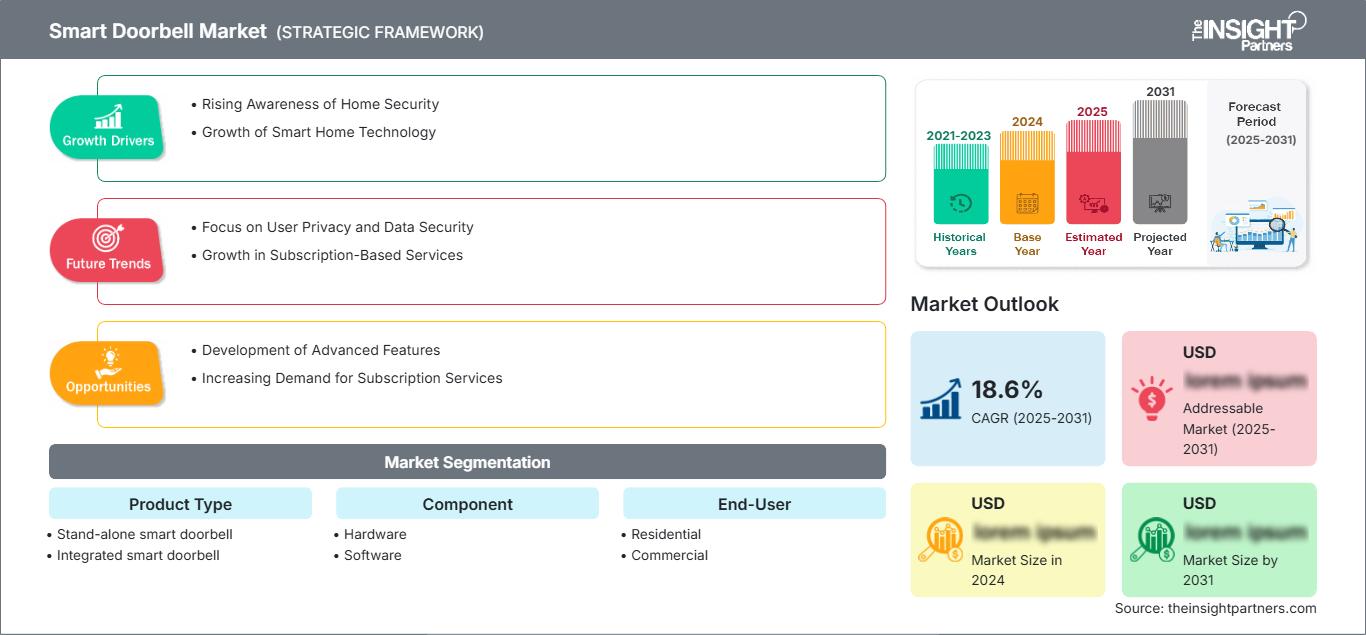
Regional Insights
North America Smart Doorbell Market
North America accounted for 32–35% share in 2025 and is projected to grow at 31–34% CAGR through 2034. The Smart Doorbell Market share is concentrated in the US, where connected security devices are sold through online channels, telecom bundles, consumer electronics stores, and professional installers.
The regional demand is driven by concerns over package thefts, smart speaker compatibility, and subscription billing practices. Canada helps with single-family home upgrades and condo security retrofits, whereas Mexico has early growth opportunities due to increasing broadband availability and middle-class housing development.
U.S. Smart Doorbell Market
The U.S. Smart Doorbell Market represented 78–82% of North America in 2025 and is forecast to expand at a 31–33% CAGR. Adoption is fueled by suburban families, residential property owners, and businesses who want front door proof, delivery confirmation, and visitor screening using mobile applications. The increasing worry about package thefts, home security, and monitoring remotely is adding to the adoption, especially among homeowners who are incorporating connected devices within their smart homes.
Ring LLC, Google LLC, Arlo Technologies, Inc., and August Home, Inc. stay visible through integration within platforms, home security services, and availability at retailers. App features are artificial intelligence-based visitor summaries, package notifications, battery-operated models, and use alongside smart locks within multi-device homes. Demand growth is being aided by advancements in video clarity, cloud-based storage, motion detector precision, and voice assistant compatibility, making the offerings even more convenient.
Europe Smart Doorbell Market
Europe held 24–27% of the Smart Doorbell Market share in 2025 and is forecast to record a 29–32% CAGR. The UK leads regional uptake because parcel delivery frequency, terraced housing layouts, and DIY retail availability support practical front-door monitoring. Increasing awareness among consumers regarding home security and the convenience of remote visitor management systems is also contributing to increased usage in residential premises.
Germany continues to progress by means of energy-efficient housing renovations and preferences for privacy-focused connected gadgets. France, Italy and Spain are developing as a result of advancements in access control at apartments, expansion of broadband connections, and the need for low-cost video entry systems to meet regional requirements for data protection. Smart home adoption and better wireless connectivity are also contributing to the increasing demand.
APAC Smart Doorbell Market
Asia Pacific accounted for 25–28% of the Smart Doorbell Market share in 2025 and is projected to grow at a 35–38% CAGR, the fastest regional pace. China leads through smart apartment construction, domestic electronics manufacturing, and high mobile commerce usage. Expanding smart-home adoption, widespread smartphone penetration, and increasing investment in connected residential infrastructure continue to strengthen demand across urban areas.
Japan and South Korea contribute through premium connected homes, while India and Australia expand through affordable wireless devices and rising urban security awareness. Policy support for digital infrastructure, smart-city initiatives, and local manufacturing programs further strengthens the Smart Doorbell Market across emerging urban clusters. Growing consumer interest in remote monitoring, package protection, and integrated home security ecosystems is also encouraging wider adoption throughout the region.
Middle East & Africa Smart Doorbell Market
Middle East & Africa accounted for a smaller share of the Smart Doorbell Market in 2025 but is expected to grow at a 28–31% CAGR through 2034. The UAE emerges as the leader within the region on the back of the presence of premium homes, smart city initiatives, and security solutions that use digital technology, paving the way for the acceptance of connected access control devices. The investments made in the automation and security of the residential sector are boosting the demand for smart doorbell solutions in the region's urban affluent communities.
Following the UAE is Saudi Arabia, with the development of residential communities and infrastructure modernization initiatives, South Africa, and the rest of MEA with demand coming from gated communities, devices that can utilize solar energy, and increasing desire for cost-effective home monitoring solutions.
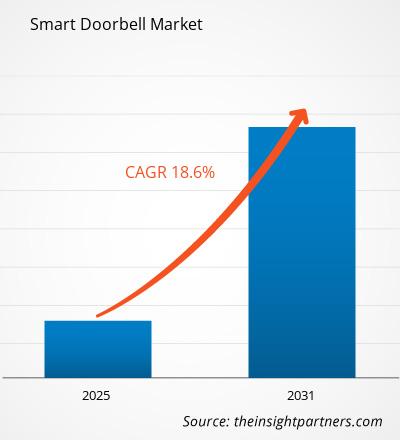
Segmentation Analysis
Product Type
Product Type is forecast to grow at 32–35% CAGR during 2026–2034 as buyers choose between independent monitoring devices and integrated access-control systems. The Smart Doorbell Market scope is widening because households want simple installation, while premium users prefer links with locks, alarms, lighting, and cloud intelligence.
- Stand-alone smart doorbell devices remain important for first-time buyers seeking affordable video alerts, two-way audio, and app access without complex installation or broader smart home commitments.
- Integrated smart doorbell systems are gaining strategic relevance as users connect doorbells with locks, cameras, hubs, and monitoring subscriptions to create coordinated property security workflows.
Component
Component is projected to grow at 31–34% CAGR during 2026–2034. Hardware remains the revenue base, but software is becoming the main differentiation layer as AI detection, cloud storage, encrypted access, and automated alerts influence brand loyalty and lifetime value.
- Hardware demand centers on cameras, microphones, speakers, batteries, processors, housings, and wireless modules, with buyers prioritizing video clarity, durability, weather resistance, and easy installation.
- Software supports recurring value through mobile applications, video analytics, cloud storage, package detection, facial alerts, device management, firmware updates, and privacy controls.
End-User
End-User is expected to grow at 32–35% CAGR during 2026–2034. Residential users dominate because front-door monitoring directly addresses personal safety and delivery visibility, while commercial users increasingly adopt video doorbells for small offices, clinics, rental properties, and low-cost access verification.
- Residential users prioritize visitor screening, parcel confirmation, child safety, and remote entry awareness, making the segment the core volume driver for device replacement and subscriptions.
- Commercial adoption is rising among small premises and property managers that need visible deterrence, visitor logs, after-hours alerts, and lower-cost access monitoring.
Opportunity Snapshot
| End-User | Revenue Contribution | Trend Tag | Adoption Stage |
| Residential | High | Parcel Alerts | Scaling |
| Commercial | Medium | Access Logs | Emerging |
Smart Doorbell Market Growth Drivers and Impact Analysis
Parcel Delivery Visibility Becomes a Purchase Trigger
Smart Doorbell Market growth is being driven by the rapid expansion of online shopping, which has made the doorstep a critical security point, especially in dense suburbs and apartment communities. Smart doorbells enable customers to confirm their deliveries, document attempts at stealing, converse with delivery personnel, and observe unaccompanied parcels in real-time. Such innovation greatly increases the need for replacement since traditional doorbell chimes do not cater to these needs. The rising fears of homeowners about parcel theft and safety of their houses are driving the adoption even further.
On the side of retailers and logistics firms, smart doorbells help them by enabling consumers to coordinate their delivery instructions remotely, lowering rates of unsuccessful and skipped deliveries, as well as customer complaints. With parcel volumes still being high structurally, manufacturers of smart doorbells are integrating such features as package detection, configurable activity areas, automated visitor alerts, and advanced motion analysis into their budget and top-end devices.
AI Analytics Improve Device Utility and Retention
AI analytics are shifting product value from passive recording to actionable security intelligence. Person recognition, vehicle alerts, familiar-face identification, package detection, and event captions reduce false notifications and make monitoring more useful for busy users. This improvement supports subscription conversion because advanced analytics often sit behind paid service tiers. Vendors that process more events on-device can also address privacy concerns and reduce cloud dependency. Over the forecast period, the Smart Doorbell Market will increasingly reward brands that combine accurate detection, transparent data practices, and reliable mobile experiences.
Wireless Installation Lowers Adoption Barriers
Solar energy and battery-based systems lessen dependence on existing wiring infrastructure, thereby increasing the use of doorbells in rented apartments, old constructions, and developing countries. Less complicated installations decrease the overall ownership costs and make these devices applicable for e-commerce delivery. Developers are working on better battery management systems, easy-to-remove batteries, and low-power processors in order to reduce the inconvenience of maintenance. It is very important for Asia-Pacific, MEA, and retrofitted European housing with different wiring standards.
Smart Doorbell Market Future Trends
Edge AI and Privacy-by-Design Architectures
Smart Doorbell Market trends point toward edge AI that processes more video data locally before sending alerts or clips to the cloud. This model can result in less latency, less bandwidth consumption, less privacy compromise, and more relevant events. The next generation of devices will probably come with specialized chips for AI functions, encrypted storage capacity, and options to control the retention period. Suppliers who make privacy easy to understand may get an edge in Europe and higher-tier North America.
Interoperable Entry Ecosystems
Interoperability will be more of a purchasing consideration since homes will connect their doorbells with smart locks, lighting, alarms, speakers, and energy systems. Matter-compatible products and open APIs could ease platform lock-ins and installation processes for builders, landlords, and installers. This might alter the focus of competition from individual devices' specifications to overall system reliability and package services. Companies that securely integrate across diverse settings can serve both high-end smart homes and affordable multi-family housing projects.
Smart Doorbell Market Opportunities
Builder and Property Management Partnerships
New housing developments and managed rental communities create a scalable route for bundled device deployment. Vendors can partner with builders, real estate managers, and telecom providers to install smart doorbells at the point of construction or tenant onboarding. This reduces customer acquisition costs and supports recurring service enrollment. Smart Doorbell Market Forecasts indicate that integrated devices will outpace stand-alone products, making bulk deployment strategies attractive for firms that can provide installation support, maintenance dashboards, and privacy-compliant resident controls.
Affordable AI Devices for Emerging Urban Markets
Emerging urban markets offer room for affordable models with localized apps, efficient batteries, and basic AI alerts. Consumers in India, Southeast Asia, the Middle East, and parts of Africa often need flexible installation and price-accessible security rather than premium feature depth. Manufacturers can capture this opportunity by simplifying setup, supporting regional languages, and using solar accessories where power reliability varies. Channel partnerships with broadband providers and electronics retailers can accelerate trust and after-sales support in these markets.
Recent Developments
- June 2026: EZVIZ, a relentless innovator, boldly adopts dual-lens technology and pre-rolling recording with an AI-powered interactive screen in its newly launched EP8 Ultra interactive video doorbell. Bringing a human touch to safe technology, it watches out things that tend to be missed in complicated environments, and extends touchable interaction to doorways, satisfying the ever-evolving demands.
- May 2026: Consistent Infosystems has launched a 3MP Wi-Fi Video Doorbell in India, expanding its smart security range. Aimed at homes and workplaces, the device lets users monitor visitors through a smartphone. Features include 3MP HD imaging, PIR motion detection, two-way audio, night vision and a 166° viewing angle.
- August 2024: Tapo, a TP-Link brand and global provider of smart home products, launched a new line of smart video doorbells, led by the flagship Tapo D225: the brand’s first dual-powered smart video doorbell with 24/7 continuous recording. The value-priced Tapo D210 rounds out the new line of smart video doorbells, offering a dedicated battery-powered option with an impressive suite of shared features. These standout security siblings from Tapo instantly elevate entryways and eliminate the need for multiple front yard monitoring devices.
Frequently Asked Questions

- Comprehensive Market Sizing and Forecast Analysis
- Detailed Segmentation Analysis
- In-Depth Market Dynamics Assessment
- Regional and Country-Level Insights
- Competitive Landscape and Company Benchmarking
- Strategic Business Intelligence
Recent Reports
Testimonials

The Insight Partners' SCADA System Market report is comprehensive, with valuable insights on current trends and future forecasts. The team was highly professional, responsive, and supportive throughout. We are very satisfied and highly recommend their services.
RAN KEDEM Partner, Reali Technologies LTDs
I requested a report on a very specific software market and the team produced the report in a few days. The information was very relevant and well presented. I then requested some changes and additions to the report. The team was again very responsive and I got the final report in less than a week.
JEAN-HERVE JENN Chairman, Future Analytica
We worked with The Insight Partners for an important market study and forecast. They gave us clear insights into opportunities and risks, which helped shape our plans. Their research was easy to use and based on solid data. It helped us make smart, confident decisions. We highly recommend them.
PIYUSH NAGPAL Sr. Vice President, High Beam Global
The Insight Partners delivered insightful, well-structured market research with strong domain expertise. Their team was professional and responsive throughout. The user-friendly website made accessing industry reports seamless. We highly recommend them for reliable, high-quality research services
YUKIHIKO ADACHI CEO, Deep Blue, LLC.
This is the first time I have purchased a market report from The Insight Partners.While I was unsure at first, I visited their web site and felt more comfortable to take the risk and purchase a market report.I am completely satisfied with the quality of the report and customer service. I had several questions and comments with the initial report, but after a couple of dialogs over email with their analyst I believe I have a report that I can use as input to our strategic planning process.Thank you so much for taking the extra time and making this a positive experience.I will definitely recommend your service to others and you will be my first call when we need further market data.
JOHN SUZUKI President and Chief Executive Officer, Board Director, BK Technologies
I wish to appreciate your support and the professionalism you displayed in the course of attending to my request for information regarding to infectious disease IVD market in Nigeria. I appreciate your patience, your guidance, and the fact that you were willing to offer a discount, which eventually made it possible for us to close a deal. I look forward to engaging The Insight Partners in the future, all thanks to the impression you have created in me as a result of this first encounter.
DR CHIJIOKE ONYIA MANAGING DIRECTOR, PineCrest Healthcare Ltd.Reason to Buy
- Informed Decision-Making
- Understanding Market Dynamics
- Competitive Analysis
- Identifying Emerging Markets
- Customer Insights
- Market Forecasts
- Risk Mitigation
- Boosting Operational Efficiency
- Strategic Planning
- Investment Justification
- Tracking Industry Innovations
- Aligning with Regulatory Trends





 Get Free Sample for