
Smart Temperature Sensors Market Growth, Share & Trends by 2034
Coverage: by Type (Homofermentative, Heterofermentative); Application (Automated Industry, Biomedical and Healthcare, Consumer Electronics Products, Building Automation, Automobile Industry, Aerospace and Defense, Other) , and Geography (North America, Europe, Asia Pacific, and South and Central America)
- Status : Data Released
- Report Code : TIPRE00010568
- Category : Electronics and Semiconductor
- No. of Pages : 150
- Available Report Formats :


- Last update date : September 01, 2026


2025 Market Size
US$ 7.06 Bn
Base year value
2034 Forecast
US$ 12.31 Bn
Projected by 2034
CAGR 2026-2034
6.38 %
Growth rate
Addressable Market
US$ 87.67 Bn
(2026-2034)
The global smart temperature sensors market was valued at US$ 7.06 billion in 2025 and is projected to reach US$ 12.31 billion by 2034, registering a compound annual growth rate (CAGR) of 6.38% from 2026 to 2034. This growth trajectory is underpinned by the increasing adoption of IoT-enabled devices, the rising demand for real-time temperature monitoring across industries, and the growing emphasis on energy efficiency and automation in industrial and building applications.
North America accounted for a substantial portion of the global smart temperature sensors market size in 2025, estimated at 38-42%, and is projected to grow at a CAGR of 6-8% from 2026 to 2034. Structural growth drivers in the region include the rapid digitalization of healthcare systems and the strong presence of leading sensor manufacturers, alongside robust investments in industrial automation and smart building technologies.
Smart Temperature Sensors Market Assessment and Insights
- North America: North America is a leading regional market, driven by high healthcare spending and the early adoption of industrial IoT technologies. It is estimated to hold a 38-42% share in 2025 and is projected to grow at a CAGR of 6-8% from 2026 to 2034.
- U.S.: The U.S. dominates the North American market, accounting for 85-89% of the region's share in 2025. Its growth is propelled by significant investments in healthcare infrastructure and the presence of major technology companies. The market is expected to grow at a CAGR of 7-9% from 2026 to 2034.
- Europe: Europe holds an estimated 28-32% share of the global market in 2025, with a projected CAGR of 5-7% from 2026 to 2034. Leading countries include Germany, the UK, and France, driven by stringent energy efficiency regulations and a strong focus on Industry 4.0 initiatives.
- Asia Pacific: APAC is estimated to hold a 22-26% share in 2025 and is projected to grow at the fastest CAGR of 8-10% from 2026 to 2034. China, Japan, and India are key markets, fueled by rapid industrialization, the expansion of consumer electronics manufacturing, and increasing healthcare modernization efforts.
- Largest Segment: The Automated Industry segment is estimated to be the largest application segment, holding a 30-35% share in 2025 and projected to grow at a CAGR of 6-8% from 2026 to 2034.
- High Growth Segment: The Biomedical and Healthcare segment is projected to be the fastest-growing, driven by the increasing use of remote patient monitoring and the need for accurate temperature control in pharmaceutical logistics. It holds a 25-30% share in 2025 and is expected to grow at a CAGR of 9-11% from 2026 to 2034 .
- Key companies analyzed in detail: ABB, Analog Devices, Inc., Eaton Corporation Inc, Honeywell International Inc., Infineon Technologies AG, Microchip Technology Inc., NXP Semiconductors, Siemens, STMicroelectronics, and TE Connectivity .
Source: The Insight Partners' analysis based on proprietary research, government publications, company annual reports, investor presentations, industry databases, and expert interviews.
The global smart temperature sensors market report shows that the market has undergone a significant transformation, evolving from basic analog devices to intelligent, connected systems that integrate data processing, wireless communication, and cloud-based analytics. This evolution has been driven by advancements in semiconductor technology and the proliferation of IoT ecosystems, enabling real-time remote monitoring and predictive maintenance across diverse sectors. Production dynamics have shifted toward developing highly integrated, low-power systems-on-chip (SoCs) that balance performance with energy efficiency to meet the growing demand for battery-operated wireless sensors.
Looking forward, the smart temperature sensors market is poised for substantial expansion, particularly in emerging economies where industrialization and infrastructure development are accelerating. Considerable investments are being channeled into sensors with enhanced features like AI-driven analytics, edge computing capabilities, and 5G connectivity to support the next generation of smart applications. Regulatory tailwinds, including stricter environmental standards and healthcare mandates, are expected to further catalyze market growth and innovation across the globe.
Smart Temperature Sensors Market Report Scope
| Report Attribute | Details |
|---|---|
| Market size in 2025 | US$ 7.06 Billion |
| Market Size by 2034 | US$ 12.31 Billion |
| Global CAGR (2026 - 2034) | 6.38% |
| Historical Data | 2021-2024 |
| Forecast period | 2026-2034 |
Smart Temperature Sensors Market Analysis
The global smart temperature sensors market is propelled by the increasing demand for automation and real-time monitoring in industrial processes to enhance efficiency, reduce downtime, and ensure product quality. The rapid digitalization of healthcare, which is projected to exceed US$ 660 billion by 2025, is creating a surge in demand for connected medical devices that rely on accurate temperature monitoring for remote patient care and vaccine logistics. The ecosystem comprises semiconductor manufacturers, sensor developers, communication module providers, and system integrators collaborating to deliver comprehensive sensing solutions.
Supply-side dynamics are characterized by strategic partnerships and continuous innovation to develop smaller, more accurate, and lower-power sensors. Companies such as Siemens and ABB are leveraging their industrial automation expertise to integrate advanced sensing capabilities into their broader portfolios. Semiconductor leaders like Analog Devices, Inc. and Infineon Technologies AG are focusing on developing highly integrated sensor ICs with on-chip signal processing and wireless connectivity. Investment trends indicate a strong shift toward wireless and IoT-enabled sensors, driven by the need for remote monitoring and the falling costs of connectivity solutions.
Consolidation is another trend that has been observed in the market, as bigger companies buy smaller innovators to expand their product range and geographical presence. Technological improvements related to MEMS, semiconductor manufacturing, and edge computing have led to enhanced capabilities of the devices, which at the same time require less energy and become cheaper to implement. This trend contributes to the wider application of temperature sensors in such fields as manufacturing, automotive, aerospace, food processing, and energy production. Finally, the emergence of artificial intelligence and predictive analytics allows businesses to analyze information and foresee possible equipment malfunctions.
In the future, one should expect significant growth in the segment of temperature sensors due to the development of smart factories and other intelligent infrastructure. The use of wireless technologies, cloud services, and advanced analytics systems will play a crucial role in the development of integrated sensing solutions. Moreover, the tightening of requirements regarding the regulation of temperature in healthcare, pharmaceutical, and food industries will stimulate the demand for the devices. Overall, with the focus of industries on resilience, energy efficiency, and remote asset management, the role of smart temperature sensors will grow significantly.
● REPORT CUSTOMIZATION
Tailor This Report To Align With Your Specific Business Requirements
This report can be customized to align precisely with your business objectives, scope, and target markets. Customization options include tailored segmentation, geography, competitive analysis, and strategic insights to support informed decision-making.
Customize This Report →WHAT YOU CAN ADJUST
- ● Segmentations
- ● Geography
- ● Competitive Analysis
- ● Language Preferences
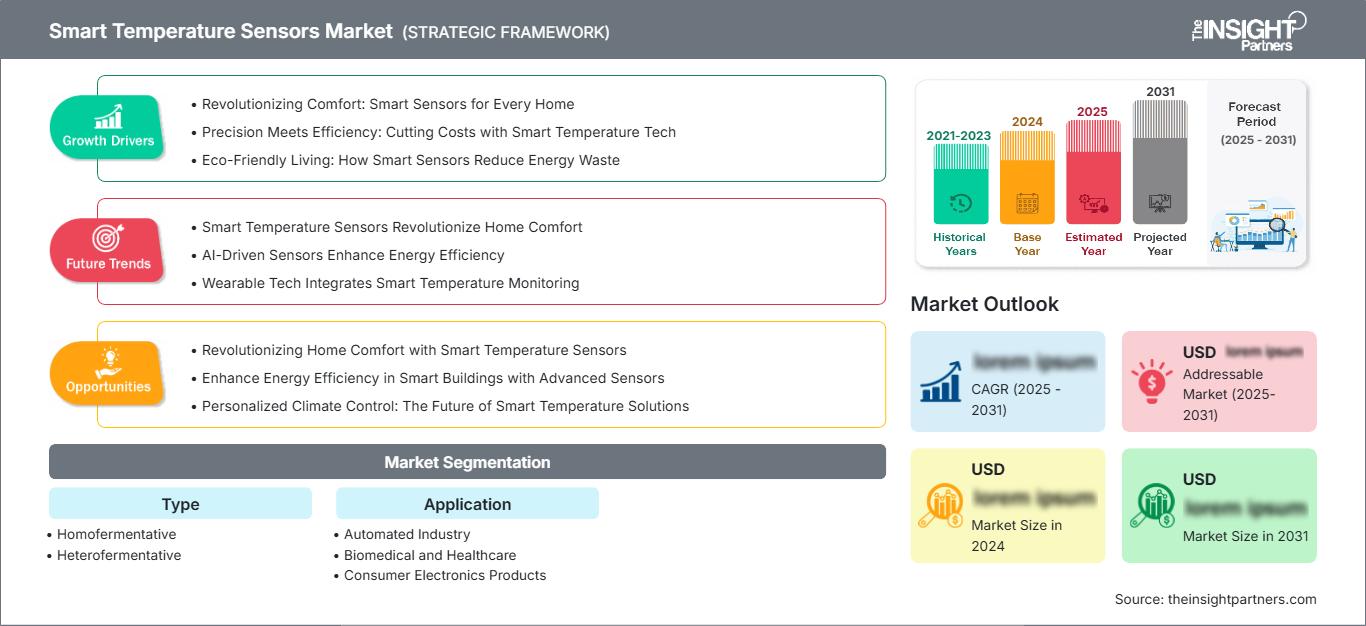
Smart Temperature Sensors Market: Strategic Insights
Regional Insights
North America Smart Temperature Sensors Market
North America is a dominant force in the global smart temperature sensors market, holding an estimated 38-42% share in 2025 and projected to grow at a CAGR of 6-8% from 2026 to 2034. The region's growth is underpinned by the rapid digitalization of healthcare systems and the strong presence of leading sensor manufacturers. The U.S. leads the region, with robust investments in industrial automation and smart building technologies driving demand across both commercial and residential sectors. The region's focus on energy efficiency and compliance with environmental regulations further fuels the adoption of smart temperature monitoring solutions.
U.S. Smart Temperature Sensors Market
The U.S. accounts for approximately 85-89% of the North American smart temperature sensors market share in 2025. The market is characterized by significant investments in healthcare infrastructure and the presence of major technology companies. The market is projected to grow at a CAGR of 7-9% from 2026 to 2034, driven by the integration of IoT and AI in temperature sensing applications. Application trends show a strong leaning toward remote patient monitoring systems and predictive maintenance in manufacturing, with the U.S. consuming a substantial share of advanced medical-grade sensors globally.
Europe Smart Temperature Sensors Market
Europe is estimated to hold a 28-32% share of the global market in 2025, with a projected CAGR of 5-7% from 2026 to 2034. Germany and the UK are leading countries, driven by stringent energy efficiency regulations and a strong focus on Industry 4.0 . France, Italy, and Spain are also significant markets, with demand fueled by investments in smart city infrastructure and green building initiatives. The region's emphasis on sustainability and carbon reduction targets is accelerating the adoption of smart temperature sensors in HVAC systems, industrial processes, and automotive applications.
APAC Smart Temperature Sensors Market
APAC is estimated to hold a 22-26% share of the global smart temperature sensors market in 2025 and is projected to grow at the fastest CAGR of 8-10% from 2026 to 2034. China, Japan, and India are key markets, driven by rapid industrialization, the expansion of consumer electronics manufacturing, and increasing healthcare modernization efforts. China is a significant market, supported by its strong domestic manufacturing base and aggressive investments in smart manufacturing infrastructure. Government policies promoting digital transformation and the adoption of IoT technologies are significant growth drivers in the region.
Middle East & Africa Smart Temperature Sensors Market
The MEA region is estimated to hold a 3-5% share of the global smart temperature sensors market in 2025, with a projected CAGR of 4-6% from 2026 to 2034. Saudi Arabia and the UAE are key markets, with growth driven by infrastructure development and investments in smart city initiatives. The UAE is a leader in the region, implementing advanced smart technologies in new developments, including building automation systems and healthcare facilities. Energy efficiency and economic diversification are important contextual factors influencing the gradual adoption of smart temperature sensors in the region.
Segmentation Analysis
Type
Type segmentation distinguishes smart temperature sensors according to their sensing and measurement characteristics, with adoption influenced by accuracy requirements, operating environments, response time, integration capabilities, and application-specific performance requirements. The segment is expected to grow at a CAGR of 5.8–6.8% during 2026–2034, supported by increasing demand for intelligent temperature monitoring across connected industrial and electronic systems.
- Homofermentative: This type represents applications requiring consistent temperature conditions and controlled operating environments. Demand is shaped by monitoring requirements, process stability, and integration with automated control systems where dependable temperature measurement supports operational consistency.
- Heterofermentative: This type serves environments involving varied process conditions and broader monitoring requirements. Its strategic importance is linked to flexible sensing architectures, connected monitoring platforms, and applications where temperature data supports automated decision-making and process optimization.
Application
The application segment of the smart temperature sensors market is categorized into Automated Industry, Biomedical and Healthcare, Consumer Electronics Products, Building Automation, Automobile Industry, and Aerospace and Defense. The Automated Industry segment is estimated to be the largest, holding a 30-35% share in 2025, with a projected CAGR of 6-8% from 2026 to 2034. This dominance is driven by the extensive use of temperature sensors in manufacturing processes for quality control, predictive maintenance, and safety monitoring. The smart temperature sensors scope encompasses a wide range of industry applications, with healthcare emerging as a critical growth area.
- Automated Industry: This is the largest segment, driven by the need for precise temperature monitoring in manufacturing, chemical processing, and food production. Sensors enable real-time process control, reduce downtime, and ensure product quality in automated environments.
- Biomedical and Healthcare: This segment is projected to be the fastest-growing, driven by the increasing use of remote patient monitoring systems, vaccine cold chain management, and smart hospital infrastructure. Healthcare digitalization and the global digital health market exceeding US$ 660 billion by 2025 are key drivers.
- Consumer Electronics Products: Smart temperature sensors are widely integrated into consumer devices such as smartphones, laptops, and wearables for device management and user comfort. The growing demand for smart home appliances also fuels this segment.
- Building Automation: This segment includes HVAC control, energy management, and environmental monitoring in commercial and residential buildings. Stringent energy efficiency regulations are driving adoption .
- Automobile Industry: Temperature sensors are critical in automotive applications for engine management, battery monitoring in electric vehicles, and cabin climate control. The rise of electric and autonomous vehicles is creating new opportunities .
- Aerospace and Defense: This segment requires highly reliable sensors for environmental control, engine monitoring, and structural health monitoring in extreme conditions. It represents a niche but technologically demanding application area .
Opportunity Snapshot
| Application | Revenue Contribution | Trend Tag | Adoption Stage |
|---|---|---|---|
| Automated Industry | High | Process Control | Mature |
| Biomedical and Healthcare | High | Remote Monitoring | Scaling |
| Consumer Electronics Products | Medium | Smart Devices | Mature |
| Building Automation | Medium | Green Buildings | Scaling |
| Automobile Industry | Medium | EV Thermal Mgt | Scaling |
| Aerospace and Defense | Low | Extreme Sensing | Mature |
Smart Temperature Sensors Market Growth Drivers and Impact Analysis
Growing Demand for Real-Time Monitoring in Healthcare and Pharmaceutical Logistics
The rapid digitalization of healthcare and the expansion of remote patient monitoring are key drivers of the smart temperature sensors market. Healthcare accounted for approximately 62% of total market applications in 2025, underscoring the sector’s critical importance. The growing need for continuous and accurate temperature monitoring in medical devices, vaccine storage, and pharmaceutical supply chains is further accelerating demand for smart temperature sensing solutions. This trend is supported by the global digital health market, which is projected to exceed US$660 billion by 2025. In addition, healthcare IoT investments are expected to surpass US$300 billion through 2030, further highlighting the significant growth potential for reliable and connected temperature-sensing technologies.
Technological Advancements in IoT, AI, and Wireless Connectivity
The market is propelled by continuous innovation in IoT, AI, and wireless communication technologies. The integration of 5G connectivity, which can reduce data latency by up to 85%, is enabling real-time, distributed monitoring networks . Sensors are increasingly incorporating AI for predictive analytics and edge computing, moving beyond simple data collection to intelligent analysis and autonomous decision-making . The growing adoption of wireless sensors, which dominate the connectivity segment, is driven by their flexibility, lower installation costs, and support for Industry 4.0 initiatives.
Increasing Focus on Energy Efficiency and Industrial Automation
A significant driver is the global push for energy efficiency and sustainable industrial practices. Smart temperature sensors are integral to building automation systems and industrial processes, enabling precise control of HVAC systems, reducing energy consumption, and optimizing manufacturing operations . The escalating adoption of Industry 4.0 technologies and stringent government regulations on energy consumption are compelling organizations across sectors to invest in smart sensing solutions for monitoring, control, and predictive maintenance, supporting broader corporate sustainability goals.
Smart Temperature Sensors Market Future Trends
Integration of AI and Predictive Analytics for Enhanced Functionality
A key future trend is the deep integration of artificial intelligence (AI) and predictive analytics into smart temperature sensors, which is a major part of the smart temperature sensors market trends. AI algorithms will analyze historical and real-time data to detect anomalies, predict equipment failures, and optimize energy usage without human intervention . This shift from passive monitoring to proactive, intelligent sensing will be crucial for complex environments like industrial plants and smart hospitals, enhancing operational efficiency and reducing costs, with sensors increasingly incorporating on-device AI for faster response times.
Expansion of Wireless and 5G-Enabled Sensor Networks
The market is moving toward large-scale, interconnected wireless sensor networks enabled by the expansion of 5G and IoT technologies . 5G connectivity supports applications requiring ultra-reliable, low-latency communication, such as real-time remote monitoring and control . As cellular IoT technologies like NB-IoT and LTE-M mature, smart temperature sensors will become more accessible and scalable for widespread deployments in smart cities, industrial facilities, and agricultural settings, marking a significant evolution in sensor deployment strategies.
Smart Temperature Sensors Market Opportunities
Untapped Growth in Emerging Economies and Industrial Sectors
A significant opportunity lies in the expanding adoption of smart temperature sensors in emerging economies across Asia Pacific, Latin America, and the Middle East. Rapid industrialization, urbanization, and the modernization of healthcare and infrastructure are creating substantial demand . Companies that can offer cost-effective, scalable, and localized solutions are well-positioned to capture market share in these high-growth regions, as highlighted in smart temperature sensors market forecasts. The food and beverage industry, with its increasing consumption of packaged foods, also presents a significant opportunity for temperature monitoring .
Development of Integrated Solutions for Smart Buildings and Smart Cities
A major opportunity exists in the development of integrated sensing solutions for smart buildings and smart cities. By combining temperature sensors with other environmental sensors (humidity, air quality, occupancy) and building management platforms, companies can provide a holistic approach to energy management, occupant comfort, and operational efficiency . The trend toward green buildings and stringent environmental regulations creates a favorable environment for integrated solutions that offer clear ROI through energy savings and improved building performance.
Recent Developments
- August 2024: OMRON Electronic Components, a global leader in innovative component solutions, has announced the release of its next-generation Weather Sensor designed to meet the growing demand for reliable environmental data across agriculture, meteorology, and smart city applications. As climate volatility and resource management challenges intensify, accurate weather data is becoming a critical tool in mitigating environmental risk and optimizing system performance. OMRON’s new Weather Sensor delivers robust, real-time insights – empowering more responsive and resilient infrastructure and operations.
- December 2025: MOKOSMART, a pioneer in IoT hardware solutions, and Silicon Labs, a global leader in secure and intelligent wireless technology, have announced a strategic partnership to launch two innovative Bluetooth beacons, the M4 Pro and S05T temperature loggers, aiming to making contributions in the current situation of cold chain transportation. In this partnership, MOKOSMART brings its rugged and scalable IoT devices experiences while Silicon takes out the cutting-edge BG22 SoCs, renowned for the ultra-low power consumption and high-performance capabilities. By integrating the BG22 SoCs to MOKOSMART robust hardware, M4 Pro and S05T temperature loggers could achieve longer battery life using just a compact battery.
- June 2025: Metafoodx, a company specialising in AI-driven food operations, has launched its advanced temperature monitoring system. This technology is crafted to identify, predict, and avert food safety issues before they arise. It seeks to address problems proactively in professional kitchens. The system offers continuous temperature tracking and proactive notifications. It enables kitchens to minimise waste and enhance regulatory adherence on a large scale.
Frequently Asked Questions

- Comprehensive Market Sizing and Forecast Analysis
- Detailed Segmentation Analysis
- In-Depth Market Dynamics Assessment
- Regional and Country-Level Insights
- Competitive Landscape and Company Benchmarking
- Strategic Business Intelligence
Recent Reports
Testimonials

The Insight Partners' SCADA System Market report is comprehensive, with valuable insights on current trends and future forecasts. The team was highly professional, responsive, and supportive throughout. We are very satisfied and highly recommend their services.
RAN KEDEM Partner, Reali Technologies LTDs
I requested a report on a very specific software market and the team produced the report in a few days. The information was very relevant and well presented. I then requested some changes and additions to the report. The team was again very responsive and I got the final report in less than a week.
JEAN-HERVE JENN Chairman, Future Analytica
We worked with The Insight Partners for an important market study and forecast. They gave us clear insights into opportunities and risks, which helped shape our plans. Their research was easy to use and based on solid data. It helped us make smart, confident decisions. We highly recommend them.
PIYUSH NAGPAL Sr. Vice President, High Beam Global
The Insight Partners delivered insightful, well-structured market research with strong domain expertise. Their team was professional and responsive throughout. The user-friendly website made accessing industry reports seamless. We highly recommend them for reliable, high-quality research services
YUKIHIKO ADACHI CEO, Deep Blue, LLC.
This is the first time I have purchased a market report from The Insight Partners.While I was unsure at first, I visited their web site and felt more comfortable to take the risk and purchase a market report.I am completely satisfied with the quality of the report and customer service. I had several questions and comments with the initial report, but after a couple of dialogs over email with their analyst I believe I have a report that I can use as input to our strategic planning process.Thank you so much for taking the extra time and making this a positive experience.I will definitely recommend your service to others and you will be my first call when we need further market data.
JOHN SUZUKI President and Chief Executive Officer, Board Director, BK Technologies
I wish to appreciate your support and the professionalism you displayed in the course of attending to my request for information regarding to infectious disease IVD market in Nigeria. I appreciate your patience, your guidance, and the fact that you were willing to offer a discount, which eventually made it possible for us to close a deal. I look forward to engaging The Insight Partners in the future, all thanks to the impression you have created in me as a result of this first encounter.
DR CHIJIOKE ONYIA MANAGING DIRECTOR, PineCrest Healthcare Ltd.Reason to Buy
- Informed Decision-Making
- Understanding Market Dynamics
- Competitive Analysis
- Identifying Emerging Markets
- Customer Insights
- Market Forecasts
- Risk Mitigation
- Boosting Operational Efficiency
- Strategic Planning
- Investment Justification
- Tracking Industry Innovations
- Aligning with Regulatory Trends





 Get Free Sample for