
Smart Textiles in Military Market Size, Share & Demand by 2034
Coverage: by Type (Active Smart, Passive Smart, Ultra Smart); Application (Energy Harvest, Thermal, Protectiona and mobility, Health Monitoring) , and Geography (North America, Europe, Asia Pacific, and South and Central America)
- Status : Data Released
- Report Code : TIPRE00003950
- Category : Electronics and Semiconductor
- No. of Pages : 150
- Available Report Formats :


- Last update date : August 27, 2026


2025 Market Size
US$ 3.15 Bn
Base year value
2034 Forecast
US$ 9.74 Bn
Projected by 2034
CAGR 2026-2034
13.38 %
Growth rate
Addressable Market
US$ 55.95 Bn
(2026-2034)
The Smart Textile in Military Market was valued at US$ 3.15 billion in 2025 and is projected to reach US$ 9.74 billion by 2034, registering a CAGR of 13.38% from 2026 to 2034. This growth reflects the accelerating integration of advanced electronic capabilities into military textiles to enhance soldier performance and survivability.
North America is estimated to account for approximately 38-42% of the Smart Textile in Military Market in 2025, growing at a CAGR of 12-15% over the forecast period. Key structural drivers include substantial U.S. defense spending on soldier modernization programs and the increasing adoption of health monitoring technologies to improve troop readiness and reduce casualties.
Smart Textiles in Military Market Assessment and Insights
- North America: Held approximately 38-42% share in 2025, growing at a CAGR of 12-15% during 2026-2034. The region leads due to advanced defense infrastructure and high procurement budgets for smart combat uniforms and wearable sensor systems.
- U.S.: Accounted for approximately 86-90% of North America's Smart Textile in Military Market in 2025, growing at a CAGR of 13-16% through 2034. High R&D expenditure by the Department of Defense and strong supplier presence drive market leadership.
- Europe: Represented around 22-26% market share in 2025, expanding at a CAGR of 13-16% during 2026-2034. Leading countries include Germany, the UK, and France, where defense modernization programs prioritize soldier system integration.
- Asia Pacific: Held approximately 28-32% market share in 2025, growing at the highest regional CAGR of 15-18% through 2034. China, Japan, and South Korea lead the region, supported by rising military expenditure and technological advancements.
- Largest Segment: The Protection and Mobility application accounted for approximately 34-38% market share in 2025, growing at a CAGR of 12-15% during 2026-2034. Enhanced ballistic protection and improved soldier mobility are primary drivers in this segment.
- High Growth Segment: Health Monitoring, capturing approximately 18-22% market share in 2025, projected to grow at a CAGR of 16-19% through 2034. Real-time physiological tracking and injury prevention capabilities fuel segment expansion.
- Key companies analyzed in detail: BAE Systems Plc, E. I. du Pont de Nemours and Company, Mide Technology Corp., Milliken and Company, Ohmatex A/S, Outlast Technologies LLC, Schoeller Textil AG, TenCate Protective Fabrics, Texas Instruments Incorporated, W. L. Gore and Associates, Inc.
Source: The Insight Partners' analysis based on proprietary research, government publications, company annual reports, investor presentations, industry databases, and expert interviews.
The Smart Textile in Military Market has moved from just basic conductive materials to more advanced systems that include sensors, actuators, and communication modules. With advancements in nanotechnology and flexible electronics, there has been the production of lightweight combat uniforms that will facilitate monitoring of physiological parameters, protect the wearer from the environment, and ensure that real-time data transmission takes place. There is a shift towards production dynamics with scalable processes to incorporate electronic parts directly onto the textile substrates at reduced costs and better durability for on-field use. The advances in these areas have greatly improved the operational capacity of the military personnel and thus smart textiles become essential in the military operations.
In the future, emerging geographies such as the Asia Pacific region have come to be very significant in market growth due to increased defense budget and geopolitical tensions in the regions. There is an increase in investments in sustainable smart textiles as the regulations are pushing for eco-friendly production. There are also innovations in integrating smart textiles with AI and IoT for performance and durability purposes and for revenue generation.
Smart Textiles in Military Market Report Scope
| Report Attribute | Details |
|---|---|
| Market size in 2025 | US$ 3.15 Billion |
| Market Size by 2034 | US$ 9.74 Billion |
| Global CAGR (2026 - 2034) | 13.38% |
| Historical Data | 2021-2024 |
| Forecast period | 2026-2034 |
Smart Textiles in Military Market Analysis
The demand for smart textiles in the military industry is inherently based on the necessity to improve the safety and efficiency of soldiers through health monitoring and advanced protection. The driving factors for the growth in the Smart Textile in Military Market include the worldwide defense modernization projects, with the total global military spending surpassing the mark of USD 2.24 trillion in 2024, promoting the integration of soldier systems.
The supply chain includes raw material providers, textile producers, producers of electronic components, and defense systems integrators, with well-established defense contractors and technology companies entering into partnerships. The supply factors include the availability of conductive fibers and miniaturized electronic components.
The competition in the Smart Textiles in the Military Market industry consists of both experienced defense contractors and material-focused firms. The company BAE Systems Plc keeps improving its advanced soldier systems. The company E. I. du Pont de Nemours and Company offers high performance protective and conductive fabrics. The company TenCate Protective Fabrics develops ballistic protection solutions. Also, W. L. Gore and Associates, Inc. adds its expertise in developing advanced fabrics and membranes.
The Milliken and Company and Schoeller Textil AG provide specialized performance textiles. The investment trends show the growing amounts of money that are spent on the research and development in nanotechnology and energy harvesting. Companies use vertical integration and strategic alliances to build up their market positions, and there is collaboration between defense agencies and textile/electronic manufacturers.
● REPORT CUSTOMIZATION
Tailor This Report To Align With Your Specific Business Requirements
This report can be customized to align precisely with your business objectives, scope, and target markets. Customization options include tailored segmentation, geography, competitive analysis, and strategic insights to support informed decision-making.
Customize This Report →WHAT YOU CAN ADJUST
- ● Segmentations
- ● Geography
- ● Competitive Analysis
- ● Language Preferences
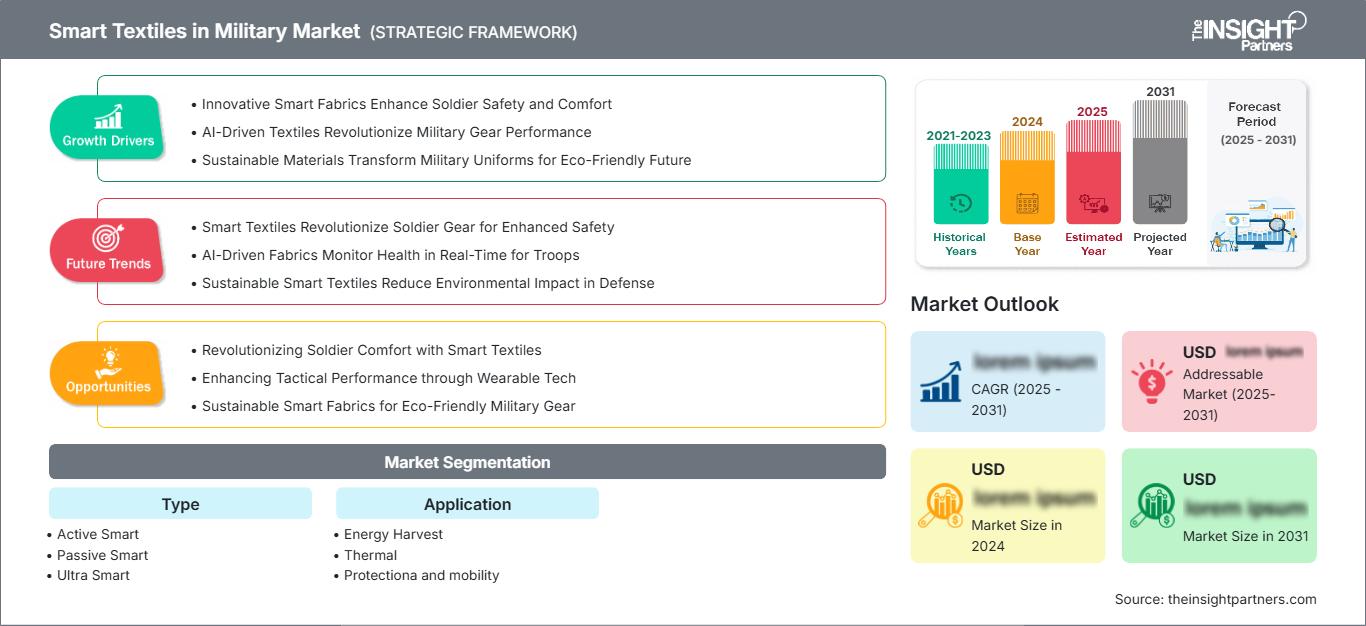
Smart Textiles in Military Market: Strategic Insights
Regional Insights
North America Smart Textile in Military Market
North America is estimated to hold the largest market share of 38-42% in 2025, growing at a CAGR of 12-15% through 2034. The leadership of the region is based on substantial defense research activities and a technologically advanced defense procurement framework. The U.S. Department of Defense has been investing extensively in the development of smart textiles for the protection and performance monitoring of soldiers, where USD 420 million is allocated annually towards research into wearable soldier systems. The involvement of key companies like BAE Systems Plc, DuPont, and TenCate Protective Fabrics facilitates the commercialization of technology. Canada contributes towards regional growth due to its technological capabilities in wearable technologies and favorable defense policies with adoption rates of 34% among active duty U.S. soldiers.
U.S. Smart Textile in Military Market
The U.S. accounts for approximately 86-90% of the North American Smart Textile in Military Market in 2025, growing at a CAGR of 13-16% during the forecast period. Government investment in military smart fabrics, especially in those related to sensors within uniforms that help in situational awareness and health tracking, drives the growth of the market. The spending of U.S. defense textiles research and development grew by 26% from 2021 to 2024, while more than 420,000 military personnel across the globe are expected to wear smart combat uniforms by 2025. Key players, including DuPont, Milliken and Company, and Texas Instruments, have a robust domestic presence in the market and are technologically innovative.
Europe Smart Textile in Military Market
Europe accounted for approximately 22-26% of the global Smart Textile in Military Market in 2025, expanding at a CAGR of 13-16% from 2026 to 2034. The region enjoys extensive know-how on technical textiles and performance materials. Germany dominates the market with its engineering and automotive related materials knowledge. UK offers research strengths in material science and defense, including projects such as the ARMETISS which received funding of €20 million from the EU for developing smart multifunctional textiles for soldier systems. France and Italy have emerged as new players in the region through their defense innovation projects. There is a trend among the EU regulations in encouraging sustainable textile production processes.
APAC Smart Textile in Military Market
The Asia Pacific region is estimated to hold approximately 28-32% market share in 2025, expanding at a regional CAGR of 15-18%. China dominates the regional market for Smart Textile in Military market, with Japan, South Korea, and India following suit and showing high growth in Australia. The reason behind the domination of China is due to its vast textile manufacturing industries and huge investment on modernization in the defense sector. The contribution of Japan is seen in its electronic expertise and advanced materials, while that of South Korea is in terms of research in adaptive camouflage and thermal signature management where researchers have been developing artificial skin for cloaking. The emerging growth market for this region is that of India, where the Indian army has purchased extended cold-weather clothing systems and also developed smart soldier jacket through DRDO-IIT collaboration.
Middle East & Africa Smart Textile in Military Market
The Middle East and Africa region is growing at a CAGR of 11-14% during 2026-2034, driven by investments in defense modernization and military equipment upgrades. Saudi Arabia and UAE lead regional smart textile adoption with substantial defense spending programs. South Africa is building capabilities in safety and industrial smart textiles for defense applications. The region's growth is supported by economic diversification initiatives and rising geopolitical tensions, while infrastructure projects in the Gulf Cooperation Council countries present opportunities for smart fabric integration.
Segmentation Analysis
Type
The global Smart Textile in Military Market by type is segmented into Active Smart, Passive Smart, and Ultra-Smart textiles. The Active Smart segment is anticipated to exhibit a CAGR of 14-17% during 2026-2034, driven by increasing demand for textiles capable of sensing and responding to environmental stimuli with integrated sensors and actuators. Passive Smart textiles, incorporating basic sensing functionality without response mechanisms, currently maintain significant market presence due to their established applications in military uniforms. Ultra-Smart textiles represent an advanced category combining sensing, actuation, and communication capabilities with artificial intelligence integration.
- Passive Smart: Incorporates sensors and conductive fibers without active response mechanisms, widely used in health monitoring and protection applications due to established manufacturing processes and lower costs.
- Active Smart: Features sensing and actuation capabilities with shape memory, thermoregulation, and camouflage properties, significantly relevant for advanced soldier systems and combat uniforms.
- Ultra-Smart: Combines sensing, actuation, and communication capabilities with AI integration, enabling adaptive functionality and complex data processing for next-generation military applications.
Application
The Smart Textile in Military Market by application includes Energy Harvest, Thermal, Protection and Mobility, and Health Monitoring segments. The Protection and Mobility application segment is projected to grow at a CAGR of 12-15% during 2026-2034, driven by increasing demand for enhanced ballistic protection and soldier maneuverability. Health Monitoring applications are gaining traction as defense agencies prioritize soldier wellness and performance optimization. The market scope encompasses diverse functional applications addressing both survivability and operational effectiveness.
- Energy Harvest: Converts body movement, heat, or solar energy into usable power, reducing battery dependence and enabling extended mission durations.
- Thermal: Provides temperature regulation and adaptive insulation, essential for operations in extreme environments and cold-weather combat scenarios.
- Protection and Mobility: Enhances ballistic protection and soldier maneuverability through lightweight, flexible materials combining multiple protective functions.
- Health Monitoring: Enables real-time physiological tracking for injury prevention and performance optimization through embedded biometric sensors.
Opportunity Snapshot
| Application | Revenue Contribution | Trend Tag | Adoption Stage |
|---|---|---|---|
| Protection and Mobility | High | Ballistic Protection | Scaling |
| Health Monitoring | High | Bio-Monitoring | Scaling |
| Thermal | Medium | Climate Control | Scaling |
| Energy Harvest | Low | Power Generation | Emerging |
Smart Textiles in Military Market Growth Drivers and Impact Analysis
Rising Defense Modernization Expenditures Worldwide
Defense spending across the world has seen an increase of over USD 2.24 trillion in 2024, with leading nations emphasizing soldier enhancement programs. These trends have resulted in the deployment of money directly towards purchasing smart textiles designed specifically for military use. The United States Department of Defense and various defense agencies of Europe have been funding integrated systems for soldiers equipped with sensing, communications, and protection technologies. The continued trend ensures a solid demand base for the smart textiles sector, with defense agencies upgrading from conventional uniforms to integrated fabric platforms offering added protection and advantages.
Integration of IoT and AI in Military Wearables
With the integration of IoT technology with military fabrics, there has been a revolutionary change in the capabilities of the soldiers, allowing them to collect and analyze real-time data for increased situational awareness. Smart fabrics with embedded sensors help collect data from the environment as well as the physiological condition of the soldiers and send this data to the command center for making tactical decisions. Using artificial intelligence algorithms, predictions can be made for optimizing the health and performance of the soldiers. The inclusion of these technologies into combat uniforms helps in improved communication, situational awareness, and data analysis, thus adding value to the military operations.
Priority on Soldier Health and Wellness Monitoring
Military organizations worldwide are increasingly focusing on soldier health and wellness, driving demand for smart textile-based monitoring solutions. Continuous physiological tracking through embedded sensors enables early detection of fatigue, dehydration, and other health issues that could compromise mission effectiveness. Defense trials conducted between 2022 and 2024 demonstrated that smart uniforms with integrated health sensors improved soldier survivability metrics by 18-22%. This focus on preventive health monitoring is particularly relevant for special forces and troops operating in extreme environments. Healthcare initiatives within defense establishments are incorporating smart textiles into wellness and rehabilitation programs to reduce injury rates and improve operational readiness.
Smart Textiles in Military Market Future Trends
Advanced Camouflage and Thermal Signature Management
The evolution of military camouflage from static patterns to dynamic, multispectral stealth capabilities represents a significant future trend in smart textiles. Active camouflage technologies enable materials to adjust their thermal and visual signatures to blend with fluctuating backgrounds, effectively hiding soldiers from advanced infrared sensors and drones. Nanotechnology developments in adaptive materials allow smart textiles to mimic environmental thermal profiles, rendering personnel invisible to heat-seeking detection systems. These technologies are rapidly transitioning from research phases to field applications, providing defense against increasingly sophisticated detection systems. The Smart Textile in Military Market trends indicate substantial investment in camouflage and concealment technologies for next-generation combat uniforms.
Energy-Harvesting and Self-Powered Military Wearables
One of the most significant challenges in military smart textiles is providing reliable power for integrated electronics without adding weight. Emerging energy-harvesting technologies convert body movement, heat, or solar energy into usable power, reducing reliance on batteries and extending mission durations. Advanced power solutions, such as silicon anode cells achieving energy density of 450 Wh/kg, offer lightweight energy storage necessary for high-mobility operations. This trend toward self-powered military wearables addresses the critical trade-off between functionality and mobility, enabling broader deployment of smart textile systems across defense applications. Manufacturers are investing in energy-harvesting textiles that can power sensors and communication devices without external power sources.
Smart Textiles in Military Market Opportunities
Emerging Military Markets in Asia Pacific and Middle East
Significant opportunities exist for smart textile adoption in emerging military markets across Asia Pacific and the Middle East, where defense modernization programs are accelerating. China, India, and Middle Eastern countries are increasing military expenditure and upgrading equipment, creating new procurement channels for advanced textile systems. The Smart Textile in Military Market forecasts indicate substantial growth potential in these regions as geopolitical tensions drive equipment modernization. Defense agencies in these regions are actively seeking partnerships with established manufacturers to develop indigenous smart textile capabilities. Collaborative ventures and technology transfer arrangements present strategic opportunities for market expansion in these high-growth territories.
Indigenous Smart Textile Development Programs
Countries seeking to reduce dependence on foreign suppliers are establishing indigenous smart textile development programs, creating opportunities for technology providers and joint ventures. India's DRDO-IIT collaboration on smart soldier jackets exemplifies this trend, with defense agencies seeking domestic solutions for soldier system requirements. The Smart Textile in Military Market analysis indicates that localization initiatives in emerging economies will drive demand for technology licensing and manufacturing partnerships. Companies offering technology transfer and local production capabilities can capitalize on these market development trends. Government initiatives supporting domestic defense manufacturing present significant business opportunities for smart textile solution providers with adaptable production models.
Recent Developments
- August 2025: Georgia Tech is a core founding partner on a new 10-year Department of War initiative aimed at modernizing textile manufacturing in the United States to support the defense industry. FutureTEX – which includes $36 million in its first year and has a ceiling of $480 million over a decade – brings together university, industry, government, and nonprofit partners to advance textile manufacturing technologies for military and domestic applications. FutureTEX will champion workforce development and modernization of facilities and equipment to increase U.S. competitiveness.
- June 2025: Researchers in South Korea have unveiled a new type of fabric-based technology that transforms standard military uniforms into wearable data-gathering tools. The innovation centres on electronic textiles (e-textiles) that incorporate sensors and circuits into the fibres, offering real-time monitoring of a soldier’s physical movements and condition.
- October 2024: The European Defence Agency began implementing three new projects, ARMETISS, EC2 and TIRESYAS, that were selected under the European Defence Fund (EDF) 2022 call for proposals. The EDF incentivises cooperation and supports the competitiveness of the European Defence Technological and Industrial Base. It aims at providing financial support to defence research and capability development. Following the signature of the Contribution Agreement by the European Commission, EDA is responsible for the indirect management of the projects. The project 'smARt Multifunction tExtiles for integrated Soldier Systems' has a duration of 36 months and will receive an EU grant of €20 million. Coordinated by NFM Group (Norway), the consortium encompasses a total of 20 participants from seven countries. The project will develop smart clothes and equipment for soldiers by using innovative textile technologies with smart functionalities that will enhance soldiers’ protection and improve their performance, as well as their operational capabilities during military operations.
Frequently Asked Questions

- Comprehensive Market Sizing and Forecast Analysis
- Detailed Segmentation Analysis
- In-Depth Market Dynamics Assessment
- Regional and Country-Level Insights
- Competitive Landscape and Company Benchmarking
- Strategic Business Intelligence
Recent Reports
Testimonials

The Insight Partners' SCADA System Market report is comprehensive, with valuable insights on current trends and future forecasts. The team was highly professional, responsive, and supportive throughout. We are very satisfied and highly recommend their services.
RAN KEDEM Partner, Reali Technologies LTDs
I requested a report on a very specific software market and the team produced the report in a few days. The information was very relevant and well presented. I then requested some changes and additions to the report. The team was again very responsive and I got the final report in less than a week.
JEAN-HERVE JENN Chairman, Future Analytica
We worked with The Insight Partners for an important market study and forecast. They gave us clear insights into opportunities and risks, which helped shape our plans. Their research was easy to use and based on solid data. It helped us make smart, confident decisions. We highly recommend them.
PIYUSH NAGPAL Sr. Vice President, High Beam Global
The Insight Partners delivered insightful, well-structured market research with strong domain expertise. Their team was professional and responsive throughout. The user-friendly website made accessing industry reports seamless. We highly recommend them for reliable, high-quality research services
YUKIHIKO ADACHI CEO, Deep Blue, LLC.
This is the first time I have purchased a market report from The Insight Partners.While I was unsure at first, I visited their web site and felt more comfortable to take the risk and purchase a market report.I am completely satisfied with the quality of the report and customer service. I had several questions and comments with the initial report, but after a couple of dialogs over email with their analyst I believe I have a report that I can use as input to our strategic planning process.Thank you so much for taking the extra time and making this a positive experience.I will definitely recommend your service to others and you will be my first call when we need further market data.
JOHN SUZUKI President and Chief Executive Officer, Board Director, BK Technologies
I wish to appreciate your support and the professionalism you displayed in the course of attending to my request for information regarding to infectious disease IVD market in Nigeria. I appreciate your patience, your guidance, and the fact that you were willing to offer a discount, which eventually made it possible for us to close a deal. I look forward to engaging The Insight Partners in the future, all thanks to the impression you have created in me as a result of this first encounter.
DR CHIJIOKE ONYIA MANAGING DIRECTOR, PineCrest Healthcare Ltd.Reason to Buy
- Informed Decision-Making
- Understanding Market Dynamics
- Competitive Analysis
- Identifying Emerging Markets
- Customer Insights
- Market Forecasts
- Risk Mitigation
- Boosting Operational Efficiency
- Strategic Planning
- Investment Justification
- Tracking Industry Innovations
- Aligning with Regulatory Trends





 Get Free Sample for