
Smart Transformers Market Growth, Share & Trends by 2034
Coverage: By Type (Power, Distribution, Specialty, Instrument); Application (Smart Grid, Traction Locomotive, Electric Vehicle Charging, Others), and Geography (North America, Europe, Asia Pacific, and South and Central America)
- Status : Data Released
- Report Code : TIPRE00003380
- Category : Electronics and Semiconductor
- No. of Pages : 150
- Available Report Formats :


- Last update date : August 28, 2026


2025 Market Size
US$ 3.9 Bn
Base year value
2034 Forecast
US$ 10.94 Bn
Projected by 2034
CAGR 2026-2034
12.14 %
Growth rate
Addressable Market
US$ 65.01 Bn
(2026-2034)
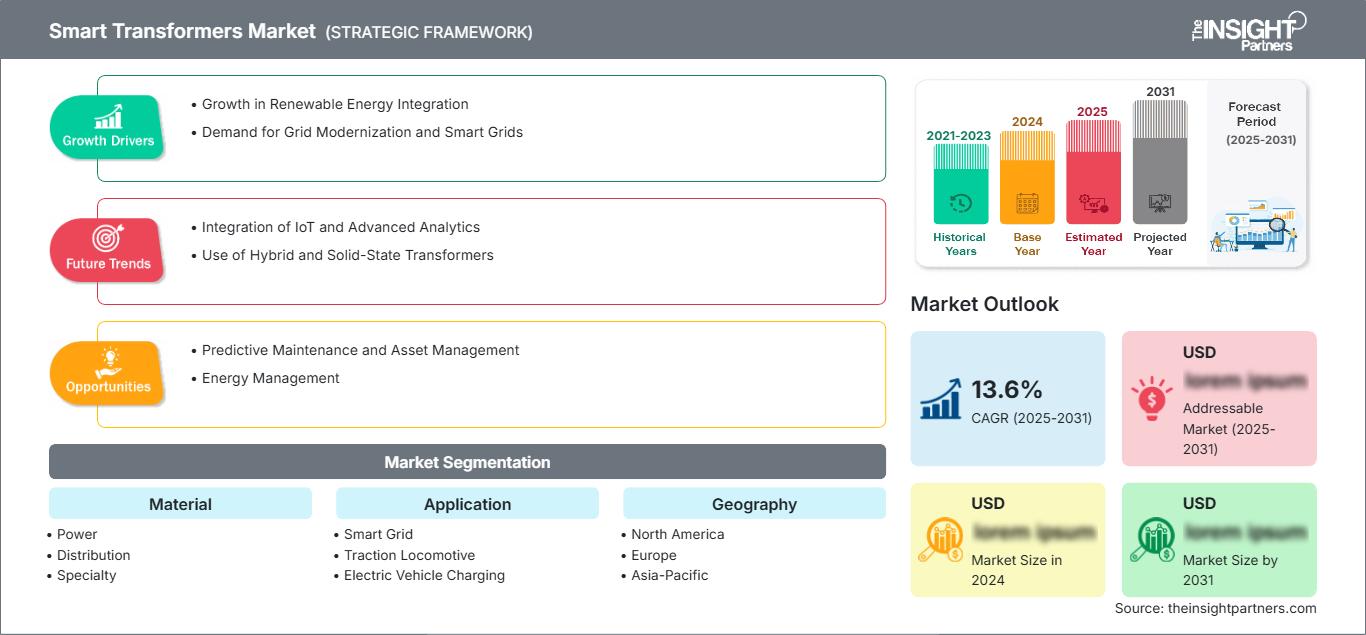
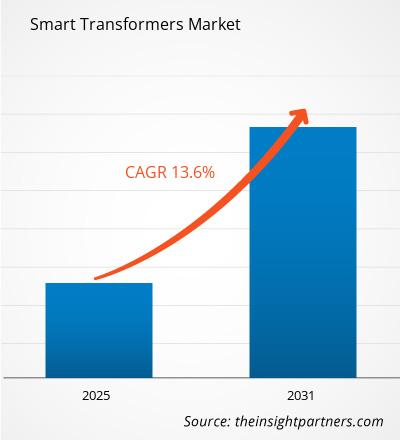
The global Smart Transformers Market size was valued at US$ 3.9 billion in 2025 and is projected to reach US$ 10.94 billion by 2034, registering a compound annual growth rate of 12.14% from 2026 to 2034. This growth trajectory is underpinned by the accelerating modernization of aging power grids, the large-scale integration of renewable energy sources, and the increasing digitalization of power utilities worldwide.
The Smart Transformers Market forecasts indicate that North America represents a significant regional market, estimated to account for 20-24% of the global share in 2025, growing at a steady CAGR of 9-11%. The region's market is propelled by substantial federal investments in grid modernization through the Infrastructure Investment and Jobs Act, a pressing need to replace aging transformer infrastructure, and a strong emphasis on wildfire-driven grid reliability measures, particularly in the U.S. states of California and Texas.
Smart Transformers Market Assessment and Insights
- North America holds a substantial Smart Transformers Market share, estimated at 20-24% in 2025, and is projected to grow at a CAGR of 9-11% from 2026 to 2034. The region's growth is driven by large-scale grid modernization projects and a focus on integrating renewable energy and enhancing grid resilience.
- U.S. dominates the North American market, representing approximately 80-85% of the regional share in 2025, with a growth rate of 9-11% through 2034. The U.S. market is characterized by substantial infrastructure investments and persistent congestion in major interconnections, which necessitate advanced transformer solutions.
- Europe holds a significant market share of 18-22% in 2025, with a projected CAGR of 8-10%. Leading countries include Germany, the U.K., and France, where the market is driven by the European Green Deal, stringent emissions targets, and the need to upgrade aging grid infrastructure to support renewable energy integration.
- Asia Pacific is the dominant and fastest-growing region, capturing a 44-48% market share in 2025 with a high CAGR of 14-16%. Key markets include China, India, and Japan, driven by massive smart city investments, rapid urbanization, and aggressive grid expansion programs .
- Largest Segment by material, the Distribution Transformers segment, held the largest share of 36-40% in 2025 and is expected to grow at a steady CAGR of 11-13% through 2034, driven by their widespread use in regulating voltage for residential and commercial applications .
- High Growth Segment by application, the Electric Vehicle Charging segment, is projected to grow at the fastest CAGR of 13-15% during 2026-2034. This rapid growth is fueled by the exponential increase in electric vehicle adoption and the subsequent need for grid infrastructure to manage high-power charging loads.
- Key companies analyzed in detail: ABB Ltd., Alstom S.A, Bharat Heavy Electricals Limited, Crompton Greaves Ltd., Eaton Corporation PLC, General Electric, Mitsubishi Electric Corporation, Schneider Electric SE, Siemens, Wilson Transformer.
Source: The Insight Partners' analysis based on proprietary research, government publications, company annual reports, investor presentations, industry databases, and expert interviews.
The market for smart transformers is undergoing changes due to the combination of monitoring, edge computing, and artificial intelligence for real-time grid management and predictive maintenance. In addition to voltage regulation functions, these intelligent devices come with IoT-based sensors and bi-directional communication for monitoring power quality and bi-directional power transfer. The production process will move toward software-defined systems and modular design, along with using amorphous metal core and natural ester fluid to minimize no-load loss and decrease the environmental footprint.
Future growth potential of the smart transformers market comes from the new application areas that include fast charging for high-power EVs, data center infrastructure, and solid-state transformers. Investments into software and analytics features are also growing; in particular, the software sector grows at the significant CAGR due to licensing of modules for topology optimization and cyber security. There are favorable regulations coming from the government requirements on grid digitalization and decarbonization.
Smart Transformers Market Report Scope
| Report Attribute | Details |
|---|---|
| Market size in 2025 | US$ 3.9 Billion |
| Market Size by 2034 | US$ 10.94 Billion |
| Global CAGR (2026 - 2034) | 12.14% |
| Historical Data | 2021-2024 |
| Forecast period | 2026-2034 |
Smart Transformers Market Analysis
The need for smart transformers is essentially dictated by the world trend toward the modernization of grids as well as the integration of renewable energy sources such as solar and wind into power supply. According to the statistics provided by the International Energy Agency (IEA), the growth of global electricity consumption has amounted to 3.3% in 2025 and is expected to rise even more, which leads to the necessity of the development of efficient distribution networks capable of dealing with bi-directional power flows and changing load conditions. Currently, the value chain includes not only hardware producers (sensors, power electronics), but also software developers (AI analytics, cloud platforms) as well as companies providing maintenance services. Supply conditions are determined by the availability of semiconductor devices and raw materials.
The competition scene is characterized by the existence of traditional electrical conglomerates as well as technology companies. Some of the major companies like Siemens, ABB, Schneider Electric, and Eaton are making efforts to expand their range of smart transformers through partnership arrangements revolving around AI and cyber security . The trend in investment shows a growing move from product offerings to outcomes and a conversion of capital expenditures to operating expenditures with multi-year performance guarantees . Companies like Mitsubishi Electric and General Electric are concentrating on solid state transformers, while others like Bharat Heavy Electricals and Wilson Transformers have chosen particular geographical markets.
● REPORT CUSTOMIZATION
Tailor This Report To Align With Your Specific Business Requirements
This report can be customized to align precisely with your business objectives, scope, and target markets. Customization options include tailored segmentation, geography, competitive analysis, and strategic insights to support informed decision-making.
Customize This Report →WHAT YOU CAN ADJUST
- ● Segmentations
- ● Geography
- ● Competitive Analysis
- ● Language Preferences
Smart Transformers Market: Strategic Insights
Regional Insights
North America Smart Transformers Market
North America continues to be a key market, holding a share of approximately 20-24% in 2025 and growing at a CAGR of 9-11% from 2026 to 2034. Strength of the region's market is determined by the large amount of federal investments that will be used on grid modernization according to the Infrastructure Investment and Jobs Act, as well as grid resilience with regard to harsh weather conditions. Market of the United States is mainly motivated by constant congestion in such interconnections as PJM, MISO and ERCOT due to insufficient power transmission in the specific regions. Another factor that motivates market development is the necessity of the replacement of old grid infrastructure and connection of renewable energy sources like wind and solar.
U.S. Smart Transformers Market
The U.S. market dominates North America, representing approximately 80-85% of the regional share in 2025 and growing at a CAGR of 9-11% through 2034. The nation's extensive and aged grid infrastructure requires advanced smart transformer technologies for addressing rising energy consumption demands from data centers, artificial intelligence, and manufacturing facilities. Some of the dominant vendors include Eaton, General Electric, and Siemens, providing integrated solutions for the smart grid and traction markets. Rising demand is especially evident in the segment of distribution class smart transformers that ensure stable voltage supply in the feeders when clustered EV fast chargers are used. The industry is driven by state initiatives focused on cutting emissions and enhancing reliability.
Europe Smart Transformers Market
Europe represents a substantial market, holding a share of approximately 18-22% in 2025, with a projected CAGR of 8-10% through 2034. Germany is leading the region because of its industrial strength and renewable energy goals that have accelerated the demand for interconnected systems and intelligent transformers. The UK has invested greatly in digital twin technology through the substations of National Grid. Other countries such as France, Italy, and Spain have invested in their smart transformer systems through European Union (EU) funding that seeks to promote sustainable mobility and grid upgrades. The regional market is highly regulated by the EU Green Deal and emissions policy, which encourages the adoption of innovative technologies.
APAC Smart Transformers Market
The Asia Pacific market is the largest and fastest-growing region, capturing a dominant share of 44-48% in 2025 and projected to grow at a robust CAGR of 14-16% during 2026-2034. With huge investments in ultra-high voltage power grid corridors and smart grid network, China is the leader in the area. India comes second, as it is undergoing large expansion in the area of renewables and fast urbanization. Japan and South Korea are also notable players, working towards grid security against seismic activities and the adoption of solid-state transformer technology. The market growth is due to huge government support in terms of smart city initiatives and digitalization plans, along with the pressing requirement to handle high load concentration of EV charging points and data centers.
Middle East & Africa Smart Transformers Market
The Middle East & Africa market for smart transformers will be another area of development for the product over the forecast period 2024–2034, with constant CAGR growth in place. The market will be spurred by the fast pace of urbanization and major infrastructure projects in GCC countries such as Saudi Arabia and the United Arab Emirates that are actively involved in digital transformation and smart city construction. South Africa will emerge as one of the most significant markets in Africa, backed by the increasing necessity to modernize their transmission and distribution grids.
Segmentation Analysis
Type
The Distribution Transformers segment is the largest material category, commanding a market share of 36-40% in 2025 and is projected to achieve a CAGR of 11-13% through 2034. These transformers form the backbone of the electricity distribution network, providing voltage regulation and energy optimization across residential and commercial applications. The demand for this segment is fueled by grid-edge digitalization programs in urban areas, where rooftop solar and EV chargers are proliferating, necessitating smart features for bidirectional power flow management. The replacement cycle and the need to improve grid resilience are key drivers of growth in this segment.
- Power: These transformers are used in bulk power transfer across high-voltage transmission networks. Although volumes are lower than distribution types, each unit's high value drives steady capital investments in digital monitoring and diagnostic technologies.
- Distribution: Widely used to regulate and optimize voltage for residential and commercial end-users. This segment is experiencing rapid growth due to its role in managing bidirectional power flows from distributed energy resources like solar panels and EV charging stations.
- Specialty: This sub-segment includes transformers designed for niche applications such as traction locomotives, wind farms, and solar parks. They often feature specific voltage ratings and require robust performance under variable environmental conditions.
- Instrument: These are precise transformers used for measurement and protection in high-voltage power systems. They are essential for metering, relaying, and ensuring the safe and accurate monitoring of electrical networks.
Application
The Smart Grid application is the dominant segment in the smart transformers market, driven by the extensive integration of digitalized infrastructure to manage electricity flow, voltage regulation, and real-time load balancing. The segment is projected to lead the market with a significant share through 2034. The demand is supported by increasing investments in renewable energy integration and grid modernization initiatives globally.
- Smart Grid: This is the largest application area, as transformers are critical nodes in modern smart grids. Smart transformers provide real-time data for grid optimization, voltage control, and fault detection, ensuring grid stability and preventing blackouts.
- Traction Locomotive: Smart transformers are used in railway systems to provide significant weight reduction, improve efficiency, and reduce electromagnetic compatibility emissions. They are critical for modernizing rail networks and supporting high-speed trains.
- Electric Vehicle Charging: This is the fastest-growing sub-segment, driven by the need for specialized transformers at charging stations. They manage high-power loads, ensure voltage stability, and support fast-charging infrastructure.
Opportunity Snapshot
| Application | Revenue Contribution | Trend Tag | Adoption Stage |
|---|---|---|---|
| Smart Grid | High | Grid Modernization | Mature |
| Traction Locomotive | Medium | Rail Electrification | Scaling |
| Electric Vehicle Charging | Medium | EV Infrastructure | Scaling |
Smart Transformers Market Growth Drivers and Impact Analysis
Accelerating Grid Modernization and Smart City Initiatives
The global imperative to modernize aging electrical grids is a primary driver for the smart transformers market. There is heavy investment by governments and utilities in the digitalization of the grid for improved reliability, efficiency, and the handling of complex decentralization of energy production. Smart transformers are crucial in this regard as they have better sensors, two-way communication, and analytics capabilities than traditional transformers. Modernization efforts are especially prevalent in North America and Europe, where the average age of transformer infrastructure is over 25 years. In the United States, there are many multi-year grants that utilities can get due to heavy investment in the Infrastructure Investment and Jobs Act.
Integration of Renewable Energy and Distributed Resources
The large-scale integration of renewable energy sources such as solar, wind, and distributed generation is creating an urgent need for smart transformers. Traditional transformers are not equipped to handle the bidirectional power flows and voltage fluctuations caused by these variable energy sources. Smart transformers offer the necessary voltage regulation, real-time monitoring, and adaptive control to maintain grid stability. As countries around the world increase their renewable energy targets, the demand for intelligent transformer solutions is expected to surge, making this a primary growth driver for the industry.
Rising Electricity Demand and Electrification of Transport
The Smart Transformers Market report indicates that global surge in electricity demand, driven by population growth, industrialization, and the electrification of sectors like transport and heating, is a significant market driver. The IEA reports that global electricity demand is growing at a pace exceeding overall energy demand, exceeding 29,000 TWh by 2026 [citation:3]. The growth of EV charging infrastructure and data centers places immense stress on distribution networks, requiring advanced solutions like smart transformers for high-power load management and grid-edge voltage stabilization. This demand is expected to be particularly pronounced in the Asia Pacific region, where rapid urbanization and industrial growth are concentrated.
Smart Transformers Market Future Trends
Rise of Cloud-Based Platforms and Digital Twin Integration
The smart transformers market trends show that the market is witnessing a significant transition toward cloud-based data platforms and the integration of digital twin technology. These platforms enable centralized management and data analysis from multiple assets, allowing utilities to model, simulate, and optimize transformer performance in real-time. Digital twins provide a virtual representation of physical transformers, enabling operators to test relay settings, predict failure events, and approve load transfers without physical intervention. This trend is shifting the focus from selling hardware to providing software and subscription-based analytics services, marking a key development in the industry.
Growth of Solid-State and AI-Enhanced Transformers
Solid-state transformers (SSTs) are emerging as a transformative trend, promising higher efficiency, smaller footprints, and better voltage control than traditional designs. These devices, built on power electronics, offer superior grid management capabilities and are expected to be crucial for future smart grids and EV infrastructure. The integration of Artificial Intelligence is enabling advanced predictive maintenance and the automation of complex grid operations, further enhancing the value proposition of smart transformers. As costs decrease, the adoption of these high-efficiency, flexible smart transformers is expected to gain significant momentum.
Smart Transformers Market Opportunities
Developing Specialized Solutions for Data Center Infrastructure
A significant investment opportunity lies in the growing data center market, which demands highly reliable and efficient power distribution. The expansion of AI and cloud computing is creating energy-intensive data centers that require advanced power management to handle dynamic loads. Smart transformers can provide high-quality, stable power, offering modular and scalable solutions tailored to this application. Developing specialized, robust smart transformer systems for data centers can create a new and lucrative revenue stream for manufacturers, particularly in regions with booming digital infrastructure like North America and Asia Pacific.
Pioneering Transformer-as-a-Service (TaaS) Business Models
The shift toward operational expenditure over capital expenditure models presents a strong opportunity to offer "Transformer-as-a-Service" (TaaS). This involves outcome-based contracts where manufacturers provide equipment, predictive maintenance, and performance guarantees for a recurring fee. This model lowers the entry barrier for smaller utilities and commercial clients, while providing manufacturers with predictable, recurring revenue. By bundling hardware, software, and analytics into a single service package, companies can differentiate themselves and capture long-term customer value in the evolving smart grid landscape.
Recent Developments
- July 2026: IONATE, a London-based deep-tech energy startup, is bringing a smart transformer technology to a General Motors manufacturing plant in Michigan, giving the automaker real-time control over power conditions as electricity demand puts growing pressure on industrial facilities and the wider grid.
- February 2026: IONATE and JST announce their collaboration to bring the Hybrid Intelligent Transformer (HIT) to the U.S. market. This technology is designed to give industrials, data centers, and grid operators greater control over increasingly volatile power flows.
- October 2024: Hammond Power Solutions proudly announces the launch of HPS Smart Transformers, now available for medium and low voltage transformers. This advanced solution integrates IIoT-enabled power monitors to provide critical data insights, empowering users to proactively analyze and address potential issues before they lead to costly downtime. HPS Smart Transformers are designed to give users unprecedented control over their electrical systems. By continuously monitoring key parameters and delivering real-time analytics, users can interpret the data to detect early warning signs of equipment stress or failure. This proactive approach is essential for maintaining operational efficiency and preventing expensive disruptions.
Frequently Asked Questions

- Comprehensive Market Sizing and Forecast Analysis
- Detailed Segmentation Analysis
- In-Depth Market Dynamics Assessment
- Regional and Country-Level Insights
- Competitive Landscape and Company Benchmarking
- Strategic Business Intelligence
Recent Reports
Testimonials

The Insight Partners' SCADA System Market report is comprehensive, with valuable insights on current trends and future forecasts. The team was highly professional, responsive, and supportive throughout. We are very satisfied and highly recommend their services.
RAN KEDEM Partner, Reali Technologies LTDs
I requested a report on a very specific software market and the team produced the report in a few days. The information was very relevant and well presented. I then requested some changes and additions to the report. The team was again very responsive and I got the final report in less than a week.
JEAN-HERVE JENN Chairman, Future Analytica
We worked with The Insight Partners for an important market study and forecast. They gave us clear insights into opportunities and risks, which helped shape our plans. Their research was easy to use and based on solid data. It helped us make smart, confident decisions. We highly recommend them.
PIYUSH NAGPAL Sr. Vice President, High Beam Global
The Insight Partners delivered insightful, well-structured market research with strong domain expertise. Their team was professional and responsive throughout. The user-friendly website made accessing industry reports seamless. We highly recommend them for reliable, high-quality research services
YUKIHIKO ADACHI CEO, Deep Blue, LLC.
This is the first time I have purchased a market report from The Insight Partners.While I was unsure at first, I visited their web site and felt more comfortable to take the risk and purchase a market report.I am completely satisfied with the quality of the report and customer service. I had several questions and comments with the initial report, but after a couple of dialogs over email with their analyst I believe I have a report that I can use as input to our strategic planning process.Thank you so much for taking the extra time and making this a positive experience.I will definitely recommend your service to others and you will be my first call when we need further market data.
JOHN SUZUKI President and Chief Executive Officer, Board Director, BK Technologies
I wish to appreciate your support and the professionalism you displayed in the course of attending to my request for information regarding to infectious disease IVD market in Nigeria. I appreciate your patience, your guidance, and the fact that you were willing to offer a discount, which eventually made it possible for us to close a deal. I look forward to engaging The Insight Partners in the future, all thanks to the impression you have created in me as a result of this first encounter.
DR CHIJIOKE ONYIA MANAGING DIRECTOR, PineCrest Healthcare Ltd.Reason to Buy
- Informed Decision-Making
- Understanding Market Dynamics
- Competitive Analysis
- Identifying Emerging Markets
- Customer Insights
- Market Forecasts
- Risk Mitigation
- Boosting Operational Efficiency
- Strategic Planning
- Investment Justification
- Tracking Industry Innovations
- Aligning with Regulatory Trends





 Get Free Sample for