
Smart Water Leak Sensor Market Trends, Demand & Growth by 2034
Coverage: By Type (Fixed Sensors, Portable Sensors); Technology (Wi-Fi, Zigbee, Z-Wave, Others); Application (Residential, Commercial, Industrial) , and Geography (North America, Europe, Asia Pacific, and South and Central America)
- Status : Data Released
- Report Code : TIPRE00006605
- Category : Electronics and Semiconductor
- No. of Pages : 150
- Available Report Formats :


- Last update date : September 01, 2026


2025 Market Size
US$ 1.19 Bn
Base year value
2034 Forecast
US$ 4.56 Bn
Projected by 2034
CAGR 2026-2034
16.15 %
Growth rate
Addressable Market
US$ 24.37 Bn
(2026-2034)
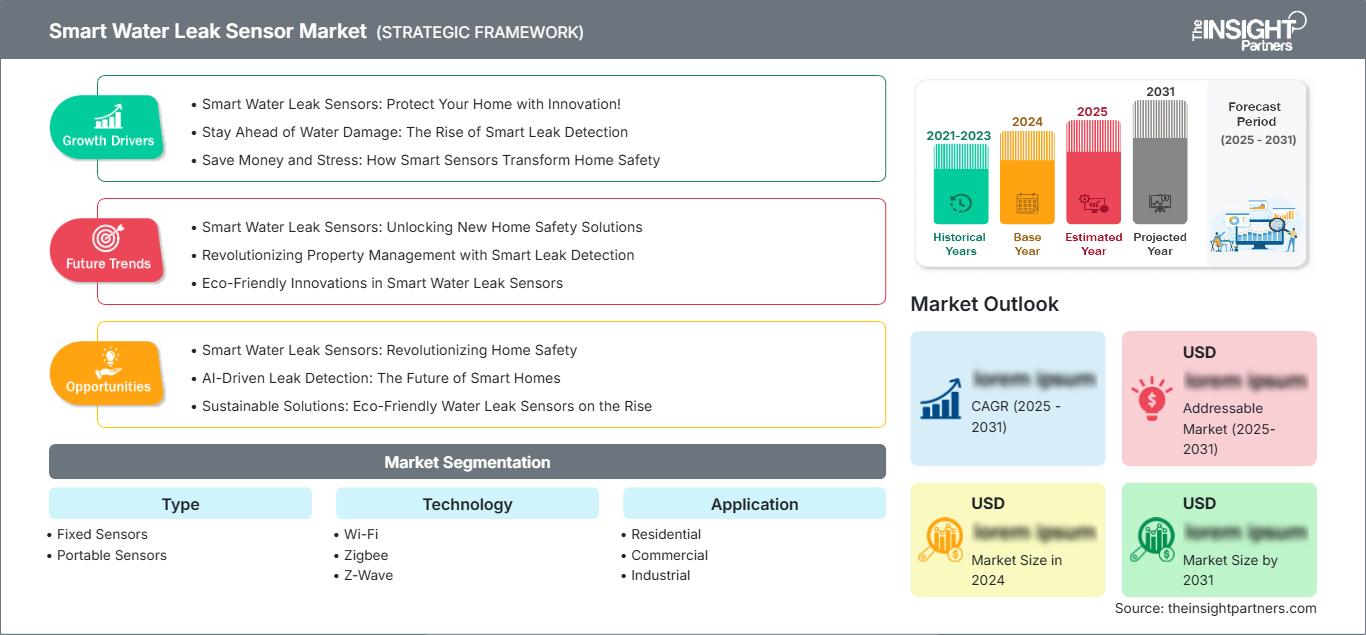
The Smart Water Leak Sensor Market was valued at US$ 1.19 Billion in 2025 and is projected to reach US$ 4.56 Billion by 2034, expanding at a CAGR of 16.15% during 2026–2034. Growth is supported by increasing adoption of connected building technologies, property-loss prevention requirements, water conservation priorities, and advances in wireless sensing. The market is moving beyond basic alarms toward intelligent monitoring, predictive analytics, remote notifications, and integration with automated water shutoff systems.
North America is expected to remain a leading regional market, with a CAGR of 15.5–16.3% during 2026–2034. The Smart Water Leak Sensor Market size is supported by insurance-led loss-prevention initiatives, aging building infrastructure, smart-home penetration, and commercial property modernization. Demand is also strengthening where building owners seek measurable reductions in water waste, emergency maintenance, and damage-related operating costs. External market evidence identifies North America as the leading regional market for connected water leak detection.
Smart Water Leak Sensor Market Assessment and Insights
- North America: North America is estimated to hold a 42–45% Smart Water Leak Sensor Market share in 2025 and expand at a 15.5–16.3% CAGR between 2026–2034, supported by smart-home adoption, insurance incentives, commercial retrofits, and mature IoT infrastructure.
- US: The US represents 72–76% of North American demand in 2025 and is projected to grow at a 15.7–16.5% CAGR, supported by property-risk management and connected building adoption.
- Europe: Europe accounts for a 24–27% share in 2025 and is projected to grow at a 15.0–15.8% CAGR, led by the UK, Germany, France, Italy, and Spain, where water efficiency and building modernization support connected monitoring.
- Asia Pacific: Asia Pacific represents a 21–24% share in 2025 and is expected to grow at a 17.0–17.8% CAGR, with China, Japan, South Korea, India, and Australia benefiting from urbanization, smart-building investment, and water-security priorities.
- Largest Segment: Fixed Sensors represent a 72–76% market share in 2025 and are expected to grow at a 15.7–16.4% CAGR, reflecting permanent building protection requirements.
- High Growth Segment: Portable Sensors hold a 24–28% market share in 2025 and are forecast to grow at a 16.8–17.6% CAGR as retrofit flexibility expands.
- Key companies analyzed in detail: Alert Labs Inc.; BROWAN COMMUNICATIONS CO., LTD.; Flo Technologies, Inc.; Lifelong Online; Phyn LLC; Tantiv4 Inc.; Watts Water Technologies, Inc.; Waxman Consumer Products Group, Inc.; Samsung Electronics Co., Ltd.; SmartThings Inc.
Source: The Insight Partners' analysis based on proprietary research, government publications, company annual reports, investor presentations, industry databases, and expert interviews.
The technology has evolved from point-based sensors that cause local alarms to intelligent devices integrating moisture detection, temperature sensing, wireless technology, mobile alerts, and automatic shut-off. Fixed sensors have been connecting with buildings, while portable sensors are designed for appliance rooms, basements, kitchens, bathrooms, and mechanical areas. In addition, the technology is evolving to lower power wireless technology with increased battery life, thus not requiring major electrical or plumbing changes.
Further adoption of the technology will largely consist of multifamily, commercial, hospitality, educational, and smart building portfolios. Policies related to water conservation and property loss prevention will help with adoption, while insurers offer another economic reason for adoption. The International Water Association and other water organizations still focus on avoiding unnecessary water losses in their infrastructures.
Smart Water Leak Sensor Market Report Scope
| Report Attribute | Details |
|---|---|
| Market size in 2025 | US$ 1.19 Billion |
| Market Size by 2034 | US$ 4.56 Billion |
| Global CAGR (2026 - 2034) | 16.15% |
| Historical Data | 2021-2024 |
| Forecast period | 2026-2034 |
Smart Water Leak Sensor Market Analysis
Smart Water Leak Sensor Market growth will be influenced by the financial implications of unreported water events. The presence of a smart sensor can detect moisture or abnormal flow prior to any regular inspections; thereby providing value for consumers, property managers, insurance companies, utility organizations, and facilities management teams. The market ecosystem comprises the following: sensor makers, connectivity companies, cloud service providers, smart home hubs, valve makers, installers, insurance companies, property managers, and maintenance providers. Increasing integration plays an important role in the decision-making process for the customers who need direct response.
Vendors that can produce sensors that are reliable along with low power connectivity and easy-to-use software will have supply-side advantages. BROWAN COMMUNICATIONS CO., LTD. offers smart water leak sensors with the help of LoRaWAN, while Phyn LLC integrates pressure and flow with the use of machine learning technology. Finally, Watts Water Technologies, Inc. integrates water leakage with automatic washing machine shutoff application.
Smart Water Leak Sensor Market analysis reveals a mixed competitive landscape that includes specialist water technology firms, connected home solutions providers, plumbing equipment makers, and Internet of Things specialists. Alert Labs Inc. shows a strong emphasis on commercial and institutional water intelligence, whereas Phyn LLC pays particular attention to whole-home flow and pressure analysis. Watts Water Technologies, Inc. offers plumbing-oriented leak protection, and Samsung Electronics Co., Ltd. and SmartThings Inc. have a good fit within connected home ecosystems.
Investments become more frequent in AI-driven detection, interoperability, connectivity via cellular and low-power wireless networks, and automatic shut-off. Alert Labs Inc. adds Flowie O and Shuttie to its product portfolio, combining flow measurement and automatic actions. Phyn LLC keeps improving AI-enabled plumbing diagnostics, including detection of extremely small leaks. This way, differentiation becomes more related to false positive mitigation, automation of responses, offline functioning, and portfolio analytics.
● REPORT CUSTOMIZATION
Tailor This Report To Align With Your Specific Business Requirements
This report can be customized to align precisely with your business objectives, scope, and target markets. Customization options include tailored segmentation, geography, competitive analysis, and strategic insights to support informed decision-making.
Customize This Report →WHAT YOU CAN ADJUST
- ● Segmentations
- ● Geography
- ● Competitive Analysis
- ● Language Preferences
Smart Water Leak Sensor Market: Strategic Insights
Regional Insights
North America Smart Water Leak Sensor Market
North America holds a 42–45% share in 2025 and is forecast to grow at a 15.5–16.3% CAGR through 2034. There is well-developed smart home technology infrastructure, good insurance penetration, high-value properties, and significant building stock that is getting old. Connected water monitoring is becoming more common among commercial and multifamily buildings in order to protect against water damage and detect hidden leaks.
The US is the primary market in terms of demand for the technology, while Canada is an excellent secondary market thanks to commercial and institutional properties as well as residential retrofits. Alert Labs Inc. has processed more than 480,000 water alerts from 14,000 buildings in the US and Canada, which demonstrates the operational utility of the portfolio approach to water monitoring.
U.S. Smart Water Leak Sensor Market
The US accounts for 72–76% of North America's 2025 market and is projected to grow at a 15.7–16.5% CAGR. The demand is fueled by the level of smart-home adoption, costly building repairs, interest among insurers in preventing losses, and a large stock of commercial buildings. Whole-home sensing is especially relevant in areas where customers prefer full monitoring rather than alerts from individual devices.
Alert Labs Inc., Phyn LLC, Watts Water Technologies Inc., Samsung Electronics Co. Ltd., and SmartThings Inc. target various levels of the market opportunity in the US. Residential implementations focus on leak warnings, freeze warnings, and automated shut-off, whereas commercial solutions concentrate on water flow analytics and portfolio management. The Phyn LLC products rely on water pressure and flow data for detecting anomalies.
Europe Smart Water Leak Sensor Market
Europe represents a 24–27% share in 2025 and is expected to expand at a 15.0–15.8% CAGR. There are plenty of market possibilities due to the fact that there is a need for monitoring technology driven by water efficiency issues and building modernization. In Germany, there is a combination of building automation and a high level of engineering skills, while in France, Italy and Spain, there is a possibility to work with residential renovations, hotels and smart buildings.
The UK pays more attention to saving water and making buildings resistant to any damage. The German market is favorable for the development of connected building controls and sensors. The French one is favored by the sustainability of buildings, whereas Italy and Spain have potential in residential areas and tourism infrastructure.
APAC Smart Water Leak Sensor Market
APAC holds a 21–24% share in 2025 and is projected to grow at a 17.0–17.8% CAGR, making it the fastest-growing major region. In terms of market potential, China takes the lead, followed by Japan, South Korea, India, and Australia. Urbanization, investments in smart building technology, growth of connected home ecosystems, and the need to ensure water security all help drive adoption.
Electronics manufacturing on a large scale is an advantage for China. Connected home technology advancement is the focus of Japan and South Korea. India provides growth opportunities due to increased adoption of smart buildings. Australia has water conservation needs alongside advanced home technology requirements.
Middle East & Africa Smart Water Leak Sensor Market
Middle East & Africa is forecast to grow at a 14.2–15.2% CAGR, with the UAE and Saudi Arabia leading regional adoption. The greatest opportunity in Africa exists in South Africa, while Rest of MEA depends more on infrastructure development, distribution capabilities, and construction. The issue of water scarcity gives added importance to the need for detection.
In Saudi Arabia and the UAE, large residential, hospitality, and smart city developments exist. South Africa consists of existing building infrastructure and increasing use of technology, while Rest of MEA is relatively fragmented. High cost of water and electricity can drive deployment of sensors due to their effect on utility costs and equipment performance or building operations.
Segmentation Analysis
Type
The Type segment is expected to expand at a 15.9–16.6% CAGR during 2026–2034. Fixed Sensors remain the principal deployment format because they provide continuous protection at predefined risk locations and can integrate with permanent building systems. Portable Sensors address retrofit and temporary monitoring requirements, providing a lower-installation-barrier option for renters, property managers, and targeted inspection programs. The Smart Water Leak Sensor Market scope is consequently broadening across permanent and flexible deployment models.
- Fixed Sensors: Fixed sensors remain the preferred format for continuous protection around water heaters, pumps, mechanical rooms, basements, appliances, and plumbing systems. Their strategic value increases when connected with automated shutoff and building-management platforms.
- Portable Sensors: Portable sensors provide flexible deployment without permanent plumbing modification, making them suitable for rental housing, temporary monitoring, inspections, and high-risk locations. Their value is strengthened by battery operation and wireless alerts.
Technology
The Technology segment is projected to grow at a 16.2–16.9% CAGR during 2026–2034. Connectivity selection increasingly depends on range, power consumption, installation environment, ecosystem compatibility, and the required communication architecture. Wi-Fi remains highly relevant in consumer applications, while Zigbee and Z-Wave maintain strategic importance where low-power mesh connectivity and smart-home interoperability are priorities.
- Wi-Fi: Wi-Fi supports direct communication with home networks and cloud platforms, making it highly relevant for consumer applications. Its broad installed base simplifies smartphone integration, although power consumption can influence battery-operated deployment.
- Zigbee: Zigbee offers low-power mesh networking and can connect multiple sensors through compatible hubs. Its strategic relevance is strongest in smart-home environments where numerous devices need coordinated communication.
- Z-Wave: Z-Wave remains important for home-security and automation ecosystems requiring reliable low-power communication. Its established device ecosystem supports integration with hubs, alarms, controllers, and automated response equipment.
Opportunity Snapshot
| Technology | Revenue Contribution | Trend Tag | Adoption Stage |
|---|---|---|---|
| Wi-Fi | High | Cloud Alerts | Mature |
| Zigbee | Medium | Mesh Sensors | Scaling |
| Z-Wave | Medium | Hub Integration | Scaling |
Smart Water Leak Sensor Market Growth Drivers and Impact Analysis
Insurance-Led Property Risk Reduction Supports Sensor Adoption
There is substantial property loss due to water damage, which provides an economic motivation for early detection. With sensors, it is possible to detect any irregularities related to water before the property is severely affected. There is the greatest commercial potential when there is an understanding from insurance schemes about preventive technology or if the owners of portfolios have less claim exposure. According to the 2026 assessment done by Alert Labs Inc., 56% of floods monitored occur after hours, making it clear how important it is to have constant monitoring through sensors. In addition, sensors give information for the purpose of improving risk segmentation and loss prevention programs for insurance companies. They also make regular inspections unnecessary for property managers.
Water Scarcity Raises the Economic Value of Early Leak Detection
Water shortages and increasing utility prices add further impetus for detecting potential leaks that might not result in any noticeable flooding. Continuous running of toilets, irrigation system problems, and even undetected leaks from pipes can lead to the wastage of many gallons before they are even noticed on regular utility bills. Smart flow sensors are able to detect the abnormal use of water in a much more efficient way. Alert Labs Inc., for instance, announced that in one year in 2026, they discovered a total of 3.4 billion gallons of water waste in their monitored properties. The benefits are not only restricted to residential savings as companies can utilize flow intelligence to detect equipment malfunctions and abnormal water use.
Smart-Building Integration Expands Sensor Deployment Beyond Homes
Building owners increasingly want water sensors to communicate with broader facility-management infrastructure rather than operate as isolated alarms. Integration with building-management systems, access controls, security platforms, energy systems, and automated valves can convert a simple moisture event into an actionable response workflow. This expands the addressable market into offices, hospitals, hotels, educational facilities, warehouses, and multifamily properties. BROWAN COMMUNICATIONS CO., LTD. already positions water leak sensors within broader smart-building portfolios covering environmental and occupancy monitoring. The strategic impact is significant because shared connectivity infrastructure can reduce incremental installation costs when several sensor categories are deployed together. Vendors that provide open interfaces and multiple connectivity options can therefore compete for larger building-wide technology projects instead of individual sensor purchases.
Smart Water Leak Sensor Market Future Trends
AI Will Move Leak Detection from Alerts toward Predictive Water Intelligence
Smart Water Leak Sensor Market trends are moving toward predictive systems that learn normal water behavior and distinguish genuine leaks from expected consumption. Future platforms will increasingly combine pressure, flow, temperature, humidity, occupancy, and historical usage information to assess risk continuously. AI models should become better at recognizing fixture-specific patterns, reducing false positives and improving confidence before an alert is issued. Phyn LLC already uses machine learning to build individualized household water-use profiles, while Alert Labs Inc. applies machine learning to identify water inefficiencies. Over time, predictive systems could estimate leak severity, identify probable sources, recommend corrective actions, and automatically activate shutoff valves when risk thresholds are exceeded. This evolution will increase the value of software relative to sensor hardware alone.
Interoperable Wireless Platforms Will Shape Next-Generation Building Protection
Future deployments will increasingly combine multiple wireless technologies within a common building-management architecture. Wi-Fi can support high-bandwidth consumer connectivity, while Zigbee, Z-Wave, and low-power wide-area networks can serve distributed sensors where battery life and coverage are more important. Matter and broader interoperability initiatives should further reduce fragmentation between connected-home platforms. Commercial buyers are likely to favor systems that can operate across mixed device environments rather than requiring a proprietary sensor network. This trend should encourage vendors to expose application programming interfaces, support multiple gateways, and maintain cloud interoperability. As sensor deployments scale from individual homes to portfolios, centralized device management and cybersecurity will become essential purchasing criteria alongside detection accuracy and battery performance.
Smart Water Leak Sensor Market Opportunities
Commercial Portfolio Monitoring Creates Scalable Service Models
Smart Water Leak Sensor Market Forecasts indicate strong opportunity in commercial portfolios where a single technology platform can monitor numerous buildings and risk points. Property managers can deploy sensors across mechanical rooms, water heaters, HVAC systems, bathrooms, kitchens, and irrigation zones while receiving centralized alerts. Vendors can monetize this installed base through recurring software, analytics, maintenance, and monitoring services. The commercial model is particularly attractive where organizations manage geographically dispersed properties and cannot rely on physical inspections. Alert Labs Inc. demonstrates the potential of portfolio-scale monitoring across commercial, institutional, educational, and multifamily buildings. Suppliers can further expand value by integrating automatic shutoff, work-order management, insurance reporting, and water-use analytics into a single service proposition.
Smart Retrofit Programs Can Accelerate Adoption in Existing Buildings
Existing buildings provide an extensive retrofit opportunity because many leak-prone locations can be monitored without replacing complete plumbing systems. Portable and battery-powered sensors allow property owners to begin with high-risk areas, while fixed devices can be added later as part of broader modernization. This staged approach can reduce upfront capital requirements and demonstrate savings before portfolio-wide deployment. Vendors should prioritize simple installation, long battery life, reliable connectivity, and compatibility with legacy building systems. Partnerships with plumbing contractors, insurers, utilities, facility-management companies, and property technology providers can broaden distribution. Retrofit programs are particularly relevant in mature markets where large stocks of older buildings coexist with increasing expectations for digital monitoring, water efficiency, and resilience.
Recent Developments
- July 2026: Zircon Corporation, a Silicon Valley-based technology company specializing in advanced sensor technologies that solve common problems for homeowners and professionals, announced the release of the Leak Alert 360™ Smart Home Water Detection System. These advanced detection devices can help homeowners and property managers discover water leaks before they cause significant and costly damage.
- April 2026: AprilAire, the leader in Healthy Air solutions, introduces the AprilAire Water Sensor. This easy-to-install, battery-powered wireless sensor provides real-time monitoring, helping prevent potential water damage.
- April 2023: Specialty insurer HSB today introduced Meshify Defender Sensors, its next generation LoRaWAN Internet of Things (IoT) device suite, and the new Meshify Defender Water Shutoff, which combine to help prevent property and equipment damage using a mobile app. Designed by Meshify, the IoT subsidiary of HSB, Meshify Defender Sensors monitor commercial and residential buildings and equipment 24/7 for water leaks, frozen pipes, temperature changes, and humidity.
Frequently Asked Questions

- Comprehensive Market Sizing and Forecast Analysis
- Detailed Segmentation Analysis
- In-Depth Market Dynamics Assessment
- Regional and Country-Level Insights
- Competitive Landscape and Company Benchmarking
- Strategic Business Intelligence
Recent Reports
Testimonials

The Insight Partners' SCADA System Market report is comprehensive, with valuable insights on current trends and future forecasts. The team was highly professional, responsive, and supportive throughout. We are very satisfied and highly recommend their services.
RAN KEDEM Partner, Reali Technologies LTDs
I requested a report on a very specific software market and the team produced the report in a few days. The information was very relevant and well presented. I then requested some changes and additions to the report. The team was again very responsive and I got the final report in less than a week.
JEAN-HERVE JENN Chairman, Future Analytica
We worked with The Insight Partners for an important market study and forecast. They gave us clear insights into opportunities and risks, which helped shape our plans. Their research was easy to use and based on solid data. It helped us make smart, confident decisions. We highly recommend them.
PIYUSH NAGPAL Sr. Vice President, High Beam Global
The Insight Partners delivered insightful, well-structured market research with strong domain expertise. Their team was professional and responsive throughout. The user-friendly website made accessing industry reports seamless. We highly recommend them for reliable, high-quality research services
YUKIHIKO ADACHI CEO, Deep Blue, LLC.
This is the first time I have purchased a market report from The Insight Partners.While I was unsure at first, I visited their web site and felt more comfortable to take the risk and purchase a market report.I am completely satisfied with the quality of the report and customer service. I had several questions and comments with the initial report, but after a couple of dialogs over email with their analyst I believe I have a report that I can use as input to our strategic planning process.Thank you so much for taking the extra time and making this a positive experience.I will definitely recommend your service to others and you will be my first call when we need further market data.
JOHN SUZUKI President and Chief Executive Officer, Board Director, BK Technologies
I wish to appreciate your support and the professionalism you displayed in the course of attending to my request for information regarding to infectious disease IVD market in Nigeria. I appreciate your patience, your guidance, and the fact that you were willing to offer a discount, which eventually made it possible for us to close a deal. I look forward to engaging The Insight Partners in the future, all thanks to the impression you have created in me as a result of this first encounter.
DR CHIJIOKE ONYIA MANAGING DIRECTOR, PineCrest Healthcare Ltd.Reason to Buy
- Informed Decision-Making
- Understanding Market Dynamics
- Competitive Analysis
- Identifying Emerging Markets
- Customer Insights
- Market Forecasts
- Risk Mitigation
- Boosting Operational Efficiency
- Strategic Planning
- Investment Justification
- Tracking Industry Innovations
- Aligning with Regulatory Trends





 Get Free Sample for