Smartphone Sensor Market Size & Overview
The Smartphone Sensor Market was valued at US$ 86.07 Billion in 2025 and is projected to reach US$ 379.8 Billion by 2034, expanding at a CAGR of 17.93% during 2026–2034. The market encompasses sensing components embedded in smartphones to enable imaging, identity verification, motion detection, orientation, navigation, and adaptive display functions across high-end, mid-range, and low-end devices.
North America is expected to record an estimated ~16% CAGR through 2034 as premium-device replacement, on-device artificial intelligence, and sophisticated camera architectures increase sensor content per handset. The Smartphone Sensor Market size in the region is also supported by strong carrier financing, a large installed base of high-value devices, and demand for secure biometric authentication, precise location services, and immersive mobile applications.
Growth in the Smartphone Sensors Market does not only depend on volume shipments, but increasingly also on the increasing value of the sensor content per phone. Multiple camera systems, computational photography, biometrics, gaming, navigation, and context-aware artificial intelligence systems demand higher resolution and lower noise from sensors. Higher specification sensors are first pulled in premium smartphones, while mid-range platforms leverage them through standardization modules. The ecosystem in the Smartphone Sensor Market involves wafer manufacturing, MEMS and CMOS technology, optics emitter, packaging, modules, calibration, operating system integration, and handsets validation. Image sensors have high value content, and accelerometers, gyroscopes, magnetometers, ambient light sensors, and GPS-related components have continuous context generation capacity. Supply considerations include long qualification period, yield considerations, and balance between small size, thermal and power consumption requirements.
Smartphone Sensor Market analysis reveals a market structure characterized by a split between general semiconductor players and specialists. Samsung Electronics Co., Ltd. and Sony Semiconductor Solutions Corporation compete in high-end imaging sensors, and ams-OSRAM AG competes in optical and spectral sensors. Murata Manufacturing Co., Ltd., STMicroelectronics N.V., Broadcom Inc., and Epson Europe Electronics GmbH focus on motion, timing, connectivity-related positioning or module-level integration. The investments in the Smartphone Sensor Market are being made into stacked sensor technology, embedded processing, sensor fusion, and collaboration with the smartphone manufacturers. Dyna Image Corporation, EVERLIGHT ELECTRONICS CO., LTD., and Panasonic Holdings Corporation differentiate themselves by offering application specific components and manufacturing skills. The strategic differentiator in this space comes from achieving platform qualification in an early stage, providing calibrated solutions, ensuring supply continuity, and working on multiple price segments.
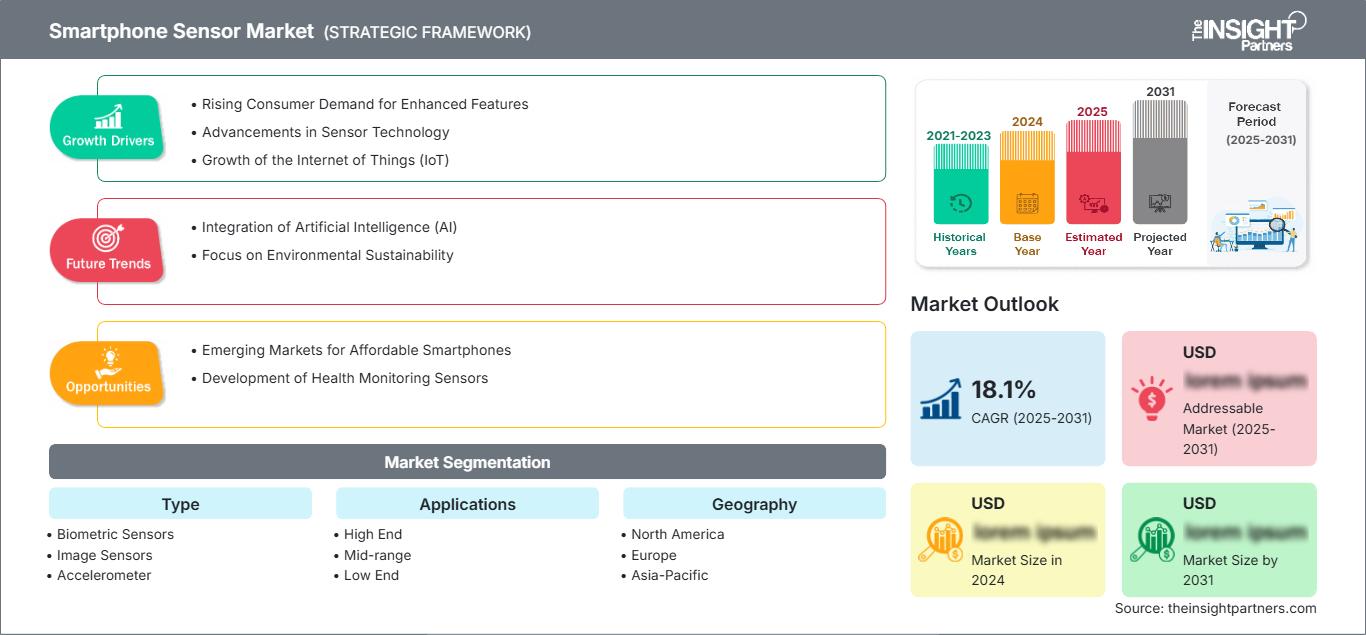
Smartphone Sensor Market Assessment and Insights
Regional Outlook
- North America: ~24% of the global Smartphone Sensor Market share in 2025 | ~16% CAGR through 2034. Market position: The region ranks second, supported by premium handset penetration, intensive camera use, secure authentication, and rapid deployment of AI-enabled features that require richer sensing stacks.
- US: ~82% of North American market revenue in 2025 | ~16% CAGR through 2034. Market position: The US leads North America through high flagship adoption, carrier-led upgrades, strong application ecosystems, and concentrated demand for advanced imaging, biometrics, navigation, and augmented reality.
- Europe: ~22% of the global market in 2025 | ~15% CAGR through 2034. Market position: A mature replacement market, Europe benefits from premiumization and privacy-conscious authentication; Germany and the UK lead, with France, Italy, and Spain sustaining broad mid-range demand.
- Asia Pacific: ~45% of the global market in 2025 | ~20% CAGR through 2034. Market position: Asia Pacific is the largest and fastest-growing region, combining China’s component scale, South Korea’s semiconductor depth, Japan’s imaging expertise, and India’s expanding smartphone production.
Segment Outlook
- Type: ~68% Share in 2025 | ~18% CAGR through 2034. Market position: Type leads because every handset requires a multi-sensor bill of materials, while camera, biometric, motion, and light-sensing upgrades expand component value per device.
- Applications: ~32% Share in 2025 | ~17% CAGR through 2034. Market position: Applications expand as premium functions move into mid-range phones, raising sensor count and specification while preserving cost discipline in lower-price tiers.
Competitive Coverage
ams-OSRAM AG, Broadcom Inc., Dyna Image Corporation, Epson Europe Electronics GmbH, EVERLIGHT ELECTRONICS CO., LTD., Murata Manufacturing Co., Ltd., Panasonic Holdings Corporation, Samsung Electronics Co., Ltd., Sony Semiconductor Solutions Corporation, STMicroelectronics N.V.
Methodology
The Insight Partners follows Data Collection & Secondary Research, Primary Research, Data Analysis, and Data Triangulation & Final Review to validate market estimates and insights.
Source: The Insight Partners' analysis based on proprietary research, government publications, company annual reports, investor presentations, industry databases, and expert interviews.
Smartphone Sensor Market Trends
Intelligence Migrates into the Sensor Stack
Smartphone Sensor Market trends increasingly point toward preprocessing at or near the sensing element. Stacked image sensors, embedded signal processing, event-aware operation, and compact AI functions can filter data before it reaches the main application processor. This architecture may improve responsiveness, lower bandwidth, and reduce power use while enabling adaptive exposure, scene interpretation, and privacy-preserving outputs. Through 2034, competitive differentiation is likely to shift from isolated component specifications toward the quality of sensor-plus-algorithm platforms. Qualification will consequently examine model performance, firmware support, cybersecurity, and upgrade paths alongside conventional parameters such as noise, dynamic range, accuracy, and package size.
Behind-display and Multimodal Sensing Converge
Bezel reduction and uninterrupted displays are encouraging optical sensing behind OLED panels, while handset makers seek coordinated understanding across cameras, spectral sensors, time-of-flight devices, and inertial inputs. Future designs may combine front-facing ambient and proximity detection with rear spatial sensing and camera calibration, creating a continuous imaging-to-display chain. The commercial implication is greater demand for optical filters, emitters, algorithms, and factory calibration that compensate for display transmission and changing light. Suppliers must solve interference, thermal, and power challenges without enlarging the device. Successful platforms can improve color management, flicker control, autofocus, depth perception, and spatial applications in a unified architecture.
Smartphone Sensor Market Growth Factors
Rising Sensor Value per Handset
More sensor revenues are increasingly becoming associated with content and specification and not just growing smartphone volume alone. A top-end mobile phone could incorporate multiple cameras, inertial sensors, biometric sensors, light detectors, and multi-frequency positioning sensors, all aided by calibration and computation. With the adoption of computational photography, stabilization technology, secure payment methods, and location-based gaming applications among other purchase parameters, the manufacturers will incorporate more sensor silicon and module value into their devices. The effect will be felt in the entire value chain, since wafer suppliers have to provide larger dies and processes, while the module manufacturers will need better optics. The mechanism helps ensure revenue in the market even with increased replacement cycles, since every new generation has better sensing capability.
Premium Features Moving into Mid-range Devices
Feature migration expands the addressable volume for advanced sensors. High-resolution cameras, optical stabilization, in-display authentication, and precise motion sensing typically enter flagship phones before standardized designs and improved yields reduce cost. Mid-range manufacturers can then adopt proven modules without bearing the full development expense, while suppliers gain longer production runs and broader customer exposure. Platform-level reference designs further shorten qualification and enable consistent performance across product families. The market impact is a widening revenue base that is less dependent on a narrow premium tier. Vendors that simplify integration, provide calibration software, and offer scalable performance variants can protect design continuity as handset makers differentiate models around imaging, security, gaming, and battery life.
On-device AI Requires Better Physical Context
On-device AI becomes more useful when it receives accurate, continuous information about the user’s surroundings and device movement. Cameras, ambient-light sensors, accelerometers, gyroscopes, magnetometers, biometric devices, and positioning systems provide that physical context for photography, translation, accessibility, safety, and intelligent interface functions. Local processing can reduce latency and limit unnecessary cloud transfer, but it also raises requirements for synchronized data, low noise, and disciplined power consumption. The resulting market impact is deeper collaboration among sensor vendors, chipset providers, handset makers, and software developers. Suppliers able to pair hardware with embedded algorithms, metadata processing, and fusion libraries can capture more value than component-only competitors.
Smartphone Sensor Market Opportunities
Scale Advanced Sensing for Mid-range Platforms
The largest actionable volume opportunity lies in converting premium sensing functions into manufacturable mid-range modules. Investors and suppliers can prioritize common footprints, mature process nodes where suitable, automated calibration, and firmware that works across multiple chipsets. Smartphone Sensor Market Forecasts support this strategy because sustained revenue expansion requires broader adoption, not only higher flagship specifications. Partnerships with original design manufacturers and regional handset brands can secure platform-level commitments and longer production runs. Commercial discipline remains essential: components must deliver visible improvements in camera quality, authentication, navigation, or battery efficiency while meeting strict bill-of-material limits and avoiding costly redesign late in qualification.
Build Localized Supply and Engineering Support in Asia
Asia Pacific’s assembly scale creates opportunity beyond fabrication. Sensor companies can invest in application engineering, module integration, test, calibration, and failure analysis close to handset manufacturing clusters in China, India, Vietnam, and South Korea. Local support reduces iteration time, improves yield learning, and helps customers adapt reference designs for different price tiers. Joint development with display, optics, chipset, and camera-module partners can also increase switching costs and support bundled solutions. The strongest projects will complement existing semiconductor capacity rather than duplicate it, using regional incentives and customer proximity to build resilient supply while maintaining consistent intellectual-property protection and quality governance.
Segmentation Analysis
Type
Type is projected to expand at ~18% CAGR during 2026–2034 as smartphone makers increase sensing density, improve camera performance, and fuse optical, motion, magnetic, and location inputs. This dimension accounts for ~68% of 2025 revenue in the report framework. The Smartphone Sensor Market scope includes biometric sensors, image sensors, accelerometers, gyroscopes, magnetometers, GPS, and ambient light sensors, with value determined by resolution, accuracy, power efficiency, package size, and integration support.
- Biometric Sensors: Fingerprint and facial-authentication components support secure access, payments, and privacy controls. Demand favors compact modules, reliable liveness detection, and performance through varied display stacks, lighting conditions, and user environments.
- Image Sensors: Multi-camera arrays, larger optical formats, high dynamic range, and in-sensor processing make imaging strategically important. Suppliers compete on low-light quality, autofocus, power consumption, yield, and compatibility with computational-photography pipelines.
- Accelerometer: Always-on motion detection enables screen orientation, activity recognition, stabilization, gesture control, and power management. High-volume adoption rewards low-noise performance, compact packaging, and minimal energy consumption across every handset tier.
- Gyroscope: Gyroscopes improve optical stabilization, gaming, augmented reality, and navigation by measuring rotation. Their strategic role rises as camera zoom, spatial interfaces, and sensor-fusion algorithms require stable, precisely calibrated motion data.
- Magnetometer: Digital compassing and orientation correction support maps, location services, and augmented-reality overlays. Robust calibration and resistance to magnetic interference are essential as tightly packed phone designs place multiple electronic components near the sensor.
- GPS: Satellite-positioning functionality underpins navigation, emergency services, mobility, logistics, and location-aware applications. Demand increasingly emphasizes multi-band accuracy, fast acquisition, urban-canyon performance, and efficient coordination with inertial and wireless positioning.
- Ambient Light Sensor: Ambient-light sensing adjusts display brightness and color, supports camera exposure, and reduces power use. Behind-OLED designs and flicker detection strengthen its relevance as bezel reduction and eye-comfort features spread.
Applications
Applications are forecast to grow at ~17% CAGR during 2026–2034 and represent ~32% of 2025 revenue in the analytical structure. Adoption varies by device economics: high-end phones prioritize differentiation, mid-range models scale proven functions, and low-end products focus on essential sensing at strict cost and power limits. Platform reuse, module standardization, and software calibration will accelerate feature migration while preserving clear performance tiers.
- High End: Flagship phones carry the richest sensor mix, including large image sensors, advanced stabilization, secure biometrics, spectral sensing, and precise positioning. This tier establishes performance benchmarks and supports higher component value per device.
- Mid-range: Mid-range devices offer the broadest path for volume expansion as premium camera, biometric, and motion functions become affordable. Reference designs and integrated modules help manufacturers balance differentiation, qualification speed, battery life, and cost.
- Low End: Low-end phones prioritize dependable accelerometers, basic imaging, light sensing, and location functionality. Strategic opportunity centers on highly integrated, mature-process components that reduce board space, calibration effort, energy use, and total bill of materials.
Opportunity Snapshot
| Applications | Revenue Contribution | Trend Tag | Adoption Stage |
| High End | High | Sensor Fusion | Mature |
| Mid-range | High | Feature Migration | Scaling |
| Low End | Medium | Cost Integration | Scaling |
Regional Insights
North America Smartphone Sensor Market
North America is projected to expand at ~16% CAGR through 2034. Its position rests on high premium-smartphone penetration, frequent use of computational photography, strong biometric expectations, and developer demand for accurate motion and location data. The regional Smartphone Sensor Market share reflects greater component value per handset rather than the world’s largest unit volume.
The carrier installment plan and the trade-in scheme maintain the replacement cycle, while the on-device AI technology motivates the microphone, camera, accelerometer, and light sensors to work together as input devices. High power needs, privacy issues, and reliability standards should be met by the suppliers. The Canadian advantage lies in connectivity and application design, while the Mexican advantage is the electronics manufacturing.
U.S. Smartphone Sensor Market
The US accounts for ~82% of North American revenue and is expected to grow at ~16% CAGR through 2034. High-end concentration and large installed base of iOS and premium Android devices enable sophisticated image sensors, security of facial recognition and fingerprinting, accurate location, and motion sensing capabilities for games, accessibility, wellbeing, and space applications.
The design influence is supplemented by significant handset, chipset, cloud and applications ecosystems. Connectivity and positioning architectures are enabled by Broadcom Inc., whereas ams-OSRAM AG, Samsung Electronics Co., Ltd., Sony Semiconductor Solutions Corporation, and STMicroelectronics N.V. provide device programs using their optical, imaging, and motion capabilities. The replacement cycle is likely fully matured, but specification improvement and addition of extra cameras raise the sensor per device revenue.
Europe Smartphone Sensor Market
Europe represents ~22% of global revenue in 2025 and is forecast to advance at ~15% CAGR through 2034. The market encompasses mature replacement demand and demand for high quality camera, secure authentication, effective battery usage, and longer lifetimes of devices. Privacy, repairability, and sustainability regulations increase qualification requirements and make suppliers who can show their expertise in terms of handling data, reliability, and sustainability more attractive.
Germany is the dominant European country due to its high purchasing power, engineering skills, and demand for premium devices. In addition, the UK has large numbers of premium users and people who use apps intensively, whereas France has a balance between adoption of flagships and medium-range devices. Moreover, Italy and Spain provide value-driven replacement demand, in which camera quality, effective battery usage, and navigation play key roles in buying decisions.
The European expertise in semiconductors and sensors plays an important role in the European market. STMicroelectronics N.V. provides motion and MEMS products, Epson Europe Electronics GmbH offers timing and sensing solutions, and ams-OSRAM AG offers optical technologies. The business opportunity of Europe is high-reliability components, privacy-enabled biometric solutions, behind-display sensing, and calibrated modules to help handset makers meet consumer expectations and regulatory requirements.
APAC Smartphone Sensor Market
Asia Pacific holds ~45% of global Smartphone Sensor Market in 2025 and is the fastest-growing region at ~20% CAGR through 2034. China is the largest player in Asia-Pacific due to its huge capacity for handset assembly, component concentration, and strong domestic demand. Japan provides expertise in image sensing and precision manufacturing, whereas South Korea brings together memory, displays, imaging, and flagships manufacturing.
Production incentives in India and growing 5G deployment enable localization, and Australia keeps demand for high-end replacements alive. The presence of shorter distances between suppliers and assemblers, a highly concentrated network of engineers, and fast adoption of multi-camera systems and biometrics in mid-level devices make Asia-Pacific integral to volume manufacturing and sensing innovations.
Middle East & Africa Smartphone Sensor Market
The Middle East & Africa Smartphone Sensor Market is expected to achieve ~18% CAGR through 2034. Saudi Arabia and the UAE support premium devices through high connectivity investment, digital services, and modern retail channels. The UAE is the leading country in the Middle East & Africa where flagship mix and rapid technology adoption increase demand for sophisticated imaging, biometrics, and location functions.
South Africa anchors the region’s more developed sub-Saharan channel, while the Rest of MEA remains sensitive to device cost and financing. Expanding mobile broadband, digital identity, payments, navigation, and utility applications support sensor adoption. Growth depends on durable, power-efficient components that perform reliably across heat, dust, uneven connectivity, and varied purchasing power.
Smartphone Sensor Market Report Scope
| Report Attribute | Details |
|---|---|
| Market size in 2025 | US$ 86.07 Billion |
| Market Size by 2034 | US$ 379.8 Billion |
| Global CAGR (2026 - 2034) | 17.93% |
| Historical Data | 2021-2024 |
| Forecast period | 2026-2034 |
| Segments Covered | Type, Applications, Geography |
| Region scope | North America, Europe, Asia-Pacific, South and Central America, Middle East and Africa |
Recent Developments
- September 2026: Samsung Electronics – launched its 200MP ISOCELL HPC image sensor featuring DeepPix technology, designed to improve HDR, low-light imaging, and zoom performance in smartphones. The sensor increases pixel full-well capacity and supports 16-bit HDR in a single frame, along with 4K video recording at up to 180 fps.
- September 2026: Motorola – introduced its new Motorola Signature 27 smartphone with a photography-focused camera system using Sony Lytia image sensors. The setup includes a 50MP Lytia 910 LOFIC main sensor and a 200MP Lytia 901 telephoto sensor, targeting improved dynamic range, detail, and mobile photography performance.
- September 2026: Mivi – revealed that its upcoming Mivi One 5G smartphone will feature a 50MP primary rear camera ahead of its India launch. The camera specification highlights Mivi’s entry into the smartphone market and its focus on camera capabilities in the mid-range 5G segment.
Frequently Asked Questions

Recent Reports






