
Smartwatch Market Growth, Share & Trends by 2034
Coverage: By Product (Extension, Standalone, Classical); Operating System (Apple WatchOS, Google WearOS, Lite OS, Amazefit OS, Others) , and Geography (North America, Europe, Asia Pacific, and South and Central America)
- Status : Data Released
- Report Code : TIPRE00006776
- Category : Electronics and Semiconductor
- No. of Pages : 150
- Available Report Formats :


- Last update date : October 16, 2026


2025 Market Size
US$ 38.53 Bn
Base year value
2034 Forecast
US$ 67.86 Bn
Projected by 2034
CAGR 2026-2034
6.49 %
Growth rate
Addressable Market
US$ 481.17 Bn
(2026-2034)
The Smartwatch Market demand is being shaped by the convergence of wearable computing, mobile connectivity, health monitoring, and fitness applications. The market was valued at US$ 38.53 Billion in 2025 and is projected to reach US$ 67.86 Billion by 2034, expanding at a CAGR of 6.49% during 2026–2034. Product innovation increasingly combines advanced sensors, connectivity, software ecosystems, and personalized health features, while manufacturers are broadening portfolios across premium, mainstream, outdoor, and youth-oriented use cases.
North America remains an important revenue center, supported by high consumer familiarity with connected devices, established smartphone ecosystems, and strong replacement demand for feature-rich wearables. The Smartwatch Market size is reinforced by the adoption of cellular-enabled devices, health and wellness applications, and integration with digital services. The regional market is expected to expand at a CAGR of ~5% through 2034, with premiumization and ecosystem integration supporting continued demand.
Smartwatch Market Assessment and Insights
Regional Outlook
- North America: ~31% of the global market in 2025 | ~5% CAGR through 2034. Market position: North America maintains a substantial mature-market position, supported by high smartwatch penetration, strong Apple and Google ecosystems, premium device demand, cellular connectivity, and sustained replacement purchases linked to health, fitness, and communications.
- US: ~82% of North American market revenue in 2025 | ~5% CAGR through 2034. Market position: The US represents the principal North American demand center, supported by extensive iPhone and Android installed bases, premium wearable adoption, sports and fitness applications, and consumer interest in continuous health and activity monitoring.
- Europe: ~24% of the global market in 2025 | ~5% CAGR through 2034. Market position: Europe is a mature market with diversified demand across premium, fitness, and outdoor devices. Germany is the leading country in Europe, while the UK, France, Italy, and Spain provide broad regional demand.
- Asia Pacific: ~38% of the global market in 2025 | ~8% CAGR through 2034. Market position: Asia Pacific is the fastest-growing region, driven by large consumer populations, expanding domestic brands, improving wearable affordability, manufacturing strength, and rising health and fitness awareness. China is the leading country in Asia Pacific.
Segment Outlook
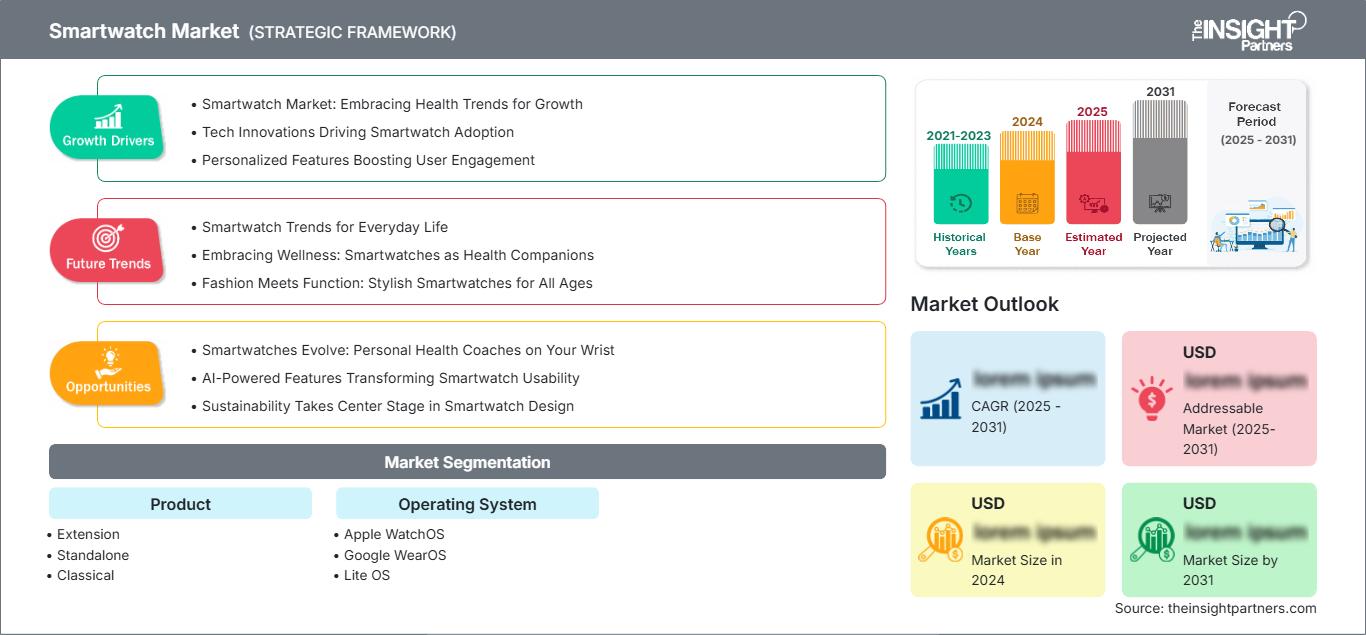
- Extension: ~60% Share in 2025 | ~6% CAGR through 2034. Market position: Extension devices lead because they benefit from established smartphone ecosystems, broad consumer familiarity, companion applications, notifications, health tracking, and seamless device synchronization. Their comparatively broad compatibility supports mainstream replacement demand.
- Standalone: ~25% Share in 2025 | ~8% CAGR through 2034. Market position: Standalone devices have the higher growth outlook as cellular connectivity, independent communications, GPS, emergency functions, and increasingly capable processors reduce reliance on smartphones for selected everyday and outdoor activities.
Competitive Coverage
Amazfit, Apple Inc., Fitbit LLC, Fossil Group, Garmin Ltd., Google, Huawei Technologies Co., Ltd., imoo, LG Electronics, Samsung Electronics Co., Ltd.
Methodology
The Insight Partners follows Data Collection & Secondary Research, Primary Research, Data Analysis, and Data Triangulation & Final Review to validate market estimates and insights.
Source: The Insight Partners' analysis based on proprietary research, government publications, company annual reports, investor presentations, industry databases, and expert interviews.
The Smartwatch Market has evolved from notification-oriented companion devices into multifunctional wearable computing platforms. Older versions focused mainly on time display, notifications, fitness tracking, and phone synchronization, but newer versions integrate optical sensing, GPS, cellular connections, sleep tracking, workout analysis, and software personalization features. Moreover, production trends have changed with Chinese companies entering foreign markets and premium brands differentiating through proprietary chips, sensors, operating systems, and services. This has led to a market that is becoming polarized between premium smartwatches, which offer many features, and cost-conscious smartwatches that rely on their features.
Going forward, it is expected that geographic diversification will become more evident. In China and other Asian countries, local ecosystems are being developed, whereas mature markets will continue to evolve in the direction of premium watches and replacements. Investment is expected to be focused on sensor precision, battery efficiency, artificial intelligence in data interpretation, connectivity, and sports-specific features. Issues related to digital health, privacy, wireless communication, and medical device claims are expected to play an important role in product development. Smartwatch companies that can successfully combine good sensing and a good software experience can take advantage of the replacement market.
Smartwatch Market Report Scope
| Report Attribute | Details |
|---|---|
| Market size in 2025 | US$ 38.53 Billion |
| Market Size by 2034 | US$ 67.86 Billion |
| Global CAGR (2026 - 2034) | 6.49% |
| Historical Data | 2021-2024 |
| Forecast period | 2026-2034 |
Smartwatch Market Analysis
Smartwatch Market growth is supported by rising demand for continuous activity monitoring, health insights, communication, navigation, and connected lifestyle services. Value chain participants include semiconductor suppliers, sensor suppliers, display and battery suppliers, device assembly companies, operating systems providers, application providers, distributors, and retailers. Consumers have become more concerned about the quality of the overall ecosystem and not just the technical specifications of their hardware, software compatibility and data integration are among the factors taken into account by purchasers at all price levels.
Factors affecting supply include worldwide electronics manufacturing capabilities, availability of components, and branding differentiation. Manufacturing facilities in Asia still play a pivotal role in the assembly of devices and components, while large technology companies still maintain a strong position because of the hardware and software ecosystems they have created. The premiumization trend is driving companies to incorporate better displays, sensors, materials, and connectivity modules in premium devices, whereas competition for entry-level devices is forcing suppliers to improve the efficiency of their supply chain.
The Smartwatch Market analysis indicates a competitive structure spanning ecosystem-led technology companies, specialist fitness brands, and value-oriented wearable manufacturers. Competitors like Apple Inc. and Samsung Electronics Co., Ltd. use integrated mobile ecosystems and health functionalities, while Garmin Ltd. stresses sports, navigation, and outdoor uses. Both competitors, like Huawei Technologies Co., Ltd. and Amazfit, compete internationally and increasingly in health and fitness, battery performance, and specialized uses. Contributions by Google and Fitbit LLC are through software, health, and wearables ecosystems.
Priorities in investment are becoming focused on sensing differentiation, AI-based software, independent connectivity, and form factors for specialized uses. Performance-based positioning is being strengthened by Garmin Ltd., while health sensing integration with wearables is continuing with Apple Inc. Feature-rich portfolios are being increased at Huawei Technologies Co., Ltd., Amazfit, and Samsung Electronics Co., Ltd. at multiple price levels. imoo is maintaining its differentiated focus in youth-focused devices, while Fossil Group and LG Electronics are providing competitive diversification. Strategic positioning, therefore, depends increasingly on ecosystem depth, Smartwatch Market share, sensor capabilities, brand reach, and software support.
● REPORT CUSTOMIZATION
Tailor This Report To Align With Your Specific Business Requirements
This report can be customized to align precisely with your business objectives, scope, and target markets. Customization options include tailored segmentation, geography, competitive analysis, and strategic insights to support informed decision-making.
Customize This Report →WHAT YOU CAN ADJUST
- ● Segmentations
- ● Geography
- ● Competitive Analysis
- ● Language Preferences
Smartwatch Market: Strategic Insights
Regional Insights
North America Smartwatch Market
North America accounted for ~31% of the global Smartwatch Market in 2025 and is projected to expand at a CAGR of ~5% through 2034. The region benefits from mature smartphone ownership, established wearable ecosystems, high purchasing power, and broad awareness of digital health and fitness applications. Replacement demand is particularly important because consumers increasingly upgrade when new generations provide improved sensors, battery performance, connectivity, or software functions.
This region is represented by the main consumer of the products – the US, where Apple Inc., Google, Fitbit LLC, Garmin Ltd., and Samsung Electronics Co., Ltd. possess considerable ecosystem visibility and product presence. Canada brings extra demand to the market due to fitness and outdoor activities, as well as device connectivity. The cellular feature, sports tracking, sleep tracking, and health-focused applications are becoming key factors in purchases in the region. The developed state of the market suggests that its further growth will rely mostly on premiumization and improvements.
U.S. Smartwatch Market
The U.S. represented ~82% of North American Smartwatch Market revenue in 2025 and is expected to grow at a CAGR of ~5% through 2034. Its large installed base of smartphones, strong consumer electronics ecosystem, and high purchasing power support demand for premium connected wearables. Consumers increasingly use smartwatches for communications, exercise, navigation, sleep tracking, and health-related monitoring.
Apple Inc. maintains strong ecosystem integration through Apple Watch and its broader device environment, while Google and Fitbit LLC address Android-oriented users and health-focused applications. Garmin Ltd. serves endurance sports, outdoor recreation, and performance training, while Samsung Electronics Co., Ltd. provides Galaxy Watch products for Android users. Application trends are shifting toward more sophisticated health interpretation, fitness readiness, cellular connectivity, and personalized training. These developments support replacement demand even as the mature market limits rapid unit expansion.
Europe Smartwatch Market
Europe represented ~24% of the global Smartwatch Market in 2025 and is expected to expand at a CAGR of ~5% through 2034. Germany is the top country in Europe, with a strong base of consumer electronics, purchasing power, sports culture, and retail infrastructure. The United Kingdom also counts as an important country owing to high premium wearable usage and smartphone ecosystem penetration. France provides demand through healthcare, fitness, and lifestyle applications, whereas Italy and Spain offer opportunities relating to sports, wellness, and connected devices usage.
European customers today make a distinction between generic smartwatches and specialized watches that cater to running, cycling, hiking, and outdoor sports. Garmin Ltd. enjoys success on account of specialized watches, whereas Apple Inc., Samsung Electronics Co., Ltd., Google, and Huawei Technologies Co., Ltd. have the opportunity through broad ecosystem strengths. Privacy concerns, digital health information, and consumer data have their impact on the product development. Growth therefore lies in replacement, premiumization, sensor advances, and better integration than simply expanding the first-time user base.
APAC Smartwatch Market
APAC represented ~38% of the global Smartwatch Market in 2025 and is forecast to expand at a CAGR of ~8% through 2034, making it the fastest-growing region. China is the leading country in Asia Pacific, supported by domestic brands, large-scale electronics manufacturing, extensive retail networks, and increasing demand for feature-rich connected devices. Japan and South Korea provide mature technology-oriented demand, while India offers substantial long-term potential despite recent normalization in budget smartwatch shipments.
China's manufacturing ecosystem supports rapid product iteration and competitive pricing, while Japan emphasizes quality, health, and technology integration. South Korea benefits from Samsung's ecosystem, and Australia has an established demand for fitness and outdoor applications. India's market is increasingly shifting from low-cost devices toward premium products with better sensors and functionality. Policy support for domestic electronics manufacturing, broader digital connectivity, and rising health awareness provide structural support for regional expansion.
Middle East & Africa Smartwatch Market
The Middle East & Africa Smartwatch Market is projected to expand at a CAGR of ~7% through 2034. Saudi Arabia represents a significant Middle Eastern demand center, supported by digital transformation initiatives, consumer technology spending, fitness-oriented lifestyles, and investment in connected infrastructure. The UAE provides another important market because of high smartphone penetration, premium consumer electronics demand, and strong retail and tourism ecosystems.
South Africa represents a key African market, while the Rest of MEA remains fragmented across countries with different income levels and connectivity conditions. Energy and infrastructure development support broader digital-device adoption, particularly in urban centers. Smartwatches linked to fitness, navigation, communications, and wellness applications can benefit from increasing consumer interest in connected lifestyles. Expansion is likely to remain uneven, with premium products concentrated in higher-income markets and more affordable devices supporting broader penetration elsewhere.
Segmentation Analysis
Product
The Product segmentation covers Extension, Standalone, and Classical smartwatches. Product architecture influences connectivity requirements, software integration, use cases, battery design, and consumer replacement behavior. Ecosystem compatibility remains particularly important for mainstream products, while independent functionality and cellular connectivity create additional opportunities for devices designed to operate beyond a paired smartphone. The segment is expected to evolve toward greater functional differentiation as consumers increasingly evaluate health, fitness, communication, and specialized activity capabilities.
- Extension: These devices function primarily as smartphone companions, providing notifications, health tracking, applications, communications, and synchronized services. Their broad compatibility and familiarity support mainstream adoption, while ecosystem integration encourages replacement when new hardware or software capabilities become available.
- Standalone: Standalone products reduce dependence on smartphones through cellular connectivity, GPS, independent communications, and autonomous applications. They are strategically important for outdoor activities, emergency communication, children's use, and consumers seeking greater freedom from a continuously paired phone.
- Classical: Classical smartwatches retain conventional watch aesthetics while incorporating connected functions. Their appeal is strongest among consumers seeking a traditional appearance with selected digital capabilities, creating opportunities for premium materials, fashion-oriented designs, and hybrid lifestyle positioning.
Operating System
The Operating System segmentation includes Apple WatchOS, Google WearOS, Lite OS, and Amazefit OS. Operating systems determine application availability, smartphone compatibility, interface design, health-data integration, update cycles, and developer participation. Ecosystem strength is consequently a major competitive differentiator because users often consider compatibility with existing smartphones and digital services before selecting a smartwatch platform.
- Apple WatchOS: Apple WatchOS is closely integrated with Apple's hardware and software ecosystem. Its strategic importance comes from seamless interaction with compatible Apple devices, health and fitness functionality, applications, and services, supporting strong customer retention within the broader ecosystem.
- Google WearOS: Google WearOS supports Android-oriented smartwatch experiences and integrates applications, notifications, services, and device connectivity. Its position benefits from the broader Android ecosystem and partnerships with hardware manufacturers, allowing multiple brands to compete using a common software foundation.
- Lite OS: Lite OS has been associated with Huawei's smartwatch ecosystem and emphasizes efficient operation, health monitoring, fitness functions, and battery-conscious performance. Its strategic relevance is linked to Huawei's broader wearable portfolio and its efforts to maintain differentiated software capabilities.
- Amazefit OS: Amazefit OS supports Amazfit's connected wearable portfolio, emphasizing health, fitness, activity monitoring, and user interaction. Its importance lies in enabling Amazfit to differentiate through integrated software experiences while supporting a broad portfolio across mainstream and performance-oriented devices.
Opportunity Snapshot
| Operating System | Revenue Contribution | Trend Tag | Adoption Stage |
|---|---|---|---|
| Apple WatchOS | High | Health Ecosystem | Mature |
| Google WearOS | Medium | Android Integration | Scaling |
| Lite OS | Medium | Battery Efficiency | Scaling |
| Amazefit OS | Medium | Fitness Analytics | Scaling |
Smartwatch Market Growth Drivers and Impact Analysis
Expansion of Continuous Health and Fitness Monitoring
Monitoring of health and fitness is gradually evolving from a communication-centric smartwatch into a persistent personal device for data gathering. The consumer expectation of data collection capabilities on health metrics like heart rate, sleep, physical activity, recovery, movements, etc., is increasing. This goes beyond mere notification functionality and makes the replacement of old-generation devices more relevant as newer models come with more accurate sensing technology or better interpretation. Engineering focus for manufacturers is therefore turning toward sensing technology, optical sensing, data analysis software, and health interfaces. The commercial implications cover both high-end and mainstream segments as simple activity tracking may enable an entry-level product, and the differentiation factor lies in advanced sensing technologies.
Growing Demand for Independent Connectivity and Communication
Independent connectivity is making it possible for the smartwatch to function in even more scenarios without requiring a phone to be within reach. Connectivity features such as cellular, GPS, emergency services, and apps are very significant for people who run, cycle, travel, children, outdoor users, and consumers in need of more convenience. This aspect also enables premiumization since services and modules for cellular connectivity allow manufacturers to charge a higher price tag and create chances for recurrent connectivity business models. Independent architecture therefore has strategic value in addition to what exists currently among the installed devices. In addition, vendors are working on ensuring efficient use of power so that independent connectivity does not have a detrimental effect on battery lifespan.
Premiumization Through Specialized Performance and Materials
Premiumization is changing the competitive basis of the smartwatch industry. Instead of competing solely on display size or basic activity tracking, vendors are increasingly differentiating through titanium cases, brighter displays, advanced navigation, higher sensor density, longer battery life, satellite communication, and specialized training functions. These features can increase average selling prices while encouraging replacement among experienced users. Premium devices also allow brands to target specialized communities such as endurance athletes, outdoor enthusiasts, and health-conscious consumers. The market impact is significant because stronger premium demand can offset slower growth in low-cost categories. It also encourages manufacturers to rationalize portfolios, improve component quality, and invest in proprietary software rather than relying exclusively on volume-driven competition.
Smartwatch Market Future Trends
AI-Enhanced Personalization and Contextual Health Insights
Smartwatch Market trends are increasingly moving toward software that interprets large volumes of sensor data rather than simply displaying measurements. Artificial intelligence can help convert activity, sleep, heart-rate, workout, and environmental information into personalized summaries, training suggestions, readiness indicators, or contextual notifications. The next stage of development is likely to emphasize on-device processing, privacy-conscious personalization, and tighter integration between smartwatch data and smartphone health platforms. AI-enabled interfaces can also make complex information easier for consumers to understand, potentially increasing engagement with health and fitness features. For manufacturers, differentiation will depend on the usefulness and reliability of these interpretations rather than simply adding AI terminology. Software quality, sensor consistency, data privacy, and transparent user controls will therefore become increasingly important competitive factors.
Convergence of Smartwatches With Broader Wearable Ecosystems
Smartwatch Market trends are also moving toward greater integration with rings, earbuds, smartphones, connected exercise equipment, health applications, and other wearable devices. Rather than functioning as an isolated product, the smartwatch is increasingly becoming an interface within a broader personal technology ecosystem. Data synchronization can allow different devices to contribute complementary information while reducing reliance on any single sensor or form factor. This convergence may encourage manufacturers to strengthen platform compatibility and cross-device services. It also creates opportunities for differentiated ecosystem strategies, particularly where companies control both hardware and software. Over time, consumers may evaluate smartwatch purchases according to how effectively the device coordinates with their broader digital environment, making interoperability and data continuity important considerations.
Smartwatch Market Opportunities
Expansion of Premium Wearables in Emerging Consumer Markets
Smartwatch Market Forecasts indicate commercial opportunities in emerging markets where consumer adoption is shifting from inexpensive basic products toward more capable devices. India demonstrates this transition, with recent industry evidence showing weaker budget demand alongside stronger premium smartwatch performance. Similar dynamics can emerge in other developing markets as consumers become more familiar with health monitoring, GPS, cellular connectivity, and advanced fitness features. Vendors can address these opportunities through localized pricing, regional retail partnerships, language support, financing, and products that emphasize practical health and fitness benefits. The opportunity is not simply to increase unit volume but to capture consumers moving upward in product sophistication. Brands with scalable manufacturing and strong digital distribution can use tiered portfolios to serve both first-time users and upgrading customers.
Specialized Outdoor, Sports, and Performance Smartwatches
Specialized performance wearables provide an opportunity for manufacturers to capture higher-value users seeking functions that general-purpose devices may not emphasize. Outdoor navigation, endurance metrics, training analytics, satellite communication, rugged construction, and extended battery performance can support differentiated positioning. The opportunity extends across running, cycling, hiking, adventure sports, and structured training. Manufacturers can strengthen monetization by combining hardware with software platforms, coaching functions, training plans, and connected services. Specialist products also create opportunities for partnerships with sporting organizations, training platforms, and health or fitness ecosystems. As consumers become more experienced with wearable technology, products designed around clearly defined activities can command attention through functional relevance rather than broad feature lists.
Recent Developments
- September 2026: Apple Inc. introduced Apple Watch Series 12 with a new Health Sensing System, higher-frequency heart-rate and heart-rate variability sensing, a readiness score, and the S11 chip. The company positioned the device around enhanced health and fitness capabilities, while also adding new audio intelligence functionality and continued emphasis on privacy and accessibility.
- August 2026: Garmin Ltd. introduced the fēnix 9 and fēnix 9 Pro multisport GPS smartwatches. The new lineup adds titanium construction on the Pro model, a larger AMOLED display, enhanced stamina metrics, Garmin Epic functionality, and satellite and LTE connectivity on selected Pro models, strengthening Garmin's positioning in performance and outdoor wearables.
- July 2026: Samsung Electronics Co., Ltd. unveiled Galaxy Watch Ultra2 and Galaxy Watch9 at Galaxy Unpacked in London. The products expand Samsung's digital health proposition with functions spanning sleep, cardiovascular health, exercise, recovery, and demanding outdoor activities, reinforcing the company's focus on integrated health and fitness experiences.
Frequently Asked Questions

- Comprehensive Market Sizing and Forecast Analysis
- Detailed Segmentation Analysis
- In-Depth Market Dynamics Assessment
- Regional and Country-Level Insights
- Competitive Landscape and Company Benchmarking
- Strategic Business Intelligence
Recent Reports
Testimonials

The Insight Partners provided valuable market intelligence that supported our global go-to-market strategy. Their team was professional, responsive, and attentive to our feedback, providing thoughtful analysis and helpful methodological clarifications throughout the project.
Junmo Kim Chief Financial Officer (CFO), Enertech Co., Ltd.
The Insight Partners' SCADA System Market report is comprehensive, with valuable insights on current trends and future forecasts. The team was highly professional, responsive, and supportive throughout. We are very satisfied and highly recommend their services.
RAN KEDEM Partner, Reali Technologies LTDs
I requested a report on a very specific software market and the team produced the report in a few days. The information was very relevant and well presented. I then requested some changes and additions to the report. The team was again very responsive and I got the final report in less than a week.
JEAN-HERVE JENN Chairman, Future Analytica
We worked with The Insight Partners for an important market study and forecast. They gave us clear insights into opportunities and risks, which helped shape our plans. Their research was easy to use and based on solid data. It helped us make smart, confident decisions. We highly recommend them.
PIYUSH NAGPAL Sr. Vice President, High Beam Global
The Insight Partners delivered insightful, well-structured market research with strong domain expertise. Their team was professional and responsive throughout. The user-friendly website made accessing industry reports seamless. We highly recommend them for reliable, high-quality research services
YUKIHIKO ADACHI CEO, Deep Blue, LLC.
This is the first time I have purchased a market report from The Insight Partners.While I was unsure at first, I visited their web site and felt more comfortable to take the risk and purchase a market report.I am completely satisfied with the quality of the report and customer service. I had several questions and comments with the initial report, but after a couple of dialogs over email with their analyst I believe I have a report that I can use as input to our strategic planning process.Thank you so much for taking the extra time and making this a positive experience.I will definitely recommend your service to others and you will be my first call when we need further market data.
JOHN SUZUKI President and Chief Executive Officer, Board Director, BK Technologies
I wish to appreciate your support and the professionalism you displayed in the course of attending to my request for information regarding to infectious disease IVD market in Nigeria. I appreciate your patience, your guidance, and the fact that you were willing to offer a discount, which eventually made it possible for us to close a deal. I look forward to engaging The Insight Partners in the future, all thanks to the impression you have created in me as a result of this first encounter.
DR CHIJIOKE ONYIA MANAGING DIRECTOR, PineCrest Healthcare Ltd.Reason to Buy
- Informed Decision-Making
- Understanding Market Dynamics
- Competitive Analysis
- Identifying Emerging Markets
- Customer Insights
- Market Forecasts
- Risk Mitigation
- Boosting Operational Efficiency
- Strategic Planning
- Investment Justification
- Tracking Industry Innovations
- Aligning with Regulatory Trends





 Get Free Sample for