
Solid State Lighting (SSL) Market Size, Trends & Growth by 2034
Coverage: by Technology (LED, OLED and Emerging SSL Technologies), Applications (Indoor Lighting, Outdoor Lighting), Installation Type (New Installation, Retrofit), End-user Industry Vertical (Commercial and Residential, Industrial and Infrastructure), and Geography (North America, Europe, Asia Pacific, and South and Central America)
- Status : Data Released
- Report Code : TIPTE100000127
- Category : Electronics and Semiconductor
- No. of Pages : 150
- Available Report Formats :


- Last update date : October 30, 2026


2025 Market Size
US$ 49.25 Bn
Base year value
2034 Forecast
US$ 139.84 Bn
Projected by 2034
CAGR 2026-2034
12.30 %
Growth rate
Addressable Market
US$ 827.66 Bn
(2026-2034)
The Solid State Lighting Market size was valued at US$ 49.25 Billion in 2025 and is expected to reach US$ 139.84 Billion by 2034, registering a CAGR of 12.30% during 2026–2034. The market encompasses semiconductor-based lighting technologies, primarily LED solutions, used across residential, commercial, industrial, infrastructure, automotive, and specialty applications. Expansion is supported by energy-efficiency requirements, replacement of conventional light sources, improvements in efficacy and controllability, and wider deployment of connected lighting systems.
North America is expected to maintain a substantial position, with the Solid State Lighting Market share supported by modernization of commercial buildings, outdoor infrastructure, and industrial facilities. The region is modeled to register a ~10% CAGR through 2034. Federal and state energy-efficiency programs, utility incentives, building renovation, and demand for connected controls are strengthening replacement activity, while advanced lighting designs increasingly integrate sensors, networking, and automated controls.
Solid State Lighting (SSL) Market Assessment and Insights
Regional Outlook
- North America: ~26% of the global Solid State Lighting Market share in 2025 | ~10% CAGR through 2034. Market position: North America remains a major mature market, supported by commercial retrofit programs, industrial modernization, outdoor infrastructure upgrades, energy-efficiency standards, and increasing integration of connected controls with LED luminaires.
- US: ~80% of North American market revenue in 2025 | ~10% CAGR through 2034. Market position: The US is the leading country in North America, supported by large commercial and institutional building stocks, municipal lighting programs, industrial facilities, and continued investment in controllable, high-efficiency lighting systems.
- Europe: ~24% of the global market in 2025 | ~9% CAGR through 2034. Market position: Europe represents a mature lighting market shaped by stringent energy-performance requirements and replacement demand. Germany, the UK, France, Italy, and Spain form important national markets, with Germany holding the leading position in Europe.
- Asia Pacific: ~42% of the global market in 2025 | ~15% CAGR through 2034. Market position: Asia Pacific is the largest and fastest-growing regional market, driven by manufacturing capacity, urbanization, infrastructure construction, electronics ecosystems, and rapid LED adoption. China is the leading country in Asia Pacific.
Segment Outlook
- Technology: ~82% Share in 2025 | ~12% CAGR through 2034. Market position: LED-based solid-state solutions lead because of high efficacy, long operating life, controllability, compact form factors, and broad compatibility with residential, commercial, industrial, and outdoor lighting systems.
- Installation Type: ~55% Share in 2025 | ~14% CAGR through 2034. Market position: New installations represent a major demand pool as buildings, infrastructure projects, industrial facilities, and smart-city developments increasingly specify LED luminaires and integrated controls at the design stage.
Competitive Coverage
ams-OSRAM AG, Nichia Corporation, General Electric Company, Koninklijke Philips N.V., Seoul Semiconductor Co., Ltd., Applied Materials, Inc., Cambridge Display Technology Ltd., Mitsubishi Electric Corporation, Wolfspeed, Inc., Eaton Corporation plc, Lutron Electronics Co., Inc., Energy Focus, Inc., Samsung Electronics Co., Ltd., Tridonic GmbH & Co KG
Methodology
The Insight Partners follows Data Collection & Secondary Research, Primary Research, Data Analysis, and Data Triangulation & Final Review to validate market estimates and insights.
Source: The Insight Partners' analysis based on proprietary research, government publications, company annual reports, investor presentations, industry databases, and expert interviews.
Improvements in semiconductor technology, LED encapsulation technology, optical design, thermal management, driving, and control have progressively transformed the manufacturing process of lighting products and their economics. Manufacturers are progressing from mere lamps replacements to integrated luminaires that can provide optical distribution, dimming capability, sensors integration, networking, and color control. Hence, the Solid State Lighting Market has progressed from just providing lighting solutions to architectural, industrial, transportation, horticulture, entertainment, and specialty lighting solutions. There has also been geographical diversification in manufacturing ecosystems, but large scale semiconductor and electronics manufacturing in Asia has contributed significantly to component supply and product innovations.
The future outlook of the Solid State Lighting Market will be defined largely by emerging economies, infrastructure improvement, and regulation that favors reduced energy consumption. There are large potential installation markets in China, India, Southeast Asian economies, and certain Middle Eastern countries due to urbanization that will create the need for efficient indoor and outdoor lighting installations. There is emphasis on product efficiency and lifecycle in Europe, whereas in North America, there is a combination of lighting upgrades with building automation.
Solid State Lighting (SSL) Market Report Scope
| Report Attribute | Details |
|---|---|
| Market size in 2025 | US$ 49.25 Billion |
| Market Size by 2034 | US$ 139.84 Billion |
| Global CAGR (2026 - 2034) | 12.30% |
| Historical Data | 2021-2024 |
| Forecast period | 2026-2034 |
Solid State Lighting (SSL) Market Analysis
In terms of demand, lighting is now more associated with the total cost of ownership of the assets as opposed to simply equipment cost. LED lighting systems lower power consumption, maintenance, and the frequency of replacements when compared to many legacy lighting solutions. Value chain includes semiconductor materials, epitaxy, chip manufacturing, packaging, phosphors, optics, thermal components, drivers, controls, luminaires, distribution, system integration, and end users. Supply situation involves not only the supply of semiconductors but also their manufacturing, thus differentiating through optics, electronics, controls, reliability, and applications.
The competitive landscape of the Solid State Lighting Market comprises general electrical/electronics players along with niche semiconductor and lighting companies. Koninklijke Philips N.V., Eaton Corporation plc, Tridonic GmbH & Co KG, and ams-OSRAM AG operate in the professional lighting and component ecosystems while Nichia Corporation and Seoul Semiconductor Co., Ltd. offer LED lighting technology know-how. Samsung Electronics Co., Ltd. and Applied Materials, Inc. offer semiconductor and display technologies while Energy Focus, Inc. and other niche players offer specific lighting technologies.
● REPORT CUSTOMIZATION
Tailor This Report To Align With Your Specific Business Requirements
This report can be customized to align precisely with your business objectives, scope, and target markets. Customization options include tailored segmentation, geography, competitive analysis, and strategic insights to support informed decision-making.
Customize This Report →WHAT YOU CAN ADJUST
- ● Segmentations
- ● Geography
- ● Competitive Analysis
- ● Language Preferences
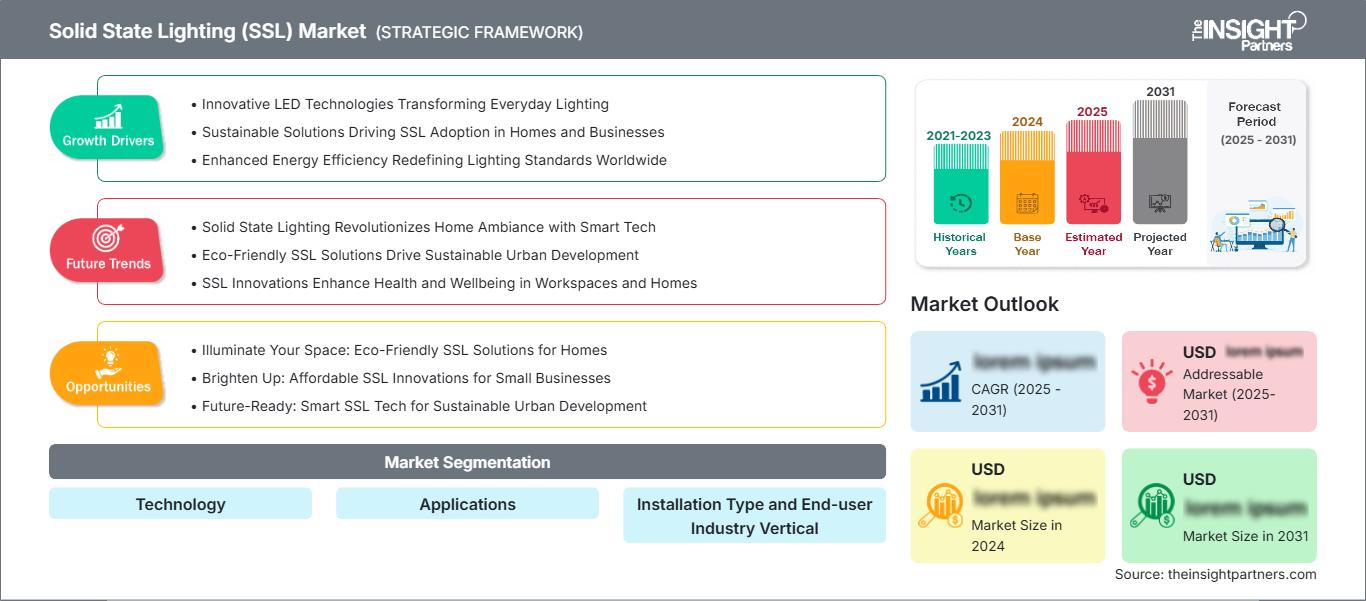
Solid State Lighting (SSL) Market: Strategic Insights
Regional Insights
North America Solid State Lighting Market
The Solid State Lighting Market forecast shows that North America combines a mature installed base with continuing replacement potential across commercial buildings, warehouses, manufacturing facilities, healthcare sites, educational campuses, roads, and municipal infrastructure. The region is modeled to expand at a ~10% CAGR through 2034. Retrofit economics remain important because lighting upgrades can be combined with occupancy sensing, daylight harvesting, scheduling, and building-management systems. Federal procurement activity and utility efficiency programs can further support demand for high-efficiency equipment.
The United States holds about 80% of the North American Solid State Lighting Market revenue by 2025 and continues to be the top country in North America. The vast amount of commercial floor space, industrial buildings, data centers, distribution centers, and outdoor lighting equipment create various demand streams. Manufacturers have increasingly resorted to competing in terms of connected controls, tunable white systems, optics, high bay lighting, and control systems. Canada provides demand via commercial construction and infrastructure modernization, whereas Mexico creates demand due to manufacturing activities.
U.S. Solid State Lighting Market
The US represents ~80% of North American revenue in 2025 and is modeled to record a ~10% CAGR through 2034. The market benefits from a broad installed base of conventional lighting and continued replacement with LED products in commercial and institutional buildings. Municipal streetlighting, warehouses, manufacturing plants, retail facilities, and public buildings provide recurring retrofit opportunities where energy savings and maintenance reductions can justify investment.
The requirements of applications are also changing to include systems that use luminaires along with sensors and networking capabilities. Products are being developed by major players and specialty manufacturers for applications ranging from high bay, troffer, roadway, architectural, and industrial applications. It is also becoming increasingly common for building managers to make evaluations of lighting in conjunction with their investment in overall energy management solutions.
Europe Solid State Lighting Market
Europe represented ~24% of the global Solid State Lighting Market in 2025 and is modeled to expand at a ~9% CAGR through 2034. Germany is the leading country in Europe, supported by its industrial base, commercial building stock, engineering capabilities, and demand for efficient industrial and professional lighting. The UK remains an important market for commercial modernization and infrastructure replacement, while France benefits from public-building upgrades and energy-efficiency priorities. Italy and Spain provide additional demand through commercial, hospitality, industrial, architectural, and outdoor applications.
Regulation in Europe further enhances the trend towards lighting efficiency. According to the European Commission, the category of lighting has been listed as one of the key ecodesign product categories and there are mandatory ecodesign requirements and energy labels for covered light sources. This ensures that manufacturers as well as consumers give due consideration to efficiency, controllability, product information, and life cycle performance. Retrofitting is significant since there is a considerable installed base of lighting in Europe but LEDs and digital controls have now become common in new buildings.
APAC Solid State Lighting Market
APAC accounted for ~42% of the global market in 2025 and is modeled to expand at a ~15% CAGR, making it the fastest-growing region. China is the dominant player in the region owing to its vast LED manufacturing infrastructure, domestic construction market, and efficient electronics manufacturing. Japan and South Korea play an important role by way of their semiconductor, display, automotive, and electronics industries.
India is being driven by urban infrastructure development, industrialization, and energy efficiency measures, whereas Australia offers demand via its commercial upgrade and infrastructure programs. The region features a combination of component manufacturing with a growing end use application market, which ranges from residential, commercial, industrial, street lighting, and special applications. The new indoor LED efficiency standard in China, effective 2027, further accentuates the trend towards efficiency.
Middle East & Africa Solid State Lighting Market
Middle East and Africa demand is supported by urban expansion, infrastructure investment, public-space illumination, hospitality developments, industrial projects, and the need to control electricity consumption in hot climates. The region is modeled to register a ~13% CAGR through 2034. Saudi Arabia represents an important market within the Middle East, particularly through large-scale urban and infrastructure development, while the UAE benefits from commercial, hospitality, transportation, and smart-city projects.
South Africa remains an important African market because of its established commercial and industrial base and continuing interest in energy-efficient lighting. Other Middle Eastern markets offer opportunities through new cities, transportation networks, retail facilities, and public infrastructure. Across MEA, solar-compatible lighting, durable outdoor luminaires, remote controls, and low-maintenance systems can become increasingly relevant where operating conditions and energy infrastructure influence lighting investment decisions.
Segmentation Analysis
Technology
Technology is the largest main segment, with a modeled ~12% CAGR during 2026–2034. LED technology dominates because semiconductor light sources offer high efficiency, long operating life, compact packaging, controllability, and broad design flexibility. Continued improvements in efficacy, thermal management, color quality, and driver integration are expanding applications from basic lamps to sophisticated luminaires and connected systems. OLED and other emerging technologies remain relevant in specialized applications where thin form factors, diffuse illumination, or design flexibility can create differentiated value.
- LED: LED remains the core technology because of its broad installed base, established manufacturing ecosystem, efficiency advantages, and compatibility with smart controls. Demand spans replacement lamps, integrated luminaires, architectural systems, streetlighting, industrial equipment, and specialty applications.
- OLED and Emerging SSL Technologies: OLED and emerging solid-state technologies address specialized design requirements where thinness, surface emission, flexible form factors, or distinctive optical characteristics provide advantages. Adoption remains more application-specific than mainstream LED lighting.
Applications
Applications segment in the Solid State Lighting Market is modeled to expand at a ~13% CAGR through 2034 as solid-state solutions penetrate both conventional illumination and digitally enabled environments. Demand varies according to operating hours, energy prices, maintenance requirements, design specifications, and the value of controllability. Commercial and industrial facilities are particularly attractive because long operating periods can strengthen the financial case for efficient systems. Outdoor applications also benefit from improved optics and remote monitoring.
- Indoor Lighting: Indoor systems cover residential, office, retail, healthcare, education, hospitality, and industrial spaces. Buyers increasingly seek high-quality illumination, dimming, occupancy sensing, and integration with building automation.
- Outdoor Lighting: Outdoor applications include roads, parking areas, public spaces, sports facilities, and architectural installations. Product selection emphasizes optical distribution, weather resistance, reliability, maintenance reduction, and compatibility with remote controls.
Installation Type
Installation Type segment in the Solid State Lighting Market is modeled to grow at a ~14% CAGR through 2034 and represents the high-growth main segment. New construction increasingly specifies LED and controls during building or infrastructure design, allowing systems to be optimized around energy management from the outset. Retrofit projects remain substantial because existing installations provide a large replacement opportunity. The balance between these categories varies by region, building age, construction activity, and local energy-efficiency requirements.
- New Installation: New projects allow lighting designers and engineers to optimize luminaires, controls, sensors, wiring, and building-management interfaces together. This supports higher-value systems and facilitates integration with broader automation infrastructure.
- Retrofit: Retrofit demand is driven by aging lighting assets, energy costs, maintenance requirements, and efficiency regulations. Replacement programs can preserve existing infrastructure while improving illumination quality and enabling modern control capabilities.
End-user Industry Vertical
End-user Industry Vertical segment in the Solid State Lighting Market is modeled to record a ~12% CAGR during 2026–2034. Demand differs considerably by operating profile and investment priorities. Industrial facilities tend to value high output and reliability, commercial buildings emphasize energy management and occupant experience, and residential users increasingly seek convenience and connected functionality. Infrastructure operators prioritize durability, optical control, remote monitoring, and maintenance economics.
- Commercial and Residential: These users represent broad demand across offices, retail, hospitality, homes, healthcare, and education. Product selection increasingly incorporates controllability, visual quality, design flexibility, and interoperability with smart-building or smart-home platforms.
- Industrial and Infrastructure: Industrial plants, warehouses, transportation assets, roads, utilities, and public facilities require durable and efficient systems capable of extended operation. High-bay, roadway, floodlighting, and networked solutions are strategically important.
Opportunity Snapshot
| End-user Industry Vertical | Revenue Contribution | Trend Tag | Adoption Stage |
| Commercial and Residential | High | Smart Controls | Scaling |
| Industrial and Infrastructure | High | Connected Retrofit | Scaling |
Solid State Lighting (SSL) Market Growth Drivers and Impact Analysis
Rising Energy-Efficiency Requirements and Lighting Replacement
Energy efficiency remains a fundamental demand mechanism because lighting represents a recurring electricity and maintenance expense across buildings and infrastructure. LED systems can deliver substantial energy reductions compared with legacy incandescent, halogen, and fluorescent technologies, while longer operating life can reduce maintenance interventions. The IEA has identified LED technology as a key pathway for improving lighting efficiency and notes that LED solutions can achieve substantial savings relative to conventional sources. Regulatory minimum-performance requirements reinforce this shift by reducing the addressable market for inefficient technologies. For suppliers, the result is a continuing replacement cycle in which energy savings, maintenance economics, and compliance requirements jointly influence procurement decisions.
Expansion of Connected and Controllable Lighting Infrastructure
Lighting is increasingly becoming part of a broader digital building and infrastructure system rather than an isolated electrical product. Sensors, wireless connectivity, programmable drivers, occupancy detection, daylight harvesting, and building-management interfaces allow lighting output to respond to real-time conditions. The DOE identifies connected LED lighting and improved controllability as important contributors to future energy savings. This creates additional value beyond lamp replacement because customers can optimize operating schedules, reduce unnecessary illumination, and collect asset information. Suppliers that combine efficient luminaires with interoperable controls can therefore address a larger portion of the lighting value chain and participate in building-automation investment.
Urban Infrastructure and Industrial Modernization
Urbanization and industrial development are expanding the installed base of lighting assets that require reliable, efficient illumination. Warehouses, factories, logistics centers, transport corridors, public spaces, commercial complexes, and large infrastructure projects increasingly specify LED solutions because operating hours and maintenance requirements make lifecycle economics important. Industrial modernization also creates demand for high-bay systems, hazardous-area products, machine-vision lighting, and application-specific illumination. Outdoor projects add requirements for optical precision, environmental durability, remote monitoring, and network connectivity. The resulting opportunity is not limited to replacement lamps; it includes integrated luminaires, drivers, controls, sensors, and software-enabled systems designed around the operational characteristics of each facility.
Solid State Lighting (SSL) Market Future Trends
Convergence of Lighting With Building Intelligence
The Solid State Lighting Market trends show that future lighting systems are expected to become more deeply integrated with building-management, occupancy, environmental sensing, and digital control platforms. Instead of treating illumination as a fixed-output utility, building operators can increasingly use lighting networks as distributed infrastructure capable of responding to occupancy, daylight, schedules, and user requirements. This convergence should increase the importance of interoperable communication protocols, programmable drivers, edge controls, cybersecurity, and analytics. Product differentiation will consequently move beyond luminous efficacy toward system-level performance. Vendors able to combine reliable hardware with flexible controls and data interfaces can address customers seeking integrated energy-management solutions rather than stand-alone luminaires.
Higher-Efficacy and Application-Specific Solid-State Platforms
Future product development is likely to emphasize higher efficacy alongside better spectral quality, thermal performance, optical precision, and application-specific functionality. Research and development will increasingly address the trade-offs between efficiency, color rendering, reliability, form factor, and lifecycle performance. DOE research continues to focus on materials, device structures, optical delivery, spectral efficiency, and system integration. At the product level, this direction can support specialized solutions for industrial, healthcare, horticultural, architectural, automotive, and infrastructure applications. The market should therefore evolve from generalized LED substitution toward differentiated solid-state platforms optimized for particular operating environments.
Solid State Lighting (SSL) Market Opportunities
Integrated Retrofit Platforms for Existing Building Assets
A significant investment opportunity lies in packaged retrofit solutions that combine efficient luminaires, drivers, sensors, controls, installation services, and performance monitoring. Existing commercial and industrial buildings contain large installed lighting bases, creating an opportunity for suppliers that can simplify project design and shorten installation cycles. Rather than selling individual lamps, vendors can offer standardized upgrade platforms tailored to offices, warehouses, retail facilities, hospitals, educational buildings, and industrial sites. Financing models based on energy savings can further reduce upfront barriers where customers are reluctant to fund large capital programs. The opportunity is particularly relevant in mature markets where replacement demand is substantial but building owners require clear operational and financial justification.
Smart Outdoor Lighting for Infrastructure Modernization
Municipal and infrastructure modernization creates opportunities for connected streetlighting, roadway systems, parking illumination, public-space lighting, and smart-city platforms. LED luminaires can be combined with remote monitoring, adaptive dimming, environmental sensors, and centralized management to improve operational visibility. Projects can also create recurring service opportunities through maintenance, analytics, software, and network management. Suppliers that develop open, interoperable architectures can address infrastructure owners seeking flexibility over long asset lifecycles. The commercial opportunity extends beyond luminaire supply because large outdoor deployments require planning, installation, controls, commissioning, maintenance, and data-management capabilities.
Recent Developments
- September 2026: Signify announced new Philips Hue innovations including Custom AI behaviors, Screen Sync capabilities, Sonos integration, and additional design-led products. The development illustrates the continued movement of LED lighting toward personalized, software-enabled connected experiences across residential environments.
- March 2025: Luminus Devices launched its patented SFT-12R and SFT-25R Round LED Technologies, targeting directional lighting applications that require precise optical control. The products use a round light-emitting surface (LES) in a flat-top package, designed to improve optical efficiency and enable more precise light distribution.
- December 2025: Bridgelux: Bridgelux announced its expansion into the high-power outdoor lighting segment with three new LED platform families: Ceramic 3535, EMC5050, and CSP2424. The platforms are designed for demanding applications including street lighting, area lighting, high-bay lighting, and floodlighting.
Frequently Asked Questions

- Comprehensive Market Sizing and Forecast Analysis
- Detailed Segmentation Analysis
- In-Depth Market Dynamics Assessment
- Regional and Country-Level Insights
- Competitive Landscape and Company Benchmarking
- Strategic Business Intelligence
Recent Reports
Testimonials

The Insight Partners provided valuable market intelligence that supported our global go-to-market strategy. Their team was professional, responsive, and attentive to our feedback, providing thoughtful analysis and helpful methodological clarifications throughout the project.
Junmo Kim Chief Financial Officer (CFO), Enertech Co., Ltd.
The Insight Partners' SCADA System Market report is comprehensive, with valuable insights on current trends and future forecasts. The team was highly professional, responsive, and supportive throughout. We are very satisfied and highly recommend their services.
RAN KEDEM Partner, Reali Technologies LTDs
I requested a report on a very specific software market and the team produced the report in a few days. The information was very relevant and well presented. I then requested some changes and additions to the report. The team was again very responsive and I got the final report in less than a week.
JEAN-HERVE JENN Chairman, Future Analytica
We worked with The Insight Partners for an important market study and forecast. They gave us clear insights into opportunities and risks, which helped shape our plans. Their research was easy to use and based on solid data. It helped us make smart, confident decisions. We highly recommend them.
PIYUSH NAGPAL Sr. Vice President, High Beam Global
The Insight Partners delivered insightful, well-structured market research with strong domain expertise. Their team was professional and responsive throughout. The user-friendly website made accessing industry reports seamless. We highly recommend them for reliable, high-quality research services
YUKIHIKO ADACHI CEO, Deep Blue, LLC.
This is the first time I have purchased a market report from The Insight Partners.While I was unsure at first, I visited their web site and felt more comfortable to take the risk and purchase a market report.I am completely satisfied with the quality of the report and customer service. I had several questions and comments with the initial report, but after a couple of dialogs over email with their analyst I believe I have a report that I can use as input to our strategic planning process.Thank you so much for taking the extra time and making this a positive experience.I will definitely recommend your service to others and you will be my first call when we need further market data.
JOHN SUZUKI President and Chief Executive Officer, Board Director, BK Technologies
I wish to appreciate your support and the professionalism you displayed in the course of attending to my request for information regarding to infectious disease IVD market in Nigeria. I appreciate your patience, your guidance, and the fact that you were willing to offer a discount, which eventually made it possible for us to close a deal. I look forward to engaging The Insight Partners in the future, all thanks to the impression you have created in me as a result of this first encounter.
DR CHIJIOKE ONYIA MANAGING DIRECTOR, PineCrest Healthcare Ltd.Reason to Buy
- Informed Decision-Making
- Understanding Market Dynamics
- Competitive Analysis
- Identifying Emerging Markets
- Customer Insights
- Market Forecasts
- Risk Mitigation
- Boosting Operational Efficiency
- Strategic Planning
- Investment Justification
- Tracking Industry Innovations
- Aligning with Regulatory Trends





 Get Free Sample for