
South and Central America Military Protected Vehicles Market Analysis and Forecast by Size, Share, Growth, Trends 2031
Coverage: By Vehicle Type [Armored Personnel Carriers, Infantry Fighting Vehicles, Mine-Resistant Ambush Protected (MRAP) vehicles, Main Battle Tanks, Light Protected Vehicles, and Others], Mobility (Wheeled and Tracked), Propulsion Type (Conventional and Hybrid), Onboard Weapon System (Machine Guns, Missiles, and Others), Protection Level (Ballistic Protection, Mine or IED Protection, and Chemical and Biological Warfare Protection), and Operation (Non-Amphibious Vehicles and Amphibious vehicles)
- Status : Published
- Report Code : TIPRE00042524
- Category : Aerospace and Defense
- No. of Pages : 280
- Available Report Formats :


- Last update date : June 10, 2026


2024 Market Size
US$ 1,198.3 Mn
Base year value
2031 Forecast
US$ 1,459.3 Mn
Projected by 2031
CAGR 2025-2031
2.9 %
Growth rate
Addressable Market
US$ 9,419.65 Mn
(2025-2031)
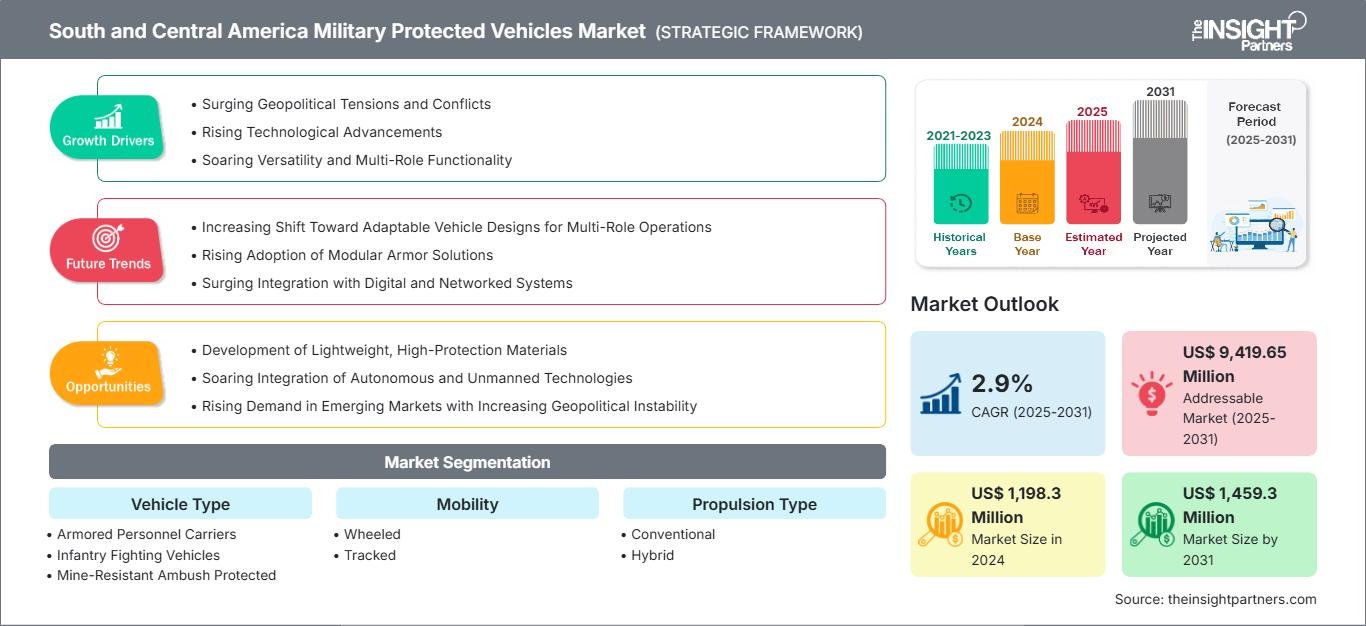
The South and Central America Military Protected Vehicles Market size is expected to reach US$ 1,459.3 Million by 2031 from US$ 1,198.3 Million in 2024. The market is estimated to record a CAGR of 2.9% from 2025 to 2031.
Executive Summary and South and Central America Military Protected Vehicles Market Analysis:
The region of South America and Central America, led by countries such as Brazil, Argentina, and Chile, is actively modernizing its military fleets with a focus on replacing aging equipment and enhancing operational capabilities. Such modernization efforts are driven by territorial disputes, internal security challenges, and a growing need for robust defense infrastructure to safeguard national interests.
There is an increasing allocation of defense budgets toward military land vehicles, particularly armored and multi-role protected vehicles. Brazil stands out with the largest defense budget in South America, complemented by significant domestic defense manufacturing capabilities that support indigenous development of armored personnel carriers and infantry fighting vehicles. Chile prioritizes advanced procurement and domestic production, while Argentina continues to operate a diverse but more budget-constrained fleet.
Advancements in technology, such as lightweight composite armor, integrated weapon systems, enhanced mobility solutions, and smart vehicle automation, enhance battlefield survivability and align with the evolving threat landscapes characterized by asymmetric warfare and geopolitical tensions in the region. Strategic government collaborations, international partnerships, and supportive regulatory frameworks create a conducive environment for the adoption of modern military-protected vehicles. The ongoing demand for hardened mobility platforms capable of withstanding complex threat scenarios, including ambushes and improvised explosive devices, creates a sustained need for MRAP vehicles and other specialized armored solutions. Regional security dynamics, including cross-border conflicts and internal insurgencies, make the modernization of military fleets a strategic imperative.
Overall, the region reflects moderate but steady growth, driven by growing defense modernization, technology adoption, regional security concerns, and a commitment toward enhancing military operational readiness through improved protected vehicle fleets.
● REPORT CUSTOMIZATION
Tailor This Report To Align With Your Specific Business Requirements
This report can be customized to align precisely with your business objectives, scope, and target markets. Customization options include tailored segmentation, geography, competitive analysis, and strategic insights to support informed decision-making.
Customize This Report →WHAT YOU CAN ADJUST
- ● Segmentations
- ● Geography
- ● Competitive Analysis
- ● Language Preferences
South & Central America Military Protected Vehicles Market: Strategic Insights
-
Get Top Key Market Trends of this report.This FREE sample will include data analysis, ranging from market trends to estimates and forecasts.
South and Central America Military Protected Vehicles Market Segmentation Analysis:
- By Vehicle Type, the South and Central America Military Protected Vehicles Market is segmented into Armored Personnel Carriers, Infantry Fighting Vehicles, Mine-Resistant Ambush Protected (MRAP) vehicles, Main Battle Tanks, Light Protected Vehicles, and Others. The Infantry Fighting Vehicles segment dominated the market in 2024.
- By Mobility, the South and Central America Military Protected Vehicles Market is segmented into Wheeled and Tracked. The Wheeled segment dominated the market in 2024.
- By Propulsion Type, the South and Central America Military Protected Vehicles Market is segmented into Conventional and Hybrid. The Conventional segment dominated the market in 2024.
- By Onboard Weapon System, the South and Central America Military Protected Vehicles Market is segmented into Machine Guns, Missiles, and Others. The Machine Guns segment dominated the market in 2024.
- By Protection Level, the South and Central America Military Protected Vehicles Market is segmented into Ballistic Protection, Mine or IED Protection, and Chemical and Biological Warfare Protection. The Ballistic Protection segment dominated the market in 2024.
- By Operation, the South and Central America Military Protected Vehicles Market is segmented into Non-Amphibious Vehicles and Amphibious Vehicles. The Non-Amphibious Vehicles segment dominated the market in 2024.
South & Central America Military Protected Vehicles Market Report Scope
| Report Attribute | Details |
|---|---|
| Market size in 2024 | US$ 1,198.3 Million |
| Market Size by 2031 | US$ 1,459.3 Million |
| CAGR (2025 - 2031) | 2.9% |
| Historical Data | 2021-2023 |
| Forecast period | 2025-2031 |
| Segments Covered |
By Vehicle Type
|
| Regions and Countries Covered |
South and Central America
|
| Market leaders and key company profiles |
|
South & Central America Military Protected Vehicles Market Players Density: Understanding Its Impact on Business Dynamics
The South & Central America Military Protected Vehicles Market is growing rapidly, driven by increasing end-user demand due to factors such as evolving consumer preferences, technological advancements, and greater awareness of the product's benefits. As demand rises, businesses are expanding their offerings, innovating to meet consumer needs, and capitalizing on emerging trends, which further fuels market growth.
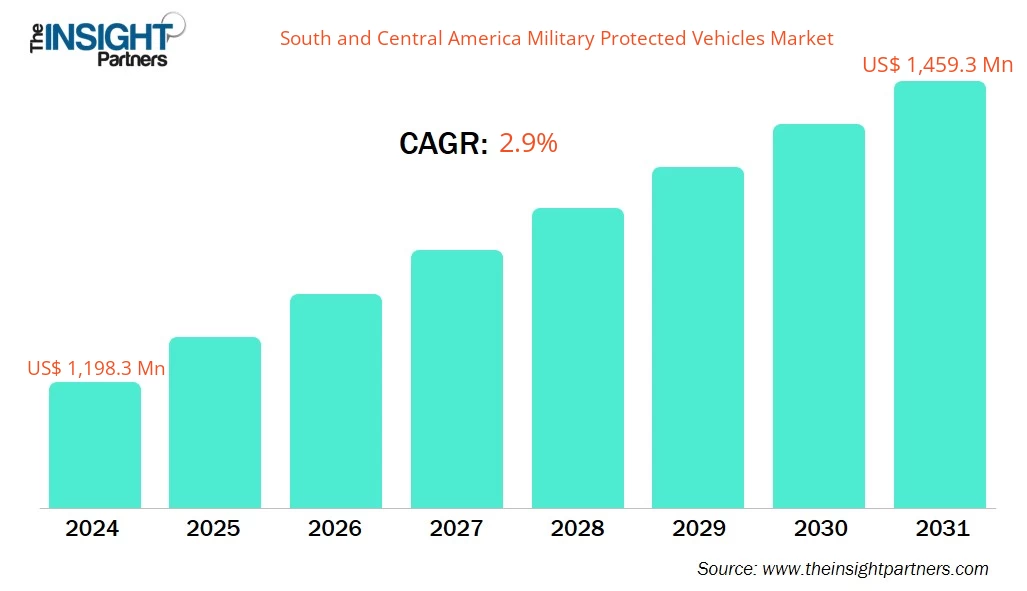
South and Central America Military Protected Vehicles Market Outlook
Modern armed forces are increasingly striving to enhance mobility, efficiency, and adaptability on the battlefield. Traditional armor materials, while providing strong protection, add significant weight to vehicles, limiting their speed, range, and maneuverability. The development of advanced materials such as composite armors, nano-engineered metals, ceramics, and hybrid laminates offers a solution to this challenge by achieving high levels of ballistic and blast protection while reducing vehicle weight.
Lightweight protection technologies enable military vehicles to operate effectively across a broader range of terrains and missions, including reconnaissance, rapid deployment, and urban warfare. Likewise, enhanced mobility improves survivability and enables forces to react more quickly to changing combat conditions. Reduced vehicle weight translates to lower fuel consumption and maintenance costs, thereby improving operational efficiency and extending the vehicle's lifespan. The integration of lightweight, high-protection materials facilitates better payload management, allowing the addition of new communication and weapon systems without compromising performance or safety.
The shift toward lightweight yet robust protection technologies is opening a new window of opportunity for manufacturers and defense contractors. Defense companies worldwide, investing in research and development of next-generation armor systems, will gain a competitive edge as defense agencies prioritize agility and performance over sheer mass. Nations modernizing their defense fleets are expected to favor platforms incorporating these materials, creating demand across new production and upgrade programs. This trend encourages collaborations between the defense and materials science sectors, leading to technological convergence that accelerates innovation. The development of lightweight, high-protection materials is likely to create new opportunities for the market in the upcoming years.
South and Central America Military Protected Vehicles Market Country Insights
By country, the South and Central America Military Protected Vehicles Market is segmented into Brazil, Argentina, and the Rest of South and Central America. The Rest of South and Central America held the largest share in 2024.
Chile, Colombia, Peru, Ecuador, Venezuela, Bolivia, Paraguay, Uruguay, Guatemala, Honduras, El Salvador, Nicaragua, Costa Rica, and Panama are among the countries contributing to the military protected vehicles market in the Rest of South and Central America. The market in the Rest of South and Central America is characterized by moderate growth driven by heightened geopolitical tensions, internal security challenges, and increasing defense budgets. Countries such as Chile and Colombia are actively modernizing their armed forces, emphasizing procurement of advanced military protected vehicles to enhance troop mobility and protection in diverse terrains and conflict scenarios. The market growth in the Rest of South and Central America is underpinned by increased defense spending, government initiatives to upgrade military infrastructure, and rising demand for versatile and technologically advanced vehicles capable of countering asymmetric warfare and insurgency threats.
Prominent defense contractors and vehicle manufacturers within the region are engaging in strategic partnerships, localized production, and technology transfer agreements to expand their footprint, thereby boosting market growth and fostering regional self-reliance and capability enhancement.
South and Central America Military Protected Vehicles Market Company Profiles
Some of the key players operating in the market include BAE Systems Plc, General Dynamics Corp, Lockheed Martin Corp, Mahindra & Mahindra Ltd, Singapore Technologies Engineering Ltd, Otokar Otomotiv ve Savunma Sanayi A.Ş., Oshkosh Corp, Iveco Group NV, Patria Group, Paramount Group, BMC Automotive Industry and Trade Inc, ND Defense LLC, NIMR Automotive, Nurol Makina, Inguar Defence, Tata Advanced Systems Limited, Lenco Industries, Inc, Roshel Inc.
These players are adopting various strategies such as expansion, product innovation, and mergers and acquisitions to provide innovative products to their consumers and increase their market share.
South and Central America Military Protected Vehicles Market Research Methodology
The following methodology has been followed for the collection and analysis of data presented in this report:
Secondary Research
The research process begins with comprehensive secondary research, utilizing internal and external sources to gather qualitative and quantitative data for each market. Commonly referenced secondary research sources include, but are not limited to:
- Company websites, annual reports, financial statements, broker analyses, and investor presentations
- Industry trade journals and other relevant publications
- Government documents, statistical databases, and market reports
- News articles, press releases, and webcasts specific to companies operating in the market
Note:
All financial data included in the Company Profiles section has been standardized to US$. For companies reporting in other currencies, figures have been converted to US$ using the relevant exchange rates for the corresponding year.Primary Research
The Insight Partners conducts a significant number of primary interviews each year with industry stakeholders and experts to validate its data analysis and gain valuable insights. These research interviews are designed to:
- Validate and refine findings from secondary research
- Enhance the expertise and market understanding of the analysis team
- Gain insights into market size, trends, growth patterns, competitive dynamics, and future prospects
Primary research is conducted via email interactions and telephone interviews, encompassing various markets, categories, segments, and sub-segments across different regions. Participants typically include:
- Industry stakeholders: Vice Presidents, Business Development Managers, Market Intelligence Managers, and National Sales Managers
- External experts: Valuation specialists, research analysts, and key opinion leaders with industry-specific expertise

- Comprehensive Market Sizing and Forecast Analysis
- Detailed Segmentation Analysis
- In-Depth Market Dynamics Assessment
- Regional and Country-Level Insights
- Competitive Landscape and Company Benchmarking
- Strategic Business Intelligence
Recent Reports
Testimonials

The Insight Partners provided valuable market intelligence that supported our global go-to-market strategy. Their team was professional, responsive, and attentive to our feedback, providing thoughtful analysis and helpful methodological clarifications throughout the project.
Junmo Kim Chief Financial Officer (CFO), Enertech Co., Ltd.
The Insight Partners' SCADA System Market report is comprehensive, with valuable insights on current trends and future forecasts. The team was highly professional, responsive, and supportive throughout. We are very satisfied and highly recommend their services.
RAN KEDEM Partner, Reali Technologies LTDs
I requested a report on a very specific software market and the team produced the report in a few days. The information was very relevant and well presented. I then requested some changes and additions to the report. The team was again very responsive and I got the final report in less than a week.
JEAN-HERVE JENN Chairman, Future Analytica
We worked with The Insight Partners for an important market study and forecast. They gave us clear insights into opportunities and risks, which helped shape our plans. Their research was easy to use and based on solid data. It helped us make smart, confident decisions. We highly recommend them.
PIYUSH NAGPAL Sr. Vice President, High Beam Global
The Insight Partners delivered insightful, well-structured market research with strong domain expertise. Their team was professional and responsive throughout. The user-friendly website made accessing industry reports seamless. We highly recommend them for reliable, high-quality research services
YUKIHIKO ADACHI CEO, Deep Blue, LLC.
This is the first time I have purchased a market report from The Insight Partners.While I was unsure at first, I visited their web site and felt more comfortable to take the risk and purchase a market report.I am completely satisfied with the quality of the report and customer service. I had several questions and comments with the initial report, but after a couple of dialogs over email with their analyst I believe I have a report that I can use as input to our strategic planning process.Thank you so much for taking the extra time and making this a positive experience.I will definitely recommend your service to others and you will be my first call when we need further market data.
JOHN SUZUKI President and Chief Executive Officer, Board Director, BK Technologies
I wish to appreciate your support and the professionalism you displayed in the course of attending to my request for information regarding to infectious disease IVD market in Nigeria. I appreciate your patience, your guidance, and the fact that you were willing to offer a discount, which eventually made it possible for us to close a deal. I look forward to engaging The Insight Partners in the future, all thanks to the impression you have created in me as a result of this first encounter.
DR CHIJIOKE ONYIA MANAGING DIRECTOR, PineCrest Healthcare Ltd.Reason to Buy
- Informed Decision-Making
- Understanding Market Dynamics
- Competitive Analysis
- Identifying Emerging Markets
- Customer Insights
- Market Forecasts
- Risk Mitigation
- Boosting Operational Efficiency
- Strategic Planning
- Investment Justification
- Tracking Industry Innovations
- Aligning with Regulatory Trends





 Get Free Sample for