
Submarine Sensor Market Growth, Trends & Demand by 2034
Coverage: By Type (Sonar, Acoustic, Fiber Optic, Electromagnetic); Submarine Type (Nuclear-Powered Attack submarine (SSN), Ballistic Missile Submarines (SSBN), Diesel Electric Submarine (SSK)); Application (Marine Environmental Monitoring, Underwater species protection, Oil Resources Detection, Underwater Communication, Others), and Geography (North America, Europe, Asia Pacific, and South and Central America)
- Status : Data Released
- Report Code : TIPRE00003381
- Category : Electronics and Semiconductor
- No. of Pages : 150
- Available Report Formats :


- Last update date : October 30, 2026


2025 Market Size
US$ 312.53 Mn
Base year value
2034 Forecast
US$ 492.37 Mn
Projected by 2034
CAGR 2026-2034
5.18 %
Growth rate
Addressable Market
US$ 3,651.62 Mn
(2026-2034)
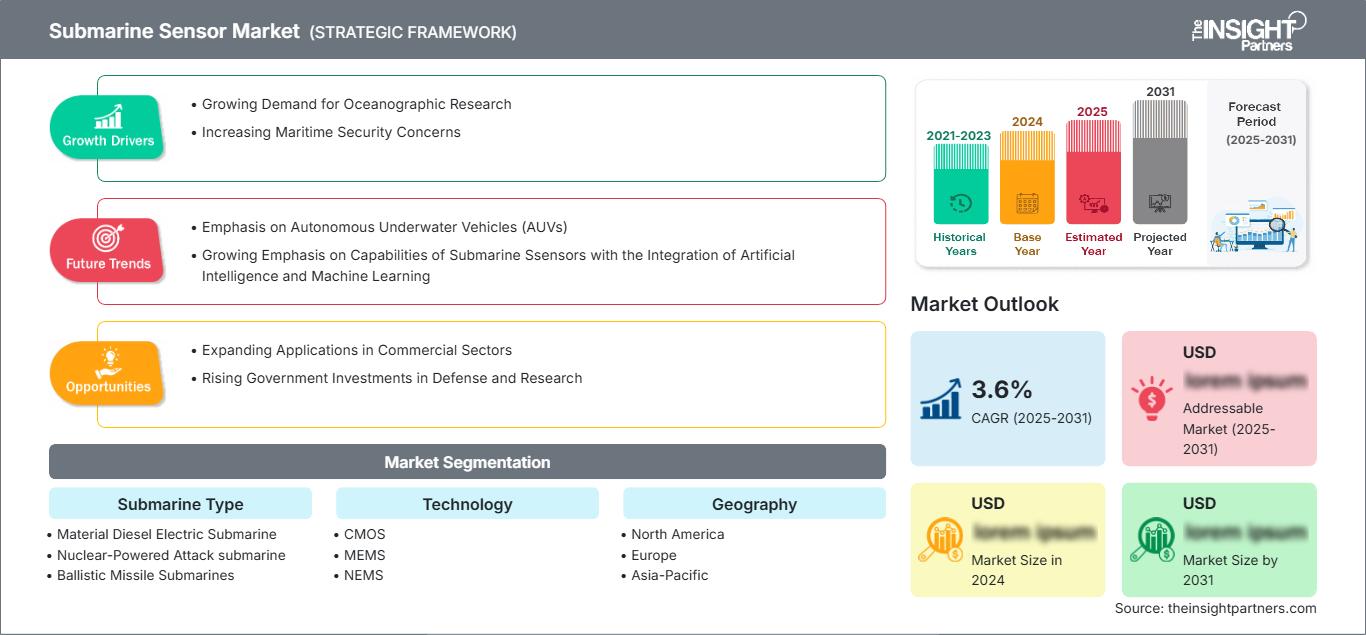
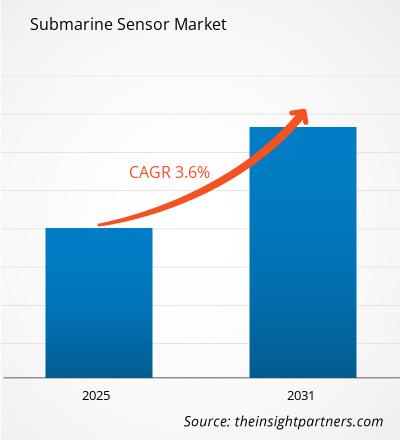
The Submarine Sensors Market was valued at US$ 312.53 Million in 2025 and is projected to reach US$ 492.37 Million by 2034, expanding at a 5.18% CAGR during 2026–2034. The market encompasses sensing technologies integrated into submarines to support underwater detection, navigation, situational awareness, environmental assessment, communication, and mission operations. Demand is shaped by submarine modernization programs, sensor replacement cycles, increasing integration of digital systems, and the need for accurate operation in GNSS-denied underwater environments.
North America remains an important demand center, supported by sustained submarine modernization, naval procurement, advanced underwater warfare programs, and domestic development of high-performance sensing and navigation technologies. The Submarine Sensors Market size is also influenced by replacement of legacy sensing architectures with digitally integrated systems, increasing use of autonomous and unmanned underwater platforms, and investment in signal processing and sensor fusion. These factors support a modeled regional CAGR of ~4% through 2034.
Submarine Sensor Market Assessment and Insights
Regional Outlook
- North America: ~29% of the global Submarine Sensors Market share in 2025 | ~4% CAGR through 2034. Market position: North America maintains a major position because of established submarine fleets, advanced naval electronics capabilities, replacement of legacy sensors, and sustained investment in undersea surveillance, navigation, acoustic processing, and integrated combat systems.
- US: ~80% of North American market revenue in 2025 | ~4% CAGR through 2034. Market position: The US represents the principal North American demand center, supported by submarine modernization, advanced sonar development, inertial navigation requirements, sensor processing, and integration of increasingly networked underwater mission systems.
- Europe: ~28% of the global market in 2025 | ~4% CAGR through 2034. Market position: Europe has a mature submarine industrial base, with Germany leading the regional market, followed by established capabilities in the UK, France, Italy, and Spain. Modernization and export-oriented submarine programs sustain sensor demand.
- Asia Pacific: ~34% of the global market in 2025 | ~6% CAGR through 2034. Market position: Asia Pacific is the fastest-growing region, supported by submarine fleet modernization and indigenous naval technology programs. China represents the leading country in Asia Pacific, while Japan, South Korea, India, and Australia contribute to expanding demand.
Segment Outlook
- CMOS: ~45% Share in 2025 | ~5% CAGR through 2034. Market position: CMOS represents the largest technology segment because compact semiconductor architectures can support optical, imaging, monitoring, and electronic sensing functions while enabling lower power consumption and increasingly integrated processing capabilities.
- MEMS: ~30% Share in 2025 | ~6% CAGR through 2034. Market position: MEMS has the higher growth profile as miniaturized inertial, pressure, acoustic, and motion-sensing architectures gain relevance in space-constrained platforms and distributed sensor configurations requiring lower size, weight, and power.
Competitive Coverage
Atlas Elektronik, DRS Technologies, Ducommun Incorporated, Harris Corporation, L3 KEO, Lockheed Martin, Northrop Grumman, Raytheon Company, Safran Electronics and Defense, Thales Group
Methodology
The Insight Partners follows Data Collection & Secondary Research, Primary Research, Data Analysis, and Data Triangulation & Final Review to validate market estimates and insights.
Source: The Insight Partners' analysis based on proprietary research, government publications, company annual reports, investor presentations, industry databases, and expert interviews.
Submarine sensors have developed over time from standalone devices to integrated systems that integrate acoustic, inertial, optical, electromagnetic, environmental, and navigation sensors. Sonar still plays an important role in underwater sensing. At present, more sophisticated platforms are being built by integrating several sensors through digital systems and combat management architecture. Sensor design has been advancing in terms of modularity, signal processing, miniaturization, and reduced power requirements. This is particularly the case as submarines become more sophisticated in their ability to endure longer times underwater.
In the future, investments will be geared toward sensor fusion, autonomous operation, miniature sensing devices, inertial navigation, and sensors that are adaptable to underwater network operations. Growing demand from the Asia Pacific region could serve as a catalyst for further procurements alongside existing demand from North America and Europe. Requirements for sovereignty-based defense manufacturing, supply chain reliability, and local technology development may also contribute to the localization of sensing technologies.
Submarine Sensor Market Report Scope
| Report Attribute | Details |
|---|---|
| Market size in 2025 | US$ 312.53 Million |
| Market Size by 2034 | US$ 492.37 Million |
| Global CAGR (2026 - 2034) | 5.18% |
| Historical Data | 2021-2024 |
| Forecast period | 2026-2034 |
Submarine Sensor Market Analysis
Submarine Sensor Market demand is closely tied to submarine build, modernization, midlife upgrade, and replacement of old electronics systems. The Value Chain involves sensor component makers, semiconductor and microelectronics manufacturers, sonar and navigation system designers, submarine platforms integrators, naval shipyards, and defense organizations. While acoustic sensing still holds strategic importance, inertial, environmental, optical, and electromagnetic sensing increase the technological range available to the market. Submarine Sensors Market growth is driven not only by new submarines being built, but also by the possibilities for retrofitting old fleets and growing complexity of submarine sensor architecture.
Supply considerations are affected by high qualification criteria, special production capabilities, defense reliability requirements, and long development cycles. Companies able to supply sensing hardware with signal processing, data fusion, software, and platform integration are more likely to gain access to subsystem level programs. Component suppliers continue playing a vital role in applications when miniature electronics, MEMS sensors, semiconductors, and special transducers are needed. Long qualification processes hinder fast switching of suppliers making relationships between defense primes, sensor makers, and navies relatively stable.
The competitive landscape comprises diversified defense product companies and specialized maritime electronics product firms. Atlas Elektronik provides sonar, sensor integration, and underwater combat system services, while Lockheed Martin and Northrop Grumman supply advanced undersea sensing and signal processing solutions. Thales is highly proficient in naval sonar technology, while Safran specializes in inertial navigation systems of submarines. DRS Technologies, Ducommun, Harris Corporation, L3 KEO, and Raytheon offer supplementary electronics, sensing, navigation, or defense systems solutions.
Investment emphasis shifts toward integration over sensing elements. The suppliers are marketing their products by means of open architecture, modularity, interoperability, digital processing, and lifecycle considerations. This opens up prospects for those businesses which are able to integrate hardware and software and satisfy qualification needs of the defense market. Consequently, Submarine Sensors Market analysis suggests that competitive advantage will become more dependent on sensor accuracy, processing, compatibility, reliability, upgradeability, and lifecycle sustainability.
● REPORT CUSTOMIZATION
Tailor This Report To Align With Your Specific Business Requirements
This report can be customized to align precisely with your business objectives, scope, and target markets. Customization options include tailored segmentation, geography, competitive analysis, and strategic insights to support informed decision-making.
Customize This Report →WHAT YOU CAN ADJUST
- ● Segmentations
- ● Geography
- ● Competitive Analysis
- ● Language Preferences
Submarine Sensor Market: Strategic Insights
Regional Insights
North America Submarine Sensors Market
North America accounted for a modeled ~29% of the global market in 2025 and is expected to expand at a ~4% CAGR through 2034. The region benefits from a mature defense electronics ecosystem, established submarine programs, specialized sonar development, and continuous modernization of underwater platforms. Demand is supported by replacement of legacy sensing equipment and integration of advanced acoustic, inertial, optical, and electronic sensing technologies.
The US is the key demand driver in the region. The procurement programs place more importance on integration of sensors, better awareness under water, autonomy and interoperability with distributed systems under water. Canada also has longer-term possibilities through upgrading its maritime surveillance and underwater capabilities in the Arctic region. Demand in the region, thus, is evenly divided between new high-end platforms and upgrades to existing navy platforms.
U.S. Submarine Sensors Market
The US represented approximately ~80% of North American market revenue in 2025 and is projected to record a ~4% CAGR through 2034. The large ecosystem of submarines in the country facilitates demand in sonar, navigation, electronic sensors, signal processing, and integration into the combat system. The procurement focus is not only on the single sensor but on the architecture that will enable processing and integration of data from different sources.
Lockheed Martin, Northrop Grumman, Raytheon, DRS Technologies, Harris Corporation, and L3 KEO provide their expertise to the larger ecosystem of undersea electronics in the US. Application demand includes attack submarines, strategic vehicles, unmanned underwater vehicles, and other navy infrastructure. Focus on undersea awareness and autonomous vehicles opens avenues for advanced sensing technology.
Europe Submarine Sensors Market
Europe represented a modeled ~28% of the global market in 2025 and is expected to expand at a ~4% CAGR through 2034. The leader among European countries is Germany due to the conventional-submarine manufacturing infrastructure and the maritime electronics industry in the country. The UK and France possess considerable submarine capabilities, while Italy and Spain make their contribution to submarine demand in Europe with help of naval shipbuilding and modernization.
The German position is underpinned by the submarine system integration and sonar capability with technologies of Atlas Elektronik. The UK demand is generated by the modernization of submarine capabilities in the Royal Navy and demand for underwater defensive systems. France has both nuclear-submarine demand and naval electronics development resulting in the demand for sensor and navigation systems.
Italy and Spain contribute to the demand for submarine construction and fleet support as well as naval modernization. The European procurement is more oriented now on such factors as interoperability, lifecycle support, sensor integration, and technology sovereignty. It stimulates manufacturers to produce modular products for several platforms at the same time and satisfy national qualification requirements. Export opportunities can influence European manufacturers in particular cases when submarine platforms are supplied with local sensor suites.
APAC Submarine Sensors Market
Asia Pacific represented a modeled ~34% of the global market in 2025 and is expected to record a ~6% CAGR, making it the fastest-growing regional market. China is the leading country in Asia Pacific, supported by its large naval modernization program and expanding indigenous submarine technology base. Japan and South Korea maintain sophisticated submarine fleets, while India and Australia are strengthening underwater capabilities.
Demand extends across sonar, inertial navigation, environmental sensing, communications-related sensing, and integrated combat systems. Japan and South Korea emphasize advanced conventional submarines, India continues to develop indigenous naval capabilities, and Australia is pursuing long-term undersea modernization. These programs support demand for both platform-specific sensors and components that can be integrated into broader national defense electronics ecosystems.
Middle East & Africa Submarine Sensors Market
The Middle East & Africa market is expected to expand at a modeled ~5% CAGR through 2034. Demand is concentrated around countries maintaining submarine or advanced maritime-security capabilities, while investment in coastal surveillance and underwater awareness creates adjacent opportunities. Saudi Arabia and the UAE provide important defense-electronics demand through broader maritime security investments.
South Africa represents an established regional submarine operator and contributes to demand for submarine support, sensor maintenance, and underwater systems. Rest of MEA demand is more fragmented and depends on procurement cycles, fleet modernization, maritime-security priorities, and infrastructure investment. Sensor suppliers with strong integration and lifecycle-support capabilities can benefit where customers prefer complete system solutions rather than individual components.
Segmentation Analysis
Submarine Type
The Submarine Type segment is projected to expand at a ~5% CAGR during 2026–2034. Demand varies by propulsion architecture because diesel-electric, nuclear-powered attack, and ballistic missile submarines have different endurance, mission, size, acoustic, navigation, and survivability requirements. These differences directly influence sensor quantity, sophistication, redundancy, and integration requirements. The Submarine Sensors Market scope consequently includes sensing requirements across both conventional and nuclear-powered submarine architectures.
- Material Diesel Electric Submarine: Conventional submarines require acoustic, navigation, environmental, and platform-monitoring sensors optimized for long-duration submerged operations. Demand is supported by fleet modernization and adoption of air-independent propulsion architectures in several naval programs.
- Nuclear-Powered Attack submarine: Nuclear-powered attack submarines require sophisticated acoustic detection, inertial navigation, environmental monitoring, and integrated combat sensing. Their extended operational endurance increases the importance of high reliability, redundancy, signal processing, and continuous sensor availability.
- Ballistic Missile Submarines: Ballistic missile submarines place strong emphasis on stealth, navigation accuracy, environmental awareness, and secure mission operation. Their strategic role supports demand for highly reliable sensor architectures with strict performance, integration, and lifecycle requirements.
Technology
The Technology segment is projected to expand at a ~5% CAGR through 2034. Technology selection is increasingly influenced by miniaturization, power efficiency, reliability, processing capability, and the ability to integrate sensors into digital architectures. CMOS remains important for semiconductor-based sensing and imaging functions, while MEMS technologies support compact motion, inertial, pressure, and environmental sensing. NEMS offers longer-term potential where extreme miniaturization is technically and commercially viable.
- CMOS: CMOS technologies support compact semiconductor-based sensing and processing architectures and can enable integration of sensing, electronics, and signal-processing functions. Their scalability and established semiconductor ecosystem make them important across multiple sensor applications.
- MEMS: MEMS devices are strategically relevant where low size, weight, and power are priorities. Their applicability to inertial, pressure, vibration, and other sensing functions supports integration into distributed and compact submarine electronics.
- NEMS: NEMS technologies offer further miniaturization potential for highly sensitive sensing applications. Adoption depends on qualification maturity, manufacturing scalability, environmental robustness, and the ability to demonstrate advantages over established sensor architectures.
- Others: The broader technology landscape includes specialized sensing architectures that complement semiconductor-based technologies in acoustic, optical, electromagnetic, environmental, and mission-specific applications.
Opportunity Snapshot
| Technology | Revenue Contribution | Trend Tag | Adoption Stage |
|---|---|---|---|
| CMOS | High | Sensor Integration | Mature |
| MEMS | Medium | Miniaturized Sensing | Scaling |
| NEMS | Low | Nano Sensing | Emerging |
| Others | Medium | Specialized Detection | Scaling |
Submarine Sensor Market Growth Drivers and Impact Analysis
Expansion of Submarine Modernization Programs
Submarine modernization is a fundamental demand driver because sensors are among the core electronics systems requiring periodic upgrades as platforms receive new combat-management, navigation, communications, and surveillance capabilities. Modernization can involve complete replacement of legacy sensor suites or incremental upgrades to processing units, inertial systems, sonar components, and environmental sensors. The impact extends beyond newly constructed submarines because established fleets can generate recurring retrofit requirements during mid-life upgrades and maintenance cycles. As naval operators seek longer service lives from expensive platforms, sensor suppliers can benefit from demand for higher accuracy, improved reliability, digital interfaces, and compatibility with newer architectures. Modernization also creates opportunities for suppliers offering modular systems that can be installed without extensive platform redesign.
Growing Demand for Underwater Situational Awareness
Underwater operations require reliable information about acoustic contacts, navigation position, environmental conditions, and potential threats because satellite navigation signals cannot directly support submerged operations. This increases the importance of autonomous navigation, acoustic sensing, environmental monitoring, and integrated sensor processing. Modern submarine architectures increasingly require information from multiple sensor sources to be combined into a coherent operational picture. The resulting demand favors suppliers capable of improving detection quality while reducing false contacts, power consumption, and operator workload. Greater use of autonomous underwater vehicles and distributed maritime sensing can further expand the need for compact, interoperable sensor technologies. For manufacturers, this shifts competition from individual sensor performance toward system-level accuracy, data integration, reliability, and software-enabled interpretation.
Advancement of Miniaturized and Digital Sensor Technologies
Miniaturization is enabling more sensing functions to be incorporated into constrained submarine platforms without proportionally increasing size, weight, or power consumption. MEMS-based technologies are particularly relevant to inertial and environmental sensing, while semiconductor advances support increasingly integrated electronics and processing. Digital architectures can also simplify the connection of multiple sensors to centralized or distributed processing systems. The market impact is significant because smaller sensor modules can provide greater design flexibility for submarine integrators and enable additional sensing points across a platform. Digital processing also supports more sophisticated filtering, classification, fusion, and anomaly detection. Suppliers that successfully combine compact hardware with reliable processing and robust underwater qualification can therefore address both new-build and modernization requirements.
Submarine Sensor Market Future Trends
AI-Enabled Sensor Fusion and Autonomous Interpretation
AI-enabled processing is expected to increasingly influence submarine sensing by allowing large volumes of acoustic and non-acoustic information to be processed more rapidly. Instead of relying exclusively on manual interpretation, future architectures can use machine-learning models to identify patterns, classify contacts, prioritize information, and assist operators in complex environments. The Submarine Sensors Market trends are therefore moving toward sensor fusion rather than isolated sensor operation. This development can improve the usefulness of existing hardware because better algorithms can extract additional information from available signals. However, deployment in defense environments will require extensive validation, cybersecurity controls, explainability, and reliable performance under changing acoustic and environmental conditions. The trend is likely to favor suppliers combining sensing hardware, processing technologies, software, and platform integration expertise.
Greater Use of Compact and Distributed Sensor Architectures
Future submarine platforms are likely to place greater emphasis on distributed sensing and compact sensor modules. Instead of concentrating every function in a limited number of large systems, platform designers can distribute sensing functions across multiple locations and connect them through digital architectures. This approach can improve redundancy, provide broader coverage, and support modular upgrades. MEMS and advanced semiconductor technologies are well suited to this direction because they can deliver compact sensing functions with comparatively low power requirements. Distributed architectures may also facilitate integration with unmanned underwater vehicles and external maritime sensing networks. The resulting technology direction creates opportunities for suppliers that can provide standardized interfaces, robust underwater packaging, cybersecurity, and reliable synchronization across multiple sensing nodes.
Submarine Sensor Market Opportunities
Localization of Underwater Electronics Supply Chains
Defense procurement authorities are increasingly interested in resilient domestic supply chains for strategically important electronics. Submarine sensors are particularly sensitive to supply-chain requirements because qualification, reliability, cybersecurity, and lifecycle support are critical to naval programs. This creates opportunities for sensor manufacturers and component suppliers that can establish local production, engineering, testing, and maintenance capabilities in countries pursuing indigenous submarine programs. Partnerships between global technology providers and domestic defense manufacturers can provide a route to localization while retaining access to established technologies. Suppliers can also create opportunities by designing products around open architectures that allow localized integration and future component replacement without complete system redesign. Such strategies can support participation in long-duration naval programs where lifecycle availability is as important as initial procurement.
Integration of Sensors Across Crewed and Uncrewed Platforms
The expansion of autonomous underwater vehicles creates a complementary opportunity for submarine sensor suppliers. Sensors originally designed for crewed submarines can potentially be adapted into smaller platforms where size, weight, power, and processing requirements are more restrictive. Acoustic, navigation, environmental, and imaging technologies can support missions including surveillance, seabed mapping, mine detection, and maritime security. The Submarine Sensors Market Forecasts therefore extend beyond traditional submarine procurement and include technology transfer into adjacent underwater platforms. Suppliers that develop scalable architectures can address several platform classes using common sensing technologies while adapting packaging, processing, and communication interfaces. This can broaden addressable demand and reduce development costs across related naval programs.
Recent Developments
- September 2026: Atlas Elektronik — TKMS ATLAS UK was awarded a UK Ministry of Defence development and supply contract for the Next Generation Countermeasure capability for Royal Navy submarines. The program is intended to provide an adaptable next-generation torpedo-defense capability and supports continued development of underwater defensive systems.
- August 2026: Lockheed Martin — Lockheed Martin and the US Navy demonstrated SensorMAX, an AI/ML sonar expert, during RIMPAC 2026. The system processes subsurface acoustic data, supports rapid threat detection, and includes an over-the-air model update capability, illustrating the increasing role of software and machine learning in underwater sensing.
- August 2026: Raytheon Company — Raytheon and Composite Energy Technologies demonstrated the HADALUS unmanned underwater vehicle during a US Navy exercise. The system integrates sonar and electronics with an autonomous undersea platform, demonstrating the expanding relationship between sensing technologies and long-endurance unmanned underwater operations.
Frequently Asked Questions

- Comprehensive Market Sizing and Forecast Analysis
- Detailed Segmentation Analysis
- In-Depth Market Dynamics Assessment
- Regional and Country-Level Insights
- Competitive Landscape and Company Benchmarking
- Strategic Business Intelligence
Recent Reports
Testimonials

The Insight Partners provided valuable market intelligence that supported our global go-to-market strategy. Their team was professional, responsive, and attentive to our feedback, providing thoughtful analysis and helpful methodological clarifications throughout the project.
Junmo Kim Chief Financial Officer (CFO), Enertech Co., Ltd.
The Insight Partners' SCADA System Market report is comprehensive, with valuable insights on current trends and future forecasts. The team was highly professional, responsive, and supportive throughout. We are very satisfied and highly recommend their services.
RAN KEDEM Partner, Reali Technologies LTDs
I requested a report on a very specific software market and the team produced the report in a few days. The information was very relevant and well presented. I then requested some changes and additions to the report. The team was again very responsive and I got the final report in less than a week.
JEAN-HERVE JENN Chairman, Future Analytica
We worked with The Insight Partners for an important market study and forecast. They gave us clear insights into opportunities and risks, which helped shape our plans. Their research was easy to use and based on solid data. It helped us make smart, confident decisions. We highly recommend them.
PIYUSH NAGPAL Sr. Vice President, High Beam Global
The Insight Partners delivered insightful, well-structured market research with strong domain expertise. Their team was professional and responsive throughout. The user-friendly website made accessing industry reports seamless. We highly recommend them for reliable, high-quality research services
YUKIHIKO ADACHI CEO, Deep Blue, LLC.
This is the first time I have purchased a market report from The Insight Partners.While I was unsure at first, I visited their web site and felt more comfortable to take the risk and purchase a market report.I am completely satisfied with the quality of the report and customer service. I had several questions and comments with the initial report, but after a couple of dialogs over email with their analyst I believe I have a report that I can use as input to our strategic planning process.Thank you so much for taking the extra time and making this a positive experience.I will definitely recommend your service to others and you will be my first call when we need further market data.
JOHN SUZUKI President and Chief Executive Officer, Board Director, BK Technologies
I wish to appreciate your support and the professionalism you displayed in the course of attending to my request for information regarding to infectious disease IVD market in Nigeria. I appreciate your patience, your guidance, and the fact that you were willing to offer a discount, which eventually made it possible for us to close a deal. I look forward to engaging The Insight Partners in the future, all thanks to the impression you have created in me as a result of this first encounter.
DR CHIJIOKE ONYIA MANAGING DIRECTOR, PineCrest Healthcare Ltd.Reason to Buy
- Informed Decision-Making
- Understanding Market Dynamics
- Competitive Analysis
- Identifying Emerging Markets
- Customer Insights
- Market Forecasts
- Risk Mitigation
- Boosting Operational Efficiency
- Strategic Planning
- Investment Justification
- Tracking Industry Innovations
- Aligning with Regulatory Trends





 Get Free Sample for