
Surgical Catheters Market Demand, Trends & Forecast by 2034
Coverage: ByType (Cardiovascular Catheters, Urology Catheters, Gastrointestinal Catheters, Neurovascular Catheters, Ophthalmic Catheters); Application (Physical Examination and Diagnosis, Drug Injection, Waste Drain Out, Surgical Assistant), and Geography (North America, Europe, Asia Pacific, and South and Central America)
- Status : Data Released
- Report Code : TIPRE00021192
- Category : Life Sciences
- No. of Pages : 150
- Available Report Formats :


- Last update date : November 25, 2026


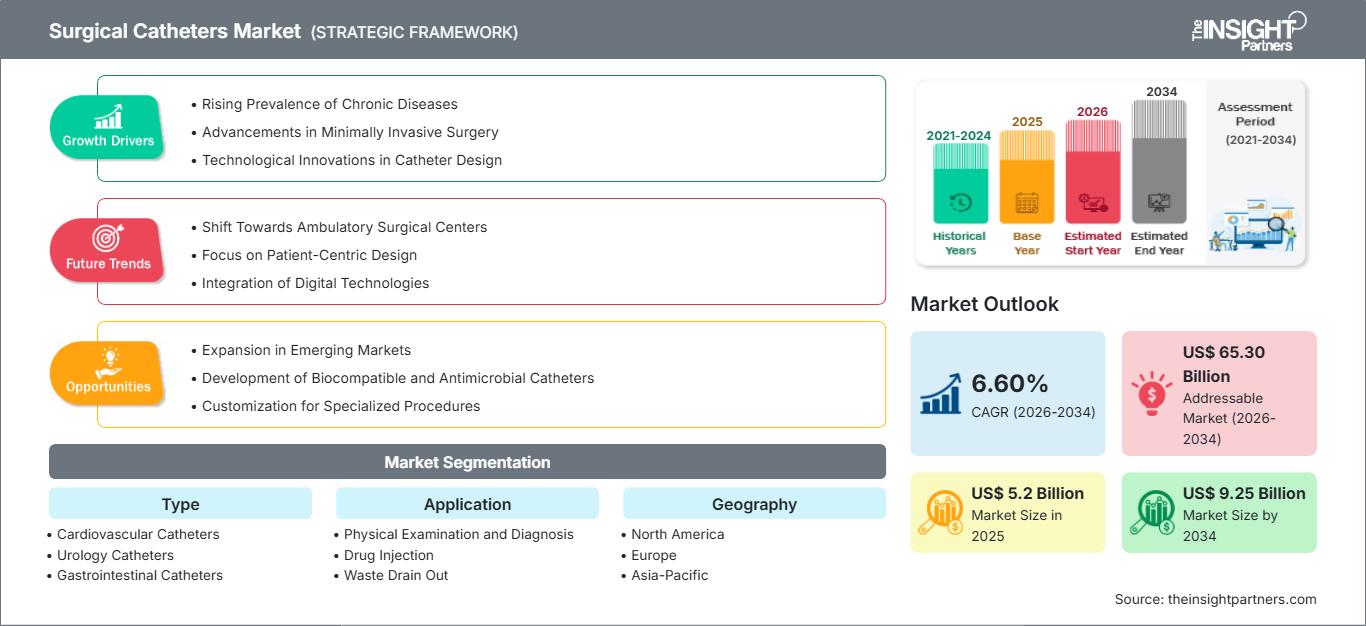
2025 Market Size
US$ 5.2 Bn
Base year value
2034 Forecast
US$ 9.25 Bn
Projected by 2034
CAGR 2026-2034
6.60 %
Growth rate
Addressable Market
US$ 65.30 Bn
(2026-2034)
The Surgical Catheters Market was valued at US$ 5.2 billion in 2025 and is expected to reach US$ 9.25 billion by 2034, registering a CAGR of 6.60% during 2026–2034. Expansion is driven by increasing surgical caseloads, increasing burdens of diseases such as cardiovascular and urological ailments, and increasing applications of minimally invasive techniques. Advances in catheter flexibility, visualization, coating, and navigation are also enhancing the safety of these procedures and allowing surgeons to handle more anatomically challenging cases.
In North America, the Surgical Catheters Market size is projected to grow at an estimated ~6% CAGR through 2034. High use of catheter-based cardiovascular, neurovascular, and urological procedures ensures high replacement rates, while modern hospital facilities drive adoption of imaging-compatible and procedure-specific devices. Approvals for systems, including mapping, ablation, aspiration, and diagnostics, also encourage hospitals to update their catheter inventories and move away from multiple-device procedures.
Surgical Catheters Market Assessment and Insights
Regional Outlook
- North America: ~39% of the global market in 2025 | ~6% CAGR through 2034. Market position: Leadership of North America can be attributed to its high procedure intensity, catheterization infrastructure, insurance cover, and early acceptance of cardiovascular and neurovascular intervention systems.
- US: ~88% of North American market revenue in 2025 | ~6% CAGR through 2034. Market position: The US holds a majority share in the regional revenue owing to its medical device innovations, purchasing power of hospitals, training facilities for specialists, and usage of catheter-based treatment and diagnosis.
- Europe: ~28% of the global market in 2025 | ~6% CAGR through 2034. Market position: Europe forms a matured market with Germany at the forefront, followed by the UK and France, due to the aging population, surgical infrastructure, and technology upgradation.
- Asia Pacific: ~24% of the global market in 2025 | ~8% CAGR through 2034. Market position: Asia-Pacific forms the fastest growing market owing to hospital growth, increasing specialty availability, production facilities, and increased intervention rates in countries like China, Japan, India, South Korea, and Australia.
Segment Outlook
- Cardiovascular Catheters: ~38% Share in 2025 | ~7% CAGR through 2034. Market position: The cardiovascular segment dominates as catheterization, structural heart interventions, electrophysiology, vascular imaging, thrombectomy, and ablation necessitate differentiated tools that are used in high procedure volume.
- Neurovascular Catheters: ~12% Share in 2025 | ~9% CAGR through 2034. Market position: Growth will be driven by more access to mechanical thrombectomy, higher-bore aspirating devices, better distal navigation, and investments in dedicated stroke centers and neurointerventional training.
Competitive Coverage
Boston Scientific Corporation, Abbott Laboratories, Johnson & Johnson, B. Braun Melsungen AG, Smiths Group plc, Cook Medical LLC, Terumo Corporation, Medtronic plc, Coloplast A/S, Edwards Lifesciences Corporation, Interplex Holdings Pte. Ltd., Sterimed Group, Q Holding Company
Methodology
The Insight Partners follows Data Collection & Secondary Research, Primary Research, Data Analysis, and Data Triangulation & Final Review to validate market estimates and insights.
Source: The Insight Partners' analysis based on proprietary research, government publications, company annual reports, investor presentations, industry databases, and expert interviews.
Catheter technology has advanced from basic drainage and access tubes to sophisticated systems that incorporate steerability, sensing, imaging capability, energy delivery, and atraumatic passage characteristics. In addition, catheter manufacturers are now making more use of reinforcement by polymers, hydrophilic coating, braiding, shape retention in the distal tip region, and smaller sizes in order to maintain the proper trade-off between torquing capabilities and flexibility. Economies of production are also being transformed as providers combine extrusion, molding, metal incorporation, coating, sterilization packaging, and validation into their processes. This will benefit producers that can control tolerances and supply procedure-specific products.
For the period 2017 through 2034, development and investment are anticipated to focus on the growth of interventional capability in the Asia-Pacific region, Latin America, and select areas of the Middle East. Increasing expectations for biocompatibility, coating, particulates, sterilization, and performance will raise development needs and raise barriers to entry but not affect the attractiveness of local manufacturing incentives, which might result in regional supplies, if clinical confidence and physician experience persist as advantages.
Surgical Catheters Market Report Scope
| Report Attribute | Details |
|---|---|
| Market size in 2025 | US$ 5.2 Billion |
| Market Size by 2034 | US$ 9.25 Billion |
| Global CAGR (2026 - 2034) | 6.60% |
| Historical Data | 2021-2024 |
| Forecast period | 2026-2034 |
Surgical Catheters Market Analysis
Catheter-based interventional demand is evolving from universal procedural compatibility to device specialization based on anatomical location, imaging technology, and therapy process. Growth in Surgical Catheters Market thus not only correlates with volume of procedures performed but also with intensity of catheters used per procedure. Complicated cardiovascular, neurovascular and gastrointestinal interventions may involve access, diagnostic, supporting, delivering, aspiration, drainage and treatment catheters all in one procedure.
The value chain includes suppliers of medical-grade resins, wires, hypotubes, sensors, electrodes, coatings and packaging, OEMs, sterilization services, distribution channels, hospitals and specialists. Sourcing reliability is determined by validated materials and qualified manufacturing processes since small variations in shaft material, coating chemistry or bonding necessitate verification. Thus, OEMs have to maintain dual sourcing and disciplined design control concurrently.
Competition involves diversification of device classes along with procedural specialization. As per Surgical Catheters Market, competition in the form of integrated interventional solutions exists among Boston Scientific Corporation, Abbott Laboratories, Johnson & Johnson, Terumo Corporation, and Medtronic plc, while Cook Medical LLC, B. Braun Melsungen AG, and Coloplast A/S remain relevant with respect to specialty access, drainage, and urology applications.
Investment strategies are evolving towards multitalented catheters, navigation systems, and manufacturing technologies that reduce time from development to scale. Specialized suppliers such as Interplex Holdings Pte. Ltd. and Q Holding Company help achieve assembly and elastomer capabilities, while Sterimed Group brings medical packaging capabilities. Increasingly, differentiation is based on workflow integration, availability, training support, and ability to turn physician feedback into controlled design evolution.
● REPORT CUSTOMIZATION
Tailor This Report To Align With Your Specific Business Requirements
This report can be customized to align precisely with your business objectives, scope, and target markets. Customization options include tailored segmentation, geography, competitive analysis, and strategic insights to support informed decision-making.
Customize This Report →WHAT YOU CAN ADJUST
- ● Segmentations
- ● Geography
- ● Competitive Analysis
- ● Language Preferences
Surgical Catheters Market: Strategic Insights
Regional Insights
North America Surgical Catheters Market
North America is projected to register an estimated ~6% CAGR through 2034. North America has comprehensive networks for cardiovascular, endovascular, urological, gastrointestinal, and stroke-care interventions that help sustain catheter consumption. Academic medical centers and high-volume community hospitals frequently review products providing better visualization, trackability, flow performance, and compatibility with existing imaging and navigation technologies.
Market share of Surgical Catheters in North America is maintained by reimbursement processes for well-documented interventions and procurement systems that can afford premium devices when workflow or outcome improvements are demonstrated. Canada provides its contribution through investments in provincial hospital networks and specialist urban centers, whereas Mexico does so through production and the growing need for private healthcare in the region. Cost pressure remains considerable, favoring contracts based on product standardization, procedures, and supply security rather than device specifications.
U.S. Surgical Catheters Market
The US accounted for approximately ~88% of North American revenue in 2025 and is projected to record an estimated ~6% CAGR through 2034. Based on a significant presence of catheterization labs, hybrid ORs, ambulatory surgical centers, stroke units, and specialized urology departments, the U.S. has strong demand. The high procedure volumes generate ongoing need for disposable products and facilitate early clinical testing of innovative catheters.
Boston Scientific Corporation, Abbott Laboratories, Johnson & Johnson, Medtronic plc, and Terumo Corporation have significant commercial and clinical development operations in the country. The adoption of products is being driven by the integrated solutions providing mapping, imaging, aspiration, and therapy, which minimize the number of device changes. Nevertheless, hospitals need to see value in procedures, especially when the use of premium devices increases the cost of equipment and inventory.
Europe Surgical Catheters Market
Europe represented approximately ~28% of global revenue in 2025 and is expected to expand at an estimated ~6% CAGR through 2034. Older demographic, universal or widespread hospitals, and existing MIS programs ensure a continuous demand for this segment. Procurement is relatively structured, and therefore clinical proof, regulatory continuity, total costs of procedures, and environmental aspects are crucial for purchasing.
Germany is the top country in Europe thanks to its hospital market, capabilities of interventional cardiology, medical devices' infrastructure, and usage of high-tech surgical equipment. The UK provides a combination of centralized procurement and developed specialist centers, while France takes advantage of its developed pathways in cardiovascular and neurovascular care. Italy adds to the demand through its regional centers of cardiology and urology, even though different geographical conditions affect procurement processes. Spain is developing catheter treatment through hospital infrastructure modernization and specialists' training.
Medical Device Regulation requirements, post-market surveillance activities, and conformity assessment capability should be provided, but product availability should also be ensured. This puts companies with well-developed clinical, quality, and regulatory activities at an advantage. Moreover, there is a trend towards increasing demand for devices with integrated diagnostic and treatment features, short procedures, and compatibility with current platforms in Europe.
APAC Surgical Catheters Market
Asia Pacific represented approximately ~24% of global revenue in 2025 and is projected to grow at an estimated ~8% CAGR through 2034, making it the fastest-growing region. Asia Pacific has China as the dominant country because of the size of the hospitals, growing capacity for intervention, localization, and indigenous catheter production.
Japan continues to maintain an advanced system of cardiovascular procedures and imaging guided intervention. South Korea is supportive of rapid uptake of technology in advanced hospitals. India provides opportunities for growth owing to the presence of private hospital chains and availability of interventional procedures. Australia adds experience and a mature system for procedures along with established reimbursement processes.
Middle East & Africa Surgical Catheters Market
The Middle East & Africa region is expected to register an estimated ~7% CAGR through 2034. The leadership position of Saudi Arabia in the Middle East and Africa is through hospital investments, specialist recruitments, and healthcare transformation initiatives. The United Arab Emirates fuels the need for catheterization solutions through sophisticated private hospitals and medical tourism, especially for cardiovascular and surgery procedures.
South Africa remains significant in the sub-Saharan region due to the presence of specialist and private healthcare facilities in addition to academic hospitals. In the rest of the MEA, adoption is hindered by the lack of catheterization facilities, trained personnel, reimbursements, and reliable supply chains. Potential markets are found in urban referral centers and hospitals and distributors.
Segmentation Analysis
By Type
The scope of the Surgical Catheters Market by types is quite diverse on the basis of anatomical differences, structure of lumens, flexibility, resistance to pressure, and procedure-related functionality. The purchase decision is based on the clinical efficiency, compatibility, and total need for a particular procedure, rather than just the cost. Neurovascular Catheters are projected to register an estimated ~9% CAGR during 2026–2034 as stroke intervention capabilities expand.
- Cardiovascular Catheters: These products provide assistance in vascular access, hemodynamic monitoring, imaging, ablation, thrombectomy, structural interventions, and device delivery. The wide range of applications and repeat purchases makes this category generate the highest amount of revenue among the types.
- Urology Catheters: The urological devices cover perioperative drainage, urinary retention management, access, irrigation, and other special procedures. The drivers include infection control procedures, elderly population, material choice, comfort of the product, and long-term care needs.
- Gastrointestinal Catheters: GI devices are used for drainage, decompression, nutritional access, diagnostics and endoscopy. The adoption is driven by kink resistance, lumen performance, precise placement and compatibility with endoscopy rooms.
- Neurovascular Catheters: These types of products require small size, distal flexibility, proximal support and precise navigation through tortuous vessels. The need for stroke thrombectomy and aneurysm management drives the growth in aspiration, support, delivery and microcatheters devices.
- Ophthalmic Catheters: The ophthalmic products are used for delicate procedures that require precise fluid delivery, drainage, access or treatment. The precision, low trauma, sterility and consistency are the main factors that drive purchases due to anatomical specifics.
Application
Purchase on an application basis shows the use of catheters during different procedures. Hospitals have standardized their preferred devices but keep special devices for complicated procedures. The need for catheters depends on how frequently a procedure is performed, infection prevention, duration of dwelling, fluid flow, and compatibility with other devices. Surgical Assistant applications are projected to expand at an estimated ~7% CAGR during 2026–2034 as minimally invasive workflows require more dependable access and delivery support.
- Physical Examination and Diagnosis: Diagnosing catheters allow measuring pressures, delivering contrasts, obtaining samples, taking images, and anatomical evaluation. Requirements for demand include intervention planning and accurate data collection prior to making any therapeutic decisions.
- Drug Injection: Such medical products allow localized or systemic administration of drugs in which precise dose administration is important. The factors that determine choice include compatibility with material, dead space, connection safety, and reliable flow.
- Waste Drain Out: Draining catheters drain blood, urine, fluid, pus, or some other accumulated substances. The requirements for adopting them include post-operative care, prevention of infections, resistance to obstructions, safe location, and applicability for temporary and prolonged use.
- Surgical Assistant: Catheters that are used as procedural tools allow gaining access, guiding, taking images, irrigation, aspiration, or delivery of another instrument. The importance of these medical devices becomes crucial as physicians conduct complicated interventions via small access sites and require less frequent exchanges of devices.
End User
The end-user requirements vary depending on the complexity of the procedure involved, the purchase process involved, the imaging devices available, and the number of specialists involved. Hospitals will be the key venue for complex interventions, while out-patient clinics require standard products that are predictable to use and quick to turnover. Ambulatory Surgical Centers are projected to register an estimated ~8% CAGR during 2026–2034 as suitable procedures migrate toward lower-cost outpatient settings.
- Hospitals: Hospitals generate the highest catheter consumption through emergency, inpatient, surgical, intensive-care, and specialist intervention services. Procurement commonly emphasizes clinical breadth, supply assurance, contracting efficiency, and compatibility with installed capital equipment.
- Ambulatory Surgical Centers: These facilities prioritize efficient setup, predictable procedure times, compact inventories, and cost control. Growth is strongest for catheter-assisted interventions that can be performed safely without prolonged postoperative monitoring.
- Specialty Clinics: Urology, cardiology, gastroenterology, ophthalmology, and vascular clinics create focused demand for procedure-specific devices. Purchasing decisions are closely tied to physician preference, patient throughput, training requirements, and distributor responsiveness.
- Other End Users: Research institutions, diagnostic centers, long-term care providers, and home-care organizations use selected catheter categories. Their requirements vary considerably according to clinical supervision, duration of use, and care-delivery model.
Opportunity Snapshot
| End Users | Revenue Contribution | Trend Tag | Adoption Stage |
| Hospitals | High | Platform Integration | Mature |
| Ambulatory Surgical Centers | Medium | Outpatient Migration | Scaling |
| Specialty Clinics | Medium | Procedure Specialization | Scaling |
| Other End Users | Low | Decentralized Care | Emerging |
Surgical Catheters Market Growth Drivers and Impact Analysis
Rising Burden of Catheter-Treatable Chronic Conditions
CVD, urological problems, stroke, GI diseases, and aging-based surgical needs make a solid foundation for catheter applications. This effect goes beyond patient development since numerous ailments require re-assessment, staging of procedures, post-operative drainage, and ongoing catheterization. Elderly patients add complexity to the procedures, prompting practitioners to employ catheters which allow making a smaller incision and facilitate fast recovery. Device suppliers will win when the pathways of disease treatments shift from purely pharmaceutical ones to more invasive procedures, but the demand is likely to be different depending on availability and reimbursement of specialists.
Expansion of Minimally Invasive and Image-Guided Procedures
Minimally invasive surgical techniques turn complicated treatment procedures into catheter-based procedures with the requirement for access, navigation, imaging, delivery, and fluid management. Compared to traditional open surgery, these techniques have the ability to offer less tissue disruption and allow for a faster recovery process. This increases the attractiveness of the procedure within the hospital setting when clinical evidence and expert experience are present. The impact in the market would be a move from basic tubular products to more sophisticated devices with the capabilities of steerability, radiopacity, reinforcement, coating, sensors, or energy delivery.
Hospital Capacity and Specialist Infrastructure Investment
Cath labs, hybrid ORs, stroke centers, endoscopy rooms, and ambulatory locations all increase the install base of surgical catheters through new build opportunities. Capital expenditures have a multiplier effect since each such room creates repeat demand for single-use, sterile products. The biggest business impact comes when these capital spending projects also incorporate the education of physicians, nurses, maintenance, and payment systems, instead of focusing on hardware purchases alone. While there is plenty of opportunity in emerging markets, fragmented supply channels and inconsistent inventories may limit the actual usage even after an installation is made.
Surgical Catheters Market Future Trends
Multifunctional Catheters Will Consolidate Procedural Steps
Market trends for Surgical Catheters tend to be shifting towards the production of devices that merge operations that have previously been carried out using different diagnostic, mapping, imaging, aspiration or treatment devices. Merging of these operations is expected to help reduce the number of exchanges, ease inventory management, and possibly reduce procedure times, even though it is expected to entail more complex engineering and proof of benefit in the workflow. Future product development in this market segment is expected to involve merging of sensing electrodes, imaging components, controlled delivery of energy, pressure measurements, and navigation within acceptable profiles.
Data-Enabled Navigation and Procedure Planning
Future systems will leverage catheter positioning, anatomical imaging, pressure, flow, electrophysiology, and delivery of therapy information to enhance procedure guidance. Catheters with navigation capabilities can be useful for documenting the treatment region, verifying positioning, and eliminating the need for repeat imaging or analysis. Such an opportunity is especially applicable in electrophysiology, structural heart interventions, neurovascular therapy, and complicated drainage. However, the adoption of such technologies is subject to conditions like interoperability, cybersecurity, usability, and evidence of how the additional information enhances decision making and does not overwhelm the clinician's capacity.
Surgical Catheters Market Opportunities
Localized Manufacturing for High-Growth Healthcare Systems
Market Forecasts for Surgical Catheters present a viable business opportunity where the manufacture can develop facilities for extrusion, assembly, packaging or final release in close proximity to the growing health care system in Asia and the Middle East. The benefits would be shortening the delivery time, meeting the requirements of public procurement policies, and developing products that are priced according to the regional market. The focus should not only be on low costs but on having a reliable supplier and coating consistency, sterility, and proper training of the workforce. Partnership with distributors or contract manufacturers would reduce risks while having clear intellectual property and regulatory controls.
Purpose-Built Products for Ambulatory Procedures
Outpatient migrations present an opening to rethink catheter kits based on fast deployment, standardization, small inventory footprint, and reliable discharge. Outpatient surgical centers require reliable equipment not saddled with the complexities and economics of tertiary hospital solutions. Suppliers can deliver on this by developing procedure-specific designs, compact packaging, simpler connections, and instructional materials suited to lean healthcare teams. Opportunities within Surgical Catheters Market in this context will be best realized in situations where there is a payor basis for doing outpatient surgery and complications are handled by defined escalation routes.
Recent Developments
- December 2025: Medtronic plc announced the first commercial use of the Liberant thrombectomy system for removing fresh, soft emboli or thrombi from peripheral arteries and veins. The platform combines aspiration catheters with an adaptive pulse-rate algorithm, ultrasonic blood-flow measurement, and blood-conservation features. Available catheter sizes broaden its applicability across arterial, venous, and arteriovenous procedures.
- November 2025: Boston Scientific Corporation received CE marking for the FARAPOINT Pulsed Field Ablation Catheter for right atrial flutter treatment. The catheter provides focal and linear cavotricuspid isthmus ablation and expands the FARAPULSE platform beyond atrial fibrillation applications. Supporting clinical data showed the product’s ability to create controlled lesions while maintaining safety around adjacent cardiac tissue.
- October 2025: Terumo Interventional Systems received US FDA 510(k) clearance for the OPUSWAVE Dual Sensor Imaging System and DualView Imaging Catheter. The system combines optical frequency domain imaging and intravascular ultrasound through one catheter, enabling simultaneous coronary assessment. The catheter provides a 150 mm maximum pullback length, 2.6 Fr imaging profile, and compatibility with 6 Fr guides.
Frequently Asked Questions

- Comprehensive Market Sizing and Forecast Analysis
- Detailed Segmentation Analysis
- In-Depth Market Dynamics Assessment
- Regional and Country-Level Insights
- Competitive Landscape and Company Benchmarking
- Strategic Business Intelligence
Recent Reports
Testimonials

The Insight Partners provided valuable market intelligence that supported our global go-to-market strategy. Their team was professional, responsive, and attentive to our feedback, providing thoughtful analysis and helpful methodological clarifications throughout the project.
Junmo Kim Chief Financial Officer (CFO), Enertech Co., Ltd.
The Insight Partners' SCADA System Market report is comprehensive, with valuable insights on current trends and future forecasts. The team was highly professional, responsive, and supportive throughout. We are very satisfied and highly recommend their services.
RAN KEDEM Partner, Reali Technologies LTDs
I requested a report on a very specific software market and the team produced the report in a few days. The information was very relevant and well presented. I then requested some changes and additions to the report. The team was again very responsive and I got the final report in less than a week.
JEAN-HERVE JENN Chairman, Future Analytica
We worked with The Insight Partners for an important market study and forecast. They gave us clear insights into opportunities and risks, which helped shape our plans. Their research was easy to use and based on solid data. It helped us make smart, confident decisions. We highly recommend them.
PIYUSH NAGPAL Sr. Vice President, High Beam Global
The Insight Partners delivered insightful, well-structured market research with strong domain expertise. Their team was professional and responsive throughout. The user-friendly website made accessing industry reports seamless. We highly recommend them for reliable, high-quality research services
YUKIHIKO ADACHI CEO, Deep Blue, LLC.
This is the first time I have purchased a market report from The Insight Partners.While I was unsure at first, I visited their web site and felt more comfortable to take the risk and purchase a market report.I am completely satisfied with the quality of the report and customer service. I had several questions and comments with the initial report, but after a couple of dialogs over email with their analyst I believe I have a report that I can use as input to our strategic planning process.Thank you so much for taking the extra time and making this a positive experience.I will definitely recommend your service to others and you will be my first call when we need further market data.
JOHN SUZUKI President and Chief Executive Officer, Board Director, BK Technologies
I wish to appreciate your support and the professionalism you displayed in the course of attending to my request for information regarding to infectious disease IVD market in Nigeria. I appreciate your patience, your guidance, and the fact that you were willing to offer a discount, which eventually made it possible for us to close a deal. I look forward to engaging The Insight Partners in the future, all thanks to the impression you have created in me as a result of this first encounter.
DR CHIJIOKE ONYIA MANAGING DIRECTOR, PineCrest Healthcare Ltd.Reason to Buy
- Informed Decision-Making
- Understanding Market Dynamics
- Competitive Analysis
- Identifying Emerging Markets
- Customer Insights
- Market Forecasts
- Risk Mitigation
- Boosting Operational Efficiency
- Strategic Planning
- Investment Justification
- Tracking Industry Innovations
- Aligning with Regulatory Trends





 Get Free Sample for