
Synthetic Menthol Market Demand, Trends & Forecast by 2034
Coverage: By Form (Dry and Liquid); Application (Pharmaceuticals, Oral Care, Food and Beverages, Others), and Geography (North America, Europe, Asia Pacific, and South and Central America)
- Status : Data Released
- Report Code : TIPRE00013921
- Category : Chemicals and Materials
- No. of Pages : 150
- Available Report Formats :


- Last update date : June 22, 2026


2025 Market Size
US$ 764.14 Mn
Base year value
2034 Forecast
US$ 1293.34 Mn
Projected by 2034
CAGR 2026-2034
6 %
Growth rate
Addressable Market
US$ 9,307.83 Mn
(2026-2034)
The global synthetic menthol market size is projected to reach US$ 1293.34 million by 2034 from US$ 764.14 million in 2025. The market is anticipated to register a CAGR of 6% during the forecast period 2026–2034.
Key market dynamics include an accelerating industrial shift toward cost-effective and consistent chemical inputs, rising consumer demand for over-the-counter respiratory and pain-relief remedies, and a significant reliance on synthetic alternatives to mitigate the yield and price volatility of natural mint crops. Additionally, the market is expected to benefit from the growing inclusion of high-purity cooling agents in oral hygiene products, expanding production capabilities in chemical hubs across emerging economies, and the continuous integration of advanced flavoring and cooling technologies in consumer goods.
Synthetic Menthol Market Analysis
The synthetic menthol market analysis shows a distinct pivot toward high-purity, standardized chemical formulations as large-scale manufacturers prioritize raw material price stability and predictable batch quality. The market trends indicate that while the natural mint market faces frequent climate-driven supply disruptions, the synthetic menthol landscape remains highly resilient, led by advanced industrial-scale chemical synthesis. Strategic opportunities are rapidly emerging in the pharmaceutical-grade segment, where strict regulatory standards for purity give synthetic variants a massive competitive edge over agricultural alternatives. The analysis also highlights that market expansion depends heavily on energy-efficient production processes and optimization of advanced catalytic synthesis pathways. Competitive differentiation now stands out based on compliance with rigorous quality standards, structural cost advantages, and the adoption of greener, bio-based chemical processing methods to appeal to sustainability-focused corporate buyers.
Synthetic Menthol Market Overview
Synthetic menthol has evolved from an entry-level chemical substitute into a core functional ingredient across premium consumer segments. The market includes pharmaceutical-grade formulas, food-and-beverage flavorings, and cooling agents for oral hygiene and personal care products. Both multinational chemical conglomerates and specialized flavor houses compete in this market, leveraging advanced petrochemical and bio-based raw materials. Growing demand for high-performance consumer staples and therapeutic products among health-conscious populations has cemented synthetic menthol as a critical ingredient in daily wellness. Asia-Pacific leads in global production and consumption due to its massive chemical manufacturing infrastructure and dominant consumer goods sectors, while North America and Europe remain foundational markets for pharmaceutical applications. The market is heavily driven by industrial modernization, prompting manufacturers to innovate and introduce highly specialized, custom-grade menthol varieties designed to optimize the sensory performance of everyday products. The US market is the most mature, driven by a highly established healthcare system and widespread consumer adoption of personal care products. Robust pharmaceutical manufacturing infrastructure alongside advanced therapeutic development supports stable consumption. Brands continuously innovate, introducing highly specialized, custom-grade varieties to meet strict regulatory benchmarks and satisfy evolving regional needs.
Market Research Highlights
- Global market for Synthetic Menthol was valued at US$ 764.14 Million in 2025
- Annual market size is expected to reach US$ 1,293.34 Million by 2034
- Total addressable market (TAM) during 2026-2034 is projected to reach approximately US$ 9,307.83 Million
- Market is anticipated to register a CAGR of 6% during the forecast period
- The United States represents a key market, supported by Growing Demand in Personal Care, Pharmaceutical Applications, Rising Preference for Artificial Ingredients, as well as evolving industry dynamics
- Market analysis covers North America, Europe, Asia-Pacific, South and Central America, Middle East and Africa, with growth evaluated across the forecast period
- Market opportunities such as Emerging Markets Growth, Cosmetic Industry Innovations, Expansion in Respiratory Care are expected to influence market dynamics and addressable market
- Report profiles industry participants, including BASF SE, Mosselman SA, Symrise AG, Rochem International Inc, Takasago International Corporation, SRS Aromatics Limited, AEP Colloids, Frey + Lau GmbH, Tokyo Chemical Industry Co Ltd, Vigon International LLC, while analyzing competitive strategies and innovation developments
-
Source: The Insight Partners' analysis based on proprietary research, government publications, company annual reports, investor presentations, industry databases, and expert interviews.
● REPORT CUSTOMIZATION
Tailor This Report To Align With Your Specific Business Requirements
This report can be customized to align precisely with your business objectives, scope, and target markets. Customization options include tailored segmentation, geography, competitive analysis, and strategic insights to support informed decision-making.
Customize This Report →WHAT YOU CAN ADJUST
- ● Segmentations
- ● Geography
- ● Competitive Analysis
- ● Language Preferences
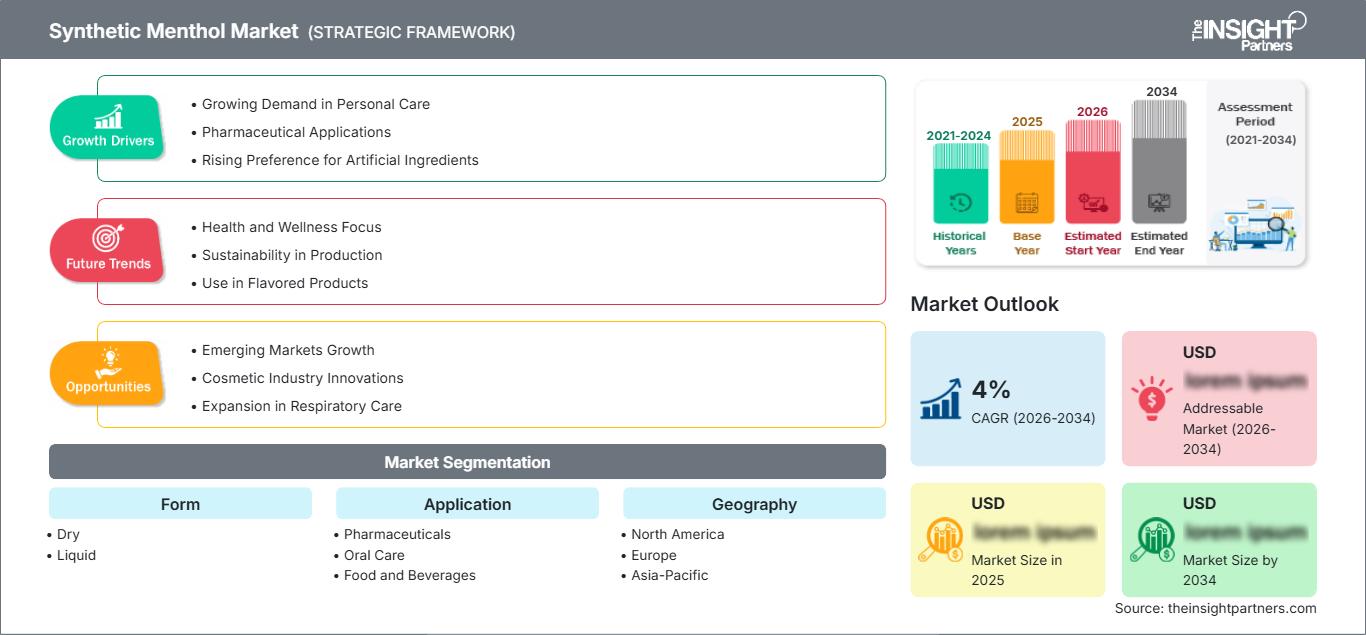
Synthetic Menthol Market: Strategic Insights
-
Get Top Key Market Trends of this report.This FREE sample will include data analysis, ranging from market trends to estimates and forecasts.
Synthetic Menthol Market Drivers and Opportunities
Market Drivers
- Rising Demand for High-Purity and Cost-Effective Alternatives: Synthetic menthol offers consistent quality and performance that is entirely immune to the weather dependencies and crop disease vulnerabilities of natural mint farming, providing a highly predictable pricing model for major manufacturers.
- Purity Validation in Pharmaceutical Applications: The strict regulatory criteria of global healthcare frameworks heavily favor synthetic menthol for topical analgesics, cough drops, and oral medications due to its exceptionally low level of impurities and predictable sensory impact.
- Integration of Advanced Flavoring Technologies: The explosive growth of innovative, fresh-flavor oral care products and cosmetic formulations has sustained continuous commercial demand for specialized synthetic cooling agents.
Market Opportunities
- Transition Toward Sustainable Sourcing and Bio-Based Production: Developing green chemical processing methods and bio-derived raw materials presents a significant avenue to secure high-margin supply contracts with eco-conscious consumer brands.
- Expansion in the Functional Personal Care and Wellness Sectors: Beyond basic oral hygiene, synthetic menthol is unlocking massive opportunities in therapeutic skin care, muscle recovery topicals, and specialized aromatherapy products.
- Strategic B2B Supply Contracts in Emerging APAC Markets: Establishing long-term procurement agreements with expanding food, beverage, and personal hygiene giants in China and India enables direct access to the world’s fastest-growing consumer bases.
Synthetic Menthol Market Report Segmentation Analysis
The Synthetic Menthol Market share is analyzed across various segments to provide a clearer understanding of its structure, growth potential, and emerging trends. Below is the standard segmentation approach used in most industry reports:
By Form
- Dry: The dominant volume driver, highly preferred for solid formulations like lozenges, powder tablets, crystals, and traditional confectionery manufacturing due to easy storage and handling.
- Liquid: A fast-growing form that offers excellent blending efficiencies, heavily utilized in liquid oral rinses, cough syrups, and personal care formulations.
By Application
- Pharmaceuticals: One of the most stable revenue streams, relying on menthol’s natural analgesic and decongestant qualities for over-the-counter medicine, therapeutic rubs, and medicated lozenges.
- Oral Care: A primary and fast-growing retail application, driven by everyday consumer usage of toothpastes, breath strips, and mouthwashes.
- Food and Beverages: A core commercial engine fueled by steady global consumption of mint-flavored treats, chewing gum, and functional foods.
By Geography
- North America
- Europe
- Asia Pacific
- South & Central America
- Middle East & Africa
Synthetic Menthol Market Report Scope
| Report Attribute | Details |
|---|---|
| Market size in 2025 | US$ 764.14 Million |
| Market Size by 2034 | US$ 1293.34 Million |
| Global CAGR (2026 - 2034) | 6% |
| Historical Data | 2021-2024 |
| Forecast period | 2026-2034 |
| Segments Covered |
By Form
|
| Regions and Countries Covered |
North America
|
| Market leaders and key company profiles |
|
Synthetic Menthol Market Players Density: Understanding Its Impact on Business Dynamics
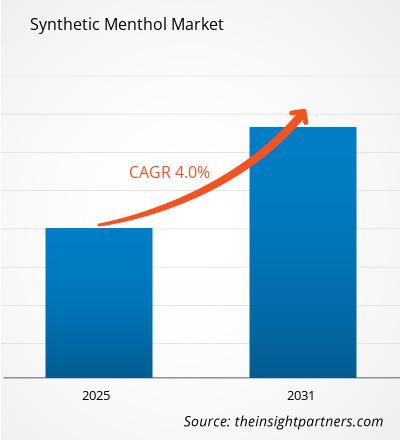
The Synthetic Menthol Market is growing rapidly, driven by increasing end-user demand due to factors such as evolving consumer preferences, technological advancements, and greater awareness of the product's benefits. As demand rises, businesses are expanding their offerings, innovating to meet consumer needs, and capitalizing on emerging trends, which further fuels market growth.
Synthetic Menthol Market Share Analysis by Geography
Asia-Pacific is expected to grow fastest in the coming years. Emerging markets in South & Central America, the Middle East, and Africa also have many untapped opportunities for consumer goods chemical supply chains and contract manufacturing setups.
The synthetic menthol market is undergoing a significant transformation, moving from a niche chemical alternative to an indispensable element of global manufacturing. Growth is driven by the scaling of advanced chemical facilities, a strong push for raw material price stabilization, and the steady expansion of the pharmaceutical and personal care industries. Below is a summary of market share and trends by region:
1. North America
- Market Share: A highly mature market holding a strong value position, centered around specialized pharmaceutical manufacturing and a high consumer base for over-the-counter remedies.
- Key Drivers:
- High regional spending on advanced clinical healthcare, driving massive utilization of pharmaceutical-grade synthetic menthol.
- Robust consumer focus on premium oral hygiene and high-end personal wellness products.
- Local infrastructure for continuous product innovation and advanced therapeutic consumer item development.
- Trends: Widespread transition toward chemical transparency and clean labeling, forcing manufacturers to highlight eco-certified production steps to align with consumer preferences.
2. Europe
- Market Share: Holds a prominent market share, structurally backed by stringent chemical safety frameworks and global flavor-house market leaders.
- Key Drivers:
- Heavy presence of large-scale chemical corporations and multinational pharmaceutical firms.
- Stringent adherence to regional chemical guidelines, favoring highly controlled laboratory-synthesized ingredients over variable crops.
- Massive domestic consumption of functional personal care items and therapeutic mint flavorings.
- Trends: A structural investment pivot toward sustainable chemical manufacturing, with major players heavily funding the development of bio-based synthetic menthol lines to reduce industrial carbon footprints.
3. Asia-Pacific
- Market Share: The largest and fastest-growing region globally, serving as the central production and consumption hub for industrial chemical processing.
- Key Drivers:
- Massive domestic production capacities with state-of-the-art catalytic chemical synthesis plants.
- Rapid urbanization and exponential middle-class growth driving consumption of everyday fast-moving consumer goods.
- Favorable regional manufacturing dynamics and strong chemical supply chain ecosystems.
- Trends: Reliance on heavy industrial B2B export contracts alongside a rapid rise in domestic utilization of synthetic menthol for oral hygiene and localized confectionery products.
4. South and Central America
- Market Share: An emerging market landscape characterized by a scaling consumer goods manufacturing sector in key urban industrial centers.
- Key Drivers:
- Increasing shift among domestic consumer brands away from volatile natural mint imports toward stable synthetic inputs.
- Growing consumer purchasing power leading to higher adoption of mid-to-high-tier oral care products.
- Expansion of local pharmaceutical compounding and generic medicine production.
- Trends: Gradual formalization of supply contracts and an influx of international chemical distribution networks to support localized consumer brands.
5. Middle East and Africa
- Market Share: A developing regional segment focused on securing stable raw materials for domestic packaging and light consumer goods production.
- Key Drivers:
- Rising domestic demand for shelf-stable personal care products suited for warm climates.
- Strategic regional investments in industrial chemical diversification and local manufacturing self-reliance.
- Steady population growth driving volume demands for staple pharmaceutical and oral hygiene products.
- Trends: Consolidation of import logistics channels to ensure regular access to high-purity inputs for expanding regional personal care brands.
High Market Density and Competition
Competition is intensifying due to the presence of established global chemical leaders such as BASF SE and Symrise AG. International specialty chemical experts and dominant market forces like Takasago International Corporation and Chemical Sources International, alongside key regional suppliers such as Fengchen Group Co., Ltd. and standard global flavor houses, also contribute to a highly competitive and technically demanding market landscape.
This competitive environment pushes vendors to differentiate through:
- Purity Maximization and Tailored Technical Specifications: Positioning specific synthetic menthol lines as premium, ultra-pure options perfectly engineered for precise pharmaceutical and cosmetic application requirements.
- Diversification of Finished Product Offerings: Moving beyond crude chemical production to offer ready-to-use liquid blends, customized crystal configurations, and optimized sensory carriers for global brand manufacturing.
- Complete Manufacturing Supply Chain Control: Overseeing the complete synthetic pipeline, from raw material chemical feedstocks through cutting-edge asymmetric synthesis to final packaging. This process guarantees uncompromising traceability and compliance with global environmental standards.
Opportunities and Strategic Moves
- Partner with multinational oral hygiene brands and pharmaceutical networks to establish long-term, high-volume procurement agreements to insulate operations from open-market demand shifts.
- Incorporate bio-based raw materials and energy-efficient processing practices to secure competitive advantages with environmental, social, and corporate governance-driven corporate buyers.
Major Companies operating in the Synthetic Menthol Market are:
- BASF SE
- Mosselman SA
- Symrise AG
- Rochem International Inc
- Takasago International Corporation
- SRS Aromatics Limited
- AEP Colloids
- Frey + Lau GmbH
- Tokyo Chemical Industry Co Ltd
- Vigon International LLC
Disclaimer: The companies listed above are not ranked in any particular order.
Synthetic Menthol Market News and Recent Developments
- In April 2026, BASF’s Aroma Ingredients business unit announced the official launch of three newly built world-scale plants – menthol and linalool in Ludwigshafen, Germany, and citral in Zhanjiang, China. The citral plant in Zhanjiang will supply the local market as well as the expanded downstream production, including menthol and linalool in Ludwigshafen. Menthol is an indispensable mint ingredient used in numerous products for oral and body care, in flavor compounds for confectionery and in the pharmaceutical industry.
- In April 2025, BASF Aroma Ingredients announced the launch of L-Menthol FCC rPCF as its first product with a reduced Product Carbon Footprint (rPCF). Further rPCF product launches are planned to help customers achieve their ambitious Scope 3 carbon reduction targets. BASF's rPCF aroma ingredients come with a PCF reduction of about 10 to 15% compared to conventional BASF products.
Synthetic Menthol Market Report Coverage and Deliverables
The Synthetic Menthol Market Size and Forecast (2021–2034) report provides a detailed analysis of the market covering below areas:
- Synthetic Menthol Market size and forecast at global, regional, and country levels for all the key market segments covered under the scope
- Synthetic Menthol Market trends, as well as market dynamics such as drivers, restraints, and key opportunities
- Detailed PEST and SWOT analysis
- Synthetic Menthol Market analysis covering key market trends, global and regional framework, major players, regulations, and recent market developments
- Industry landscape and competition analysis covering market concentration, heat map analysis, prominent players, and recent developments in the Synthetic Menthol Market
- Detailed company profiles
Frequently Asked Questions

- Comprehensive Market Sizing and Forecast Analysis
- Detailed Segmentation Analysis
- In-Depth Market Dynamics Assessment
- Regional and Country-Level Insights
- Competitive Landscape and Company Benchmarking
- Strategic Business Intelligence
Recent Reports
Testimonials

The Insight Partners' SCADA System Market report is comprehensive, with valuable insights on current trends and future forecasts. The team was highly professional, responsive, and supportive throughout. We are very satisfied and highly recommend their services.
RAN KEDEM Partner, Reali Technologies LTDs
I requested a report on a very specific software market and the team produced the report in a few days. The information was very relevant and well presented. I then requested some changes and additions to the report. The team was again very responsive and I got the final report in less than a week.
JEAN-HERVE JENN Chairman, Future Analytica
We worked with The Insight Partners for an important market study and forecast. They gave us clear insights into opportunities and risks, which helped shape our plans. Their research was easy to use and based on solid data. It helped us make smart, confident decisions. We highly recommend them.
PIYUSH NAGPAL Sr. Vice President, High Beam Global
The Insight Partners delivered insightful, well-structured market research with strong domain expertise. Their team was professional and responsive throughout. The user-friendly website made accessing industry reports seamless. We highly recommend them for reliable, high-quality research services
YUKIHIKO ADACHI CEO, Deep Blue, LLC.
This is the first time I have purchased a market report from The Insight Partners.While I was unsure at first, I visited their web site and felt more comfortable to take the risk and purchase a market report.I am completely satisfied with the quality of the report and customer service. I had several questions and comments with the initial report, but after a couple of dialogs over email with their analyst I believe I have a report that I can use as input to our strategic planning process.Thank you so much for taking the extra time and making this a positive experience.I will definitely recommend your service to others and you will be my first call when we need further market data.
JOHN SUZUKI President and Chief Executive Officer, Board Director, BK Technologies
I wish to appreciate your support and the professionalism you displayed in the course of attending to my request for information regarding to infectious disease IVD market in Nigeria. I appreciate your patience, your guidance, and the fact that you were willing to offer a discount, which eventually made it possible for us to close a deal. I look forward to engaging The Insight Partners in the future, all thanks to the impression you have created in me as a result of this first encounter.
DR CHIJIOKE ONYIA MANAGING DIRECTOR, PineCrest Healthcare Ltd.Reason to Buy
- Informed Decision-Making
- Understanding Market Dynamics
- Competitive Analysis
- Identifying Emerging Markets
- Customer Insights
- Market Forecasts
- Risk Mitigation
- Boosting Operational Efficiency
- Strategic Planning
- Investment Justification
- Tracking Industry Innovations
- Aligning with Regulatory Trends





 Get Free Sample for