
Terminal Blocks Market Outlook and Strategic Insights by 2034
Coverage: By Type (Barriers, Sectional Terminal Blocks, PCB Mount Terminal Blocks, Power Blocks, and Others), Function Type (Single-feed Through, Dual-level Terminal Block, and Three-level Terminal Blocks), Connection Technologies (Spring Clamp Terminal Blocks, Screw-type Terminal Blocks, Insulation Displacement Connection, Push-in Type Terminal Blocks, and Barriers), Industry (Business Equipment, HVAC, Power Supplies, Industry Controls, Instruments, Telecom Equipment, Transportation, and Others), and Device Type (Ground Circuit Terminal, Fuse Terminal Blocks, and Others), and by Geography
- Status : Data Released
- Report Code : TIPRE00012057
- Category : Electronics and Semiconductor
- No. of Pages : 150
- Available Report Formats :


- Last update date : July 15, 2026


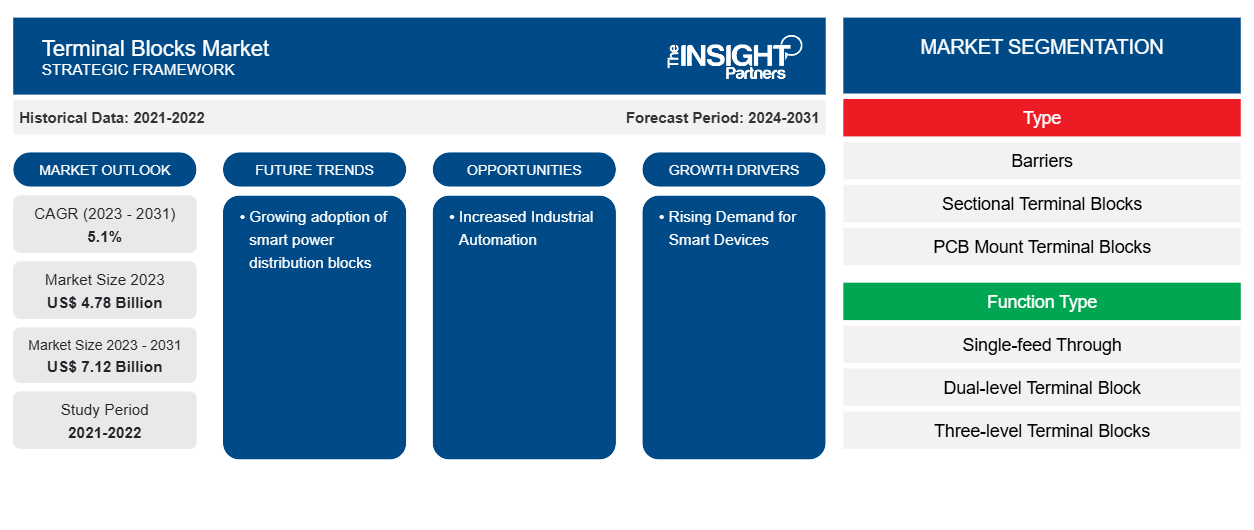
2025 Market Size
US$ 4.78 Bn
Base year value
2034 Forecast
US$ 8.26 Bn
Projected by 2034
CAGR 2026-2034
5.1 %
Growth rate
Addressable Market
US$ 55.62 Bn
(2026-2034)
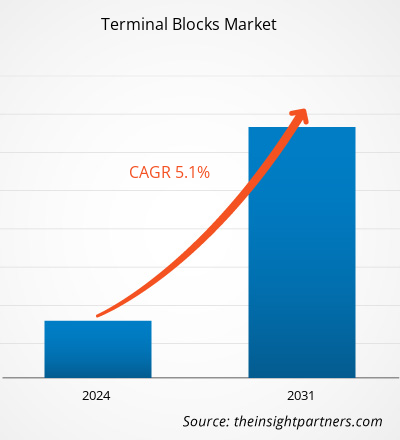
The Terminal Blocks Market size is projected to grow from US$ 5.28 Billion in 2025 to US$ 8.26 Billion by 2034; it is expected to register a CAGR of 5.1% from 2026 to 2034. Demand is supported by industrial electrification, higher control-panel density, and continued adoption of modular wiring interfaces across automation, HVAC, telecom equipment, power supplies, transportation, and instrumentation applications.
It is forecast that North America will grow at a CAGR of 4.6–5.0% from 2026 to 2034, due to upgrades in factory automation as well as investments in grid modernization. The panel manufacturers of this region have been switching over to smaller, touch-proof, and faster-wireable terminals for reducing installation costs as well as addressing safety requirements of industrial controls, HVAC, and transportation grids.
Terminal Blocks Market Assessment and Insights
- North America accounted for 18–20% share in 2025 and is projected to grow at a CAGR of 4.6–5.0% during 2026–2034, led by automation retrofits, energy infrastructure renewal, and stricter electrical safety practices.
- The US represented 78–82% of North America in 2025 and the Terminal Blocks Market forecast is expected to register a CAGR of 4.7–5.1%, supported by control-panel modernization and OEM reshoring activity.
- Europe held 24–27% share in 2025 and is expected to expand at a CAGR of 4.3–4.8%, with Germany, the UK, France, Italy, and Spain leading demand.
- Asia Pacific captured 45–49% share in 2025 and is projected to grow at a CAGR of 5.5–6.0%, driven by China, Japan, South Korea, India, and Australia.
- Largest Segment: Screw-type terminal blocks held 34–38% market share in 2025 and are expected to grow at a CAGR of 4.1–4.6% through 2034.
- High Growth Segment: Push-in type terminal blocks held 14–17% market share in 2025 and are projected to grow at a CAGR of 6.2–6.8% through 2034.
- Key companies analyzed in detail: ABB Ltd., Eaton Corporation plc, METZ CONNECT USA Inc., Molex, LLC, Phoenix Contact GmbH and Co. KG, Rockwell Automation, Inc., WAGO GmbH and Co. KG, WECO Electrical Connectors Inc., Weidmüller Interface GmbH and Co. KG, Wieland Electric GmbH.
Source: The Insight Partners' analysis based on proprietary research, government publications, company annual reports, investor presentations, industry databases, and expert interviews.
The market has moved beyond the simple screw terminals towards a compact and modular system for making wire connections which is also tool-operated and helps to make connections more reliable in small cabinets. There is a move towards more automation in molding, plating, and assembly of terminals while the suppliers maintain a balance between standard stock items and application-specific versions that include rail equipment, power electronics, HVAC controls, and distributed I/O.
The Terminal Blocks Market report suggests that performance differentiation would be based more on speed of installation, vibration-proof capabilities, and accessories available. Future demand would be driven by development of new industrial clusters, connection of renewable energy sources, electrification of transport applications, and safe low voltage assemblies being the regulatory focus. The scope of the Terminal Blocks Market is expanding due to panel manufacturers adopting families of terminal blocks which have features such as feed through, multiple levels, grounding, disconnect and power distribution.
Terminal Blocks Market Report Scope
| Report Attribute | Details |
|---|---|
| Market size in 2025 | US$ 4.78 Billion |
| Market Size by 2034 | US$ 8.26 Billion |
| Global CAGR (2026 - 2034) | 5.1% |
| Historical Data | 2021-2024 |
| Forecast period | 2026-2034 |
Terminal Blocks Market Analysis
Demand is highly correlated with machines manufacturing, electrical enclosures construction, distribution grid hardware, and embedded electronics. Terminal blocks are required because they offer reliable, recognizable, and secure mechanical wiring termination in mixed-voltage circuits. Growth in the Terminal Blocks Market is driven by densification of the control panels where OEMs require additional points of connections while keeping enclosure size unchanged.
The industry involves copper alloy manufacturers, insulation material suppliers, molders, certification bodies, distributors, panel manufacturers, and OEM design engineers. The market dynamics are in favor of the companies that are able to keep diverse SKUs, short lead times, and worldwide approvals. Terminal Blocks Market is also dependent on the replacement cycle due to maintenance standards for long life equipment.
Market competition is relatively concentrated, where Phoenix Contact GmbH & Co. KG, Weidmüller Interface GmbH & Co. KG, WAGO GmbH & Co. KG, ABB Ltd., Eaton Corporation plc, and Rockwell Automation, Inc., compete by offering terminal platforms, safety approvals, and channel access. Product line breadth is a key strength as customers require compatible accessories, labeling systems, jumpers, and software-based cabinet design.
Capital allocation priorities are based on push-in technologies, spring-loaded systems, high current power modules, and PCB solutions. Molex, LLC, METZ CONNECT USA Inc., WECO Electrical Connectors Inc., and Wieland Electric GmbH enhance strategic positioning by means of dedicated connector series and distributors. Thus, the Terminal Blocks Market share analysis favors technical support and application certification.
● REPORT CUSTOMIZATION
Tailor This Report To Align With Your Specific Business Requirements
This report can be customized to align precisely with your business objectives, scope, and target markets. Customization options include tailored segmentation, geography, competitive analysis, and strategic insights to support informed decision-making.
Customize This Report →WHAT YOU CAN ADJUST
- ● Segmentations
- ● Geography
- ● Competitive Analysis
- ● Language Preferences
Terminal Blocks Market: Strategic Insights
Regional Insights
North America Terminal Blocks
North America held 18–20% share in 2025 and is projected to grow at a CAGR of 4.6–5.0% during 2026–2034. Demand is concentrated in industrial controls, HVAC, telecom infrastructure, and power distribution assemblies. Manufacturers are prioritizing compact terminal strips, touch-safe power blocks, and pre-engineered accessories to reduce wiring errors in high-mix panel production.
Regional growth is supported by utility modernization, semiconductor facilities, battery plants, and logistics automation. Electrical contractors and panel shops value components with UL recognition, fast labeling, and simplified troubleshooting. North America remains a specification-driven market where reliability, documentation, and distributor availability carry more weight than lowest unit price in mission-critical installations.
U.S. Terminal Blocks Market
The US represented 78–82% of North America in 2025 and is expected to grow at a CAGR of 4.7–5.1% from 2026 to 2034. The country benefits from strong presence of ABB Ltd., Eaton Corporation plc, Rockwell Automation, Inc., Molex, LLC, and major distributors serving automation OEMs and panel builders.
Application trends are shifting toward higher-density controls for warehouses, data centers, HVAC systems, and process plants. Push-in and spring clamp technologies are gaining attention where labor productivity is critical, while screw-type terminals retain relevance in maintenance-intensive settings. Domestic manufacturing incentives support new electrical infrastructure and increase demand for certified connector assemblies.
Europe Terminal Blocks Market
Europe accounted for 24–27% share in 2025 and is forecast to grow at a CAGR of 4.3–4.8% between 2026 and 2034. Germany leads regional consumption due to machine building, automation exports, rail systems, and dense networks of panel builders requiring IEC-compliant terminal platforms.
In the UK market, building control systems, rail improvements, renewable energy grids, and water infrastructure developments form the market foundation. Customers require safety certifications, functionality, and continuous supply. Additionally, there is demand from the renovation of existing commercial buildings that have to be equipped with updated cabinets, grounding, and compact feed-throughs.
On the other hand, France, Italy, and Spain add their input through manufacturing equipment, energy production equipment, telecoms installations, and electrical transport systems. In particular, Italian OEMs pay great attention to flexible connection sourcing for machinery export, whereas France and Spain contribute through grid reliability schemes and transportation developments. The regional Terminal Blocks market trends relate to tool-less wiring and cabinet documentation.
APAC Terminal Blocks Market
APAC held 45–49% share in 2025 and is expected to expand at a CAGR of 5.5–6.0% during 2026–2034. China is the leading country, supported by electronics manufacturing, industrial automation, power equipment production, and export-oriented machinery supply chains.
Japan and South Korea demand high-reliability terminal systems for robotics, factory automation, and transportation electronics. India is scaling demand through renewable power, metro rail, industrial corridors, and data infrastructure. Australia contributes through mining automation, utilities, and distributed energy projects.
Middle East & Africa Terminal Blocks Market
Middle East and Africa is projected to grow at a CAGR of 5.0–5.6% from 2026 to 2034. Saudi Arabia is the leading country, supported by energy diversification, industrial zones, utilities, and smart infrastructure. The UAE adds demand from data centers, airports, and building automation.
South Africa remains important for mining, power distribution, and industrial maintenance. Rest of MEA demand is project-led, tied to oil and gas facilities, renewable power, and transport infrastructure. Buyers typically prioritize ruggedness, certified insulation, and availability through regional electrical distributors.
Segmentation Analysis
Type
The type segment is projected to grow at a CAGR of 4.8–5.4% during 2026–2034, reflecting continued replacement of legacy wiring blocks with compact and modular designs. Adoption differs by current rating, enclosure space, vibration exposure, and technician familiarity. Screw-type blocks remain widely specified, while push-in and sectional formats gain share in high-throughput panel assembly.
- Barriers serve applications requiring physical separation, clear circuit isolation, and protection against accidental contact, making them relevant in power supplies, HVAC boards, and legacy equipment maintenance.
- Sectional Terminal Blocks are valued for modular DIN rail layouts, enabling panel builders to add, isolate, or replace circuits while maintaining consistent labeling and accessory compatibility.
- PCB Mount Terminal Blocks support compact electronic assemblies, providing secure board-level wire termination for controls, instruments, telecom hardware, and embedded power conversion products.
- Power Blocks address higher-current distribution needs in industrial cabinets, renewable systems, and machinery, where thermal performance, conductor capacity, and touch-safe serviceability are critical.
Function Type
The function type segment is expected to grow at a CAGR of 4.7–5.3% from 2026 to 2034 as cabinet architectures become more layered and space constrained. Single-feed through terminals dominate routine wiring, while dual-level and three-level formats help reduce rail length, improve circuit grouping, and support dense signal distribution in automation systems.
- Single-feed Through terminals remain the baseline option for organized wire-to-wire connections, favored where maintenance teams need simple tracing, standardized drawings, and broad inventory availability.
- Dual-level Terminal Block designs support denser cabinets by stacking circuits vertically, reducing rail space and improving routing efficiency in control panels with numerous signal lines.
- Three-level Terminal Blocks are strategically important in advanced automation cabinets, where multiple circuits must be consolidated without sacrificing accessibility, identification, or safe separation.
Connection Technologies
The connection technologies segment is forecast to grow at a CAGR of 5.0–5.7% during 2026–2034, led by installation productivity and reliability needs. Screw-type products continue to serve conservative maintenance environments, while spring clamp and push-in technologies reduce wiring time, improve vibration behavior, and support automated or semi-automated cabinet assembly workflows.
- Spring Clamp Terminal Blocks offer stable contact pressure, making them suitable for vibration-prone machinery, rail equipment, and industrial automation systems requiring low-maintenance electrical continuity.
- Screw-type Terminal Blocks retain strong market position because technicians understand torque-based fastening, and many industrial sites maintain approved inventories built around screw connections.
- Insulation Displacement Connection products reduce conductor preparation steps, supporting faster assembly in selected signal and communication applications where compatible wire types are standardized.
- Push-in Type Terminal Blocks are gaining strategic importance as panel builders seek tool-less wiring, repeatable quality, and faster commissioning in high-volume control cabinet production.
- Barriers remain relevant for applications emphasizing isolation, visual separation, and safety in circuits where accidental bridging or service contact must be minimized.
Industry
The industry segment is projected to grow at a CAGR of 5.0–5.6% from 2026 to 2034. Demand is diversified across equipment manufacturing, climate systems, power conversion, automation, instrumentation, telecom, and transportation. This breadth stabilizes replacement demand and supports product families that can serve low-voltage control, signal, and higher-current distribution requirements.
- Business Equipment uses terminal blocks for internal power routing and serviceable wiring, with demand linked to compact assemblies, safety certification, and predictable maintenance access.
- HVAC applications require reliable connections for compressors, sensors, controllers, and power modules, making vibration resistance and clear circuit identification important procurement criteria.
- Power Supplies rely on terminal blocks for input and output wiring, where current capacity, creepage distance, thermal behavior, and touch-safe construction shape design selection.
- Industry Controls remain a core demand base because PLC panels, drives, relays, and I/O systems require organized, labeled, and easily serviceable wire termination.
- Instruments require compact and stable signal connections, especially in measurement devices, process equipment, and laboratory systems where wiring integrity affects operating accuracy.
- Telecom Equipment uses terminal blocks in power distribution and signal interfaces, with demand supported by network densification, backup power systems, and cabinet-level serviceability.
- Transportation applications emphasize vibration resistance, safety approvals, and maintainability across rail, commercial vehicles, charging systems, and infrastructure control equipment.
Opportunity Snapshot
| Industry | Revenue Contribution | Trend Tag | Adoption Stage |
| Business Equipment | Medium | Compact Wiring | Mature |
| HVAC | High | Smart Controls | Scaling |
| Power Supplies | High | High Current | Mature |
| Industry Controls | High | Panel Density | Scaling |
| Instruments | Medium | Signal Integrity | Mature |
| Telecom Equipment | Medium | Cabinet Power | Scaling |
| Transportation | Medium | Vibration Safe | Scaling |
Terminal Blocks Market Growth Drivers and Impact Analysis
Automation Cabinet Density and Wiring Productivity
Automated manufacturing is resulting in the increase in the installation of more sensors, drives, control units, relays, and communications components in each enclosure. This increases cabling complications and the need to select appropriate terminals becomes an efficiency consideration rather than just a component issue. Small sized, multi-level, and tool-less terminal blocks help in reducing rail length, enabling proper cable routing, and fast installation. The effect is highly pronounced in the case of machinery original equipment manufacturers and system integrators who manufacture identical panels.
Grid Modernization and Distributed Energy Connections
Utilities, renewables companies, and energy equipment manufacturers are installing distributed generation, storage, protection relays, metering, and monitoring devices at substations and distributed energy sites. Terminal blocks play an important role in this activity by providing organized connections for the control, grounding, and power circuitry that are contained in enclosures required to be functional for many years. Power terminal blocks with higher current capabilities and touch-safe designs are especially needed in situations where people have to work around energized systems.
Safety Compliance and Maintenance Standardization
Procurement processes are still affected by electrical safety requirements, maintenance procedures at work, and customers' approval lists. Terminal blocks featuring approved insulation characteristics, marked properly, equipped with accessories, and with their ratings stated are safer to use in terms of inspection, diagnostics, and replacement of components. Larger industrial customers typically tend to rely on certain families of terminals in order to facilitate their drawings, spares and technician training programs.
Terminal Blocks Market Future Trends
Tool-less Wiring Becomes a Design Standard
Push-in and advanced spring technology will be introduced from specialized applications to more widespread cabinet applications as labor scarcity and pressure on panel output become more pronounced. Design trends will focus on achieving uniform clamping pressure, effortless conductor release, and suitability for automation of wire handling. Manufacturers that are capable of offering tool-less connections along with accessories and digitally marked components will impact buying specifications.
Miniaturized Blocks for Electronics-Heavy Equipment
The increasing amount of embedded control functions, interface connections, sensors, and power conversions in smaller pieces of equipment will result in an increased requirement for terminal blocks which are mounted on printed circuit boards, small sectional blocks, and multi-level blocks that minimize footprint yet provide wiring access. This trend will be particularly applicable to instruments, telecom power systems, HVAC control systems, and transport electronics. Success in design will hinge on thermal behavior, wire range, coding features, and electronic assembly capability.
Terminal Blocks Market Opportunities
Localized Supply for Fast-Growing Industrial Regions
An opening is available for suppliers through increasing localized assembly, stocking, and technical support in India, Southeast Asia, the Gulf region, and specific African industrial centers. This area is undergoing development with the installation of renewable energy, transportation networks, manufacturing capabilities, and utilities, but there is a lag in deliveries of verified electrical products. Stocking initiatives, distributor training, and applications engineering can change one-time projects to recurring orders. Locally available products will also assist in reducing downtimes and meeting tight deadlines for commissioning.
Value-Added Cabinet Engineering Services
Terminal block suppliers will be able to achieve higher account penetration through services such as cabinet design assistance, digital parts libraries, labeling solutions, jumper design, and pre-configured terminal assemblies. OEMs and panel shops wish to minimize mistakes when wiring, speed up documentation, and make compliance review easier. Services differentiate products where products seem identical. The potential for this is greatest in accounts which deal with constant changes in design, as the standardization of terminal assemblies will lower engineering time and raise repeatability
Recent Developments
- November 2024: The new XT 2.5 terminal blocks from Phoenix Contact are the first to feature a front Push-X connection, allowing fast and easy wiring. The XT 2.5 portfolio includes feed-through and multi-conductor terminal blocks as well as function versions for using disconnect knives, plug-in fuses, and components.
- February 2023: Weidmuller USA, a leading provider of smart industrial automation and connectivity products and solutions headquartered in Richmond, Va., is pleased to introduce the new OMNIMATE 4.0 PCB Terminal Blocks in the MTS 5 product series. These innovative terminal blocks mark an exciting expansion of the company’s PCB product portfolio.
Frequently Asked Questions

- Comprehensive Market Sizing and Forecast Analysis
- Detailed Segmentation Analysis
- In-Depth Market Dynamics Assessment
- Regional and Country-Level Insights
- Competitive Landscape and Company Benchmarking
- Strategic Business Intelligence
Recent Reports
Testimonials

The Insight Partners' SCADA System Market report is comprehensive, with valuable insights on current trends and future forecasts. The team was highly professional, responsive, and supportive throughout. We are very satisfied and highly recommend their services.
RAN KEDEM Partner, Reali Technologies LTDs
I requested a report on a very specific software market and the team produced the report in a few days. The information was very relevant and well presented. I then requested some changes and additions to the report. The team was again very responsive and I got the final report in less than a week.
JEAN-HERVE JENN Chairman, Future Analytica
We worked with The Insight Partners for an important market study and forecast. They gave us clear insights into opportunities and risks, which helped shape our plans. Their research was easy to use and based on solid data. It helped us make smart, confident decisions. We highly recommend them.
PIYUSH NAGPAL Sr. Vice President, High Beam Global
The Insight Partners delivered insightful, well-structured market research with strong domain expertise. Their team was professional and responsive throughout. The user-friendly website made accessing industry reports seamless. We highly recommend them for reliable, high-quality research services
YUKIHIKO ADACHI CEO, Deep Blue, LLC.
This is the first time I have purchased a market report from The Insight Partners.While I was unsure at first, I visited their web site and felt more comfortable to take the risk and purchase a market report.I am completely satisfied with the quality of the report and customer service. I had several questions and comments with the initial report, but after a couple of dialogs over email with their analyst I believe I have a report that I can use as input to our strategic planning process.Thank you so much for taking the extra time and making this a positive experience.I will definitely recommend your service to others and you will be my first call when we need further market data.
JOHN SUZUKI President and Chief Executive Officer, Board Director, BK Technologies
I wish to appreciate your support and the professionalism you displayed in the course of attending to my request for information regarding to infectious disease IVD market in Nigeria. I appreciate your patience, your guidance, and the fact that you were willing to offer a discount, which eventually made it possible for us to close a deal. I look forward to engaging The Insight Partners in the future, all thanks to the impression you have created in me as a result of this first encounter.
DR CHIJIOKE ONYIA MANAGING DIRECTOR, PineCrest Healthcare Ltd.Reason to Buy
- Informed Decision-Making
- Understanding Market Dynamics
- Competitive Analysis
- Identifying Emerging Markets
- Customer Insights
- Market Forecasts
- Risk Mitigation
- Boosting Operational Efficiency
- Strategic Planning
- Investment Justification
- Tracking Industry Innovations
- Aligning with Regulatory Trends





 Get Free Sample for