
Thermoelectric Assemblies Market Size, Growth & Demand by 2034
Coverage: by Type (Air to Air, Direct to Air, Liquid to Air, Liquid to Liquid); End-user (Aerospace and Defense, Automotive, Consumer Electronics, Healthcare, Food and Beverages, Telecom, BFSI, Others) , and Geography (North America, Europe, Asia Pacific, and South and Central America)
- Status : Data Released
- Report Code : TIPRE00008390
- Category : Electronics and Semiconductor
- No. of Pages : 150
- Available Report Formats :


- Last update date : July 15, 2026


2025 Market Size
US$ 798.85 Mn
Base year value
2034 Forecast
US$ 1,745.9 Mn
Projected by 2034
CAGR 2026-2034
9.08 %
Growth rate
Addressable Market
US$ 11,384.46 Mn
(2026-2034)
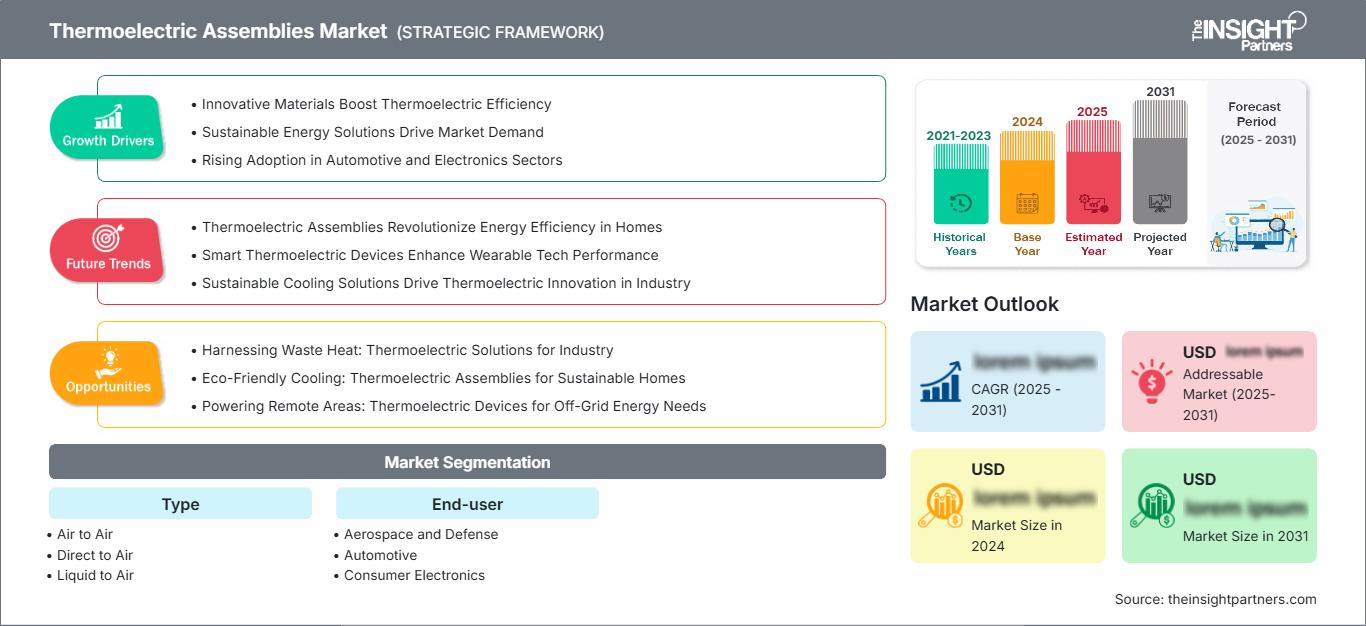
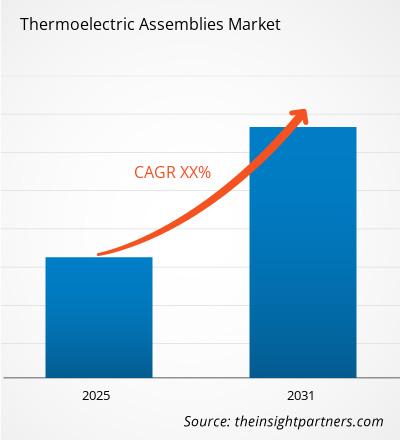
The Thermoelectric Assemblies Market is projected to increase from US$ 798.85 Million in 2025 to US$ 1,745.9 Million by 2034, registering a CAGR of 9.08% during 2026–2034. The demand is fueled by efficient solid-state cooling technology, precise temperature control, and no refrigerants required thermal management technology for electronics, health care, automobiles, telecommunications, aerospace, and defense sectors.
In North America, the Thermoelectric Assemblies market size is projected to grow at a Compound Annual Growth Rate (CAGR) of 8.6% to 9.1%, driven by developments in defense electronics, diagnostic instrumentation, and the 5G network. This is due to the presence of robust medical device manufacturing, aviation certification, and premium-level thermal management solution design in the region.
Thermoelectric Assemblies Market Assessment and Insights
- North America held 32–35% share in 2025 and is projected to grow at an 8.6–9.1% CAGR between 2026–2034, led by U.S. defense, telecom, and diagnostic equipment demand.
- US accounted for 78–82% of North America in 2025 and is expected to record an 8.7–9.2% CAGR between 2026–2034.
- Europe represented 24–27% share in 2025 and is projected to expand at 8.1–8.7% CAGR between 2026–2034, led by Germany, the UK, and France.
- Asia Pacific captured 29–32% share in 2025 and is likely to post a 9.8–10.5% CAGR between 2026–2034, with China, Japan, South Korea, and India leading demand.
- Largest Segment Liquid to Air held 34–38% market share in 2025 and is expected to grow at an 8.8–9.4% CAGR between 2026–2034.
- High Growth Segment Healthcare held 15–18% market share in 2025 and is projected to grow at a 10.2–11.0% CAGR between 2026–2034.
- Key companies analyzed in detail: Crystal Ltd., Ferrotec Corporation, Coherent Corp., KRYOTHERM, Tark Thermal Solutions, TE Technology, Inc., TEC Microsystems GmbH, Thermonamic Electronics (Jiangxi) Corp., Ltd, TOSHIBA MATERIALS CO., LTD., Wakefield-Vette, Inc.
Source: The Insight Partners' analysis based on proprietary research, government publications, company annual reports, investor presentations, industry databases, and expert interviews.
Thermoelectric Assemblies have evolved from lab-based cooling devices to thermal systems in response to shrinking temperature margins as electronics modules become increasingly compact. Manufacturers are upgrading their products with bismuth telluride elements, solder joints, ceramic bases, heat sinks, and controllers to enhance reliability during cycling operation. Manufacturers are also gradually shifting toward producing customized assemblies to meet end users' specific requirements.
The Thermoelectric Assemblies Market forecast states that the development of manufacturing centers in Asia and select investments in North America will drive a change in procurement. Government regulations on refrigerants, efficiency mandates in electronics, and government spending on diagnostics will drive demand for solid-state cooling technology. Although the qualification process is lengthy in aerospace, once assembled into aircraft, replacement parts are consistent and reliable.
Thermoelectric Assemblies Market Report Scope
| Report Attribute | Details |
|---|---|
| Market size in 2025 | US$ 798.85 Million |
| Market Size by 2034 | US$ 1,745.9 Million |
| Global CAGR (2026 - 2034) | 9.08% |
| Historical Data | 2021-2024 |
| Forecast period | 2026-2034 |
Thermoelectric Assemblies Market Analysis
The factors driving growth in the Thermoelectric Assemblies Market are applications that require efficient, quiet temperature control rather than maximum cooling capacity. Analytical instruments, lasers, optical transceivers, automobile seats, and robust electronics use thermoelectric modules because mechanical compressors are vibration-prone, use refrigerants, and pose servicing risks. The value chain involves semiconductor suppliers, ceramic substrate makers, module makers, controller makers, heat exchanger makers, and OEM integrators.
Vendor advantage comes from having application engineering expertise and not just cheap modules. Simulation, accelerated life testing, moisture protection, and heat sink matching make the difference for actual applications. Scale production is possible in Asia, however the U.S. and European customers usually control the design process for health care, defense, and telecommunications programs.
Thermoelectric Assemblies Market analysis indicates a moderately consolidated competitive field, with Ferrotec Corporation, Coherent Corp., Tark Thermal Solutions, and KRYOTHERM competing on performance depth, while TE Technology, Inc., TEC Microsystems GmbH, Thermonamic Electronics (Jiangxi) Corp., Ltd, Crystal Ltd., TOSHIBA MATERIALS CO., LTD., and Wakefield-Vette, Inc. serve specialized design, module, and thermal hardware requirements.
The direction of investment is toward power densities, micro thermoelectric coolers, higher temperatures, and liquid-based assembly. Positioning will rely upon qualification capability, regional availability, and the capability to design and control electronics, together with mechanical housing. Firms that can decrease their prototype-to-validation time will be able to protect margins as their customers move away from catalog parts.
● REPORT CUSTOMIZATION
Tailor This Report To Align With Your Specific Business Requirements
This report can be customized to align precisely with your business objectives, scope, and target markets. Customization options include tailored segmentation, geography, competitive analysis, and strategic insights to support informed decision-making.
Customize This Report →WHAT YOU CAN ADJUST
- ● Segmentations
- ● Geography
- ● Competitive Analysis
- ● Language Preferences
Thermoelectric Assemblies Market: Strategic Insights
Regional Insights
North America Thermoelectric Assemblies
North America held 32–35% share in 2025 and is expected to expand at an 8.6–9.1% CAGR through 2034. The Thermoelectric Assemblies market share is supported by defense electronics, compact medical diagnostics, optical communications, and laboratory instrumentation. U.S. technology programs and Canadian photonics clusters reinforce demand for precision assemblies with high reliability and low acoustic output.
Validation for performance under shock, vibration, and thermal cycling is the focus for regional buyers, especially for products used in the aerospace industry, military computers, and telecommunications cabinets. Traffic recovery at IATA and increased aircraft manufacturing provide cooling requirements for the avionics sector, whereas medical labs continue installing automated machines for temperature-controlled sample handling.
U.S. Thermoelectric Assemblies Market
The U.S. represented 78–82% of North America in 2025 and is expected to post a CAGR of 8.7% to 9.2%. Adaptation is seen in defense electronics, photonic, life sciences instrumentation, semiconductor testing equipment, and electric vehicle sub-systems. Homegrown design creates an opportunity for suppliers to meet documentation, export control, and accelerated life-test requirements.
The companies that provide assistance for applications and hardware needs in the country are Coherent Corp., TE Technology Inc., Wakefield-Vette Inc., and Tark Thermal Solutions. The demand pattern shows increasing demand for applications such as laser diode temperature stabilization, sample storage, medical transportation, telecommunications transceivers, and electronic enclosure systems, where reliability is more critical than cost.
Europe Thermoelectric Assemblies Market
The Europe region held a 24–27% share in 2025 and is expected to expand at a CAGR of 8.1–8.7%. Germany will lead among countries. In the United Kingdom, the advantages lie in the aerospace sector, defense electronics, and university programs in photonic sciences, whereas regional buyers of medical technology are interested in small cooling without refrigerant compliance issues and precise laboratory process flow.
Germany dominates in auto electronics, industrial automation, and instrument manufacture. Aerospace and health care applications make up the French share, whereas Italy and Spain contribute to food & beverages monitoring, telecom enclosures, and specialized industrial electronics. Documentation of energy efficiency, RoHS compliance, and lifetime reliability usually makes a supplier more competitive in Europe.
APAC Thermoelectric Assemblies Market
Asia Pacific held 29–32% share in 2025 and is expected to register a 9.8–10.5% CAGR, making it the fastest-growing region. China leads through electronics manufacturing, telecom equipment, and electric vehicle supply chains, while Japan and South Korea support semiconductor, sensor, and optical device demand.
Healthcare equipment, military upgrades, and remote infrastructure are additional factors that will be beneficial to the Thermoelectric Assemblies Market in India and Australia. Continued policy support for semiconductor manufacturing, medical devices, and efficient electronics is further propelling the Thermoelectric Assemblies Market growth, while competition remains fierce due to price sensitivity and qualification fragmentation.
Middle East & Africa Thermoelectric Assemblies Market
Middle East and Africa is projected to grow at a 7.4–8.0% CAGR through 2034, with Saudi Arabia leading regional adoption. Demand is associated with telecommunications infrastructure, oil and gas electronics, military electronics, and lab equipment operating in ambient environments that require sealed and vibration-resistant cooling solutions.
Data infrastructure initiatives from the UAE, medical and smart-city applications from the UAE and South Africa, and mining and process instrumentation from South Africa are driving new demand. Adoption in RoMEA is limited but improving, driven by investments in energy infrastructure and electronics sensitive to ambient temperature.
Segmentation Analysis
Type
The Type segment is projected to grow at an 8.7–9.3% CAGR between 2026–2034 as OEMs match heat rejection method to enclosure size, ambient conditions, and fluid availability. The Thermoelectric Assemblies Market scope is strongest where buyers require a complete cooling path, including module, heat exchanger, fan, liquid loop, controller, and mechanical interface.
Air to Air serves cabinets, kiosks, and instrumentation where simple installation and ambient heat rejection matter. It remains practical for moderate loads and sealed electronics.
- Direct to Air fits compact cold plates, sensors, and localized device cooling. Demand is tied to small footprints, quick thermal response, and low mechanical complexity.
- Liquid to Air is the largest type because it balances higher heat pumping with manageable system design, serving medical chambers, laser systems, and analytical instruments.
- Liquid to Liquid is selected for controlled loops, semiconductor tools, and advanced research equipment where precise fluid temperatures and stable process conditions are strategically important.
End-user
The End-user segment is estimated to grow at a 9.0–9.6% CAGR between 2026–2034. Healthcare, telecom, aerospace and defense, and automotive applications create the most demanding qualification requirements. Consumer electronics and food and beverages add volume opportunities, while BFSI demand is linked to secure data infrastructure and equipment reliability.
- Aerospace and Defense uses assemblies in avionics, sensors, rugged communications, and targeting electronics. Demand emphasizes shock tolerance, reliability, and lifecycle support over lowest initial cost.
- Automotive adoption covers seat comfort, battery electronics, sensors, and cabin subsystems. Growth depends on electrification, premium vehicle features, and compact thermal zoning.
- Consumer Electronics applies solid-state cooling in wearables, gaming, imaging, portable coolers, and high-performance devices. Miniaturization keeps demand selective but technically important.
- Healthcare is the high-growth end user, using assemblies in diagnostics, sample storage, laser therapy, medical transport, and incubation systems requiring precise and repeatable temperatures.
- Food and Beverages uses assemblies for portable refrigeration, monitoring equipment, and compact dispensing systems where low vibration and refrigerant-free operation support specialty use cases.
- Telecom applies cooling in optical transceivers, base station electronics, and remote enclosures. The shift to higher data rates increases need for localized temperature stabilization.
- BFSI demand comes from secure data rooms, ATMs, edge equipment, and transaction infrastructure where component reliability supports uptime and controlled electronics environments.
Opportunity Snapshot
| Segment Name | Revenue Contribution | Trend Tag | Adoption Stage |
| Aerospace and Defense | High | Rugged Cooling | Mature |
| Automotive | Medium | EV Thermal | Scaling |
| Consumer Electronics | Medium | Device Miniaturization | Scaling |
| Healthcare | High | Diagnostics Cooling | Scaling |
| Food and Beverages | Low | Portable Cold | Emerging |
| Telecom | High | Optical Stability | Scaling |
| BFSI | Low | Edge Uptime | Emerging |
Thermoelectric Assemblies Market Growth Drivers and Impact Analysis
Rising Need for Precision Thermal Control
Precision temperature control is becoming a design requirement in diagnostics, photonics, sensors, and semiconductor tools, where small deviations can reduce measurement accuracy or shorten component life. Thermoelectric Assemblies provide bidirectional heating and cooling, enabling fast stabilization without compressors, refrigerant handling, or moving mechanical systems. This driver affects OEM purchasing because buyers increasingly evaluate complete thermal performance, controller compatibility, and qualification data rather than only module price. WHO-linked diagnostic expansion and higher laboratory automation create a durable healthcare pathway, while optical telecom systems require tight laser temperature control. The market impact is higher content per device and longer supplier engagement during design-in phases.
Refrigerant-Free Cooling Aligns with Sustainability Rules
Environmental pressure on refrigerants is strengthening the case for solid-state cooling in compact systems. Thermoelectric Assemblies avoid refrigerant leakage, compressor oil, and many service requirements, making them attractive in small chambers, portable equipment, and electronics cabinets. While they are not a universal replacement for vapor-compression systems, they fit applications where precise control and low maintenance outweigh coefficient-of-performance disadvantages. IEA efficiency priorities and national decarbonization programs are pushing OEMs to assess lifecycle energy use and material compliance. The impact is strongest in medical, laboratory, telecom, and specialty food equipment, where refrigerant-free design supports compliance, reliability, and product differentiation.
Electronics Density and Edge Infrastructure Expansion
Higher power density in telecom, industrial computing, and edge infrastructure is creating localized heat challenges that conventional fans cannot always solve. Thermoelectric Assemblies are used to stabilize specific components such as lasers, detectors, processors, and sealed electronics exposed to changing ambient conditions. The rollout of 5G, industrial IoT, and remote monitoring systems increases demand for rugged thermal subsystems that operate with limited maintenance access. IMF-supported infrastructure spending in emerging economies also supports telecom and healthcare upgrades. Market impact appears through more customized assemblies, strengthening the Thermoelectric Assemblies Market share of suppliers offering integrated heat sinks, sensors, and controllers for critical electronics.
Thermoelectric Assemblies Market Future Trends
Micro and Multistage Cooling for Photonics
Thermoelectric Assemblies Market trends are moving toward micro, multistage, and high-temperature designs that stabilize photonics, LiDAR, imaging sensors, and AI-linked optical transceivers. As coherent optics and high-speed laser packages become smaller, suppliers must deliver higher temperature differentials in tighter footprints while managing condensation and cycling stress. Future differentiation will come from material improvements, low-profile packaging, and controller algorithms that reduce power draw during standby. This direction favors companies with semiconductor processing expertise and close relationships with optical module makers. It also supports premium pricing because failure in these systems can impair network capacity, sensing accuracy, or industrial inspection performance.
Hybrid Liquid-Assist Architectures
Hybrid architectures that combine thermoelectric modules with liquid loops, microchannels, and intelligent control will gain traction in applications needing higher heat transfer without compressor complexity. The approach is suited to medical chambers, semiconductor tools, battery electronics, and precision test systems where fluid temperature stability is valuable. Vendors will need to prove leak resistance, pump reliability, and serviceability, making integration capability more important than catalog breadth. Future adoption will depend on reducing total system power while improving heat rejection. Successful designs can further shape Thermoelectric Assemblies Market trends by expanding addressable use cases and reducing the historical efficiency gap that limited broader deployment.
Thermoelectric Assemblies Market Opportunities
Healthcare Instrument Platforms
The Thermoelectric Assemblies Market forecast points to strong opportunity in healthcare platforms that need temperature-stable storage, transport, incubation, and laser control. Manufacturers can target diagnostic analyzers, sample preparation systems, point-of-care instruments, and medical logistics equipment by offering validated assemblies with documentation packages, controller options, and contamination-resistant housings. Investment priorities should include application-specific reference designs, faster prototype support, and regional technical service for regulated customers. The opportunity is attractive because medical programs often carry long product lifecycles and repeat purchases after qualification. Suppliers that align thermal performance with regulatory traceability can capture higher-value content and reduce commoditization risk.
Telecom and Edge Electronics Localization
Telecom and edge electronics offer an action-oriented opportunity as optical links, remote cabinets, and distributed computing nodes require stable operation in variable climates. Suppliers can create value by bundling thermoelectric modules with heat sinks, sensors, sealed enclosures, and power controllers optimized for field reliability. Regional manufacturing and second-source strategies will matter because network equipment makers increasingly review supply resilience. Partnerships with telecom hardware vendors can accelerate design-ins before mass deployment. The opportunity can further expand the Thermoelectric Assemblies Market scope as emerging economies expand broadband, digital payments, and remote healthcare infrastructure that depends on reliable electronics.
Recent Developments
- August 2025: Tark Thermal Solutions — announced next-generation active cooling technologies for high-performance optoelectronics at CIOE 2025, including thermoelectric coolers, assemblies, and chillers for AI clusters, optical transceivers, LiDAR, imaging sensors, industrial lasers, and medical laser cooling. The launch highlighted compact thermal stability for high-density photonics and autonomous systems.
- April 2025: Ferrotec Corporation — broke ground on its second high-technology manufacturing facility in Kulim, Kedah, Malaysia, expanding regional capacity for precision materials, components, and system solutions. The investment supports supply-chain resilience for semiconductor, electronic device, and thermal management customers that need scalable Asian manufacturing close to electronics assembly clusters.
Frequently Asked Questions

- Comprehensive Market Sizing and Forecast Analysis
- Detailed Segmentation Analysis
- In-Depth Market Dynamics Assessment
- Regional and Country-Level Insights
- Competitive Landscape and Company Benchmarking
- Strategic Business Intelligence
Recent Reports
Testimonials

The Insight Partners' SCADA System Market report is comprehensive, with valuable insights on current trends and future forecasts. The team was highly professional, responsive, and supportive throughout. We are very satisfied and highly recommend their services.
RAN KEDEM Partner, Reali Technologies LTDs
I requested a report on a very specific software market and the team produced the report in a few days. The information was very relevant and well presented. I then requested some changes and additions to the report. The team was again very responsive and I got the final report in less than a week.
JEAN-HERVE JENN Chairman, Future Analytica
We worked with The Insight Partners for an important market study and forecast. They gave us clear insights into opportunities and risks, which helped shape our plans. Their research was easy to use and based on solid data. It helped us make smart, confident decisions. We highly recommend them.
PIYUSH NAGPAL Sr. Vice President, High Beam Global
The Insight Partners delivered insightful, well-structured market research with strong domain expertise. Their team was professional and responsive throughout. The user-friendly website made accessing industry reports seamless. We highly recommend them for reliable, high-quality research services
YUKIHIKO ADACHI CEO, Deep Blue, LLC.
This is the first time I have purchased a market report from The Insight Partners.While I was unsure at first, I visited their web site and felt more comfortable to take the risk and purchase a market report.I am completely satisfied with the quality of the report and customer service. I had several questions and comments with the initial report, but after a couple of dialogs over email with their analyst I believe I have a report that I can use as input to our strategic planning process.Thank you so much for taking the extra time and making this a positive experience.I will definitely recommend your service to others and you will be my first call when we need further market data.
JOHN SUZUKI President and Chief Executive Officer, Board Director, BK Technologies
I wish to appreciate your support and the professionalism you displayed in the course of attending to my request for information regarding to infectious disease IVD market in Nigeria. I appreciate your patience, your guidance, and the fact that you were willing to offer a discount, which eventually made it possible for us to close a deal. I look forward to engaging The Insight Partners in the future, all thanks to the impression you have created in me as a result of this first encounter.
DR CHIJIOKE ONYIA MANAGING DIRECTOR, PineCrest Healthcare Ltd.Reason to Buy
- Informed Decision-Making
- Understanding Market Dynamics
- Competitive Analysis
- Identifying Emerging Markets
- Customer Insights
- Market Forecasts
- Risk Mitigation
- Boosting Operational Efficiency
- Strategic Planning
- Investment Justification
- Tracking Industry Innovations
- Aligning with Regulatory Trends





 Get Free Sample for