
Thermoelectric Refrigerator and Cooling System Market Size, Growth & Demand by 2034
Coverage: by Type (Coolers, Refrigerator); Capacity (Small, Medium, Large); End-user Industry (Healthcare and Pharmaceutical, Aerospace and Defense, Consumer Goods and Retail, Industrial, Others), and Geography (North America, Europe, Asia Pacific, and South and Central America)
- Status : Data Released
- Report Code : TIPRE00013547
- Category : Electronics and Semiconductor
- No. of Pages : 150
- Available Report Formats :


- Last update date : July 15, 2026


2025 Market Size
US$ 564.78 Mn
Base year value
2034 Forecast
US$ 1,338.27 Mn
Projected by 2034
CAGR 2026-2034
10.06 %
Growth rate
Addressable Market
US$ 8,462.30 Mn
(2026-2034)
Thermoelectric Refrigerator and Cooling System market will rise from US$ 564.78 Million in 2025 to US$ 1,338.27 Million in 2034, posting a CAGR of 10.06% in 2026-2034. The market will show growing requirements for smaller sized, refrigerant free temperature control equipment in applications such as healthcare, aerospace, industrial electronics, retail cooling, and consumer goods, where low vibrations, precision, and maintenance free operations are important criteria for purchase decisions.
North America region will post a CAGR between 9.6%-10.4% on account of growing demand for sealed, silent refrigeration in medical device manufacturing, defense electronics, and edge computing in data centers. Growth of the Thermoelectric Refrigerator and Cooling System market size in North America region will be driven by return of precision manufacturing backshoring and stringent requirements for handling of temperature sensitive diagnostic, biological, and sensor devices.
Thermoelectric Refrigerator and Cooling System Market Assessment and Insights
- North America accounted for 34–37% Thermoelectric Refrigerator and Cooling System market share in 2025 and is growing at a CAGR of 9.6–10.4% during 2026–2034, supported by medical instrumentation, defense-grade electronics, and compact cold-chain devices requiring sealed precision cooling.
- US represented 72–76% of North America in 2025 and is growing at a CAGR of 9.4–10.2% during 2026–2034, led by diagnostics, aerospace programs, and photonics suppliers.
- Europe held 25–28% share in 2025 and is growing at a CAGR of 8.7–9.5% during 2026–2034, with Germany, the UK, and France leading demand from analytical instruments and regulated healthcare logistics.
- Asia Pacific captured 27–30% share in 2025 and is growing at a CAGR of 10.8–11.8% during 2026–2034, driven by China, Japan, South Korea, and India across electronics, optics, and portable medical equipment.
- Largest Segment Coolers held 58–62% market share in 2025 and are growing at a CAGR of 9.5–10.3% during 2026–2034 as OEMs prioritize modular cooling assemblies.
- High Growth Segment Healthcare and Pharmaceutical held 29–33% market share in 2025 and is growing at a CAGR of 10.9–11.7% during 2026–2034 due to diagnostic and biologics handling demand.
- Key companies analyzed in detail: Crystal Ltd., Custom Thermoelectric, LLC, Delta Electronics, Inc., Ferrotec (USA) Corporation, Coherent Corp., Tark Thermal Solutions, RMT Ltd., TEC Microsystems GmbH, ThermoElectric Cooling America Corporation, Xiamen Hicool Electronics Co., Ltd.
Source: The Insight Partners' analysis based on proprietary research, government publications, company annual reports, investor presentations, industry databases, and expert interviews.
The move towards technology migration has been altering product designs to incorporate not just Peltier modules but also controllers, heat sinks, fans, and liquid interface systems. Module manufacturers have improved material, solder, and ceramic substrate quality to enable continuous thermal cycling. The production process dynamic is driving manufacturers to develop catalog depth and engineering capabilities, fast prototypes, and more stringent validation process capabilities, as each application-specific module may not have identical heat load requirements such as those of lab analyzers, optical transmitters, vaccine carriers, and ruggedized packages.
Future demand is forecast to be generated outside the existing US, German, Japanese, and Chinese electronics industry clusters, as India, Southeast Asia, and Gulf healthcare industry centers develop diagnostic testing capacity. The need for stability of medicines, proper IATA temperature-controlled packaging procedures, and robust immunization facilities endorsed by WHO has ensured strong demand for reliable refrigeration. The focus for investment would be on small modules, sealed assemblies, and efficient thermal paths.
Thermoelectric Refrigerator and Cooling System Market Report Scope
| Report Attribute | Details |
|---|---|
| Market size in 2025 | US$ 564.78 Million |
| Market Size by 2034 | US$ 1,338.27 Million |
| Global CAGR (2026 - 2034) | 10.06% |
| Historical Data | 2021-2024 |
| Forecast period | 2026-2034 |
Thermoelectric Refrigerator and Cooling System Market Analysis
The Thermoelectric Refrigerator and Cooling System market is growing in applications where compressor-type refrigeration solutions are oversized, noisy, or difficult to service. There is demand for thermoelectric cooling technology in applications such as laboratory storage, photonic equipment, infrared sensors, avionics, outdoor electronic enclosures, mobile retail coolers, and local temperature control for critical components that do not endure thermal cycling.
The supply chain includes semiconductors, assembly of modules, heat transfer solutions, controller solutions, enclosures, and qualification of applications. Availability of tellurium, bismuth, ceramics, fans, and bonding capability influences the supply chain. Original equipment manufacturers are requesting that suppliers improve the total thermal resistance and coefficient of performance, and test for vibration, humidity, and cycling conditions.
The Thermoelectric Refrigerator and Cooling System market identifies a competitive environment segmented into large thermal management companies and niche players manufacturing specialized modules. Coherent Corp., Ferrotec (USA) Corporation and Tark Thermal Solutions focus on performance levels and engineering services, while Crystal Ltd., TEC Microsystems GmbH, RMT Ltd., and Custom Thermoelectric, LLC specialize in customized solutions, micro-modules and technical support.
Current investment focus involves reliable production, automatic testing and assembly technologies minimizing the risk for customers. Delta Electronics, Inc. has an advantage in enclosure-cooling technology; Xiamen Hicool Electronics Co., Ltd. is responding to low-cost module requirements; and ThermoElectric Cooling America Corporation is providing custom solutions for North America. Effective positioning is based on proven performance results, supply reliability, and market regulation capabilities.
● REPORT CUSTOMIZATION
Tailor This Report To Align With Your Specific Business Requirements
This report can be customized to align precisely with your business objectives, scope, and target markets. Customization options include tailored segmentation, geography, competitive analysis, and strategic insights to support informed decision-making.
Customize This Report →WHAT YOU CAN ADJUST
- ● Segmentations
- ● Geography
- ● Competitive Analysis
- ● Language Preferences
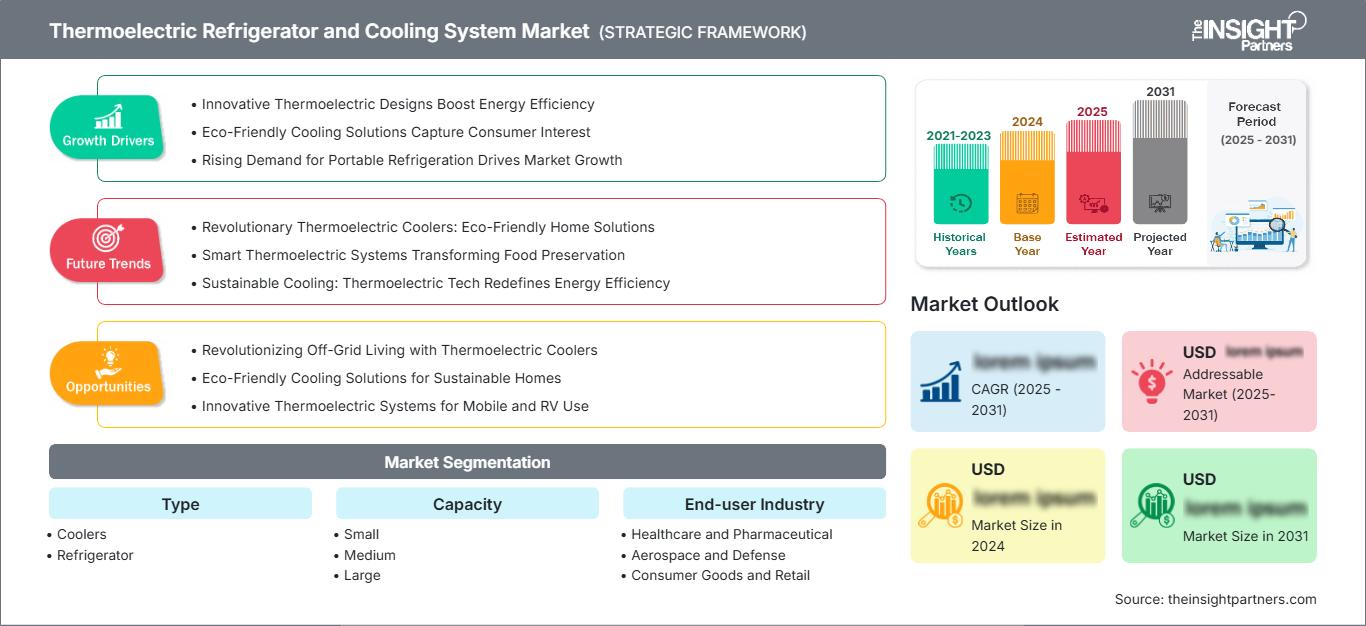
Thermoelectric Refrigerator and Cooling System Market: Strategic Insights
Regional Insights
North America Thermoelectric Refrigerator and Cooling System
North America held 34-37% market share in 2025 and is expected to exhibit CAGR of 9.6-10.4% in 2026-2034. The share of thermoelectric refrigerators and cooling systems depends on healthcare manufacturing concentration, aerospace electronics, defense sensors, and cold chain compliance workflows which are suitable for solid-state cooling because of their low vibration level and temperature control capabilities.
North America is a region characterized by strong institutional demand such as hospital laboratories, biopharma R&D centers, and field-ready diagnostic systems. The IATA temperature control procedures and quality system documentation requirements push suppliers to provide traceable and validated components. Local engineering services, fast time-to-market, and rugged products needed for optical, industrial, and military applications are highly appreciated in North America.
U.S. Thermoelectric Refrigerator and Cooling System Market
The U.S. accounted for 72%–76% of North America in 2025, and its growth rate is estimated to be 9.4%–10.2% from 2026–2034. The applications that drive demand are life-science instruments, payload electronics in aerospace, semiconductor process control, defense communication equipment, and portable cooling units for storing samples and temperature-sensitive biologics.
Some companies with US-oriented product and engineering resources include Coherent Corp., Ferrotec (USA) Corporation, Custom Thermoelectric, LLC, ThermoElectric Cooling America Corporation, and Tark Thermal Solutions. Thermoelectric Refrigerator and Cooling System Market trends are focused on faster thermal cycling, miniaturization of medical coolers, laser diode stabilization, enclosure robustness, and maintenance-free spot cooling systems.
Europe Thermoelectric Refrigerator and Cooling System Market
The European region held 25–28% market share in 2025 and is expected to have growth at 8.7–9.5% CAGR between 2026 and 2034. The lead country in Europe is Germany, driven by advanced analytics tools, optics-based systems, industrial automation, and highly-specialized lab equipment. The UK is contributing to the market through biopharmaceutical services, defense electronics, and precision medical device manufacturing.
The contributions from France include the aerospace sector, diagnostics and laboratories; while those from Italy are through industrial refrigeration segments and packaging equipment. In Europe, Spain is emerging as an important country owing to improved healthcare logistics and electronics assembly. Europe purchases favor RoHS compliance, long-life cycle support, energy-efficient design, and reliability documentation among others.
APAC Thermoelectric Refrigerator and Cooling System Market
The APAC region accounts for 27-30% market share in 2025 and is anticipated to witness a CAGR of 10.8-11.8% during the forecast period from 2026 to 2034. China is the dominant country owing to its huge electronics industry, optical communication and low-cost module production, whereas Japan and South Korea form the stronghold for high-reliability photonics, imaging, and semiconductor equipment.
According to the Thermoelectric Refrigerator and Cooling System Market report, India is growing with the help of its diagnostics segment, vaccine cold chain logistics, and electronics assembling sector, while Australia contributes to healthcare, defense, and tough environmental industrial applications segments. Policies favoring domestic electronics and medical equipment manufacturing are contributing to the use of these products.
Middle East & Africa Thermoelectric Refrigerator and Cooling System Market
The Thermoelectric Refrigerator and Cooling System Market forecast indicates that Middle East & Africa will experience a CAGR between 8.1% and 8.9% over the period 2026-2034. Leading nations include Saudi Arabia, thanks to healthcare infrastructure, pharmaceutical logistics and industrialization, and UAE due to temperature-sensitive air freight, diagnostics and high-performance electronics for smart infrastructure.
In South Africa, demand is driven by clinical laboratories, retail cold chain modernization and electronics enclosures near mines. In the Rest of MEA category, there is inconsistent adoption of refrigerators due to their need for consistent power supply, remote healthcare and tough ambient conditions.
Segmentation Analysis
Type
Type is projected to grow at a 9.8–10.6% CAGR during 2026–2034 as OEMs choose between modular coolers and enclosed refrigerator formats. Thermoelectric Refrigerator and Cooling System scope is broadening because buyers increasingly specify cooling performance, enclosure design, controls, acoustic profile, and validated thermal stability as one integrated purchasing decision.
- Coolers dominate adoption because modular assemblies fit electronics enclosures, analytical devices, optical systems, and portable boxes where targeted thermal control is preferred over compressor-based refrigeration.
- Refrigerator formats serve compact storage applications in healthcare, consumer goods, and retail, with demand linked to stable temperatures, low noise, and maintenance-light operation.
Capacity
Capacity is expected to grow at a 9.6–10.4% CAGR during 2026–2034. Small systems support portable diagnostics and localized electronics, medium units address cabinet and sample-storage needs, and large solutions serve industrial or multi-compartment environments. Selection depends on heat load, ambient exposure, duty cycle, power budget, and whether the system must both cool and heat.
- Small capacity systems are favored for sample carriers, compact retail boxes, optical modules, and point-of-care equipment where low weight and precise localized cooling drive procurement.
- Medium capacity systems suit electronics cabinets, laboratory storage, and transport containers that require balanced cooling output, manageable power consumption, and configurable mechanical integration.
- Large capacity systems address rugged industrial enclosures and higher heat-load assemblies, but adoption is selective because thermoelectric economics remain strongest in precision rather than bulk refrigeration.
End-user Industry
End-user Industry is projected to grow at a 10.2–11.0% CAGR during 2026–2034 as demand shifts toward regulated and mission-critical environments. Healthcare and pharmaceutical applications lead in precision storage, aerospace and defense require ruggedization, consumer goods and retail need compact silent cooling, and industrial users prioritize reliability in cabinets, sensors, and process-monitoring equipment.
- Healthcare and Pharmaceutical demand is reinforced by diagnostics, sample protection, vaccine handling, and biologics workflows where small temperature deviations can compromise product quality.
- Aerospace and Defense applications value vibration-free operation, sealed construction, and fast thermal response for sensors, avionics, infrared systems, and field equipment.
- Consumer Goods and Retail adoption focuses on beverage coolers, countertop storage, beauty devices, and specialty retail formats where low noise and compact form factors support differentiation.
- Industrial users deploy thermoelectric systems in control cabinets, machine-vision equipment, lasers, and harsh-location electronics where reduced maintenance offsets higher unit costs.
Opportunity Snapshot
| Segment Name | Revenue Contribution | Trend Tag | Adoption Stage |
| Healthcare and Pharmaceutical | High | Sample Integrity | Scaling |
| Aerospace and Defense | Medium | Rugged Sensors | Scaling |
| Consumer Goods and Retail | Medium | Quiet Cooling | Mature |
| Industrial | High | Cabinet Control | Scaling |
Thermoelectric Refrigerator and Cooling System Market Growth Drivers and Impact Analysis
Precision Cooling for Regulated Healthcare Workflows
The growth in the use of healthcare and pharmaceutical applications is driven by the need for stable temperature storage in a space-efficient design for diagnostics, biologicals, reagents, and clinical samples. Attention on the temperature aspect from immunization guidelines of the WHO and good distribution practices ensures continued interest in the temperature aspect, whereas the IATA guidelines ensure documentation of the handling process during transportation. Thermoelectric technology caters to small payloads that don’t merit compressors, especially portable sample containers, benchtop analyzers, vaccine-related devices, and temperature-controlled processes. The effect on the market is an increased willingness to invest in tested kits with sensors and alarms for thermal cycling.
Miniaturization in Photonics and Defense Electronics
Optical communication systems, infrared cameras, laser stabilization, and rugged electronics are driving the need for high-density thermal management near sensitive electronic components. High-speed photonic applications and military-grade sensors require operation in very tight temperature tolerances, rendering fanless or compressorless solid-state cooling quite desirable. Market introductions of micro coolers, slim modules, and devices with high heat removal density demonstrate how suppliers are responding to smaller optical pluggable and embedded sensor modules. This means not only an increase in the revenue from components sold but a more involved design process from the suppliers side as well.
Refrigerant-Free Design and Lower Maintenance Needs
Pressure from regulations and sustainability issues regarding refrigerants is making manufacturers more interested in exploring alternative cooling mechanisms for smaller-scale applications. Thermoelectric cooling doesn't require refrigerants, can both heat and cool bidirectionally, and doesn't have as many opportunities to fail as compressors do. Although thermoelectric efficiency depends on load and environmental factors, this is a significant advantage when working with remote cabinets, portable medical equipment, POS coolers, and other sensors. This effect is most pronounced where downtime and acoustics matter. Companies that design efficient modules together with the appropriate cooling system will be able to harness this opportunity.
Thermoelectric Refrigerator and Cooling System Market Future Trends
Smart Thermal Control with Embedded Monitoring
The Thermoelectric Refrigerator and Cooling System Trends would more and more revolve around monitoring, prediction and connectivity features instead of just focusing on module output. The controllers having integrated temperature sensors, alarms, self-test and logging could be used in regulated health care environments, industrial remote cabinets and retail environments requiring stable storage validation. The future products would probably utilize fan speed and ambient adjustment with faults identification in order to optimize energy efficiency depending on the conditions. It would be beneficial for manufacturers since software-based assemblies have higher profit margin compared to standard modules and relieve OEM customers from integrating issues.
Advanced Materials and Higher Heat-Pumping Density
Material development will continue to be an important pathway towards increased adoption as users require greater performance within a smaller footprint. Advances in the design of thermoelectric legs, solder alloys, ceramic substrates, and thermal interfaces can minimize losses and increase cycling lifetime. The future competition will focus on performance in specific applications, including deep cooling of imaging sensors, slim modules for photonics, and larger units for analytical instruments. Suppliers who demonstrate they can consistently manufacture at a high level and clearly test their reliability will have an edge, as OEMs increasingly want measured performance results.
Thermoelectric Refrigerator and Cooling System Market Opportunities
Healthcare Cold-Chain Devices for Decentralized Care
The thermoelectric refrigerator & Coolant System market forecast indicates a promising market for decentralized healthcare, wherein samples, reagents, and medicine transport between clinics, labs, pharmacies, and patients' homes. Investments can be made in portable storage containers, small vaccine auxiliary devices, and coolers for diagnosis proven to offer both temperature control and digital monitoring. This promising field lies not in household refrigerators but in smaller-sized devices with proven reliability and maintainability. It can be developed through cooperation with medical devices OEMs, logistics companies, and clinical trial organizations due to the need in compliance documents and thermal consistency.
Integrated Thermal Assemblies for Industrial Electronics
The field of industrial electronics offers an opening for providers who can provide total thermal assemblies, not just components. Machine vision systems, lasers, inspection devices, control cabinets, and outdoor communication enclosures need reliable cooling in limited space. Investors need to target configurable platforms that include well-tested heat sinks, fans, controllers, and enclosed housings, which help customers reduce their product development time frame. The best way to add value in this field is through application engineering since the industrial clients rarely have any expertise in thermoelectrics. Companies that keep regional offices and provide fast prototypes along with conservative performance numbers gain repeat business.
Recent Developments
- January 2026: TEC Microsystems GmbH — updated its MC06 thermoelectric module series, expanding the portfolio to more than 500 cooler variants for standard and multistage applications, including telecom transceivers and TOSA packages. The update strengthens options for compact precision cooling across optoelectronics and miniature thermal control designs.
- September 2025: Tark Thermal Solutions — introduced new custom options in its OptoTEC MBX Series micro thermoelectric coolers for ultra-high-speed optical pluggables used in AI data centers. The MBX Series of micro thermoelectric coolers support high-temperature applications with compact geometric space constraints. MBX delivers precise temperature stabilization under changing environmental conditions. The MBX Series offers micro footprints as small as 1.5 x 1.1mm with thicknesses down to 0.65mm. The packing fraction for thermoelectric materials enables high heat pumping densities up to 43 W/cm2 at lower operating currents than traditional thermoelectric coolers.
- January 2025: Coherent Corp. launched CT-Series thermoelectric coolers for life sciences, medical, and industrial markets. The product line targets mid-tier thermal stabilization, offering temperature differentials exceeding 70°C at 27°C and up to 100,000 thermal cycles for applications such as medical laser stabilization and sensor cooling.
Frequently Asked Questions

- Comprehensive Market Sizing and Forecast Analysis
- Detailed Segmentation Analysis
- In-Depth Market Dynamics Assessment
- Regional and Country-Level Insights
- Competitive Landscape and Company Benchmarking
- Strategic Business Intelligence
Recent Reports
Testimonials

The Insight Partners provided valuable market intelligence that supported our global go-to-market strategy. Their team was professional, responsive, and attentive to our feedback, providing thoughtful analysis and helpful methodological clarifications throughout the project.
Junmo Kim Chief Financial Officer (CFO), Enertech Co., Ltd.
The Insight Partners' SCADA System Market report is comprehensive, with valuable insights on current trends and future forecasts. The team was highly professional, responsive, and supportive throughout. We are very satisfied and highly recommend their services.
RAN KEDEM Partner, Reali Technologies LTDs
I requested a report on a very specific software market and the team produced the report in a few days. The information was very relevant and well presented. I then requested some changes and additions to the report. The team was again very responsive and I got the final report in less than a week.
JEAN-HERVE JENN Chairman, Future Analytica
We worked with The Insight Partners for an important market study and forecast. They gave us clear insights into opportunities and risks, which helped shape our plans. Their research was easy to use and based on solid data. It helped us make smart, confident decisions. We highly recommend them.
PIYUSH NAGPAL Sr. Vice President, High Beam Global
The Insight Partners delivered insightful, well-structured market research with strong domain expertise. Their team was professional and responsive throughout. The user-friendly website made accessing industry reports seamless. We highly recommend them for reliable, high-quality research services
YUKIHIKO ADACHI CEO, Deep Blue, LLC.
This is the first time I have purchased a market report from The Insight Partners.While I was unsure at first, I visited their web site and felt more comfortable to take the risk and purchase a market report.I am completely satisfied with the quality of the report and customer service. I had several questions and comments with the initial report, but after a couple of dialogs over email with their analyst I believe I have a report that I can use as input to our strategic planning process.Thank you so much for taking the extra time and making this a positive experience.I will definitely recommend your service to others and you will be my first call when we need further market data.
JOHN SUZUKI President and Chief Executive Officer, Board Director, BK Technologies
I wish to appreciate your support and the professionalism you displayed in the course of attending to my request for information regarding to infectious disease IVD market in Nigeria. I appreciate your patience, your guidance, and the fact that you were willing to offer a discount, which eventually made it possible for us to close a deal. I look forward to engaging The Insight Partners in the future, all thanks to the impression you have created in me as a result of this first encounter.
DR CHIJIOKE ONYIA MANAGING DIRECTOR, PineCrest Healthcare Ltd.Reason to Buy
- Informed Decision-Making
- Understanding Market Dynamics
- Competitive Analysis
- Identifying Emerging Markets
- Customer Insights
- Market Forecasts
- Risk Mitigation
- Boosting Operational Efficiency
- Strategic Planning
- Investment Justification
- Tracking Industry Innovations
- Aligning with Regulatory Trends





 Get Free Sample for