
Thin-Film Battery Market Share, Demand & Growth by 2034
Coverage: By Type (Disposable, Rechargeable); Voltage (Below 1.5 V, 1.5 V to 3 V, Above 3 V); Application (Wearable Devices, Medical, Consumer Electronics, Smart Cards, Others) , and Geography (North America, Europe, Asia Pacific, and South and Central America)
- Status : Data Released
- Report Code : TIPRE00017183
- Category : Electronics and Semiconductor
- No. of Pages : 150
- Available Report Formats :


- Last update date : July 21, 2026


2025 Market Size
US$ 708.06 Mn
Base year value
2034 Forecast
US$ 4,359.31 Mn
Projected by 2034
CAGR 2026-2034
22.38 %
Growth rate
Addressable Market
US$ 19,968.58 Mn
(2026-2034)
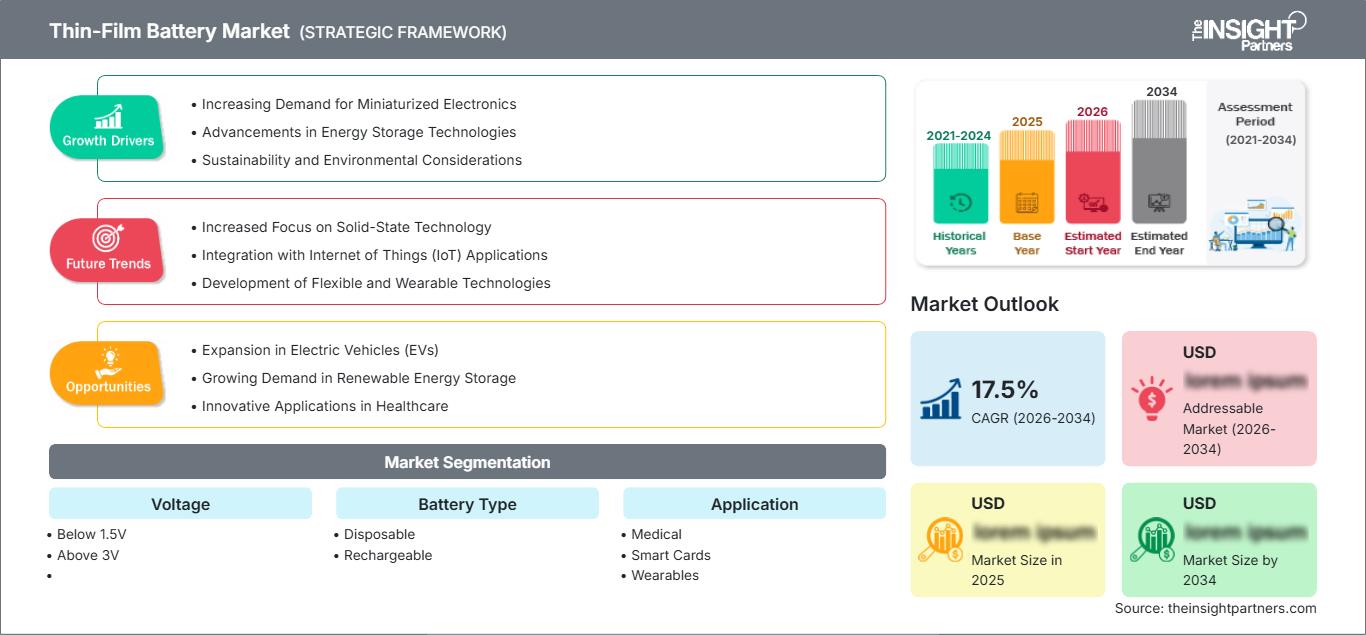
The Thin-Film Battery Market size is expected to grow from US$ 708.06 Million in 2025 to US$ 4,359.31 Million by 2034, at a CAGR of 22.38% for 2026-2034. The demand drivers for Thin Film Batteries include miniaturization of devices, solid state safety considerations, and increasing adoption in the medical electronics, smart cards, and wearables segments.
North America continues to be an important region for commercialization, where the Thin-Film Battery Market would be driven by opportunities in medical electronics, secure identification, and wearable health solutions. North America is forecasted to grow at a CAGR of 21-23% during 2026-2034.
Thin-Film Battery Market Assessment and Insights
- North America accounted for 31–34% Thin-Film Battery Market share in 2025 and is expected to grow at a CAGR range of 21–23% during 2026–2034, supported by medical device miniaturization and secure electronics.
- US represented 74–78% of North America in 2025 and is expected to grow at 21–23% CAGR through 2034, led by health monitoring and defense electronics.
- Europe held 22–25% share in 2025 and is projected to grow at 20–22% CAGR, with the UK, Germany, and France leading research, flexible electronics, and battery safety initiatives.
- Asia Pacific captured 30–33% share in 2025 and is forecast to grow at 23–25% CAGR, led by China, Japan, South Korea, and India across electronics manufacturing and wearable adoption.
- Largest Segment Rechargeable batteries held 70–74% market share in 2025 and are expected to grow at 22–24% CAGR as connected devices require reusable, compact power.
- High Growth Segment Wearables held 34–38% market share in 2025 and are projected to grow at 24–26% CAGR due to health, fitness, and remote monitoring demand.
- Key companies analyzed in detail: Blue Spark Technologies, Inc.; BrightVolt, Inc.; Cymbet Corporation; Enfucell Oy; Excellatron Solid State, LLC; Ilika plc; Imprint Energy, Inc.; ITN Energy Systems, Inc.; Molex, LLC; STMicroelectronics N.V.
Source: The Insight Partners' analysis based on proprietary research, government publications, company annual reports, investor presentations, industry databases, and expert interviews.
The technology is evolving from an experimental microcell format to more commercial formats including solid-state, printable, and flexible batteries. Manufacturing efficiencies have been improved with the help of processes such as roll-to-roll, vacuum deposition, and substrate engineering which allow thinner batteries while retaining charge. The market itself is transitioning from RFID use to high-end applications like medical patches and smart wearables that need micro-batteries with higher safety requirements.
There will be influences on future demand based on regional electronics supply chains, safety concerns for batteries, and investment in healthcare applications. Asia Pacific region will bring additional manufacturing capacity, but North America and Europe will maintain their strength in certified medical and industrial applications. Digital health, smart infrastructure, and secure identities system policies will further increase qualified demand.
Thin-Film Battery Market Report Scope
| Report Attribute | Details |
|---|---|
| Market size in 2025 | US$ 708.06 Million |
| Market Size by 2034 | US$ 4,359.31 Million |
| Global CAGR (2026 - 2034) | 22.38% |
| Historical Data | 2021-2024 |
| Forecast period | 2026-2034 |
Thin-Film Battery Market Analysis
The development of the Thin-Film Battery Market is driven by the convergence of low-power devices, connected health, and secure transactions. The battery must be in thin-film form and should not leak. Solid-state design ensures that all safety problems are taken care of, while also ensuring stability and efficiency in small designs.
The value chain includes electrode materials, solid electrolyte materials, deposition equipment, packaging, and device assembly. Supply dynamics will continue to remain niche since micro-batteries have to be made with proper layering and qualification. As more people use thin film batteries, buyers begin to focus on energy density, flexibility, and qualification timelines instead of the unit cost.
The Thin-Film Battery market analysis portrays a competitive environment that is dominated by niche specialists and diversified electronic component providers. Blue Spark Technologies, Cymbet, Enfucell, Ilika, Imprint Energy, and Excellatron work on unique chemistries and form factors, whereas Molex and STMicroelectronics have advantages in electronics and module integration.
The investment strategy is driven by the ability to prove scalability, longevity, and feasibility of automated assembly processes. The supplier's strategic position is increasingly determined by applications such as medical patches, smart labels, and wearables. Companies with reliable performance history win design projects ahead of others due to prolonged qualification time of devices.
● REPORT CUSTOMIZATION
Tailor This Report To Align With Your Specific Business Requirements
This report can be customized to align precisely with your business objectives, scope, and target markets. Customization options include tailored segmentation, geography, competitive analysis, and strategic insights to support informed decision-making.
Customize This Report →WHAT YOU CAN ADJUST
- ● Segmentations
- ● Geography
- ● Competitive Analysis
- ● Language Preferences
Thin-Film Battery Market: Strategic Insights
Regional Insights
North America Thin-Film Battery Market
In 2025, North America accounted for 31-34% market share of Thin-Film Battery with expected growth of 21-23% CAGR for the period of 2026-2034. It is driven by applications in medical electronics, security cards, and wearable devices, with buying behavior dependent on safety and reliability, as well as local innovation hubs.
There are highly developed research and development facilities, regulation of medical equipment, and early adaptation of remote monitoring systems. Development of microbatteries in the U.S. and medtech collaboration in Canada, as well as defense electronics projects are key drivers of demand for high-quality batteries.
U.S. Thin-Film Battery Market
United States accounted for 74–78% of North America in 2025 and will continue to register a CAGR of 21-23% till 2034. Drivers of the market include wearable biosensors, smart identification, and military electronic devices that require lightweight, safety-compliant cells to offer design flexibility.
Brand presence includes Blue Spark Technologies, Cymbet, Imprint Energy, Excellatron, and ITN Energy Systems. Trends in applications have tilted in favor of patch devices for monitoring patients, access cards, and small IoTs. Increasingly, purchasing decisions depend on qualification data, battery safety reports, and supplier support.
Europe Thin-Film Battery Market
Europe accounts for 22-25% market share in 2025 and is projected to witness growth at 20-22% CAGR through UK, Germany, and France. The UK enjoys advantages in Ilika’s expertise in solid-state batteries and materials innovations related to medical and industrial applications of micro energy.
Germany has strength in precise manufacturing, expertise in automobile electronics, and sensors. France, Italy, and Spain enjoy strengths in smart cards, digital healthcare solutions, and electronics assembly. European consumers value safety, recyclability, and regulations concerning batteries, which gives an edge to suppliers offering information on materials.
APAC Thin-Film Battery Market
The APAC region represented 30-33% market share in 2025 and will register CAGR of 23-25%. APAC region is dominated by China in the field of electronics manufacturing. Japan and South Korea are contributing by providing materials, sensors, and miniaturization of consumer devices.
The emerging demand comes from India and Australia, driven by digital health, secure identity, and energy storage initiatives in research. The policy for domestic manufacturing of electronics and semiconductors and connected healthcare is increasing adoption in APAC region.
Middle East & Africa Thin-Film Battery Market
Middle East & Africa is expected to grow at 18–20% CAGR during 2026–2034. Saudi Arabia and the UAE lead demand through smart infrastructure, healthcare modernization, and secure identification programs aligned with digital government initiatives.
South Africa and the Rest of MEA show selective adoption in medical monitoring, logistics tags, and industrial sensors. Energy diversification, hospital infrastructure investment, and connected asset tracking create opportunities, although limited local manufacturing keeps the region import-dependent.
Segmentation Analysis
Voltage
The voltage segment is expected to grow at 21–23% CAGR during 2026–2034. Thin-Film Battery scope across voltage categories reflects device power profiles, from ultra-low-power smart labels to higher-voltage medical and wearable electronics. Designers choose voltage specifications based on operating duration, signal transmission needs, and safety margins.
- Below 1.5V batteries serve low-power tags, sensors, and disposable electronics where compactness, shelf stability, and cost control are more important than high output.
- Above 3V batteries support more demanding medical patches, connected cards, and wearable modules requiring stronger voltage delivery within constrained device footprints.
Battery Type
The battery type segment is forecast to grow at 22–24% CAGR during 2026–2034. Rechargeable formats dominate where repeated use, charging convenience, and device lifecycle economics matter. Disposable formats remain relevant for single-use medical, logistics, and identification products requiring reliable activation and safe disposal after limited operating periods.
- Disposable batteries are used in smart labels, diagnostic patches, and temporary monitoring products where low maintenance and predictable one-time performance are central procurement criteria.
- Rechargeable batteries held 70–74% market share in 2025 and are preferred in wearables, medical electronics, and secure devices with repeated operating cycles.
Application
The application segment is projected to grow at 23–25% CAGR during 2026–2034. Adoption is strongest where product designers need compact batteries embedded into flexible, thin, or sealed systems. Medical, smart card, and wearable applications each require different balances of safety certification, durability, energy density, and scalable assembly.
- Medical applications include patches, biosensors, and implant-adjacent devices where safe solid-state operation and predictable discharge profiles support patient monitoring reliability.
- Smart Cards use thin cells for biometric authentication, display-enabled cards, and secure access products requiring embedded power without compromising card thickness.
- Wearables held 34–38% market share in 2025 and are expanding through health tracking, fitness monitoring, and connected lifestyle devices requiring lightweight power.
Opportunity Snapshot
| Application | Revenue Contribution | Trend Tag | Adoption Stage |
| Medical | High | Remote Care | Scaling |
| Smart Cards | Medium | Secure ID | Scaling |
| Wearables | High | Health Tracking | Scaling |
Thin-Film Battery Market Growth Drivers and Impact Analysis
Miniaturized Medical Electronics Demand
Medical technology companies are embracing lightweight, secure batteries in patches, bio sensors, and other connected devices. With solid-state batteries, there will be reduced risks of leakage, making them ideal for products that require sealing due to their contact with patients. In light of increased remote monitoring programs for chronic diseases, the battery industry can win through the delivery of reliable and certified micro-energy solutions.
Growth in Secure Smart Cards
The growing use of smart cards with displays, sensors, and dynamic authentication capabilities necessitates embedded power sources. Thin film batteries can enable power to be stored on such cards without adding to their thickness or altering the user experience. Applications by banks, government agencies issuing identification cards, and corporations issuing access control cards are driving demand for efficient microcells with long-term standby capabilities.
Wearable Device Design Constraints
Wearable device manufacturers find themselves constrained by the need for lightness, comfort, and long battery life. Thin-Film Batteries make it possible for the designers to incorporate batteries in curved bands, patches, and small modules where neither cylinder batteries nor button batteries will fit. The greatest market impact will be in health monitoring, fitness, and workplace safety wearables, as user compliance increases when wearables are lightweight and non-intrusive.
Thin-Film Battery Market Future Trends
Printable Solid-State Architectures
Thin-Film Battery market trends point toward printable and solid-state architectures that can be integrated directly into electronics substrates. Future designs will emphasize lower processing temperatures, flexible packaging, and compatibility with roll-to-roll manufacturing. This direction can reduce integration complexity for smart labels, medical patches, and low-power IoT devices. As production learning improves, suppliers may shift from custom prototypes toward platform products with standardized performance ranges and faster qualification cycles.
Battery Data and Traceability Integration
Future product requirements will increasingly include traceability, material transparency, and lifecycle documentation. Thin batteries used in healthcare, identity, and industrial devices will need stronger data records covering chemistry, safety, performance, and disposal. This trend favors suppliers that can provide documentation alongside the cell, helping device makers prepare for digital product passports, regulated procurement, and sustainability audits. Differentiation will move beyond capacity toward verifiable compliance readiness.
Thin-Film Battery Market Opportunities
Medical Wearable Platform Partnerships
Thin-Film Battery market Forecasts indicate attractive opportunities in partnerships with medical wearable developers. Battery suppliers can move upstream by co-designing power modules for patches, biosensors, and remote patient monitoring systems. Investment should focus on validated safety data, sterilization compatibility, and predictable discharge behavior. Companies able to provide engineering support during device certification can improve customer retention and capture higher margins than suppliers selling standard cells into fragmented channels.
Smart Identity and Payment Cards
Secure identity programs and premium payment cards create opportunities for embedded thin power sources. Battery developers can partner with card manufacturers to support biometric authentication, dynamic security codes, and display-enabled interfaces. The opportunity is action-oriented because buyers require reliable supply, consistent thickness, and long shelf life. Suppliers that align early with certification processes and high-volume lamination workflows can establish defensible positions in secure card ecosystems.
Recent Developments
- July 2026: Southwest Research Institute (SwRI) and Southern Methodist University (SMU) are collaborating to advance solid-state battery technology. Solid-state batteries are safer, longer-lasting, and more efficient alternatives to traditional lithium-ion batteries, offering faster charging and greater energy storage potential. They are especially promising for powering electric vehicles, but current designs are held back by electrodes and interfaces that degrade over time. SwRI and SMU will address this bottleneck and work together to develop a more stable solid-state battery design architecture.
- November 2025: Swiss battery start-up BTRY AG has raised USD 5.7 million in an oversubscribed seed round. The funds will accelerate the industrialization of its ultra-thin solid-state batteries – a new category of energy storage combining fast charging, extreme temperature stability, and intrinsic safety in one of the world’s thinnest formats.
Frequently Asked Questions

- Comprehensive Market Sizing and Forecast Analysis
- Detailed Segmentation Analysis
- In-Depth Market Dynamics Assessment
- Regional and Country-Level Insights
- Competitive Landscape and Company Benchmarking
- Strategic Business Intelligence
Recent Reports
Testimonials

The Insight Partners' SCADA System Market report is comprehensive, with valuable insights on current trends and future forecasts. The team was highly professional, responsive, and supportive throughout. We are very satisfied and highly recommend their services.
RAN KEDEM Partner, Reali Technologies LTDs
I requested a report on a very specific software market and the team produced the report in a few days. The information was very relevant and well presented. I then requested some changes and additions to the report. The team was again very responsive and I got the final report in less than a week.
JEAN-HERVE JENN Chairman, Future Analytica
We worked with The Insight Partners for an important market study and forecast. They gave us clear insights into opportunities and risks, which helped shape our plans. Their research was easy to use and based on solid data. It helped us make smart, confident decisions. We highly recommend them.
PIYUSH NAGPAL Sr. Vice President, High Beam Global
The Insight Partners delivered insightful, well-structured market research with strong domain expertise. Their team was professional and responsive throughout. The user-friendly website made accessing industry reports seamless. We highly recommend them for reliable, high-quality research services
YUKIHIKO ADACHI CEO, Deep Blue, LLC.
This is the first time I have purchased a market report from The Insight Partners.While I was unsure at first, I visited their web site and felt more comfortable to take the risk and purchase a market report.I am completely satisfied with the quality of the report and customer service. I had several questions and comments with the initial report, but after a couple of dialogs over email with their analyst I believe I have a report that I can use as input to our strategic planning process.Thank you so much for taking the extra time and making this a positive experience.I will definitely recommend your service to others and you will be my first call when we need further market data.
JOHN SUZUKI President and Chief Executive Officer, Board Director, BK Technologies
I wish to appreciate your support and the professionalism you displayed in the course of attending to my request for information regarding to infectious disease IVD market in Nigeria. I appreciate your patience, your guidance, and the fact that you were willing to offer a discount, which eventually made it possible for us to close a deal. I look forward to engaging The Insight Partners in the future, all thanks to the impression you have created in me as a result of this first encounter.
DR CHIJIOKE ONYIA MANAGING DIRECTOR, PineCrest Healthcare Ltd.Reason to Buy
- Informed Decision-Making
- Understanding Market Dynamics
- Competitive Analysis
- Identifying Emerging Markets
- Customer Insights
- Market Forecasts
- Risk Mitigation
- Boosting Operational Efficiency
- Strategic Planning
- Investment Justification
- Tracking Industry Innovations
- Aligning with Regulatory Trends





 Get Free Sample for