
Timing Devices Market Demand, Share & Growth by 2034
Coverage: by Type (Oscillators, Resonators, Clock Generators, Clock Buffers, Jitter Attenuators); Material (Crystal, Ceramic, Silicon); Application (Consumer Electronics, Telecommunications and Networking, Automotive, Military and Defense, Industrial, Medical and Healthcare, Others) , and Geography (North America, Europe, Asia Pacific, and South and Central America)
- Status : Data Released
- Report Code : TIPRE00011685
- Category : Electronics and Semiconductor
- No. of Pages : 150
- Available Report Formats :


- Last update date : July 21, 2026


2025 Market Size
US$ 5.71 Bn
Base year value
2034 Forecast
US$ 7.78 Bn
Projected by 2034
CAGR 2026-2034
3.5 %
Growth rate
Addressable Market
US$ 61.28 Bn
(2026-2034)
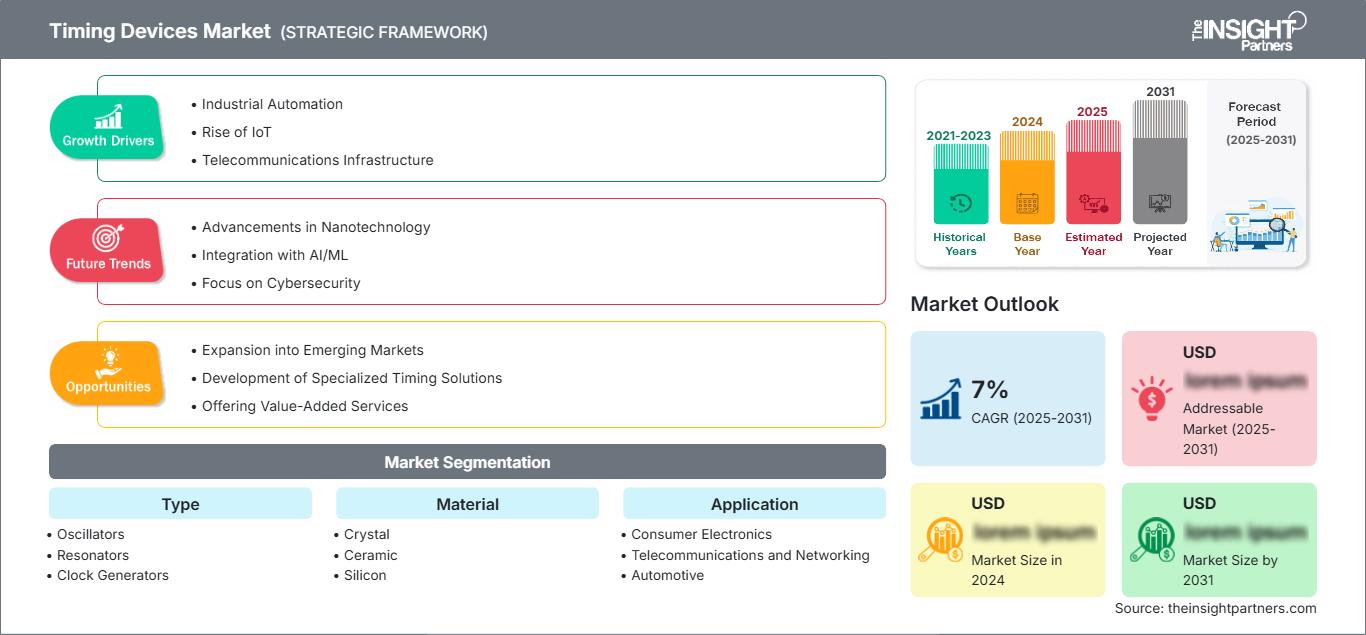
The global Timing Devices market was valued at US$ 5.71 billion in 2025 and is expected to reach US$ 7.78 billion by 2034; it is estimated to record a CAGR of 3.5% during 2026-2034.
Timing Devices Market Assessment and Insights
- North America held 27–30% share in 2025 and is projected to grow at a 3.6–4.1% CAGR during 2026–2034, supported by cloud infrastructure, aerospace electronics, and resilient domestic semiconductor programs.
- US accounted for 78–82% of North America in 2025 and is expected to grow at a 3.7–4.2% CAGR through enterprise networking and automotive electronics demand.
- Europe represented 18–21% share in 2025 and is forecast to grow at a 3.2–3.7% CAGR, led by Germany, the UK, France, Italy, and Spain.
- Asia Pacific captured 43–47% share in 2025 and is projected to grow at a 4.1–4.8% CAGR, with China, Japan, South Korea, India, and Taiwan driving volume production.
- Largest Segment Oscillators held 38–42% market share in 2025 and are expected to grow at a 3.8–4.3% CAGR because they remain core timing references in connected devices.
- High Growth Segment Jitter attenuators held 8–11% market share in 2025 and are forecast to grow at a 5.0–5.8% CAGR as high-speed network timing requirements intensify.
- Key companies analyzed in detail: Asahi Kasei Microdevices Corporation, Infineon Technologies AG, KYOCERA Corporation, Microchip Technology Incorporated, Murata Manufacturing Co., Ltd., NIHON DEMPA KOGYO CO., LTD., Rakon Limited, Seiko Epson Corporation, Texas Instruments Incorporated, TXC Corporation.
Source: The Insight Partners' analysis based on proprietary research, government publications, company annual reports, investor presentations, industry databases, and expert interviews.
Timing components have transitioned in technology migration from commoditized clocking sources to specialized synchronization platforms. Quartz plays an integral role wherever the key concerns are phase noise and stability, while silicon and ceramic-based timing options provide better miniaturization, integration capabilities, and cost efficiencies. Suppliers will continue balancing their efforts in automation, tighter tolerance selection, and local procurement to mitigate the risk of quartz blanks availability and qualification cycles in automotive, telecom, and industrial markets.
Going forward, growth will expand beyond current regions into India, Southeast Asia, and the Gulf countries, which are building up electronics manufacturing capacities and developing smart cities initiatives and medical device production. Regulatory support in semiconductors supply chain security, connected vehicle safety systems, and military communications will drive business towards those suppliers who bring frequency stability and traceability along with the expertise in applications.
Timing Devices Market Report Scope
| Report Attribute | Details |
|---|---|
| Market size in 2025 | US$ 5.71 Billion |
| Market Size by 2034 | US$ 7.78 Billion |
| Global CAGR (2026 - 2034) | 3.5% |
| Historical Data | 2021-2024 |
| Forecast period | 2026-2034 |
Timing Devices Market Analysis
The market will be influenced by greater demand for accurate clocks in 5G radio, AI servers, EV control module applications, and factory automation. These applications have increased synchronization among various sub-systems, thus making the quality of timing an important design parameter.
The supply chain involves the growth of quartz crystals, MEMS or silicon design, packaging, testing, distribution, and qualification by customers. The industry will continue being disciplined owing to the lengthy qualification processes of automotive and defense programs and also the pressure from consumer electronics end-users regarding the size, power efficiency, and multi-frequency capability of products.
Moderate competition is exhibited in the industry, with leading players such as Seiko Epson Corporation, NIHON DEMPA KOGYO CO., LTD., TXC Corporation, KYOCERA Corporation, and Rakon Limited retaining good frequency control offerings. Microchip Technology Incorporated, Texas Instruments Incorporated, Infineon Technologies AG, Murata Manufacturing Co., Ltd., and Asahi Kasei Microdevices Corporation have added more value to the ecosystem with their offerings of timing, sensing, and semiconductor solutions.
The Timing Devices Investment report is showing that the focus is on programmable clocks, reduced jitter, qualification for the automotive industry, and regional manufacturability. Companies that can provide rapid design customizations along with achieving stability and reliability levels will be able to tap into platform opportunities in routers, batteries, robots, imaging, and secure communication equipment.
● REPORT CUSTOMIZATION
Tailor This Report To Align With Your Specific Business Requirements
This report can be customized to align precisely with your business objectives, scope, and target markets. Customization options include tailored segmentation, geography, competitive analysis, and strategic insights to support informed decision-making.
Customize This Report →WHAT YOU CAN ADJUST
- ● Segmentations
- ● Geography
- ● Competitive Analysis
- ● Language Preferences
Timing Devices Market: Strategic Insights
Regional Insights
North America Timing Devices Market
North America represented 27–30% share in 2025 and is expected to register a 3.6–4.1% CAGR during 2026–2034. Hyperscale data center operations, 5G connectivity improvements, aerospace electronic systems, and next-generation automobiles that need to function efficiently with stable synchronization amid thermal and mechanical stress provide significant value in the regiosn.
The North American Timing Devices Market share is supported by semiconductor design expertise and defense purchasing power, while fabrication reliance promotes dual sourcing. The market demand centers on precision oscillators, clock generators, and jitter cleaners for routers, servers, radar units, EV power electronics, and imaging machines.
U.S. Timing Devices Market
The U.S. accounted for 78–82% of North America in 2025 and is forecast to grow at a 3.7–4.2% CAGR. There is a link between domestic demand and cloud computing, telecommunications routing, aircraft systems, industrial control systems, and vehicle electronics applications that may be impacted by timing drift in terms of accuracy and security.
Microchip Technology Incorporated and Texas Instruments Incorporated are promoting the adoption of integrated timing via their semiconductor customers base. There is an increasing demand for configurable clocks, low jitter buffer, and automotive oscillator among U.S. buyers of long life electronic products to save space and ensure continued sourcing.
Europe Timing Devices Market
Europe held 18–21% share in 2025 and is projected to grow at a 3.2–3.7% CAGR. Germany takes the lead via automotive electronics, industrial automation, and testing equipment. The UK makes its contribution via defense communications, satellite technology, and electronics design.
France, Italy, and Spain contribute demand generated by aerospace, energy, rail signaling, and medical manufacturing. European customers give preference to reliable components that are supported by lifecycle data and have traceable sources, which is beneficial for established companies with a history of reliability in harsh conditions.
APAC Timing Devices Market
APAC captured 43–47% share in 2025 and is expected to grow at a 4.1–4.8% CAGR. China leads on electronics assembly scale, while Japan, South Korea, Taiwan, India, and Australia add demand from semiconductors, telecom equipment, vehicles, and industrial systems.
Industrial policy, electronics localization, and 5G expansion support the region’s leadership. Japan remains important for quartz expertise through Seiko Epson Corporation, NIHON DEMPA KOGYO CO., LTD., KYOCERA Corporation, and Murata Manufacturing Co., Ltd., while India expands design and manufacturing incentives.
Middle East & Africa Timing Devices Market
Middle East and Africa is projected to grow at a 3.0–3.6% CAGR, led by Saudi Arabia and the UAE. Energy automation, telecom modernization, defense communications, and smart-city infrastructure increase requirements for reliable timing in harsh operating conditions.
South Africa and the Rest of MEA contribute through mining automation, grid monitoring, healthcare equipment, and network upgrades. Adoption is smaller than in APAC or North America, yet buyers increasingly favor rugged oscillators and clock modules with proven stability under power and temperature variability.
Segmentation Analysis
Type
Type is expected to grow at a 3.8–4.4% CAGR during 2026–2034. The Timing Devices Market scope across type reflects differentiated needs for reference stability, signal distribution, and jitter control. Oscillators lead installed demand, while clock generators, buffers, and attenuators gain importance as systems handle more data lanes.
- Oscillators provide the primary reference signal for electronic circuits and remain the largest type because consumer devices, telecom radios, vehicles, and industrial controllers require stable frequency sources.
- Resonators are widely used where compact, cost-efficient frequency control is sufficient, especially in embedded electronics, automotive modules, remote controls, and lower-complexity connected products.
- Clock Generators support multi-frequency system architectures by distributing synchronized signals across processors, memory, sensors, and communication interfaces in servers, routers, and advanced control boards.
- Clock Buffers strengthen signal integrity by distributing clock signals to multiple loads, making them strategically important in high-density printed circuit boards and networking platforms.
- Jitter Attenuators reduce timing noise in high-speed transmission paths, supporting optical networks, 5G infrastructure, data centers, and instrumentation requiring deterministic signal quality.
Material
Material is forecast to grow at a 3.5–4.2% CAGR during 2026–2034. Crystal remains preferred for precision and long-term stability, ceramic supports cost-sensitive resonator applications, and silicon-based timing gains share where integration, programmability, and miniaturization matter in compact electronic systems.
- Crystal materials dominate precision timing because quartz offers proven stability, mature production economics, and strong qualification history across telecom, automotive, aerospace, and instrumentation platforms.
- Ceramic materials address compact resonator demand in cost-sensitive electronics, supporting stable timing where extreme precision is less critical than package simplicity and high-volume manufacturability.
- Silicon timing solutions are gaining attention where programmable output, shock resistance, small footprints, and integration with semiconductor platforms improve design flexibility.
Application
Application is projected to grow at a 3.7–4.5% CAGR during 2026–2034. Demand is strongest where timing reliability supports synchronization, safety, and data accuracy. Consumer electronics deliver volume, while telecommunications, automotive, defense, industrial, and healthcare applications raise performance requirements.
- Consumer Electronics remains a high-volume application as smartphones, wearables, tablets, gaming devices, and smart home products require compact oscillators and resonators for power-efficient timing.
- Telecommunications and Networking uses precision clocks, buffers, and jitter attenuation to synchronize radio access networks, optical transport, routers, switches, and data center infrastructure.
- Automotive demand is rising as ADAS, infotainment, battery management, connectivity, and domain controllers increase the number of qualified timing components per vehicle.
- Military and Defense requires rugged timing references for radios, radar, navigation, secure communications, unmanned systems, and satellite payloads operating under vibration and temperature extremes.
- Industrial applications include robotics, machine vision, process automation, smart meters, programmable logic controllers, and test equipment where synchronization supports uptime and repeatability.
- Medical and Healthcare uses timing devices in imaging, monitoring, diagnostics, surgical equipment, and portable instruments where stable clocks support measurement accuracy and device reliability.
Opportunity Snapshot
| Application | Revenue Contribution | Trend Tag | Adoption Stage |
| Consumer Electronics | High | Wearables Timing | Mature |
| Telecommunications and Networking | High | 5G Sync | Scaling |
| Automotive | Medium | ADAS Clocks | Scaling |
| Military and Defense | Medium | Secure Timing | Scaling |
| Industrial | Medium | Factory Sync | Mature |
| Medical and Healthcare | Low | Portable Diagnostics | Emerging |
Timing Devices Market Growth Drivers and Impact Analysis
High-Speed Network Synchronization Requirements
The telecommunications network and data center network are moving towards denser traffic, lower latency, and deterministic synchronization. The 5G radio heads, packet transport devices, optical modules, and AI servers need clocking solutions such as clock generation, buffering, and jitter cleaning which ensures integrity in high-speed interface communications. This results in design pull for components that have low phase noise and stable output in high thermal environments. The Timing Devices Market is positively affected by this development as failure in timing can lead to reduction in throughput, packet errors, and unstable computing workload distribution.
Automotive Electronics Content Expansion
Today’s cars have more processors, communications gateways, battery management systems, sensors, and infotainment units than previous models. All these systems require clocks that qualify to automotive standards for temperature range and longevity. The rise of electric and software-defined vehicles increases the need for synchronized information between domain controllers. What is important here is that such a change in demands from the side of the customer leads to preference being given to suppliers who can provide reliability, capacity, and continuity rather than low-cost components.
Miniaturization Across Connected Devices
Wearable devices, medical patches, tracking devices for assets, and sensors used in the industrial sector continue to shrink their board space while enhancing the battery life. In such a case, the timing devices have to offer not only small form factors but also low power consumption along with stable frequency generation. Small form factor oscillators and silicon timing solutions assist in reducing the design complexity without compromising on the communication accuracy. The effect will be more pronounced for mass-produced devices, where even minor changes in the form factor have an impact.
Timing Devices Market Future Trends
Programmable Timing Architectures
Timing Devices Market trends will increasingly favor programmable architectures that replace multiple fixed-frequency components with configurable clock trees. This shift can shorten design cycles, reduce inventory complexity, and support late-stage frequency changes in networking, aerospace, and industrial platforms. Programmability also supports regional sourcing resilience because one qualified device may serve several product variants. As system complexity grows, engineers will evaluate timing devices not only by frequency stability, but also by configuration tools, output flexibility, and documentation quality. Suppliers that combine hardware performance with software-assisted design support should improve customer retention.
Higher Reliability for Space and Defense Platforms
The space, defense, and resilient communication platform is headed for a paradigm where smaller payloads with high time performance are considered. The future need will be for a device that has the characteristics of being radiation resistant, vibration resistant, low phase noise, and lower power consumption in smaller packages. This requirement will be facilitated further by satellite constellations, secure navigation, electronic warfare, and autonomous defense systems. The procurement cycle may not change much; however, successful qualification can lead to long-term revenue visibility.
Timing Devices Market Opportunities
Localized Electronics Manufacturing Programs
India, Southeast Asia, and the Middle East are expanding electronics assembly, telecom equipment production, and industrial automation programs. Timing Devices Market Forecast indicate that suppliers can benefit by aligning distribution, technical support, and inventory planning with these localization initiatives. The opportunity is not limited to high-volume consumer products because industrial, defense, and medical equipment makers also need qualified clocking solutions. Market entrants should prioritize reference designs, local application engineering, and partnerships with contract manufacturers. Established players can defend share by offering shorter lead times and broader frequency availability.
Automotive-Grade Timing Portfolio Expansion
Automotive platforms offer an attractive opportunity because timing devices are embedded across safety, connectivity, electrification, and infotainment systems. Suppliers can expand by increasing AEC-qualified oscillator, resonator, and clock generator portfolios with broader temperature ratings and smaller packages. Commercial success will depend on early engagement with Tier 1 suppliers, reliability documentation, and stable production capacity. As vehicle architectures consolidate around domain and zonal controllers, timing vendors can move from component supply toward platform support, improving design stickiness and reducing substitution risk during model cycles.
Recent Developments
- May 2026: Microchip Technology Incorporated — announced the EX-423 Evacuated Miniature Crystal Oscillator, a compact low-power timing solution for high stability, accuracy, and long-term reliability in GPS/GNSS tracking, military radios, medical devices, seismic systems, test equipment, and satellite communications.
- February 2026: Seiko Epson Corporation — developed compact TG1210SRN and TG1210STN temperature-compensated crystal oscillators with high-precision frequency stability across a wide temperature range, targeting GNSS modules, wearables, IoT equipment, communication modules, factory automation equipment, and data center timing applications.
- September 2025: NIHON DEMPA KOGYO CO., LTD. — announced the NX1612SA crystal unit for automotive applications, offering a 1.6 mm by 1.2 mm package and frequency stability over -40°C to +125°C for ADAS, Bluetooth Low Energy, Wi-Fi, Ethernet, and UWB communication modules.
Frequently Asked Questions

- Comprehensive Market Sizing and Forecast Analysis
- Detailed Segmentation Analysis
- In-Depth Market Dynamics Assessment
- Regional and Country-Level Insights
- Competitive Landscape and Company Benchmarking
- Strategic Business Intelligence
Recent Reports
Testimonials

The Insight Partners provided valuable market intelligence that supported our global go-to-market strategy. Their team was professional, responsive, and attentive to our feedback, providing thoughtful analysis and helpful methodological clarifications throughout the project.
Junmo Kim Chief Financial Officer (CFO), Enertech Co., Ltd.
The Insight Partners' SCADA System Market report is comprehensive, with valuable insights on current trends and future forecasts. The team was highly professional, responsive, and supportive throughout. We are very satisfied and highly recommend their services.
RAN KEDEM Partner, Reali Technologies LTDs
I requested a report on a very specific software market and the team produced the report in a few days. The information was very relevant and well presented. I then requested some changes and additions to the report. The team was again very responsive and I got the final report in less than a week.
JEAN-HERVE JENN Chairman, Future Analytica
We worked with The Insight Partners for an important market study and forecast. They gave us clear insights into opportunities and risks, which helped shape our plans. Their research was easy to use and based on solid data. It helped us make smart, confident decisions. We highly recommend them.
PIYUSH NAGPAL Sr. Vice President, High Beam Global
The Insight Partners delivered insightful, well-structured market research with strong domain expertise. Their team was professional and responsive throughout. The user-friendly website made accessing industry reports seamless. We highly recommend them for reliable, high-quality research services
YUKIHIKO ADACHI CEO, Deep Blue, LLC.
This is the first time I have purchased a market report from The Insight Partners.While I was unsure at first, I visited their web site and felt more comfortable to take the risk and purchase a market report.I am completely satisfied with the quality of the report and customer service. I had several questions and comments with the initial report, but after a couple of dialogs over email with their analyst I believe I have a report that I can use as input to our strategic planning process.Thank you so much for taking the extra time and making this a positive experience.I will definitely recommend your service to others and you will be my first call when we need further market data.
JOHN SUZUKI President and Chief Executive Officer, Board Director, BK Technologies
I wish to appreciate your support and the professionalism you displayed in the course of attending to my request for information regarding to infectious disease IVD market in Nigeria. I appreciate your patience, your guidance, and the fact that you were willing to offer a discount, which eventually made it possible for us to close a deal. I look forward to engaging The Insight Partners in the future, all thanks to the impression you have created in me as a result of this first encounter.
DR CHIJIOKE ONYIA MANAGING DIRECTOR, PineCrest Healthcare Ltd.Reason to Buy
- Informed Decision-Making
- Understanding Market Dynamics
- Competitive Analysis
- Identifying Emerging Markets
- Customer Insights
- Market Forecasts
- Risk Mitigation
- Boosting Operational Efficiency
- Strategic Planning
- Investment Justification
- Tracking Industry Innovations
- Aligning with Regulatory Trends





 Get Free Sample for