
Titanium Dioxide Pigments Market Size, Share & Forecast to 2035
Coverage: By Product Grade (Rutile TiO2 Pigment, Anatase TiO2 Pigment), Process (Chloride, Sulfate), and Application (Paints and Coatings, Plastics, Paper and Packaging, Printing Inks, Cosmetics and Personal Care, Pharmaceuticals, Others)
- Status : Published
- Report Code : TIPRE00044087
- Category : Chemicals and Materials
- No. of Pages : 367
- Available Report Formats :


- Last update date : November 25, 2026


2025 Market Size
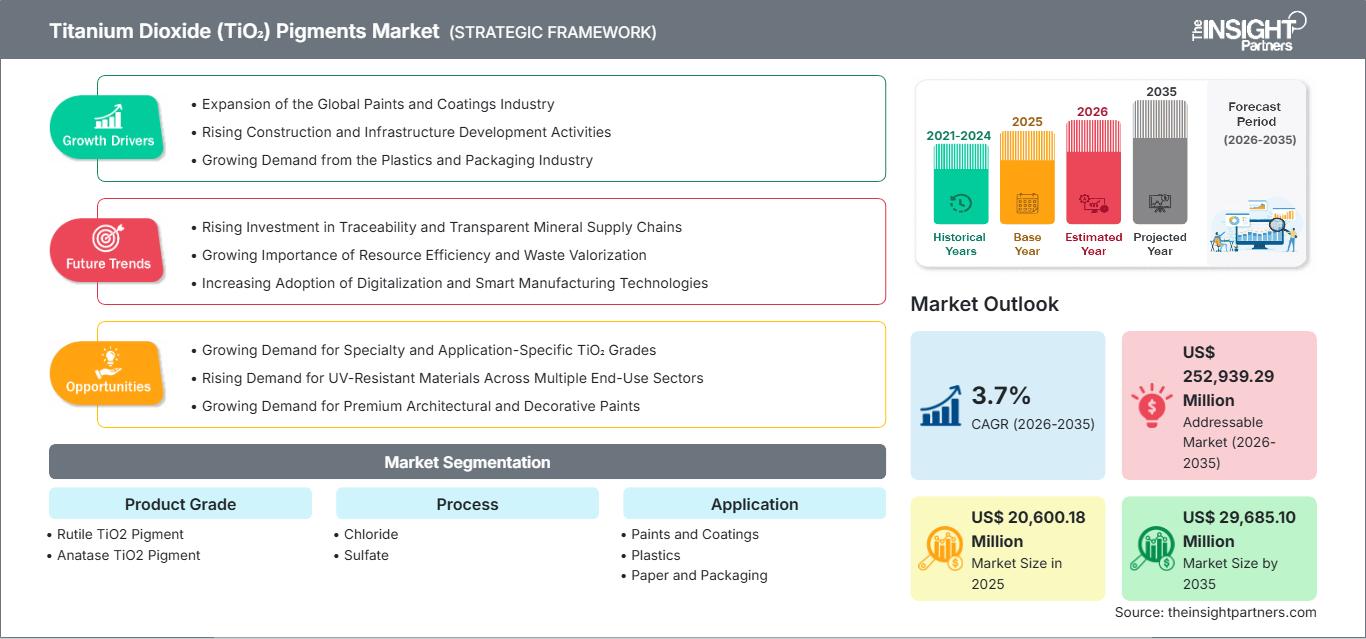
US$ 20,600.18 Mn
Base year value
2035 Forecast
US$ 29,685.10 Mn
Projected by 2035
CAGR 2026-2035
3.7 %
Growth rate
Addressable Market
US$ 252,939.29 Mn
(2026-2035)
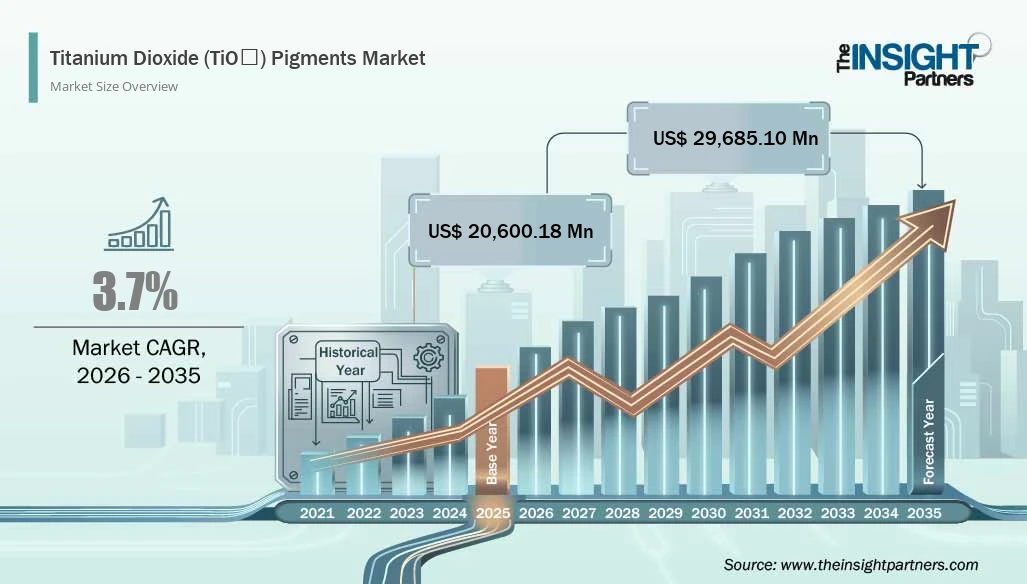
The Titanium Dioxide Pigments Market was valued at US$ 20600.18 Mn in 2025 and is projected to reach US$ 29685.10 Mn by 2035, registering a CAGR of 3.7% during 2026–2035. Market expansion is supported by increasing consumption of paints and coatings, rising plastics production, infrastructure development, and demand for high-opacity materials. Industrial manufacturing activity, construction investment, and the need for durable surface protection continue to influence pigment procurement, while manufacturing efficiency and environmental compliance shape supplier competitiveness.
North America represents an established demand centre, supported by residential and commercial construction, automotive manufacturing, industrial maintenance, and specialty coatings production. The regional market is expected to register a CAGR of ~3% through 2035. Demand is reinforced by renovation activity, advanced coating formulations, and established distribution networks. Manufacturers operating in the region increasingly emphasize product consistency, application-specific technical support, and production efficiency to maintain customer relationships amid competition from international suppliers.
Titanium Dioxide Pigments Market Assessment and Insights
Regional Outlook
- North America: ~22% of the global market in 2025 | ~3% CAGR through 2035. North America maintains a substantial position through established coatings production, industrial maintenance requirements, and automotive applications. The United States represents the principal demand centre, supported by mature manufacturing infrastructure and established pigment distribution networks.
- US: ~75% of North American market revenue in 2025 | ~3% CAGR through 2035. The United States dominates regional consumption because of its extensive construction, automotive, packaging, and industrial coatings industries. Established manufacturers and specialty formulation requirements support recurring procurement.
- Europe: ~20% of the global market in 2025 | ~2% CAGR through 2035. European demand reflects a mature industrial base, established automotive production, and stringent product stewardship requirements. Germany leads the regional market, followed by the UK, France, Italy, and Spain.
- Asia Pacific: ~48% of the global market in 2025 | ~5% CAGR through 2035. Asia Pacific represents the largest and fastest-growing regional market. China leads production and consumption, while India, Japan, and South Korea contribute through expanding manufacturing, infrastructure development, and specialty material requirements.
Segment Outlook
- Rutile TiO2 Pigment: ~93% share in 2025 | ~4% CAGR through 2035. Rutile dominates commercial demand because of its high refractive index, opacity, weather resistance, and suitability for demanding industrial applications. Its performance characteristics support extensive adoption in architectural coatings, automotive finishes, plastics, and exterior materials.
- Plastics: ~15% share in 2025 | ~5% CAGR through 2035. Market position: Increasing polymer production, packaging requirements, and demand for UV-resistant materials support this application's growth. Manufacturers value consistent dispersion, color stability, and opacity in polymer processing.
Competitive Coverage
Tronox Holdings plc, The Chemours Company, Kronos Worldwide Inc., LB Group Co., Ltd., Ishihara Sangyo Kaisha, Ltd., Meghmani Organics Ltd., The Kerala Minerals & Metals Limited, Travancore Titanium Products Ltd., Venator Materials Plc, VVTi Pigments Pvt. Ltd., TAYCA Co., Ltd., Grupa Azoty S.A., Anhui Annada Titanium Industry Co., Ltd., TOR Minerals, Titanos Group.
Methodology
The Insight Partners follows Data Collection & Secondary Research, Primary Research, Data Analysis, and Data Triangulation & Final Review to validate market estimates and insights.
Source: The Insight Partners' analysis based on proprietary research, government publications, company annual reports, investor presentations, industry databases, and expert interviews.
The industry has developed around two principal manufacturing technologies, chloride and sulfate processing, with differences in feedstock requirements, production economics, product characteristics, and environmental considerations. Producers increasingly evaluate manufacturing footprints according to energy availability, mineral feedstock access, logistics, and regional customer concentration. Production capacity remains concentrated among major international manufacturers and Chinese producers, although smaller specialists maintain positions through application-specific products. This structure creates competition across both production costs and technical performance, making consistent pigment quality an important purchasing consideration.
The forward outlook will depend on investment in production efficiency, specialty-grade development, and emerging manufacturing centres. India and Southeast Asian economies offer opportunities as construction, consumer goods, and polymer manufacturing expand. Meanwhile, European and North American producers face greater pressure to optimize existing assets and demonstrate environmental compliance. Investments in feedstock integration, energy-efficient processing, and improved waste management could influence future supplier selection. Producers capable of combining reliable supply with customer-specific formulation support are likely to maintain stronger commercial relationships.
Titanium Dioxide Pigments Market Report Scope
| Report Attribute | Details |
|---|---|
| Market size in 2025 | US$ 20,600.18 Million |
| Market Size by 2035 | US$ 29,685.10 Million |
| Global CAGR (2026 - 2035) | 3.7% |
| Historical Data | 2021-2024 |
| Forecast period | 2026-2035 |
Titanium Dioxide Pigments Market Analysis
The Titanium Dioxide Pigments Market growth is closely associated with construction expenditure, industrial production, automotive manufacturing, and consumer packaging requirements. Paints and coatings remain the principal demand-generating application because titanium dioxide provides opacity, whiteness, brightness, and durability. Infrastructure maintenance and residential renovation create recurring consumption, while new construction generates additional demand through architectural coatings. Plastics manufacturers also require pigments to improve color consistency, opacity, and resistance to ultraviolet exposure. These requirements connect pigment demand to several downstream industries rather than a single end-use sector.
The value chain begins with titanium-bearing mineral extraction and beneficiation, followed by feedstock processing, pigment manufacturing, surface treatment, finishing, and distribution. Producers depend on ilmenite, rutile, synthetic rutile, and other titanium intermediates. Raw material availability, sulfuric acid, chlorine, energy, and transportation influence manufacturing costs. Integrated producers can coordinate mineral supply and pigment output, whereas independent manufacturers may face greater exposure to feedstock price fluctuations. Distributors and technical service providers connect pigment manufacturers with coatings formulators, polymer processors, and industrial customers.
Competition in the Titanium Dioxide Pigments Market combines scale, cost control, technical differentiation, and geographic reach. LB Group has established a substantial manufacturing position through its Chinese production base, while Tronox Holdings plc benefits from mineral sands integration and geographically diversified facilities. The Chemours Company competes through established Ti-Pure product formulations and customer relationships. Kronos Worldwide Inc. emphasizes differentiated pigment grades and technical service. These companies compete with regional manufacturers that often focus on local supply, price competitiveness, and specific application requirements.
Investment decisions increasingly reflect the economics of existing capacity rather than expansion alone. Producers are evaluating underperforming facilities, improving plant utilization, and prioritizing higher-value products. Companies such as Ishihara Sangyo Kaisha, Ltd. and TAYCA Co., Ltd. maintain specialist positions through technical product development. Indian manufacturers, including Meghmani Organics Ltd., The Kerala Minerals & Metals Limited, and Travancore Titanium Products Ltd., contribute to regional supply diversification. Strategic differentiation increasingly depends on operational reliability, customer qualification, feedstock security, and the ability to manage environmental obligations.
● REPORT CUSTOMIZATION
Tailor This Report To Align With Your Specific Business Requirements
This report can be customized to align precisely with your business objectives, scope, and target markets. Customization options include tailored segmentation, geography, competitive analysis, and strategic insights to support informed decision-making.
Customize This Report →WHAT YOU CAN ADJUST
- ● Segmentations
- ● Geography
- ● Competitive Analysis
- ● Language Preferences
Titanium Dioxide Pigments Market: Strategic Insights
Regional Insights
North America Titanium Dioxide Pigments Market
North America accounts for ~22% of global revenue in 2025 and is expected to register a CAGR of ~3% through 2035. The region benefits from established construction, automotive, industrial manufacturing, and packaging sectors. Demand is supported by architectural coatings, protective coatings, automotive refinishing, and specialty plastics. The United States represents the largest national contributor because of its extensive industrial customer base and established pigment manufacturing infrastructure. Canada contributes through industrial coatings, construction materials, and downstream manufacturing, while Mexico benefits from automotive production and expanding industrial activity.
Regional purchasing patterns reflect a preference for dependable supply, consistent quality, and technical support. Manufacturers increasingly consider product performance alongside delivered cost, particularly for applications requiring weather resistance and long service life. The presence of Chemours, Tronox, and Kronos strengthens the domestic supply ecosystem. However, competition from imported products and fluctuations in industrial activity influence pricing and plant utilization. Future demand will depend on construction renovation, infrastructure maintenance, and the competitiveness of domestic pigment production relative to imported material.
US Titanium Dioxide Pigments Market
The United States represents ~75% of North American market revenue in 2025 and is projected to register a CAGR of ~3% through 2035. Its position reflects the scale of domestic architectural coatings, automotive manufacturing, packaging, and industrial maintenance. Titanium dioxide is an important formulation component for paints used in residential construction, commercial buildings, and infrastructure protection. Industrial customers also require pigments for plastics, laminates, and specialized coating systems. The country's established distribution infrastructure supports procurement across large manufacturers and smaller formulation companies.
The competitive environment includes The Chemours Company, Tronox Holdings plc, and Kronos Worldwide Inc. Their established manufacturing and distribution capabilities provide access to major industrial customers. Demand is also influenced by product reformulation, durability requirements, and procurement strategies focused on supply continuity. Coatings producers increasingly assess pigment performance through opacity, dispersion, weatherability, and compatibility with formulation systems. Mexico and Canada provide additional regional trade and manufacturing connections, but the United States remains the principal source of North American demand.
Europe Titanium Dioxide Pigments Market
Europe accounts for ~20% of global revenue in 2025 and is forecast to register a CAGR of ~2% through 2035. The region has a mature coatings and chemicals industry, established automotive manufacturing, and extensive industrial infrastructure. Germany represents the leading country in Europe, supported by its automotive, machinery, construction materials, and specialty chemicals industries. Its industrial customer base requires consistent pigment performance across architectural, automotive, and protective coating formulations. The UK maintains demand through construction maintenance, industrial coatings, and packaging production.
In addition, France utilizes its construction needs, automotive coatings, cosmetics and manufacturing industries. On the other hand, Italy has a diverse downstream application in architectural paints, furniture finishes, plastics and packaging. In Spain, construction needs, infrastructure repair and maintenance as well as automotive manufacturing support demand. All three countries provide a wide-ranging consumer base, even though their consumer habits differ based on industrial focus and construction investments.
Producers in Europe are faced with structural difficulties in relation to manufacturing costs, compliance and competition. Compliance issues affect chemical storage, emission control, waste management and stewardship of products. This creates the need for efficient manufacturing and proper documentation. Purchasers factor in supply chain assurance and product consistency in choosing pigment providers. Pigment manufacturers could opt for specialized applications, plant optimization and differentiation of formulations and not price competition alone. European demand growth will be moderate and supported by replacement and industrial applications.
Asia Pacific Titanium Dioxide Pigments Market
Asia Pacific holds ~48% of global revenue in 2025 and is projected to register a CAGR of ~5% through 2035, making it the fastest-growing region. China is the leading country in Asia Pacific, supported by its extensive pigment manufacturing capacity, coatings industry, and plastics production. India represents an important expanding demand center, driven by infrastructure development, housing construction, and industrial diversification. Japan and South Korea contribute through established automotive, electronics, specialty chemicals, and high-performance materials industries.
Demand is generated in Australia through construction, maintenance of infrastructure, industrial coating due to mining operations and manufacturing. The regional suppliers have an advantage due to existing mineral processing facilities and location near big buyers. The manufacturing volume in China affects global prices and trade movements. India has local production and import contributing to availability in the market. Investments in industry and urbanization and increased polymer consumption help generate regional demand in the future.
Middle East and Africa Titanium Dioxide Pigments Market
The Middle East and Africa region is expected to register a CAGR of ~4% through 2035. Saudi Arabia represents an important regional production and demand center, supported by industrial diversification, infrastructure investment, and its established pigment manufacturing presence. The UAE contributes through construction, real estate development, industrial coatings, and international distribution. South Africa maintains demand through mining, infrastructure maintenance, manufacturing, and protective coating applications. The Rest of MEA includes markets with developing industrial and construction requirements.
Energy availability, investment from industries, and infrastructure development will play an important role in terms of competitiveness. Saudi Arabia is well positioned due to its industry development and production of products, while the United Arab Emirates is well-positioned in terms of logistics and distribution capabilities. In African countries, there is a correlation between the demand for products and building materials and protective coatings. Supply availability and import dependence continue to be relevant in terms of purchases.
Segmentation Analysis
Product Grade
Product grade influences purchasing decisions because pigment characteristics determine performance, formulation compatibility, and suitability for different industrial applications. Manufacturers select grades according to opacity requirements, brightness, durability, dispersion, and processing conditions. Demand is concentrated in applications requiring consistent optical properties and dependable performance. Product development increasingly addresses customer-specific formulation requirements, while procurement teams evaluate technical specifications alongside price and supply continuity. This category is expected to register sustained expansion, with Rutile TiO2 Pigment recording a CAGR of ~4% through 2035.
- Rutile TiO2 Pigment: The rutile pigments are the most widely used commercial TiO2 pigments due to their high refractive index, opacity, brightness, and weather resistance. They are utilized in exterior paints, automobiles, plastics, and other industrial coatings where durability is required.
- Anatase TiO2 Pigment: The anatase pigments are used in specific applications where their optical and processing properties are met with the cost effectiveness. While they retain importance in some paper, chemical, and specialty applications, they do not have good weather resistance.
Process
Manufacturing process selection influences capital requirements, feedstock flexibility, product quality, environmental management, and operating costs. Producers assess technology according to mineral availability, energy prices, regulatory conditions, and the characteristics of their intended product portfolio. Process economics also affect decisions concerning plant modernization, capacity utilization, and geographic investment. Buyers may not directly select the manufacturing route, but its impact on consistency, sustainability, and delivered cost influences supplier competitiveness. Process innovation and operational efficiency remain important considerations for future investment.
- Chloride process: This process is well-liked because it yields good quality rutile pigments with reliable properties. Economics of this process rely upon right raw materials, handling of chlorine, and integration of operations. Companies use this process to meet the needs of customers in coatings and plastic industry.
- Sulfate process: This process gives flexibility to choose different types of titanium containing raw materials. Economics of this process involve availability of sulfuric acid, disposal issues, energy consumption, and efficiency of plants.
Application
Application demand determines the commercial distribution of pigment consumption and influences manufacturers' product development priorities. The category benefits from titanium dioxide's ability to improve opacity, whiteness, brightness, and material performance across diverse industrial formulations. Demand is linked to construction, packaging, polymer manufacturing, and consumer products. Buyers evaluate pigment quality according to the requirements of their finished products, creating opportunities for differentiated grades and technical collaboration. Plastics are expected to register a CAGR of ~5% through 2035.
- Paints and Coatings: It is the primary application due to the hiding, whitening, and durability properties of titanium dioxide. Paint and coating makers need consistent pigment dispersion and performance to meet their desired product specifications.
- Plastics: Polymer producers use titanium dioxide for whitening, opacity, and UV stability. The demands come from plastic packaging, auto parts, consumer goods, and construction materials among others where formulation efficiency affects the pigment choice.
- Paper and Packaging: The pigments help enhance brightness, opacity, and surface properties of certain papers and packages. Printing quality, specialty paper production, and coated paper demands affect the demands of the pigments.
- Printing Inks: Printing ink manufacturers use titanium dioxide for its whitening, opacity, and consistency of color formulation. The importance of titanium dioxide pigments in the inks industry relies on printing technology, substrate type, and performance demands.
- Makeup and Personal Care Products: Makeup products employ titanium dioxide in their formulations for purposes of bleaching, opaquing, and selected protection attributes. The purity of the product, particle attributes, compatibility of the formulation and safety requirements play a role in selection.
- Medicinal Purposes: Pharmaceuticals use titanium dioxide in their formulations based on specific requirements of regulations, selected formulation and manufacturing processes. Quality, traceability and purity play a role in supplier selection.
- Others: Other uses of the mineral include speciality materials, ceramics, catalysis and industrial products. These applications lead to diversified demand despite differences in purchasing requirements depending on formulation and manufacturing process.
Opportunity Snapshot
| Application | Revenue Contribution | Trend Tag | Adoption Stage |
| Paints and Coatings | High | Durable Coatings | Mature |
| Plastics | Medium | UV Resistance | Scaling |
| Paper and Packaging | Medium | Specialty Paper | Mature |
| Printing Inks | Medium | Opacity Enhancement | Mature |
| Cosmetics and Personal Care | Low | Formulation Innovation | Scaling |
| Pharmaceuticals | Low | Purity Compliance | Emerging |
| Others | Low | Specialty Materials | Emerging |
Titanium Dioxide Pigments Market Growth Drivers and Impact Analysis
Growing Construction and Infrastructure Activities
The construction sector generates steady demand for titanium dioxide from paints for construction, protective coatings, roof coatings, and other construction materials. The building of new houses and structures generates demand for paints whether interior or exterior, while renovation of existing buildings creates demand for replacements. Building infrastructure also generates demand through the need for coatings for bridges, industrial structures, transport systems, and public buildings. Urbanization and building of new houses and constructions in developing countries generate a wider market for the pigment manufacturers, while in developed economies, demand for maintenance and reconstruction provides steadier demand. This impacts the regional purchasing trends and production strategies. Companies that are able to reliably supply quality product and distribution will benefit from their stable relationship with coating companies supplying construction companies.
Rising Demand for Titanium Dioxide in Polymer Processing
Due to the increase in the industry of polymer processing, the prospects for titanium dioxide pigments become brighter. The companies producing packaging, automobile parts, household goods, construction materials make use of the pigment for providing whiteness, opacity, and colorfastness. Due to the growing demand for the high-quality plastics, there appears a necessity to provide UV-resistance and stability. In this regard, the manufacturer has to make sure of reaching the balance between the quantity of the pigment, its dispersion properties, processing qualities, and the quality of the final product. This is why the grades of the pigment designed specifically for certain polymer systems become more demanded. Packaging and industrial polymers are highly significant for Asia Pacific.
Growth in Automotive and Industrial Manufacturing
Assembly and manufacture of automobiles are the primary forces behind the need for pigments used in protective coating, equipment finishing, components, and specialty products. It is important that pigments have consistent optical and durability characteristics when exposed to various environmental conditions, chemicals, and mechanical stress. Industrial maintenance is an important sector which requires replacement protective coating in order to keep equipment and infrastructure safe. It is important to test the performance of pigments due to the intricacies in formulation of the pigment characteristics in the automotive sector. Emerging manufacturing eco-systems in Asia and established automobile sectors in North America and Europe create different demands geographically. Those suppliers that can satisfy the demanding needs of their customers compete on performance and not price.
Titanium Dioxide Pigments Market Future Trends
Growing Focus on Sustainable Manufacturing Practices
The environmental performance of titanium dioxide production processes is becoming increasingly important. There is pressure to improve energy efficiency, waste management from processing, emissions, and efficient use of water and resources. This is especially true for sulfuric acid production since the use of acid and the treatment of wastes impacts on the economics of the process. There are also requirements that the chloride producers have to meet, concerning feed stock, the use of chlorine, and efficiencies. Future developments in technologies might involve improved resource usage and processing performance. This would impact the competitive advantage of facilities in various countries around the world.
Increasing Demand for Application-Specific Titanium Dioxide Grades
The expected trend in the market would be to move towards increased specialization in pigments with the increasing demands of the end-users for performance and efficiency. Coatings formulators would need opaqueness, dispersion, weather resistance, and compatibility in more advanced formulations. Plastics formulators would be seeking color stability, compatibility of polymers, and processability. This applies even in specialty papers, printing inks, and some personal care uses. Suppliers can respond by developing product grades, partnering, and supplying product grades tailored to specific applications. This would increase the competitiveness of suppliers who already have research capabilities and customer qualification systems in place. But specialization would protect the producers against commodity-based competition.
Titanium Dioxide Pigments Market Opportunities
Expansion Opportunities in Emerging Asian Markets and Regional Manufacturing
The growth of pigment consumption in India and developing Asia presents investment opportunities in the production facilities, processing facilities and distribution centers in the region. Depending on whether the pigment needs to be imported in some cases, there are investment opportunities in local manufacturing facilities due to the presence of right minerals, energy, environmental approvals, and sufficient demand. Manufacturing of pigments in the region will reduce risks associated with increased transportation costs and disruptions in deliveries from other countries, and increase reliability of supplies. There is also an opportunity for cooperation between international manufacturers of pigments and local manufacturers, each interested in technology transfer or specific grades of pigments. In order to make the right investment decisions, one needs to analyze the security of feedstocks, plant usage, environmental approvals, and proximity to customers in the coating and plastic industries.
Growth Opportunities in High-Performance and Specialty Pigment Applications
There are a lot of coating, plastic, packaging, and personal care applications that provide opportunities for developing value-added portfolios of pigments. In most cases, the products utilized in such applications are driven by quality, purity, opticals, and formulary rather than price at the very beginning. Activities in research and development and technical services may be helpful in qualifying the customers and establishing closer business relations with them. There are some opportunities available even for small businesses by satisfying some particular regional requirements that cannot be met by large-scale suppliers of commodities. The success of the commercial aspect is going to depend on matching the properties of the product with the demands of the customers and providing them with quality products.
Recent Developments
- January 2026: Tronox Holdings plc announced plans to permanently close its 46,000 metric ton-per-year TiO2 pigment manufacturing plant in Fuzhou, China. The facility currently employs approximately 550 permanent employees, who will be affected by the closure.
- March-2025: The Chemours Company and Energy Fuels Inc. forming a strategic alliance to expand the companies’ existing relationship to enhance U.S. domestic rare earth and critical mineral supply chains to meet increasing demand. The alliance will capitalize on the geographic and operational synergies of both organizations.
- February-2025: The Chemours Company launched of Ti-Pure TS-6706, a TMP- and TME- free version of Ti-Pure R-706, the benchmark, universal titanium dioxide (TiO₂) grade that works reliably for a variety of coatings applications.
- June-2024: Tronox Holdings plc announced that it entered into a long-term renewable energy power purchase agreement in South Africa, aimed at supplying over 200MW of wind and solar power to its titanium dioxide production facilities, supporting lower-carbon pigment manufacturing and strengthening its vertically integrated TiO2 supply chain.
Frequently Asked Questions

- Comprehensive Market Sizing and Forecast Analysis
- Detailed Segmentation Analysis
- In-Depth Market Dynamics Assessment
- Regional and Country-Level Insights
- Competitive Landscape and Company Benchmarking
- Strategic Business Intelligence
Recent Reports
Testimonials

The Insight Partners provided valuable market intelligence that supported our global go-to-market strategy. Their team was professional, responsive, and attentive to our feedback, providing thoughtful analysis and helpful methodological clarifications throughout the project.
Junmo Kim Chief Financial Officer (CFO), Enertech Co., Ltd.
The Insight Partners' SCADA System Market report is comprehensive, with valuable insights on current trends and future forecasts. The team was highly professional, responsive, and supportive throughout. We are very satisfied and highly recommend their services.
RAN KEDEM Partner, Reali Technologies LTDs
I requested a report on a very specific software market and the team produced the report in a few days. The information was very relevant and well presented. I then requested some changes and additions to the report. The team was again very responsive and I got the final report in less than a week.
JEAN-HERVE JENN Chairman, Future Analytica
We worked with The Insight Partners for an important market study and forecast. They gave us clear insights into opportunities and risks, which helped shape our plans. Their research was easy to use and based on solid data. It helped us make smart, confident decisions. We highly recommend them.
PIYUSH NAGPAL Sr. Vice President, High Beam Global
The Insight Partners delivered insightful, well-structured market research with strong domain expertise. Their team was professional and responsive throughout. The user-friendly website made accessing industry reports seamless. We highly recommend them for reliable, high-quality research services
YUKIHIKO ADACHI CEO, Deep Blue, LLC.
This is the first time I have purchased a market report from The Insight Partners.While I was unsure at first, I visited their web site and felt more comfortable to take the risk and purchase a market report.I am completely satisfied with the quality of the report and customer service. I had several questions and comments with the initial report, but after a couple of dialogs over email with their analyst I believe I have a report that I can use as input to our strategic planning process.Thank you so much for taking the extra time and making this a positive experience.I will definitely recommend your service to others and you will be my first call when we need further market data.
JOHN SUZUKI President and Chief Executive Officer, Board Director, BK Technologies
I wish to appreciate your support and the professionalism you displayed in the course of attending to my request for information regarding to infectious disease IVD market in Nigeria. I appreciate your patience, your guidance, and the fact that you were willing to offer a discount, which eventually made it possible for us to close a deal. I look forward to engaging The Insight Partners in the future, all thanks to the impression you have created in me as a result of this first encounter.
DR CHIJIOKE ONYIA MANAGING DIRECTOR, PineCrest Healthcare Ltd.Reason to Buy
- Informed Decision-Making
- Understanding Market Dynamics
- Competitive Analysis
- Identifying Emerging Markets
- Customer Insights
- Market Forecasts
- Risk Mitigation
- Boosting Operational Efficiency
- Strategic Planning
- Investment Justification
- Tracking Industry Innovations
- Aligning with Regulatory Trends





 Get Free Sample for