
Traffic Sensor Market Share, Demand & Growth by 2034
Coverage: by Type (Inductive Loop, Piezoelectric Sensor, Bending Plate, Image Sensor, Infrared Sensor, Radar Sensor, LiDAR Sensor, Magnetic Sensor, Acoustic Sensor, Others); Application (Vehicle Measurement and Profiling, Weigh in Motion, Traffic Monitoring, Automated Tolling) , and Geography (North America, Europe, Asia Pacific, and South and Central America)
- Status : Data Released
- Report Code : TIPRE00011331
- Category : Electronics and Semiconductor
- No. of Pages : 150
- Available Report Formats :


- Last update date : October 30, 2026


2025 Market Size
US$ 25.78 Bn
Base year value
2034 Forecast
US$ 47.22 Bn
Projected by 2034
CAGR 2026-2034
6.96 %
Growth rate
Addressable Market
US$ 329.74 Bn
(2026-2034)
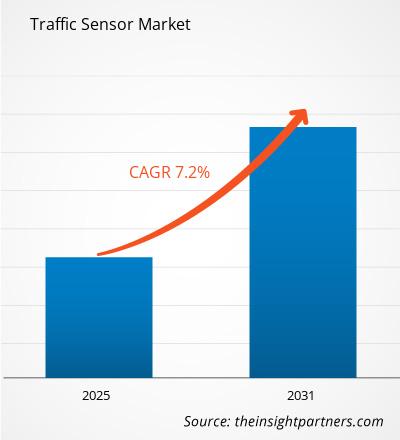
The Traffic Sensor Market is entering a sustained infrastructure-upgrade cycle as road authorities connect detection, analytics, and control systems. Valued at US$ 25.78 Billion in 2025, the market is projected to reach US$ 47.22 Billion by 2034, expanding at a CAGR of 6.96% during 2026–2034. The scope covers sensors used for vehicle measurement and profiling, weigh in motion, traffic monitoring, and automated tolling across urban roads, highways, bridges, tunnels, and managed lanes.
Across North America, modernization of aging roadside equipment and continued deployment of intelligent transportation systems support an estimated ~6% CAGR through 2034. The Traffic Sensor Market size is reinforced by federal and state safety programs, broader use of adaptive signal control, and procurement of non-intrusive radar, image, and thermal detection that reduces lane closures while improving multimodal visibility.
Traffic Sensor Market Assessment and Insights
Regional Outlook
- North America: ~34% of the global market in 2025 | ~6% CAGR through 2034. Market position: The region ranks first because of its extensive installed base, recurring replacement budgets, managed-lane expansion, and mature procurement channels for traffic monitoring and electronic tolling.
- US: ~82% of North American market revenue in 2025 | ~6% CAGR through 2034. Market position: The country leads North America through state-level ITS programs, freeway management centers, connected-corridor investment, and demand for vehicle classification, incident detection, and toll interoperability.
- Europe: ~29% of the global market in 2025 | ~7% CAGR through 2034. Market position: A mature motorway network, road-safety regulation, low-emission mobility policy, and coordinated digital transport programs sustain demand, with Germany, the UK, and France forming the leading national markets.
- Asia Pacific: ~26% of the global market in 2025 | ~9% CAGR through 2034. Market position: Asia Pacific is the fastest-growing region as China, Japan, India, and South Korea expand urban traffic control, expressway automation, and smart-city sensing.
Segment Outlook
- Traffic Monitoring: ~43% Share in 2025 | ~7% CAGR through 2034. Market position: Continuous network visibility, adaptive signals, congestion management, and incident detection make traffic monitoring the largest application, supported by recurring software and maintenance needs.
- Automated Tolling: ~22% Share in 2025 | ~9% CAGR through 2034. Market position: Open-road tolling, congestion pricing, and interoperable account-based systems accelerate sensor demand while reducing manual collection and roadway bottlenecks.
Competitive Coverage
EFKON AG, Teledyne FLIR LLC, International Road Dynamics Inc., Kapsch TrafficCom AG, Kyosan Electric Manufacturing Co., Ltd., Sensor Line GmbH, TE Connectivity Ltd., TransCore, Urbiotica, Vossloh AG
Methodology
The Insight Partners follows Data Collection & Secondary Research, Primary Research, Data Analysis, and Data Triangulation & Final Review to validate market estimates and insights.
Source: The Insight Partners' analysis based on proprietary research, government publications, company annual reports, investor presentations, industry databases, and expert interviews.
Traffic detection technology in the Traffic Sensor Market has evolved from independent in-road loops to connected and multi-modal systems. Whereas inductive loops have continued to be inexpensive for fixed lane presence detection applications, other technologies, such as radar, image, infrared and LIDAR are increasingly being employed to detect speed, trajectory, classification and movements of vulnerable road users from the roadside. There is currently a trend towards integrated sensor/processing devices, edge computing and interoperable interfaces that make it easy for the technology to connect to signal control devices and traffic management systems. Buyers today are looking at life cycle cost, weather robustness, cybersecurity and quality of data in addition to product price, which compels vendors to include hardware plus calibration, communication and software services.
Between now and 2034, new urban arterial and high volume highways would expand the market potential, especially in Asia Pacific and some Middle Eastern cities. Money would flow to scalable roadside systems that can provide tolling, analytics and mobility planning from an integrated sensor platform. Concerns about road fatalities, congestion, emissions and infrastructure digitalization would ensure government procurement continues, while private concessionaires would deploy when there is need for accuracy in vehicle classification and transaction security.
Traffic Sensor Market Report Scope
| Report Attribute | Details |
|---|---|
| Market size in 2025 | US$ 25.78 Billion |
| Market Size by 2034 | US$ 47.22 Billion |
| Global CAGR (2026 - 2034) | 6.96% |
| Historical Data | 2021-2024 |
| Forecast period | 2026-2034 |
Traffic Sensor Market Analysis
Traffic Sensor Market growth comes from the requirement to convert road performance into real-time control actions. Factors such as congestion, mixed traffic flow, freight, and pedestrian safety require constant measurement rather than sporadic surveillance. This gives rise to a market that requires not only vehicle counting but also accurate measuring of speed, classification, axle count, direction, and queuing. Suppliers include traffic management organizations, toll organizations, system integrators, telecommunications services, and analysts, who form a chain of customers whose actions depend on the accuracy of the sensor.
The supply chain is defined by a tension between robust in-road hardware and versatile off-road devices. Loops, piezo and bending plates offer solid measurements on the lane level but at the cost of road works. Radar, thermal, video, acoustic, and LiDAR-based measurement systems allow for less roadworks and offer additional capabilities but also bring challenges in terms of calibration, computing, privacy issues, and network management.
Traffic Sensor Market report shows that the market has become very competitive including both the well-established ITS contractors, detection companies, and connectivity companies. Kapsch TrafficCom AG, EFKON AG, and TransCore provide integration of sensing with tolling and traffic solutions; International Road Dynamics Inc. specializes in applications related to commercial vehicles and weigh-in-motion sensors; Teledyne FLIR LLC provides visible and thermal imaging technology; and TE Connectivity Ltd. provides the enabling sensor and connectivity technology.
The trend of investments is going toward software-defined roadside intelligence, maintenance, and interoperable data services. Competition of Kyosan Electric Manufacturing Co., Ltd., Sensor Line GmbH, Urbiotica, and Vossloh AG comes from the application expertise, geographical connection, or sensing technology. The future strategic position of companies requires proving the performance of detection systems in local weather and traffic conditions, legacy controller integration, and upgrading the previous infrastructure investment.
● REPORT CUSTOMIZATION
Tailor This Report To Align With Your Specific Business Requirements
This report can be customized to align precisely with your business objectives, scope, and target markets. Customization options include tailored segmentation, geography, competitive analysis, and strategic insights to support informed decision-making.
Customize This Report →WHAT YOU CAN ADJUST
- ● Segmentations
- ● Geography
- ● Competitive Analysis
- ● Language Preferences
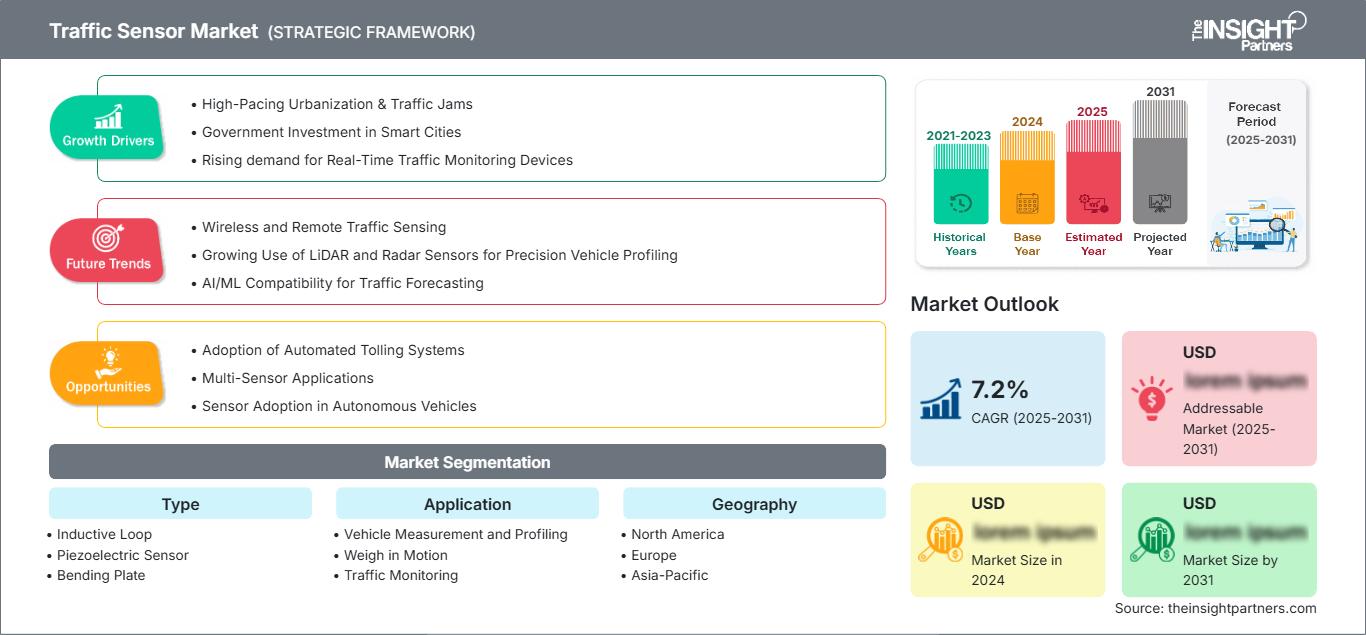
Traffic Sensor Market: Strategic Insights
Regional Insights
North America Traffic Sensor Market
The North American market is projected at a ~6% CAGR till 2034, based on the presence of an extensive installed base of signal control, freeway management, and tolling systems. The Traffic Sensors Market share in North America includes the frequent upgrading of inductive loops and cameras along with the usage of radar and thermal technologies which have the capability to detect vehicles, bikes, and pedestrians without making any incisions in the pavement surface.
The state/provincial authorities focus more on network level performance metrics and incident management and work zone safety. Specification driven procurement is expected in the region. High importance is placed on NEMA compatibility, cybersecurity, environmental ruggedness, and seamless integration in existing traffic management centers. Managed lanes and all-electronic tolling drive classification and transaction integrity, and cities use multimodal counts to redesign intersections.
U.S. Traffic Sensor Market
The US dominates the North American market with nearly ~82% of Traffic Sensor Market share in 2025 and is forecast to grow at ~6% CAGR up to 2034. Federal-aid highway funding, state DOT upgrade projects, and local municipality Vision Zero initiatives lead to acquisitions in connection with freeway, arterial, and intersection applications. Vehicle detection in combination with bicycle and pedestrian detection is increasingly being used in the applications.
Teledyne FLIR LLC, International Road Dynamics Inc., TransCore, and others have relevant channels, engineering services, and installations in the United States. Authorities are turning to alternative technologies that are not prone to failures in the case of pavement cutting but lanes require loop detectors as well due to lane-specific presence information and existing controller logic. Managed-lanes and open-road tolling ensure significant radar, imaging and classification installations.
Europe Traffic Sensor Market
Europe holds ~29% of the total revenue in 2025 and is forecasted to have a ~7% CAGR growth until 2034. Europe's potential can be attributed to high density of motorway networks, existing urban traffic management systems and focus on road safety, congestion, and transport emissions. Germany is considered to be the top country in Europe due to its extensive road infrastructure, sensor base, and multiple use cases ranging from motorways to cities, tunnels, and freight corridors.
New technology for motorways along with requests from local authorities concerning bus priority, active travel monitoring, and enforcement are used in the UK. In France, the development towards connected corridors, toll roads, and mobility management of cities is being made, while in Italy, there is a concession system of motorways, with the use of equipment for classification, tunnel security, and electronic toll collection systems. In Spain, the demand arises through traffic management of metropolitan areas, interurban traffic monitoring, and corridor management. Privacy requirements encourage the development of edge processing and metadata extraction without retaining identifying images.
Cross-border ITS standards and systems integration capabilities are advantages for European suppliers. Kapsch TrafficCom AG and EFKON AG operate in the tolling and mobility management area, and engineering skills related to sensing as well as adjacent railway operations are added to the list of suppliers. Replacement cycles now depend on the cost of ownership; although non-intrusive technologies do not require road construction, loops and piezoelectric sensors remain necessary when data on axles or lanes are required.
APAC Traffic Sensor Market
Asia-Pacific generates around 26% of the world’s revenue in 2025 and registers the highest regional CAGR of 9% up until 2034. The major player in the region is China, backed by substantial urban surveillance network, expressways, and integration in smart cities. Japan focuses on intersection management and infrastructure renovation, while South Korea works toward connected roads and intelligent urban corridors.
In India, there is huge potential through electronic tolls, highways, and city command centers. Australia has mature demand for freeway management, weigh-in-motion, and remote road monitoring. Localization, scalability in communication networks, and sensor capability for heterogeneous traffic classification in harsh weather conditions will drive the regional growth.
Middle East & Africa Traffic Sensor Market
The Middle East & Africa is projected to expand at a ~8% CAGR through 2034 as major cities link transport investment with digital infrastructure programs. The UAE is assessed as the leading country in the Middle East & Africa, reflecting intensive smart-mobility deployment, high-capacity highways, and early adoption of automated traffic enforcement. Saudi Arabia adds large urban and intercity projects connected to economic diversification and new-city development.
Demand is focused on urban corridors, tollways, and logistics roads in South Africa, but the Rest of MEA continues to be project-driven and budget-sensitive to municipal expenditure and communications footprint. Heat, dust, power reliability, and maintenance ease support resilient radar, magnetic, and solar-friendly roadside solutions. There are also special opportunities in energy logistics and ports.
Segmentation Analysis
Type
The type segment is projected to expand at a ~7% CAGR during 2026–2034. The Traffic Sensor Market scope spans established in-road detectors and increasingly capable roadside systems. Selection depends on measurement objective, pavement access, weather, lane geometry, privacy constraints, and lifecycle maintenance. Hybrid architectures are gaining relevance because no single sensing principle delivers optimal classification, speed, occupancy, axle, pedestrian, and environmental performance in every location.
- Inductive Loop: Loops retain a strong installed position in signalized intersections and lane-specific counting. Proven controller compatibility and economical detection support replacement demand, although pavement cutting and maintenance exposure encourage substitution where non-intrusive alternatives are practical.
- Piezoelectric Sensor: Piezoelectric devices are strategically important for axle detection, vehicle classification, and weigh-in-motion systems. Freight enforcement and pavement planning sustain demand, but installation quality and calibration discipline directly affect measurement reliability.
- Bending Plate: Bending plates serve high-accuracy static and low-speed weighing environments where agencies require dependable axle loads. Their infrastructure intensity limits broad deployment, yet enforcement stations and commercial-vehicle screening preserve specialized demand.
- Image Sensor: Image sensors combine broad scene coverage with software-based classification, queue measurement, and incident recognition. Edge analytics and low-light performance improve utility, while privacy controls, lens maintenance, and adverse weather remain key procurement considerations.
- Infrared Sensor: Infrared sensing supports vehicle and vulnerable-road-user detection when visible-light performance is constrained. Thermal systems are valued in tunnels, nighttime operations, and difficult illumination, often complementing radar or video rather than operating alone.
- Radar Sensor: Radar offers non-intrusive speed, range, and multi-lane tracking with resilient operation in darkness and many weather conditions. Agencies favor it for intersections, highways, and wrong-way detection where pavement closures are undesirable.
- LiDAR Sensor: LiDAR provides detailed three-dimensional object positioning and trajectory data for complex intersections and smart corridors. Falling integration costs and edge perception broaden adoption, although capital cost, occlusion management, and environmental validation influence scaling.
- Magnetic Sensor: Compact magnetic sensors enable presence detection and parking or lane monitoring with low power requirements. Wireless deployment can simplify installation, but battery life, roadwork, and sensitivity to vehicle geometry shape lifecycle economics.
- Acoustic Sensor: Acoustic devices offer supplementary vehicle detection and classification where visual privacy or line-of-sight constraints matter. Their strategic role is strongest in multisensor systems that compensate for wind, background noise, and variable traffic conditions.
Application
Applications segment in the Traffic Sensor Market are expected to grow at a ~7% CAGR over 2026–2034 as traffic agencies shift from isolated counts to operational decision support. Traffic monitoring is the largest main segment, holding ~43% in 2025 and advancing at ~7%, while automated tolling is the high-growth main segment with ~22% share and ~9% CAGR. Integration with control centers, enforcement workflows, and payment platforms determines value capture.
- Vehicle Measurement and Profiling: This application supports vehicle length, height, class, speed, and movement analysis for planning, enforcement, and asset management. Demand rises where authorities need richer fleet composition data without conducting disruptive manual surveys.
- Weigh in Motion: Weigh-in-motion systems help screen commercial vehicles, protect pavement, and target enforcement resources. Sensor accuracy, calibration traceability, axle recognition, and integration with roadside inspection databases are decisive purchasing criteria.
- Traffic Monitoring: The application leads because cities and highway operators require continuous flow, speed, queue, occupancy, and incident data. Its strategic importance extends from daily operations to capital planning and performance reporting.
- Automated Tolling: Automated tolling is scaling through open-road collection, congestion charging, and managed lanes. Reliable detection, classification, account matching, and violation evidence make multisensor fusion essential to transaction integrity and user trust.
Opportunity Snapshot
| Application | Revenue Contribution | Trend Tag | Adoption Stage |
| Vehicle Measurement and Profiling | Medium | Fleet Analytics | Scaling |
| Weigh in Motion | Medium | Axle Enforcement | Mature |
| Traffic Monitoring | High | Adaptive Control | Mature |
| Automated Tolling | High | Open Road | Scaling |
Traffic Sensor Market Growth Drivers and Impact Analysis
Networked Traffic Management and Adaptive Signal Control
Operators must have access to continual data on lane use and objects to synchronize signaling, control queues, and react to incidents. Sensing technology takes the motion detected by traffic sensors and turns it into controller input so that timing programs can respond dynamically to conditions rather than following set schedules. There is much more at stake than managing congestion; multimodal detection enables pedestrian clearance, cycling preferential treatment, transit performance, and emergency vehicle pre-emption. The procurement process changes to focus not on individual detectors but rather on networked sensing with monitoring and synchronization. Suppliers who are able to show minimal false alarms and interoperability with existing controllers are better positioned since they allow for gradual upgrading.
Expansion of Electronic Tolling and Managed Lanes
Operators are shifting towards free flow tolling to increase throughput and reduce manual handling. Each gantry needs reliable detection, axle/vehicle classification, speed calculation, imaging, and transaction mapping in a congested environment. Time-of-use pricing and managed lanes complicate the issue because the charges could depend on time, occupancy, or vehicle type. Fusion sensor solutions help in eliminating misses and enable audit-proof enforcement that clearly links system reliability with operator income. With interoperable solutions becoming common, integrators have the opportunity to integrate roadside hardware with the account management system and back-end systems. This increased demand makes radar, imaging, loops, and profiling solutions desirable due to their reliability and remote monitoring capabilities.
Road Safety Programs and Vulnerable-User Detection
Modern safety programs need data on near misses, clashes, wrong way maneuvers, and pedestrian vulnerability, as opposed to just crash records. Modern image, thermal, radar, and LiDAR systems can monitor trajectories and detect hazardous trends before any redesigning of the infrastructure takes place. At intersections, the information is used to optimize clearance intervals, introduce protective phases, and analyze countermeasures. In terms of highways and tunnels, the fast detection of stopped vehicles and incidents reduces the response time. The commercial aspect of it is an expanded performance requirement – the customers look at how good the system is in object recognition, occlusion management, nighttime operation, and privacy-preserving edge computing.
Traffic Sensor Market Future Trends
Edge AI and Multisensor Fusion
Traffic Sensor Market trends will increasingly center on processing data near the roadside rather than streaming every raw image or point cloud to a central server. Edge AI can classify vehicles, pedestrians, and cyclists, compress events into metadata, and issue low-latency alerts. Combining radar with video or thermal imaging improves confidence when glare, darkness, weather, or occlusion weakens one modality. Through 2034, this architecture should make multi-use deployments more economical because the same node can support signal control, safety analytics, and planning. Adoption will depend on transparent model validation, secure software updates, and clear governance for retained data.
Sensing as Shared Digital Road Infrastructure
Roadside sensing is likely to evolve from application-specific equipment into a shared infrastructure layer. A corridor initially funded for traffic control may also provide freight counts, curb activity, incident alerts, travel-time feeds, and connected-vehicle messages. Open data models and application programming interfaces will become more important as agencies seek to avoid proprietary silos. The transition can alter procurement from one-time device acquisition toward service-level agreements covering uptime, data quality, and software support. Suppliers will need modular hardware, device management, and auditable cybersecurity to remain relevant across longer infrastructure lifecycles.
Traffic Sensor Market Opportunities
Retrofit Packages for Legacy Intersections
A large installed base of loops, older cameras, and proprietary controllers creates an opportunity for retrofit solutions that improve data quality without complete cabinet replacement. Vendors can package roadside radar or thermal detection with interface modules, commissioning, and remote health monitoring. Traffic Sensor Market Forecasts support a phased commercial model: prioritize failure-prone intersections, prove maintenance savings, then expand across a municipal network. Integrators should build compatibility libraries for common controllers and offer performance-based maintenance. Financing structures that spread capital cost across multiyear service agreements can help cities move from isolated pilots to repeatable programs while preserving earlier infrastructure investments.
High-Growth Tolling and Freight Corridors
Expressway expansion, port connectivity, and urban road pricing create investable demand for classification, weigh-in-motion, and free-flow tolling. Suppliers can target corridors where lost transactions, overloaded vehicles, or lane closures have measurable economic consequences. The strongest proposition combines sensors with calibration, evidence management, and analytics rather than selling stand-alone hardware. Local assembly and certified installation partners can improve bid competitiveness in Asia Pacific and the Middle East, while cloud-connected diagnostics reduce support costs across dispersed sites. Partnerships with concessionaires and system integrators also provide access to recurring upgrade cycles and back-office integration work.
Recent Developments
- February 2026: Kapsch TrafficCom AG highlighted its latest VDX camera system for open-road tolling. The platform consolidates multiple proven sensing functions into one roadside device, supports overlapping multi-lane coverage, and uses software-defined detection zones. Its deployment during changing lane configurations in Texas demonstrated how overhead video classification can preserve toll operations while avoiding repeated relocation of in-pavement sensors.
- October 2025: TransCore achieved system acceptance for its next-generation Infinity Digital Lane System on the Tacoma Narrows Bridge. The installation introduced AI-based overhead vehicle classification and tracking, vehicle capture and recognition, and automated license-plate recognition across toll-booth and open-road lanes, reducing dependence on in-pavement detection while adding off-site data resilience.
- January 2025: EFKON AG secured a new framework contract that reinforced its role in Norway's free-flow tolling ecosystem. The award extends EFKON's participation in a market where electronic road charging supports bridge, tunnel, road, and urban-ring financing, highlighting continued demand for interoperable roadside detection and transaction infrastructure in a mature European deployment environment.
Frequently Asked Questions

- Comprehensive Market Sizing and Forecast Analysis
- Detailed Segmentation Analysis
- In-Depth Market Dynamics Assessment
- Regional and Country-Level Insights
- Competitive Landscape and Company Benchmarking
- Strategic Business Intelligence
Recent Reports
Testimonials

The Insight Partners provided valuable market intelligence that supported our global go-to-market strategy. Their team was professional, responsive, and attentive to our feedback, providing thoughtful analysis and helpful methodological clarifications throughout the project.
Junmo Kim Chief Financial Officer (CFO), Enertech Co., Ltd.
The Insight Partners' SCADA System Market report is comprehensive, with valuable insights on current trends and future forecasts. The team was highly professional, responsive, and supportive throughout. We are very satisfied and highly recommend their services.
RAN KEDEM Partner, Reali Technologies LTDs
I requested a report on a very specific software market and the team produced the report in a few days. The information was very relevant and well presented. I then requested some changes and additions to the report. The team was again very responsive and I got the final report in less than a week.
JEAN-HERVE JENN Chairman, Future Analytica
We worked with The Insight Partners for an important market study and forecast. They gave us clear insights into opportunities and risks, which helped shape our plans. Their research was easy to use and based on solid data. It helped us make smart, confident decisions. We highly recommend them.
PIYUSH NAGPAL Sr. Vice President, High Beam Global
The Insight Partners delivered insightful, well-structured market research with strong domain expertise. Their team was professional and responsive throughout. The user-friendly website made accessing industry reports seamless. We highly recommend them for reliable, high-quality research services
YUKIHIKO ADACHI CEO, Deep Blue, LLC.
This is the first time I have purchased a market report from The Insight Partners.While I was unsure at first, I visited their web site and felt more comfortable to take the risk and purchase a market report.I am completely satisfied with the quality of the report and customer service. I had several questions and comments with the initial report, but after a couple of dialogs over email with their analyst I believe I have a report that I can use as input to our strategic planning process.Thank you so much for taking the extra time and making this a positive experience.I will definitely recommend your service to others and you will be my first call when we need further market data.
JOHN SUZUKI President and Chief Executive Officer, Board Director, BK Technologies
I wish to appreciate your support and the professionalism you displayed in the course of attending to my request for information regarding to infectious disease IVD market in Nigeria. I appreciate your patience, your guidance, and the fact that you were willing to offer a discount, which eventually made it possible for us to close a deal. I look forward to engaging The Insight Partners in the future, all thanks to the impression you have created in me as a result of this first encounter.
DR CHIJIOKE ONYIA MANAGING DIRECTOR, PineCrest Healthcare Ltd.Reason to Buy
- Informed Decision-Making
- Understanding Market Dynamics
- Competitive Analysis
- Identifying Emerging Markets
- Customer Insights
- Market Forecasts
- Risk Mitigation
- Boosting Operational Efficiency
- Strategic Planning
- Investment Justification
- Tracking Industry Innovations
- Aligning with Regulatory Trends





 Get Free Sample for