
Vibrating Tuning Fork Sensor Market Demand, Share & Growth by 2034
Coverage: By Detection Type (Liquid Detection, Solid Material Detection); Application (Brewery Production, Chemical Plants, Packaging Machine, Manufacturing, Others), and Geography (North America, Europe, Asia Pacific, and South and Central America)
- Status : Data Released
- Report Code : TIPRE00015826
- Category : Electronics and Semiconductor
- No. of Pages : 150
- Available Report Formats :


- Last update date : September 15, 2026


2025 Market Size
US$ 879.3 Mn
Base year value
2034 Forecast
US$ 1,769.28 Mn
Projected by 2034
CAGR 2026-2034
8.08 %
Growth rate
Addressable Market
US$ 11,907.23 Mn
(2026-2034)
The Vibrating tuning fork sensor market stood at US$ 879.3 Million in 2025 and is projected to reach US$ 1,769.28 Million by 2034, expanding at a CAGR of 8.08% from 2026 to 2034. The market reflects sustained adoption of compact point-level detection technologies across process industries, where reliable switching, minimal maintenance, and compatibility with liquids and bulk solids support increasingly automated production environments.
North America is expected to represent a mature but steadily expanding opportunity, with the market anticipated to grow at approximately 7.4–8.0% CAGR during 2026–2034. Replacement of mechanical level switches, stronger emphasis on overfill protection, and investments in automated food, beverage, chemical, and packaging facilities are expected to underpin regional demand. The vibrating tuning fork sensor market size is also supported by established instrumentation ecosystems and stringent process-safety practices.
Vibrating Tuning Fork Sensor Market Assessment and Insights
- North America: The region is estimated to account for 28–32% share in 2025, with demand growing at a 7.4–8.0% CAGR between 2026–2034 as process automation, safety instrumentation, and hygienic production upgrades accelerate sensor replacement cycles.
- US: The US is estimated to represent 62–66% of North American share in 2025, expanding at a 7.7–8.3% CAGR between 2026–2034, supported by process modernization and safety-focused instrumentation.
- Europe: Europe is estimated at 24–28% share in 2025, growing at 7.0–7.7% CAGR between 2026–2034, with Germany, the UK, France, and Italy providing strong demand from chemical, food, beverage, and machinery industries.
- Asia Pacific: Asia Pacific is estimated at 31–35% share in 2025, growing at 9.1–9.8% CAGR between 2026–2034. China, Japan, South Korea, and India are leading adoption through manufacturing expansion and automation investment.
- Largest Segment: Liquid Detection is estimated to hold 62–66% market share in 2025, advancing at 7.6–8.2% CAGR during 2026–2034, supported by broad use in tanks, pipelines, and hygienic processes.
- High Growth Segment: Packaging Machine applications are estimated at 18–22% market share in 2025, expanding at 9.0–9.7% CAGR during 2026–2034, driven by fast switching and automated filling control.
- Key companies analyzed in detail: ABB Ltd.; Baumer Holding AG; Emerson Electric Co.; Endress+Hauser Group Services AG; Fine Controls Ltd.; OMEGA Engineering, Inc.; Pepperl+Fuchs SE; Sapcon Instruments Pvt. Ltd.; Sensor One; SICK AG; KROHNE Messtechnik GmbH; VEGA Grieshaber KG.
Source: The Insight Partners' analysis based on proprietary research, government publications, company annual reports, investor presentations, industry databases, and expert interviews.
The technology has evolved from basic electromechanical point-level switching toward compact electronic instruments capable of handling turbulence, foam, coating, changing media characteristics, and demanding installation conditions. Piezoelectric excitation, solid-state electronics, hygienic fork designs, self-monitoring, and faster switching have improved suitability for automated production. These changes have strengthened the vibrating tuning fork sensor market across liquid and bulk-solid detection, particularly where calibration-free operation and dependable high or low-level alarms are required.
In the future, investment will focus on digital communication-enabled instrumentation, hazardous area approvals, hygienic instrumentation and diagnostics. New manufacturing capacity coming up in India, Southeast Asia and other parts of Asia will add to the installed base opportunity, while retrofits in Europe and North America are becoming more common. The regulatory push for functional safety, sanitary processes and environmental containment will make repeated switching technology even more attractive.
Vibrating Tuning Fork Sensor Market Report Scope
| Report Attribute | Details |
|---|---|
| Market size in 2025 | US$ 879.3 Million |
| Market Size by 2034 | US$ 1,769.28 Million |
| Global CAGR (2026 - 2034) | 8.08% |
| Historical Data | 2021-2024 |
| Forecast period | 2026-2034 |
Vibrating Tuning Fork Sensor Market Analysis
The vibrating tuning fork sensor market growth is closely linked to industrial requirements for dependable point-level detection rather than continuous measurement. These instruments are utilized within process plants for overfill protection, dry running prevention, material detection, and sequencing. The ecosystem includes piezo elements, stainless steel or coated forks, electronics, process connectors, control systems interfaces, distributors, and system integrators. Therefore, demand for these products depends both on plant constructions and switch replacements.
The dynamics in supply are shifting toward modular platforms, which could be capable of handling various process connectors, outputs, fork lengths, approvals, and hygiene options. Product differentiation is made in terms of response time, build-up resistance, approvals for hazardous areas, functional safety, and diagnostics. Applications in liquid materials tend to be the most common ones. However, fine powder, granule, and light solids could help generate demand for special fork geometry and sensitivity levels.
The vibrating tuning fork sensor market analysis indicates a competitive structure combining diversified automation groups with specialist level-instrument manufacturers. Emerson, Endress+Hauser, ABB, SICK, Pepperl+Fuchs, Baumer, KROHNE, and VEGA compete through broad process portfolios, certification coverage, and global service networks. Specialist suppliers such as Sapcon Instruments, Fine Controls, OMEGA Engineering, and Sensor One compete through application-specific configurations, pricing flexibility, and regional responsiveness.
Investment priorities increasingly center on smart diagnostics, HART or digital connectivity, hygienic construction, faster switching, and simplified commissioning. Large vendors can bundle point-level products with transmitters, controllers, and automation software, strengthening account penetration. Smaller suppliers can target packaging, brewing, and specialized solids handling where compact designs and customized process connections matter. Strategic positioning therefore, depends on balancing instrumentation breadth with application expertise, certification, lifecycle support, and retrofit compatibility, reflecting key Vibrating Tuning Fork Sensor Market trends.
● REPORT CUSTOMIZATION
Tailor This Report To Align With Your Specific Business Requirements
This report can be customized to align precisely with your business objectives, scope, and target markets. Customization options include tailored segmentation, geography, competitive analysis, and strategic insights to support informed decision-making.
Customize This Report →WHAT YOU CAN ADJUST
- ● Segmentations
- ● Geography
- ● Competitive Analysis
- ● Language Preferences
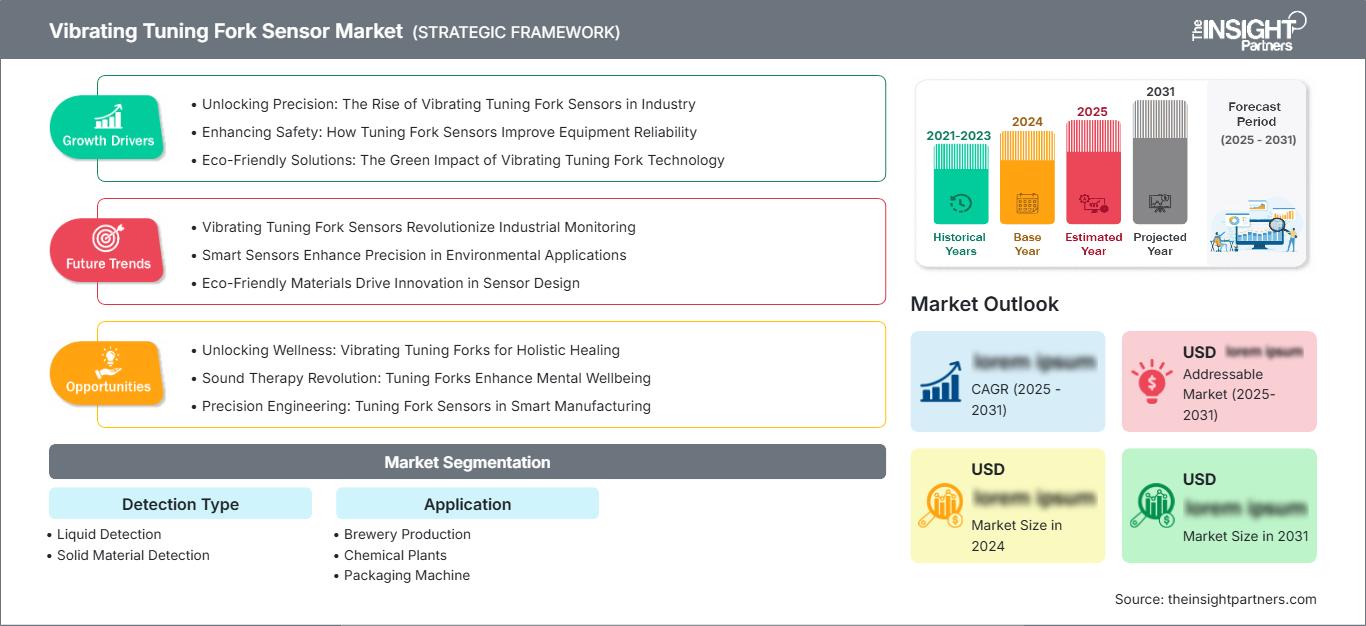
Vibrating Tuning Fork Sensor Market: Strategic Insights
Regional Insights
North America Vibrating Tuning Fork Sensor Market
North America is estimated to command 28–32% of the Vibrating Tuning Fork Sensor Market share in 2025 and expand at a 7.4–8.0% CAGR during 2026–2034. The USA is still the major end market, fueled by large process instrumentation installations in chemicals, food and beverages, pharmaceuticals, water treatment, and packaging industries. Retrofit opportunities with solid-state level switches replacing float level switches are still prevalent. There is also a need for overfill protection and reliable pump protection.
Canada contributes to the market through applications in food processing, chemicals, mining, and other resource-processing markets, whereas Mexico will add demand for its applications in automotive, packaging, beverages, and manufacturing markets. Hygiene compliance, hazardous area suitability, diagnostics, and easy maintenance capabilities are now gaining importance among regional users. The level switch market is also helped by automation distribution channels and system integrators who can incorporate level switches into PLC and safety systems.
U.S. Vibrating Tuning Fork Sensor Market
The US is estimated to represent 62–66% of North American Vibrating Tuning Fork Sensor Market share in 2025 and grow at 7.7–8.3% CAGR during 2026–2034. Chemical plants, breweries, food processors, pharmaceutical facilities, and packaging machinery users constitute major application pools. Companies including Emerson, ABB, SICK, Endress+Hauser, and OMEGA Engineering maintain established product and distribution positions across industrial customers.
Demand increasingly centers on compact sensors that require limited commissioning and can operate reliably in turbulence, foam, vibration, or changing material conditions. Packaging lines favor fast response, while process plants prioritize SIL-rated or hazardous-area configurations where safety integrity is important. Retrofit projects are particularly relevant because point-level switches can often replace legacy devices without extensive modifications to vessel geometry or control architecture.
Europe Vibrating Tuning Fork Sensor Market
Europe is estimated at 24–28% share of the Vibrating Tuning Fork Sensor Market in 2025, with a 7.0–7.7% CAGR during 2026–2034. Germany is the leading market, supported by process machinery, chemicals, food production, and industrial automation. The UK, France, Italy, and Spain provide additional demand through packaging, beverage production, pharmaceuticals, and discrete manufacturing. Strong engineering capabilities encourage the adoption of certified and application-specific instrumentation.
The UK maintains demand from food, beverage, water, and chemical processing, with emphasis on hygienic and reliable level control. Germany benefits from dense automation integration and machinery manufacturing, while France combines chemical, food, and industrial processing applications. Italy and Spain add opportunities through packaging machinery, beverage production, food processing, and industrial modernization. European buyers increasingly value energy-efficient operation, lifecycle reliability, hazardous-area certification, and integration with digital plant architectures.
APAC Vibrating Tuning Fork Sensor Market
APAC is estimated to hold 31–35% share in 2025 and grow at 9.1–9.8% CAGR during 2026–2034, making it the fastest-expanding major region. China leads regional demand, followed by Japan, South Korea, India, and Australia. Manufacturing expansion, process automation, food and beverage production, chemical capacity, and packaging investment support new installations.
China benefits from large industrial production volumes, while Japan and South Korea emphasize high-reliability automation. India presents strong opportunities for expanding manufacturing, breweries, chemicals, and packaging equipment. Australia contributes through food processing, mining-related applications, and industrial infrastructure. Local certification requirements, automation programs, and increasing adoption of electronic point-level technologies should support regional penetration.
Middle East & Africa Vibrating Tuning Fork Sensor Market
The Middle East & Africa Vibrating Tuning Fork Sensor Market is estimated to expand at a 6.4–7.1% CAGR during 2026–2034. Saudi Arabia is a leading regional market, with the UAE and South Africa also contributing substantially. Industrial diversification, chemical processing, food production, utilities, and infrastructure development create recurring demand for robust point-level detection.
Saudi Arabia and the UAE benefit from investments in industrial processing and automated facilities, while South Africa provides applications across mining, food, chemicals, and manufacturing. The rest of MEA remains comparatively fragmented but offers opportunities through water infrastructure and industrial modernization. Hazardous-area certification, resistance to harsh conditions, and straightforward maintenance are important purchase criteria in these environments.
Segmentation Analysis
Detection Type
Detection Type includes Liquid Detection and Solid Material Detection. The segment is projected to expand at 7.5–8.2% CAGR during 2026–2034. Liquid applications retain a broader installed base because tanks, pipelines, process vessels, and hygienic production systems require dependable high and low-level switching. Solid detection remains strategically important for powders, granules, silos, and hoppers where reliable material presence is required, according to the Vibrating Tuning Fork Sensor Market report.
- Liquid Detection: Liquid detection represents the core application base because sensors can provide repeatable switching across water, chemicals, beverages, oils, and viscous process media. Hygienic connections and hazardous-area options expand applicability across specialized installations.
- Solid Material Detection: Solid material detection supports silos, bins, hoppers, and process vessels containing powders or granules. Robust fork construction and sensitivity adjustment are strategically important where dust, vibration, low density, or material buildup complicate point-level switching.
Application
The application comprises Brewery Production, Chemical Plants, Packaging Machine, and Manufacturing. The segment is projected to grow at 8.3–9.0% CAGR during 2026–2034. Adoption depends on switching speed, hygienic construction, chemical resistance, installation constraints, and compatibility with automated control systems. Packaging applications are expected to demonstrate particularly strong momentum as equipment builders emphasize compact, rapid, repeatable level detection, according to the Vibrating Tuning Fork Sensor Market forecast.
- Brewery Production: Brewery production requires hygienic, cleanable point-level detection across tanks, pipelines, and process vessels. Fork designs compatible with sanitary fittings support reliable switching while limiting contamination risks during frequent cleaning cycles.
- Chemical Plants: Chemical plants prioritize corrosion resistance, hazardous-area approvals, dependable overfill protection, and compatibility with aggressive media. Sensor configuration must accommodate process temperature, pressure, viscosity, and vessel geometry while maintaining reliable switching.
- Packaging Machine: Packaging machine applications emphasize compact installation, fast response, repeatable switching, and integration with automated filling systems. Rapid detection helps reduce overfill events, material waste, line interruptions, and inconsistent package volumes.
- Manufacturing: Manufacturing applications span tanks, hoppers, material handling equipment, and utility systems. Flexible mounting, low maintenance, and compatibility with varied process materials make point-level detection useful across heterogeneous production environments.
Opportunity Snapshot
| Application | Revenue Contribution | Trend Tag | Adoption Stage |
| Brewery Production | Medium | Hygienic Filling | Scaling |
| Chemical Plants | High | Safe Overfill | Mature |
| Packaging Machine | Medium | Fast Switching | Scaling |
| Manufacturing | High | Automated Control | Mature |
Vibrating Tuning Fork Sensor Market Growth Drivers and Impact Analysis
Replacement of Mechanical Switches with Solid-State Detection
Industrial operators are beginning to favor vibrating fork technology over float or mechanical switch technology in situations where there are maintenance issues or where mechanical movement leads to inconsistency in the switching process. Vibrating forks are point-level devices that allow consistent switching despite the presence of no mechanical movement in the sensing part of the instrument. The implication here is felt strongly in tanks, pipelines, and automation machines, in which level switch failures may result in plant shutdowns. Manufacturers of vibrating fork devices have been able to capitalize on this issue as their products do not require much installation as opposed to the total revamp of the entire measuring system.
Expansion of Automated Packaging and Process Production
Increasingly, automation means that there are more locations where industrial machinery has to reliably detect the presence of material. Packaging machines, filling systems, mixing tanks, and production lines all need to switch rapidly in order to coordinate the supply of material with the operation of valves, pumps, conveyor systems, and programmable logic controls. Vibrating forks are able to meet these needs through rapid response configuration and compact mounting. The business impact is greater than just replacing sensors since machine manufacturers often include point-level sensors in their equipment designs. This is even more important in the Asia Pacific, where packaging and manufacturing facilities are being built. As plants pursue lower waste and more consistent throughput, dependable switching becomes a control-enabling component rather than merely a basic alarm function within the Vibrating Tuning Fork Sensor Market.
Stronger Process Safety and Hygienic Instrumentation Requirements
Process manufacturers are more interested in avoiding overfill situations, safeguarding pumps, managing material transfer processes, and ensuring hygienic processing environments. This makes them look for sensors that come with functional safety certificates, hazardous area approvals, polished wetted surfaces, and designs that are immune to foam, turbulence, or buildup. This effect becomes most apparent in sectors such as chemicals, food and beverages, pharmaceuticals, and many others, wherein giving out wrong level signals may have safety, quality, or environmental implications. Companies that are able to manufacture sensors that have proof testing capability and self-monitoring capacity, apart from being good sensors, will be able to target higher value-added applications beyond simple switch applications. Hygiene needs also make old units need to be replaced with newer models.
Vibrating Tuning Fork Sensor Market Future Trends
Connected Diagnostics and Remote Verification
The future products will come up with diagnostics that are more advanced than just having the covered or uncovered switch functionality. With electronic monitoring, one could detect any issues regarding abnormal frequency, health of the device, and other process changes that would provide valuable information via HART, digital communication, or control communication architecture. Remote verification may help to cut down on operator accessibility to high-level tanks, unsafe locations, or hard-to-access vessels. It becomes especially pertinent when discussing big chemical or energy plants, where proof testing and verification may prove to be expensive. Such capabilities could shift purchasing decisions from lowest unit cost toward lifecycle value, reliability, maintenance efficiency, and measurable reductions in unplanned intervention, according to the Vibrating Tuning Fork Sensor Market report.
Miniaturization and Application-Specific Fork Engineering
The need for miniaturization will grow in importance as the machinery industry looks for sensors that will suit small vessels, piping, filling equipment, and tightly-packed machinery. At the same time, the design of the forks will be more application-specific, with sensors designed to work with viscous liquids, fine powders, hygienic applications, fast drainage, and tough buildup situations. The smaller size of electronic packages will allow for versatile installation while still maintaining the diagnostic ability of the sensor. This approach will be advantageous for those suppliers who will be able to provide standardized electronics coupled with a flexible mechanical design. The packaging, laboratory, and compact manufacturing are good options since equipment engineers have less room and predictability of switching is required.
Vibrating Tuning Fork Sensor Market Opportunities
Localized Manufacturing and Regional Application Engineering
Manufacturers have incremental opportunities to grow through regional capability in production, configuration, and service within the rapidly growing Asian markets. India, China, Southeast Asia, and other manufacturing hubs are home to not only new growth potential but also replacement potential as old facilities become obsolete. Regional engineering enables quicker delivery, adaptation of process interface to regional needs, as well as packaging, chemical, food-processing, and manufacturing applications. The regional technical centers can be used by suppliers to demonstrate the sensor performance in their own media and operating conditions. This way, dependency on global standardization is reduced while building confidence with the customer in special installations. System integrators and machine builders represent strategic partners for expanding into this market since they impact the instrument selection in the plant/equipment design phase.
Expansion of Safety-Certified and Hygienic Product Portfolios
A good opportunity exists in the development of product platforms that incorporate the features of hazardous area approval, functional safety, hygienic design, and digital diagnostics into one solution. Customers desire fewer models of instruments for use in several plants, creating opportunities for suppliers to offer standard electronics with configurable process connectors and certifications. Chemical plants would have use for designs that are certified safe for overfill protection, whereas brewery and food-processing plants would need hygienic design and sanitary connectors. Platforms offering solutions for both cases would lead to efficiency in production as well as in distribution. Vendors must focus on the certification strategy and modular product architectures instead of depending on small changes in mechanics only. These platforms could be used for high-value propositions where the cost of failure is higher than the purchase cost of the instrument.
Frequently Asked Questions

- Comprehensive Market Sizing and Forecast Analysis
- Detailed Segmentation Analysis
- In-Depth Market Dynamics Assessment
- Regional and Country-Level Insights
- Competitive Landscape and Company Benchmarking
- Strategic Business Intelligence
Recent Reports
Testimonials

The Insight Partners' SCADA System Market report is comprehensive, with valuable insights on current trends and future forecasts. The team was highly professional, responsive, and supportive throughout. We are very satisfied and highly recommend their services.
RAN KEDEM Partner, Reali Technologies LTDs
I requested a report on a very specific software market and the team produced the report in a few days. The information was very relevant and well presented. I then requested some changes and additions to the report. The team was again very responsive and I got the final report in less than a week.
JEAN-HERVE JENN Chairman, Future Analytica
We worked with The Insight Partners for an important market study and forecast. They gave us clear insights into opportunities and risks, which helped shape our plans. Their research was easy to use and based on solid data. It helped us make smart, confident decisions. We highly recommend them.
PIYUSH NAGPAL Sr. Vice President, High Beam Global
The Insight Partners delivered insightful, well-structured market research with strong domain expertise. Their team was professional and responsive throughout. The user-friendly website made accessing industry reports seamless. We highly recommend them for reliable, high-quality research services
YUKIHIKO ADACHI CEO, Deep Blue, LLC.
This is the first time I have purchased a market report from The Insight Partners.While I was unsure at first, I visited their web site and felt more comfortable to take the risk and purchase a market report.I am completely satisfied with the quality of the report and customer service. I had several questions and comments with the initial report, but after a couple of dialogs over email with their analyst I believe I have a report that I can use as input to our strategic planning process.Thank you so much for taking the extra time and making this a positive experience.I will definitely recommend your service to others and you will be my first call when we need further market data.
JOHN SUZUKI President and Chief Executive Officer, Board Director, BK Technologies
I wish to appreciate your support and the professionalism you displayed in the course of attending to my request for information regarding to infectious disease IVD market in Nigeria. I appreciate your patience, your guidance, and the fact that you were willing to offer a discount, which eventually made it possible for us to close a deal. I look forward to engaging The Insight Partners in the future, all thanks to the impression you have created in me as a result of this first encounter.
DR CHIJIOKE ONYIA MANAGING DIRECTOR, PineCrest Healthcare Ltd.Reason to Buy
- Informed Decision-Making
- Understanding Market Dynamics
- Competitive Analysis
- Identifying Emerging Markets
- Customer Insights
- Market Forecasts
- Risk Mitigation
- Boosting Operational Efficiency
- Strategic Planning
- Investment Justification
- Tracking Industry Innovations
- Aligning with Regulatory Trends





 Get Free Sample for