
Vibration Sensors Market Size, Share & Trends by 2034
Coverage: By Product (Accelerometers, Velocity Sensors, Non-contact Displacement Transducers, Other); End-User Industry (Automotive, Healthcare, Aerospace and Defense, Consumer Electronics, Oil and Gas, Other) , and Geography (North America, Europe, Asia Pacific, and South and Central America)
- Status : Data Released
- Report Code : TIPRE00017742
- Category : Electronics and Semiconductor
- No. of Pages : 150
- Available Report Formats :


- Last update date : September 21, 2026


2025 Market Size
US$ 5.94 Bn
Base year value
2034 Forecast
US$ 12.71 Bn
Projected by 2034
CAGR 2026-2034
8.82 %
Growth rate
Addressable Market
US$ 83.53 Bn
(2026-2034)
The vibration sensors market is projected to expand from US$ 5.94 Billion in 2025 to US$ 12.71 Billion by 2034, registering a CAGR of 8.82% during 2026–2034. The market covers sensing technologies that capture acceleration, velocity, and displacement for machinery diagnostics, safety monitoring, product validation, and operational control.
North America is expected to advance at an estimated 8.3–9.0% CAGR through 2034, supported by condition-based maintenance adoption, semiconductor-enabled sensor integration, and investment in automated manufacturing. The vibration sensors market size is also supported by aerospace testing, electric vehicle production, and the modernization of aging industrial assets requiring continuous equipment-health data.
Vibration Sensors Market Assessment and Insights
- North America is expected to represent 29–33% share in 2025 and expand at a CAGR of 8.3–9.0% between 2026–2034, supported by automation, predictive maintenance, and aerospace testing.
- US is projected to account for 74–78% of North America's 2025 value and grow at a CAGR of 8.4–9.1% between 2026–2034, led by industrial digitization.
- Europe is estimated at 24–28% vibration sensors market share in 2025 and a CAGR of 8.0–8.7% between 2026–2034, with Germany, the UK, France, Italy, and Spain supporting automotive, machinery, and aerospace demand.
- Asia Pacific is estimated at 31–35% share in 2025 and a CAGR of 9.5–10.3% between 2026–2034, led by China, Japan, South Korea, and India as electronics and manufacturing capacity expands.
- Largest Segment: is Accelerometers, with a 56–60% market share in 2025 and a CAGR of 8.5–9.0% during 2026–2034, reflecting broad industrial and automotive deployment.
- High Growth Segment: is Healthcare, with a 9–12% market share in 2025 and a CAGR of 10.0–10.8% during 2026–2034, supported by equipment monitoring and medical-device testing.
- Key companies analyzed in detail: Analog Devices, Inc.; DIS Sensors B.V.; Emerson Electric Co.; Hansford Sensors Ltd.; Honeywell International Inc.; National Instruments Corporation; Rockwell Automation, Inc.; SKF AB; TE Connectivity Ltd.; Texas Instruments Incorporated.
Source: The Insight Partners' analysis based on proprietary research, government publications, company annual reports, investor presentations, industry databases, and expert interviews.
The vibration sensors market has evolved from discrete measurement components toward compact, digitally connected sensing nodes. MEMS accelerometers are becoming increasingly integrated with not just sensing but also signal processing, diagnostic capabilities, and communication functionalities, although piezoelectric sensor systems continue to retain importance where high-frequency accuracy is essential. Scalable semiconductor manufacturing and electronics are lowering implementation obstacles in motors, pumps, compressors, vehicles, and test rigs.
For the future, implementation may be expected to expand further in new manufacturing centers and smart infrastructure. Resources are shifting towards wireless sensors and edge computing solutions, including interoperable monitoring systems capable of transforming vibrations into practical maintenance data. A regulatory focus on safety, energy savings, emission reduction, and reliability may help drive sensor installations where equipment malfunctioning has significant consequences.
Vibration Sensors Market Report Scope
| Report Attribute | Details |
|---|---|
| Market size in 2025 | US$ 5.94 Billion |
| Market Size by 2034 | US$ 12.71 Billion |
| Global CAGR (2026 - 2034) | 8.82% |
| Historical Data | 2021-2024 |
| Forecast period | 2026-2034 |
Vibration Sensors Market Analysis
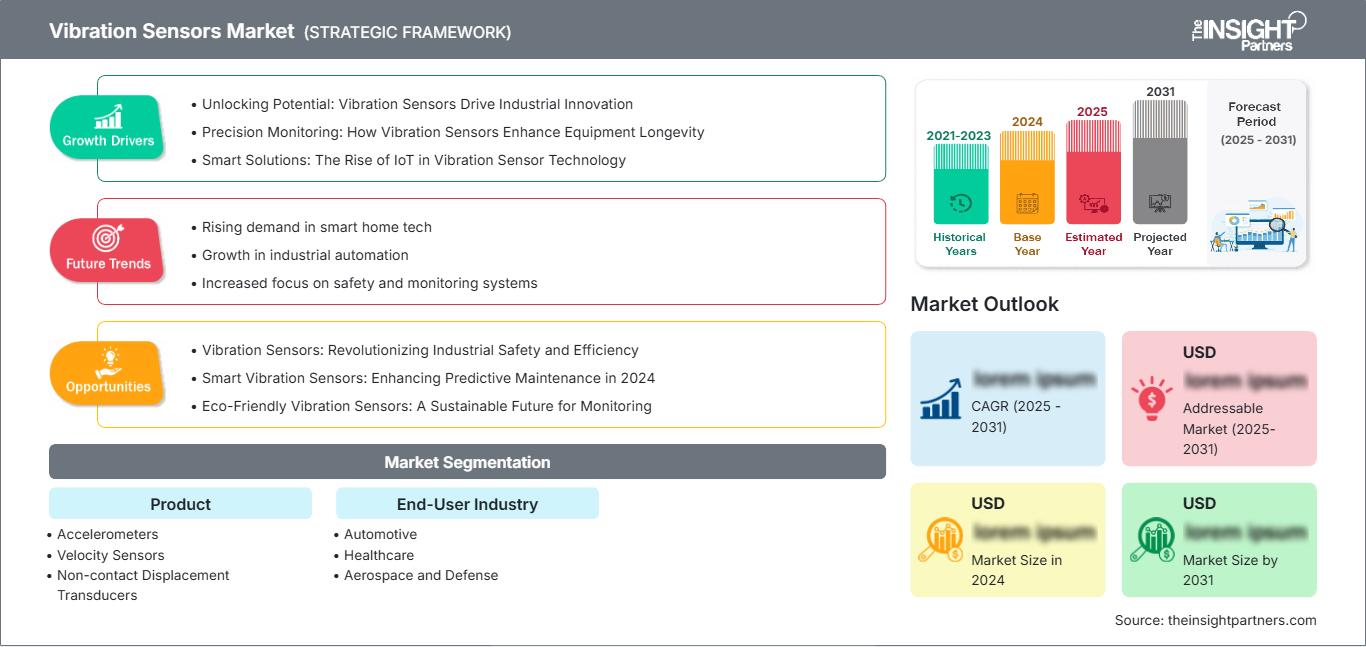
Demand is being shaped by the need to detect imbalance, bearing wear, misalignment, looseness, and other mechanical abnormalities before they interrupt production. The vibration sensors market growth is therefore linked to condition-based maintenance, industrial automation, and asset digitization. The value chain includes sensors, electronics, packaging, connectivity, data acquisition, analysis, and maintenance service; its effectiveness is now more and more determined by signal integrity and the capabilities of software interpretation.
Suppliers who can integrate noiseless sensors with good packaging and interfacing have an advantage due to market trends. Increasingly, industrial customers are assessing sensors as parts of larger monitoring systems rather than standalone devices. It highlights the need for interoperability, calibration, resilience to harsh environments, and lifetime services. There is even more need for this when it comes to automotive and aerospace programs.
Competition is increasingly centered on differentiated sensing performance, integration depth, and software compatibility. The vibration sensors market analysis shows complementary positioning among Analog Devices, Inc., Texas Instruments Incorporated, TE Connectivity Ltd., and DIS Sensors B.V. in sensing and connectivity, while Emerson Electric Co., National Instruments Corporation, Rockwell Automation, Inc., and Honeywell International Inc. extend value into measurement, automation, and industrial analytics.
Hansford Sensors Ltd. and SKF AB advance their efforts in application-oriented monitoring of rotating machinery. Competition in investments is heading toward edge computing, wireless communication, multi-axis sensing, and prediction algorithms. This trend was confirmed by Analog Devices in its AI-based condition monitoring concepts, whereas Emerson's test and measurement solutions focus on engineering connections. Differentiation relies more and more on operational insights from sensor readings.
● REPORT CUSTOMIZATION
Tailor This Report To Align With Your Specific Business Requirements
This report can be customized to align precisely with your business objectives, scope, and target markets. Customization options include tailored segmentation, geography, competitive analysis, and strategic insights to support informed decision-making.
Customize This Report →WHAT YOU CAN ADJUST
- ● Segmentations
- ● Geography
- ● Competitive Analysis
- ● Language Preferences
Vibration Sensors Market: Strategic Insights
Regional Insights
North America vibration sensors market
North America is estimated to hold 29–33% share in 2025 and grow at a CAGR of 8.3–9.0% through 2034. The US is still the major player, thanks to its manufacturing prowess, aerospace activities, semiconductor production and automated industrial systems. Condition monitoring is becoming increasingly important, as operators look for means of early detection and predictive maintenance.
Canada and Mexico contribute through their strengths in energy, automotive, mining, and manufacturing sectors. The market will also benefit from the possibilities of retrofits at existing industrial facilities that will make use of wireless sensors without having to install cables.
Aerospace and defense testing calls for highly accurate measurement, whereas automotive electrification will call for increased characterization of electric motors, drive-trains, batteries and manufacturing equipment.
U.S. vibration sensors Market
The U.S. is estimated to represent 74–78% of North America's 2025 value and expand at a CAGR of 8.4–9.1% through 2034. The machinery in industry, aerospace, and automation leads to an extensive application space. Increasingly, vibration measurements are linked to maintenance software and analysis systems within plants.
Analog Devices, Inc., Honeywell International Inc., Emerson Electric Co., Rockwell Automation, Inc., National Instruments Corporation, and Texas Instruments Incorporated offer technologies or measurement abilities for this market segment in the United States. The applications include machinery, turbines, pumps, motors, test stands, vehicles, and aerospace systems. There is special appeal when there are significant benefits from continuous monitoring.
Europe vibration sensors Market
Europe is estimated at 24–28% vibration sensors market share in 2025 and is projected to expand at a CAGR of 8.0–8.7% through 2034. Germany leads regional demand, followed by the UK, France, Italy, and Spain, with automotive engineering, industrial machinery, aerospace, energy, and process industries supporting deployment. Environmental and machinery-efficiency priorities further encourage monitoring.
The UK combines aerospace, rail, and advanced manufacturing applications, while Germany benefits from automotive production and machinery exports. France has strong aerospace and industrial engineering demand. Italy and Spain add automotive, machinery, energy, and process-industry applications. Suppliers increasingly compete on compact form factors, ruggedization, digital interfaces, and analytics compatibility, while factories create retrofit potential.
APAC vibration sensors Market
APAC is estimated at 31–35% share in 2025 and is expected to grow at a CAGR of 9.5–10.3% through 2034, making it the leading regional market. China, Japan, South Korea, India, and Australia provide diverse demand across electronics, automotive, energy, mining, and industrial automation.
China leads regional volume through manufacturing scale and equipment modernization. Japan and South Korea emphasize precision manufacturing and electronics, while India is expanding automotive, infrastructure, and industrial capacity. Australia contributes to mining and energy applications. Industrial digitization, smart-factory programs, and connected production assets support deployment.
Middle East & Africa vibration sensors Market
The Middle East & Africa is expected to expand at a CAGR of 6.8–7.6% through 2034. Demand in the region is being led by Saudi Arabia, based on energy, petrochemicals, infrastructure, and industrial diversification. The UAE is contributing to the market via aviation, utilities, manufacturing, and smart infrastructure initiatives, while South Africa is adding mining and industrial applications.
With energy-intensive plants, there is a definite case for the condition monitoring of pumps, compressors, turbines, and rotating machinery. With infrastructure modernization and the growth in digital industrial solutions, interest in sensor-based technologies is growing, but project economics and technology serviceability still figure prominently in adoption.
Segmentation Analysis
Product
The Product segment is expected to grow at a CAGR of 8.4–9.0% during 2026–2034. Accelerometers account for the broadest application base because they combine versatile measurement with compact form factors and increasing MEMS integration. Velocity sensors remain valuable for established machinery-monitoring practices, while non-contact displacement transducers address precision applications where shaft position, motion, or surface access makes direct contact unsuitable.
- Accelerometers: Broadly adopted across machinery, vehicles, electronics, and test systems because they support multi-axis measurement, compact packaging, and integration with edge electronics for continuous condition monitoring.
- Velocity Sensors: Maintain relevance in rotating-equipment monitoring where velocity-based vibration metrics are familiar to maintenance teams and support practical assessment of machine severity.
- Non-contact Displacement Transducers: Serve precision applications requiring direct measurement of shaft movement, position, or surface displacement without physical contact, in specialized machinery and testing.
End-User Industry
The End-User Industry segment is projected to grow at a CAGR of 8.8–9.5% during 2026–2034. Automotive, aerospace and defense, and consumer electronics increasingly require vibration measurement during product development, validation, manufacturing, and reliability testing. Oil and gas uses monitoring to protect critical rotating assets, while healthcare applications are expanding through equipment diagnostics, medical-device testing, and facility reliability requirements. The vibration sensors market scope therefore, spans both production assets and specialized equipment.
- Automotive: Demand is supported by electric and conventional powertrain testing, manufacturing automation, durability validation, and monitoring of motors, pumps, compressors, and production machinery.
- Healthcare: Adoption is developing around medical-device testing, imaging equipment, laboratory systems, facility machinery, and reliability programs where abnormal vibration can affect performance or maintenance.
- Aerospace and Defense: High-value aircraft, propulsion, structural, and test applications require precise vibration measurement for qualification, diagnostics, reliability assessment, and operational safety.
- Consumer Electronics: Compact sensors support product testing, device characterization, manufacturing equipment monitoring, and reliability evaluation as electronics become smaller and more densely integrated.
- Oil and Gas: Critical pumps, compressors, turbines, and rotating equipment create recurring monitoring needs because vibration changes can provide early indications of mechanical degradation.
Opportunity Snapshot
| End-User Industry | Revenue Contribution | Trend Tag | Adoption Stage |
|---|---|---|---|
| Automotive | High | EV Testing | Scaling |
| Healthcare | Medium | Device Reliability | Scaling |
| Aerospace & Defense | Medium | Flight Testing | Mature |
| Consumer Electronics | Medium | Device Testing | Scaling |
| Oil & Gas | High | Asset Integrity | Mature |
Vibration Sensors Market Growth Drivers and Impact Analysis
Expansion of wireless condition monitoring
Wireless frameworks have reduced the real-world cost and complexity associated with monitoring assets that were hard to instrument continuously before. Thanks to energy-efficient MEMS-based sensors, wireless connectivity, and edge processing capabilities, the sensors can function with minimal wiring, sending out diagnostic signals rather than all raw waveforms. The market opportunity is largest where there are many semi-critical machines, including motors, pumps, fans, conveyors, and gearboxes at large manufacturing facilities. With wireless, it is possible to focus on assets, broaden coverage of the machines being monitored, and link up maintenance personnel to machine health signals. There is an increase in addressable installed base as well. In addition, solution providers have more value to capture, while component vendors can take advantage of increased sensors per facility.
Integration of edge intelligence into sensing nodes
Evolving edge intelligence is revolutionizing the cost structure of vibration sensing by enabling sensors and proximate gateways to perform signal processing before transmitting data to control centers. By avoiding the transmission of continuous large volumes of data, these sensors can compute metrics, detect any anomalies and send alerts or characteristics. Communication and storage costs are minimized, along with faster reaction times for maintenance decisions. Market implications expand beyond industrial plants to include transportation, aerospace testing, robotics, and even distributed networks. Processing power, digital connectivity, and artificial intelligence capabilities also improve the usability of the output from sensors for automation applications. Those suppliers that can provide robust algorithms without sacrificing sensing accuracy can compete on diagnostics.
Electrification and higher equipment operating complexity
The rise of electrification makes vibration sensing even more important in terms of vehicles, manufacturing systems, motors, compressors, and infrastructure components. Different rotation behavior, switching behavior, heat interaction, and manufacturing tolerances associated with the electric drivetrain necessitate thorough validation. On the other hand, there is an increasing use of automation equipment in factory settings, making the detection of mechanical problems even more serious and necessitating even better sensing in terms of product design and manufacture. The use of vibrations along with temperature, current, sound, and pressure sensing allows for improved fault diagnostics. Providers offering high bandwidth, low-noise operation, small form factors, and multi-sensor fusion are well-positioned for this trend.
Vibration Sensors Market Future Trends
Sensor-level analytics will become a standard architecture
The next generation of monitoring devices is likely to perform more signal processing inside the sensor or immediately at the edge. Rather than treating the sensor as a simple transducer, manufacturers will increasingly combine acceleration measurement, temperature sensing, digital filtering, feature extraction, diagnostics, and industrial communications. This architecture can shorten response times. It also allows maintenance systems to receive standardized health indicators while retaining access to raw data for advanced investigations. As embedded processing becomes more capable, vibration sensors market trends will increasingly reflect software-defined functionality and updateable diagnostic models. The strongest solutions will balance algorithmic sophistication with transparent measurement quality, cybersecurity, calibration stability, and long-term industrial support.
Multi-sensor fusion will improve fault identification
There is an increasing use of vibration measurement coupled with temperature, current, pressure, acoustic, velocity, and operational context data. Future measurement systems will incorporate all these parameters to identify real mechanical issues as opposed to changes due to load, velocity, temperature, or process conditions. This will be beneficial to facilities where maintenance actions have high costs. There will be an increasing incorporation of edge gateways and industrial software that correlates different signal data between machines as opposed to evaluating each sensor individually. This will help with the representation of assets and accurate maintenance recommendations. In aircraft and automobile tests, synchronized measurement of data will assist in the characterization of complex systems.
Vibration Sensors Market Opportunities
Retrofit monitoring for aging industrial assets
A significant opportunity lies in converting existing machinery into connected assets without replacing installed control infrastructure. Many plants operate equipment that remains productive but lacks continuous health monitoring. Compact wireless sensors can add vibration measurement with limited disruption, particularly on motors, pumps, fans, compressors, and gearboxes. Providers can package hardware with installation, baseline assessment, analytics, and recurring diagnostic services to reduce the technical burden on customers. The vibration sensors market forecasts favor this opportunity because retrofit programs can proceed incrementally, beginning with critical assets and expanding according to measured benefits. Suppliers that support legacy interfaces, simple commissioning, remote diagnostics, and scalable subscriptions can address smaller facilities as well as large industrial groups pursuing plant-wide reliability programs.
Specialized sensing for high-value equipment
High-value equipment provides another attractive opportunity because customers are more willing to pay for measurement performance when failure costs are substantial. Aircraft systems, turbines, precision machine tools, advanced production equipment, and specialized medical devices require dependable sensing under demanding operating conditions. Suppliers can differentiate through higher bandwidth, lower noise, temperature stability, rugged packaging, calibration services, and application-specific analytics. Partnerships with equipment manufacturers can embed sensors during design rather than adding them after installation. This creates longer product lifecycles and stronger specification control. This is especially relevant where qualification requirements make supplier changes difficult. Companies that combine hardware engineering with application expertise can therefore build durable positions in specialized monitoring niches.
Frequently Asked Questions

- Comprehensive Market Sizing and Forecast Analysis
- Detailed Segmentation Analysis
- In-Depth Market Dynamics Assessment
- Regional and Country-Level Insights
- Competitive Landscape and Company Benchmarking
- Strategic Business Intelligence
Recent Reports
Testimonials

The Insight Partners provided valuable market intelligence that supported our global go-to-market strategy. Their team was professional, responsive, and attentive to our feedback, providing thoughtful analysis and helpful methodological clarifications throughout the project.
Junmo Kim Chief Financial Officer (CFO), Enertech Co., Ltd.
The Insight Partners' SCADA System Market report is comprehensive, with valuable insights on current trends and future forecasts. The team was highly professional, responsive, and supportive throughout. We are very satisfied and highly recommend their services.
RAN KEDEM Partner, Reali Technologies LTDs
I requested a report on a very specific software market and the team produced the report in a few days. The information was very relevant and well presented. I then requested some changes and additions to the report. The team was again very responsive and I got the final report in less than a week.
JEAN-HERVE JENN Chairman, Future Analytica
We worked with The Insight Partners for an important market study and forecast. They gave us clear insights into opportunities and risks, which helped shape our plans. Their research was easy to use and based on solid data. It helped us make smart, confident decisions. We highly recommend them.
PIYUSH NAGPAL Sr. Vice President, High Beam Global
The Insight Partners delivered insightful, well-structured market research with strong domain expertise. Their team was professional and responsive throughout. The user-friendly website made accessing industry reports seamless. We highly recommend them for reliable, high-quality research services
YUKIHIKO ADACHI CEO, Deep Blue, LLC.
This is the first time I have purchased a market report from The Insight Partners.While I was unsure at first, I visited their web site and felt more comfortable to take the risk and purchase a market report.I am completely satisfied with the quality of the report and customer service. I had several questions and comments with the initial report, but after a couple of dialogs over email with their analyst I believe I have a report that I can use as input to our strategic planning process.Thank you so much for taking the extra time and making this a positive experience.I will definitely recommend your service to others and you will be my first call when we need further market data.
JOHN SUZUKI President and Chief Executive Officer, Board Director, BK Technologies
I wish to appreciate your support and the professionalism you displayed in the course of attending to my request for information regarding to infectious disease IVD market in Nigeria. I appreciate your patience, your guidance, and the fact that you were willing to offer a discount, which eventually made it possible for us to close a deal. I look forward to engaging The Insight Partners in the future, all thanks to the impression you have created in me as a result of this first encounter.
DR CHIJIOKE ONYIA MANAGING DIRECTOR, PineCrest Healthcare Ltd.Reason to Buy
- Informed Decision-Making
- Understanding Market Dynamics
- Competitive Analysis
- Identifying Emerging Markets
- Customer Insights
- Market Forecasts
- Risk Mitigation
- Boosting Operational Efficiency
- Strategic Planning
- Investment Justification
- Tracking Industry Innovations
- Aligning with Regulatory Trends





 Get Free Sample for