
Wind Turbine Lubricants Market Growth, Trends & Demand by 2034
Coverage: By Base Oil (Mineral Oil, Synthetic, and Bio-Based) and Product Type (Grease, Gear Oil, Hydraulic Oil, and Others)
- Status : Upcoming
- Report Code : TIPRE00029905
- Category : Chemicals and Materials
- No. of Pages : 150
- Available Report Formats :


- Last update date : March 09, 2026


2025 Market Size
US$ 244.58 Mn
Base year value
2034 Forecast
US$ 605.64 Mn
Projected by 2034
CAGR 2026-2034
10.6 %
Growth rate
Addressable Market
US$ 3,767.32 Mn
(2026-2034)
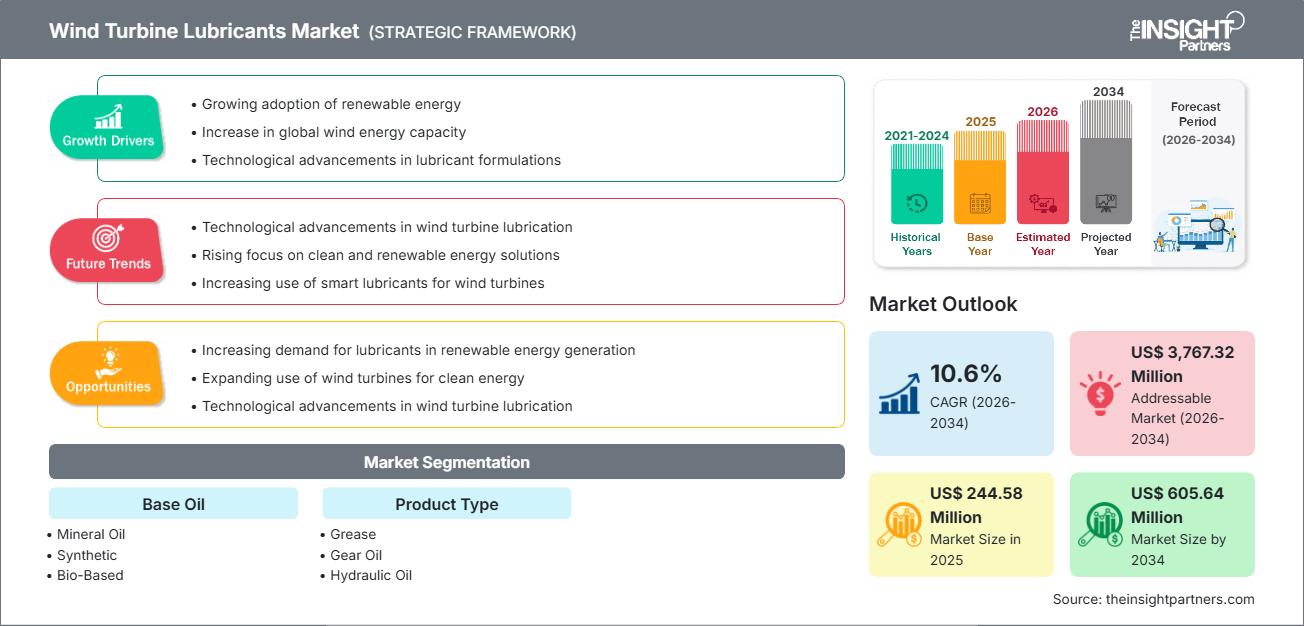
The global wind turbine lubricants market size is projected to reach US$ 605.64 million by 2034 from US$ 244.58 million in 2025. The market is anticipated to register a CAGR of 10.6% during the forecast period 2026–2034.
Key market dynamics include a heightening global focus on renewable energy infrastructure, rising installations of high-capacity offshore wind farms, and a significant shift toward high-performance synthetic fluids that minimize mechanical wear. Additionally, the market is expected to benefit from the growing adoption of predictive maintenance technologies, the expansion of wind energy projects across emerging economies in Asia-Pacific, and the increasing inclusion of biodegradable lubricants in environmentally sensitive marine and onshore sites.
Wind Turbine Lubricants Market Analysis
The wind turbine lubricants market analysis points to a clear movement toward advanced synthetic and bio‑based formulations as operators place greater emphasis on reliability, extended maintenance intervals, and overall lifecycle efficiency. The industry is evolving along two distinct paths: conventional onshore operations that continue to rely on mineral‑based lubricants, and rapidly expanding offshore installations that demand high‑performance synthetic oils capable of withstanding harsher environments. Significant opportunities are emerging in critical gearbox and bearing applications, where the superior thermal stability and oxidative resistance of synthetic lubricants provide a tangible performance edge over traditional mineral alternatives. Future market growth will also depend on the development of next‑generation additive packages that offer enhanced extreme‑pressure protection, corrosion resistance, and moisture tolerance—factors essential for modern high‑capacity turbines. Competitive advantage is increasingly shaped by close technical collaboration with original equipment manufacturers (OEMs) and by brand positioning that emphasizes sustainability, long‑term asset protection, and integration of real‑time condition‑monitoring technologies. These capabilities allow leading companies to sustain premium pricing in a market defined by stringent operational and performance requirements.
Wind Turbine Lubricants Market Overview
Industrial maintenance solutions have evolved from basic mineral oils to sophisticated high-performance products. Wind turbine lubricants include specialized gear oils, high-load greases, and biodegradable hydraulic fluids. Both global energy giants and specialized chemical companies compete in this market using base oils such as polyalphaolefins (PAO), esters, and high-grade mineral stocks. Growing demand for operational efficiency among utility companies in Europe and North America has increased the popularity of synthetic lubricants as a durable maintenance solution. Asia-Pacific leads in volume due to massive wind power capacity additions, while Europe is advancing in bio-based innovation and offshore adoption. The US market is the most rapidly expanding, driven by aggressive renewable energy targets and the broad availability of locally manufactured turbines. Competition among brands is fueling greater additive innovation and the inclusion of advanced anti-pitting and anti-corrosion agents.
Market Assessment and Insights
- Global market for Wind Turbine Lubricants was valued at US$ 244.58 Million in 2025
- Annual market size is expected to reach US$ 605.64 Million by 2034
- Total addressable market (TAM) during 2026-2034 is projected to reach approximately US$ 3,767.32 Million
- Market is anticipated to register a CAGR of 10.6% during the forecast period
- The United States represents a key market, supported by Growing adoption of renewable energy, Increase in global wind energy capacity, Technological advancements in lubricant formulations, as well as evolving industry dynamics
- Market analysis covers North America, Europe, Asia-Pacific, South and Central America, Middle East and Africa, with growth evaluated across the forecast period
- Market opportunities such as Increasing demand for lubricants in renewable energy generation, Expanding use of wind turbines for clean energy, Technological advancements in wind turbine lubrication are expected to influence market dynamics and addressable market
- Report profiles industry participants, including TotalEnergies SE, BP p.l.c., Chevron, Exxon Mobil Corporation, FUCHS Petrolub SE, Kl?ber Lubrication GmbH & Co., Phillips 66 Company, Shell Plc, The Lubrizol Corporation, Afton Chemical, AMSOIL INC., while analyzing competitive strategies and innovation developments
-
Source: The Insight Partners' analysis based on proprietary research, government publications, company annual reports, investor presentations, industry databases, and expert interviews.
● REPORT CUSTOMIZATION
Tailor This Report To Align With Your Specific Business Requirements
This report can be customized to align precisely with your business objectives, scope, and target markets. Customization options include tailored segmentation, geography, competitive analysis, and strategic insights to support informed decision-making.
Customize This Report →WHAT YOU CAN ADJUST
- ● Segmentations
- ● Geography
- ● Competitive Analysis
- ● Language Preferences
Wind Turbine Lubricants Market: Strategic Insights
-
Get Top Key Market Trends of this report.This FREE sample will include data analysis, ranging from market trends to estimates and forecasts.
Wind Turbine Lubricants Market Drivers and Opportunities
Market Drivers:
- Surge in Global Wind Capacity Additions: With over 100 GW of new wind capacity being added annually, the expanding installed base creates a massive service fill market for lubricants required during routine maintenance.
- Technological Shift to Larger, High-Torque Turbines: Modern turbines with larger rotor diameters and higher power ratings generate extreme heat and pressure in gearboxes, driving the mandatory use of premium synthetic lubricants over conventional mineral oils.
- Stringent Environmental Regulations: Increasing pressure to protect local ecosystems, especially in offshore and forested areas, is driving the adoption of biodegradable and non-toxic lubricants to prevent environmental damage from potential leaks.
Market Opportunities:
- Expansion into Condition-Based Monitoring (CBM): Integrating lubricants with AI-driven diagnostic tools offers a major opportunity for vendors to provide Lubrication-as-a-Service, moving from fixed schedules to optimized, health-based replacement.
- Repowering of Aging Wind Fleets: As thousands of turbines in mature markets reach the end of their 20-year design life, the repowering or upgrading of these assets creates a secondary surge in demand for modern, high-efficiency lubrication solutions.
- Growth in Deep-Water Offshore Projects: The rise of floating offshore wind farms presents a niche but high-margin opportunity for specialized lubricants that can survive extreme salinity and high-vibration environments.
Wind Turbine Lubricants Market Report Segmentation Analysis
The Wind Turbine Lubricants Market share is analyzed across various segments to provide a clearer understanding of its structure, growth potential, and emerging trends. Below is the standard segmentation approach used in industry reports:
By Base Oil:
- Synthetic: The dominant and most preferred segment for modern high-capacity turbines. It is increasingly preferred by operators who prioritize long drain intervals and superior performance under extreme temperatures.
- Mineral Oil: A volume-driven segment that remains relevant for older turbine models and cost-sensitive onshore projects due to established supply chains and lower initial costs.
- Bio-Based: A fast-growing niche that aligns with global sustainability trends. It is primarily utilized in offshore applications and sensitive ecological zones to minimize environmental risk.
By Product Type:
- Gear Oil: Remains the primary product segment, benefiting from the critical role of gearboxes in power transmission and the high volume of fluid required for each change.
- Grease: The fastest-growing product category, essential for the lubrication of main bearings, yaw systems, and pitch bearings across all turbine sizes.
- Hydraulic Oil: Offers a stable but essential range of fluids used in turbine braking systems and pitch control mechanisms in both onshore and offshore units.
By Geography:
- North America
- Europe
- Asia Pacific
- South & Central America
- Middle East & Africa
Wind Turbine Lubricants Market Report Scope
| Report Attribute | Details |
|---|---|
| Market size in 2025 | US$ 244.58 Million |
| Market Size by 2034 | US$ 605.64 Million |
| Global CAGR (2026 - 2034) | 10.6% |
| Historical Data | 2021-2024 |
| Forecast period | 2026-2034 |
| Segments Covered |
By Base Oil
|
| Regions and Countries Covered |
North America
|
| Market leaders and key company profiles |
|
Wind Turbine Lubricants Market Players Density: Understanding Its Impact on Business Dynamics
The Wind Turbine Lubricants Market is growing rapidly, driven by increasing end-user demand due to factors such as evolving consumer preferences, technological advancements, and greater awareness of the product's benefits. As demand rises, businesses are expanding their offerings, innovating to meet consumer needs, and capitalizing on emerging trends, which further fuels market growth.
Wind Turbine Lubricants Market Share Analysis by Geography
Asia-Pacific is expected to grow fastest in the coming years. Emerging markets in South & Central America, the Middle East, and Africa also have many untapped opportunities for lubricant manufacturers and maintenance service providers to expand.
The wind turbine lubricants market is undergoing a significant transformation, moving from a standard industrial commodity to a specialized high-performance sector. Growth is driven by the rising average size of turbines, a surge in offshore installations, and the expansion of the global renewable energy fleet. Below is a summary of market share and trends by region:
North America
- Market Share: A significant segment driven by federal incentives for renewable energy and a large base of aging turbines requiring maintenance.
- Key Drivers:
- Rising operator preference for synthetic lubricants to reduce the levelized cost of energy (LCOE)
- Growth of repowering projects that replace old components with high-torque modern systems
- Increased development of offshore wind clusters along the East Coast
- Trends: Widespread adoption of predictive oil analysis and the successful implementation of long-life gear oils to reduce maintenance frequency in remote locations.
Europe
- Market Share: Holds a leading position globally, anchored by the world’s most advanced offshore wind infrastructure in the North Sea and Baltic Sea.
- Key Drivers:
- High regional focus on sustainability and the use of biodegradable lubricants in marine environments
- Established technical standards and strict environmental regulations for lubricant disposal
- Robust presence of major wind OEMs requiring specific high-performance lubricant certifications
- Trends: A strategic shift toward bio-based base oils and circular economy initiatives, such as the re-refining of used turbine oils.
Asia-Pacific
- Market Share: The largest and fastest-growing region, with China serving as the primary driver for global wind capacity expansion.
- Key Drivers:
- Massive government-supported wind energy targets in China and India
- Rapid urbanization and increasing electricity demand are driving large-scale onshore wind farm developments
- Growing domestic manufacturing of turbines requiring high-volume initial fills of gear oil and grease
- Trends: Heavy reliance on high-performance synthetic lubricants for desert-based wind farms in the Gobi and coastal offshore projects.
South and Central America
- Market Share: Emerging market with a growing wind energy industry in countries like Brazil and Chile.
- Key Drivers:
- Increasing awareness of the cost-benefits of premium lubricants for extending the life of remote assets
- Modernization of energy grids to include more intermittent renewable sources
- Rising interest in international maintenance standards among regional power producers
- Trends: Growth of specialized maintenance contracts and the introduction of high-viscosity greases to handle the high humidity and variable wind conditions of the region.
Middle East and Africa
- Market Share: Developing market with a focus on diversifying energy mixes beyond fossil fuels.
- Key Drivers:
- Strategic investments in large-scale wind projects in Morocco, Egypt, and South Africa
- Need for lubricants with high thermal stability to operate in arid, high-temperature desert climates
- Implementation of national renewable energy programs to improve local energy security
- Trends: Adoption of advanced synthetic formulations that prevent oil oxidation in extreme heat, coupled with a focus on dust-resistant sealing and lubrication systems.
High Market Density and Competition
Competition is intensifying due to the presence of established leaders such as Shell, ExxonMobil, and Castrol (BP). Regional specialists and high-performance niche players like Klüber Lubrication and FUCHS, alongside major energy companies such as TotalEnergies and Chevron, also contribute to a diverse and technologically advanced market landscape.
This competitive environment pushes vendors to differentiate through:
- Technical Certification and OEM Partnerships: Positioning lubricants as co-engineered solutions by obtaining formal approvals from major turbine manufacturers to ensure compatibility and warranty compliance.
- Innovative Product Portfolios: Offering more than just standard gear oil. Companies provide rescue greases for damaged bearings, biodegradable fluids for offshore use, and high-performance synthetics that last over seven years.
- Integrated Service Models: Managing the entire lubrication lifecycle, from initial fill to used oil analysis and environmentally safe disposal. This approach ensures quality and helps operators meet ethical ESG standards.
- Digital Integration: New monitoring technologies and oil sensors help create data-driven maintenance schedules, moving the industry toward a predictive rather than reactive model.
Opportunities and Strategic Moves
- Partner with high-end digital service providers to offer Lubrication-as-a-Service. Using real-time oil condition monitoring sensors allows operators to switch from reactive to predictive maintenance, tapping into the surging demand for reduced downtime in Asia-Pacific and North American markets.
- Develop biodegradable formulations for offshore applications to meet growing sustainability concerns and ensure compliance with stringent maritime environmental regulations.
Major Companies operating in the Wind Turbine Lubricants Market are:
- TotalEnergies SE
- BP p.l.c.
- Chevron
- Exxon Mobil Corporation
- FUCHS Petrolub SE
- Klüber Lubrication GmbH & Co.
- Phillips 66 Company
- Shell Plc
- The Lubrizol Corporation
- Afton Chemical
- AMSOIL INC.
Disclaimer: The companies listed above are not ranked in any particular order.
Wind Turbine Lubricants Market News and Recent Developments
- In August 2024, Klüber Lubrication presented a new Gear Oil Booster and a new Rescue Grease for more efficiency in wind turbines. High-quality specialty lubricants make an effective and indispensable contribution to the efficient operation of wind turbines.
- In January 2024, Shell U.K. Limited announced the acquisition of MIDEL and MIVOLT from Manchester-based M&I Materials Ltd. Shell will manufacture, distribute, and market the MIDEL and MIVOLT product lines as part of Shell’s global lubricants portfolio. The acquisition of MIDEL enables Shell to complement its differentiated position in Transformer Oils used for power distribution, offshore wind parks, utility companies, and traction power systems. By adding synthetic and natural ester-based transformer fluids and services to its portfolio, Shell Lubricants aims to deliver improved fire protection and biodegradability to its customers.
Wind Turbine Lubricants Market Report Coverage and Deliverables
The Wind Turbine Lubricants Market Size and Forecast (2021–2034) report provides a detailed analysis of the market covering below areas:
- Wind Turbine Lubricants Market size and forecast at global, regional, and country levels for all the key market segments covered under the scope
- Wind Turbine Lubricants Market trends, as well as market dynamics such as drivers, restraints, and key opportunities
- Detailed PEST and SWOT analysis
- Wind Turbine Lubricants Market analysis covering key market trends, global and regional framework, major players, regulations, and recent market developments
- Industry landscape and competition analysis covering market concentration, heat map analysis, prominent players, and recent developments in the Wind Turbine Lubricants Market.
- Detailed company profiles
Frequently Asked Questions

- Comprehensive Market Sizing and Forecast Analysis
- Detailed Segmentation Analysis
- In-Depth Market Dynamics Assessment
- Regional and Country-Level Insights
- Competitive Landscape and Company Benchmarking
- Strategic Business Intelligence
Recent Reports
Testimonials

The Insight Partners' SCADA System Market report is comprehensive, with valuable insights on current trends and future forecasts. The team was highly professional, responsive, and supportive throughout. We are very satisfied and highly recommend their services.
RAN KEDEM Partner, Reali Technologies LTDs
I requested a report on a very specific software market and the team produced the report in a few days. The information was very relevant and well presented. I then requested some changes and additions to the report. The team was again very responsive and I got the final report in less than a week.
JEAN-HERVE JENN Chairman, Future Analytica
We worked with The Insight Partners for an important market study and forecast. They gave us clear insights into opportunities and risks, which helped shape our plans. Their research was easy to use and based on solid data. It helped us make smart, confident decisions. We highly recommend them.
PIYUSH NAGPAL Sr. Vice President, High Beam Global
The Insight Partners delivered insightful, well-structured market research with strong domain expertise. Their team was professional and responsive throughout. The user-friendly website made accessing industry reports seamless. We highly recommend them for reliable, high-quality research services
YUKIHIKO ADACHI CEO, Deep Blue, LLC.
This is the first time I have purchased a market report from The Insight Partners.While I was unsure at first, I visited their web site and felt more comfortable to take the risk and purchase a market report.I am completely satisfied with the quality of the report and customer service. I had several questions and comments with the initial report, but after a couple of dialogs over email with their analyst I believe I have a report that I can use as input to our strategic planning process.Thank you so much for taking the extra time and making this a positive experience.I will definitely recommend your service to others and you will be my first call when we need further market data.
JOHN SUZUKI President and Chief Executive Officer, Board Director, BK Technologies
I wish to appreciate your support and the professionalism you displayed in the course of attending to my request for information regarding to infectious disease IVD market in Nigeria. I appreciate your patience, your guidance, and the fact that you were willing to offer a discount, which eventually made it possible for us to close a deal. I look forward to engaging The Insight Partners in the future, all thanks to the impression you have created in me as a result of this first encounter.
DR CHIJIOKE ONYIA MANAGING DIRECTOR, PineCrest Healthcare Ltd.Reason to Buy
- Informed Decision-Making
- Understanding Market Dynamics
- Competitive Analysis
- Identifying Emerging Markets
- Customer Insights
- Market Forecasts
- Risk Mitigation
- Boosting Operational Efficiency
- Strategic Planning
- Investment Justification
- Tracking Industry Innovations
- Aligning with Regulatory Trends





 Get Free Sample for