
Airborne Radars Market Growth, Trends & Forecast by 2034
Coverage: By Component (Antenna, Transmitter, Duplexer, Receiver, Power Amplifier, Digital Signal Processor, Others); Technology (Software-defined Radar (SDR), Conventional RADAR, Quantum Radar); Platform (Commercial Aircraft, Military Aircraft, Business Jets, Helicopters, UAVs, UAM, Aerostats); Dimensions (2D, 3D, 4D); Application (Commercial and Civil, Defense and Security) , and Geography (North America, Europe, Asia Pacific, and South and Central America)
- Status : Data Released
- Report Code : TIPRE00022710
- Category : Aerospace and Defense
- No. of Pages : 150
- Available Report Formats :


- Last update date : October 30, 2026


2025 Market Size
US$ 11.58 Bn
Base year value
2034 Forecast
US$ 20.68 Bn
Projected by 2034
CAGR 2026-2034
6.66 %
Growth rate
Addressable Market
US$ 145.87 Bn
(2026-2034)
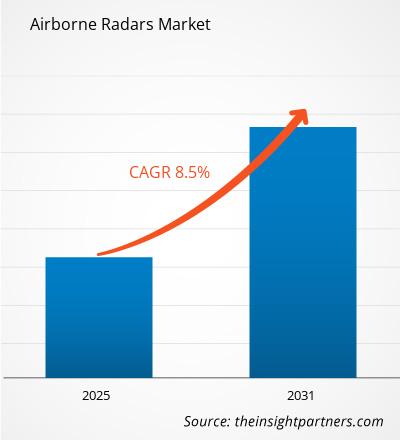
The airborne radars market was valued at US$ 11.58 Billion in 2025 and is expected to reach US$ 20.68 Billion by 2034, registering a CAGR of 6.66% during 2026–2034. Airborne radar systems support detection, tracking, identification, navigation, surveillance, and fire-control functions across commercial aircraft, military aircraft, business jets, helicopters, UAVs, UAM platforms, and aerostats. The market includes software-defined radar, conventional RADAR, and emerging quantum radar technologies, with 2D, 3D, and 4D architectures serving commercial, civil, and defense applications.
North America remains an important technology and procurement center, supported by aircraft modernization, integrated air and missile defense requirements, and continuing investment in electronically scanned sensors. The airborne radars market size is increasingly influenced by software-driven upgrades, open architectures, and demand for persistent sensing across crewed and uncrewed platforms. North American growth is supported by modernization of airborne surveillance fleets and increasing integration between radar, electronic warfare, command-and-control, and mission-computing systems, resulting in a modeled CAGR of ~6% through 2034.
Airborne Radars Market Assessment and Insights
Regional Outlook
- North America: ~37% of the global market in 2025 | ~6% CAGR through 2034. Market position: North America maintains the largest regional position, supported by extensive military aircraft fleets, aerospace research capabilities, advanced radar development programs, and procurement of networked sensors for contested and multi-domain operating environments.
- US: ~86% of North American market revenue in 2025 | ~6% CAGR through 2034. Market position: The US represents the principal North American demand center, with radar requirements spanning fighter aircraft, airborne early warning platforms, helicopters, UAVs, and integrated defense systems, alongside substantial domestic engineering and production capabilities.
- Europe: ~28% of the global market in 2025 | ~6% CAGR through 2034. Market position: Europe combines mature aerospace manufacturing with defense modernization and multinational procurement. Germany, France, the UK, Italy, and Spain sustain demand, while Germany represents the leading country in Europe through industrial capability, defense investment, and sensor modernization.
- Asia Pacific: ~24% of the global market in 2025 | ~8% CAGR through 2034. Market position: Asia Pacific is the fastest-growing region as China, Japan, South Korea, India, and Australia expand airborne surveillance, fighter, AEW&C, and unmanned-aircraft capabilities. Regional demand is reinforced by airspace monitoring and defense-industry localization.
Segment Outlook
- Conventional RADAR: ~55% Share in 2025 | ~5% CAGR through 2034. Market position: Conventional RADAR remains the largest technology segment because installed aircraft fleets continue to require established radar architectures for surveillance, navigation, weather detection, and fire-control functions, particularly where replacement cycles favor incremental modernization.
- Software Defined Radar: ~10% Share in 2025 | ~10% CAGR through 2034. Market position: Software Defined Radar has the highest growth outlook because programmable architectures permit capability updates through software, support multifunction sensing, and reduce the need for complete hardware replacement as mission requirements evolve.
Competitive Coverage
Lockheed Martin Corporation, Northrop Grumman Corporation, Thales Group, HENSOLDT AG, Leonardo S.p.A., BAE Systems plc, Israel Aerospace Industries Ltd., Saab AB, ASELSAN A.Ş., Elbit Systems Ltd.
Methodology
The Insight Partners follows Data Collection & Secondary Research, Primary Research, Data Analysis, Data Triangulation & Final Review to validate market estimates and insights.
Source: The Insight Partners' analysis based on proprietary research, government publications, company annual reports, investor presentations, industry databases, and expert interviews.
The radar has moved away from its legacy mechanical scanning and purpose-built radar designs to electronic scanning, digital processing, and increasingly software configurable solutions. AESA has enhanced capabilities in beam steering, multi-mission functionality, and complexity of operating within an electromagnetic environment, whereas digitized receivers and high-speed processors have increased the volume of data available to airborne sensors. Meanwhile, manufacturing is moving towards modular line replaceable architectures that may be fitted with mission computers, electronic warfare suites, data links, and electro-optic sensors. This has allowed for an increase in platform relevance through radar upgrades as opposed to purely airframe procurement.
As regards future procurement, it will become more diverse as nations seek to improve their airspace awareness as well as their airborne networked surveillance capability. The Asia Pacific region is especially interesting since the region’s air forces are modernizing their fighter fleets, AEW&C, maritime patrol aircraft, and UAVs. European demand will be driven by defense modernization and multinational capability development, while North America continues to focus on resilient sensing and open architecture. An example of the latter can be provided by NATO’s 2026 decision to procure up to ten Saab GlobalEye systems.
Airborne Radars Market Report Scope
| Report Attribute | Details |
|---|---|
| Market size in 2025 | US$ 11.58 Billion |
| Market Size by 2034 | US$ 20.68 Billion |
| Global CAGR (2026 - 2034) | 6.66% |
| Historical Data | 2021-2024 |
| Forecast period | 2026-2034 |
Airborne Radars Market Analysis
The first-level demand arises from the need for detection and tracking of aircraft, missiles, unmanned aerial vehicles, ships, topographical features, and weather phenomena from air. There is an increasing need for multifunctional sensors that can support surveillance, targeting, electronic protection, and situational awareness on a single platform for military applications. Civilian and commercial aviation demand tends to be more focused on weather, navigation, traffic surveillance, and safe operation. Therefore, the ecosystem ranges from semiconductor and antenna suppliers through to radar integrators, aircraft original equipment manufacturers, mission systems providers, software developers, maintenance providers, and defense ministries.
Supply in the airborne radars market is becoming increasingly biased towards companies capable of integrating radio frequency hardware, digital signal processing, software, mission computers, and platform integration. Companies involved include Lockheed Martin, Northrop Grumman, Thales Group, HENSOLDT, Leonardo, BAE Systems, Israel Aerospace Industries, Saab, ASELSAN, and Elbit Systems. Northrop Grumman attributed its first quarter of 2026 Mission Systems sales to partial ramp up on restricted airborne radar programs.
The competitive advantage based on positioning is becoming increasingly reliant on integration rather than just the radar antenna. Suppliers differentiate themselves using open architecture, software-defined processors, sensor fusion, low probability of intercept features, electronic protection, and interoperability with command-and-control networks. For instance, in Lockheed Martin’s Sentinel A4 program, the emphasis is on open architecture and AESA sensing, whereas Northrop Grumman relies on airborne radars via such products as F-35 fire control radar and MESA radar onboard the E-7 AEW&C aircraft.
According to the airborne radars market report, there is an increasing spent on systems that will work in an increasingly networked battlespace environment. The GlobalEye procurement by NATO and the incorporation of the E-7A Wedgetail by Australia and the E-2D by Japan at Exercise Pitch Black 2026 exemplify this trend.
● REPORT CUSTOMIZATION
Tailor This Report To Align With Your Specific Business Requirements
This report can be customized to align precisely with your business objectives, scope, and target markets. Customization options include tailored segmentation, geography, competitive analysis, and strategic insights to support informed decision-making.
Customize This Report →WHAT YOU CAN ADJUST
- ● Segmentations
- ● Geography
- ● Competitive Analysis
- ● Language Preferences
Airborne Radars Market: Strategic Insights

Regional Insights
North America airborne radars market
North America will be responsible for an estimated ~37% of the global airborne radars market share in 2025 and is expected to grow at a modelled CAGR of ~6% over 2034. The region has advantages in terms of a large fleet of military aircraft, aerospace electronics technology and the procurement of modern sensors. The United States is the primary source of demand, whereas Canada has demand because of its aerospace production and defense cooperation programs.
Primary sources of demand include fighter aircraft, airborne early warning and control aircraft, helicopters, UAVs, and special mission aircraft. The region is also developing radar systems with the ability to operate with electronic warfare systems and command and control systems. The delivery of the first Sentinel A4 radar by Lockheed Martin during the second low rate initial production run in February 2026 is a good example.
U.S. airborne radars market
The US represents approximately ~86% of North American market revenue in 2025 and is modeled to record a CAGR of ~6% through 2034. Its position reflects the scale of the US military aviation fleet, ongoing aircraft modernization, and requirements for long-range surveillance, precision targeting, electronic protection, and integrated air and missile defense.
Lockheed Martin, Northrop Grumman, BAE Systems, and other large defense technology companies are supplying the needs of the US in airborne sensors and mission systems. The applications include fighter fire control radars, airborne early warning & control (AEW&C), helicopter mission systems, unmanned aerial vehicle (UAV) sensors, and airborne surveillance. Digital upgrade is also critical since Lockheed Martin and Northrop Grumman have done joint development in digital receiver and exciter technologies for E-2D aircraft.
Europe airborne radars market
Europe constitutes approximately ~28% of the global market in 2025 and is expected to grow at a CAGR of ~6% through 2034. Germany is the leading nation in Europe, backed by its aerospace and defense industry base and investments in surveillance, electronic warfare and air-defence modernization programs. France continues to have robust demand driven by combat aircraft and national defense needs, while UK is driven by fighter modernization and airborne surveillance and electronic warfare programs.
Italy and Spain are contributing through their aircraft manufacturing and defense purchases as well as participation in multilateral aerospace programs. Increasingly, demand in Europe is focused on integration of airborne and ground sensors. The selection by NATO in 2026 of Saab's GlobalEye program for future AEW&C modernization underscores the need for airborne surveillance, multi-domain sensor capabilities and command and control systems. Up to ten aircraft will be acquired as part of the acquisition program to replace some of NATO's old E-3A systems.
Thales, HENSOLDT, Leonardo, BAE Systems, and Saab are also helpful to the regional market with respect to their complementing capabilities in radar, electronic warfare, aircraft technology, and surveillance. It is becoming more common for European initiatives to focus on upgrades and digital processing since such features enable users to enhance detection and tracking abilities without changing the entire fleet of aircraft.
APAC airborne radars market
Asia Pacific accounts for an estimated ~24% of global revenue in 2025 and is modeled to expand at a CAGR of ~8% through 2034, making it the fastest-growing region. China is the leading country in Asia Pacific based on the scale of military aviation modernization and domestic aerospace electronics activity. Japan and South Korea continue to invest in advanced fighter, surveillance, and AEW&C capabilities.
India is expanding indigenous aerospace and defense production while Australia is strengthening networked airborne surveillance and multinational interoperability. Exercise Pitch Black 2026 brought together aircraft and personnel from numerous Indo-Pacific and European partners, while Australia's E-7A and Japan's E-2D were integrated during the exercise. The region's growth is therefore linked to fleet modernization, airspace monitoring, maritime security, UAV adoption, and national defense-industrial policies.
Middle East & Africa airborne radars market
Middle East and Africa demand is supported by air-defense modernization, military aircraft procurement, border surveillance, and requirements for persistent situational awareness. The region is modeled to expand at a CAGR of ~7% through 2034. Saudi Arabia and the UAE maintain substantial investment in advanced defense systems, while South Africa contributes through aerospace engineering and regional security requirements.
The Middle East is also becoming relevant to airborne early warning procurement. Saab received an order in July 2026 for two GlobalEye aircraft from an unidentified Middle Eastern customer, with deliveries scheduled for 2030. GlobalEye combines active and passive sensors for long-range detection and identification across air, maritime, and land environments, illustrating regional demand for integrated airborne surveillance.
Segmentation Analysis
Technology
Technology segmentation in the airborne radars market covers Software Defined Radar, Conventional RADAR, and Quantum Radar. The technology segment is modeled to expand at a CAGR of ~7% through 2034. Demand is increasingly shaped by digital processing, multifunction operation, electronic protection, and the need to upgrade installed aircraft fleets without extensive hardware redesign. Conventional systems remain important, while software-defined architectures gain traction as aircraft operators prioritize flexible mission functionality.
- Software Defined Radar: Software-driven architectures allow radar functions to be modified through programmable processing and digital signal management. Their strategic importance lies in supporting evolving missions, interoperability, rapid capability updates, and multifunction sensing without requiring complete radar replacement.
- Conventional RADAR: Conventional RADAR remains widely deployed because established systems support proven surveillance, navigation, weather, and fire-control functions. Replacement and modernization programs sustain demand where operators prioritize reliability, certification continuity, existing integration, and predictable lifecycle support.
- Quantum Radar: Quantum Radar remains an emerging technology area centered on advanced sensing concepts and potential improvements in detection under difficult electromagnetic conditions. Its strategic relevance is associated with long-term research into low-observable target detection and next-generation sensing architectures.
Platform
Platform segmentation in the airborne radars market includes Commercial Aircraft, Military Aircraft, Business Jets, Helicopters, UAVs, and UAM, Aerostats. The platform segment is modeled to grow at a CAGR of ~6% through 2034. Military aircraft remain central to high-performance radar demand, while UAVs and emerging airborne platforms broaden the addressable application base.
- Commercial Aircraft: Radar systems support weather detection, navigation, traffic awareness, and operational safety. Replacement cycles and increasing aircraft utilization sustain demand for reliable sensing technologies integrated into increasingly digital avionics environments.
- Military Aircraft: Military aircraft require radar for surveillance, fire control, targeting, electronic protection, and situational awareness. Modernization of fighters, AEW&C aircraft, maritime patrol platforms, and specialized aircraft makes this subsegment strategically significant.
- Business Jets: Business jets use radar primarily for weather awareness and operational safety. Demand is influenced by fleet growth, avionics modernization, and increasing expectations for integrated cockpit systems.
- Helicopters: Helicopter radar applications include weather awareness, terrain and obstacle detection, maritime surveillance, and mission support. The subsegment benefits from modernization of military, emergency-service, offshore, and specialized rotorcraft fleets.
- UAVs: UAVs increasingly require compact and power-efficient sensors for surveillance, mapping, maritime missions, and defense applications. Radar enables operation under conditions where optical sensors can be constrained by darkness, weather, or concealment.
- UAM, Aerostats: Emerging UAM and aerostat applications create opportunities for lightweight surveillance and situational-awareness sensors. Adoption depends on certification, platform economics, mission requirements, and integration with broader airspace-management systems.
Dimensions
Dimensions segmentation in the airborne radars market comprises 2D, 3D, and 4D radar architectures. The dimensions segment is modeled to expand at a CAGR of ~7% through 2034. Demand is shifting toward systems that provide greater spatial and motion information because modern aircraft increasingly operate within networked environments requiring accurate tracking and identification.
- 2D: 2D radar remains relevant for applications where range and azimuth information meets mission requirements. Its established architecture supports cost-sensitive surveillance and legacy platform modernization.
- 3D: 3D radar provides elevation information alongside range and azimuth, improving target localization and situational awareness. It is important for modern surveillance and defense missions requiring more precise spatial tracking.
- 4D: 4D radar adds velocity or other temporal information to three-dimensional tracking, supporting more detailed target characterization. Its strategic importance is rising in environments where accurate tracking of fast-moving or maneuvering objects is required.
Application
Application segmentation in the airborne radars market comprises Commercial & Civil and Defense. The application segment is modeled to grow at a CAGR of ~6% through 2034. Defense represents the principal demand base because airborne radar is integral to surveillance, targeting, air combat, and mission management, while commercial and civil applications maintain a large installed requirement for safety-related sensing.
- Commercial & Civil: Commercial and civil applications include weather monitoring, navigation, traffic surveillance, and airspace safety. Demand is linked to aircraft utilization, avionics upgrades, airport capacity, and requirements for reliable operation in complex weather and airspace environments.
- Defense: Defense applications encompass fighter fire-control, AEW&C, maritime surveillance, reconnaissance, electronic warfare support, and integrated battlespace awareness. Modernization programs increasingly emphasize multifunction AESA sensors, software-defined processing, and interoperability with other mission systems.
Opportunity Snapshot
| Application | Revenue Contribution | Trend Tag | Adoption Stage |
| Commercial & Civil | Medium | Avionics Modernization | Mature |
| Defense | High | Multi-Domain Sensing | Scaling |
Airborne Radars Market Growth Drivers and Impact Analysis
Expansion of Networked Airborne Surveillance
Modern air operations increasingly depend on a shared and continuously updated picture of the battlespace rather than isolated sensor outputs. Airborne radar is therefore becoming more closely integrated with AEW&C aircraft, fighter mission systems, UAVs, ground-based command centers, and secure datalinks. This integration increases the value of radar systems that can generate standardized digital information and exchange data with other platforms. NATO's GlobalEye modernization initiative illustrates this direction because the platform is intended to provide multi-domain surveillance and command-and-control capabilities from the air. For suppliers, the implication is a broader value proposition extending from antenna and receiver performance to sensor fusion, data management, cybersecurity, and mission-system interoperability.
Modernization of Aging Aircraft and Radar Fleets
Aircraft operators are increasingly balancing new-platform procurement with upgrades to existing fleets. Radar modernization can extend aircraft utility by replacing processing, receiver, antenna, or software components without redesigning the complete airframe. This creates recurring demand for modular architectures, digital receivers, AESA technology, and open-system interfaces. Lockheed Martin's Sentinel A4 production activity demonstrates how modern radar programs are moving into production while emphasizing open architecture and AESA sensing. For the airborne segment specifically, digital upgrades such as receiver and exciter modernization can improve capability while reducing the operational disruption associated with full aircraft replacement. The resulting lifecycle model supports both original equipment production and aftermarket modernization.
Increasing Detection Requirements from Uncrewed Systems
The proliferation of UAVs and increasingly complex airborne threats is expanding requirements for detection, tracking, classification, and rapid target updates. Airborne radar suppliers must increasingly support missions involving small, maneuverable, low-altitude, and potentially networked targets. This favors high-resolution sensing, rapid beam management, multifunction operation, and integration with electronic warfare and command systems. Japan's defense authorities have continued emphasizing airborne surveillance and response capabilities amid increased activity around its surrounding airspace, while Australia and partner countries are expanding interoperability through airborne early warning exercises. The commercial impact is a stronger requirement for radar systems that can manage dense and heterogeneous target environments without imposing excessive size, weight, and power penalties.
Airborne Radars Market Future Trends
Software-Centric Radar Architectures
The next phase of radar development is likely to place greater emphasis on software as a mechanism for adding capabilities after hardware deployment. Software-defined architectures can allow operators to modify waveforms, signal-processing functions, tracking logic, and mission modes as threats and operational requirements change. Saab's recent radar development illustrates this broader direction, with software architecture being positioned as a mechanism for continuous upgrades and operational flexibility. In airborne applications, the trend is particularly relevant because aircraft face strict constraints on size, weight, power, cooling, and certification. A radar capable of receiving software upgrades can therefore deliver capability evolution without the physical disruption associated with repeated hardware redesigns.
Uncrewed Airborne Early Warning Systems
Airborne early warning is beginning to extend beyond traditional large crewed aircraft toward uncrewed platforms. Saab and General Atomics Aeronautical Systems completed the first flight of an unmanned airborne early warning solution in May 2026 by integrating Saab's LoyalEye radar sensor with an MQ-9B aircraft. This direction could change the economics and deployment model of persistent surveillance by allowing operators to distribute sensing across more numerous platforms. The implications in the airborne radars market trends extend to radar miniaturization, lower-power processing, autonomous mission management, communications, and distributed sensor architectures. For radar suppliers, successful commercialization would create a new platform category alongside conventional fighter, AEW&C, helicopter, and maritime-patrol applications.
Airborne Radars Market Opportunities
Modular Radar Upgrades for Existing Aircraft
A significant commercial opportunity lies in supplying modular radar upgrades for aircraft that remain operational but require improved detection, tracking, or processing capabilities. Operators can face high costs and lengthy timelines when replacing entire platforms, making radar-level modernization attractive where the airframe has sufficient remaining service life. Vendors with open architectures, digital processing, standardized interfaces, and established aircraft-integration experience can address this requirement through phased upgrades. Such programs can also create recurring revenue from software updates, maintenance, calibration, spares, and lifecycle engineering. The airborne radars market forecast opportunity is particularly relevant for mature military fleets and specialized surveillance aircraft where mission capability must advance faster than complete platform replacement cycles.
Regional Production and Technology Partnerships
Localization is creating opportunities for radar companies to combine technology ownership with regional manufacturing, integration, maintenance, and training partnerships. Governments seeking greater defense-industrial autonomy increasingly value domestic participation in sophisticated electronics programs, while suppliers benefit from access to long-term procurement and sustainment opportunities. Asia Pacific and the Middle East offer particular potential because countries in these regions are expanding aerospace capabilities and seeking greater control over critical defense technologies. Successful partnerships can involve antenna production, electronic assemblies, software development, system integration, and through-life support rather than simple equipment sales. Companies that structure technology cooperation around local industrial requirements can broaden their addressable opportunities while supporting regional supply-chain resilience.
Frequently Asked Questions

- Comprehensive Market Sizing and Forecast Analysis
- Detailed Segmentation Analysis
- In-Depth Market Dynamics Assessment
- Regional and Country-Level Insights
- Competitive Landscape and Company Benchmarking
- Strategic Business Intelligence
Recent Reports
Testimonials

The Insight Partners provided valuable market intelligence that supported our global go-to-market strategy. Their team was professional, responsive, and attentive to our feedback, providing thoughtful analysis and helpful methodological clarifications throughout the project.
Junmo Kim Chief Financial Officer (CFO), Enertech Co., Ltd.
The Insight Partners' SCADA System Market report is comprehensive, with valuable insights on current trends and future forecasts. The team was highly professional, responsive, and supportive throughout. We are very satisfied and highly recommend their services.
RAN KEDEM Partner, Reali Technologies LTDs
I requested a report on a very specific software market and the team produced the report in a few days. The information was very relevant and well presented. I then requested some changes and additions to the report. The team was again very responsive and I got the final report in less than a week.
JEAN-HERVE JENN Chairman, Future Analytica
We worked with The Insight Partners for an important market study and forecast. They gave us clear insights into opportunities and risks, which helped shape our plans. Their research was easy to use and based on solid data. It helped us make smart, confident decisions. We highly recommend them.
PIYUSH NAGPAL Sr. Vice President, High Beam Global
The Insight Partners delivered insightful, well-structured market research with strong domain expertise. Their team was professional and responsive throughout. The user-friendly website made accessing industry reports seamless. We highly recommend them for reliable, high-quality research services
YUKIHIKO ADACHI CEO, Deep Blue, LLC.
This is the first time I have purchased a market report from The Insight Partners.While I was unsure at first, I visited their web site and felt more comfortable to take the risk and purchase a market report.I am completely satisfied with the quality of the report and customer service. I had several questions and comments with the initial report, but after a couple of dialogs over email with their analyst I believe I have a report that I can use as input to our strategic planning process.Thank you so much for taking the extra time and making this a positive experience.I will definitely recommend your service to others and you will be my first call when we need further market data.
JOHN SUZUKI President and Chief Executive Officer, Board Director, BK Technologies
I wish to appreciate your support and the professionalism you displayed in the course of attending to my request for information regarding to infectious disease IVD market in Nigeria. I appreciate your patience, your guidance, and the fact that you were willing to offer a discount, which eventually made it possible for us to close a deal. I look forward to engaging The Insight Partners in the future, all thanks to the impression you have created in me as a result of this first encounter.
DR CHIJIOKE ONYIA MANAGING DIRECTOR, PineCrest Healthcare Ltd.Reason to Buy
- Informed Decision-Making
- Understanding Market Dynamics
- Competitive Analysis
- Identifying Emerging Markets
- Customer Insights
- Market Forecasts
- Risk Mitigation
- Boosting Operational Efficiency
- Strategic Planning
- Investment Justification
- Tracking Industry Innovations
- Aligning with Regulatory Trends





 Get Free Sample for