
Baby Food Market Insights & Growth Scope 2031
Coverage: By Product Type (Milk Formula, Fruit and Vegetable Puree, Baby Cereals and Porridge, Pureed Meat, Yogurt, Yogurt Melts, Biscuits and Cookies, Teether Crackers/Cookies, Puffed Baby Snacks, Baby Snack Bars, Juices, Shakes, and Smoothies, and Others), Category (Organic and Conventional), Age Group (Upto 6 Months, 6-10 Months, 10-16 Months, 16-24 Months, and 24-36 Months), Distribution Channel (Supermarkets and Hypermarkets, Convenience Stores, Pharmacies and Drugstores, Online Retail, and Others)
- Status : Published
- Report Code : TIPRE00004257
- Category : Food and Beverages
- No. of Pages : 295
- Available Report Formats :


- Last update date : December 30, 2025


2024 Market Size
US$ 74.33 Bn
Base year value
2031 Forecast
US$ 103.01 Bn
Projected by 2031
CAGR 2025-2031
4.8 %
Growth rate
Addressable Market
US$ 630.40 Bn
(2025-2031)
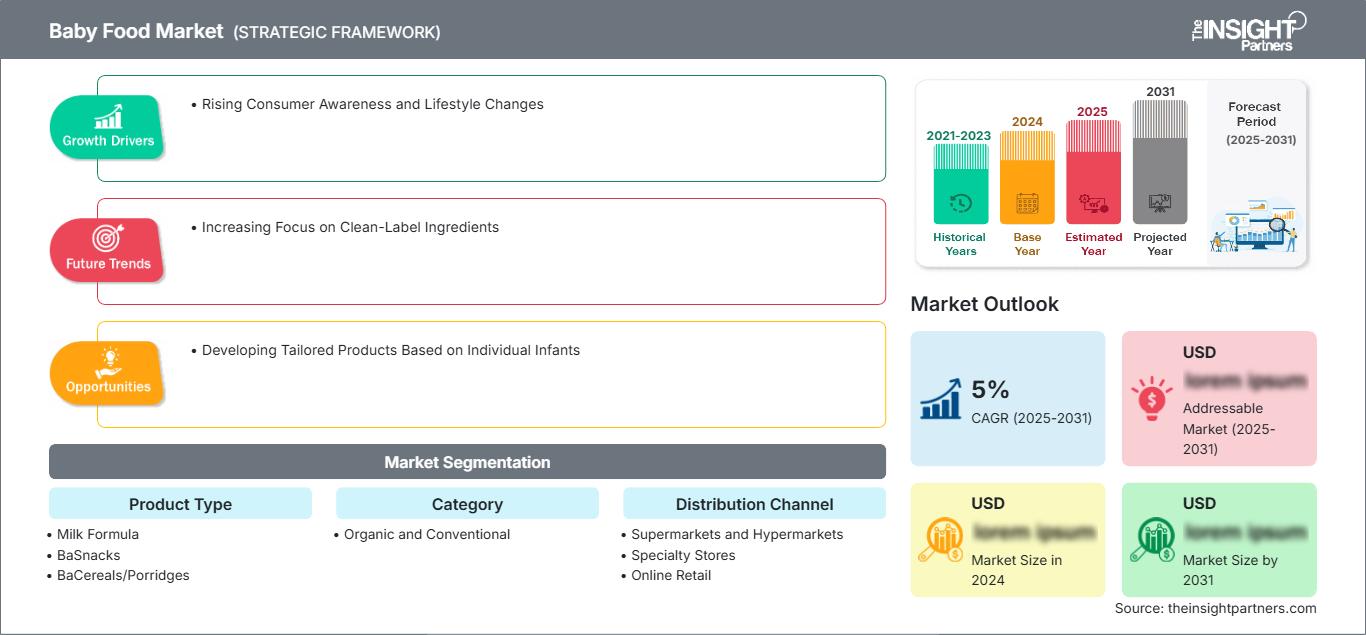
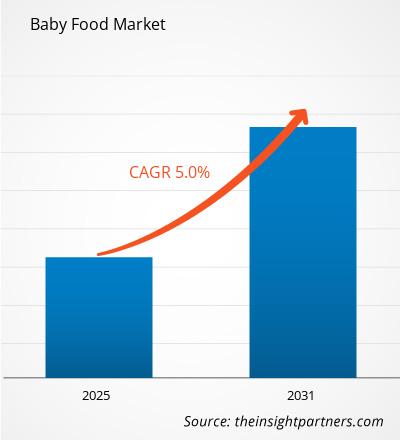
The baby food market size is projected to reach US$ 103.01 billion by 2031 from US$ 74.33 billion in 2024. The market is expected to register a CAGR of 4.8% from 2025 to 2031.
Baby Food Market Analysis
Growing demand for safe, convenient, and nutritionally superior baby foods is driving the uptake of packaged products such as milk formula. Parents are more inclined toward scientifically formulated stage-matched offerings, which provide balanced growth, allergen control, and good digestion, along with the desired safety associated with long shelf life. Access is accelerated by the development of modern retail, e-commerce, and temperature-controlled supply chains in emerging markets. From clean label, organic, HMO-enriched, and plant-based options to premium, convenience-driven ready-to-feed and pouch offerings or plant-forward products, align with time-starved consumers who refuse to compromise on quality. Increased attention on food safety, traceability, and regulatory compliance is why branded baby food is the preferred choice in retail, institutional, and export markets worldwide.
Baby Food Market Overview
The need for high-barrier, contaminant-free packaging that ensures long shelf life and superior ingredient protection is driven by stringent global regulations combined with parental demand for safety and premium nutrition. BPA-free cans, aseptic cartons, recyclable pouches, and high-clarity tubs will be in demand for infant milk formulas, organic purees, and ready-to-feed products. For infant nutrition, consumption is spurred by rises in birth rates, dual-income households, and a heightened focus on protein & immunity. Europe and North America are core markets, due to mature regulatory environments and organic preferences. However, APAC has emerged as the fastest-growing region, powered by urbanization, rising disposable incomes, expanding modern retail, and booming e-commerce channels.
Market Research Highlights
- Asia Pacific dominated the market with 44.9% share in 2024.
- Asia Pacific is poised to grow at a CAGR of 5.1% over the forecast period.
- United States market is projected to grow at a CAGR of 4.2% over the forecast period.
- By Product Type, the Milk Formula segment accounted for the largest market share of 57.2% in 2024.
- By Category, the Organic segment is anticipated to witness the fastest growth, registering a CAGR of 5.2% over the forecast period
- By Age Group, the Upto 6 Months segment accounted for the largest market share of 29.5% in 2024.
- By Distribution Channel, the Online Retail segment is anticipated to witness the fastest growth, registering a CAGR of 5.4% over the forecast period
- The report profiles key industry players such as Abbott Laboratories, Nestle SA, Danone SA, Reckitt Benckiser Group Plc, Royal FrieslandCampina NV, Nature's Path, The Hain Celestial Group Inc, China Mengniu Dairy Co Ltd, Hero Group, Little Spoon, Inc, while also analyzing key developments in novel ideas, disruptive products, and innovative services that could reshape the future market and reveal emerging themes across the industry.
Source: The Insight Partners' analysis based on proprietary research, government publications, company annual reports, investor presentations, industry databases, and expert interviews.
● REPORT CUSTOMIZATION
Tailor This Report To Align With Your Specific Business Requirements
This report can be customized to align precisely with your business objectives, scope, and target markets. Customization options include tailored segmentation, geography, competitive analysis, and strategic insights to support informed decision-making.
Customize This Report →WHAT YOU CAN ADJUST
- ● Segmentations
- ● Geography
- ● Competitive Analysis
- ● Language Preferences
Baby Food Market: Strategic Insights
-
Get Top Key Market Trends of this report.This FREE sample will include data analysis, ranging from market trends to estimates and forecasts.
Baby Food Market Drivers and Opportunities
Market Drivers:
- Rising Global Birth Rates & Female Workforce Participation: The changes to lifestyle in the cities due to urbanization and the rise of dual-income families in APAC and MEA have led to a demand for more convenient and safe infant nutrition.
- Premiumization & Health-Conscious Parenting: Millennial/Gen-Z parents who want the best for their children prefer organic, clean-label, HMO-fortified, A2, goat milk, and allergy-friendly formulas.
- Expansion of Modern Retail & E-commerce: The presence of hypermarkets, baby specialty stores, quick-commerce, and D2C subscription models has made it easier for consumers to have access to branded baby food products.
- Stringent Regulatory & Safety Standards: The adoption of strict global guidelines on contaminants, labeling, and traceability keeps the quality of packaged milk formula and prepared baby food products at a high standard, and thus, safety is ensured.
Market Opportunities:
- Clean-Label and Plant-Based Innovation: The demand for organic, non-GMO, lactose-free, and plant-based alternatives is growing due to changing dietary preferences.
- Sustainable & Recyclable Packaging: The changes in packaging from BPA-free, mono-material pouches, paper-based tubs, and PCR plastics are meant to be in line with ESG and regulatory requirements.
- Fast-Growing Emerging Markets: India, China, Indonesia, and Africa, due to increasing incomes and a modern cold-chain infrastructure, offer potential for volume increase.
Baby Food Market Report Segmentation Analysis
The baby food market is divided into different segments to give a clearer view of its growth potential and the latest trends. Below is the standard segmentation approach used in industry reports:
By Type:
- Milk Formula: It is used as a full breast-milk replacement. The product offers stage-wise nutrition and is enriched with DHA, ARA, prebiotics, and HMOs for the immune system and brain development.
- Fruit and Vegetable Puree: The products are either single-ingredient or multi-fruit/vegetable blends in spouted pouches that are convenient.
- Baby Cereals and Porridge: The products include iron-fortified rice, oatmeal, and multigrain variants, and are organic and instant-mix for easy preparation.
- Pureed Meat: High-protein stage-2/3 meals; single-meat or meat-vegetable mixtures that deliver the necessary iron and zinc in a smooth consistency.
- Yogurt: Dairy snacks rich in probiotics; the products are full-fat, low-sugar, fruit-added, and come in refrigerated cups that support gut health from the age of 6+ months.
- Yogurt Melts: Probiotic snacks that have been freeze-dried and that melt in the mouth, available in resealable pouches; a finger food for self-feeding.
- Biscuits and Cookies: The products are low-sugar, no-artificial-flavor options and are made to relieve the teething child's gums.
- Teether Crackers/Cookies: Hard, dissolvable rice/hydrolyzed wheat crackers that have been shaped to facilitate holding and safe gumming practice.
- Puffed Baby Snacks: Light, air-puffed whole-grain or vegetable puffs; low-mess, easy-to-hold finger foods with minimal ingredients.
- Baby Snack Bars: Soft-baked oat/fruit bars; on-the-go nutrition with added vitamins, no added sugar, and portable packaging.
- Juices, Shakes, and Smoothies: Whole fruit or fruit-vegetable mixes, typically sold in pouches; their use is restricted due to concerns over sugar content, yet they are increasing in the number of low-sugar, fortified variants.
- Others: The assortment comprises toddler meals, soups, follow-on milk, electrolyte drinks, and functional snacks, as well as specialty therapeutic formulas.
By Category:
- Organic
- Conventional
By Age Group:
- Up to 6 Months
- 6-10 Months
- 10-16 Months
- 16-24 Months
- 24-36 Months
By Distribution Channel:
- Supermarkets and Hypermarkets
- Convenience Stores
- Pharmacies and Drugstores
- Online Retail
- Others
By Geography:
- North America
- Europe
- Asia Pacific
- Middle East & Africa
- South & Central America
Baby Food Market Report Scope
| Report Attribute | Details |
|---|---|
| Market size in 2024 | US$ 74.33 Billion |
| Market Size by 2031 | US$ 103.01 Billion |
| Global CAGR (2025 - 2031) | 4.8% |
| Historical Data | 2021-2023 |
| Forecast period | 2025-2031 |
| Segments Covered |
By Product Type
|
| Regions and Countries Covered |
North America
|
| Market leaders and key company profiles |
|
Baby Food Market Players Density: Understanding Its Impact on Business Dynamics
The Baby Food Market is growing rapidly, driven by increasing end-user demand due to factors such as evolving consumer preferences, technological advancements, and greater awareness of the product's benefits. As demand rises, businesses are expanding their offerings, innovating to meet consumer needs, and capitalizing on emerging trends, which further fuels market growth.
Baby Food Market Share Analysis by Geography
Urbanization on a large scale, more and more households with two incomes, and the birth rate in APAC have led to huge investments in modern retail, e-commerce, and temperature-controlled supply chains, which have rapidly increased the consumption of packaged baby food. Countries classified as the emerging market in South & Central America and MEA have a great potential for development in the future due to the growth of organized retail, the proliferation of quick-commerce platforms, and the increasing demand for safe, high-quality infant nutrition.
The baby food market growth differs in each region due to the rate of economic development and consumer preferences. Below is a summary of market share and trends by region:
1. North America
-
Market Share: Holds a significant share of the global market
- Key Drivers:
- Extremely high demand for organic and top-quality milk-based formulas
- Tight regulations by the FDA and USDA on infant nutrition
- E-commerce and baby specialty retail channels are mature and well-developed
- Trends: Clean-label, plant-based, and environmentally friendly packaging
2. Europe
- Market Share: Substantial market owing to mature consumption
- Key Drivers:
- Strict EU safety and labeling regulations for infant food
- Organic and hypoallergenic formulas are most preferred
- Modern retail and pharmacy channels have deep penetration
- Trends: Switching to recyclable pouches and BPA-free packaging
3. Asia Pacific
- Market Share: The fastest-growing region with a rapidly increasing market share
- Key Drivers:
- High birth rates and an increase in female labor force participation
- Modern retail, e-commerce, and quick-commerce are booming
- Middle-class consumers are driving the demand for branded milk formula
- Trends: HMO-fortified, A2, and goat milk formulas for the luxury segment
4. Middle East and Africa
- Market Share: A growing market with steady progress
- Key Drivers:
- Increasing birth rates and urbanization
- The supermarket sector is expanding with more infant formula imports
- Trends: The consumption of fortified and halal-certified products is on the rise
5. South and Central America
- Market Share: Smaller market share, growing at a rapid pace
- Key Drivers:
- Economic conditions are getting better, and organized retail is growing
- The demand for affordable and high-quality infant nutrition is rising
- Trends: Rapid transition to pouch packaging and ready-to-feed formats
Baby Food Market Players Density: Understanding Its Impact on Business Dynamics
High Market Density and Competition
Competition is intense due to the presence of established players such as Nestlé SA, The Hain Celestial Group Inc., Royal FrieslandCampina NV, and Danone SA.
This high level of competition urges companies to stand out by:
- Manufacturing products that have clean labels is organic, non-GMO, and free of allergens, while being minimally processed and sourced transparently.
- Employing eco-friendly parent and regulatory-compliant packaging such as BPA-free, recyclable pouches, paper-based tubs, and PCR-plastic packages.
Opportunities and Strategic Moves
- Introduce organic, vegan, and special therapeutic formula product lines
- Create more convenient formats such as ready-to-feed, spouted pouches, and single-serve packaging
- Conceive packaging solutions that are 100% recyclable and environmentally friendly
- Collaborating with e-commerce and fast-commerce platforms to deliver tailored subscription and bundle offerings
Major companies operating in the baby food market are:
- Nestlé SA
- The Hain Celestial Group Inc
- Royal FrieslandCampina NV
- Danone SA
- Hero Group
- Reckitt Benckiser Group Plc
- Abbott Laboratories
- China Mengniu Dairy Co Ltd
- Little Spoon Inc
- Nature's Path
Disclaimer: The companies listed above are not ranked in any particular order.
Other companies analyzed during research:
- Feihe International Inc.
- HiPP GmbH & Co. Vertrieb KG
- Perrigo Company PLC
- Bellamy's Organic
- Arla Foods amba
- Bubs Australia Limited
- Beingmate Co., Ltd.
- Yili Group
- Ausnutria Dairy Corporation
- Junlebao Dairy Co., Ltd.
- DMK Group GmbH
- The Kraft Heinz Company
Baby Food Market News and Recent Developments
- Little Spoon Expands Groundbreaking Testing Standards Beyond Baby to Raise the Bar in Toddler + Big Kid. Little Spoon, Inc., expanded its rigorous testing standards beyond baby foods to include its Biteables, Baby Puffs, Smoothies, and YoGos ranges. It also tightened EU-aligned thresholds for lead and mercury—reaffirming its leadership in child nutrition transparency and safety.
- Danone acquires Kate Farms, enhancing its US specialized nutrition offerings. Danone SA acquired a majority stake in Kate Farms, a US-based plant-based clinical nutrition company, integrating its allergen-free, organic formulas into Danone's Specialized Nutrition portfolio.
Baby Food Market Report Coverage and Deliverables
The " Baby Food Market Size and Forecast (2021–2031)" report provides a detailed analysis of the market covering the following areas:
- Baby food market size and forecast at global, regional, and country levels for all market segments covered under the scope
- Baby food market trends, as well as market dynamics such as drivers, restraints, and key opportunities
- Detailed Porter's five forces analysis and SWOT analysis
- Baby food market analysis covering market trends, global and regional framework, major players, regulations, and recent market developments
- Industry landscape and competition analysis covering market concentration, heat map analysis, prominent players, and recent developments for the baby food market
- Detailed company profiles
Frequently Asked Questions

- Comprehensive Market Sizing and Forecast Analysis
- Detailed Segmentation Analysis
- In-Depth Market Dynamics Assessment
- Regional and Country-Level Insights
- Competitive Landscape and Company Benchmarking
- Strategic Business Intelligence
Recent Reports
Testimonials

The Insight Partners' SCADA System Market report is comprehensive, with valuable insights on current trends and future forecasts. The team was highly professional, responsive, and supportive throughout. We are very satisfied and highly recommend their services.
RAN KEDEM Partner, Reali Technologies LTDs
I requested a report on a very specific software market and the team produced the report in a few days. The information was very relevant and well presented. I then requested some changes and additions to the report. The team was again very responsive and I got the final report in less than a week.
JEAN-HERVE JENN Chairman, Future Analytica
We worked with The Insight Partners for an important market study and forecast. They gave us clear insights into opportunities and risks, which helped shape our plans. Their research was easy to use and based on solid data. It helped us make smart, confident decisions. We highly recommend them.
PIYUSH NAGPAL Sr. Vice President, High Beam Global
The Insight Partners delivered insightful, well-structured market research with strong domain expertise. Their team was professional and responsive throughout. The user-friendly website made accessing industry reports seamless. We highly recommend them for reliable, high-quality research services
YUKIHIKO ADACHI CEO, Deep Blue, LLC.
This is the first time I have purchased a market report from The Insight Partners.While I was unsure at first, I visited their web site and felt more comfortable to take the risk and purchase a market report.I am completely satisfied with the quality of the report and customer service. I had several questions and comments with the initial report, but after a couple of dialogs over email with their analyst I believe I have a report that I can use as input to our strategic planning process.Thank you so much for taking the extra time and making this a positive experience.I will definitely recommend your service to others and you will be my first call when we need further market data.
JOHN SUZUKI President and Chief Executive Officer, Board Director, BK Technologies
I wish to appreciate your support and the professionalism you displayed in the course of attending to my request for information regarding to infectious disease IVD market in Nigeria. I appreciate your patience, your guidance, and the fact that you were willing to offer a discount, which eventually made it possible for us to close a deal. I look forward to engaging The Insight Partners in the future, all thanks to the impression you have created in me as a result of this first encounter.
DR CHIJIOKE ONYIA MANAGING DIRECTOR, PineCrest Healthcare Ltd.Reason to Buy
- Informed Decision-Making
- Understanding Market Dynamics
- Competitive Analysis
- Identifying Emerging Markets
- Customer Insights
- Market Forecasts
- Risk Mitigation
- Boosting Operational Efficiency
- Strategic Planning
- Investment Justification
- Tracking Industry Innovations
- Aligning with Regulatory Trends





 Get Free Sample for