Biobased Propylene Market Growth, Size & Forecast by 2034
Biobased Propylene Market Size and Forecast (2021 - 2034), Global and Regional Share, Trend, and Growth Opportunity Analysis Report Coverage: By Derivative (Polypropylene, Propylene Oxide, Acrylonitrile, Cumene, and Others)
Historic Data: 2021-2024 | Base Year: 2025 | Forecast Period: 2026-2034- Report Date : Apr 2026
- Report Code : TIPRE00027435
- Category : Chemicals and Materials
- Status : Upcoming
- Available Report Formats :


- No. of Pages : 150

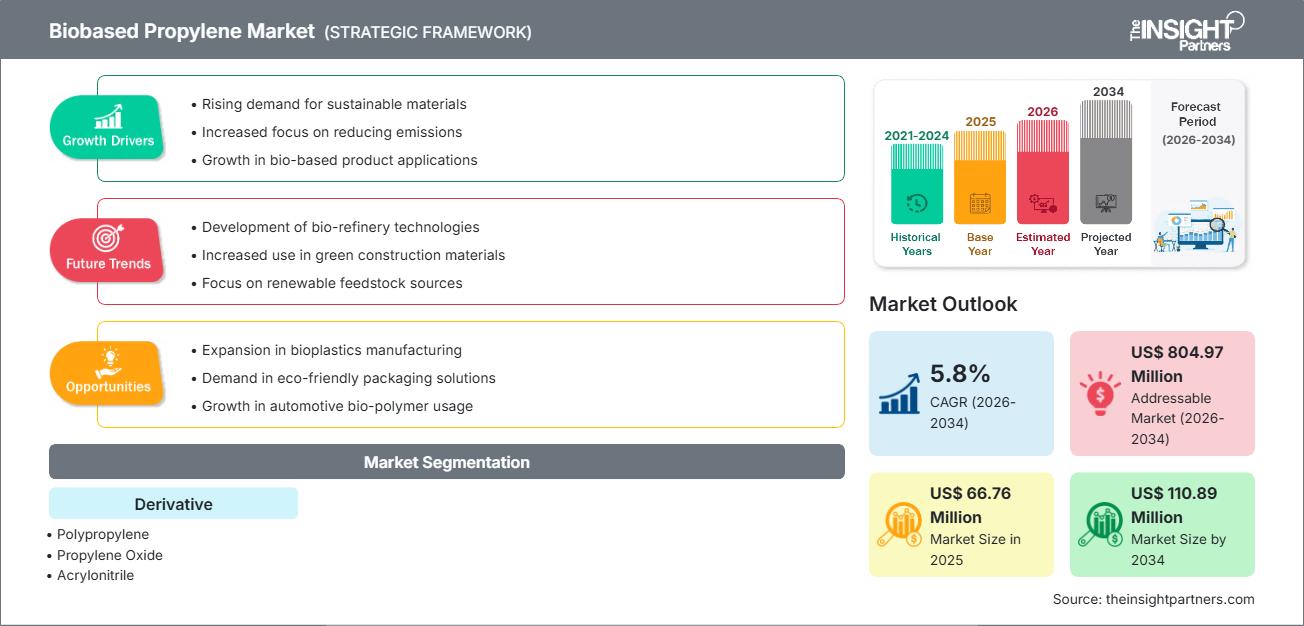
The global biobased propylene market size is projected to reach US$ 110.89 million by 2034 from US$ 66.76 million in 2025. The market is anticipated to register a CAGR of 5.8% during the forecast period 2026–2034. Key market dynamics include an intensifying global shift toward decarbonizing the plastics value chain, stringent government mandates on renewable content in polymers, and rising consumer demand for eco-friendly alternatives in packaging and automotive sectors. Additionally, the market is expected to benefit from rapid advancements in catalytic dehydration and fermentation technologies, the expansion of mass-balance certification schemes, and the increasing adoption of bio-polypropylene (Bio-PP) by major FMCG brands seeking to meet net-zero targets.
Biobased Propylene Market Analysis
The biobased propylene market analysis indicates a transition from a nascent, technology-driven niche to a high-growth industrial segment as manufacturing scale improves. Procurement trends indicate the market is splitting into traditional first-generation feedstock regions (Brazil and North America) and high-growth waste-to-olefin sectors in Europe. Strategic opportunities are emerging in high-performance applications such as medical-grade sterile packaging and lightweight automotive interiors, where the material’s lower carbon footprint compared to fossil-based alternatives offers a clear competitive advantage. The analysis also notes that market expansion depends on the stability of renewable feedstock supply chains and the efficiency of on-purpose production routes. Competitive differentiation now stands out depending on branding that highlights carbon-negative footprints, sustainable sourcing of non-food crops, and the ability to provide drop-in solutions for existing plastic converters. This approach helps bio-based producers command premium pricing in a market increasingly focused on circularity.
Biobased Propylene Market Overview
Sustainable chemicals have evolved from niche laboratory concepts to mainstream industrial pillars. The sector now includes bio-polypropylene for durable goods, bio-propylene oxide for polyurethane foams, and bio-acrylonitrile for high-strength synthetic fibers. Both global petrochemical giants and specialized bio-refinery startups compete in this market, using renewable feedstocks such as sugarcane, corn starch, and waste cooking oils. Growing demand for sustainable packaging solutions among environmentally conscious brands in Europe and North America has increased the popularity of bio-based resins as a viable replacement for petroleum-based plastics. Europe leads in revenue due to its established regulatory frameworks like the Green Deal, while Asia-Pacific is advancing in production capacity and agricultural feedstock innovation.
The US market is highly developed in the medical and pharmaceutical segments, driven by health-focused innovation and the broad availability of bio-based humectants and excipients. Competition among brands is fueling greater application variety and the inclusion of second-generation feedstocks like lignocellulosic biomass.
Customize This Report To Suit Your Requirement
Get FREE CUSTOMIZATIONBiobased Propylene Market: Strategic Insights
-
Get Top Key Market Trends of this report.This FREE sample will include data analysis, ranging from market trends to estimates and forecasts.
Biobased Propylene Market Drivers and Opportunities
Market Drivers:
- Stringent Environmental Regulations and Net-Zero Targets: Global mandates for reducing plastic waste and carbon emissions are compelling manufacturers to adopt bio-based olefins. Policies such as the EU’s Packaging and Packaging Waste Regulation (PPWR) are key drivers for market adoption.
- Drop-in Compatibility with Existing Infrastructure: Biobased propylene is chemically identical to its fossil counterpart, allowing it to be used in existing steam crackers and downstream processing lines without requiring significant capital expenditure for retooling.
- Rising Consumer Preference for Sustainable Packaging: The expansion of the eco-conscious consumer base has sustained high demand for bio-polypropylene in food and beverage packaging. As brands trade up to sustainable packaging, ISCC PLUS-certified resins continue to see stable volume gains.
Market Opportunities:
- Expansion into Automotive Lightweighting: Beyond packaging, bio-polypropylene offers significant opportunities in automotive interiors and under-the-hood components, where its high strength-to-weight ratio helps reduce vehicle mass and improve fuel efficiency.
- Growth in Medical and Hygiene Segments: Forming strategic partnerships between bio-chemical suppliers and medical device manufacturers may facilitate access to high-margin segments for biocompatible plastics used in surgical trays and hygiene nonwovens.
- Diversification into Bio-Acrylonitrile for Carbon Fibers: There is a growing opportunity for producers to target the aerospace and wind energy sectors through the development of bio-acrylonitrile, serving the demand for lightweight, renewable carbon fiber composites.
Biobased Propylene Market Report Segmentation Analysis
The Biobased Propylene Market share is analyzed across various segments to provide a clearer understanding of its structure, growth potential, and emerging trends. Below is the standard segmentation approach used in most industry reports:
By Derivative:
- Polypropylene: The dominant volume driver, particularly within the packaging and automotive manufacturing sectors, due to established supply chains and its versatile application as a durable plastic.
- Propylene Oxide: A fast-growing niche that aligns with global green building trends. It is increasingly preferred for producing bio-based polyols used in sustainable insulation and furniture foams.
- Acrylonitrile: Essential for the production of synthetic fibers and high-performance resins (ABS), seeing increased demand in the textile and electronics industries.
- Cumene: Primarily used for the production of phenol and acetone, bio-based cumene is gaining traction in the manufacturing of sustainable polycarbonates and adhesives.
By Geography:
- North America
- Europe
- Asia Pacific
- South & Central America
- Middle East & Africa
Biobased Propylene Market Report Scope
| Report Attribute | Details |
|---|---|
| Market size in 2025 | US$ 66.76 Million |
| Market Size by 2034 | US$ 110.89 Million |
| Global CAGR (2026 - 2034) | 5.8% |
| Historical Data | 2021-2024 |
| Forecast period | 2026-2034 |
| Segments Covered |
By Derivative
|
| Regions and Countries Covered |
North America
|
| Market leaders and key company profiles |
|
Biobased Propylene Market Players Density: Understanding Its Impact on Business Dynamics
The Biobased Propylene Market is growing rapidly, driven by increasing end-user demand due to factors such as evolving consumer preferences, technological advancements, and greater awareness of the product's benefits. As demand rises, businesses are expanding their offerings, innovating to meet consumer needs, and capitalizing on emerging trends, which further fuels market growth.
Biobased Propylene Market Share Analysis by Geography
Europe is expected to hold the largest market share in the coming years due to aggressive decarbonization policies. Emerging markets in Asia-Pacific, particularly China and Thailand, also have many untapped opportunities as they invest in massive bio-refinery infrastructure.
The biobased propylene market is undergoing a significant transformation, moving from a specialized laboratory product to a global industrial commodity. Growth is driven by the rising cost of carbon credits, a surge in "green" brand commitments, and the expansion of the circular economy. Below is a summary of market share and trends by region:
1. North America
- Market Share: A mature yet evolving segment driven by the shale gas advantage transitioning toward hybrid bio-feedstock models.
- Key Drivers:
- High demand for bio-based propylene glycol in the pharmaceutical and personal care sectors.
- Government-supported incentives for bio-manufacturing and renewable chemical production.
- Mainstreaming of sustainable materials in major retail chains.
- Trends: Scaling of ethanol-to-olefin production facilities and the successful adoption of bio-based resins in the medical-grade plastic segment.
2. Europe
- Market Share: Holds the largest share globally, anchored by strict EU environmental legislation and a robust automotive industry in Germany and France.
- Key Drivers:
- Legislative mandates favoring recycled and bio-based content in the automotive and packaging industries.
- Established processing infrastructure and standardized certification frameworks like ISCC PLUS.
- Robust R&D investment in second-generation (non-food) biomass conversion technologies.
- Trends: A strategic shift toward waste-based feedstocks (such as used cooking oil) over first-generation food crops to meet higher sustainability ratings.
3. Asia-Pacific
- Market Share: The fastest-growing region, with Southeast Asia acting as a primary production hub for bio-based chemicals.
- Key Drivers:
- Massive consumer base seeking sustainable alternatives to single-use plastics.
- Abundant availability of agricultural residues provides a stable feedstock supply.
- Rapid urbanization leading to a preference for "green" consumer electronics and textiles.
- Trends: Heavy reliance on B2B contracts for bio-based acrylonitrile and propylene oxide used in the region’s massive electronics and construction industries.
4. South and Central America
- Market Share: An emerging powerhouse, particularly in Brazil, due to its global leadership in sugarcane ethanol production.
- Key Drivers:
- Vertical integration of sugarcane farming and bio-olefin production.
- Modernization of bio-refineries to supply global markets with carbon-negative polymers.
- Increasing awareness of the environmental impact of traditional plastics among the growing middle class.
- Trends: Growth of export-oriented bio-polypropylene production and the introduction of bio-based resins for regional agricultural applications.
5. Middle East and Africa
- Market Share: Developing market transitioning toward formalized bio-refining as part of economic diversification strategies.
- Key Drivers:
- Strategic investments in "Smart Agriculture" to develop non-food feedstocks suitable for arid climates.
- High demand for high-performance insulation foams in the region’s massive infrastructure projects.
- Efforts to reduce industrial carbon footprints in line with global energy transition goals.
- Trends: Implementation of waste-to-chemical technologies to process municipal and industrial waste into high-value olefins.
High Market Density and Competition
Competition is intensifying due to the presence of established leaders such as Braskem, Neste, and LyondellBasell. Regional chemical experts and niche players like Borealis AG and Mitsui Chemicals, alongside North American innovators such as Dow and ADM, also contribute to a diverse and rapidly expanding market landscape.
This competitive environment pushes vendors to differentiate through:
- Premiumization and Functional Branding: Positioning biobased propylene as a superior, low-carbon alternative to fossil-based versions by emphasizing its life-cycle assessment (LCA) benefits for climate-conscious B2B clients.
- Diversified Product Portfolios: Biobased products now include more than just liquid monomers. Companies offer bio-polypropylene resins, bio-propylene glycol for cosmetics, and bio-acrylonitrile for high-end textiles.
- Vertical Feedstock Integration: Producers manage the entire supply chain, from sourcing sugarcane or waste oils to local processing, ensuring quality and transparency.
- Advanced Processing Technologies: New catalytic processes and fermentation techniques help create high-purity bio-propylene used in medical and electronic products worldwide.
Opportunities and Strategic Moves
- Leading players are increasingly forming strategic partnerships, such as the collaboration between Neste and IKEA or Shell and Braskem, to secure stable supplies of bio-circular feedstocks and ensure long-term market reliability.
- Strategic focus on "on-purpose" bio-propylene technologies, such as bio-ethanol dehydration or specialized propane dehydrogenation (PDH) using bio-propane, enables manufacturers to maximize yield and achieve cost-competitiveness against traditional naphtha-based routes.
Major Companies operating in the Biobased Propylene Market are:
- Mitsui Chemicals, Inc.
- Borealis AG
- Global Bioenergies
- The Dow Chemical Company
- Cereplast, Inc
- Trellis Earth Products, Inc.
- BASF SE
- Braskem
- Corbion
- SABIC
Disclaimer: The companies listed above are not ranked in any particular order.
Biobased Propylene Market News and Recent Developments
- In January 2026, Mitsui Chemicals, Inc. announced that the Prasus™ line of bio-based and chemically recycled polyethylene produced and sold by Prime Polymer Co., Ltd., a Mitsui Chemicals Group company, has been adopted for plastic bags offered at Natural Lawson stores operated by Lawson, Inc.
- In January 2026, Borealis announced a EUR 49 million strategic investment to scale up production of Borstar® Nextension polypropylene (PP) at its manufacturing site in Burghausen, Germany. This will expand commercial production of next-generation single-site polypropylene (ssPP) grades that deliver enhanced purity, processability, and performance, thereby supporting customers in key sectors (including packaging, healthcare, mobility, and fibers) to meet evolving market and regulatory demands.
Biobased Propylene Market Report Coverage and Deliverables
The Biobased Propylene Market Size and Forecast (2021–2034) report provides a detailed analysis of the market covering below areas:
- Biobased Propylene Market size and forecast at global, regional, and country levels for all the key market segments covered under the scope
- Biobased Propylene Market trends, as well as market dynamics such as drivers, restraints, and key opportunities
- Detailed PEST and SWOT analysis
- Biobased Propylene Market analysis covering key market trends, global and regional framework, major players, regulations, and recent market developments
- Industry landscape and competition analysis covering market concentration, heat map analysis, prominent players, and recent developments in the Biobased Propylene Market.
- Detailed company profiles
Frequently Asked Questions

- Historical Analysis (2 Years), Base Year, Forecast (7 Years) with CAGR
- PEST and SWOT Analysis
- Market Size Value / Volume - Global, Regional, Country
- Industry and Competitive Landscape
- Excel Dataset
Recent Reports
Testimonials

The Insight Partners' SCADA System Market report is comprehensive, with valuable insights on current trends and future forecasts. The team was highly professional, responsive, and supportive throughout. We are very satisfied and highly recommend their services.
RAN KEDEM Partner, Reali Technologies LTDs
I requested a report on a very specific software market and the team produced the report in a few days. The information was very relevant and well presented. I then requested some changes and additions to the report. The team was again very responsive and I got the final report in less than a week.
JEAN-HERVE JENN Chairman, Future Analytica
We worked with The Insight Partners for an important market study and forecast. They gave us clear insights into opportunities and risks, which helped shape our plans. Their research was easy to use and based on solid data. It helped us make smart, confident decisions. We highly recommend them.
PIYUSH NAGPAL Sr. Vice President, High Beam Global
The Insight Partners delivered insightful, well-structured market research with strong domain expertise. Their team was professional and responsive throughout. The user-friendly website made accessing industry reports seamless. We highly recommend them for reliable, high-quality research services
YUKIHIKO ADACHI CEO, Deep Blue, LLC.
This is the first time I have purchased a market report from The Insight Partners.While I was unsure at first, I visited their web site and felt more comfortable to take the risk and purchase a market report.I am completely satisfied with the quality of the report and customer service. I had several questions and comments with the initial report, but after a couple of dialogs over email with their analyst I believe I have a report that I can use as input to our strategic planning process.Thank you so much for taking the extra time and making this a positive experience.I will definitely recommend your service to others and you will be my first call when we need further market data.
JOHN SUZUKI President and Chief Executive Officer, Board Director, BK Technologies
I wish to appreciate your support and the professionalism you displayed in the course of attending to my request for information regarding to infectious disease IVD market in Nigeria. I appreciate your patience, your guidance, and the fact that you were willing to offer a discount, which eventually made it possible for us to close a deal. I look forward to engaging The Insight Partners in the future, all thanks to the impression you have created in me as a result of this first encounter.
DR CHIJIOKE ONYIA MANAGING DIRECTOR, PineCrest Healthcare Ltd.Reason to Buy
- Informed Decision-Making
- Understanding Market Dynamics
- Competitive Analysis
- Identifying Emerging Markets
- Customer Insights
- Market Forecasts
- Risk Mitigation
- Boosting Operational Efficiency
- Strategic Planning
- Investment Justification
- Tracking Industry Innovations
- Aligning with Regulatory Trends




 Get Free Sample For