
Commercial Boilers Market Size, Share & Trends by 2034
Coverage: By Fuel Type (Gas, Oil, And Coal); Capacity (0.3-2.5 MMBtu/hr, 2.5-10 MMBtu/hr, 50-100 MMBtu/hr, 100-250 MMBtu/hr); Application (Hospitals, Schools, Offices, Others) , and Geography (North America, Europe, Asia Pacific, and South and Central America)
- Status : Data Released
- Report Code : TIPRE00021636
- Category : Manufacturing and Construction
- No. of Pages : 150
- Available Report Formats :


- Last update date : July 17, 2026


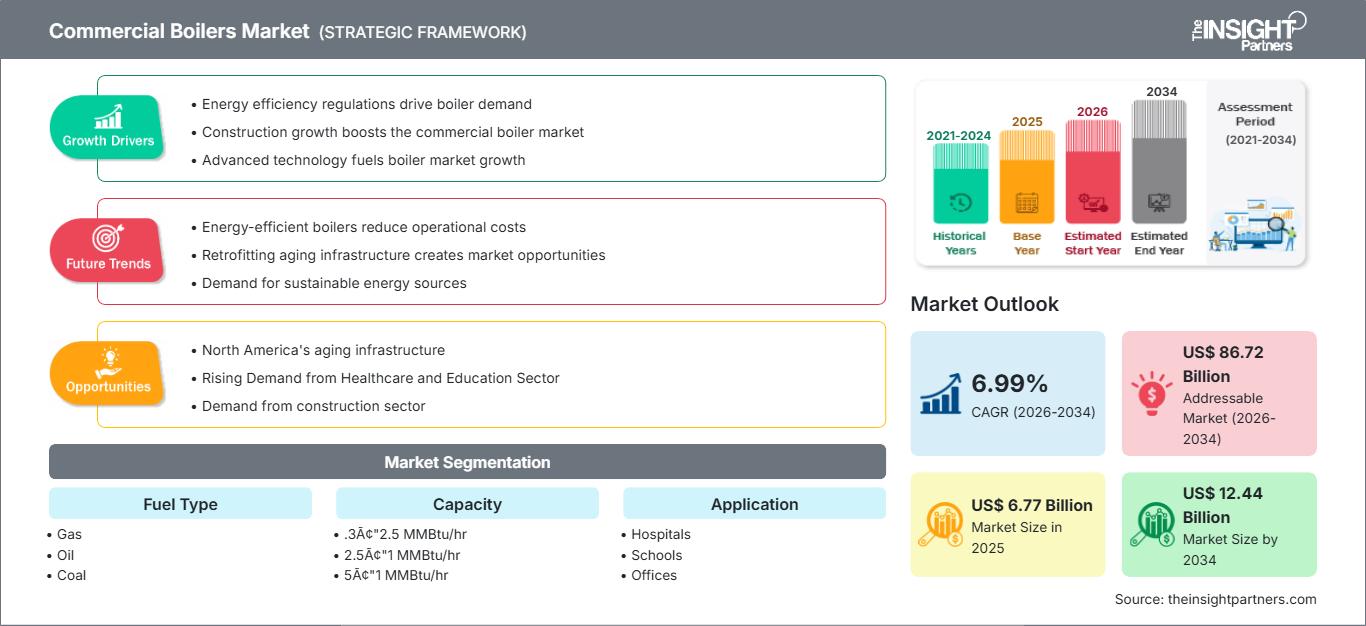
2025 Market Size
US$ 6.77 Bn
Base year value
2034 Forecast
US$ 12.44 Bn
Projected by 2034
CAGR 2026-2034
6.99 %
Growth rate
Addressable Market
US$ 86.72 Bn
(2026-2034)
The commercial boilers market is projected to grow from US$ 6.77 Billion in 2025 to US$ 12.44 Billion by 2034, registering a CAGR of 6.99% during 2026–2034. Demand is supported by replacement of aging heating assets, efficiency upgrades in institutional buildings, and expanding commercial floor space requiring reliable hot water and steam systems across hospitals, schools, offices, and mixed-use facilities.
Across North America, the commercial boilers market size is shaped by code-driven equipment replacement, colder-climate heating demand, and wider use of condensing systems in healthcare and education assets. Regional expansion is estimated in the 6.3–6.7% CAGR range through 2034, with utility incentives, low-NOx rules, and building automation integration supporting procurement decisions among facility owners.
Commercial Boilers Market Assessment and Insights
- North America held 40–42% share in 2025 and is growing at a CAGR of 6.3–6.7% during 2026–2034, supported by institutional retrofits, healthcare capacity additions, and tighter building energy codes.
- US accounted for 78–82% of North America in 2025 and is growing at a CAGR of 6.2–6.6% during 2026–2034, led by hospitals, universities, and offices.
- Europe held 29–32% share in 2025 and is growing at a CAGR of 6.0–6.4% during 2026–2034, with Germany, the UK, France, Italy, and Spain leading replacement cycles.
- Asia Pacific held 21–24% share in 2025 and is growing at a CAGR of 7.4–7.8% during 2026–2034, led by China, India, Japan, South Korea, and Australia.
- Largest Segment Gas fuel held 66–69% market share in 2025, with a CAGR of 6.4–6.8% during 2026–2034 due to network availability and condensing efficiency.
- High Growth Segment Hospitals held 27–30% market share in 2025, with a CAGR of 7.2–7.6% during 2026–2034 as steam reliability and hygiene needs rise.
- Key companies analyzed in detail: Acme Engineering Products Ltd., Bosch Industriekessel GmbH, Burnham Commercial Boilers, Hamworthy Heating, Ideal Heating, Indtex Boiler Pvt. Ltd., Parker Boiler Co., Superior Boiler Works, Inc., Viessmann Climate Solutions SE, Weil-McLain.
Source: The Insight Partners' analysis based on proprietary research, government publications, company annual reports, investor presentations, industry databases, and expert interviews.
The trend in technology development will result in an ongoing shift from traditional boilers to condensing, modular, low-NOx, and digitally monitored ones within the commercial boilers industry. Manufacturing processes will continue to undergo transformation as manufacturers redevelop heat exchangers, burners, and control systems to ensure increased efficiency, as well as maintainability. Hospitals and campuses will seek out multi-boiler rooms due to reliability, turndown capacity, and faster maintenance.
Future demands will include cold-climate North America, regulated Europe, and urbanizing Asia. Infrastructure investments, sustainable building certifications, and emission requirements will cause buyers to favor more efficient technologies. Investors will also consider hybrid boiler systems wherein gas-fired units will be important to achieve high-load resilience, whereas control systems and renewable integration are becoming a part of design.
Commercial Boilers Market Report Scope
| Report Attribute | Details |
|---|---|
| Market size in 2025 | US$ 6.77 Billion |
| Market Size by 2034 | US$ 12.44 Billion |
| Global CAGR (2026 - 2034) | 6.99% |
| Historical Data | 2021-2024 |
| Forecast period | 2026-2034 |
Commercial Boilers Market Analysis
The industry is closely related to the impact of nonpresidential heating requirements, old equipment replacements, and costs of operation in big structures. The International Energy Agency has reported that there are buildings which make up 30% of world energy consumption, out of which commercial and public buildings have consumed 30% of energy used by buildings. Thus, there is considerable room for efficiency improvements through boiler replacements where space and water heating still account for much energy use.
The favorable supply side is where firms can offer boilers which will be manufactured with an integrated system including manufacturing pressure vessel, integrating burners, control and after sales service. Distributors are still important due to the fact that boiler replacements are often ordered from consulting engineers or mechanical contractors. Delays in manufacture of boilers are influenced by time required for manufacture of steel parts and electronics.
Positioning in the commercial boilers market analysis is driven not by product price but by reliability, the installed base, compliance, and efficiency of operation throughout the entire life cycle of the equipment. The competition among Bosch Industriekessel GmbH, Viessmann Climate Solutions SE, Weil-McLain, Burnham Commercial Boilers, and Superior Boiler Works, Inc. involves covering broad capacity ranges, whereas Parker Boiler Co., Hamworthy Heating, Ideal Heating, Acme Engineering Products Ltd., and Indtex Boiler Pvt. Ltd. offer products to meet local needs.
Funds are set aside to design low-emission burners, a full plantroom solution, predictive maintenance, and modular systems, thereby reducing any downtime. Differentiation strategies work best where the vendors are able to supply not just equipment, but also the installation and documentation services, spare parts, and matching control systems. Buyers consider cost of ownership as well as risk associated with carbon footprint reporting.
● REPORT CUSTOMIZATION
Tailor This Report To Align With Your Specific Business Requirements
This report can be customized to align precisely with your business objectives, scope, and target markets. Customization options include tailored segmentation, geography, competitive analysis, and strategic insights to support informed decision-making.
Customize This Report →WHAT YOU CAN ADJUST
- ● Segmentations
- ● Geography
- ● Competitive Analysis
- ● Language Preferences
Commercial Boilers Market: Strategic Insights
Regional Insights
North America commercial boilers Market
North America represented 40–42% of global commercial boilers market share in 2025 and is projected to expand at a 6.3–6.7% CAGR during 2026–2034. Demands have been focused on hospitals, universities, municipal buildings, offices, and heating district retrofits where hot water reliability, redundancy, and winter performance are critical. Standards related to low-NOx and energy benchmarking are further driving condensing upgrades.
The end-users prefer to go for modular systems which can be easily installed with little downtime. Efficiency incentives from the federal government and states, air quality regulations, and utility demand-side management programs will help fuel demand in the healthcare and education sectors. The region has a huge number of installed systems, thus ensuring steady revenue through the aftermarket.
U.S. commercial boilers Market
The US represented 78% - 82% of North America in 2025 and is projected to have a 6.2% – 6.6% CAGR for the period 2026 – 2034. The commercial boiler market includes hospitals, educational institutions, offices, hotels, and public buildings wherein the need for efficiency outweighs uptime considerations.
Companies such as Burnham Commercial Boilers, Weil-McLain, Parker Boiler Co., and Superior Boiler Works, Inc. capitalize on their strong service networks and specification expertise. There is more interest in condensing gas boiler technology in offices and university institutions, whereas hospitals buy boilers capable of handling steam to provide sterilizing, humidifying, laundry, and process hot water needs.
Europe commercial boilers Market
Europe accounted for 29–32% share in 2025 and is expected to register a 6.0–6.4% CAGR in 2026–2034. Germany has been the most dominant in the region owing to the presence of district energy plants, industrial sites, and high efficiency expectations. Bosch Industriekessel GmbH and Viessmann Climate Solutions SE continue to be significant players in the specification-driven applications.
The UK market operates on the basis of decarbonization of public estates, schools, and hospital resilience. In France, Italy, and Spain, there is demand for the replacement of old systems based on the regulations that promote condensing technology and hybrid-ready units. The directive of the European Commission that prohibits financing of individual fossil boilers from 2025 creates a new market situation.
APAC commercial boilers Market
APAC held 21–24% share in 2025 and is forecast to grow at a 7.4–7.8% CAGR during 2026–2034. China leads regional demand because hospitals, schools, offices, and industrial-commercial campuses continue to expand across urban clusters.
Efficiency and space-saving are the main features of Japanese and South Korean boilers, while Indian boilers have evolved from scattered boilers to system boilers used in hospitals and institutions. The demands on the Australian market are energy efficiency standards of commercial buildings, heating requirement in the cold regions, and replacement of assets in institutions.
Middle East & Africa commercial boilers Market
MEA & Africa’s growth rate during 2026-2034 will be at 5.8-6.2% CAGR with the highest demand coming from Saudi Arabia in hospitals, hotels, campuses, and process heating related to infrastructure. UAE also plays its role in premium boilers installation in mixed use developments.
South Africa and Rest of MEA follow replacement demand based on energy security and servicing issues. Availability of gas, infrastructure development, desalination related projects, and investments in healthcare industry affect the buying behavior, although limited budgets make replacement cycles more extensive than in North America and Europe.
Segmentation Analysis
Fuel Type
Fuel Type is expected to grow at a 6.5–6.9% CAGR during 2026–2034. The commercial boilers market scope by fuel remains dominated by gas because distribution networks, stable combustion performance, and condensing technology suit institutional applications. Oil and coal retain selective use where fuel logistics, legacy systems, or energy security considerations influence procurement.
- Gas remains the preferred fuel in developed markets because pipelines, cleaner combustion, and condensing efficiency support hospitals, schools, and offices seeking predictable operating costs.
- Oil serves backup and off-grid heating needs, especially in facilities requiring fuel storage resilience where gas access is limited or winter reliability planning is critical.
- Coal is declining in regulated markets but persists in cost-sensitive locations with existing infrastructure, mainly where replacement economics and fuel availability delay cleaner conversions.
Capacity
Capacity is projected to grow at a 6.6–7.0% CAGR during 2026–2034. Demand is shifting toward modular capacity planning, allowing facilities to match variable loads while maintaining redundancy. Smaller units suit offices and schools, mid-range systems serve hospitals and campuses, and high-capacity boilers remain essential for district, laundry, sterilization, and process heating loads.
- Less Than 10 MMBtu/Hr is common in offices, smaller schools, and hospitality assets where compact installation, lower capital cost, and staged replacement improve project feasibility.
- 10-50 MMBtu/Hr addresses hospitals, campuses, and larger commercial buildings requiring balanced capacity, redundancy, and strong load-following across heating and domestic hot water demand.
- Above 50 MMBtu/Hr serves district systems, large healthcare complexes, and institutional facilities where steam continuity, process loads, and centralized plant economics justify larger equipment.
Application
Application is expected to grow at a 6.8–7.2% CAGR during 2026–2034. Hospitals remain strategically important because boiler downtime can affect sterilization, humidity control, hot water, and patient services. Schools and offices drive replacement cycles through efficiency mandates, while broader commercial uses depend on reliability, maintenance access, and integration with building controls.
- Hospitals prioritize redundancy, steam quality, hygiene support, and continuous operation, making lifecycle reliability and service responsiveness central to procurement specifications.
- Schools adopt replacement boilers through public funding cycles, safety upgrades, and energy efficiency programs that reduce utility costs across seasonal heating loads.
- Offices favor compact, high-efficiency systems integrated with automation platforms, particularly in retrofits where tenant comfort, emissions reporting, and maintenance scheduling influence decisions.
Opportunity Snapshot
| Application | Revenue Contribution | Trend Tag | Adoption Stage |
| Hospitals | High | Steam Reliability | Mature |
| Schools | Medium | Public Retrofits | Scaling |
| Offices | Medium | Smart Controls | Scaling |
| Others | Low | Mixed Loads | Emerging |
Commercial Boilers Market Growth Drivers and Impact Analysis
Replacement of Aging Institutional Heating Assets
Large public and private facilities are replacing boilers installed before modern efficiency and emissions standards. Many hospitals, schools, and municipal offices operate assets with declining combustion efficiency, higher maintenance needs, and limited controls compatibility. Replacement projects reduce fuel consumption, improve reliability, and allow staged capacity rather than oversized single-unit operation. The market impact is strongest in North America and Europe, where energy benchmarking, public procurement rules, and aging building stock converge. For suppliers, this creates recurring demand for condensing boilers, low-NOx burners, controls retrofits, and service contracts that extend beyond the initial equipment sale.
Efficiency Codes and Emissions Compliance
Building energy codes, air quality rules, and public-sector decarbonization policies are reshaping boiler specifications. The IEA notes that global building energy intensity has decreased about 8% since 2015, reflecting policy progress, yet rising floor area keeps demand for efficient equipment high. Low-NOx requirements and lifecycle carbon reporting encourage facility teams to move toward condensing, hybrid-ready, and digitally monitored boilers. This driver increases specification complexity but supports premium equipment adoption. It also raises the value of manufacturers that can provide compliance documentation, commissioning support, and credible efficiency performance across variable operating loads.
Expansion of Healthcare and Education Infrastructure
Healthcare and education facilities require reliable thermal systems for patient care, sterilization, kitchens, laboratories, dormitories, and seasonal heating. New construction in emerging economies and refurbishment in developed markets both support equipment demand. Hospitals often select multiple boilers for redundancy, while schools seek safer, easier-to-maintain systems that reduce utility expense. The commercial boilers market benefits because these end users evaluate performance over long asset lives rather than lowest upfront cost. Manufacturers with strong service availability, packaged solutions, and flexible capacity ranges are positioned to capture projects tied to public funding and institutional modernization.
Commercial Boilers Market Future Trends
Hybrid Boiler Rooms with Electrification Interfaces
Future boiler rooms will increasingly combine gas-fired systems with electric boilers, heat pumps, thermal storage, or renewable-ready controls. This shift reflects the need to reduce emissions while maintaining resilience during peak loads and grid constraints. The commercial boilers market trends indicate that facility owners will avoid abrupt fuel transitions where uptime is critical, instead adopting hybrid plant designs that allow staged decarbonization. Suppliers able to integrate controls across multiple heat sources will gain specification advantages. The trend also expands consulting engineering involvement, because load profiles, tariffs, standby requirements, and carbon targets must be evaluated together before final system selection.
Predictive Maintenance and Connected Controls
Connected boiler systems are moving from optional features to standard procurement requirements in large commercial facilities. Sensors, combustion analytics, remote alarms, and service dashboards help operators identify fouling, cycling losses, burner drift, and pump issues before failure. This trend is particularly relevant for hospitals and campuses where downtime has operational consequences. Over the forecast period, data-enabled service models will strengthen manufacturer relationships with facility managers. The commercial boilers market will therefore see greater value attached to software compatibility, cybersecurity, field technician training, and long-term service agreements rather than equipment efficiency alone.
Commercial Boilers Market Opportunities
Hospital Boiler Plant Modernization Programs
Healthcare facilities offer one of the strongest investment opportunities because boiler systems directly support sterilization, humidification, laundry, kitchens, and space heating. The commercial boilers market forecasts point to sustained hospital spending where resilience, infection-control support, and regulatory compliance justify premium specifications. Vendors can target this opportunity through modular steam systems, redundancy planning, energy audits, and service contracts tied to uptime metrics. Engineering firms and equipment suppliers also have scope to bundle controls upgrades with boiler replacement, enabling hospitals to reduce energy waste without compromising critical operations during phased installation schedules.
Retrofit Solutions for School and Office Portfolios
School districts and office portfolio owners represent attractive retrofit targets because they often operate multiple aging boiler rooms with similar design issues. Suppliers can develop standardized replacement packages covering compact condensing boilers, low-NOx burners, smart controls, and commissioning documentation. This approach reduces engineering effort, shortens installation windows, and helps owners prioritize sites with the highest fuel savings. Financing models based on energy performance, public funding cycles, or bundled service agreements can accelerate adoption. The opportunity is especially relevant in colder regions where heating reliability affects occupancy, comfort, and operating budgets.
Recent Developments
- December 2024: AERCO expands its Sequoia high-voltage electrode hot water boilers series with the introduction of the Sequoia J and Sequoia S models for large commercial and industrial applications. Virtually 100% energy-efficient, emission-free heating solutions, the two new models deliver simplicity and cost-efficiency during installation, operation, and maintenance while addressing government regulations and corporate sustainability initiatives.
- July 2025: Rheem launched FT Series. The new line will meet a variety of heating needs, making it a versatile and efficient choice for homes and businesses. The FT Boiler Series, which is the latest innovation in Rheem’s line of boilers, features advanced condensing technology, ensuring superior performance with up to 95% AFUE.
Frequently Asked Questions

- Comprehensive Market Sizing and Forecast Analysis
- Detailed Segmentation Analysis
- In-Depth Market Dynamics Assessment
- Regional and Country-Level Insights
- Competitive Landscape and Company Benchmarking
- Strategic Business Intelligence
Recent Reports
Testimonials

The Insight Partners' SCADA System Market report is comprehensive, with valuable insights on current trends and future forecasts. The team was highly professional, responsive, and supportive throughout. We are very satisfied and highly recommend their services.
RAN KEDEM Partner, Reali Technologies LTDs
I requested a report on a very specific software market and the team produced the report in a few days. The information was very relevant and well presented. I then requested some changes and additions to the report. The team was again very responsive and I got the final report in less than a week.
JEAN-HERVE JENN Chairman, Future Analytica
We worked with The Insight Partners for an important market study and forecast. They gave us clear insights into opportunities and risks, which helped shape our plans. Their research was easy to use and based on solid data. It helped us make smart, confident decisions. We highly recommend them.
PIYUSH NAGPAL Sr. Vice President, High Beam Global
The Insight Partners delivered insightful, well-structured market research with strong domain expertise. Their team was professional and responsive throughout. The user-friendly website made accessing industry reports seamless. We highly recommend them for reliable, high-quality research services
YUKIHIKO ADACHI CEO, Deep Blue, LLC.
This is the first time I have purchased a market report from The Insight Partners.While I was unsure at first, I visited their web site and felt more comfortable to take the risk and purchase a market report.I am completely satisfied with the quality of the report and customer service. I had several questions and comments with the initial report, but after a couple of dialogs over email with their analyst I believe I have a report that I can use as input to our strategic planning process.Thank you so much for taking the extra time and making this a positive experience.I will definitely recommend your service to others and you will be my first call when we need further market data.
JOHN SUZUKI President and Chief Executive Officer, Board Director, BK Technologies
I wish to appreciate your support and the professionalism you displayed in the course of attending to my request for information regarding to infectious disease IVD market in Nigeria. I appreciate your patience, your guidance, and the fact that you were willing to offer a discount, which eventually made it possible for us to close a deal. I look forward to engaging The Insight Partners in the future, all thanks to the impression you have created in me as a result of this first encounter.
DR CHIJIOKE ONYIA MANAGING DIRECTOR, PineCrest Healthcare Ltd.Reason to Buy
- Informed Decision-Making
- Understanding Market Dynamics
- Competitive Analysis
- Identifying Emerging Markets
- Customer Insights
- Market Forecasts
- Risk Mitigation
- Boosting Operational Efficiency
- Strategic Planning
- Investment Justification
- Tracking Industry Innovations
- Aligning with Regulatory Trends





 Get Free Sample for