
Cooling Fabrics Market Growth, Size & Forecast by 2034
Coverage: by Type (Synthetic, Natural); Application (Sports Apparel, Protective Wearing, Lifestyle, Others) , and Geography (North America, Europe, Asia Pacific, and South and Central America)
- Status : Data Released
- Report Code : TIPRE00003788
- Category : Chemicals and Materials
- No. of Pages : 150
- Available Report Formats :


- Last update date : September 01, 2026


2025 Market Size
US$ 2.02 Bn
Base year value
2034 Forecast
US$ 3.96 Bn
Projected by 2034
CAGR 2026-2034
7.77 %
Growth rate
Addressable Market
US$ 26.93 Bn
(2026-2034)
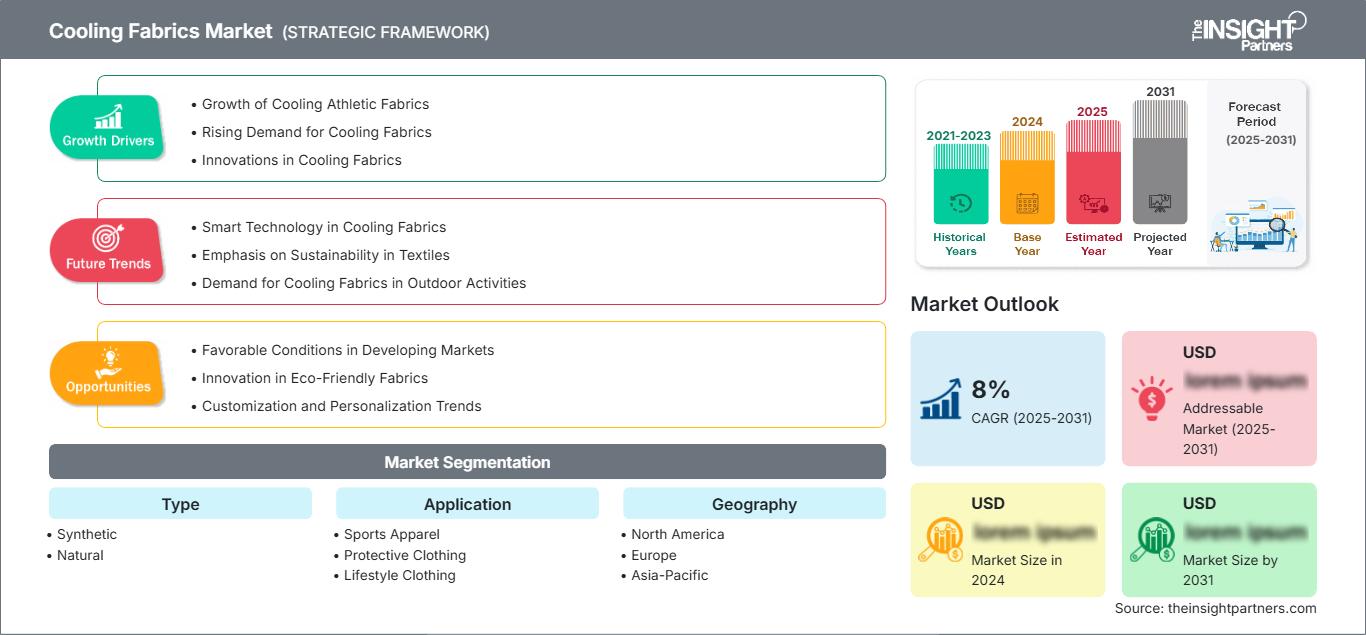
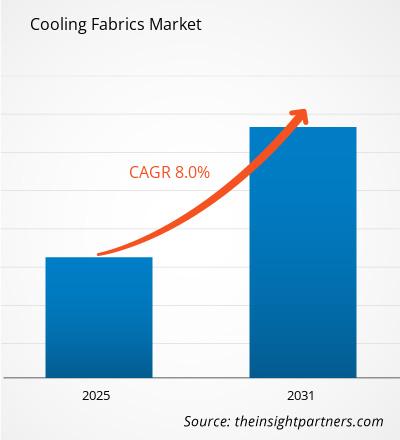
The Cooling Fabrics Market is valued at US$ 2.02 Billion in 2025 and is projected to reach US$ 3.96 Billion by 2034, expanding at a CAGR of 7.77% during 2026–2034. The market is benefiting from growing demand for thermal comfort, moisture management, lightweight performance textiles, and functional apparel. Advances in fiber engineering, fabric construction, and temperature-regulating technologies are broadening applications across sportswear, protective clothing, and lifestyle garments.
North America is expected to maintain a significant position, with the Cooling Fabrics Market size supported by established sportswear brands, outdoor recreation, and increasing attention to occupational heat exposure. The region is estimated to expand at a 6.8–7.5% CAGR through 2034. Demand is further supported by technical apparel innovation and the incorporation of cooling functions into everyday clothing.
Cooling Fabrics Market Assessment and Insights
- North America: North America is estimated to hold a 27–31% Cooling Fabrics Market share in 2025, supported by established performance-apparel demand, outdoor recreation, and workplace heat-management requirements, with a 6.8–7.5% CAGR during 2026–2034.
- US: The US accounts for approximately 72–76% of North American demand in 2025 and is projected to grow at a 6.7–7.4% CAGR through 2034.
- Europe: Europe represents an estimated 25–29% share in 2025, led by Germany, the UK, France, Italy, and Spain, and is projected to register a 6.4–7.1% CAGR through 2034.
- Asia Pacific: Asia Pacific is estimated at 34–38% share in 2025, led by China, Japan, South Korea, India, and Australia, with a 8.2–9.0% CAGR supported by textile manufacturing and apparel exports.
- Largest Segment: Synthetic fabrics lead by type, representing a 68–72% market share in 2025 and expanding at a 7.3–7.9% CAGR during 2026–2034.
- High Growth Segment: Natural fabrics account for a 28–32% share in 2025 and are projected to grow at a 8.1–8.8% CAGR through 2034.
- Key companies analyzed in detail: Adidas AG, Ahlstrom Oyj, Coolcore, LLC, Formosa Taffeta Co., Ltd., HDM, Inc., Kraton Corporation, Nan Ya Plastics Corporation, NILIT Ltd., Polartec, LLC, Tex-Ray Industrial Co. Ltd.
Source: The Insight Partners' analysis based on proprietary research, government publications, company annual reports, investor presentations, industry databases, and expert interviews.
The Cooling Fabrics Market has evolved from standard moisture wicking fabrics to engineered fabrics with combinations of evaporative cooling properties, thermal conductivity, airflow enhancement, and temperature control. Synthetic fibers are critical due to polymer science allowing for specific cross-sectional design as well as inclusion of functional yarns. Recycled and bio-degradable fibers are being developed by the manufacturers, and new knit constructions allow for enhanced moisture transfer and drying along with airflow.
Future development will focus on multi-functional fabrics offering combination of cooling with UV resistance, odor management, elasticity, anti-microbial properties, and sustainability. New centers for apparel production in South and Southeast Asia can help increase volumes, whereas North America and Europe brands will play an increasing role in premium specifications. Testing, traceability of the raw materials, and durability of cooling effect will gain importance.
Cooling Fabrics Market Report Scope
| Report Attribute | Details |
|---|---|
| Market size in 2025 | US$ 2.02 Billion |
| Market Size by 2034 | US$ 3.96 Billion |
| Global CAGR (2026 - 2034) | 7.77% |
| Historical Data | 2021-2024 |
| Forecast period | 2026-2034 |
Cooling Fabrics Market Analysis
Growth of the Cooling Fabrics Market is driven by increased involvement in sports, outdoor, fitness, and active lifestyle, along with increased awareness of thermal comfort in hot weather activities. The ecosystem includes polymer and fiber suppliers, yarn spinners, textile manufacturers, finishers, apparel brands, and retailers. Cooling effects may be provided either by fiber structure, hydrophilic-hydrophobic structure, mineral additives, phase change materials, or by special finishes.
Supply trends are affected by polyester, nylon, cellulose fibers, specialty polymers, colors, and additives. The presence of significant production capacity in Asian textile manufacturers along with the growing role of branding in choosing high-end technical fabrics determines the new supply dynamics towards close cooperation between fiber producers, textile mills, and apparel producers, especially when cooling effects should stay the same after several washes.
Cooling Fabrics Market forecast suggests a market with a competitive structure characterized by a combination of diversified textile manufacturers, specialty fibers firms and apparel companies with innovative technologies. The Adidas AG company uses cooling and airflow technology in its performance apparels. On the other hand, Polartec, LLC specializes in cooling fabric construction engineering. Coolcore, LLC uses fiber geometry and moisture-induced cooling, while NILIT Ltd uses cooling nylon yarns technology. Lastly, Tex-Ray Industrial Co. Ltd. also maintains temperature regulating textiles platform.
Investments in the Cooling Fabrics Market are increasingly geared towards use of recycled material, innovative yarn structures, minimal impact manufacturing process and versatile performance. Ahlstrom Oyj brings experience in engineered textile material, while Formosa Taffeta Co., Ltd. and Nan Ya Plastics Corporation have the advantage of using integrated synthetic fibers capability. Cooling performance, durability, manufacturing scalability and brand development are becoming key differentiating elements.
● REPORT CUSTOMIZATION
Tailor This Report To Align With Your Specific Business Requirements
This report can be customized to align precisely with your business objectives, scope, and target markets. Customization options include tailored segmentation, geography, competitive analysis, and strategic insights to support informed decision-making.
Customize This Report →WHAT YOU CAN ADJUST
- ● Segmentations
- ● Geography
- ● Competitive Analysis
- ● Language Preferences
Cooling Fabrics Market: Strategic Insights
Regional Insights
North America Cooling Fabrics Market
North America is estimated to account for 27–31% of global demand in 2025 and is projected to grow at a 6.8–7.5% CAGR through 2034. America plays the leading role in the regional consumption market due to the development of sportswear, outdoor, fitness, workwear, and demand for clothes meant to be worn in hot climates. Canada contributes to this sector with its production of outdoor clothing and workplace clothing.
Performance clothing now includes cooling, ventilation, moisture control, and light weighting in their premium range. Heat exposure at workplaces is a structural trend, since protective and workwear companies start considering thermal comfort in addition to protection. Other factors include the developed textiles testing industry, advanced clothing distribution channels, and the consumers' readiness to accept performance textiles.
U.S. Cooling Fabrics Market
The US represents approximately 72–76% of North American demand in 2025 and is expected to register a 6.7–7.4% CAGR through 2034. Sports apparel continues to be one of the key areas of application, with running, golf, tennis, cycling, training, and outdoor leisure requiring cooling and moisture management technology. Technical fabrics are also being applied in lifestyle products, such as casual wear.
Adidas AG and Polartec, LLC have visibility within the field of applications where there is a need for performance. Coolcore, LLC is another company providing cooling fabrics for apparel and other related products. There is increasing demand for technical fabrics in non-professional sports, including travel apparel, uniform, and outdoor apparel for working outdoors.
Europe Cooling Fabrics Market
Europe is estimated to hold a 25–29% share in 2025 and is projected to grow at a 6.4–7.1% CAGR through 2034. Germany is the leader among the regions followed by UK, France, Italy, and Spain. The high demand for sportswear, sustainability requirements, technical textile capability, and growing trend towards clothes resistant to heat drive the adoption in the region in both performance and lifestyle segments.
UK and Germany offer high potential owing to outdoor activities, technical sportswear and luxury clothing. France, Italy, and Spain offer additional demand due to the fusion of fashion and performance, tourism, cycling, and warm-weather clothing. Italy is especially important due to its textile production and clothing segment while Spain can leverage climate for cooling clothing. Germany is still a leader in the region thanks to its capabilities in industrial textiles and performance clothing market.
APAC Cooling Fabrics Market
APAC is estimated to represent 34–38% share in 2025 and is expected to expand at an 8.2–9.0% CAGR through 2034. China dominates regional demand, followed by Japan, South Korea, India, and Australia. China boasts robust textile manufacturing capacity, export of apparels, manufacture of sportswear, exposure to urban heat, and growth in middle-class consumption that promotes adoption.
China has massive textile manufacturing capacity combined with high domestic demand for apparel. Japan and South Korea are focused on the development of advanced functional textiles, while India has manufacturing growth and hot weather conditions. Australia has good demand for outdoor and sportswear. The manufacturers in the region are making investments in recycled fibers, specialty yarns, moisture management, and thermal regulating structures.
Middle East & Africa Cooling Fabrics Market
Middle East and Africa demand is supported by hot climates, outdoor activities, occupational exposure, and growing sportswear consumption. Saudi Arabia and the UAE represent leading markets, while South Africa provides an important base for outdoor, sports, and protective clothing. The region is projected to grow at a 7.0–7.8% CAGR through 2034.
Saudi Arabia is supported by sports development and large-scale events, while the UAE benefits from tourism, fitness, and premium lifestyle apparel. South Africa contributes through outdoor and performance clothing, with Rest of MEA offering longer-term potential. Cooling textiles can provide value where lightweight construction, moisture management, UV protection, and comfort are required under prolonged heat exposure.
Segmentation Analysis
Type
Synthetic fabrics represent the established core of the category, supported by engineered polyester and nylon yarns capable of delivering precise moisture and thermal-management properties. The segment is projected to grow at a 7.3–7.9% CAGR during 2026–2034. Natural fabrics are gaining strategic attention because brands seek renewable materials and lower-impact alternatives without sacrificing comfort.
- Synthetic: Synthetic fabrics dominate technical apparel because polyester and nylon enable controlled fiber geometry, functional additives, rapid drying, durability, and scalable manufacturing. Their versatility supports sportswear, protective clothing, and lifestyle applications.
- Natural: Natural fabrics benefit from consumer interest in breathable, renewable materials and skin comfort. Cotton, wool, and cellulosic fibers can be engineered or blended to improve moisture handling while retaining familiar tactile properties.
Application
Application demand varies according to performance requirements, garment frequency, climatic exposure, and purchasing priorities. Sports apparel remains a major commercial outlet, while protective clothing is becoming more relevant as employers address thermal comfort. Lifestyle clothing provides a broad consumer opportunity as cooling functionality moves into casual and everyday garments. The application segment is projected to expand at a 7.6–8.2% CAGR.
- Sports Apparel: Sports apparel remains strategically important because athletes require moisture transport, breathability, reduced cling, and thermal comfort during high-intensity activity. Premium performance brands continue to use advanced cooling constructions for differentiated products.
- Protective Clothing: Protective clothing increasingly combines thermal comfort with occupational protection, creating demand for fabrics that manage sweat and heat without compromising durability, visibility, or required protective characteristics.
- Lifestyle Clothing: Lifestyle clothing is expanding the addressable consumer base by incorporating cooling and moisture-management features into casual shirts, travel apparel, underwear, and warm-weather everyday garments.
Opportunity Snapshot
| Application | Revenue Contribution (High/Medium/Low) | Trend Tag | Adoption Stage |
| Sports Apparel | High | Heat Management | Mature |
| Protective Clothing | Medium | Worker Cooling | Scaling |
| Lifestyle Clothing | High | Everyday Cooling | Scaling |
Cooling Fabrics Market Growth Drivers and Impact Analysis
Rising participation in sports and outdoor activities
Growing participation in running, cycling, fitness, hiking, golf, tennis, and other outdoor activities is increasing the need for apparel that manages heat and moisture during sustained exertion. Cooling fabrics allow brands to differentiate garments beyond basic stretch and moisture-wicking claims. The commercial impact is strongest in premium sportswear, where consumers are more willing to pay for measurable performance characteristics. Textile suppliers benefit because specialized cooling constructions can command greater value than conventional commodity fabrics. Apparel brands can also extend these technologies across multiple product categories, increasing development efficiency. As sports participation becomes more year-round and geographically diverse, cooling performance is moving from a niche feature toward a broader design criterion for performance clothing.
Increasing occupational focus on thermal comfort
Heat exposure is becoming an important consideration in protective and workwear design, particularly for outdoor construction, logistics, utilities, agriculture, and industrial activities. Cooling fabrics can complement protective systems by improving moisture transport, breathability, and wearer comfort without necessarily changing the fundamental protective architecture. This creates a distinct commercial pathway beyond consumer apparel. Employers and workwear suppliers can evaluate cooling textiles as part of broader heat-management strategies involving work-rest cycles, hydration, shade, and appropriate clothing. Textile manufacturers that can document performance under realistic working conditions may gain an advantage in specification-driven procurement. The opportunity also encourages collaboration between fiber developers, protective-clothing manufacturers, occupational-safety specialists, and testing laboratories, strengthening the technical requirements surrounding cooling textile adoption.
Advances in functional fiber and fabric engineering
Technological progress is enabling cooling functions to be incorporated directly into fibers, yarns, and fabric structures rather than relying exclusively on temporary surface treatments. Engineered cross-sections, ceramic-infused yarns, bi-component constructions, and three-dimensional knits can manipulate moisture, airflow, thermal conductivity, and evaporation. This improves durability and allows manufacturers to combine cooling with stretch, UV protection, odor management, and recycled content. The competitive impact is significant because proprietary fiber geometry and construction techniques can create differentiated performance that is difficult to reproduce through simple finishing. As textile mills gain access to more advanced spinning, knitting, and finishing equipment, the range of commercially scalable cooling solutions should expand across price points and application categories.
Cooling Fabrics Market Future Trends
Convergence of cooling with multifunctional performance
The Cooling Fabrics Market trends are moving toward multifunctional materials that deliver thermal regulation alongside moisture management, UV protection, odor control, stretch, antimicrobial properties, and durability. Future fabrics will increasingly be specified according to a performance package rather than a single cooling attribute. Fiber developers are likely to combine shaped cross-sections, mineral components, advanced knitting, and recycled inputs to create differentiated constructions. Apparel brands may also use body mapping to position cooling zones according to sweat concentration and heat generation. This approach can reduce unnecessary material complexity while improving perceived comfort. Testing will become increasingly important because brands need to distinguish instantaneous cool-touch sensations from sustained evaporative performance. The resulting competitive landscape should favor suppliers able to demonstrate repeatable performance across complete garment systems.
Growth of circular and lower-impact cooling textiles
Sustainability is expected to become more closely integrated with functional textile development. Recycled polyester, biomass-balanced nylon, recycled textile feedstocks, lower-impact dyeing, and resource-efficient processing can increasingly be combined with cooling performance. This shift will challenge manufacturers to maintain thermal and moisture-management characteristics while reducing environmental impacts. Textile-to-textile recycling is particularly relevant because it can create alternative feedstock streams for performance fabrics without depending entirely on post-consumer packaging waste. Brands are also likely to request greater traceability and product-level environmental information when selecting suppliers. Consequently, cooling technology will increasingly compete on both performance and material credentials. Suppliers capable of scaling circular inputs while maintaining yarn consistency, color quality, durability, and cooling functionality should gain stronger access to premium apparel programs.
Cooling Fabrics Market Opportunities
Premium cooling solutions for climate-adaptive apparel
The Cooling Fabrics Market scope is expanding as apparel brands move toward climate-adaptive products designed for increasingly variable temperature conditions. Suppliers can target premium sportswear, travel apparel, golf, cycling, uniforms, and outdoor garments where thermal comfort has direct relevance to product positioning. The strongest opportunity lies in developing fabrics that combine cooling with lightweight construction, UV protection, stretch, odor management, and rapid drying. Manufacturers can increase customer value by providing technical data, prototype support, garment testing, and design recommendations. Partnerships with global brands can accelerate commercialization, while regional production can improve response times. Companies should prioritize technologies that maintain performance after repeated washing and prolonged exposure to sunlight, because durability can determine whether a cooling feature becomes a lasting product attribute rather than a short-term marketing proposition.
Regional production partnerships in Asia Pacific
The Cooling Fabrics Market Forecasts indicate strong potential for production and sourcing partnerships across Asia Pacific, where textile manufacturing infrastructure, skilled labor, yarn production, and apparel export networks are well established. Suppliers can collaborate with mills in China, Japan, South Korea, India, and other manufacturing centers to localize advanced cooling constructions. Such partnerships can reduce development lead times and support customization for international apparel brands. Investment opportunities include specialty spinning, advanced knitting, functional finishing, recycled-fiber processing, and testing facilities. Regional partnerships can also improve supply resilience by creating multiple production points for specialized fabrics. Companies entering these markets should prioritize intellectual-property protection, quality control, consistent raw-material sourcing, and technical training to ensure that performance remains uniform across different manufacturing locations.
Recent Developments
- June 2026: Adidas AG introduced CLIMACOOL+ fabric innovation for tennis, using a three-dimensional body-mapped embossed construction that creates physical space between skin and garment to increase airflow. The company reported development based on athlete insight, physiological testing, and climate-chamber analysis, demonstrating continued movement toward garment structures designed specifically around localized heat and sweat accumulation.
- April 2026: Coolcore, LLC showcased its CoolTouch and Textile-to-Textile collections at Functional Fabric Fair Spring. CoolTouch combines ceramic-infused yarns with evaporative cooling, while the Textile-to-Textile collection uses post-consumer textile feedstocks to produce recycled polyester. The development links instant cooling, sustained moisture management, and circular material sourcing within commercial fabric platforms.
Frequently Asked Questions

- Comprehensive Market Sizing and Forecast Analysis
- Detailed Segmentation Analysis
- In-Depth Market Dynamics Assessment
- Regional and Country-Level Insights
- Competitive Landscape and Company Benchmarking
- Strategic Business Intelligence
Recent Reports
Testimonials

The Insight Partners' SCADA System Market report is comprehensive, with valuable insights on current trends and future forecasts. The team was highly professional, responsive, and supportive throughout. We are very satisfied and highly recommend their services.
RAN KEDEM Partner, Reali Technologies LTDs
I requested a report on a very specific software market and the team produced the report in a few days. The information was very relevant and well presented. I then requested some changes and additions to the report. The team was again very responsive and I got the final report in less than a week.
JEAN-HERVE JENN Chairman, Future Analytica
We worked with The Insight Partners for an important market study and forecast. They gave us clear insights into opportunities and risks, which helped shape our plans. Their research was easy to use and based on solid data. It helped us make smart, confident decisions. We highly recommend them.
PIYUSH NAGPAL Sr. Vice President, High Beam Global
The Insight Partners delivered insightful, well-structured market research with strong domain expertise. Their team was professional and responsive throughout. The user-friendly website made accessing industry reports seamless. We highly recommend them for reliable, high-quality research services
YUKIHIKO ADACHI CEO, Deep Blue, LLC.
This is the first time I have purchased a market report from The Insight Partners.While I was unsure at first, I visited their web site and felt more comfortable to take the risk and purchase a market report.I am completely satisfied with the quality of the report and customer service. I had several questions and comments with the initial report, but after a couple of dialogs over email with their analyst I believe I have a report that I can use as input to our strategic planning process.Thank you so much for taking the extra time and making this a positive experience.I will definitely recommend your service to others and you will be my first call when we need further market data.
JOHN SUZUKI President and Chief Executive Officer, Board Director, BK Technologies
I wish to appreciate your support and the professionalism you displayed in the course of attending to my request for information regarding to infectious disease IVD market in Nigeria. I appreciate your patience, your guidance, and the fact that you were willing to offer a discount, which eventually made it possible for us to close a deal. I look forward to engaging The Insight Partners in the future, all thanks to the impression you have created in me as a result of this first encounter.
DR CHIJIOKE ONYIA MANAGING DIRECTOR, PineCrest Healthcare Ltd.Reason to Buy
- Informed Decision-Making
- Understanding Market Dynamics
- Competitive Analysis
- Identifying Emerging Markets
- Customer Insights
- Market Forecasts
- Risk Mitigation
- Boosting Operational Efficiency
- Strategic Planning
- Investment Justification
- Tracking Industry Innovations
- Aligning with Regulatory Trends





 Get Free Sample for