
Hall-Effect Current Sensor Market Trends, Size & Forecast by 2034
Coverage: by Output (Linear and Threshold); Technology (BiCMOS and CMOS); Type (Open-Loop Current Sensor and Closed-Loop Current Sensor); and Industry (Industrial Automation, Automotive, Consumer Electronics, Telecommunication, Utilities, Medical, Railways, and Aerospace & Defense), and Geography (North America, Europe, Asia Pacific, and South and Central America)
- Status : Data Released
- Report Code : TIPTE100001177
- Category : Electronics and Semiconductor
- No. of Pages : 150
- Available Report Formats :


- Last update date : November 11, 2026


2025 Market Size
US$ 3,536.32 Mn
Base year value
2034 Forecast
US$ 7,818.49 Mn
Projected by 2034
CAGR 2026-2034
9.22 %
Growth rate
Addressable Market
US$ 50,758.15 Mn
(2026-2034)
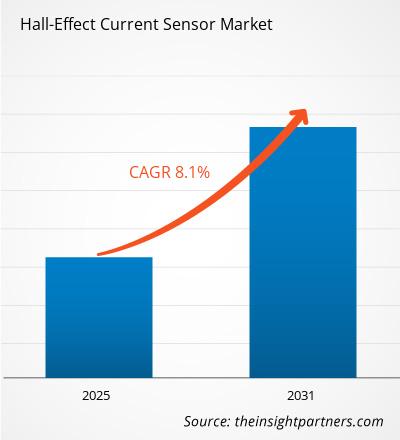
The Hall-Effect Current Sensor Market was valued at US$ 3,536.32 Million in 2025 and is projected to reach US$ 7,818.49 Million by 2034, registering a CAGR of 9.22% during 2026–2034. Demand is expanding as Hall-effect current sensing becomes increasingly important across electric vehicles, industrial automation, renewable-energy systems, charging infrastructure, power supplies, telecommunications, railway systems, medical equipment, and aerospace and defense electronics. Increasing power density and the need for isolated, accurate, compact, and fast-response current measurement are supporting wider adoption.
North America remains a major commercial and technology center, with the regional market projected to expand at a ~8% CAGR through 2034. The Hall-Effect Current Sensor Market size in the region benefits from established automotive electronics, industrial automation, EV charging infrastructure, renewable-power investment, aerospace and defense systems, and sophisticated semiconductor and power-electronics supply chains. Increasing deployment of high-voltage electrical systems is also strengthening demand for isolated current measurement.
Hall-Effect Current Sensor Market Assessment and Insights
Regional Outlook
- North America: ~31% of the global Hall-Effect Current Sensor Market share in 2025 | ~8% CAGR through 2034. Market position: Leading regional market, supported by EV powertrains, charging infrastructure, industrial automation, renewable-energy systems, aerospace electronics, data-center power equipment, and established current-sensing and semiconductor technology suppliers.
- US: ~78% of North American market revenue in 2025 | ~8% CAGR through 2034. Market position: Dominant country market in North America, supported by automotive electrification, semiconductor development, industrial controls, renewable power, aerospace and defense electronics, charging networks, and increasing investment in high-density power infrastructure.
- Europe: ~27% of the global market in 2025 | ~8% CAGR through 2034. Market position: Mature regional market supported by automotive electrification, industrial automation, renewable energy, railway systems, and advanced power electronics, with Germany representing the leading country in Europe alongside important demand from France, the UK, Italy, and Spain.
- Asia Pacific: ~32% of the global market in 2025 | ~11% CAGR through 2034. Market position: Fastest-growing regional market, driven by EV production, battery manufacturing, electronics manufacturing, industrial automation, renewable-energy equipment, semiconductor localization, and expanding power-electronics ecosystems across China, Japan, South Korea, India, and Australia.
Segment Outlook
- Open-Loop Hall-Effect Current Sensor: ~64% Share in 2025 | ~9% CAGR through 2034. Market position: Largest main segment because open-loop architectures combine cost efficiency, low power consumption, broad measurement capability, simple integration, and galvanic isolation, supporting extensive adoption across automotive systems, industrial drives, power supplies, energy equipment, and converters.
- Automotive: ~22% Share in 2025 | ~12% CAGR through 2034. Market position: High-growth main segment as electrified vehicles require current measurement across battery-management systems, traction inverters, onboard chargers, DC/DC converters, electronic protection systems, and auxiliary electrical architectures.
Competitive Coverage
ABB Ltd, Allegro MicroSystems, Inc., Asahi Kasei Microdevices Corporation, Infineon Technologies AG, Honeywell International Inc., STMicroelectronics N.V., LEM Holding SA, KOHSHIN ELECTRIC CORPORATION, Melexis NV, TDK Corporation
Methodology
The Insight Partners follows Data Collection & Secondary Research, Primary Research, Data Analysis, and Data Triangulation & Final Review to validate market estimates and insights.
Source: The Insight Partners' analysis based on proprietary research, government publications, company annual reports, investor presentations, industry databases, and expert interviews.
The Hall-Effect Current Sensor Market has moved from large magnetic transducers to small semiconductor devices where Hall effect elements together with signal conditioning, protection and increasing digital processing are combined. Simple open-loop sensors are still used due to cost efficiency and ease of design but more accurate, linear and fast responding closed-loop sensors are needed in cases where such characteristics are important. Small size, semiconductor integration, better magnetic concentrators, improved packaging and automotive qualifications allow for enhanced thermal and electromagnetic performance. Increasingly there is a trend towards semiconductor fabrication of sensor ICs and architectures and scaling technologies.
Through 2034, geographic growth will be driven by electric vehicles production, digitalization of industries, investments into renewable energy and localization of semiconductors and power electronics. Fast adoption of Hall-effect sensors will come from APAC due to development of EV production, batteries production, electronics manufacturing and plant automation while Europe and North America will keep benefiting from automotive and industrial engineering and production of EVs, infrastructure for EVs, industrial control, aerospace systems and advanced power converters due to regulatory trends of vehicle safety, energy efficiency and electrical protection.
Hall-Effect Current Sensor Market Report Scope
| Report Attribute | Details |
|---|---|
| Market size in 2025 | US$ 3,536.32 Million |
| Market Size by 2034 | US$ 7,818.49 Million |
| Global CAGR (2026 - 2034) | 9.22% |
| Historical Data | 2021-2024 |
| Forecast period | 2026-2034 |
Hall-Effect Current Sensor Market Analysis
The growth of Hall Effect Current Sensor Market is becoming more and more linked to the electric mobility of transportation and industrial machinery. Current sensors for control, protection, efficiency improvement, and diagnostic purposes are needed by electric vehicles, charging systems, battery management systems, motor control, renewable energy inverters, and power supplies. In particular, Hall Effect technology becomes important where isolation, non-invasive nature, compatibility with both AC and DC and miniaturization are demanded. Therefore, the demand for such sensors is spread over a number of end-user industries, instead of being concentrated in a single application area.
Hall effect sensors' environment includes Hall elements, magnetic concentrators, semiconductor wafers, ASICs, signal conditioning circuits, packages, current carrying conductors, transducers, modules, and full-scale electronic systems. Open-loop technology is used for inexpensive and high volume products whereas closed loop architecture is suitable for accuracy demanding applications. Rapid development of silicon carbide and gallium nitride power semiconductors results in additional requirements to performance parameters.
Competitive positioning in the Hall Effect Current Sensor Market is progressively being defined by measurement accuracy, bandwidth, isolation, temperature stability, size of the package, magnetic-field resistance, semiconductor integration and auto qualifications. ABB Ltd, Honeywell International Inc., Infineon Technologies AG, STMicroelectronics N.V. and TDK Corporation have an advantage in terms of broad industrial and electronics ecosystems while Allegro Microsystems, Inc., Asahi Kasei Microdevices Corporation, LEM Holding SA, Melexis NV and KOHSHIN ELECTRIC CORPORATION have specialization in current sensing and magnetism-based sensor technologies.
Increasing investment in miniaturized sensors, high-voltage electric vehicle platforms, intelligent diagnostics, bandwidth and application-specific current measurement technologies is the trend. Semiconductor companies able to integrate sensing with signal conditioning and protection functions can increase their value capture. Auto qualifications, functional reliability, thermal characteristics and long lifecycle of products are especially important since current sensors are used in increasing safety-critical and high power electronic applications.
● REPORT CUSTOMIZATION
Tailor This Report To Align With Your Specific Business Requirements
This report can be customized to align precisely with your business objectives, scope, and target markets. Customization options include tailored segmentation, geography, competitive analysis, and strategic insights to support informed decision-making.
Customize This Report →WHAT YOU CAN ADJUST
- ● Segmentations
- ● Geography
- ● Competitive Analysis
- ● Language Preferences
Hall-Effect Current Sensor Market: Strategic Insights

Regional Insights
North America Hall-Effect Current Sensor Market
North America accounted for ~31% of global revenue in 2025 and is projected to register a ~8% CAGR through 2034. The Hall-Effect Current Sensor Market share reflects the region's substantial automotive electronics base, advanced industrial automation, EV charging infrastructure, renewable-power development, aerospace and defense activity, and established semiconductor ecosystem. Current sensors are increasingly incorporated into traction systems, charging equipment, motor drives, battery systems, power supplies, and high-density electrical infrastructure.
Growth in the Hall-Effect Current Sensor Market is a result of increased EV production and infrastructure for charging, advancement in industrial equipment, and rising demands for power because of increased digitalization. The USA is the major customer in the region, whereas Canada makes contribution through automation of industry, energy infrastructure, mining equipment, and electrification of transport systems. Users prefer to have isolation, reduced power consumption, bandwidth, temperature stability, and miniaturized packages due to advanced electronics architecture.
U.S. Hall-Effect Current Sensor Market
The U.S. represented ~78% of North American Hall-Effect Current Sensor Market in 2025 and is projected to expand at a ~8% CAGR through 2034, making it the leading country in North America. The demand is for EV propulsion units, battery packs, chargers, industrial motor control, renewable energy converters, telecommunication infrastructure, aerospace electronics, and high-performance power supplies. The growing usage of sophisticated power conversion systems is leading to an increased requirement for highly accurate and isolation current measurement solutions.
Leading companies operating in the Hall-Effect Current Sensor Market include Allegro MicroSystems, Inc., Honeywell International Inc., Infineon Technologies AG, ABB Ltd, among others. The ongoing developments in the field of miniaturized Hall sensor ICs, high voltage current sensors, automotive-grade sensors, and wider bandwidth solutions have been expanding the addressable market. Applications in the automotive and industrial sectors are dominant; however, renewable energy, data centers, and charging stations represent other avenues.
Europe Hall-Effect Current Sensor Market
The Hall-Effect Current Sensor Market report shows that Europe held ~27% of the market in 2025 and is projected to record a ~8% CAGR through 2034. Germany is positioned as the leading country in Europe, supported by automotive manufacturing, industrial automation, machine building, railway equipment, renewable-energy systems, and sophisticated power-electronics engineering. France maintains strong demand through automotive, aerospace, energy, railway, and industrial applications, while the UK contributes through aerospace, industrial electronics, energy infrastructure, and advanced manufacturing.
Italy benefits from industrial machinery, factory automation, automotive components, energy equipment, and specialized electronics. Spain is supported by renewable-energy deployment, automotive manufacturing, grid infrastructure, railway systems, and industrial digitalization. Across Europe, the transition toward electrified transportation and increasingly efficient industrial equipment is raising the importance of current monitoring for power conversion and control.
European customers place substantial emphasis on reliability, thermal performance, functional safety, electromagnetic compatibility, and lifecycle support. The region's established industrial base also provides a large replacement and modernization opportunity. Expansion of charging infrastructure, renewable generation, battery storage, and digitally controlled industrial equipment should support demand for both integrated sensor ICs and higher-performance current transducers through 2034.
APAC Hall-Effect Current Sensor Market
Asia Pacific represented ~32% of the Hall-Effect Current Sensor Market in 2025 and is projected to register a ~11% CAGR through 2034, making it the fastest-growing region. China is positioned as the leading country in Asia Pacific, supported by EV production, battery manufacturing, consumer electronics, industrial automation, renewable-energy equipment, and a large semiconductor and component supply chain. High production volumes create opportunities for integrated Hall sensor architectures.
Japan and South Korea contribute through automotive electronics, robotics, semiconductor manufacturing, industrial machinery, and advanced consumer electronics. India is expanding through vehicle electrification, manufacturing localization, renewable power, and industrial automation, while Australia generates demand through mining, utilities, energy infrastructure, and industrial systems. Localization of electronics production and rising power-electronics content should further strengthen regional adoption.
Middle East & Africa Hall-Effect Current Sensor Market
The Middle East & Africa market is projected to expand at a ~7% CAGR through 2034. Saudi Arabia is positioned as a leading country in the Middle East & Africa, supported by industrial diversification, energy infrastructure modernization, renewable-energy projects, transportation investment, and automation of industrial facilities. The UAE similarly contributes through smart infrastructure, renewable power, electric mobility, telecommunications, and advanced building systems.
South Africa generates demand through mining, industrial automation, railway systems, utilities, renewable energy, and power equipment. Across Rest of MEA, adoption remains application-specific but is increasing in electrical infrastructure, oil and gas facilities, power conversion, industrial equipment, and energy-management systems. Ruggedness, reliability, isolation, and lifecycle economics remain important purchasing criteria for installations operating under demanding environmental conditions.
Segmentation Analysis
Type
Type is projected to record a ~9% CAGR during 2026–2034. The Hall-Effect Current Sensor Market scope spans open-loop and closed-loop Hall-effect architectures used for isolated AC and DC current measurement. Selection depends on accuracy, bandwidth, power consumption, cost, thermal stability, current range, and integration requirements. Open-loop devices remain broadly adopted in cost-sensitive applications, while closed-loop architectures serve precision-oriented power electronics and industrial systems.
- Open-Loop Hall-Effect Current Sensor: Open-loop devices provide economical current measurement with galvanic isolation and broad application compatibility. They are widely suited to automotive electronics, industrial drives, power supplies, battery systems, converters, and energy equipment where compact construction and straightforward integration are important.
- Closed-Loop Hall-Effect Current Sensor: Closed-loop devices use compensation to improve linearity, accuracy, temperature stability, and dynamic response. They remain strategically important for precision industrial controls, high-performance converters, instrumentation, and demanding applications requiring stable current feedback.
Output
Output is projected to register a ~9% CAGR during 2026–2034. Linear and threshold architectures address different control requirements. Linear outputs provide continuous proportional current information for closed-loop control and monitoring, whereas threshold outputs support rapid detection and protection functions. Increasing integration of diagnostics and fault detection is expanding the importance of output characteristics within automotive and industrial systems.
- Linear Hall-Effect Current Sensor: Linear devices provide proportional output corresponding to measured current, making them suitable for motor control, battery monitoring, power conversion, instrumentation, and feedback applications requiring continuous current information.
- Threshold Hall-Effect Current Sensor: Threshold devices support overcurrent detection, protection, switching, and fault monitoring. Their strategic value is increasing in systems where rapid response and simple decision logic are more important than continuous measurement resolution.
Technology
Technology is projected to record a ~10% CAGR during 2026–2034. BiCMOS and CMOS architectures support different approaches to integrating Hall sensing, analog signal conditioning, digital processing, and protection functions. Technology selection depends on precision, power consumption, integration level, manufacturing economics, programmability, and application requirements. Semiconductor integration is enabling increasingly compact sensor solutions for automotive and industrial electronics.
- BiCMOS: BiCMOS architectures combine analog and digital circuit capabilities, supporting integrated sensing, signal conditioning, processing, protection, and diagnostics. They are well suited to automotive, industrial, and power-management applications requiring sophisticated mixed-signal functionality.
- CMOS: CMOS supports compact, scalable Hall sensor implementations with integrated signal processing and low-power operation. Its relevance is increasing in high-volume electronics and applications where small packages, cost efficiency, and functional integration are important.
Industry
Industry is projected to register a ~10% CAGR during 2026–2034. Automotive is the highest-growth industry because electrified vehicles require current measurement throughout propulsion, charging, battery, and auxiliary power systems. Industrial automation remains a major application base, while consumer electronics, medical equipment, utilities, railway systems, telecommunications, and aerospace and defense provide diverse demand across different performance and qualification requirements.
- Automotive: Automotive current sensing supports traction inverters, battery-management systems, onboard chargers, DC/DC converters, electronic protection, and motor controls. Increasing electrification raises sensor content and strengthens requirements for isolation, accuracy, bandwidth, and functional reliability.
- Industrial Automation: Industrial equipment uses current sensors in motor drives, robotics, servo systems, converters, and power supplies. Demand is linked to efficient motor control, equipment protection, predictive maintenance, and increasingly digital factory architectures.
- Consumer Electronics: Compact current sensing supports power-management circuits, chargers, appliances, and electronic equipment. Small packages, low power consumption, integration, and cost efficiency are important adoption considerations in high-volume products.
- Medical: Medical equipment uses current monitoring in power supplies, imaging equipment, laboratory systems, precision instruments, and other electrically controlled devices. Isolation, reliability, stable measurement, and predictable long-term performance influence adoption.
- Utilities: Utilities employ current sensing in renewable generation, grid equipment, energy storage, power conversion, and energy-management systems. Expansion of distributed energy resources is increasing the number of points at which current measurement is required.
- Railway: Railway applications include traction converters, propulsion systems, braking systems, auxiliary converters, and onboard power equipment. High isolation, rugged operation, reliability, and resistance to demanding electrical and environmental conditions are important.
- Telecommunication: Telecommunications infrastructure uses current sensing in rectifiers, backup power systems, DC distribution, and network equipment. Increasing equipment power density creates demand for compact sensors capable of operating reliably in constrained electrical environments.
- Aerospace & Defense: Aerospace and defense systems use current monitoring across avionics, power supplies, electronic equipment, actuation, and mission systems. Qualification, reliability, low weight, electromagnetic resilience, and lifecycle support influence sensor selection.
Opportunity Snapshot
| Industry | Revenue Contribution | Trend Tag | Adoption Stage |
| Automotive | High | EV Powertrains | Scaling |
| Industrial Automation | High | Motor Drives | Mature |
| Consumer Electronics | Medium | Compact Power | Mature |
| Medical | Low | Precision Monitoring | Scaling |
| Utilities | Medium | Grid Modernization | Scaling |
| Railway | Medium | Traction Electrification | Scaling |
| Telecommunication | Medium | Power Density | Scaling |
| Aerospace & Defense | Low | High Reliability | Scaling |
Hall-Effect Current Sensor Market Growth Drivers and Impact Analysis
Electrification of Vehicles and Expansion of High-Voltage Powertrains
Vehicle electrification is increasing both the number and complexity of current measurements required within modern vehicles. Battery-management systems monitor charge and discharge behavior, traction inverters regulate motor power, onboard chargers convert grid electricity, and DC/DC converters manage different voltage domains. These systems require current sensing that can operate reliably under high voltage, rapid switching, thermal variation, and electromagnetic interference. Hall-effect architectures are particularly relevant where galvanic isolation and non-intrusive measurement are needed. The impact extends beyond passenger vehicles to commercial vehicles, buses, two-wheelers, hybrids, and charging infrastructure. As electrical architectures become more compact, integrated current-sensor ICs can reduce component count, wiring, and PCB area, creating further demand for smaller sensors with high bandwidth and stable thermal performance.
Industrial Automation and Intelligent Motor Control
Industrial facilities are increasingly deploying variable-speed drives, servo systems, robotics, automated machinery, and digitally controlled power converters. Accurate current feedback enables torque control, fault detection, energy optimization, equipment protection, and closed-loop operation. Hall-effect sensors can measure AC and DC currents while maintaining galvanic isolation, making them suitable for demanding motor-control environments. The market impact is particularly relevant to modernization projects where manufacturers upgrade control and monitoring capabilities without replacing complete electrical systems. Increasing adoption of connected industrial equipment also favors sensors that provide stable, fast, and diagnostically useful signals. Suppliers able to combine current measurement with programmable outputs, protection features, and compact packaging can address a wider range of industrial control architectures.
Growth of Renewable Power and Energy-Storage Infrastructure
Solar inverters, battery-energy-storage systems, EV charging equipment, microgrids, and distributed-energy technologies depend on power conversion between generation, storage, and loads. Accurate current measurement supports converter control, electrical protection, efficiency optimization, and energy management. Hall-effect sensors are useful where isolation is required between high-power conductors and low-voltage control electronics. The increasing use of high-frequency switching devices is also raising requirements for bandwidth, low noise, and fast response. The resulting impact extends across residential, commercial, industrial, and utility-scale energy systems. Suppliers capable of combining high-current measurement, compact packaging, robust isolation, and stable thermal performance can benefit as power-conversion architectures become more efficient, digitally controlled, and distributed.
Hall-Effect Current Sensor Market Future Trends
Migration Toward Integrated and Coreless Current Sensing
The Hall-Effect Current Sensor Market trends increasingly point toward integrated and coreless architectures that reduce physical size while adding signal conditioning, diagnostics, and protection. Integrated current conductors and magnetic sensing elements can simplify PCB design and reduce the need for external magnetic components. This direction is particularly relevant to EV inverters, onboard chargers, battery disconnect systems, industrial drives, and compact power supplies where board space and thermal management are constrained. Differential Hall architectures can improve immunity to external magnetic fields, while advanced packaging can support higher current levels within smaller footprints. Through 2034, sensor suppliers are likely to emphasize application-specific integration, programmable characteristics, and higher functional density rather than relying solely on improvements in basic measurement accuracy.
Higher Bandwidth for Advanced Power Semiconductor Architectures
The growing use of silicon carbide and gallium nitride power devices is changing current-sensor performance requirements. These switching technologies enable higher frequencies and faster power conversion, but precise current information is required to maintain control stability and protect power components. Sensor latency, bandwidth, noise, thermal drift, and common-mode performance therefore become increasingly important. Future products are expected to incorporate faster signal paths, improved magnetic-field rejection, integrated fault detection, and tighter thermal characteristics. This evolution should create opportunities across EV charging, traction inverters, industrial converters, data-center power supplies, renewable-energy systems, and advanced energy-storage equipment. Current sensing will increasingly function as a real-time control and protection component rather than simply a measurement device.
Hall-Effect Current Sensor Market Opportunities
Advanced Battery Monitoring and High-Voltage EV Architectures
Battery disconnect units, high-voltage battery packs, onboard chargers, and vehicle power-distribution architectures provide substantial opportunities for current-sensor manufacturers. EV manufacturers require compact devices that combine current measurement with isolation, diagnostics, and reliable operation under demanding electrical conditions. Suppliers can capture additional value through application-specific sensors rather than generic transducers. Integration with battery-management electronics can reduce component count and simplify assembly while supporting more accurate charge, discharge, and fault monitoring. The opportunity is particularly attractive for devices capable of supporting high current and high voltage within compact mechanical footprints. Hall-Effect Current Sensor Market Forecasts will therefore be influenced by both vehicle production growth and increasing current-sensing content across increasingly complex electrified power architectures.
Smart Power Infrastructure and Distributed Energy Systems
Distributed solar generation, energy storage, EV charging, microgrids, and digitally controlled electrical infrastructure create opportunities for current-sensor manufacturers to address multiple monitoring points within connected power systems. These systems require measurement to manage power flows, detect abnormal conditions, optimize conversion efficiency, and coordinate distributed assets. Suppliers can target integrated sensing for residential energy systems, commercial chargers, industrial storage, grid equipment, and power-management modules. Products offering low power consumption, robust isolation, high magnetic-field immunity, and digital interfaces can address increasingly connected electrical architectures. Strategic investment should focus on modular sensor platforms that support multiple current ranges and installation formats, allowing OEMs to reuse validated designs across different power levels and reducing engineering complexity.
Recent Developments
- February 2026: Allegro MicroSystems has announced the launch of the ACS37017, a new Hall-effect current sensor designed to deliver highly accurate and stable current measurements for demanding power-conversion applications. The ACS37017 achieves a typical sensitivity error of just 0.55% across temperature and lifetime, positioning it as a high-accuracy solution for applications where precise current feedback is critical. The sensor combines advanced sensing technology with high-voltage isolation, making it suitable for systems such as AI data centers, electric vehicles, renewable-energy systems, DC-DC converters, and industrial power equipment.
- April 2025: TDK has expanded its Micronas magnetic sensor portfolio with the HAL/HAR 35xy, a new family of high-performance, stray-field-resistant 2D Hall-effect position sensors designed for automotive and industrial applications. The new sensor family is based on the company's established HAL/HAR 39xy platform but is optimized for mainstream applications that require essential sensing and safety features at a lower cost. The devices are designed to provide accurate linear and angular position measurement while maintaining the functional-safety capabilities required for automotive systems.
- December 2025: Littelfuse has introduced a new range of automotive-qualified current sensors designed to provide accurate and isolated current measurement for electric-vehicle battery, motor-control, and safety applications. The new sensors are intended to address the growing need for reliable current monitoring in electrified vehicles. By combining precise sensing with electrical isolation, the devices can support critical functions across battery-management systems (BMS), motor-control systems, and pyrofuse safety circuits.
Frequently Asked Questions

- Comprehensive Market Sizing and Forecast Analysis
- Detailed Segmentation Analysis
- In-Depth Market Dynamics Assessment
- Regional and Country-Level Insights
- Competitive Landscape and Company Benchmarking
- Strategic Business Intelligence
Recent Reports
Testimonials

The Insight Partners provided valuable market intelligence that supported our global go-to-market strategy. Their team was professional, responsive, and attentive to our feedback, providing thoughtful analysis and helpful methodological clarifications throughout the project.
Junmo Kim Chief Financial Officer (CFO), Enertech Co., Ltd.
The Insight Partners' SCADA System Market report is comprehensive, with valuable insights on current trends and future forecasts. The team was highly professional, responsive, and supportive throughout. We are very satisfied and highly recommend their services.
RAN KEDEM Partner, Reali Technologies LTDs
I requested a report on a very specific software market and the team produced the report in a few days. The information was very relevant and well presented. I then requested some changes and additions to the report. The team was again very responsive and I got the final report in less than a week.
JEAN-HERVE JENN Chairman, Future Analytica
We worked with The Insight Partners for an important market study and forecast. They gave us clear insights into opportunities and risks, which helped shape our plans. Their research was easy to use and based on solid data. It helped us make smart, confident decisions. We highly recommend them.
PIYUSH NAGPAL Sr. Vice President, High Beam Global
The Insight Partners delivered insightful, well-structured market research with strong domain expertise. Their team was professional and responsive throughout. The user-friendly website made accessing industry reports seamless. We highly recommend them for reliable, high-quality research services
YUKIHIKO ADACHI CEO, Deep Blue, LLC.
This is the first time I have purchased a market report from The Insight Partners.While I was unsure at first, I visited their web site and felt more comfortable to take the risk and purchase a market report.I am completely satisfied with the quality of the report and customer service. I had several questions and comments with the initial report, but after a couple of dialogs over email with their analyst I believe I have a report that I can use as input to our strategic planning process.Thank you so much for taking the extra time and making this a positive experience.I will definitely recommend your service to others and you will be my first call when we need further market data.
JOHN SUZUKI President and Chief Executive Officer, Board Director, BK Technologies
I wish to appreciate your support and the professionalism you displayed in the course of attending to my request for information regarding to infectious disease IVD market in Nigeria. I appreciate your patience, your guidance, and the fact that you were willing to offer a discount, which eventually made it possible for us to close a deal. I look forward to engaging The Insight Partners in the future, all thanks to the impression you have created in me as a result of this first encounter.
DR CHIJIOKE ONYIA MANAGING DIRECTOR, PineCrest Healthcare Ltd.Reason to Buy
- Informed Decision-Making
- Understanding Market Dynamics
- Competitive Analysis
- Identifying Emerging Markets
- Customer Insights
- Market Forecasts
- Risk Mitigation
- Boosting Operational Efficiency
- Strategic Planning
- Investment Justification
- Tracking Industry Innovations
- Aligning with Regulatory Trends





 Get Free Sample for