
Level Sensor Market Size, Share & Growth by 2034
Level Sensor Market Size and Forecast (2021 - 2034), Global and Regional Share, Trend, and Growth Opportunity Analysis Report Coverage: By Technology (contact-based level sensors and non-contact-based level sensors), By Monitoring Types (Level Sensors Monitoring for Solids, Level Sensors Monitoring for Liquid, and Level Sensors Monitoring for Both Solids & Liquids), By Applications (Consumer Sector, ICT & Computing Sector, Industrial Sector, Automotive & Transportation Sector, Energy & Utility Sector, Healthcare Sector, Agricultural Sector, and Military & Defense Sector), and Geography (North America, Europe, Asia Pacific, and South and Central America)
Historic Data: 2021-2024 | Base Year: 2025 | Forecast Period: 2026-2034- Status : Data Released
- Report Code : TIPTE100000126
- Category : Electronics and Semiconductor
- No. of Pages : 150
- Available Report Formats :



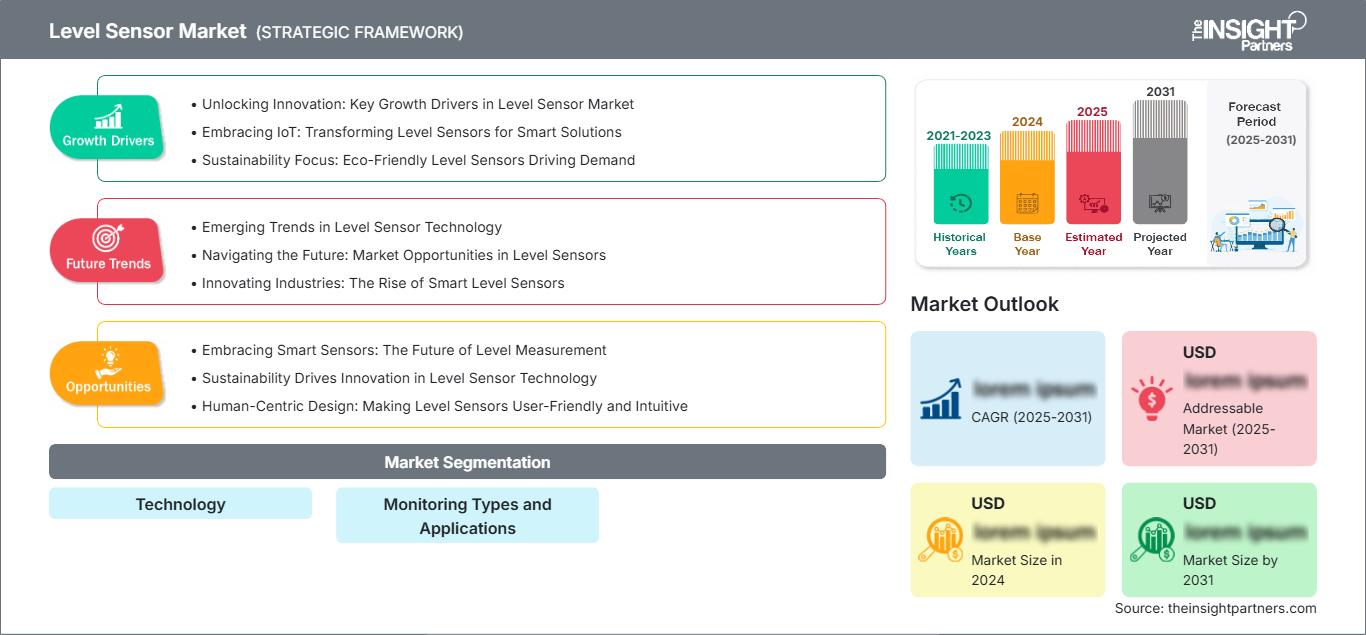
The global level sensor market size is projected to reach US$ 11.56 billion by 2034 from US$ 5.9 billion in 2025. The market is anticipated to register a CAGR of 7.77% during the forecast period 2026–2034.
Key market dynamics include the rapid escalation of Industry 4.0, a heightening global focus on automated process control, and the increasing integration of smart sensing technologies within the Internet of Things (IoT) framework. Additionally, the market is expected to benefit from stringent environmental mandates for wastewater management, the proliferation of sophisticated driver-assistance systems in the automotive industry, and the rising demand for high-precision monitoring in the healthcare and pharmaceutical industries.
Level Sensor Market Analysis
The level sensor market analysis indicates a definitive transition toward non-contact measurement solutions as industries prioritize hygiene and low-maintenance operations. The market trends suggest a bifurcated market into a stable segment for traditional contact-based sensors in cost-sensitive industrial manufacturing and a high-growth segment for advanced radar and ultrasonic technologies in volatile or hazardous environments. Strategic opportunities are emerging in the miniaturization of sensors for consumer electronics and medical devices, where MEMS technology provides a clear competitive advantage. The analysis also highlights that market expansion is increasingly tied to digital connectivity, with edge AI and remote diagnostic capabilities becoming standard requirements. Competitive differentiation now stands out depending on branding that emphasizes long-term reliability, ease of integration into existing wireless networks, and compliance with specialized safety certifications for potentially explosive or sterile zones.
Level Sensor Market Overview
Sensing solutions have evolved from basic mechanical indicators to intelligent, multi-parameter monitoring systems. The market encompasses a wide range of technologies designed to track levels in extreme conditions, from cryogenic liquid storage to high-temperature solid silos. Both global technology leaders and specialized boutique firms compete in this market, utilizing durable materials like 316L stainless steel and chemically resistant polymers. Growing demand for predictive maintenance and real-time inventory visibility among efficiency-driven operators in North America and Asia-Pacific has increased the popularity of smart sensors as a cornerstone of modern infrastructure. North America currently maintains a high revenue share due to its advanced aerospace and oil industries, while Asia-Pacific is the fastest-growing region owing to massive investments in smart city projects and electronics manufacturing. The US level sensor market is the most mature globally, characterized by deep integration of Industry 4.0 and IIoT frameworks. Growth is propelled by rigorous environmental regulations, extensive automation in oil and gas refineries, and the rising demand for high-precision, non-contact sensing in advanced pharmaceutical manufacturing and smart water infrastructure.
Customize This Report To Suit Your Requirement
Get FREE CUSTOMIZATIONLevel Sensor Market: Strategic Insights
-
Get Top Key Market Trends of this report.This FREE sample will include data analysis, ranging from market trends to estimates and forecasts.
Level Sensor Market Drivers and Opportunities
Market Drivers:
- Surge in Automotive Electrification and Safety: The automotive industry is increasingly utilizing level sensors for battery coolant monitoring, brake fluid tracking, and advanced fuel management in hybrid systems.
- Strict Environmental and Safety Regulations: Global mandates regarding the monitoring of toxic waste and the prevention of tank overflows in the chemical and energy sectors are driving steady replacement cycles.
- Advancements in IoT and Wireless Connectivity: The shift toward remote monitoring in sectors like agriculture and utilities has made wireless, low-power level sensors a critical asset for operational efficiency.
Market Opportunities:
- Modernization of Healthcare Equipment: Beyond industrial tanks, there is significant potential in precision medical applications, such as monitoring IV fluids, dialysis machines, and automated lab equipment.
- Growth in Smart Agriculture and Irrigation: Forming strategic partnerships with agricultural tech providers can facilitate access to the rising demand for automated soil moisture and water reservoir management in emerging economies.
- Expansion into Domestic and Consumer Tech: Increasing inclusion of level sensors in smart household appliances, such as coffee machines and high-end washing machines, offers a high-volume growth corridor for sensor manufacturers.
Level Sensor Market Report Segmentation Analysis
The level sensor market share is analyzed across various segments to provide a clearer understanding of its structure, growth potential, and emerging trends. Below is the standard segmentation approach used in most industry reports:
By Technology:
- Non-Contact-Based Level Sensors: Includes ultrasonic, radar, and optical sensors. This segment is projected to dominate due to its ability to measure levels without physical interference, reducing wear and contamination risks.
- Contact-Based Level Sensors: Includes float, capacitive, and hydrostatic sensors. These remain essential for high-pressure applications and cost-effective point-level detection in residential and light industrial settings.
By Monitoring Types:
- Level Sensors Monitoring for Liquid: The largest segment by volume, used extensively in water treatment, beverage production, and oil storage.
- Level Sensors Monitoring for Solids: Vital for the mining and construction industries to track bulk powders, grains, and construction materials in silos.
- Level Sensors Monitoring for Both Solids & Liquids: A versatile segment focused on multi-purpose industrial applications and complex chemical processing.
By Applications:
- Industrial Sector
- Automotive & Transportation Sector
- Energy & Utility Sector
- Consumer Sector
- Healthcare Sector
- Agricultural Sector
- ICT & Computing Sector
- Military & Defense Sector
By Geography:
- North America
- Europe
- Asia Pacific
- South & Central America
- Middle East & Africa
Level Sensor Market Report Scope
| Report Attribute | Details |
|---|---|
| Market size in 2025 | US$ 5.9 Billion |
| Market Size by 2034 | US$ 11.56 Billion |
| Global CAGR (2026 - 2034) | 7.77% |
| Historical Data | 2021-2024 |
| Forecast period | 2026-2034 |
| Segments Covered |
By Technology
|
| Regions and Countries Covered |
North America
|
| Market leaders and key company profiles |
|
Level Sensor Market Players Density: Understanding Its Impact on Business Dynamics
The Level Sensor Market is growing rapidly, driven by increasing end-user demand due to factors such as evolving consumer preferences, technological advancements, and greater awareness of the product's benefits. As demand rises, businesses are expanding their offerings, innovating to meet consumer needs, and capitalizing on emerging trends, which further fuels market growth.
Level Sensor Market Share Analysis by Geography
Asia-Pacific is expected to grow fastest in the coming years, serving as the global hub for electronics manufacturing and industrial automation. Emerging markets in the Middle East & Africa and South & Central America also present significant untapped opportunities for process control and water management technologies to expand.
The level sensor market is undergoing a significant transformation, moving from mechanical sensing to high-precision digital and non-contact monitoring. Growth is driven by the rise of smart cities, the surge in industrial automation (Industry 4.0), and the expansion of global energy. Below is a summary of market share and trends by region:
1. North America
- Market Share: Holds a leading share, driven by the widespread utilization of advanced technologies across the oil and gas, pharmaceutical, and aerospace industries.
- Key Drivers:
- Strict EPA regulations and safety standards for wastewater and chemical monitoring
- Early adoption of IIoT and wireless sensor networks for remote tank management
- High concentration of major industry players and technological innovators in the US
- Trends: Integration of AI-driven predictive maintenance and a significant trade-up to 80 GHz radar technology for high-accuracy custody transfer applications.
2. Europe
- Market Share: A major regional powerhouse anchored by deep-seated automotive and chemical manufacturing ecosystems in Germany, France, and the UK.
- Key Drivers:
- Stringent SIL-3 safety audit requirements and functional safety regulations (IEC 61511)
- Robust government support for sustainable water management and green energy initiatives
- Established processing infrastructure requiring regular modernization of legacy sensors
- Trends: A strategic focus on multifunctional sensors that integrate level, pressure, and temperature monitoring into single, compact units to meet eco-conscious manufacturing demands.
3. Asia-Pacific
- Market Share: The fastest-growing region globally, with China, India, and South Korea acting as the primary manufacturing for the continent.
- Key Drivers:
- Massive infrastructure development, including smart city projects and desalination plants
- Government-led initiatives for smart manufacturing and the rapid expansion of the electronics industry
- Increasing demand for precision-level monitoring in the burgeoning healthcare and biotech industries
- Trends: Heavy reliance on e-commerce for sensor procurement and a surge in the adoption of non-contact sensors for hazardous liquid monitoring in chemical parks.
4. South and Central America
- Market Share: An emerging market with a growing industry in countries like Brazil and Chile.
- Key Drivers:
- Modernization of the food processing and beverage industries to meet global export standards
- Increasing awareness of the need for precise liquid level monitoring in agricultural irrigation
- Expansion of mining operations requiring rugged sensors for bulk solid monitoring
- Trends: Growth of boutique sensor solutions tailored for farm-to-silo monitoring and the introduction of low-cost, reliable point-level switches.
5. Middle East and Africa
- Market Share: A developing market with deep roots in the oil and gas industry, now transitioning toward formalized commercial water and waste management.
- Key Drivers:
- Critical demand for high-durability sensors in the regional petrochemical and oil storage
- Strategic investments in agriculture and desalination megaprojects to ensure water security
- Rising focus on digital tank-farm automation across the GCC countries
- Trends: Implementation of ruggedized, explosion-proof radar sensors and a shift toward solar-powered wireless level monitoring for remote desert locations.
High Market Density and Competition
Competition is intensifying due to the presence of established leaders such as Emerson Electric Co., Endress+Hauser Group Services AG, and Siemens AG. Regional engineering experts and niche players like VEGA Grieshaber KG (Germany) and SICK AG (Germany), alongside North American innovators such as Honeywell International Inc. and TE Connectivity, contribute to a diverse and rapidly expanding market landscape.
This competitive environment pushes vendors to differentiate through:
- Sensor Fusion and AI: Integrating multiple sensing technologies within one device to provide higher data accuracy and predictive maintenance alerts.
- Wireless Protocols: Offering sensors compatible with 5G, LoRaWAN, and Zigbee for seamless connectivity in large-scale industrial IoT deployments.
- Extreme Condition Reliability: Developing sensors that can withstand high-pressure steam, cryogenic temperatures, and highly corrosive chemical environments.
Opportunities and Strategic Moves
- Integrate Smart Diagnostics: Partner with software providers to embed self-diagnostic and build-up detection features in sensors, allowing operators to reduce unplanned downtime and maintenance costs.
- Target Emerging Industrial Corridors: Form strategic partnerships with local distributors in the APAC and MEA regions to tap into surging demand for smart water grids and energy storage facilities.
Major Companies operating in the Level Sensor Market are:
- Pepperl+Fuchs AG
- Mass International
- Vega GmbH
- Gems Sensors & Control Co.
- Magnetrol International, Inc.
- Honeywell International, Inc.
- Endress+ Hauser AG
- ABB Ltd.
- Siemens
Disclaimer: The companies listed above are not ranked in any particular order.
Level Sensor Market News and Recent Developments
- In March 2026, Honeywell introduced a new gas sensor that uses optical non-dispersive infrared (NDIR) technology to detect flammable gases, such as methane, propane, and butane, in industrial settings. The NDIR Hydrocarbon Gas Sensor helps protect workers and infrastructure in industries such as mining, oil and gas, petrochemical, and plastics manufacturing.
- In January 2026, Aeva®, a leader in next-generation sensing and perception systems, announced that its Frequency Modulated Continuous Wave (FMCW) 4D LiDAR technology has been selected for the NVIDIA DRIVE Hyperion autonomous vehicle reference platform. The integration marks a significant milestone for Aeva as its role expands as a core LiDAR sensor supplier to global passenger and commercial vehicle OEMs that have selected NVIDIA’s autonomous vehicle architecture.
Level Sensor Market Report Coverage and Deliverables
The Level Sensor Market Size and Forecast (2021–2034) report provides a detailed analysis of the market covering below areas:
- Level Sensor Market size and forecast at global, regional, and country levels for all the key market segments covered under the scope
- Level Sensor Market trends, as well as market dynamics such as drivers, restraints, and key opportunities
- Detailed PEST and SWOT analysis
- Level Sensor Market analysis covering key market trends, global and regional framework, major players, regulations, and recent market developments
- Industry landscape and competition analysis covering market concentration, heat map analysis, prominent players, and recent developments in the Level Sensor Market.
- Detailed company profiles
Frequently Asked Questions

- Historical Analysis (2 Years), Base Year, Forecast (7 Years) with CAGR
- PEST and SWOT Analysis
- Market Size Value / Volume - Global, Regional, Country
- Industry and Competitive Landscape
- Excel Dataset
Recent Reports
Testimonials

The Insight Partners' SCADA System Market report is comprehensive, with valuable insights on current trends and future forecasts. The team was highly professional, responsive, and supportive throughout. We are very satisfied and highly recommend their services.
RAN KEDEM Partner, Reali Technologies LTDs
I requested a report on a very specific software market and the team produced the report in a few days. The information was very relevant and well presented. I then requested some changes and additions to the report. The team was again very responsive and I got the final report in less than a week.
JEAN-HERVE JENN Chairman, Future Analytica
We worked with The Insight Partners for an important market study and forecast. They gave us clear insights into opportunities and risks, which helped shape our plans. Their research was easy to use and based on solid data. It helped us make smart, confident decisions. We highly recommend them.
PIYUSH NAGPAL Sr. Vice President, High Beam Global
The Insight Partners delivered insightful, well-structured market research with strong domain expertise. Their team was professional and responsive throughout. The user-friendly website made accessing industry reports seamless. We highly recommend them for reliable, high-quality research services
YUKIHIKO ADACHI CEO, Deep Blue, LLC.
This is the first time I have purchased a market report from The Insight Partners.While I was unsure at first, I visited their web site and felt more comfortable to take the risk and purchase a market report.I am completely satisfied with the quality of the report and customer service. I had several questions and comments with the initial report, but after a couple of dialogs over email with their analyst I believe I have a report that I can use as input to our strategic planning process.Thank you so much for taking the extra time and making this a positive experience.I will definitely recommend your service to others and you will be my first call when we need further market data.
JOHN SUZUKI President and Chief Executive Officer, Board Director, BK Technologies
I wish to appreciate your support and the professionalism you displayed in the course of attending to my request for information regarding to infectious disease IVD market in Nigeria. I appreciate your patience, your guidance, and the fact that you were willing to offer a discount, which eventually made it possible for us to close a deal. I look forward to engaging The Insight Partners in the future, all thanks to the impression you have created in me as a result of this first encounter.
DR CHIJIOKE ONYIA MANAGING DIRECTOR, PineCrest Healthcare Ltd.Reason to Buy
- Informed Decision-Making
- Understanding Market Dynamics
- Competitive Analysis
- Identifying Emerging Markets
- Customer Insights
- Market Forecasts
- Risk Mitigation
- Boosting Operational Efficiency
- Strategic Planning
- Investment Justification
- Tracking Industry Innovations
- Aligning with Regulatory Trends
Unlock Exclusive Report Discounts
Enquire Now




 Get Free Sample For