
Polymer Modified Bitumen (PMB) Market Size, Share & Trends by 2034
Coverage: By Product (Thermoplastic Elastomers, Plastomers); Application (Road Construction, Roof Construction) , and Geography (North America, Europe, Asia Pacific, and South and Central America)
- Status : Data Released
- Report Code : TIPRE00022658
- Category : Chemicals and Materials
- No. of Pages : 150
- Available Report Formats :


- Last update date : July 08, 2026


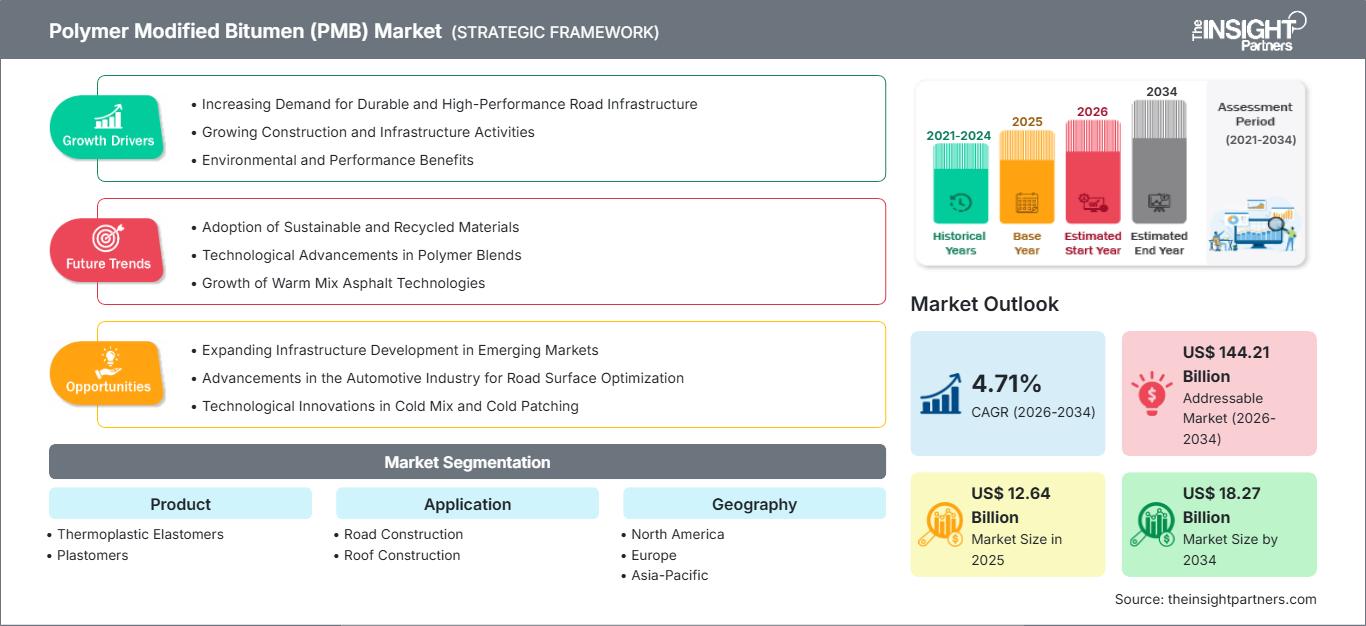
2025 Market Size
US$ 12.64 Bn
Base year value
2034 Forecast
US$ 18.27 Bn
Projected by 2034
CAGR 2026-2034
4.71 %
Growth rate
Addressable Market
US$ 144.21 Bn
(2026-2034)
The polymer modified bitumen market size was valued at US$ 12.64 Billion in 2025 and is projected to reach US$ 18.27 Billion by 2034, expanding at a CAGR of 4.71% during 2026–2034. Market growth is supported by increasing investments in durable transportation infrastructure, growing adoption of advanced road construction materials, and rising demand for high-performance waterproofing systems across residential, commercial, and industrial construction projects worldwide.
North America is expected to register a CAGR of 4.2–4.6% during the forecast period, supported by sustained investments in highway rehabilitation and resilient transportation networks. According to the polymer modified bitumen market report, Federal and state infrastructure funding, combined with increasing demand for longer-lasting pavements capable of withstanding heavy traffic loads and extreme weather conditions, continues to encourage the adoption of polymer modified bitumen in both road and roofing applications.
Polymer Modified Bitumen (PMB) Market Assessment and Insights
- North America: North America accounted for 30–34% of the polymer modified bitumen market share in 2025 and is anticipated to expand at a CAGR of 4.2–4.6% during 2026–2034. Interstate modernization programs, durable pavement specifications, and ongoing infrastructure renewal initiatives continue to support sustained demand for polymer-modified bitumen across the region.
- U.S.: The U.S. represented 81–85% of the North American market in 2025 and is projected to register a CAGR of 4.3–4.7% during 2026–2034, driven by increasing highway rehabilitation projects, public infrastructure investments, and growing adoption of high-performance paving materials.
- Europe: Europe held 26–30% polymer modified bitumen market share in 2025 and is expected to grow at a CAGR of 4.0–4.4% during 2026–2034. Germany, France, and the United Kingdom remain leading markets, supported by transport infrastructure modernization, roofing refurbishment activities, and sustainability-focused construction standards.
- Asia Pacific: Asia Pacific accounted for 31–35% market share in 2025 and is forecast to expand at a CAGR of 5.3–5.7% during 2026–2034. China, India, and Japan continue to lead regional demand, driven by expanding highway infrastructure, rapid urbanization, and increasing industrial and commercial construction investments.
- Largest Segment: Road Construction represented the largest segment in the polymer modified bitumen market and is expected to record a CAGR of 4.8–5.2% during 2026–2034, reflecting the growing preference for high-performance pavements offering enhanced durability, improved rutting resistance, and longer maintenance intervals.
- High Growth Segment: Thermoplastic Elastomers is projected to grow at a CAGR of 5.2–5.6% during 2026–2034, driven by superior flexibility, enhanced crack resistance, and improved lifecycle performance in premium road and infrastructure applications.
- Key companies analyzed in detail: Exxon Mobil Corporation; Gazprom Neft PJSC; Hindustan Colas Private Limited; Lagan Asphalt Group; MBD Industries; Nynas AB; Shell plc; Sika AG; TotalEnergies SE; Colas SA.
Source: The Insight Partners' analysis based on proprietary research, government publications, company annual reports, investor presentations, industry databases, and expert interviews.
Progress in polymer technology has been gradually revolutionizing polymer-modified bitumen, transforming it from a specialized paving material into a mainstream solution for infrastructure requiring higher durability and lower lifecycle maintenance. Ongoing research continues to focus on improving the physical properties of polymers to increase their elasticity, heat resistance, and deformability, as well as to optimize production processes. Closer cooperation among polymer manufacturers, asphalt producers, and builders ensures a stable supply chain and the commercialization of this product.
Future development of this market is predicted to be driven by increased investment in infrastructure in countries undergoing rapid development, greater demands for pavement performance, and the application of sustainable building methods. Governments' focus on climate-change-resistant infrastructure is stimulating interest in improved bituminous materials. The polymer modified bitumen market forecast indicates that the development of manufacturing capacity, product innovation, and local distribution channels is likely to ensure improved accessibility for this market segment in the future.
Polymer Modified Bitumen (PMB) Market Report Scope
| Report Attribute | Details |
|---|---|
| Market size in 2025 | US$ 12.64 Billion |
| Market Size by 2034 | US$ 18.27 Billion |
| Global CAGR (2026 - 2034) | 4.71% |
| Historical Data | 2021-2024 |
| Forecast period | 2026-2034 |
Polymer Modified Bitumen (PMB) Market Analysis
The polymer modified bitumen market has continued to gain from the growing demands for high-quality construction products with improved durability, effectiveness of waterproofing, and economics of life cycle. The increased traffic loadings, the adverse effects of weather on pavements, and the need for strict quality requirements are making contractors prefer using polymer-modified bitumen over traditional ones. The demand will continue to be especially high in highways, airport runways, bridges, and premium roofing constructions.
The supply chain starts with crude oil and polymer suppliers to the manufacture of modified bitumen through engineering and construction companies. Consistency in the supply of raw materials together with technological improvement in blending polymer has improved the quality of end product and supported big construction projects. Cooperation between the suppliers and developers of projects also allows developing a product according to different climatic and performance criteria.
Competition in the polymer modified bitumen market is marked by constant innovations in the development of products, capacity expansion and cooperation in order to increase market presence. Manufacturers pay more attention to research and development of advanced polymers with improved properties and the efficiency of production processes.
Leading participants including Exxon Mobil Corporation, Shell plc, TotalEnergies SE, Nynas AB, Sika AG, Gazprom Neft PJSC, Hindustan Colas Private Limited, Colas SA, Lagan Asphalt Group, and MBD Industries continue investing in production capabilities, application-specific solutions, and regional distribution networks. Their competitive strategies emphasize innovation, sustainable product development, operational efficiency, and long-term customer relationships to strengthen positioning across both developed and emerging infrastructure markets.
● REPORT CUSTOMIZATION
Tailor This Report To Align With Your Specific Business Requirements
This report can be customized to align precisely with your business objectives, scope, and target markets. Customization options include tailored segmentation, geography, competitive analysis, and strategic insights to support informed decision-making.
Customize This Report →WHAT YOU CAN ADJUST
- ● Segmentations
- ● Geography
- ● Competitive Analysis
- ● Language Preferences
Polymer Modified Bitumen (PMB) Market: Strategic Insights
Regional Insights
North America Polymer Modified Bitumen Market
North America accounted for 30–34% of the global polymer modified bitumen market in 2025 and is projected to expand at a CAGR of 4.2–4.6% through 2034. Aging transportation infrastructure and increasing investments in pavement rehabilitation continue supporting consistent regional demand.
Government-backed highway modernization initiatives and rising adoption of durable roofing materials further accelerate the polymer modified bitumen market growth. Contractors increasingly specify polymer modified bitumen to reduce maintenance frequency while improving pavement performance under heavy traffic volumes and diverse climatic conditions.
U.S. Polymer Modified Bitumen Market
The United States represented 81–85% of North American market revenue in 2025 and is anticipated to register a CAGR of 4.3–4.7% during the forecast period. Large-scale transportation investments continue supporting stable consumption across road construction projects.
Major suppliers including Exxon Mobil Corporation, Shell plc, Sika AG, and Hindustan Colas Private Limited maintain strong commercial engagement through product supply, technology collaboration, or project support. Growing adoption in interstate highways, bridge rehabilitation, airport pavements, and commercial roofing applications reinforces long-term expansion of the polymer modified bitumen market.
Europe Polymer Modified Bitumen Market
Europe held 26–30% of global polymer modified bitumen market revenue in 2025 and is forecast to grow at a CAGR of 4.0–4.4% through 2034. Sustainability targets, mature transportation infrastructure, and extensive building renovation activities continue supporting regional demand.
Germany remains the leading national market due to continuous investments in highway maintenance, industrial construction, and advanced paving technologies. Strong engineering capabilities and strict infrastructure quality standards encourage widespread adoption of polymer modified bitumen across both transportation and waterproofing applications.
The United Kingdom benefits from road maintenance initiatives and commercial roofing refurbishment, while France, Italy, and Spain continue investing in transportation modernization and urban infrastructure upgrades. These combined investments create consistent opportunities for manufacturers supplying premium modified bitumen products throughout the region.
APAC Polymer Modified Bitumen Market
Asia Pacific represented 31–35% of global revenue in 2025 and is expected to record the fastest regional expansion with a CAGR of 5.3–5.7% through 2034. Rapid urbanization and extensive infrastructure development continue driving regional consumption.
China leads the regional polymer modified bitumen market through substantial investments in expressways, municipal infrastructure, and industrial construction. Japan emphasizes premium pavement technologies for long-term durability, while South Korea continues upgrading transportation infrastructure using advanced construction materials.
India benefits from expanding highway development, smart city initiatives, and airport construction projects, whereas Australia continues investing in resilient road infrastructure capable of supporting heavy freight transportation. These combined developments sustain strong regional demand for polymer modified bitumen.
Middle East & Africa Polymer Modified Bitumen Market
The Middle East & Africa market is projected to expand at a CAGR of 4.8–5.2% during the forecast period. Increasing investments in transportation corridors, urban infrastructure, and commercial construction support growing regional demand for high-performance paving materials.
The polymer modified bitumen market in Saudi Arabia is the largest due to infrastructure development and economic diversification programs. The United Arab Emirates will continue developing premium transport and commercial buildings, while South Africa will stimulate market growth through the rehabilitation of roads and industrial construction. The Rest of the Middle East & Africa is forecast to experience gradual market expansion due to the prioritization of transport infrastructure, logistics connections, and energy-related construction projects that require polymer modified bitumen.
Segmentation Analysis
Product
The Product segment continues to evolve as manufacturers develop advanced polymer formulations to enhance pavement durability, flexibility, and resistance to thermal cracking. Material innovation is enabling improved performance across diverse climatic conditions while supporting infrastructure projects with extended service life and reduced maintenance requirements. Among product categories, Thermoplastic Elastomers are projected to register a CAGR of 5.2–5.6% during 2026–2034, supported by superior elasticity and long-term pavement performance.
- Thermoplastic Elastomers: Widely adopted in premium highway construction and airport pavements because they improve flexibility, rutting resistance, fatigue life, and crack resistance while lowering long-term maintenance requirements under heavy traffic and varying environmental conditions.
- Plastomers: Preferred where high stiffness, deformation resistance, and structural stability are essential. These materials improve load-bearing capacity and pavement durability, making them suitable for industrial roads, freight corridors, and roofing systems exposed to elevated temperatures.
Application
The application landscape is primarily influenced by infrastructure investment priorities and lifecycle cost considerations. Road Construction remains the dominant application and is forecast to expand at a CAGR of 4.8–5.2% during 2026–2034, driven by highway modernization, urban road expansion, and increasing preference for durable pavement materials that reduce maintenance frequency.
- Road Construction: The largest revenue-generating application due to continuous investments in highways, expressways, bridges, airport runways, and municipal roads requiring enhanced rutting resistance, durability, waterproofing performance, and extended operational life.
- Roof Construction: Increasingly adopted in commercial, industrial, and residential buildings because polymer modified bitumen provides superior waterproofing, flexibility, weather resistance, and long-term structural protection under challenging environmental conditions.
Opportunity Snapshot
| Segment Name | Revenue Contribution | Trend Tag | Adoption Stage |
| Road Construction | High | Highway Upgrades | Mature |
| Roof Construction | Medium | Green Roofing | Scaling |
Polymer Modified Bitumen (PMB) Market Growth Drivers and Impact Analysis
Expansion of Transportation Infrastructure Investment
The development of infrastructure through investments in highways, bridges, airports, ports, and urban transport continues to be a priority for governments in developed and developing countries. In many cases, investment projects require the use of polymer-modified bitumen due to its better performance with regard to rutting, cracking, moisture, and temperature sensitivity compared to ordinary bitumen. Moreover, the improved performance characteristics of polymer-modified bitumen provide economic benefits throughout the road lifecycle by extending service life and reducing maintenance needs.
Growing Preference for Long-Life Pavement Solutions
Procurement policies regarding roads have shifted from focusing solely on construction costs to prioritizing lower lifecycle costs for road owners. There is an increase in the use of polymer-modified bitumen that increases the strength and flexibility of pavements, as well as their resistance to heavy axles. Fewer repairs result in less disruption to traffic flow and reduce operational costs for infrastructure providers. This kind of procurement policy ensures wider adoption across national road departments, municipalities, airfields, and infrastructure-providing industries.
Increasing Demand for High-Performance Waterproofing Materials
Apart from roads and bridges, polymer-modified bitumen is becoming more popular in roofing construction due to its impressive water resistance, flexibility, and UV and heat resistance properties. Advanced waterproofing membranes are increasingly employed in commercial buildings, industrial plants, logistics hubs, and residential projects to enhance durability and reduce maintenance costs. Rising construction activity, stricter building performance standards, and greater awareness of lifecycle asset protection continue encouraging architects and contractors to specify polymer-modified bitumen systems, thereby creating an additional source of sustained polymer modified bitumen market expansion beyond traditional paving applications.
Polymer Modified Bitumen (PMB) Market Future Trends
Rising Adoption of Sustainable and Circular Material Technologies
The increasing focus on sustainability goals is influencing material selection for transport and construction applications, thereby motivating companies to develop higher-performing versions of polymer-modified bitumen. Increased usage of recycled polymers, reclaimed asphalt pavement, and advanced energy-saving production systems will define product development in the coming years. The industry players are working to design their products to achieve lower emissions without compromising performance. With increased sustainability demands from governments and infrastructure owners, demand for green polymer-modified bitumen products will continue to increase.
Digital Infrastructure Management Supporting Material Innovation
Digitalization is becoming an important component of infrastructure asset management, influencing the specification of advanced paving materials with predictable long-term performance. Smart sensors for monitoring, pavement performance analysis, and predictive maintenance platforms enable more accurate assessment of lifecycle costs, providing high confidence in the use of premium modified bitumen products. Suppliers are producing new products with performance and technical data, as well as engineering services, for specific applications. According to current polymer modified bitumen market trends, this shift is expected to foster greater cooperation among material suppliers, engineering firms, and infrastructure organizations.
Polymer Modified Bitumen (PMB) Market Opportunities
Expanding Infrastructure Development Across Emerging Economies
Urbanization and industrialization in Asia Pacific, the Middle East, Africa, and certain Latin American countries will continue to offer numerous opportunities for infrastructure construction. The governments in these regions are constructing expressways, logistics corridors, airports, industrial parks, and smart cities, which will require durable pavement materials capable of withstanding harsh operating conditions. Manufacturers should be able to improve their competitiveness by establishing local manufacturing plants, expanding distribution capabilities, and offering specialized technical assistance tailored to the region's climatic conditions.
Development of Advanced Application-Specific Product Portfolios
The diversification of infrastructure and construction needs presents an opportunity for manufacturers to develop more specific polymer-modified bitumen products that suit different operating conditions. Polymer-modified bitumen products developed for use on airports' runways, freight routes, bridges, tunnels, and energy-efficient roofing systems present a high degree of differentiation and value addition. Manufacturers that invest in polymer technology and product development, together with engineering firms, have an advantage in meeting their customers' needs. Technical advisory, together with the premium products, also builds sustainable relationships with customers.
Recent Developments
- October 2025: Nynas, in collaboration with Skanska and Swedavia, completed a sustainable runway paving project at Stockholm Arlanda Airport using recycled asphalt and its Nypol RE polymer-modified binder. The project demonstrated substantial carbon emission reductions while maintaining the stringent durability and performance requirements expected for international airport infrastructure, highlighting the company's continued innovation in advanced PMB technologies.
- March 2025: Shell Bitumen reported localized deployment milestones for its flagship Shell Cariphalte PMB portfolio, optimizing it for modern airport runways and heavy-traffic highways. The formulation leverages advanced polymer engineering to prevent rutting and low-temperature cracking. Shell’s focus emphasizes chemical modification to withstand heavier vehicle axle loads and climate-induced thermal stress, solidifying its position in the premium civil engineering sector.
- July 2025: Nynas reported a significant increase in sales of specialty Polymer Modified Bitumen (PMB) during the second quarter of 2025, with particularly strong demand across Scandinavian markets. The company attributed the growth to expanding road maintenance programs and increasing preference for high-performance binders that improve pavement durability and lifecycle performance.
Frequently Asked Questions

- Comprehensive Market Sizing and Forecast Analysis
- Detailed Segmentation Analysis
- In-Depth Market Dynamics Assessment
- Regional and Country-Level Insights
- Competitive Landscape and Company Benchmarking
- Strategic Business Intelligence
Recent Reports
Testimonials

The Insight Partners' SCADA System Market report is comprehensive, with valuable insights on current trends and future forecasts. The team was highly professional, responsive, and supportive throughout. We are very satisfied and highly recommend their services.
RAN KEDEM Partner, Reali Technologies LTDs
I requested a report on a very specific software market and the team produced the report in a few days. The information was very relevant and well presented. I then requested some changes and additions to the report. The team was again very responsive and I got the final report in less than a week.
JEAN-HERVE JENN Chairman, Future Analytica
We worked with The Insight Partners for an important market study and forecast. They gave us clear insights into opportunities and risks, which helped shape our plans. Their research was easy to use and based on solid data. It helped us make smart, confident decisions. We highly recommend them.
PIYUSH NAGPAL Sr. Vice President, High Beam Global
The Insight Partners delivered insightful, well-structured market research with strong domain expertise. Their team was professional and responsive throughout. The user-friendly website made accessing industry reports seamless. We highly recommend them for reliable, high-quality research services
YUKIHIKO ADACHI CEO, Deep Blue, LLC.
This is the first time I have purchased a market report from The Insight Partners.While I was unsure at first, I visited their web site and felt more comfortable to take the risk and purchase a market report.I am completely satisfied with the quality of the report and customer service. I had several questions and comments with the initial report, but after a couple of dialogs over email with their analyst I believe I have a report that I can use as input to our strategic planning process.Thank you so much for taking the extra time and making this a positive experience.I will definitely recommend your service to others and you will be my first call when we need further market data.
JOHN SUZUKI President and Chief Executive Officer, Board Director, BK Technologies
I wish to appreciate your support and the professionalism you displayed in the course of attending to my request for information regarding to infectious disease IVD market in Nigeria. I appreciate your patience, your guidance, and the fact that you were willing to offer a discount, which eventually made it possible for us to close a deal. I look forward to engaging The Insight Partners in the future, all thanks to the impression you have created in me as a result of this first encounter.
DR CHIJIOKE ONYIA MANAGING DIRECTOR, PineCrest Healthcare Ltd.Reason to Buy
- Informed Decision-Making
- Understanding Market Dynamics
- Competitive Analysis
- Identifying Emerging Markets
- Customer Insights
- Market Forecasts
- Risk Mitigation
- Boosting Operational Efficiency
- Strategic Planning
- Investment Justification
- Tracking Industry Innovations
- Aligning with Regulatory Trends





 Get Free Sample for