
Retro Reflective Textiles Market Trends, Size & Growth by 2034
Coverage: By End Users (Construction, Oil & Gas, Mining, Transportation, Firefighters, Law Enforcement Agencies, and Others) and Material (Tetoron Cotton, Polyester, Aramid, and Others)
- Status : Upcoming
- Report Code : TIPRE00028377
- Category : Chemicals and Materials
- No. of Pages : 150
- Available Report Formats :


- Last update date : March 04, 2026


2025 Market Size
US$ 3.52 Bn
Base year value
2034 Forecast
US$ 5.55 Bn
Projected by 2034
CAGR 2026-2034
5.2 %
Growth rate
Addressable Market
US$ 41.17 Bn
(2026-2034)
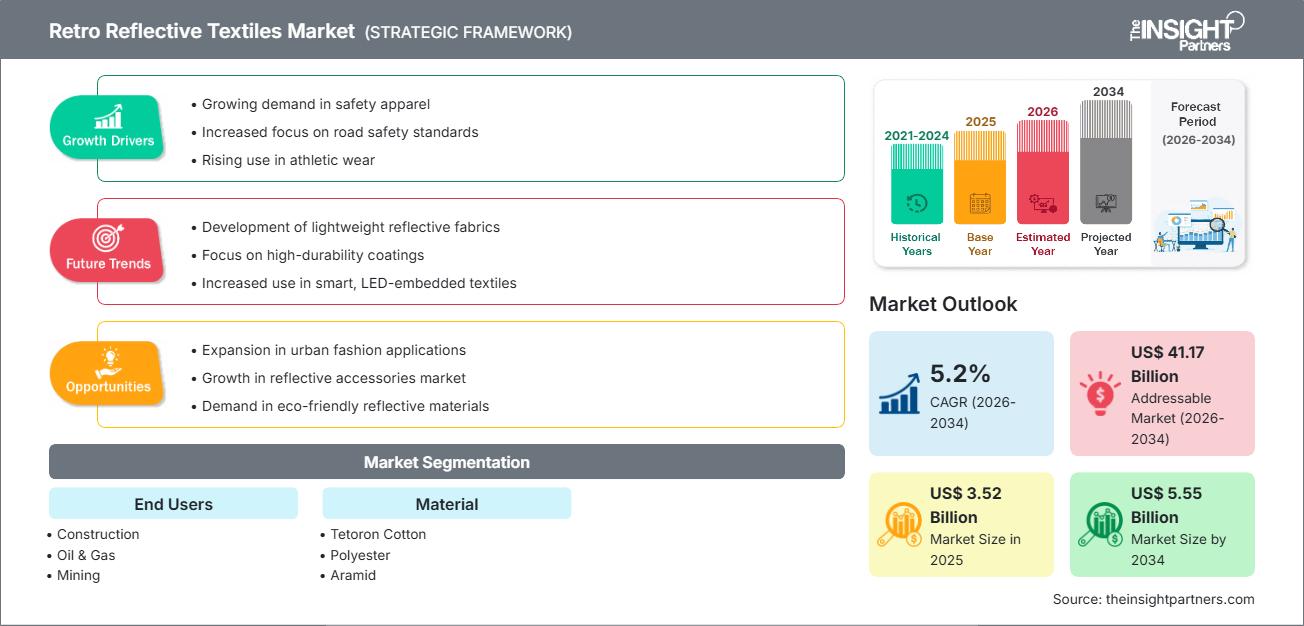
The global Retro Reflective Textiles market size is projected to reach US$ 5.55 billion by 2034 from US$ 3.52 billion in 2025. The market is anticipated to register a CAGR of 5.2% during the forecast period 2026–2034.
Key market dynamics include a heightening focus on occupational safety standards, the surge in global infrastructure and road development projects, and technological breakthroughs in microprismatic and glass bead applications. Additionally, the market is expected to benefit from the rising trend of active lifestyles and outdoor sports, the integration of reflective elements in high-street fashion, and the expanding need for visibility in extreme environments such as offshore oil rigs and deep-pit mining operations.
Retro Reflective Textiles Market Analysis
The retro reflective textiles market analysis indicates a strategic shift toward the premiumization of protective wear, where durability and wash-resistance are the primary competitive differentiators. Strategic opportunities are emerging in the development of breathable and flame-retardant reflective fabrics, which cater to the complex requirements of first responders and heavy-industry workers. For businesses, the focus is increasingly on enhancing the coefficient of retro-reflection to meet stringent international certifications such as EN ISO 20471 and ANSI/ISEA 107. The analysis also suggests that market entry and expansion strategies should prioritize the adoption of smart reflective materials that can be easily laundered without losing performance. By offering customized patterns and superior color-fastness, manufacturers can capture high-value contracts in both the professional workwear and luxury athleisure sectors.
Retro Reflective Textiles Market Overview
Retro reflective textiles are specialized fabrics engineered to return light to its source with high efficiency, utilizing millions of microscopic glass beads or prismatic structures. Traditionally restricted to standard safety vests, these textiles are now being revolutionized by flexible, lightweight films and threads that can be seamlessly bonded to various substrates. Global urbanization and the resulting increase in nighttime traffic have spurred a surge in high-conspicuity clothing, making reflective trims a staple of modern industrial and consumer apparel. While Europe and North America remain leaders in regulatory enforcement, the market is witnessing high-volume growth in the Asia-Pacific. As occupational safety becomes a non-negotiable standard in emerging economies, the demand for certified reflective textiles continues to grow across both government and private sectors. For instance, the market in the US represents a mature and highly regulated market characterized by a stringent emphasis on worker safety and legal compliance. The market is defined by steady demand for high-visibility safety apparel across federal transportation projects and private utility projects. There is a notable trend toward integrating reflective technology into performance-oriented sportswear and urban commuting gear.
Market Assessment and Insights
- Global market for Retro Reflective Textiles was valued at US$ 3.52 Billion in 2025
- Annual market size is expected to reach US$ 5.55 Billion by 2034
- Total addressable market (TAM) during 2026-2034 is projected to reach approximately US$ 41.17 Billion
- Market is anticipated to register a CAGR of 5.2% during the forecast period
- The United States represents a key market, supported by Growing demand in safety apparel, Increased focus on road safety standards, Rising use in athletic wear, as well as evolving industry dynamics
- Market analysis covers North America, Europe, Asia-Pacific, South and Central America, Middle East and Africa, with growth evaluated across the forecast period
- Market opportunities such as Expansion in urban fashion applications, Growth in reflective accessories market, Demand in eco-friendly reflective materials are expected to influence market dynamics and addressable market
- Report profiles industry participants, including 3M, Daoming Optics and Chemical Co., Ltd, HANGZHOU CHINASTARS REFLECTIVE MATERIAL CO.,LTD, Huangshan Xingwei Reflectorized Material Co., Ltd, PROMOSTY, PS Enterprises, Shelby Ltd, Swicofil AG, UNITIKA SPARKLITE LTD., V-Reflex Reflective Material Co., Ltd., while analyzing competitive strategies and innovation developments
-
Source: The Insight Partners' analysis based on proprietary research, government publications, company annual reports, investor presentations, industry databases, and expert interviews.
● REPORT CUSTOMIZATION
Tailor This Report To Align With Your Specific Business Requirements
This report can be customized to align precisely with your business objectives, scope, and target markets. Customization options include tailored segmentation, geography, competitive analysis, and strategic insights to support informed decision-making.
Customize This Report →WHAT YOU CAN ADJUST
- ● Segmentations
- ● Geography
- ● Competitive Analysis
- ● Language Preferences
Retro Reflective Textiles Market: Strategic Insights
-
Get Top Key Market Trends of this report.This FREE sample will include data analysis, ranging from market trends to estimates and forecasts.
Retro Reflective Textiles Market Drivers and Opportunities
Market Drivers:
- Stringent Occupational Health and Safety (OHS) Regulations: Governments worldwide are mandating the use of High-Visibility Safety Apparel (HVSA) for workers in high-risk zones. The enforcement of standards like ANSI/ISEA 107 in the US and ISO 20471 globally acts as a primary catalyst, compelling industries to adopt retroreflective textiles to avoid legal liabilities and ensure worker protection.
- Rapid Urbanization and Infrastructure Expansion: The massive growth in road construction, smart city projects, and maintenance activities—especially in developing economies—directly fuels the demand for reflective signage and safety clothing. Increased nighttime construction activity requires superior visibility solutions to prevent accidents involving heavy machinery and moving traffic.
- The Safety-as-Fashion and Athleisure Trend: Retro reflective materials are no longer confined to industrial use; they have permeated the fashion industry. Brands are increasingly incorporating reflective yarns and coatings into backpacks, footwear, and casual wear to appeal to safety-conscious nocturnal runners and cyclists, as well as aesthetic-driven Gen Z consumers.
Market Opportunities
- Advanced Material Science and Breathable Coatings: A significant opportunity exists in the development of perforated or segmented reflective tapes that do not compromise the breathability of the base garment. Suppliers who can offer high-visibility solutions that remain comfortable in humid or high-heat environments, such as mining or tropical construction, will secure a competitive edge.
- Smart Textiles and Integrated Illumination: By 2026, the market is shifting toward active-safety solutions where retro-reflection is combined with LED or electroluminescent technology. Integrating these textiles with sensors that detect low-light conditions to trigger active lighting presents a lucrative opportunity for high-tech PPE manufacturers targeting the emergency services segment.
- Sustainability and Bio-Based Reflective Solutions: As the textile industry moves toward a circular economy, there is a growing demand for reflective materials made from recycled polyester and eco-friendly resins. Developing solvent-free reflective coatings that maintain high reflectivity while meeting Green certifications offers a significant pathway into the ESG-focused corporate workwear market.
Retro Reflective Textiles Market Report Segmentation Analysis
The Retro Reflective Textiles Market share is analyzed across various segments to provide a clearer understanding of its structure, growth potential, and emerging trends. Below is the standard segmentation approach used in most industry reports:
By End Users:
- Construction: The largest segment by volume, driven by the global boom in infrastructure and the necessity for high-visibility vests and helmets on-site.
- Oil & Gas: Requires specialized flame-retardant and oil-resistant reflective textiles for workers on offshore platforms and refineries.
- Mining: Focuses on high-durability reflective elements that can withstand abrasive environments and low-light underground conditions.
- Transportation: Includes road maintenance crews and railway workers who require extreme-distance visibility.
- Firefighters: A high-value segment utilizing heat-stable and flame-resistant reflective trims for protective turnout gear.
- Law Enforcement Agencies: Use reflective textiles for tactical vests and uniforms to ensure officer safety during nighttime patrols.
- Others: Covers the sports, fashion, and pet accessories industry.
By Material:
- Tetoron Cotton (T/C): A popular blend offering a balance of comfort and durability, widely used in standard industrial safety shirts and jackets.
- Polyester: Favored for its lightweight nature and ease of printing, it is the primary substrate for high-visibility vests.
- Aramid: Used specifically in high-performance safety gear that requires both retro-reflection and extreme thermal protection.
- Others: Includes nylon, spandex, and specialized synthetic blends for fashion and athletic applications.
By Geography:
- North America
- Europe
- Asia Pacific
- South & Central America
- Middle East & Africa
Retro Reflective Textiles Market Report Scope
| Report Attribute | Details |
|---|---|
| Market size in 2025 | US$ 3.52 Billion |
| Market Size by 2034 | US$ 5.55 Billion |
| Global CAGR (2026 - 2034) | 5.2% |
| Historical Data | 2021-2024 |
| Forecast period | 2026-2034 |
| Segments Covered |
By End Users
|
| Regions and Countries Covered |
North America
|
| Market leaders and key company profiles |
|
Retro Reflective Textiles Market Players Density: Understanding Its Impact on Business Dynamics
The Retro Reflective Textiles Market is growing rapidly, driven by increasing end-user demand due to factors such as evolving consumer preferences, technological advancements, and greater awareness of the product's benefits. As demand rises, businesses are expanding their offerings, innovating to meet consumer needs, and capitalizing on emerging trends, which further fuels market growth.
Retro Reflective Textiles Market Share Analysis by Geography
Asia‑Pacific is expected to grow fastest in the coming years. Emerging markets in South & Central America, the Middle East, and Africa also present untapped opportunities for certified suppliers and premium workwear brands to expand alongside infrastructure spending and logistics modernization.
The retro reflective textiles market is undergoing a visible shift from basic reflective trims to engineering-led, compliance-centric systems integrated into multi-class garments. Growth stems from urbanization, road‑safety initiatives, and corporate EHS programs, with regional nuances in standards adoption, procurement models, and sustainability priorities. Below is a summary of market share dynamics and trends by region:
North America
- Market Share: A mature, compliance-driven market anchored to ANSI/ISEA 107, with high replacement cycles in transportation, utilities, and warehousing.
- Key Drivers:
- Enforcement of hi‑vis standards and buyer familiarity with garment Types & Classes.
- Institutional purchasing by DOTs, municipalities, and national logistics networks.
- Education around labeling, laundering, and performance retention to avoid non-compliance.
- Trends: Distributor training, clearer labeling, and spec-based procurement; emphasis on durable, multi-season outerwear systems.
Europe
- Market Share: Strong professional PPE heritage with EN ISO 20471 adherence and premiumization toward durable, eco-aligned trims.
- Key Drivers:
- Public procurement favors certified, traceable supply chains.
- Tightened corporate ESG expectations across utilities and transportation operators.
- Emphasis on laundering durability and abrasion resistance to control the total cost of ownership.
- Trends: Movement toward low‑solvent coatings, recycled backers, and lifecycle documentation for tender compliance.
Asia‑Pacific
- Market Share: The fastest‑growing region with South Korea, Japan, China, and India driving the volume via construction and logistics expansion.
- Key Drivers:
- Infrastructure build-out and industrialization across populous economies.
- Localization of reflective tape converting and garment manufacturing for cost‑performance.
- Rising adoption of hi‑vis uniforms in e-commerce logistics and last-mile delivery.
- Trends: Scale procurement for public works; increasing specification of microprismatic trims in uniform frameworks.
South & Central America
- Market Share: An emerging region with growing spend in logistics, ports, and civil construction.
- Key Drivers:
- Modernization of transport corridors and warehouse hubs.
- Gradual enforcement of occupational safety in public contracts.
- Demand for rugged, climate‑appropriate hi‑vis outerwear for heavy civil and mining.
- Trends: Local garment assembly with imported trims; training on reflective area requirements in municipal tenders.
Middle East & Africa
- Market Share: Developing markets where oil & gas, utilities, and construction drive incremental demand.
- Key Drivers:
- Harsh‑climate operations requiring breathable, UV‑stable hi‑vis apparel.
- Industrial projects and mega‑infrastructure initiatives.
- Growing awareness of standards-compliant PPE among public contractors.
- Trends: Preference for lightweight, quick-dry fabrics paired with reflective trims engineered for heat and dust conditions
High Market Density and Competition
Competition is intensifying due to the presence of established leaders such as 3M, Daoming Optics and Chemical Co., Ltd, HANGZHOU CHINASTARS REFLECTIVE MATERIAL CO., LTD., Huangshan Xingwei Reflectorized Material Co., Ltd, PROMOSTY, PS Enterprises, Shelby Ltd, Swicofil AG, and UNITIKA SPARKLITE LTD.
This competitive environment pushes vendors to differentiate through:
- Premiumization and Clinical Validation: Positioning retro reflective textiles as high-performance technical fabrics by emphasizing rigorous safety trial data, wash-durability metrics, and targeted physiological benefits such as breathability and flame resistance for safety-conscious industrial consumers.
- Biotech-Driven Portfolio Diversification: Moving beyond basic glass-bead coatings to include lab-engineered microprismatic structures, retroreflective threads, and flexible transfer films. Companies now offer specialized solutions for high-risk occupations, neuro-visibility (improving human recognition), and multi-spectral protection.
- Vertical Integration and Ethical Sourcing: Managing the entire value chain—from the precision engineering of optical elements to the upcycling of polyester substrates. This approach ensures maximum transparency, sustainability, and adherence to clean-label standards in the technical textile global supply chain.
- Advanced Delivery Technologies: Utilizing innovative processing such as nano-encapsulation of reflective beads, segmented adhesive patterns, and laser-cutting technology to ensure the stability and deep physical integration of sensitive active compounds into diverse textile substrates.
Opportunities and Strategic Moves
- Partner with Luxury and Indie Brand Channels: Collaborate with high-end technical outdoor brands and rapidly growing indie streetwear labels to tap into the surging demand for aesthetic-focused and personalized visibility solutions in the North American and Asia-Pacific markets.
- Incorporate White Biotechnology and Regenerative Sourcing: Adopt precision coating methods and circular economy certifications to appeal to environmentally conscious Gen Z and Millennial consumers seeking ethical, carbon-neutral, and vegan-certified reflective materials as alternatives to traditional chemical-heavy finishes.
Major Companies operating in the Retro Reflective Textiles Market are:
- 3M
- Daoming Optics and Chemical Co., Ltd
- HANGZHOU CHINASTARS REFLECTIVE MATERIAL CO., LTD
- Huangshan Xingwei Reflectorized Material Co., Ltd
- PROMOSTY
- PS Enterprises
- Shelby Ltd
- Swicofil AG
- UNITIKA SPARKLITE LTD.
- V-Reflex Reflective Material Co., Ltd.
Disclaimer: The companies listed above are not ranked in any particular order.
Retro Reflective Textiles Market News and Recent Developments
- In October 2025, Coats Group plc, a world-leading Tier 2 supplier of critical components to the apparel and footwear industries, announced that it had completed its acquisition of OrthoLite, a global market leader in footwear materials and the number one brand in premium insoles. The acquisition marked a major milestone in the company's long-term growth plans and strengthened its existing footwear division through expansion into the attractive, high-growth premium insole segment. This move provided a strategic platform for the company to integrate its Retro Reflective Textiles and sustainable Cirql technologies into a broader range of high-performance footwear products. Both companies already possessed a similar customer base, a complementary global footprint, and a shared commitment to industry-leading innovation and sustainability practices.
- In September 2025, ORAFOL Europe GmbH acquired Reflomax Co., Ltd. in South Korea, a strategic transaction that became effective on September 10, 2025. The company stated that the move represented a significant step in strengthening its presence and commitment to the Asia-Pacific region. This acquisition further enabled the implementation of innovative Retro Reflective Textiles and advanced microprismatic technologies within the ORAFOL Group, expanding its global portfolio of high-visibility safety solutions.
Retro Reflective Textiles Market Report Coverage and Deliverables
The Retro Reflective Textiles Market Size and Forecast (2021–2034) report provides a detailed analysis of the market covering below areas:
- Retro Reflective Textiles Market size and forecast at global, regional, and country levels for all the key market segments covered under the scope
- Retro Reflective Textiles Market trends, as well as market dynamics such as drivers, restraints, and key opportunities
- Detailed PEST and SWOT analysis
- Retro Reflective Textiles Market analysis covering key market trends, global and regional framework, major players, regulations, and recent market developments
- Industry landscape and competition analysis covering market concentration, heat map analysis, prominent players, and recent developments in the Retro Reflective Textiles Market.
- Detailed company profiles
Frequently Asked Questions

- Comprehensive Market Sizing and Forecast Analysis
- Detailed Segmentation Analysis
- In-Depth Market Dynamics Assessment
- Regional and Country-Level Insights
- Competitive Landscape and Company Benchmarking
- Strategic Business Intelligence
Recent Reports
Testimonials

The Insight Partners' SCADA System Market report is comprehensive, with valuable insights on current trends and future forecasts. The team was highly professional, responsive, and supportive throughout. We are very satisfied and highly recommend their services.
RAN KEDEM Partner, Reali Technologies LTDs
I requested a report on a very specific software market and the team produced the report in a few days. The information was very relevant and well presented. I then requested some changes and additions to the report. The team was again very responsive and I got the final report in less than a week.
JEAN-HERVE JENN Chairman, Future Analytica
We worked with The Insight Partners for an important market study and forecast. They gave us clear insights into opportunities and risks, which helped shape our plans. Their research was easy to use and based on solid data. It helped us make smart, confident decisions. We highly recommend them.
PIYUSH NAGPAL Sr. Vice President, High Beam Global
The Insight Partners delivered insightful, well-structured market research with strong domain expertise. Their team was professional and responsive throughout. The user-friendly website made accessing industry reports seamless. We highly recommend them for reliable, high-quality research services
YUKIHIKO ADACHI CEO, Deep Blue, LLC.
This is the first time I have purchased a market report from The Insight Partners.While I was unsure at first, I visited their web site and felt more comfortable to take the risk and purchase a market report.I am completely satisfied with the quality of the report and customer service. I had several questions and comments with the initial report, but after a couple of dialogs over email with their analyst I believe I have a report that I can use as input to our strategic planning process.Thank you so much for taking the extra time and making this a positive experience.I will definitely recommend your service to others and you will be my first call when we need further market data.
JOHN SUZUKI President and Chief Executive Officer, Board Director, BK Technologies
I wish to appreciate your support and the professionalism you displayed in the course of attending to my request for information regarding to infectious disease IVD market in Nigeria. I appreciate your patience, your guidance, and the fact that you were willing to offer a discount, which eventually made it possible for us to close a deal. I look forward to engaging The Insight Partners in the future, all thanks to the impression you have created in me as a result of this first encounter.
DR CHIJIOKE ONYIA MANAGING DIRECTOR, PineCrest Healthcare Ltd.Reason to Buy
- Informed Decision-Making
- Understanding Market Dynamics
- Competitive Analysis
- Identifying Emerging Markets
- Customer Insights
- Market Forecasts
- Risk Mitigation
- Boosting Operational Efficiency
- Strategic Planning
- Investment Justification
- Tracking Industry Innovations
- Aligning with Regulatory Trends





 Get Free Sample for