
Vacuum Pressure Sensors Market Trends, Size & Forecast by 2034
Coverage: By Output (Analogue, Digital); Technology (Piezoresistive, Capacitive, Electromagnetic, Resonant, Others); End-user (Consumer Electronics, Automotive and Transportation, Healthcare, Oil and Gas, Industrial, Others) , and Geography (North America, Europe, Asia Pacific, and South and Central America)
- Status : Data Released
- Report Code : TIPRE00016127
- Category : Electronics and Semiconductor
- No. of Pages : 150
- Available Report Formats :


- Last update date : September 17, 2026


2025 Market Size
US$ 696.94 Mn
Base year value
2034 Forecast
US$ 1,256.17 Mn
Projected by 2034
CAGR 2026-2034
6.76 %
Growth rate
Addressable Market
US$ 8,823.83 Mn
(2026-2034)
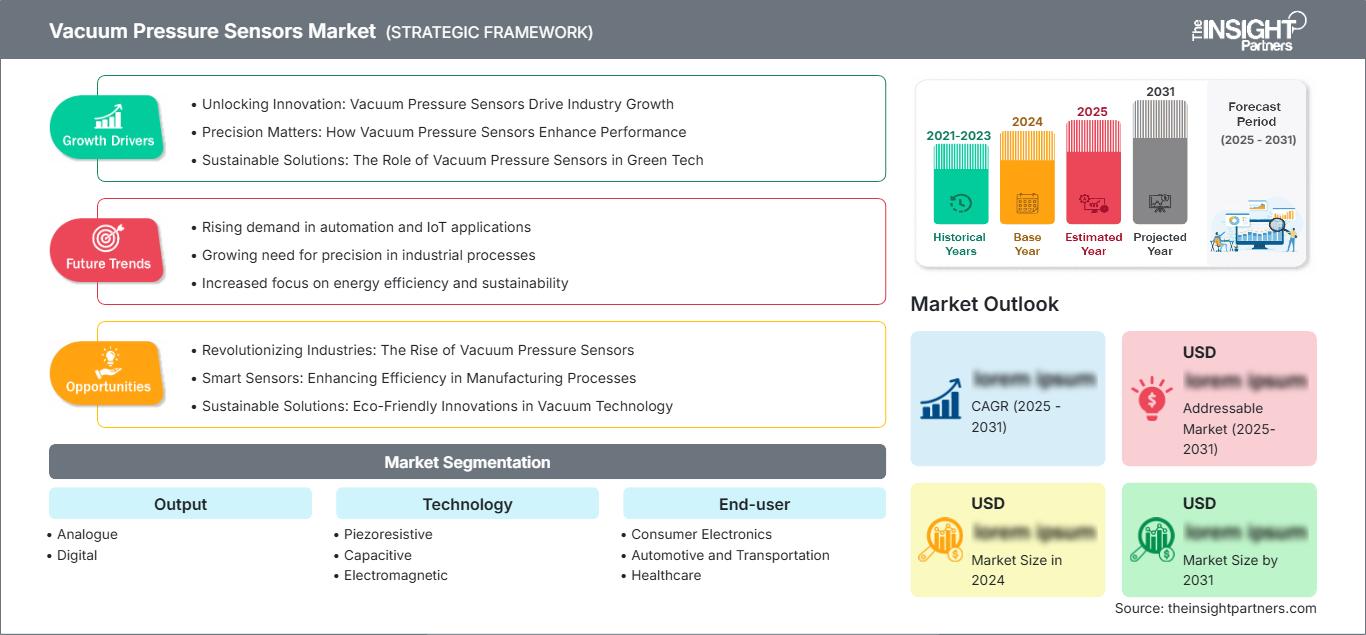
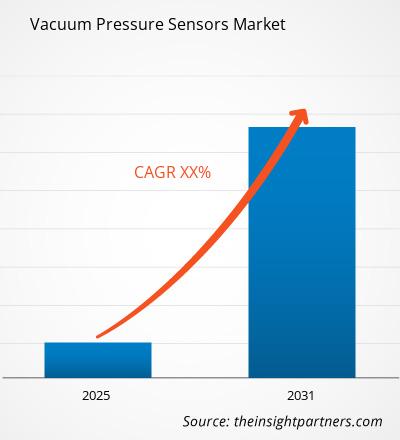
The vacuum pressure sensors market was valued at US$ 696.94 million in 2025 and is projected to reach US$ 1,256.17 million by 2034, registering a CAGR of 6.76% during 2026–2034. Demand is shaped by vacuum automation, semiconductor process control, medical equipment reliability, industrial leak detection, and the growing use of compact pressure monitoring across connected manufacturing environments.
North America remains a high-value regional base for vacuum pressure sensors market size expansion, supported by semiconductor fabrication investment, healthcare device production, aerospace testing, and industrial automation upgrades. The region is estimated to grow at a CAGR of 6.4–6.9% during 2026–2034, with adoption concentrated around digital outputs, IO-Link integration, cleanroom-compatible designs, and high-accuracy vacuum control applications.
Vacuum Pressure Sensors Market Assessment and Insights
- North America: The region accounted for an estimated 32–35% share in 2025 and is expected to grow at a CAGR of 6.4–6.9% during 2026–2034, driven by semiconductor capacity, medical devices, and industrial automation.
- US: The US represented nearly 78–82% of North America in 2025 and is projected to expand at a CAGR of 6.5–7.0% through advanced manufacturing and cleanroom demand.
- Europe: Europe held an estimated 25–28% share in 2025 and may grow at a CAGR of 5.9–6.4%, led by Germany, the UK, France, Italy, and Spain.
- Asia Pacific: Asia Pacific captured about 29–32% share in 2025 and is forecast to grow at a CAGR of 7.2–7.8%, with China, Japan, South Korea, and India leading demand.
- Largest Segment: Digital output sensors held 55–60% market share in 2025 and are expected to grow at a CAGR of 7.0–7.5% due to automation and smart diagnostics.
- High Growth Segment: Capacitive technology represented 24–28% market share in 2025 and is projected to grow at a CAGR of 7.4–8.0% due to cleanroom and precision applications.
- Key companies analyzed in detail: Festo SE & Co. KG, First Sensor AG, Honeywell International Inc., Melexis NV, Nidec Corporation, NXP Semiconductors N.V., OMEGA Engineering Inc., Sensata Technologies Holding plc, SensorsONE Ltd., and Setra Systems Inc.
Source: The Insight Partners' analysis based on proprietary research, government publications, company annual reports, investor presentations, industry databases, and expert interviews.
The market has evolved from basic analog vacuum monitoring toward compact, digitally addressable sensors that support predictive diagnostics, data logging, and faster machine response. Vacuum pressure sensors market growth is increasingly linked to process repeatability in semiconductor, healthcare, packaging, automotive, and industrial equipment. Manufacturers are refining piezoresistive, capacitive, electromagnetic, and resonant designs to improve stability, reduce drift, and withstand harsh operating conditions.
The future demand is set to gain from increasing clean manufacturing operations, localized electronics manufacturing, and stringent uptime of the equipment. New geographies are automating their operations, and existing markets are upgrading their aging switch technology to intelligent sensor platform technologies. Reliability of medical devices, process safety, and energy efficiency regulations are additional drivers for increased calibrated vacuum measurements in the manufacturing processes.
Vacuum Pressure Sensors Market Report Scope
| Report Attribute | Details |
|---|---|
| Market size in 2025 | US$ 696.94 Million |
| Market Size by 2034 | US$ 1,256.17 Million |
| Global CAGR (2026 - 2034) | 6.76% |
| Historical Data | 2021-2024 |
| Forecast period | 2026-2034 |
Vacuum Pressure Sensors Market Analysis
Demand is anchored in applications where pressure variation can directly affect yield, safety, or equipment reliability. Semiconductor tools require stable vacuum monitoring across deposition, etching, and inspection stages, while healthcare systems use sensors for suction, respiratory, and diagnostic equipment. Industrial users adopt vacuum pressure sensors market growth technologies for vacuum pumps, leak testing, packaging, pneumatics, and process automation.
Supply dynamics include miniaturized sensor technologies, MEMS manufacturing, packaging, and calibration. Digital interfaces make integration fast for OEMs, whereas analog outputs continue to hold significance in terms of cost-sensitive installed bases. Accuracy range, media capability, temperature compensation, and rugged casings make component suppliers and system integrators differentiate themselves.
Vacuum pressure sensors market analysis reveals a competitive space, whereby global automation, semiconductor, and sensing companies compete against transducer companies. Demand for pressure sensors could be created by companies such as Festo, Honeywell International, Sensata Technologies, Setra Systems, Melexis, Nidec, NXP Semiconductors, OMEGA Engineering, First Sensor, and SensorsONE.
The investment in pressure sensors is shifting towards cleanroom pressure sensors, digital signal processing, and maintenance functions. The development of Honeywell’s cleanroom pressure sensors by 2025 shows the industry's emphasis on contamination control in semiconductors and vacuum drift in pressure sensors.
● REPORT CUSTOMIZATION
Tailor This Report To Align With Your Specific Business Requirements
This report can be customized to align precisely with your business objectives, scope, and target markets. Customization options include tailored segmentation, geography, competitive analysis, and strategic insights to support informed decision-making.
Customize This Report →WHAT YOU CAN ADJUST
- ● Segmentations
- ● Geography
- ● Competitive Analysis
- ● Language Preferences
Vacuum Pressure Sensors Market: Strategic Insights
Regional Insights
North America Vacuum Pressure Sensors Market
North America held an estimated 32–35% vacuum pressure sensors market share in 2025, supported by semiconductor fabs, aerospace testing, healthcare equipment, and factory automation. Demand is strongest for digital, high-accuracy units that improve process stability in vacuum pumps, chambers, and production tools. The region is expected to grow at a CAGR of 6.4–6.9% during 2026–2034.
US manufacturing incentives, cleanroom expansion, and medical device output reinforce adoption. Canada and Mexico contribute through automotive, packaging, and industrial equipment production, although the US remains the regional demand center. OEMs are prioritizing long-term reliability, calibration traceability, and sensor designs compatible with connected maintenance platforms.
U.S. Vacuum Pressure Sensors Market
The US accounted for approximately 78–82% of North America in 2025 and is projected to grow at a CAGR of 6.5–7.0%. Semiconductor fabrication, aerospace testing, medical suction devices, and industrial pneumatics remain key drivers of procurement. The presence of companies like Honeywell, Setra Systems, OMEGA Engineering, and Sensata Technologies adds to local technical support and logistics.
Application trends show an increasing demand for small sensors with low drift, digital interface, and suitability for automated quality control systems. Clean fabrication plants need accurate vacuum regulation in order to decrease errors, while industrial applications demand robust sensors for pump measurement and leak detection.
Europe Vacuum Pressure Sensors Market
Europe represented an estimated 25–28% share in 2025 and is expected to grow at a CAGR of 5.9–6.4%. The German market is driven by demand for automation, machines, automotive, and industrial engineering, and then the British market in terms of scientific and medical instruments. The demand in France, Italy, and Spain is generated through packaging, process engineering, and transportation.
The European customers value energy efficiency, compliance, and reliability of the sensor systems. Pressure and vacuum sensors from Festo are an example of outstanding performance of pneumatic automation and sensor systems, owing to IO-Link. The reconditioning of industrial facilities and digital maintenance systems contributes to their application.
APAC Vacuum Pressure Sensors Market
APAC held an estimated 29–32% share in 2025 and is projected to grow at a CAGR of 7.2–7.8%. The demand of China emanates from the electronics, industrial automation, and manufacturing equipment market segments, while Japan and South Korea still lead in semiconductors and precision instrumentation.
India and Australia have been making contributions through the healthcare, energy, automotive, and manufacturing transformation segments. Growth within the region depends on the factory automation, EV supply chain, and electronics manufacturing strategy. The suppliers have expanded their geographical reach and engineering services to enable local OEM design cycles and faster equipment development.
Middle East & Africa Vacuum Pressure Sensors Market
The Middle East & Africa are expected to grow at a CAGR of 5.4–5.9% during 2026–2034, led by Saudi Arabia, the UAE, South Africa, and broader industrial infrastructure investments. Energy generation, petrochemicals, water treatment plants, and medical facilities represent applications for vacuum systems and process safety solutions.
Demand levels remain lower than in other areas but are getting more technical in nature. Diversification in the industrial sector is driving the adoption of automation, and hospital and lab facilities need efficient suction and vacuum systems. Distributors are helping suppliers with product sales and service, and rugged products.
Segmentation Analysis
Output
Output defines signal delivery and integration needs across the vacuum pressure sensors market scope. The segment is expected to grow at a CAGR of 6.8–7.3% during 2026–2034, as OEMs balance analog compatibility with digital diagnostics. Digital output is gaining share through smart machines, while analog remains important for legacy systems and cost-sensitive industrial applications.
- Analogue: Analogue sensors remain relevant in existing control systems, low-cost machinery, and basic vacuum monitoring, where simple proportional signals are sufficient and integration changes are limited.
- Digital: Digital sensors support IO-Link, diagnostics, remote monitoring, and faster commissioning, making them attractive for semiconductor tools, connected factories, and predictive maintenance environments.
Technology
Technology choices are shaped by pressure range, accuracy, drift tolerance, media exposure, and cost. This main segment is projected to grow at a CAGR of 6.6–7.1% during 2026–2034. Piezoresistive devices support broad industrial use, capacitive devices fit precision vacuum settings, electromagnetic designs serve specialized applications, and resonant sensors address stability-critical measurements. As highlighted in the Vacuum Pressure Sensors market report, end-user requirements increasingly determine technology selection based on measurement precision, operating environment, and long-term reliability considerations.
- Piezoresistive: Piezoresistive sensors offer compact size, cost efficiency, and broad pressure compatibility, making them suitable for industrial controls, medical devices, automotive systems, and general vacuum measurement.
- Capacitive: Capacitive sensors are preferred where high accuracy, low drift, and stable vacuum readings are required, especially in cleanrooms, process equipment, and semiconductor-related applications.
- Electromagnetic: Electromagnetic approaches support specialized measurement conditions where conventional sensing faces limitations, particularly in demanding industrial or scientific environments requiring consistent signal response.
- Resonant: Resonant sensors provide strong long-term stability and precise measurement, supporting research, calibration, and high-value process applications where repeatability is essential.
End-user
End-user demand is expected to grow at a CAGR of 6.7–7.2% during 2026–2034, with industrial applications remaining the largest revenue contributor. Healthcare and consumer electronics support higher-value requirements, while automotive, transportation, oil, and gas applications add demand for rugged, reliable, and system-integrated vacuum measurement.
- Consumer Electronics: Electronics manufacturing uses vacuum sensing in assembly, testing, coating, and miniaturized component production, where stable process environments support yield and quality objectives.
- Automotive and Transportation: Automotive applications include braking systems, emissions control, EV manufacturing, leak testing, and production automation, with demand tied to reliability and safety requirements.
- Healthcare: Healthcare users require dependable sensors for suction equipment, respiratory systems, diagnostics, sterilization, and laboratory devices, where calibration and safety remain central purchasing factors.
- Oil and Gas: Oil and gas facilities use vacuum and pressure monitoring for process equipment, safety systems, pumps, and maintenance programs in demanding operating conditions.
- Industrial: Industrial users represent the broadest base, spanning vacuum pumps, packaging, pneumatics, leak testing, robotics, and process automation across factories and utilities.
Opportunity Snapshot
| End-user | Revenue Contribution | Trend Tag | Adoption Stage |
| Consumer Electronics | Medium | Miniaturized Control | Scaling |
| Automotive and Transportation | Medium | EV Testing | Scaling |
| Healthcare | Medium | Clinical Reliability | Mature |
| Oil and Gas | Low | Process Safety | Mature |
| Industrial | High | Smart Pneumatics | Scaling |
Vacuum Pressure Sensors Market Growth Drivers and Impact Analysis
Expansion of Semiconductor and Clean Manufacturing
Advanced wafer fabrication, display production, solar manufacturing, and precision coating processes depend on stable vacuum environments. Sensor drift can affect yield, contamination control, and chamber repeatability, making accurate pressure measurement central to process quality. Honeywell’s 13MM pressure sensor launch for cleanroom and semiconductor environments reflects this need. As more fabs add automation and quality monitoring, the vacuum pressure sensors market demand rises for low-drift, high-purity, and digitally integrated products.
Shift Toward Smart Industrial Automation
Manufacturing plants are shifting from simple switches to sensors that offer real-time data, diagnostics, and maintenance alerts. Sensors are needed for quick response to avoid breakdowns and ensure the quality of the output for vacuum grippers, packaging machines, leakage detectors, pneumatic systems, and robots. Digital vacuum sensors have applications in installation, remote monitoring, and energy management. This driver boosts industrial demand due to the use of pressure data as a control parameter.
Rising Healthcare Equipment Reliability Requirements
Suction devices for medicine, respirators, sterilizers, laboratories, and diagnostic machines all require reliable vacuum measuring systems. The need is driven by the growth of the healthcare infrastructure and increasing expectations for accurate device validation processes. Providers of such measuring devices who can offer small size, calibration stability, and performance documentation are poised to capture long-term OEM programs in medicine.
Vacuum Pressure Sensors Market Future Trends
Digital Vacuum Sensor Platforms
Vacuum pressure sensors market trends are moving toward products that combine sensing, signal conditioning, diagnostics, and data communication in one compact device. IO-Link, embedded calibration records, and condition monitoring will become more common in industrial and semiconductor equipment. These functions help machine builders reduce wiring complexity, improve field service, and convert pressure readings into actionable maintenance indicators. The trend also supports subscriptions and service models built around equipment uptime.
Low-Drift Sensors for High-Purity Processes
In the future, more attention will be paid to long-term stability, material compatibility, and clean room capability. Pressure sensors for semiconductor fabrication, biopharmaceutical production, optics manufacturing, and display making need to provide reliable signals without introducing any contamination. Improvements should be made in the areas of packaging materials, surface treatments, and thermal compensation. These considerations make capacitive and MEMS pressure sensors more promising.
Vacuum Pressure Sensors Market Opportunities
Localized OEM Design Partnerships
Vacuum pressure sensors market Forecasts point to stronger opportunities for suppliers that engage early with machinery and medical device OEMs. Sensor platform designs tend to have long life-cycles that lead to revenues through production programs and parts reorders. The suppliers can leverage their application engineering capabilities, regional technical support, and customizability for pressure ranges, fittings, and output types in order to differentiate themselves.
Aftermarket Calibration and Predictive Maintenance Services
The installed vacuum systems can give more opportunities other than selling sensors. Industrial sites, laboratory environments, and manufacturing sites that have cleanrooms require calibration, replacement planning, and system performance validation. The suppliers can bundle the sensors along with services such as remote monitoring and certificate digitization. This is an appealing opportunity, especially if the costs associated with downtime are significant.
Frequently Asked Questions

- Comprehensive Market Sizing and Forecast Analysis
- Detailed Segmentation Analysis
- In-Depth Market Dynamics Assessment
- Regional and Country-Level Insights
- Competitive Landscape and Company Benchmarking
- Strategic Business Intelligence
Recent Reports
Testimonials

The Insight Partners provided valuable market intelligence that supported our global go-to-market strategy. Their team was professional, responsive, and attentive to our feedback, providing thoughtful analysis and helpful methodological clarifications throughout the project.
Junmo Kim Chief Financial Officer (CFO), Enertech Co., Ltd.
The Insight Partners' SCADA System Market report is comprehensive, with valuable insights on current trends and future forecasts. The team was highly professional, responsive, and supportive throughout. We are very satisfied and highly recommend their services.
RAN KEDEM Partner, Reali Technologies LTDs
I requested a report on a very specific software market and the team produced the report in a few days. The information was very relevant and well presented. I then requested some changes and additions to the report. The team was again very responsive and I got the final report in less than a week.
JEAN-HERVE JENN Chairman, Future Analytica
We worked with The Insight Partners for an important market study and forecast. They gave us clear insights into opportunities and risks, which helped shape our plans. Their research was easy to use and based on solid data. It helped us make smart, confident decisions. We highly recommend them.
PIYUSH NAGPAL Sr. Vice President, High Beam Global
The Insight Partners delivered insightful, well-structured market research with strong domain expertise. Their team was professional and responsive throughout. The user-friendly website made accessing industry reports seamless. We highly recommend them for reliable, high-quality research services
YUKIHIKO ADACHI CEO, Deep Blue, LLC.
This is the first time I have purchased a market report from The Insight Partners.While I was unsure at first, I visited their web site and felt more comfortable to take the risk and purchase a market report.I am completely satisfied with the quality of the report and customer service. I had several questions and comments with the initial report, but after a couple of dialogs over email with their analyst I believe I have a report that I can use as input to our strategic planning process.Thank you so much for taking the extra time and making this a positive experience.I will definitely recommend your service to others and you will be my first call when we need further market data.
JOHN SUZUKI President and Chief Executive Officer, Board Director, BK Technologies
I wish to appreciate your support and the professionalism you displayed in the course of attending to my request for information regarding to infectious disease IVD market in Nigeria. I appreciate your patience, your guidance, and the fact that you were willing to offer a discount, which eventually made it possible for us to close a deal. I look forward to engaging The Insight Partners in the future, all thanks to the impression you have created in me as a result of this first encounter.
DR CHIJIOKE ONYIA MANAGING DIRECTOR, PineCrest Healthcare Ltd.Reason to Buy
- Informed Decision-Making
- Understanding Market Dynamics
- Competitive Analysis
- Identifying Emerging Markets
- Customer Insights
- Market Forecasts
- Risk Mitigation
- Boosting Operational Efficiency
- Strategic Planning
- Investment Justification
- Tracking Industry Innovations
- Aligning with Regulatory Trends





 Get Free Sample for