Vegan Pet Food Market Size, Demand & Growth by 2034
Vegan Pet Food Market Size and Forecast (2021 - 2034), Global and Regional Share, Trend, and Growth Opportunity Analysis Report Coverage: By Product Type (Dry Food, Wet Food, Others), Pet Type (Dogs, Cats), and Distribution Channel (Supermarkets and Hypermarkets, Specialty Stores, Online Retail, Others)
Historic Data: 2021-2024 | Base Year: 2025 | Forecast Period: 2026-2034- Report Date : Apr 2026
- Report Code : TIPRE00022433
- Category : Food and Beverages
- Status : Upcoming
- Available Report Formats :


- No. of Pages : 150

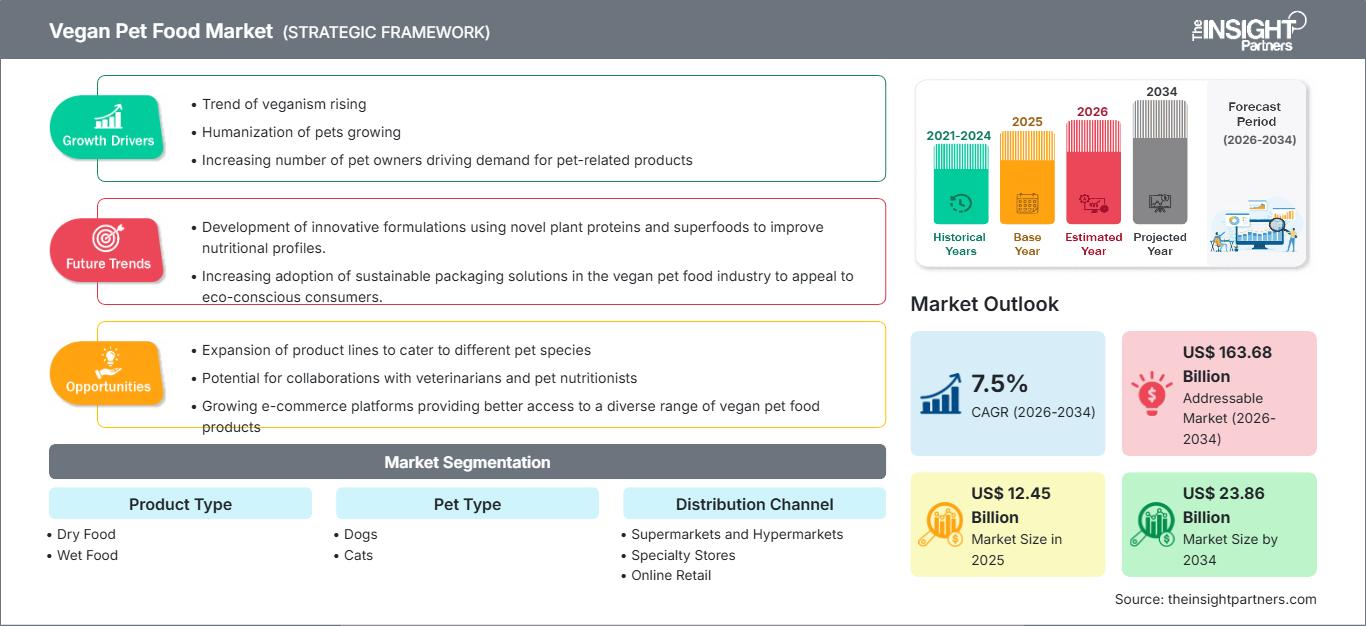
The global Vegan Pet Food market size is projected to reach US$ 23.86 billion by 2034 from US$ 12.45 billion in 2025. The market is anticipated to register a CAGR of 7.5% during the forecast period 2026–2034. Key market dynamics include the rapid "humanization" of pets, where owners apply their own dietary preferences, such as plant-based and ethical eating, to their animals. Additionally, the market is driven by rising concerns regarding the environmental impact of traditional meat-based pet food, the increasing prevalence of meat-protein allergies in dogs and cats, and significant advancements in food technology that allow for the creation of nutritionally complete, plant-derived proteins.
Vegan Pet Food Market Analysis
The vegan pet food market analysis indicates a strategic pivot toward precision nutrition as brands move beyond simple "meat-free" claims to scientifically formulated diets. Strategic opportunities are emerging in the specialty veterinary segment, where plant-based diets are being prescribed to manage chronic conditions such as obesity, digestive sensitivities, and skin inflammation. To capitalize on this, businesses should focus on "clean-label" transparency and clinical validation to overcome consumer skepticism regarding nutritional adequacy. Competition is increasingly defined by the ability to utilize alternative protein sources, such as fungi, seaweed, and laboratory-grown proteins, while ensuring palatability. For market entrants, establishing partnerships with veterinary influencers and securing third-party nutritional certifications will be critical to navigating the competitive landscape and justifying premium price points.
Vegan Pet Food Market Overview
Vegan pet food is transitioning from a niche lifestyle choice to a mainstream retail powerhouse. Once restricted to specialized health food stores, plant-based kibble, treats, and wet foods are now staple offerings in major supermarkets and multinational pet retail chains. This shift is fueled by the "Pet Parent" phenomenon, where younger demographics, particularly Millennials and Gen Z, prioritize sustainability and animal welfare in every purchase. Innovations in extrusion technology have significantly improved the texture and flavor profiles of plant-based products, making them more acceptable to pets. While the market was initially dominated by dry kibble, there is a burgeoning expansion into functional treats and shelf-stable topper segments. For instance, the market in the US is characterized by a high degree of innovation and a rapidly growing base of environmentally conscious consumers. The presence of major industry disruptors and a robust e-commerce infrastructure facilitates easy access to premium plant-based alternatives. A strong trend toward holistic pet wellness further supports domestic growth.
Customize This Report To Suit Your Requirement
Get FREE CUSTOMIZATIONVegan Pet Food Market: Strategic Insights
-
Get Top Key Market Trends of this report.This FREE sample will include data analysis, ranging from market trends to estimates and forecasts.
Vegan Pet Food Market Drivers and Opportunities
Market Drivers:
- Rising Environmental and Ethical Consciousness: Consumers are increasingly aware of the carbon footprint associated with livestock farming. This shift toward "eco-friendly" parenting is driving demand for sustainable, plant-based alternatives that reduce the ecological impact of pet ownership.
- Management of Dietary Sensitivities and Allergies: Meat-based proteins, such as beef and chicken, are among the most common allergens for domestic pets. Vegan pet food offers a hypoallergenic solution, driving adoption among owners seeking to alleviate their pets' dermatological and gastrointestinal issues.
- Advancements in Plant-Based Ingredient Technology: The development of high-quality plant isolates and synthetic amino acids (like taurine and L-carnitine) ensures that vegan diets meet the biological requirements of pets, increasing trust and adoption among pet owners and veterinarians.
Market Opportunities:
- Expansion into Life-Stage Specific Formulas: There is a significant opportunity to develop vegan products tailored to specific life stages, such as puppy growth formulas or "senior" diets focused on joint health and cognitive function, which currently remain underserved in the plant-based category.
- Growth in the Personalized Nutrition Segment: Utilizing D2C (Direct-to-Consumer) models to offer customized plant-based meal plans based on a pet's breed, activity level, and health history can allow brands to capture high-margin, loyal customer bases.
- Diversification into Novel Protein Sources: Investing in the research and development of insect-based or cell-cultivated ingredients as part of a "vegan-adjacent" or strictly plant-based portfolio can help brands stay ahead of the curve in the evolving alternative protein landscape.
Vegan Pet Food Market Report Segmentation Analysis
The Vegan Pet Food Market share is analyzed across various segments to provide a clearer understanding of its structure, growth potential, and emerging trends. Below is the standard segmentation approach used in most industry reports:
By Category:
- Organic: This segment caters to the premium market, focusing on non-GMO and pesticide-free ingredients. It appeals to health-conscious owners who prioritize the highest purity standards for their pets.
- Conventional: The primary volume driver in the market, utilizing standard plant-based ingredients. It benefits from wider availability and more competitive pricing in mass-market retail channels.
By Distribution Channel:
- Supermarkets & Hypermarkets: Serves as a major touchpoint for mainstream consumers, benefiting from the expansion of "natural" and "specialty" pet aisles.
- Online Retail: The fastest-growing channel, driven by subscription-based models and the convenience of home delivery for bulky pet food items.
- Specialty Stores: Includes independent pet boutiques and veterinary clinics that provide expert advice and high-end, niche vegan brands.
By Geography:
- North America
- Europe
- Asia Pacific
- South & Central America
- Middle East & Africa
Vegan Pet Food Market Report Scope
| Report Attribute | Details |
|---|---|
| Market size in 2025 | US$ 12.45 Billion |
| Market Size by 2034 | US$ 23.86 Billion |
| Global CAGR (2026 - 2034) | 7.5% |
| Historical Data | 2021-2024 |
| Forecast period | 2026-2034 |
| Segments Covered |
By Product Type
|
| Regions and Countries Covered |
North America
|
| Market leaders and key company profiles |
|
Vegan Pet Food Market Players Density: Understanding Its Impact on Business Dynamics
The Vegan Pet Food Market is growing rapidly, driven by increasing end-user demand due to factors such as evolving consumer preferences, technological advancements, and greater awareness of the product's benefits. As demand rises, businesses are expanding their offerings, innovating to meet consumer needs, and capitalizing on emerging trends, which further fuels market growth.
Vegan Pet Food Market Share Analysis by Geography
Asia-Pacific is expected to grow fastest in the coming years. Emerging markets in South & Central America, the Middle East, and Africa also have many untapped opportunities for premium plant-based pet food manufacturers to expand.
The vegan pet food market is undergoing a significant transformation, moving from a niche lifestyle choice to a global high-value functional sector. Growth is driven by the rising prevalence of meat-protein allergies in pets, a surge in "alternative" protein demand among eco-conscious owners, and the expansion of the premium plant-based retail sector. Below is a summary of market share and trends by region:
North America
- Market Share: Holds a significant portion of the global market, characterized by high consumer spending and a mature pet humanization trend.
- Key Drivers:
- High prevalence of meat-protein allergies in domestic dogs and cats.
- Strong culture of sustainability and environmental activism among pet owners.
- Presence of leading market innovators and high-tech food startups.
- Trends: A surge in "human-grade" plant-based pet food and the rapid growth of subscription-based D2C (Direct-to-Consumer) business models.
Europe
- Market Share: A leading region in the vegan movement, supported by stringent animal welfare regulations and a large existing vegan human population.
- Key Drivers:
- Strong demand for ethically sourced and environmentally friendly pet products.
- Government-led sustainability initiatives and plastic reduction mandates in packaging.
- High concentration of specialized pet boutiques and natural grocery chains.
- Trends: Integration of local, non-GMO grains and legumes into formulations and a strategic focus on sustainable, plastic-free packaging solutions.
Asia-Pacific
- Market Share: The fastest-growing region, driven by rising disposable incomes and the rapid Westernization of pet care habits.
- Key Drivers:
- Massive growth in pet ownership within urban centers of China, India, and Vietnam.
- Increasing interest in premium, imported health-focused pet brands over local generic options.
- Government support for biotechnology and alternative protein research.
- Trends: Heavy reliance on mobile e-commerce platforms and the emergence of regional startups focusing on plant-based functional treats.
South and Central America
- Market Share: An emerging market with a steady rise in premium pet food demand in countries like Brazil, Chile, and Argentina.
- Key Drivers:
- Increasing awareness of pet wellness and the benefits of hypoallergenic diets.
- Expansion of organized retail channels and international pet superstores.
- Modernization of local manufacturing facilities to meet export-quality standards.
- Trends: Growth of boutique vegan pet brands and the introduction of plant-based snacks as alternatives to traditional animal-hide products.
Middle East and Africa
- Market Share: A developing market with growth concentrated in affluent urban hubs such as Dubai, Abu Dhabi, and Johannesburg.
- Key Drivers:
- Growing expatriate populations are bringing international pet-rearing standards to the region.
- Strategic investments in "Smart Agriculture" and local production to reduce import reliance.
- High demand for shelf-stable products suitable for hot and arid climates.
- Trends: Increased availability of vegan pet food in high-end supermarkets and a focus on high-nutrient, specialized formulas for the veterinary channel.
High Market Density and Competition
Competition is intensifying due to the presence of established leaders such as Antos B.V., Benevo, Bond Pet Foods, Inc., V-dog, Soopa Pets, Vegan4dogs, Wild Earth, YARRAH, and Isoropimene Zootrofe Georgios Tsappis Ltd., which also contribute to a diverse and rapidly expanding market landscape.
This competitive environment pushes vendors to differentiate through:
- Premiumization and Functional Branding: Positioning vegan pet food as a superior health alternative by emphasizing its hypoallergenic properties, high digestibility, and the inclusion of superfoods like quinoa, blueberries, and algae-derived Omega-3s.
- Product Diversification: Expanding beyond basic kibble to include gourmet plant-based wet foods, probiotic-infused treats, and precision-fermented protein toppers that mirror the nutritional profile of traditional meat.
- Vertical Integration and Supply Chain Transparency: Managing the selection of non-GMO crops and utilizing advanced processing techniques to ensure quality and safety. This approach meets ethical "clean-label" standards and addresses consumer concerns regarding protein transparency.
- Technological Innovation: Leveraging next-generation food technologies, such as cellular agriculture and precision fermentation, to create bio-identical animal proteins without the environmental or ethical costs of livestock farming.
Opportunities and Strategic Moves
- Strategic Partnerships for Global Distribution: Partner with high-end retail chains and major e-commerce platforms like Amazon and Chewy to tap into the surging demand for ethical and sustainable pet products in the North American and European markets.
- Investment in Clinical Validation and Veterinary Endorsements: Collaborate with veterinary researchers to produce peer-reviewed studies on the health outcomes of plant-based diets, helping to overcome skepticism and capture the high-margin "veterinary diet" segment.
- Adoption of Circular and Regenerative Practices: Incorporate sustainable sourcing and compostable packaging to appeal to environmentally conscious Millennial and Gen Z pet parents who prioritize a brand's total ecological footprint.
Major Companies operating in the Vegan Pet Food Market are:
- Antos B.V.
- Benevo
- Bond Pet Foods, Inc.
- V-dog
- Soopa Pets
- Vegan4dogs
- Wild Earth
- YARRAH
- Isoropimene Zootrofe Georgios Tsappis Ltd.
- Halo Pets
Disclaimer: The companies listed above are not ranked in any particular order.
Vegan Pet Food Market News and Recent Developments
- In February 2025, Calysta and Marsapet launched the first complete dog food featuring FeedKind Pet protein, a cultured protein fermented without the use of arable land or animal ingredients. Produced under the Marsavet line and targeted specifically at animal health, the MicroBell dry kibble was introduced as a premium Vegan Pet Food that is both grain-free and gluten-free. This innovative product was formulated to provide all the necessary amino acids required to maintain canine health while offering a sustainable alternative to traditional meat-based diets.
- In May 2025, Prefera Petfood SRL, an Italy-based producer of natural wet foods for dogs and cats, acquired THE PACK. As part of the strategic agreement, the founders of THE PACK, Damien Clarkson and Judy Nadel, joined the Prefera team to support the growth of the brand across the United Kingdom and European markets. Following the deal, the companies announced plans to introduce several new pet nutrition products, further strengthening their position in the rapidly expanding Vegan Pet Food sector.
Vegan Pet Food Market Report Coverage and Deliverables
The "Vegan Pet Food Market Size and Forecast (2021–2034)" report provides a detailed analysis of the market covering below areas:
- Vegan Pet Food Market size and forecast at global, regional, and country levels for all the key market segments covered under the scope
- Vegan Pet Food Market trends, as well as market dynamics such as drivers, restraints, and key opportunities
- Detailed PEST and SWOT analysis
- Vegan Pet Food Market analysis covering key market trends, global and regional framework, major players, regulations, and recent market developments
- Industry landscape and competition analysis covering market concentration, heat map analysis, prominent players, and recent developments in the Vegan Pet Food Market.
- Detailed company profiles
Frequently Asked Questions

- Historical Analysis (2 Years), Base Year, Forecast (7 Years) with CAGR
- PEST and SWOT Analysis
- Market Size Value / Volume - Global, Regional, Country
- Industry and Competitive Landscape
- Excel Dataset
Recent Reports
Testimonials

The Insight Partners' SCADA System Market report is comprehensive, with valuable insights on current trends and future forecasts. The team was highly professional, responsive, and supportive throughout. We are very satisfied and highly recommend their services.
RAN KEDEM Partner, Reali Technologies LTDs
I requested a report on a very specific software market and the team produced the report in a few days. The information was very relevant and well presented. I then requested some changes and additions to the report. The team was again very responsive and I got the final report in less than a week.
JEAN-HERVE JENN Chairman, Future Analytica
We worked with The Insight Partners for an important market study and forecast. They gave us clear insights into opportunities and risks, which helped shape our plans. Their research was easy to use and based on solid data. It helped us make smart, confident decisions. We highly recommend them.
PIYUSH NAGPAL Sr. Vice President, High Beam Global
The Insight Partners delivered insightful, well-structured market research with strong domain expertise. Their team was professional and responsive throughout. The user-friendly website made accessing industry reports seamless. We highly recommend them for reliable, high-quality research services
YUKIHIKO ADACHI CEO, Deep Blue, LLC.
This is the first time I have purchased a market report from The Insight Partners.While I was unsure at first, I visited their web site and felt more comfortable to take the risk and purchase a market report.I am completely satisfied with the quality of the report and customer service. I had several questions and comments with the initial report, but after a couple of dialogs over email with their analyst I believe I have a report that I can use as input to our strategic planning process.Thank you so much for taking the extra time and making this a positive experience.I will definitely recommend your service to others and you will be my first call when we need further market data.
JOHN SUZUKI President and Chief Executive Officer, Board Director, BK Technologies
I wish to appreciate your support and the professionalism you displayed in the course of attending to my request for information regarding to infectious disease IVD market in Nigeria. I appreciate your patience, your guidance, and the fact that you were willing to offer a discount, which eventually made it possible for us to close a deal. I look forward to engaging The Insight Partners in the future, all thanks to the impression you have created in me as a result of this first encounter.
DR CHIJIOKE ONYIA MANAGING DIRECTOR, PineCrest Healthcare Ltd.Reason to Buy
- Informed Decision-Making
- Understanding Market Dynamics
- Competitive Analysis
- Identifying Emerging Markets
- Customer Insights
- Market Forecasts
- Risk Mitigation
- Boosting Operational Efficiency
- Strategic Planning
- Investment Justification
- Tracking Industry Innovations
- Aligning with Regulatory Trends




 Get Free Sample For