
ARM微处理器市场:规模、增长与预测 2034年
ARM 微处理器市场规模及预测(2021-2034 年)、全球及区域份额、趋势和增长机会分析报告涵盖范围:按类型(8 位、16 位、32 位、64 位、其他);应用(消费电子、服务器、汽车、银行、金融服务和保险 (BFSI)、航空航天和国防、医疗、工业、其他);以及地理区域(北美、欧洲、亚太地区以及南美和中美洲)。
- 状态 : 数据发布
- 报告代码 : TIPRE00014281
- 类别 : 电子和半导体
- 页数 : 150
- 可用报告格式 :


- 最后更新日期 : July 15, 2026


2025年市场规模
267.5 亿美元
基准年值
2034 年预测
767.3 亿美元
预计到2034年
2026-2034年复合年增长率
12.42 %
增长率
目标市场
4523.2 亿美元
(2026-2034)
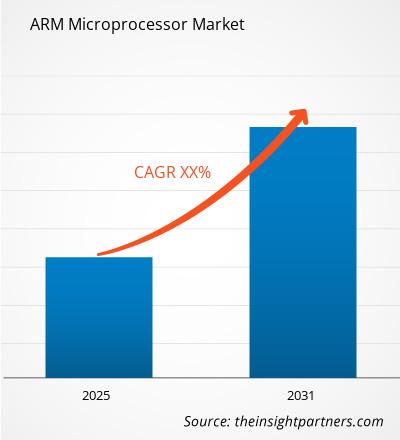
预计到2025年,Arm微处理器市场规模将达到267.5亿美元,到2034年将达到767.3亿美元;2026年至2034年期间的复合年增长率预计为12.42%。随着节能计算的应用范围从移动设备扩展到服务器、车辆、工业控制系统、医疗设备,甚至面向消费者的联网设备,市场需求将会不断增长。
受云基础设施更新周期和汽车电子领域投资的推动,预计2026年至2034年间,北美地区的复合年增长率将达到11.8%至12.6%。北美地区的需求主要来自超大规模数据中心运营商对Arm服务器CPU、软件定义汽车解决方案以及需要低功耗和可扩展生态系统的边缘人工智能应用的广泛应用。
ARM微处理器市场评估与洞察
- 2025 年,北美占全球市场份额的 31% 至 34%,预计 2026 年至 2034 年间将以 11.8% 至 12.6% 的复合年增长率增长,主要增长动力来自云 CPU 迁移、国防电子产品和汽车计算整合。
- 到 2025 年,美国占北美市场的 78% 至 82%,预计在 2026 年至 2034 年间,在超大规模计算、人工智能和半导体设计活动的支持下,将以 11.9% 至 12.7% 的复合年增长率增长。
- 2025 年欧洲市场份额为 19% 至 22%,预计 2026 年至 2034 年将以 10.8% 至 11.6% 的复合年增长率增长,其中德国、英国、法国、意大利和西班牙在汽车、航空航天和工业部署方面处于领先地位。
- 亚太地区在 2025 年占据了 36% 至 39% 的市场份额,预计在 2026 年至 2034 年间将以 12.9% 至 13.8% 的复合年增长率增长,这主要得益于中国、日本、韩国、印度和台湾地区的电子制造业的发展。
- 最大的细分市场:消费电子产品在 2025 年占据 34-38% 的市场份额,预计在 2026 年至 2034 年间将以 10.9-11.7% 的复合年增长率增长,主要增长动力来自智能手机、可穿戴设备、平板电脑和智能家居设备。
- 高增长细分市场:由于云计算提供商提高了每个工作负载的能耗效率,服务器细分市场在 2025 年的市场份额为 12-15%,预计从 2026 年到 2034 年将以 15.2-16.4% 的复合年增长率增长。
- 分析的主要公司:博通公司、国际商业机器公司、英特尔公司、Marvell Technology公司、Microchip Technology公司、英伟达公司、恩智浦半导体公司、高通公司、三星电子有限公司、东芝电子设备及存储公司。
资料来源: Insight Partners 根据专有研究、政府出版物、公司年报、投资者报告、行业数据库和专家访谈进行的分析。
The processor architecture will no longer be based on the design that can fit device-centric embedded control applications; rather, it will be scalable compute platforms that will be able to handle AI, graphics, security, and connectivity in one go in the same system. Licensing, software, and portability of the ARM processors have shortened the development cycle of the chips by chipmakers, along with the ability of the OEMs to optimize performance per watt. The manufacturing trend will be towards advanced node SoCs, mature node microcontrollers, and heterogeneous packages.
The projected period till 2034 will have a diversity in investment across the data centers, connected factories, digital health, and software-defined vehicles, in addition to the mobile domain. The funding for localizing semiconductors, efficiency standards, and regulations of the computing infrastructure, and the electrification programs will boost the growth potential of the Arm Microprocessor Market. Geographical regions will take advantage of the Arm architecture wherever cost-effective designs come into play.
ARM Microprocessor Market Report Scope
| Report Attribute | Details |
|---|---|
| Market size in 2025 | US$ 26.75 Billion |
| Market Size by 2034 | US$ 76.73 Billion |
| Global CAGR (2026 - 2034) | 12.42% |
| Historical Data | 2021-2024 |
| Forecast period | 2026-2034 |
ARM Microprocessor Market Analysis
Demand is concentrated where battery life, thermal envelopes, and compute density influence product economics. Consumer electronics continue to supply volume, while servers, vehicles, and industrial edge systems add higher-value opportunities. The Arm Microprocessor Market analysis indicates that buyers increasingly evaluate processors by ecosystem readiness, security features, AI inference support, and software continuity rather than clock speed alone.
The value chain spans architecture licensing, IP integration, EDA tools, foundry manufacturing, packaging, firmware, operating systems, and application software. Supply dynamics remain sensitive to wafer allocation, advanced-node availability, and automotive qualification cycles. Arm Holdings reported more than 310 billion cumulative Arm-based chip shipments by fiscal 2025, underscoring ecosystem scale and the Arm Microprocessor Market scope across connected devices and infrastructure.
The competition will arise from differentiation in SoCs, accelerators, and platforms. This includes companies like Qualcomm Incorporated, which emphasizes mobile, automotive, and edge AI, NVIDIA Corporation with the use of Arm architecture in its CPUs in automotive and acceleration computing, and companies like NXP Semiconductors N.V. and Microchip Technology Incorporated who focus on safety-critical and industrial control applications, respectively.
There is an increasing reliance on reference platforms, software toolchains, and supply chain assurance in terms of strategic positioning. There are companies like International Business Machines Corporation and Intel Corporation that continue to have relevance due to enterprise computing and manufacturing ecosystem, and there are companies like Samsung Electronics Co., Ltd. and Toshiba Electronic Devices & Storage Corporation that bring size into electronics and embedded components.
● REPORT CUSTOMIZATION
Tailor This Report To Align With Your Specific Business Requirements
This report can be customized to align precisely with your business objectives, scope, and target markets. Customization options include tailored segmentation, geography, competitive analysis, and strategic insights to support informed decision-making.
Customize This Report →WHAT YOU CAN ADJUST
- ● Segmentations
- ● Geography
- ● Competitive Analysis
- ● Language Preferences
ARM Microprocessor Market:
自定义此报告以满足您的要求
您将免费获得任何报告的定制,包括本报告的部分内容,或国家级分析、Excel 数据包,以及为初创企业和大学提供超值优惠和折扣
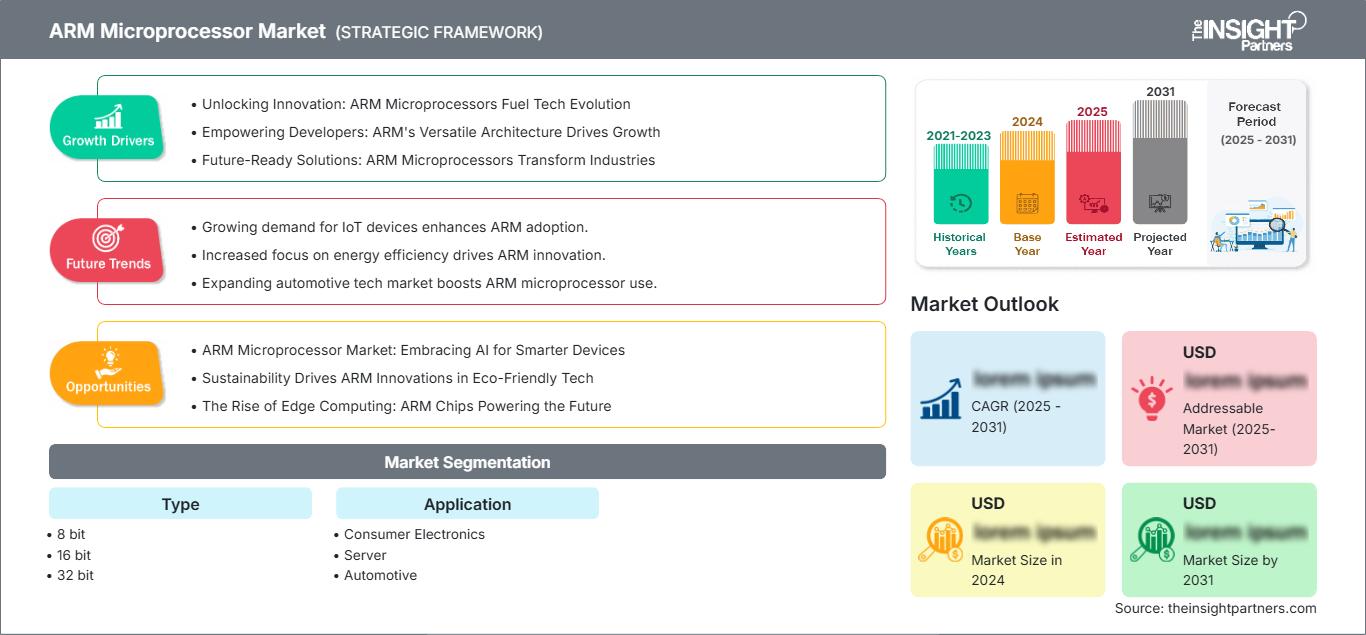
ARM微处理器市场: 战略洞察
-
获取本报告的主要市场趋势。这个免费样本将包括数据分析,从市场趋势到估计和预测。
Regional Insights
North America Arm Microprocessor Market
North America had a market share of 31-34% in 2025 and is predicted to grow at 11.8-12.6% CAGR from 2026 to 2034. The cloud computing architecture, AI inference computing, and the defense electronics market are expected to fuel the expansion of Arm processors since the efficiency of energy per unit of work is under consideration as one of the parameters for procurement of such products at the board level and rack level. There are about 22 million software engineers and more than 310 billion Arm processors, based on information from Arm investors.
Applications may include hyperscale data centers, connected cars, medical equipment, and industrial automation. The area gets an additional boost due to the semiconductor incentive policy, advanced packaging strategy, and software heterogeneity trend in enterprises. Buyers focus on lifecycle, cybersecurity, and AI framework capability, boosting the Arm Microprocessors market share due to joint considerations of efficiency and scalability.
U.S. Arm Microprocessor Market
The US accounted for 78–82% of North America in 2025 and is projected to grow at 11.9–12.7% CAGR through 2034. The demand is driven by hyperscale cloud computing firms, semiconductor design firms, autonomous mobility initiatives, and defense electronics. ARM server chips have been seeing rising interest as the operators want reduced power requirements, increased core density, and improved workload per watt performance in AI adjacent infrastructures.
Market penetration is widespread in firms such as NVIDIA Corporation, Qualcomm Incorporated, Broadcom Inc., Marvell Technology, Inc., Intel Corporation, International Business Machines Corporation, and Microchip Technology Incorporated. Applications include automotive cockpit systems, edge AI camera systems, security critical industrial control systems, and health monitoring systems. The federal government's support for domestic semiconductor production helps ensure resilience, and large software communities lessen migration risks.
Europe Arm Microprocessor Market
Europe represented 19–22% share in 2025 and is forecast to grow at 10.8–11.6% CAGR between 2026 and 2034. In the UK, the importance of the company remains relevant due to its expertise in processor IP, software, and automotive electronics systems programming, along with engineering skills in designing certified embedded solutions in mobility, industrial, and aerospace systems.
Germany is a leader due to the need for deterministic and energy-efficient processors. As software-defined architectures, zonal control systems, and electrification platforms increase the computational capacity requirements of each vehicle, suppliers prefer Arm-based microcontrollers with the necessity for functional safety, security isolation, and prolonged validation cycles.
France, Italy, and Spain are countries adding value in aerospace systems, smart manufacturing, medical devices, and transportation infrastructure. The Arm Microprocessor Market forecast is backed by the policy in Europe focusing on digital sovereignty and energy-efficient computing. Buyers in these countries tend to pay more attention to reliability and lifecycle management than product turnover rate.
APAC Arm Microprocessor Market
Share for APAC was 36-39% in 2025 and is forecasted to have a CAGR of 12.9-13.8% till 2034. China holds leadership owing to robust application opportunities offered by consumer electronics, industrial automation, and domestic semiconductor initiatives. The other nations involved include Japan and South Korea, which receive help from automotive electronics, memory, and advanced display.
India holds promise with design services, manufacturing of mobile devices, and embedded software skills, while Australia benefits due to mining automation, defense electronics, and digital health implementations. Policies of industry in this region encourage localization of manufacturing, secure supply chain, and edge computing with artificial intelligence capabilities.
Middle East & Africa Arm Microprocessor Market
The Middle East & Africa is projected to grow at 9.6–10.4% CAGR between 2026 and 2034. Saudi Arabia is the leading country regarding the deployment of smart city technologies, energy digitalization, and data centers. The United Arab Emirates provides new demands for ARM processor applications in the sphere of logistics automation, fintech, and connected services.
South Africa and other countries of the MEA region need new developments in terms of telecommunications infrastructure upgrades, production processes monitoring, medical devices, and renewable energy controls. There is potential in such projects to use ARM processors in cases where efficiency, robustness, and remote control are required.
Segmentation Analysis
Type
The Type segment is forecast to grow at a CAGR of 11.6–12.5% for 2026 through 2034 due to the need to reconcile legacy control, real-time capability, and high performance within devices. ARM processors cater to both economical embedded applications and more sophisticated 64-bit architectures that allow the reuse of existing software resources.
- 8-bit processors continue to find relevance in ultra-low-cost controllers, basic home appliances, and simple sensors where material list limitations, low memory requirements, and product longevity are valued above computing capabilities.
- 16-bit processors cater to applications including motor control, instrumentation, and mixed signal embedded systems, where determinism, small memory footprint, and low power consumption trump operating system capabilities.
- 32-bit processors encompass the vast world of embedded processors used in IoT systems, industrial controllers, medical equipment, and automotive body electronics, which require security and connectivity.
- 64-bit processors play an important role in servers, premium consumer devices, automotive computing, and AI-enabled gateways.
Application
The Application category is forecasted to expand at a CAGR of 12.0%-12.9% from 2026 through 2034 due to growing penetration of Arm-based processors in interconnected devices, infrastructure, and critical safety systems. The demand will fluctuate according to the design cycle, with common considerations being low-power consumption, software capability, AI processing, and lifecycle security.
- Consumer Electronics continues to be the leading end-use segment because smartphones, tablets, wearable devices, Smart TVs, and smart home appliances need power-efficient chips with multimedia, connectivity, security, and artificial intelligence capabilities.
- Adoption in Servers is increasing as cloud providers assess Arm CPUs for their scalability, AI orchestration, storage, and networking services, which help reduce costs due to their energy efficiency.
- Automotive end-use segment growth is driven by the increasing requirement for zonal controllers, digital cockpits, ADAS systems, battery management, and software-defined automobiles, which need safety and a long life cycle.
- BFSI segment is deploying edge computing devices, terminals for secure transactions, authentication hardware, and cloud-based infrastructure for digital payment and fraud analytics.
- Aerospace and Defense applications are designed to provide robust, reliable, and efficient processing for avionics, satellites, communication, radars, and unmanned systems subject to strict reliability standards and export controls.
Medical uses of ARM processors include applications such as patient monitoring, - peripheral medical imaging, health-related wearables, surgical systems, and connected diagnostics, where low-power consumption and compliance with privacy regulations are important factors for processor selection.
- Industrial applications utilize processors in robotic systems, programmable logic controllers, machine vision, energy management, and predictive maintenance solutions.
Opportunity Snapshot
|
Segment Name |
Revenue Contribution |
Trend Tag |
Adoption Stage |
|
Consumer Electronics |
High |
On-device AI |
Mature |
|
Server |
Medium |
Cloud Efficiency |
Scaling |
|
Automotive |
Medium |
Zonal Compute |
Scaling |
|
BFSI |
Low |
Secure Edge |
Scaling |
|
Aerospace and Defense |
Low |
Rugged AI |
Emerging |
|
Medical |
Low |
Connected Care |
Scaling |
|
Industrial |
Medium |
Factory Edge |
Scaling |
ARM Microprocessor Market Growth Drivers and Impact Analysis
Energy-Efficient Computing Becomes a Procurement Priority
Data centers, cars, wearables, and other industrial devices now design efficiency into their hardware, not as an afterthought. The International Energy Agency has pointed to growing power consumption by data centers and digital infrastructure, which means efficient processor usage is now tied directly to operational costs. Arm processors meet these needs via high performance per watt, flexible core counts, and an established software ecosystem. Market effect: Server evaluation programs; longer battery life for consumer products; smaller heat dissipation for embedded systems. Semiconductor companies that sell CPUs with AI engines and security modules can win designs through combined efficiency, density, and total cost of ownership.
Software-Defined Vehicles Raise Processor Content
There is a shift from decentralized electronic control units to zonal and centralized computing architecture in automotive electronics. In doing so, the amount of processing will increase since the computing power will be needed for workloads such as the cockpit, ADAS, BMS, connectivity, and safety systems. The introduction of 2024 automotive technology roadmap by ARM included automotive processors and virtual platforms based on Armv9 technology that could shorten development cycles up to two years. The effect of this is an increased need for 32-bit and 64-bit processors certified for safety, security, and supply.
Edge AI Expands Beyond Premium Devices
AI inference is shifting toward endpoints where latency, privacy, bandwidth cost, and offline operation matter. Smart cameras, medical monitors, industrial sensors, payment terminals, and automotive cabins increasingly need local processing instead of continuous cloud dependence. Arm platforms are well positioned because CPU cores, NPUs, GPUs, and security features can be integrated into compact SoCs. The Arm Microprocessor Market report highlights how this trend extends demand from high-volume consumer devices into higher-value industrial and healthcare systems. As models become smaller and optimized for edge deployment, processor vendors can differentiate through toolchains, reference designs, and power-aware AI performance.
ARM Microprocessor Market Future Trends
Heterogeneous Compute Platforms Move into Mainstream Designs
For future processor platforms, selection criteria will increasingly favor not only individual CPUs but also compute subsystems incorporating general-purpose cores, GPUs, AI inference, image processors, security processors, and fast interconnects. This development will apply to servers, vehicles, medical devices, and industrial systems, due to the increased need for deterministic control in combination with AI inference and visualization applications. Modular IP licensing together with software compatibility is a positive factor for Arm-based ecosystem adoption. With time, it is expected that customers will prefer solutions in the form of validated subsystem designs along with software integration and reference boards.
Arm-Based Servers Gain Workload-Specific Momentum
It seems probable that server usage will proceed in specialized workload settings before achieving ubiquity. The benefits of many cores and less energy usage could be useful for cloud-native applications, web-scale computing, storage controllers, security analysis, and AI orchestration. The trend is further bolstered by hyperscale organizations developing their own chips and companies seeking ways to decrease energy costs. Arm-powered server processors require robust compilers, mature OSs, good observability software, and other partners within an ecosystem to speed the process. As the software stack becomes portable, buyers of servers will judge architectures on total cost per workload.
ARM Microprocessor Market Opportunities
Automotive Safety Platforms for Zonal Architectures
Differentiated business opportunities for suppliers can be realized through reference platforms built on ARM technology for zonal controller, gateway processor, battery, and digital cockpit consolidation applications. The most prominent near-term business opportunity involves the combination of safety certification, secure boot, virtualization, determinism in networking, and over-the-air update capability into one validated solution. Automotive OEMs desire to have shorter development cycles without compromising on functional safety and future serviceability. The collaboration between processor manufacturers, Tier 1 suppliers, software middleware suppliers, and EDA companies will ease platform integration and reusability. The European Union, North America, Japan, South Korea, and China represent regions that offer promising business opportunities due to well-funded projects for electric cars and software-defined vehicles.
Edge AI Toolchains for Industrial and Medical Devices
Both the industrial nor the medical equipment manufacturers possess huge teams of AI engineers, which is why they require a full development environment rather than just processors. The vendors can monetize through offering model libraries that are optimized, security frameworks, lifecycle software, real-time operating system support, and compliant documentation for Arm hardware. The applications would be predictive maintenance, machine vision, patient monitoring, portable diagnostics, and treatment devices. The opportunity increases when processors are efficient in terms of energy consumption and can perform local inference with secure data management. The collaboration with hospitals' technology providers, automation vendors, and system integrators can help in turning the Arm Microprocessors Market trends into practical solutions.
Recent Developments
- March 2026: Arm Holdings plc (NASDAQ: ARM) today announced the next evolution of the Arm compute platform, extending into production silicon products for the first time in the company’s history. This begins with the launch of the Arm AGI CPU, an Arm-designed CPU for AI data centers, built to address a rising class of agentic AI workloads.
- March 2026: Arm unveils next-generation CPU architecture, enabling scalable AI performance across the global manufacturing sector and reinforcing its collaboration with major technology partners. More than 50 leading companies are supporting the expansion of the Arm compute platform into silicon, including NVIDIA, Google, and AWS.
- March 2026: Arm Holdings unveiled the Arm AGI CPU at its "Arm Everywhere" keynote in San Francisco. It is the first production silicon chip in the company's 35-year history. ARM has spent over three decades as the most influential chip company that does not make chips. Its architecture powers virtually every smartphone on earth, most of the world's embedded devices, and an expanding share of cloud servers.
Frequently Asked Questions

Naveen 是一位经验丰富的市场研究和咨询专业人士,在定制项目、联合项目和咨询项目方面拥有超过 9 年的专业经验。他目前担任副总裁,成功管理了项目价值链中的利益相关者,撰写了 100 多份研究报告和 30 多项咨询项目。他的工作涵盖工业和政府项目,为客户的成功和数据驱动的决策做出了重要贡献。
Naveen 拥有卡纳塔克邦 VTU 的电子与通信工程学位,以及马尼帕尔大学的市场营销与运营 MBA 学位。他已担任 IEEE 会员 9 年,积极参与各种会议、技术研讨会,并在分部和地区层面担任志愿者。在此之前,他曾担任 IndustryARC 的助理战略顾问和惠普(惠普全球)的工业服务器顾问。
- 全面的市场规模与预测分析
- 详细的细分市场分析
- 深入的市场动态评估
- 区域及国家级洞察
- 竞争格局与企业对标分析
- 战略性商业情报
客户评价

The Insight Partners 提供了有价值的市场情报,帮助我们制定并推进全球市场进入战略。他们的团队专业、响应及时,并认真听取我们的反馈,在整个项目过程中提供了深入的分析和有帮助的方法论说明。
Junmo Kim 首席财务官(CFO), Enertech Co., Ltd.
Insight Partners 的 SCADA 系统市场报告内容全面,对当前趋势和未来预测提供了宝贵的见解。该团队始终高度专业、响应迅速且乐于助人。我们非常满意,强烈推荐他们的服务。
兰·凯德姆 伙伴, Reali Technologies LTD
我请求一份关于特定软件市场的报告,团队在几天内就完成了。报告信息非常相关,而且呈现得非常出色。之后,我请求对报告进行一些修改和补充。团队再次迅速响应,不到一周我就收到了最终报告。
让-埃尔韦·詹恩 主席, 未来分析公司
我们与 Insight Partners 合作进行了一项重要的市场研究和预测。他们清晰地洞察了机遇和风险,帮助我们制定了计划。他们的研究简单易用,数据可靠,帮助我们做出了明智而自信的决策。我们强烈推荐他们。
皮尤什·纳格帕尔 高级副总裁, 远光全球
Insight Partners 凭借其深厚的行业专业知识,提供了富有洞察力、结构合理的市场研究。他们的团队始终专业且响应迅速。用户友好的网站让访问行业报告变得顺畅无阻。我们强烈推荐他们可靠、高质量的研究服务。
安达幸彦 首席执行官, 深蓝有限责任公司
这是我第一次从The Insight Partners购买市场报告。起初我有些犹豫,但访问了他们的网站后,我更放心地冒险购买市场报告。我对报告的质量和客户服务非常满意。我对最初的报告有一些疑问和意见,但在与他们的分析师通过电子邮件沟通了几次后,我相信这份报告可以作为我们战略规划流程的参考。非常感谢您抽出宝贵的时间,让这次体验如此愉快。我一定会向其他人推荐你们的服务,当我们需要更多市场数据时,你们将是我的首选。
约翰·铃木 总裁兼首席执行官、董事会董事, BK科技
感谢您在处理我关于尼日利亚传染病体外诊断市场信息请求的过程中所展现的支持和专业精神。感谢您的耐心、指导,以及您愿意提供的折扣,最终促成了这笔交易。我期待未来与 Insight Partners 继续合作,这一切都要归功于您与我初次接触后留下的良好印象。
奇吉奥克博士 ONYIA 董事总经理, PineCrest 医疗保健有限公司购买理由
- 明智的决策
- 了解市场动态
- 竞争分析
- 客户洞察
- 市场预测
- 风险规避
- 战略规划
- 投资论证
- 识别新兴市场
- 优化营销策略
- 提升运营效率
- 顺应监管趋势




















 获取免费样品 -