
ARM Microprocessor Market Size, Trends & Demand by 2034
Coverage: By Type (8 bit, 16 bit, 32 bit, 64 bit, Others); Application (Consumer Electronics, Server, Automotive, BFSI, Aerospace and Defense, Medical, Industrial, Others), and Geography (North America, Europe, Asia Pacific, and South and Central America)
- Status : Data Released
- Report Code : TIPRE00014281
- Category : Electronics and Semiconductor
- No. of Pages : 150
- Available Report Formats :


- Last update date : July 15, 2026


2025 Market Size
US$ 26.75 Bn
Base year value
2034 Forecast
US$ 76.73 Bn
Projected by 2034
CAGR 2026-2034
12.42 %
Growth rate
Addressable Market
US$ 452.32 Bn
(2026-2034)
The Arm Microprocessor Market size is expected to reach US$ 26.75 Billion in 2025 and is projected to reach US$ 76.73 Billion by 2034; it is expected to register a CAGR of 12.42% from 2026 to 2034. There will be an increase in demand for the market since power-efficient computing is transitioning from mobile devices to servers, vehicles, industrial control systems, medical devices, and even consumer-oriented connected devices.
North America is projected to have a CAGR of 11.8% to 12.6% during the period of 2026 to 2034 due to cloud infrastructure refresh cycles and investments in automotive electronics. The demand in North America is fueled by hyperscalers’ use of Arm server CPUs, software-defined vehicle solutions, and edge AI applications that require low power consumption and scalable ecosystems.
ARM Microprocessor Market Assessment and Insights
- North America accounted for 31–34% share in 2025 and is projected to grow at 11.8–12.6% CAGR between 2026–2034, led by cloud CPU migration, defense electronics, and automotive compute consolidation.
- The US represented 78–82% of North America in 2025 and is expected to grow at 11.9–12.7% CAGR between 2026–2034, supported by hyperscale, AI, and semiconductor design activity.
- Europe held 19–22% share in 2025 and is likely to expand at 10.8–11.6% CAGR between 2026–2034, with Germany, the UK, France, Italy, and Spain leading automotive, aerospace, and industrial deployments.
- Asia Pacific captured 36–39% share in 2025 and is forecast to grow at 12.9–13.8% CAGR between 2026–2034, driven by China, Japan, South Korea, India, and Taiwan-centered electronics manufacturing.
- Largest Segment: Consumer Electronics held 34–38% market share in 2025 and is projected to grow at 10.9–11.7% CAGR between 2026–2034, anchored by smartphones, wearables, tablets, and smart home devices.
- High Growth Segment: The segment Server has 12-15% market share in 2025 and forecasted growth of 15.2-16.4% CAGR from 2026-2034 due to the efficiency of power consumption per workload by cloud computing providers.
- Key companies analyzed: Broadcom Inc., International Business Machines Corporation, Intel Corporation, Marvell Technology, Inc., Microchip Technology Incorporated, NVIDIA Corporation, NXP Semiconductors N.V., Qualcomm Incorporated, Samsung Electronics Co., Ltd., Toshiba Electronic Devices & Storage Corporation.
Source: The Insight Partners' analysis based on proprietary research, government publications, company annual reports, investor presentations, industry databases, and expert interviews.
The processor architecture will no longer be based on the design that can fit device-centric embedded control applications; rather, it will be scalable compute platforms that will be able to handle AI, graphics, security, and connectivity in one go in the same system. Licensing, software, and portability of the ARM processors have shortened the development cycle of the chips by chipmakers, along with the ability of the OEMs to optimize performance per watt. The manufacturing trend will be towards advanced node SoCs, mature node microcontrollers, and heterogeneous packages.
The projected period till 2034 will have a diversity in investment across the data centers, connected factories, digital health, and software-defined vehicles, in addition to the mobile domain. The funding for localizing semiconductors, efficiency standards, and regulations of the computing infrastructure, and the electrification programs will boost the growth potential of the Arm Microprocessor Market. Geographical regions will take advantage of the Arm architecture wherever cost-effective designs come into play.
ARM Microprocessor Market Report Scope
| Report Attribute | Details |
|---|---|
| Market size in 2025 | US$ 26.75 Billion |
| Market Size by 2034 | US$ 76.73 Billion |
| Global CAGR (2026 - 2034) | 12.42% |
| Historical Data | 2021-2024 |
| Forecast period | 2026-2034 |
ARM Microprocessor Market Analysis
Demand is concentrated where battery life, thermal envelopes, and compute density influence product economics. Consumer electronics continue to supply volume, while servers, vehicles, and industrial edge systems add higher-value opportunities. The Arm Microprocessor Market analysis indicates that buyers increasingly evaluate processors by ecosystem readiness, security features, AI inference support, and software continuity rather than clock speed alone.
The value chain spans architecture licensing, IP integration, EDA tools, foundry manufacturing, packaging, firmware, operating systems, and application software. Supply dynamics remain sensitive to wafer allocation, advanced-node availability, and automotive qualification cycles. Arm Holdings reported more than 310 billion cumulative Arm-based chip shipments by fiscal 2025, underscoring ecosystem scale and the Arm Microprocessor Market scope across connected devices and infrastructure.
The competition will arise from differentiation in SoCs, accelerators, and platforms. This includes companies like Qualcomm Incorporated, which emphasizes mobile, automotive, and edge AI, NVIDIA Corporation with the use of Arm architecture in its CPUs in automotive and acceleration computing, and companies like NXP Semiconductors N.V. and Microchip Technology Incorporated who focus on safety-critical and industrial control applications, respectively.
There is an increasing reliance on reference platforms, software toolchains, and supply chain assurance in terms of strategic positioning. There are companies like International Business Machines Corporation and Intel Corporation that continue to have relevance due to enterprise computing and manufacturing ecosystem, and there are companies like Samsung Electronics Co., Ltd. and Toshiba Electronic Devices & Storage Corporation that bring size into electronics and embedded components.
● REPORT CUSTOMIZATION
Tailor This Report To Align With Your Specific Business Requirements
This report can be customized to align precisely with your business objectives, scope, and target markets. Customization options include tailored segmentation, geography, competitive analysis, and strategic insights to support informed decision-making.
Customize This Report →WHAT YOU CAN ADJUST
- ● Segmentations
- ● Geography
- ● Competitive Analysis
- ● Language Preferences
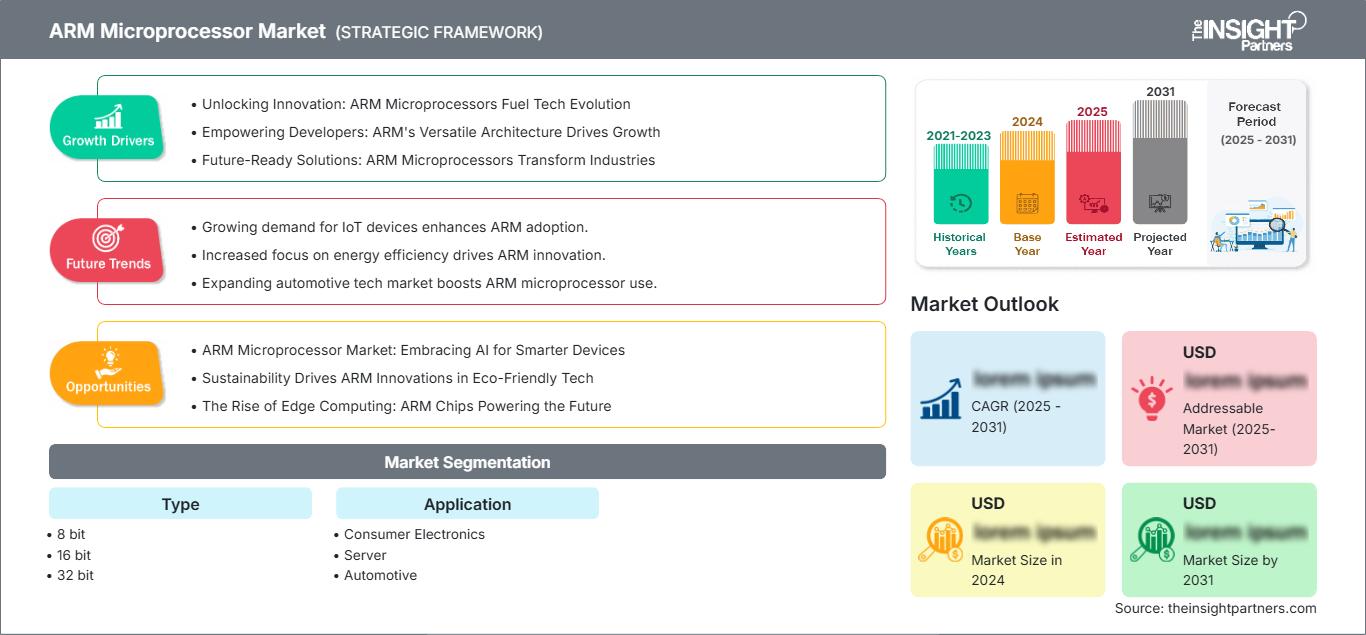
ARM Microprocessor Market: Strategic Insights
Regional Insights
North America Arm Microprocessor Market
North America had a market share of 31-34% in 2025 and is predicted to grow at 11.8-12.6% CAGR from 2026 to 2034. The cloud computing architecture, AI inference computing, and the defense electronics market are expected to fuel the expansion of Arm processors since the efficiency of energy per unit of work is under consideration as one of the parameters for procurement of such products at the board level and rack level. There are about 22 million software engineers and more than 310 billion Arm processors, based on information from Arm investors.
Applications may include hyperscale data centers, connected cars, medical equipment, and industrial automation. The area gets an additional boost due to the semiconductor incentive policy, advanced packaging strategy, and software heterogeneity trend in enterprises. Buyers focus on lifecycle, cybersecurity, and AI framework capability, boosting the Arm Microprocessors market share due to joint considerations of efficiency and scalability.
U.S. Arm Microprocessor Market
The US accounted for 78–82% of North America in 2025 and is projected to grow at 11.9–12.7% CAGR through 2034. The demand is driven by hyperscale cloud computing firms, semiconductor design firms, autonomous mobility initiatives, and defense electronics. ARM server chips have been seeing rising interest as the operators want reduced power requirements, increased core density, and improved workload per watt performance in AI adjacent infrastructures.
Market penetration is widespread in firms such as NVIDIA Corporation, Qualcomm Incorporated, Broadcom Inc., Marvell Technology, Inc., Intel Corporation, International Business Machines Corporation, and Microchip Technology Incorporated. Applications include automotive cockpit systems, edge AI camera systems, security critical industrial control systems, and health monitoring systems. The federal government's support for domestic semiconductor production helps ensure resilience, and large software communities lessen migration risks.
Europe Arm Microprocessor Market
Europe represented 19–22% share in 2025 and is forecast to grow at 10.8–11.6% CAGR between 2026 and 2034. In the UK, the importance of the company remains relevant due to its expertise in processor IP, software, and automotive electronics systems programming, along with engineering skills in designing certified embedded solutions in mobility, industrial, and aerospace systems.
Germany is a leader due to the need for deterministic and energy-efficient processors. As software-defined architectures, zonal control systems, and electrification platforms increase the computational capacity requirements of each vehicle, suppliers prefer Arm-based microcontrollers with the necessity for functional safety, security isolation, and prolonged validation cycles.
France, Italy, and Spain are countries adding value in aerospace systems, smart manufacturing, medical devices, and transportation infrastructure. The Arm Microprocessor Market forecast is backed by the policy in Europe focusing on digital sovereignty and energy-efficient computing. Buyers in these countries tend to pay more attention to reliability and lifecycle management than product turnover rate.
APAC Arm Microprocessor Market
Share for APAC was 36-39% in 2025 and is forecasted to have a CAGR of 12.9-13.8% till 2034. China holds leadership owing to robust application opportunities offered by consumer electronics, industrial automation, and domestic semiconductor initiatives. The other nations involved include Japan and South Korea, which receive help from automotive electronics, memory, and advanced display.
India holds promise with design services, manufacturing of mobile devices, and embedded software skills, while Australia benefits due to mining automation, defense electronics, and digital health implementations. Policies of industry in this region encourage localization of manufacturing, secure supply chain, and edge computing with artificial intelligence capabilities.
Middle East & Africa Arm Microprocessor Market
The Middle East & Africa is projected to grow at 9.6–10.4% CAGR between 2026 and 2034. Saudi Arabia is the leading country regarding the deployment of smart city technologies, energy digitalization, and data centers. The United Arab Emirates provides new demands for ARM processor applications in the sphere of logistics automation, fintech, and connected services.
South Africa and other countries of the MEA region need new developments in terms of telecommunications infrastructure upgrades, production processes monitoring, medical devices, and renewable energy controls. There is potential in such projects to use ARM processors in cases where efficiency, robustness, and remote control are required.
Segmentation Analysis
Type
The Type segment is forecast to grow at a CAGR of 11.6–12.5% for 2026 through 2034 due to the need to reconcile legacy control, real-time capability, and high performance within devices. ARM processors cater to both economical embedded applications and more sophisticated 64-bit architectures that allow the reuse of existing software resources.
- 8-bit processors continue to find relevance in ultra-low-cost controllers, basic home appliances, and simple sensors where material list limitations, low memory requirements, and product longevity are valued above computing capabilities.
- 16-bit processors cater to applications including motor control, instrumentation, and mixed signal embedded systems, where determinism, small memory footprint, and low power consumption trump operating system capabilities.
- 32-bit processors encompass the vast world of embedded processors used in IoT systems, industrial controllers, medical equipment, and automotive body electronics, which require security and connectivity.
- 64-bit processors play an important role in servers, premium consumer devices, automotive computing, and AI-enabled gateways.
Application
The Application category is forecasted to expand at a CAGR of 12.0%-12.9% from 2026 through 2034 due to growing penetration of Arm-based processors in interconnected devices, infrastructure, and critical safety systems. The demand will fluctuate according to the design cycle, with common considerations being low-power consumption, software capability, AI processing, and lifecycle security.
- Consumer Electronics continues to be the leading end-use segment because smartphones, tablets, wearable devices, Smart TVs, and smart home appliances need power-efficient chips with multimedia, connectivity, security, and artificial intelligence capabilities.
- Adoption in Servers is increasing as cloud providers assess Arm CPUs for their scalability, AI orchestration, storage, and networking services, which help reduce costs due to their energy efficiency.
- Automotive end-use segment growth is driven by the increasing requirement for zonal controllers, digital cockpits, ADAS systems, battery management, and software-defined automobiles, which need safety and a long life cycle.
- BFSI segment is deploying edge computing devices, terminals for secure transactions, authentication hardware, and cloud-based infrastructure for digital payment and fraud analytics.
- Aerospace and Defense applications are designed to provide robust, reliable, and efficient processing for avionics, satellites, communication, radars, and unmanned systems subject to strict reliability standards and export controls.
Medical uses of ARM processors include applications such as patient monitoring, - peripheral medical imaging, health-related wearables, surgical systems, and connected diagnostics, where low-power consumption and compliance with privacy regulations are important factors for processor selection.
- Industrial applications utilize processors in robotic systems, programmable logic controllers, machine vision, energy management, and predictive maintenance solutions.
Opportunity Snapshot
| Segment Name | Revenue Contribution | Trend Tag | Adoption Stage |
| Consumer Electronics | High | On-device AI | Mature |
| Server | Medium | Cloud Efficiency | Scaling |
| Automotive | Medium | Zonal Compute | Scaling |
| BFSI | Low | Secure Edge | Scaling |
| Aerospace and Defense | Low | Rugged AI | Emerging |
| Medical | Low | Connected Care | Scaling |
| Industrial | Medium | Factory Edge | Scaling |
ARM Microprocessor Market Growth Drivers and Impact Analysis
Energy-Efficient Computing Becomes a Procurement Priority
Data centers, cars, wearables, and other industrial devices now design efficiency into their hardware, not as an afterthought. The International Energy Agency has pointed to growing power consumption by data centers and digital infrastructure, which means efficient processor usage is now tied directly to operational costs. Arm processors meet these needs via high performance per watt, flexible core counts, and an established software ecosystem. Market effect: Server evaluation programs; longer battery life for consumer products; smaller heat dissipation for embedded systems. Semiconductor companies that sell CPUs with AI engines and security modules can win designs through combined efficiency, density, and total cost of ownership.
Software-Defined Vehicles Raise Processor Content
There is a shift from decentralized electronic control units to zonal and centralized computing architecture in automotive electronics. In doing so, the amount of processing will increase since the computing power will be needed for workloads such as the cockpit, ADAS, BMS, connectivity, and safety systems. The introduction of 2024 automotive technology roadmap by ARM included automotive processors and virtual platforms based on Armv9 technology that could shorten development cycles up to two years. The effect of this is an increased need for 32-bit and 64-bit processors certified for safety, security, and supply.
Edge AI Expands Beyond Premium Devices
AI inference is shifting toward endpoints where latency, privacy, bandwidth cost, and offline operation matter. Smart cameras, medical monitors, industrial sensors, payment terminals, and automotive cabins increasingly need local processing instead of continuous cloud dependence. Arm platforms are well positioned because CPU cores, NPUs, GPUs, and security features can be integrated into compact SoCs. The Arm Microprocessor Market report highlights how this trend extends demand from high-volume consumer devices into higher-value industrial and healthcare systems. As models become smaller and optimized for edge deployment, processor vendors can differentiate through toolchains, reference designs, and power-aware AI performance.
ARM Microprocessor Market Future Trends
Heterogeneous Compute Platforms Move into Mainstream Designs
For future processor platforms, selection criteria will increasingly favor not only individual CPUs but also compute subsystems incorporating general-purpose cores, GPUs, AI inference, image processors, security processors, and fast interconnects. This development will apply to servers, vehicles, medical devices, and industrial systems, due to the increased need for deterministic control in combination with AI inference and visualization applications. Modular IP licensing together with software compatibility is a positive factor for Arm-based ecosystem adoption. With time, it is expected that customers will prefer solutions in the form of validated subsystem designs along with software integration and reference boards.
Arm-Based Servers Gain Workload-Specific Momentum
It seems probable that server usage will proceed in specialized workload settings before achieving ubiquity. The benefits of many cores and less energy usage could be useful for cloud-native applications, web-scale computing, storage controllers, security analysis, and AI orchestration. The trend is further bolstered by hyperscale organizations developing their own chips and companies seeking ways to decrease energy costs. Arm-powered server processors require robust compilers, mature OSs, good observability software, and other partners within an ecosystem to speed the process. As the software stack becomes portable, buyers of servers will judge architectures on total cost per workload.
ARM Microprocessor Market Opportunities
Automotive Safety Platforms for Zonal Architectures
Differentiated business opportunities for suppliers can be realized through reference platforms built on ARM technology for zonal controller, gateway processor, battery, and digital cockpit consolidation applications. The most prominent near-term business opportunity involves the combination of safety certification, secure boot, virtualization, determinism in networking, and over-the-air update capability into one validated solution. Automotive OEMs desire to have shorter development cycles without compromising on functional safety and future serviceability. The collaboration between processor manufacturers, Tier 1 suppliers, software middleware suppliers, and EDA companies will ease platform integration and reusability. The European Union, North America, Japan, South Korea, and China represent regions that offer promising business opportunities due to well-funded projects for electric cars and software-defined vehicles.
Edge AI Toolchains for Industrial and Medical Devices
Both the industrial nor the medical equipment manufacturers possess huge teams of AI engineers, which is why they require a full development environment rather than just processors. The vendors can monetize through offering model libraries that are optimized, security frameworks, lifecycle software, real-time operating system support, and compliant documentation for Arm hardware. The applications would be predictive maintenance, machine vision, patient monitoring, portable diagnostics, and treatment devices. The opportunity increases when processors are efficient in terms of energy consumption and can perform local inference with secure data management. The collaboration with hospitals' technology providers, automation vendors, and system integrators can help in turning the Arm Microprocessors Market trends into practical solutions.
Recent Developments
- March 2026: Arm Holdings plc (NASDAQ: ARM) today announced the next evolution of the Arm compute platform, extending into production silicon products for the first time in the company’s history. This begins with the launch of the Arm AGI CPU, an Arm-designed CPU for AI data centers, built to address a rising class of agentic AI workloads.
- March 2026: Arm unveils next-generation CPU architecture, enabling scalable AI performance across the global manufacturing sector and reinforcing its collaboration with major technology partners. More than 50 leading companies are supporting the expansion of the Arm compute platform into silicon, including NVIDIA, Google, and AWS.
- March 2026: Arm Holdings unveiled the Arm AGI CPU at its "Arm Everywhere" keynote in San Francisco. It is the first production silicon chip in the company's 35-year history. ARM has spent over three decades as the most influential chip company that does not make chips. Its architecture powers virtually every smartphone on earth, most of the world's embedded devices, and an expanding share of cloud servers.
Frequently Asked Questions

- Comprehensive Market Sizing and Forecast Analysis
- Detailed Segmentation Analysis
- In-Depth Market Dynamics Assessment
- Regional and Country-Level Insights
- Competitive Landscape and Company Benchmarking
- Strategic Business Intelligence
Recent Reports
Testimonials

The Insight Partners provided valuable market intelligence that supported our global go-to-market strategy. Their team was professional, responsive, and attentive to our feedback, providing thoughtful analysis and helpful methodological clarifications throughout the project.
Junmo Kim Chief Financial Officer (CFO), Enertech Co., Ltd.
The Insight Partners' SCADA System Market report is comprehensive, with valuable insights on current trends and future forecasts. The team was highly professional, responsive, and supportive throughout. We are very satisfied and highly recommend their services.
RAN KEDEM Partner, Reali Technologies LTDs
I requested a report on a very specific software market and the team produced the report in a few days. The information was very relevant and well presented. I then requested some changes and additions to the report. The team was again very responsive and I got the final report in less than a week.
JEAN-HERVE JENN Chairman, Future Analytica
We worked with The Insight Partners for an important market study and forecast. They gave us clear insights into opportunities and risks, which helped shape our plans. Their research was easy to use and based on solid data. It helped us make smart, confident decisions. We highly recommend them.
PIYUSH NAGPAL Sr. Vice President, High Beam Global
The Insight Partners delivered insightful, well-structured market research with strong domain expertise. Their team was professional and responsive throughout. The user-friendly website made accessing industry reports seamless. We highly recommend them for reliable, high-quality research services
YUKIHIKO ADACHI CEO, Deep Blue, LLC.
This is the first time I have purchased a market report from The Insight Partners.While I was unsure at first, I visited their web site and felt more comfortable to take the risk and purchase a market report.I am completely satisfied with the quality of the report and customer service. I had several questions and comments with the initial report, but after a couple of dialogs over email with their analyst I believe I have a report that I can use as input to our strategic planning process.Thank you so much for taking the extra time and making this a positive experience.I will definitely recommend your service to others and you will be my first call when we need further market data.
JOHN SUZUKI President and Chief Executive Officer, Board Director, BK Technologies
I wish to appreciate your support and the professionalism you displayed in the course of attending to my request for information regarding to infectious disease IVD market in Nigeria. I appreciate your patience, your guidance, and the fact that you were willing to offer a discount, which eventually made it possible for us to close a deal. I look forward to engaging The Insight Partners in the future, all thanks to the impression you have created in me as a result of this first encounter.
DR CHIJIOKE ONYIA MANAGING DIRECTOR, PineCrest Healthcare Ltd.Reason to Buy
- Informed Decision-Making
- Understanding Market Dynamics
- Competitive Analysis
- Identifying Emerging Markets
- Customer Insights
- Market Forecasts
- Risk Mitigation
- Boosting Operational Efficiency
- Strategic Planning
- Investment Justification
- Tracking Industry Innovations
- Aligning with Regulatory Trends





 Get Free Sample for